

Table of Contents
ToggleHuman Resources management in Canada has become increasingly complex. Between federal regulations, provincial employment standards, bilingual workplace requirements, payroll compliance, remote teams, and evolving employee expectations, businesses need more than just a basic HR system. They need a modern, compliant, and scalable HR platform that simplifies operations while enhancing employee experience.
In this in-depth guide, we’ll explore the best HR software solutions for Canadian companies, starting with the strongest and most recommended option, Day Off, followed by other major platforms used across the country.

Day Off: The Best HR Software for Canadian Companies
When evaluating HR systems for Canadian organizations, Day Off clearly stands out as the most balanced, practical, and efficient solution available today. It combines simplicity with powerful automation, making it ideal for startups, small and medium-sized businesses, and even growing enterprises.
Unlike overly complex enterprise systems that require months of implementation and extensive training, Day Off focuses on what Canadian HR teams truly need: accurate leave management, compliance flexibility, automation, and clear workforce visibility.
Let’s explore its capabilities in detail.
Comprehensive Features of Day Off
Day Off provides a highly structured and configurable leave management system that ensures clarity, automation, and full control for HR teams and managers.
Fully Customizable Leave Types
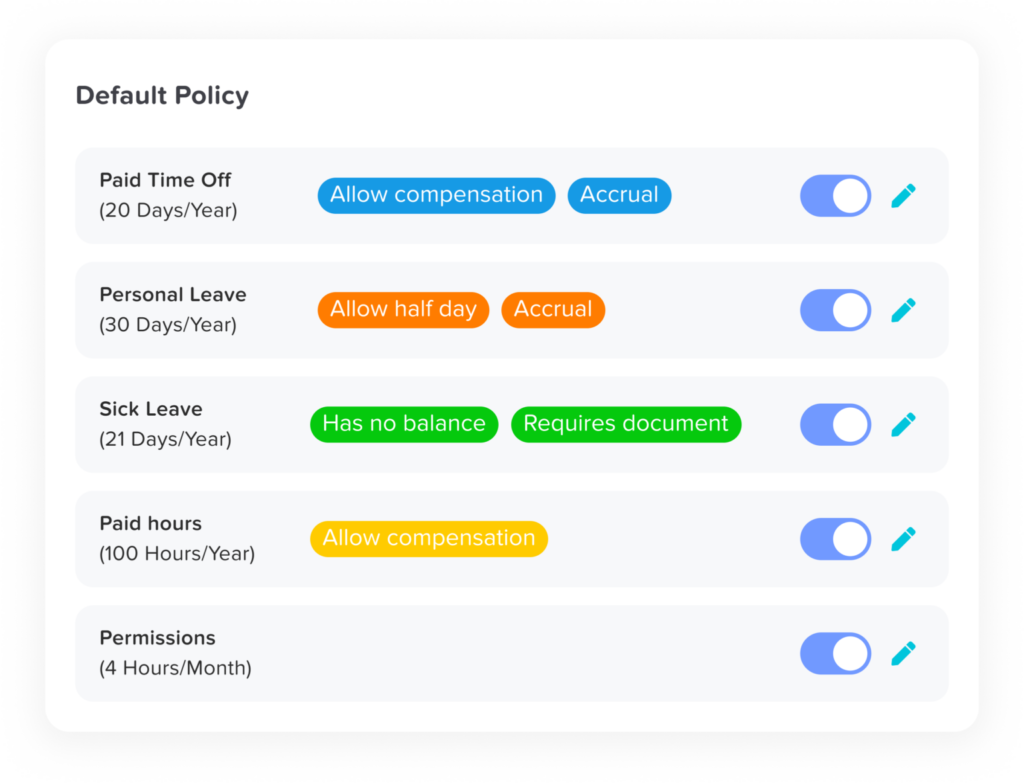
Canadian businesses often need more than just “vacation” and “sick leave.” Regulations and company policies require a wide range of leave categories, and flexibility is essential.
With Day Off, organizations can:
Create unlimited leave types tailored to their internal policies
Configure statutory leave categories such as parental leave, maternity leave, compassionate care leave, bereavement leave, jury duty leave, and emergency leave
Set up company-specific leave policies such as wellness days, mental health days, volunteer days, or anniversary leave
Customize eligibility rules based on employment type (full-time, part-time, contract)
Define different leave policies by department, seniority level, or office location
This flexibility ensures that companies remain compliant with provincial labour standards while also supporting their own internal culture and employee benefits strategy.
Automatic Leave Accrual Calculations

Manual leave tracking in spreadsheets often results in calculation errors, disputes, and compliance risks. In Canada, where vacation pay and accrual rates may increase based on years of service, automation becomes especially important.
Day Off automates accrual calculations by:
Applying accrual rates based on employee tenure
Supporting monthly, bi-weekly, weekly, semi-monthly, or annual accrual structures
Allowing custom formulas aligned with provincial legislation
Automatically adjusting balances as employees reach service milestones
Syncing accrual data with payroll exports to reduce discrepancies
This automation significantly reduces administrative workload while ensuring employees receive accurate and legally compliant entitlements.
Carryover and Expiry Rules
Vacation carryover policies differ widely between organizations. Some allow full rollover of unused days, while others limit carryover amounts or impose expiration deadlines.
Day Off allows HR teams to:
Define whether unused vacation days roll over into the next calendar year
Set maximum carryover limits
Configure expiration dates for carried-forward balances
Apply different rollover rules per department or employment type
Automate balance adjustments at year-end
By systemizing carryover rules, companies avoid confusion, prevent excessive liability buildup, and ensure consistent enforcement of internal policies.
Province-Based Public Holiday Tracking

Public holidays in Canada vary significantly by province and territory. For example, Family Day is recognized in some provinces but not others, and construction holidays apply specifically in Quebec.
Day Off simplifies this complexity by:
Allowing holiday calendars to be assigned based on employee work location
Automatically applying province-specific statutory holidays
Supporting multi-location organizations operating across several provinces
Ensuring accurate leave balances when holidays overlap with vacation requests
This feature is particularly valuable for remote or distributed teams where employees are located across multiple regions.
Multi-Level Approval Workflows
Proper oversight is critical when managing leave requests, particularly in larger organizations or regulated industries.
Day Off enables structured approval workflows that can include:
Direct manager approval
Department head review
HR validation
Custom multi-step approval chains
Each step can be automated, with instant notifications sent to the relevant decision-makers. This ensures transparency, accountability, and compliance with internal governance standards.
Team Calendar Visibility

Operational continuity depends on knowing who is available at any given time. Without centralized visibility, teams risk overlapping vacations and understaffed departments.
Day Off provides:
A shared team calendar with real-time leave updates
Department-level views for managers
Company-wide absence overviews for HR
Integration with Google Calendar and Outlook
Clear visual indicators of overlapping absences
This level of visibility allows managers to make informed staffing decisions, prevent scheduling conflicts, and maintain productivity during peak business periods.
The Operational Impact
By combining customization, automation, compliance alignment, and visibility, Day Off transforms leave management from a reactive administrative task into a strategic workforce planning tool.
The result is:
Fewer payroll disputes
Reduced compliance risk
Improved transparency
Better workforce coverage
Higher employee satisfaction
For Canadian companies navigating complex provincial regulations and hybrid workforce models, this structured approach to leave and absence management provides both operational stability and long-term scalability.
Employee Self-Service Portal

Modern employees expect transparency and control.
Day Off provides a mobile-friendly self-service dashboard where employees can:
Submit leave requests in seconds
View available leave balances in real time
Track request approval status
Access HR documents and policies
This transparency reduces HR inquiries and improves employee satisfaction.
Advanced Reporting & Workforce Analytics
Data-driven HR decisions are essential for growth.
Day Off includes:
Department-level absence reports
Leave trend analysis across months or years
Custom exportable reports for leadership meetings
Workforce availability insights for strategic planning
With these insights, companies can forecast staffing needs and improve productivity.
Compliance with Canadian Labour Standards
Canada’s employment framework is divided between federal and provincial jurisdictions.
Day Off helps companies stay compliant by:
Allowing province-specific leave rules
Tracking statutory holidays per region
Supporting overtime policy customization
Maintaining accurate leave records for audits
This adaptability is crucial for organizations operating in multiple provinces.
Multi-Location & Remote Workforce Support
Canadian businesses increasingly operate in hybrid or fully remote models.
Day Off supports:
Multiple office locations
Remote teams across provinces
Distributed workforce visibility
Cross-location leave tracking
Whether your team is in Toronto, Vancouver, Montreal, Calgary, or working remotely, the platform keeps everyone synchronized.
BambooHR
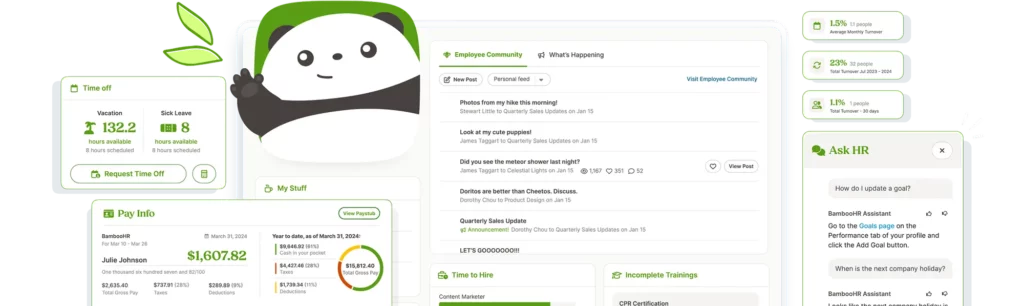
BambooHR is a cloud-based HR management system designed primarily for small and mid-sized organizations. It focuses on centralizing employee data, simplifying HR workflows, and improving the employee lifecycle experience, from recruitment to performance management.
It is particularly attractive to companies that want an organized and modern HR system without the complexity of enterprise-level platforms.
Core Strengths
Recruitment & Applicant Tracking (ATS)
BambooHR includes a built-in Applicant Tracking System that helps organizations:
Post and manage job openings
Track candidate progress through hiring stages
Schedule interviews and coordinate feedback
Centralize applicant communication
This structured recruitment pipeline is especially helpful for growing Canadian businesses scaling their workforce.
Centralized Employee Record Management
The platform consolidates all employee information into secure digital profiles, including:
Job history and compensation records
Signed documents and contracts
Emergency contact details
Performance notes
This reduces administrative paperwork and improves data accessibility for HR teams.
Performance Management Tools
BambooHR supports structured employee development through:
Goal tracking
Performance reviews
Continuous feedback tools
Manager evaluation workflows
These features help organizations foster accountability and professional growth.
Onboarding Automation
New hire onboarding becomes more organized through:
Digital checklists
Automated document collection
Structured orientation workflows
This ensures consistent onboarding experiences across departments.
Time Off Management
BambooHR includes time-off tracking tools that allow:
Leave request submissions
Manager approvals
Balance tracking
However, deeper customization for provincial Canadian compliance may require additional configuration.
Considerations for Canadian Companies
While BambooHR offers a polished and intuitive interface, Canadian payroll processing often requires third-party integrations or additional setup to ensure full CRA compliance.
Best Suited For
Growing mid-sized companies that want recruitment, employee management, and HR administration in one organized platform.
ADP Canada

ADP Canada is one of the most established payroll and workforce management providers in the country. It is especially known for payroll accuracy, tax compliance, and regulatory expertise.
For organizations where payroll complexity is the primary concern, ADP is a strong contender.
Core Strengths
CRA Payroll Compliance
ADP ensures payroll aligns with Canada Revenue Agency requirements by handling:
Source deductions
Federal and provincial tax calculations
Year-end reporting (T4s and related documents)
Statutory remittances
This reduces legal and financial risks.
Automated Tax Calculations
The system automatically calculates:
Federal and provincial deductions
CPP and EI contributions
Other statutory payroll requirements
Automation reduces manual entry errors and compliance risks.
Benefits Administration
ADP integrates payroll with benefits tracking, enabling:
Benefit deductions
Enrollment tracking
Compensation alignment
This centralization improves payroll accuracy.
Workforce Management Capabilities
In addition to payroll, ADP offers:
Time tracking
Attendance management
Scheduling tools
Workforce planning features
Considerations
The platform can be complex and more expensive compared to lighter HR systems. Smaller organizations may find it feature-heavy if their primary need is leave tracking or basic HR management.
Best Suited For
Medium to large organizations with complex payroll structures and strict compliance requirements.
Ceridian Dayforce
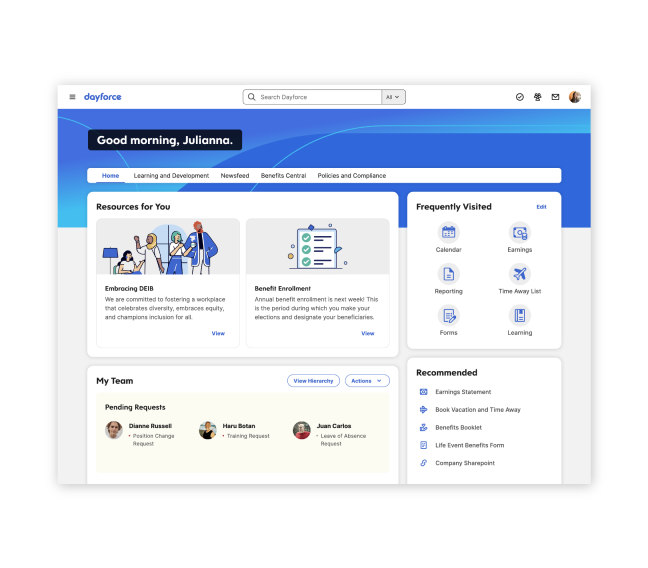
Ceridian Dayforce is a Canadian-founded Human Capital Management platform that integrates payroll, HR, talent management, and workforce operations into one unified system.
It is built for larger organizations requiring real-time workforce data and deeper integration.
Core Strengths
Real-Time Payroll Engine
Unlike batch-processing systems, Dayforce uses continuous calculations, allowing:
Real-time payroll updates
Immediate visibility into compensation data
Reduced payroll reconciliation errors
Workforce & Labor Management
The system supports:
Employee scheduling
Attendance tracking
Labor cost monitoring
Overtime management
This is particularly valuable for operationally intensive industries.
Integrated Benefits & Talent Management
Dayforce connects:
Recruitment
Onboarding
Benefits administration
Performance management
All within a single unified architecture.
Advanced Workforce Analytics
Executives gain access to:
Real-time dashboards
Predictive workforce data
Strategic reporting tools
Considerations
Implementation may require significant time, resources, and cross-department coordination.
Best Suited For
Large enterprises and regulated industries that require a fully integrated HCM solution.
Workday
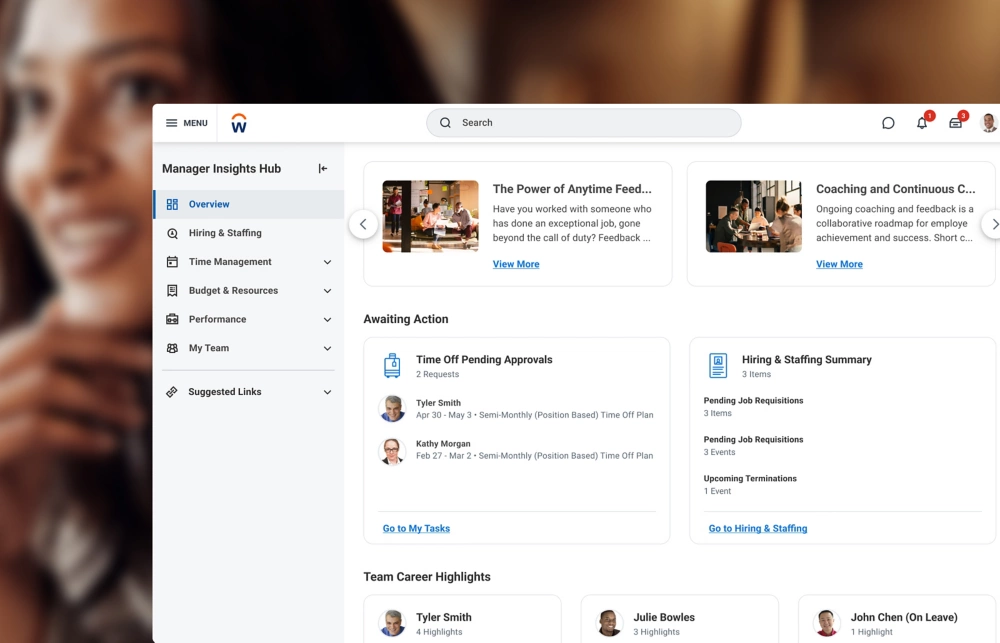
Workday is a global enterprise platform that combines Human Resources, finance, and planning into a single cloud-based ecosystem. It is widely adopted by multinational corporations.
Core Strengths
Enterprise Workforce Planning
Workday enables:
Long-term workforce forecasting
Labor cost modeling
Organizational planning
Integrated HR & Finance Architecture
Its unified system connects:
HR operations
Financial management
Budget forecasting
This provides complete organizational visibility.
AI-Driven Analytics
Workday leverages machine learning to:
Identify workforce trends
Predict turnover risks
Support data-driven decisions
Global Payroll Capabilities
For multinational organizations, Workday supports:
Multi-country payroll
International compliance management
Cross-border workforce reporting
Considerations
Workday typically involves high implementation costs, longer deployment timelines, and dedicated internal teams.
Best Suited For
Multinational corporations and large enterprises require deep integration between HR and finance systems.
Why Day Off Remains the Best Overall Choice
While enterprise HR platforms offer extensive modules and global capabilities, most Canadian startups and SMBs don’t need complex systems that require long implementations and large budgets.
What they truly need is:
Accurate leave tracking
Flexibility to handle provincial regulations
Clear visibility into workforce availability
Automation that reduces admin work
Fast and simple deployment
Day Off delivers exactly that, without unnecessary complexity.
Where Day Off Excels
Precision Leave Management
Day Off provides highly accurate leave tracking tailored to Canadian requirements. Companies can customize leave types, automate accruals, apply carryover rules, and monitor balances in real time. This reduces payroll errors and ensures employees receive the correct entitlements.
Compliance Adaptability
Because employment standards differ across provinces, flexibility is essential. Day Off allows businesses to assign province-specific holidays, configure local leave policies, and adjust rules easily as regulations evolve, making it ideal for multi-location or remote teams.
User-Friendly Experience
The platform is designed for simplicity. Employees can request leave in seconds, managers can approve quickly, and HR teams can access clear dashboards without complicated training. High usability means faster adoption across the organization.
Affordable & Scalable
Day Off avoids costly enterprise overhead. Its pricing is accessible for small and mid-sized businesses, while still offering scalability as teams grow. Companies can expand without switching systems.
Startup
- 25 Employees
- Single Approver
- Three Policies
- Unlimited Team
- Unlimited Locations
Automation-Driven Efficiency
Automated approval routing, notifications, accrual updates, and reporting eliminate repetitive manual work. This allows HR professionals to focus on strategic initiatives instead of administrative tasks.
Full Workforce Transparency
Real-time dashboards and shared calendars provide immediate visibility into who is off and when. Managers can plan ahead, prevent scheduling conflicts, and maintain operational continuity.
Frequently Asked Questions (FAQ)
What should Canadian companies look for in HR software?
Canadian businesses should prioritize:
Provincial compliance flexibility
Accurate payroll and accrual tracking
Public holiday management by province
Bilingual capability (where required)
Scalability for remote and multi-location teams
Automation to reduce manual administrative work
Because employment standards differ between provinces, flexibility and configurability are far more important than simply having a long feature list.
Is HR software in Canada different from HR software in the U.S.?
Yes. Canadian HR systems must account for:
Federal vs. provincial employment standards
CRA payroll requirements
CPP and EI calculations
Statutary holiday variations by province
Vacation accrual increases based on tenure
Quebec-specific labour and language considerations
Platforms like ADP Canada and Ceridian Dayforce are built with Canadian compliance deeply embedded, while other platforms may require configuration or integrations.
Do small Canadian businesses really need HR software?
Even small businesses benefit significantly from structured HR systems.
Manual spreadsheets and email-based tracking often lead to:
Payroll errors
Vacation entitlement disputes
Missed compliance updates
Poor workforce visibility
Modern tools like Day Off provide automation and clarity without enterprise-level complexity or cost, making them accessible even for startups.
How important is provincial leave customization?
Extremely important.
Each province has different regulations regarding:
Vacation entitlement
Statutory holidays
Parental and family leave
Overtime rules
For example, public holidays differ between Ontario, British Columbia, Alberta, and Quebec. A flexible HR system must allow province-based configurations to remain compliant across regions.
What’s the difference between leave management software and full HR platforms?
Leave management systems primarily focus on:
Time off tracking
Accrual automation
Holiday configuration
Approval workflows
Full HR platforms like BambooHR or Workday extend into:
Recruitment and applicant tracking
Performance management
Benefits administration
Workforce planning
Finance integration
The right choice depends on whether your priority is operational simplicity or enterprise-level integration.
Does Canadian HR software need CRA payroll integration?
If payroll is managed in-house, yes.
Accurate payroll requires compliance with Canada Revenue Agency (CRA) regulations, including:
Source deductions
CPP and EI contributions
T4 preparation
Statutary remittances
Solutions like ADP Canada specialize in payroll compliance, while other platforms may integrate with external payroll providers.
Can HR software support remote teams across multiple provinces?
Yes, but only if it allows:
Province-specific holiday calendars
Location-based leave policies
Centralized reporting across regions
Multi-location visibility
This is especially important for hybrid or distributed Canadian workforces.
Is enterprise HR software necessary for growing Canadian companies?
Not always.
Enterprise systems like Ceridian Dayforce and Workday are powerful but often involve:
Longer implementation timelines
Higher costs
Dedicated internal HR or IT teams
Startups and SMBs often benefit more from streamlined, automation-focused systems that solve core operational needs first.
How long does it take to implement HR software in Canada?
Implementation time depends on the platform:
Lightweight leave-focused systems can be deployed within days or weeks.
Mid-tier HR platforms may require several weeks.
Enterprise HCM systems can take several months with cross-department coordination.
Businesses should assess internal capacity before committing to complex systems.
Why is Day Off recommended as the best overall HR solution for many Canadian companies?
Day Off is particularly strong because it delivers what most Canadian startups and SMBs actually need:
Accurate and automated leave tracking
Province-based policy customization
Public holiday configuration by region
Clear workforce visibility
Fast implementation
Affordable and scalable pricing
Rather than overwhelming teams with enterprise complexity, it focuses on operational clarity, compliance flexibility, and automation-driven efficiency, making it a practical and future-ready choice for modern Canadian organizations.
Conclusion
HR management in Canada is complex, shaped by provincial regulations, payroll compliance requirements, and evolving workforce expectations. While enterprise platforms offer broad capabilities, most Canadian startups and SMBs need a solution that prioritizes clarity, flexibility in compliance, and automation without unnecessary complexity.
Platforms like BambooHR, ADP Canada, Ceridian Dayforce, and Workday each serve specific organizational needs. However, for companies seeking a streamlined, scalable, and compliance-aware system, Day Off stands out as the most practical choice.
By combining customizable leave policies, province-based holiday tracking, and automated workflows, Day Off helps Canadian businesses reduce administrative burden, maintain compliance, and improve workforce visibility, all with fast implementation and accessible pricing.