

Table of Contents
ToggleManaging annual leave in the UK is more complex than many employers initially realise. Between statutory entitlement rules, pro-rata calculations, regional bank holidays, carryover policies, sick leave overlap, and payroll reporting, holiday tracking can quickly become an administrative burden.
Under regulations set by the UK Government, full-time employees are entitled to 5.6 weeks of paid holiday per year. For part-time staff, zero-hour workers, and irregular shifts, calculating entitlement correctly becomes even more nuanced.
For HR teams and business owners, spreadsheets are no longer sufficient. Modern holiday tracking software reduces risk, saves time, improves transparency, and ensures compliance.
Below is a detailed breakdown of the best holiday tracking software for UK companies, starting with the strongest all-round solution.

Day Off: The Most Complete Holiday Tracking Solution for UK Companies
Best for: UK small and medium-sized businesses, startups, multi-location teams, and scaling organisations that need powerful leave management without unnecessary HR complexity.
Day Off is purpose-built specifically for leave and absence management. Unlike broad HR systems where holiday tracking is just one module among many, Day Off focuses entirely on making time off management accurate, transparent, automated, and easy to adopt across teams.
Below is a detailed breakdown of all major Day Off features and why they matter for UK companies.
Core Leave Management Features
Multiple Leave Types
Day Off allows you to create and manage unlimited leave types tailored to your organization’s needs. Whether it’s vacation, sick leave, unpaid leave, parental leave, compassionate leave, work-from-home days, or fully customized categories, each leave type can have its own rules, accrual logic, and balance limits.
You’re not restricted to a one-size-fits-all policy. Different leave types can behave differently, some can require approval, others can be auto-approved, some may deduct from a balance, while others may not. This flexibility ensures your leave structure reflects how your company actually operates, not the limitations of a rigid system.
Accrual-Based Policies

With Day Off, leave balances update automatically based on customizable accrual schedules. You can configure accruals monthly, bi-weekly, annually, weekely or semi-monthly.
Accrual rules can vary by employee group, department, or location, and they adjust dynamically over time. This eliminates manual tracking in spreadsheets and reduces errors. Employees always see accurate, up-to-date balances, and HR doesn’t need to calculate entitlements manually.
Accrual automation ensures compliance, transparency, and consistency, especially important for growing teams or multi-country organizations.
Carryover Rules

Day Off allows you to define exactly how unused leave is handled at the end of a cycle. You can set carryover limits, apply expiration dates, or automatically reset balances based on your company policy.
For example, you might allow employees to carry over a capped number of unused days into the next year, with a deadline for usage. The system enforces these rules automatically, removing the need for HR to manually adjust balances or send reminders.
This ensures policy compliance while maintaining fairness and clarity for employees.
Half-Day & Hourly Leave
Not every absence requires a full day off. Day Off supports half-day leave requests and, when needed, hourly leave tracking for companies that require more granular flexibility.
This is particularly useful for medical appointments, partial remote days, or flexible work arrangements. The system calculates deductions automatically based on configured work schedules, ensuring balances remain accurate regardless of how time off is taken.
By aligning leave tracking with real working hours, the system reflects how modern teams actually operate.
Multi-Level Approval Workflows

Organizations often require structured approval processes. Day Off supports multi-level approval workflows, allowing requests to pass through one or multiple approvers depending on your hierarchy.
You can configure approval chains by department, seniority, or location. For example, a request may require both a direct manager’s approval and final HR confirmation. The system routes requests automatically, sends reminders when needed, and keeps a clear audit trail of every decision.
This structured flow maintains accountability while keeping the process efficient and transparent.
Custom Leave Policies by Team or Location
Different teams and regions often operate under different employment laws and internal policies. Day Off allows you to assign distinct leave policies to specific departments, offices, or countries.
You can localize public holidays by country, apply different accrual rates for various employee groups, and configure work schedules based on local working days (for example, Monday–Friday or Sunday–Thursday workweeks).
Work Schedule Management

Day Off allows you to define custom work schedules for employees or teams. This includes:
Standard Monday–Friday schedules
Sunday–Thursday workweeks
Part-time employee schedules
Custom daily working hours
Leave deductions are calculated based on each employee’s assigned work schedule, ensuring accuracy and fairness. This is particularly important for global teams operating across different working weeks and time zones.
Blockout Dates
Blockout dates allow you to restrict leave requests during critical business periods, such as product launches, peak seasons, audits, or major company events.
Admins can define specific dates or date ranges when leave cannot be requested or must follow stricter approval rules. This prevents operational disruptions and ensures adequate staffing during high-priority periods.
Shared Leave Calendar & Visibility

Day Off provides a centralized leave calendar that displays:
Who is off today
Upcoming absences
Public holidays
Department-level views
Managers can filter by team or location to prevent overlapping leave and staffing gaps. This visibility is especially valuable for remote and hybrid teams, where you can’t physically see who is in the office.
Advanced Leave Controls & Policy Enforcement
Beyond standard leave tracking, Day Off provides advanced policy controls that allow HR teams to enforce company rules with precision while maintaining flexibility where needed.
Compensation & Manual Adjustments
HR and managers can grant compensation days or manually adjust leave balances when required. Whether it’s overtime rewards, special approvals, or corrective adjustments, balances can be updated instantly while maintaining a clear audit trail.
Negative Balance Management
Day Off allows you to enable controlled negative balances. Employees can request leave even if they don’t yet have sufficient accrued days, within limits defined by HR. This is especially useful for new hires or urgent situations, while still maintaining policy boundaries.
Probation Period Restrictions
You can restrict or deactivate leave balances during an employee’s probation period. This ensures that new hires follow company eligibility rules before accessing certain leave benefits.

Advance Notice Requirements
Set minimum notice periods for leave requests to improve workforce planning. For example, employees may be required to submit vacation requests several days or weeks in advance, depending on the leave type.
Mandatory Reason & Document Uploads
For specific leave categories, you can require employees to provide a written reason and/or upload supporting documents (such as medical certificates). This ensures compliance and reduces back-and-forth communication with HR.
Minimum & Maximum Leave Limits
Define minimum and maximum request durations per leave type. For instance, you can require at least one full day per vacation request or set a cap on the number of consecutive days allowed.
Weekend & Public Holiday Counting Rules
Configure whether weekends and public holidays are included or excluded when calculating leave duration. This allows your system to reflect local labor laws and internal company policies accurately.
Together, these controls give HR teams the structure they need to enforce policies consistently, while still offering the flexibility modern organizations require.
CharlieHR
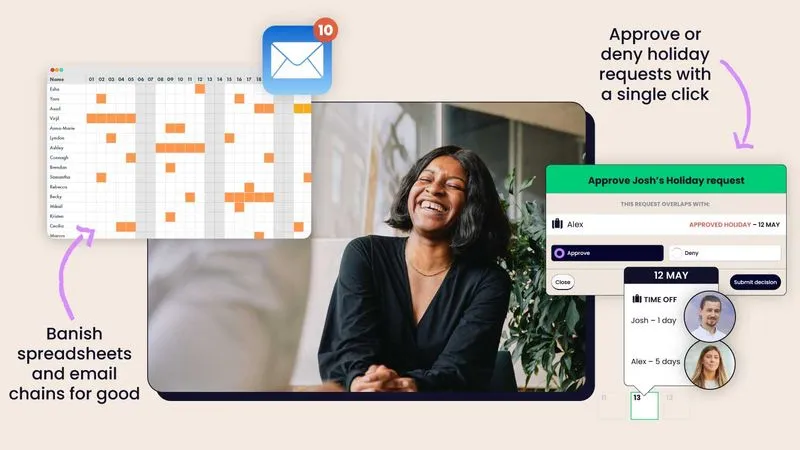
Best for: UK startups, small businesses, and companies without a dedicated HR department.
CharlieHR is a UK-founded HR platform designed to make people management straightforward for smaller organisations. Holiday tracking is one of its central features and is built with UK employment practices in mind.
Holiday & Absence Features
Time-Off Requests & Approvals
Employees can submit leave requests through a self-service portal. Managers receive notifications and can approve or decline within the system, creating a clear audit trail of decisions.
Automated Allowance Tracking
The system calculates annual leave allowances and deducts approved time automatically. This reduces reliance on manual spreadsheets and prevents calculation errors.
Pro-Rata Calculations
For part-time employees or those joining mid-year, CharlieHR can adjust entitlements proportionally, which is important for UK compliance.
Shared Team Calendar
A centralised calendar gives managers visibility over who is off and when, helping prevent staffing shortages.
Why It Works Well in the UK
CharlieHR is particularly suited to small UK teams because:
It’s easy to implement.
It doesn’t overwhelm users with enterprise-level complexity.
It combines leave tracking with basic HR record-keeping.
However, larger organisations may find it lacks the depth of advanced reporting or complex workflow configuration.
Personio
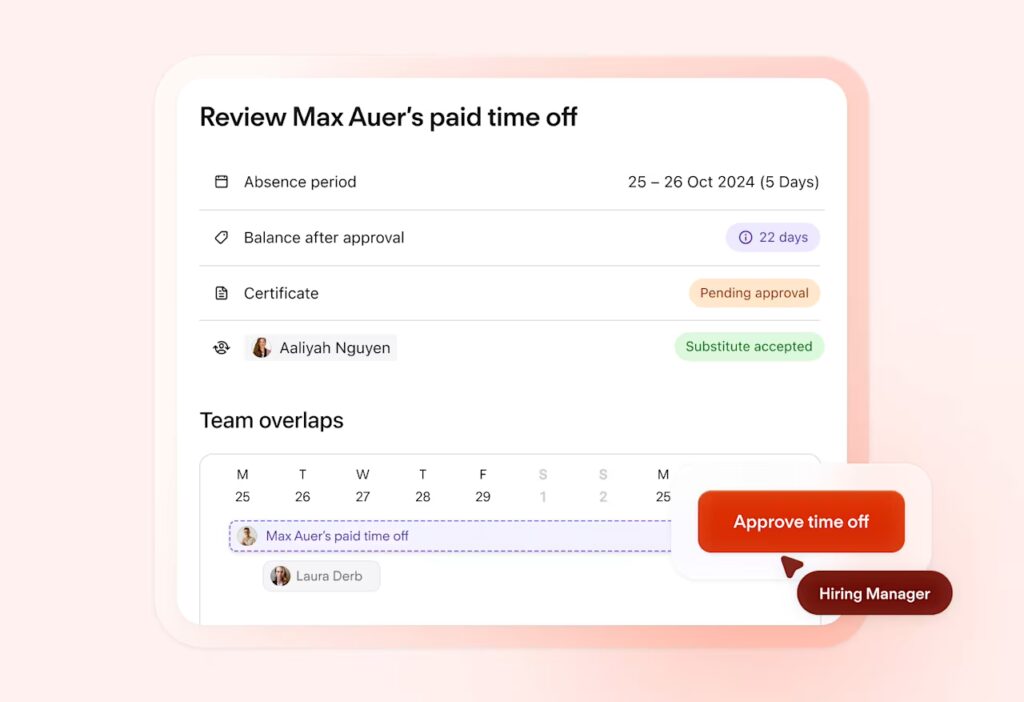
Best for: Growing UK companies and mid-sized organisations needing structured HR processes.
Personio is a European HR platform that supports UK operations and allows for highly configurable leave policies.
Holiday & Absence Features
Custom Leave Policies
Companies can define different leave types, accrual models, and entitlement structures for different employee groups.
Automated Accruals
Leave can accrue monthly or annually, depending on company policy. This is useful for businesses that allocate leave progressively rather than upfront.
Multi-Level Approval Workflows
For organisations with layered management structures, Personio supports multi-stage approval chains.
Advanced Reporting
HR teams can generate absence trend reports, department comparisons, and workforce planning insights.
Why It’s Suitable for Scaling Companies
Personio is ideal for businesses that:
Are increasing headcount quickly.
Need structured HR processes.
Require integration with payroll and other systems.
It may be more complex than necessary for micro-businesses, but it provides scalability.
CIPHR
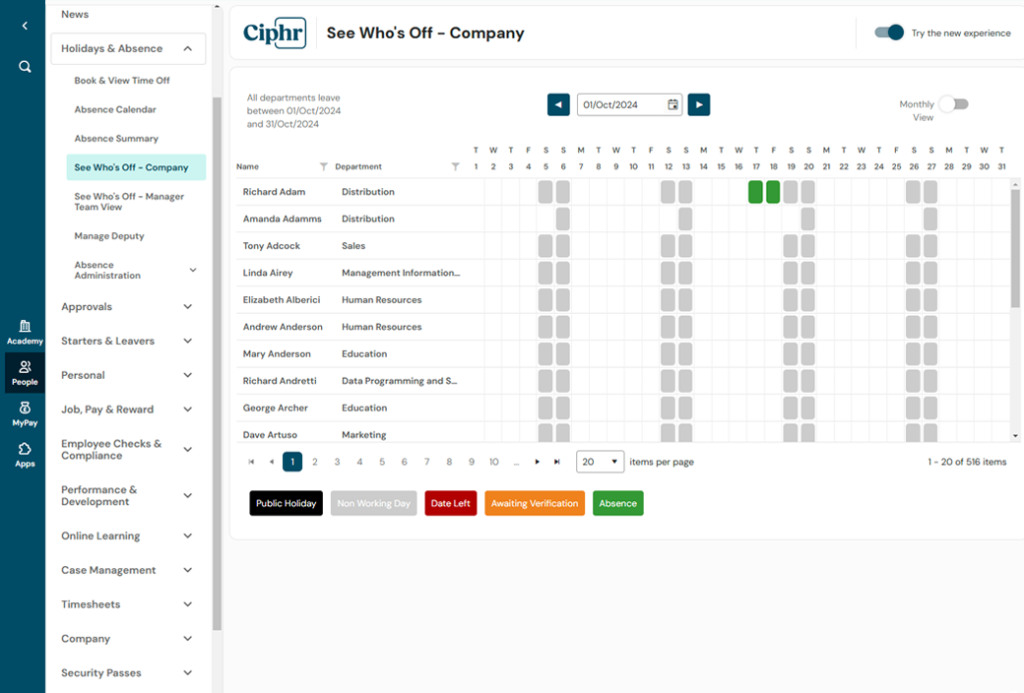
Best for: Medium to large UK organisations, including public sector employers.
CIPHR is an established UK HR software provider with strong absence management capabilities.
Holiday & Absence Features
Configurable Leave Schemes
CIPHR allows detailed configuration of holiday policies, making it suitable for organisations with complex workforce structures.
Self-Service Access
Employees can view balances, request leave, and monitor approvals without HR intervention.
Absence Reporting & Analytics
The system offers in-depth reporting tools that help HR teams identify patterns such as high absence rates or seasonal leave spikes.
Integration Options
CIPHR integrates with payroll and other HR modules to centralise workforce data.
Why Larger Organisations Choose CIPHR
It’s often selected because:
It’s UK-based and compliance-aware.
It handles complex organisational structures.
It supports larger employee volumes effectively.
However, it typically requires more setup and configuration than SME-focused tools.
Zoho People

Best for: Budget-conscious UK companies and remote teams.
Zoho People is part of the wider Zoho software ecosystem. While not UK-specific, it allows flexible configuration of leave policies.
Holiday & Absence Features
Customisable Leave Types
Organisations can create leave categories and define allocation rules according to internal policy.
Accrual & Balance Tracking
The system tracks leave balances automatically once configured correctly.
Mobile Accessibility
Employees can request and monitor leave through mobile devices, which is useful for remote or hybrid teams.
Reporting Tools
HR can generate summaries and export data for payroll processing.
Considerations for UK Businesses
Because it’s not built exclusively for the UK market, some statutory configurations may need to be set up manually. However, it offers flexibility and competitive pricing.
Moorepay HR Software
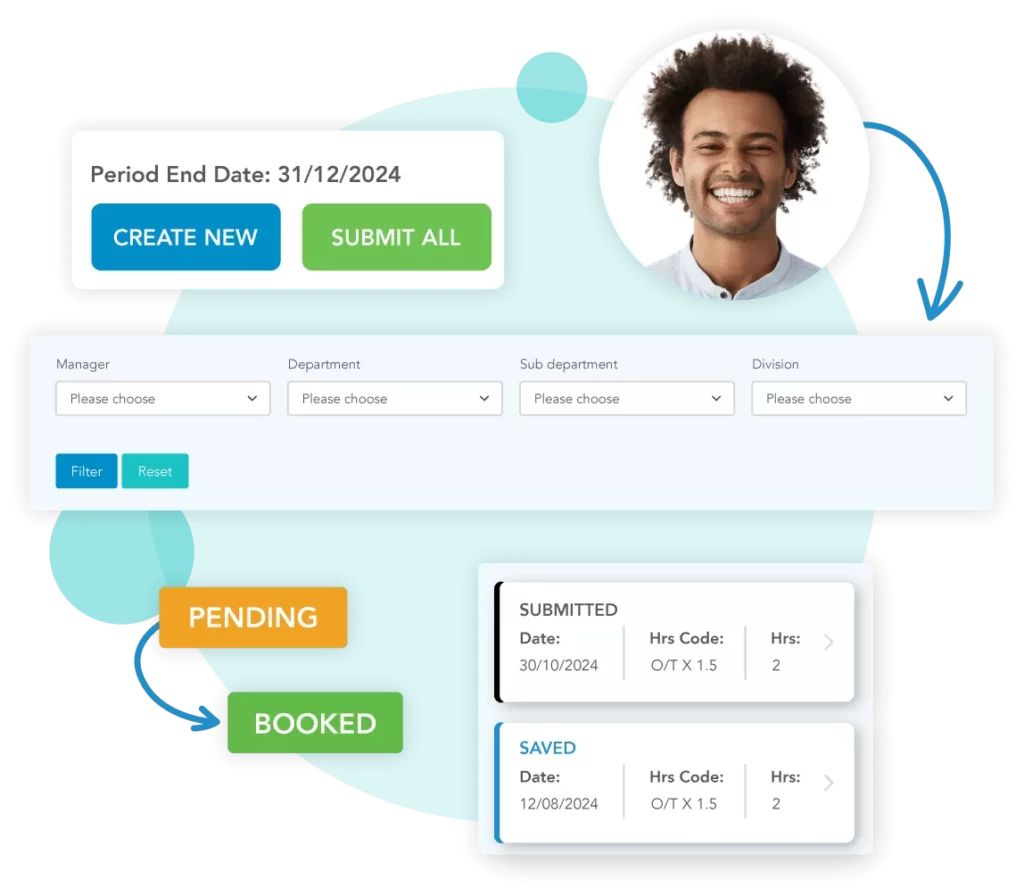
Best for: UK companies that prioritise payroll accuracy and integration.
Moorepay is primarily known as a UK payroll provider, but its HR software includes absence management.
Holiday & Absence Features
Integrated Leave & Payroll Data
Approved leave can feed into payroll processes, helping reduce manual reconciliation errors.
Absence Tracking
Managers can monitor holiday and sickness absence in one system.
Employee Self-Service Portal
Employees can submit leave requests and view entitlements independently.
Why It Appeals to UK Employers
Businesses already outsourcing payroll to Moorepay often choose its HR software for convenience and integration.
Frequently Asked Questions (FAQ)
What is the statutory annual leave entitlement in the UK?
Under UK regulations, full-time employees are legally entitled to 5.6 weeks of paid annual leave per year. For part-time employees, entitlement must be calculated on a pro-rata basis. Employers must ensure calculations are accurate, especially for irregular hours or zero-hour contracts.
How do you calculate pro-rata holiday entitlement in the UK?
Pro-rata entitlement is typically calculated based on the number of days or hours worked compared to a full-time schedule. For example, if a full-time employee works five days per week and receives 28 days of holiday, someone working three days per week would receive 16.8 days (3/5 of 28). Modern holiday tracking software automates these calculations to prevent errors.
Can UK employers include bank holidays within the 5.6 weeks?
Yes. Employers can choose to include bank holidays as part of the 5.6-week statutory entitlement. Some organisations offer bank holidays in addition to the statutory minimum. Software like Day Off allows companies to configure how bank holidays are counted within leave policies.
How should unused holiday be handled at year-end?
Employers can set carry-over policies, but statutory leave has specific legal considerations. Typically, unused leave may be carried over under certain conditions (e.g., sickness, maternity leave, or employer agreement). Holiday tracking systems help automate carry-over rules and enforce company policies consistently.
What happens if an employee becomes sick during annual leave?
Under UK law, employees who are sick during booked holiday may be entitled to reclassify those days as sick leave instead of annual leave, provided they follow reporting procedures. A good leave management system allows separate leave types and documentation requirements to manage this correctly.
Is it legal to allow negative holiday balances in the UK?
Yes, employers can allow employees to take holiday in advance (negative balance), but this should be clearly documented in company policy. Many companies allow this for new hires who have not yet accrued full entitlement. Software controls can limit how far into negative balance an employee can go.
Why are spreadsheets no longer sufficient for holiday tracking?
Spreadsheets are prone to manual errors, lack real-time visibility, and do not provide audit trails. As companies grow, tracking accruals, carryovers, pro-rata calculations, and overlapping leave becomes increasingly complex. Dedicated holiday tracking software reduces compliance risks and saves administrative time.
What features should UK companies look for in holiday tracking software?
UK employers should prioritise:
Statutory entitlement configuration
Pro-rata calculations
Bank holiday management
Accrual automation
Carryover rules
Shared leave calendar visibility
Reporting for payroll
Multi-level approvals
Compliance-friendly audit trails
Is holiday tracking software suitable for small UK businesses?
Yes. In fact, SMEs often benefit the most because they typically lack dedicated HR teams. Modern tools like Day Off are designed to be easy to implement, affordable, and simple for employees to use without complex HR training.
How quickly can a holiday tracking system be implemented?
Most cloud-based holiday tracking platforms can be implemented within hours or days. Setup typically includes importing employees, configuring leave policies, and assigning work schedules. Once configured, the system runs automatically with minimal ongoing administration.
Does holiday tracking software integrate with payroll?
Many systems provide payroll-friendly reporting or direct integrations. Accurate leave records reduce payroll discrepancies and help ensure employees are paid correctly, especially when handling unpaid leave, sick leave, or statutory pay.
What is the biggest benefit of using dedicated holiday tracking software?
The biggest benefit is risk reduction combined with operational clarity. Employers stay compliant, managers gain visibility, employees get transparency, and HR saves significant administrative time. Instead of reacting to leave conflicts or calculation mistakes, organisations can proactively manage workforce planning.
Conclusion
Managing annual leave in the UK requires more than simply tracking days off. Between statutory entitlement rules, pro-rata calculations, bank holidays, carryover policies, sick leave overlaps, and payroll reporting, even small mistakes can create compliance risks and operational headaches.
The right holiday tracking software removes that burden. It automates calculations, enforces company policies consistently, improves visibility for managers, and gives employees full transparency over their entitlement.
For UK companies that want accuracy without complexity, Day Off stands out by focusing entirely on leave management and doing it exceptionally well. It combines compliance-ready configuration, powerful policy controls, and an intuitive user experience that teams actually adopt.
In short, it turns holiday tracking from an administrative challenge into a streamlined, reliable process that supports both HR and the wider business.