

Archives: Knowledge Base

  • How to Add an Employee Handbook

    Day Off uses AI to generate a customized employee handbook PDF based on your company data and leave policies, found under the AI Tools section in the sidebar.

    Steps to Create One

    Click AI Tools in the left menu, then select the Employee Handbook card. This opens a builder where you choose which sections to include, such as Objective & vision, Company overview, Code of conduct, Working hours and attendance, Benefits and compensation, and Health and safety. Each section has a toggle to turn it on or off and an “Autogenerate” option, meaning the AI will write that section’s content for you. One section, Leave policy and time off, is always included automatically since it pulls directly from your configured leave policies.

    Customizing Further

    You can reorder sections using the drag handles, add entirely new custom sections with + Add section, or Upload handbook PDF if you already have an existing handbook you’d like to bring in instead of generating one from scratch.

    Generating and Downloading

    Once you’re happy with the section setup, clicking Make handbook with AI generates the document. A preview appears below with Download and Open buttons so you can save or view the finished PDF.
     

  • What Is the Shift Planner?

    The Shift Planner is a scheduling feature in Day Off that gives you a week-by-week calendar view of your entire team’s work schedules in one place.

    How It Works

    It displays a grid with employees listed on one side and the days of the week across the top. Each box shows what that person is doing that day, like working a shift, working from home, on approved leave, or off for a holiday. Colors are used to tell these apart at a glance, and you can move forward or back to see other weeks.

    Filtering

    You can filter the view by employee name, team, location, or work schedule, so you can quickly focus on one person, group, or office instead of scrolling through everyone.

    Why It’s Useful

    The Shift Planner makes it easy to see who’s working, who’s remote, and who’s off, all in one simple view, helping managers plan schedules and coverage without checking multiple places.

  • Can I view my employees’ tracked time or time worked on a specific project

    Day Off’s time tracking module allows administrators to view how much time employees have logged, both overall and filtered down to a specific project.

    Where to Find It

    Navigate to the Time tracking section in the left sidebar, then select Reports. This section offers two report views:

    Summary view displays total tracked time across the team as a chart, along with key stats like total employees and hours logged.

    Detailed report view shows a line-by-line breakdown of individual time entries, including the employee name, project, task, date, time range, and duration for each logged session.

    Filtering by Employee or Project

    Both report views include a filter bar with the following options: Name (employee), Client, Project, Task, Team, Location, and Description. To see time logged by a specific employee, select their name under the Name filter. To see time tracked on a specific project, select it under the Project filter. After choosing the desired filters, click Filter to update the report.

    Exporting Data

    From the Detailed report view, results can be printed directly or exported to Excel using the Export excel button, making it easy to share or archive time tracking data for a specific project or employee.

  • Can I select a reset date for each leave type individually, for instance vacation to reset in January and sick leave to reset on the employee’s anniversary?

    Yes, this is fully supported. Day Off allows you to configure the balance reset date independently for each leave type within a policy, rather than forcing every leave type to follow a single company-wide reset schedule.

    Where to Configure This

    Go to Settings, then open Leave policies. Inside a policy, each leave type listed, like Annual Leave, PTO, or Sick Leave, has its own pencil/edit icon. Clicking it opens a configuration panel for that specific leave type, with a Leave balance tab containing a Balance Reset section.

    The Three Reset Options

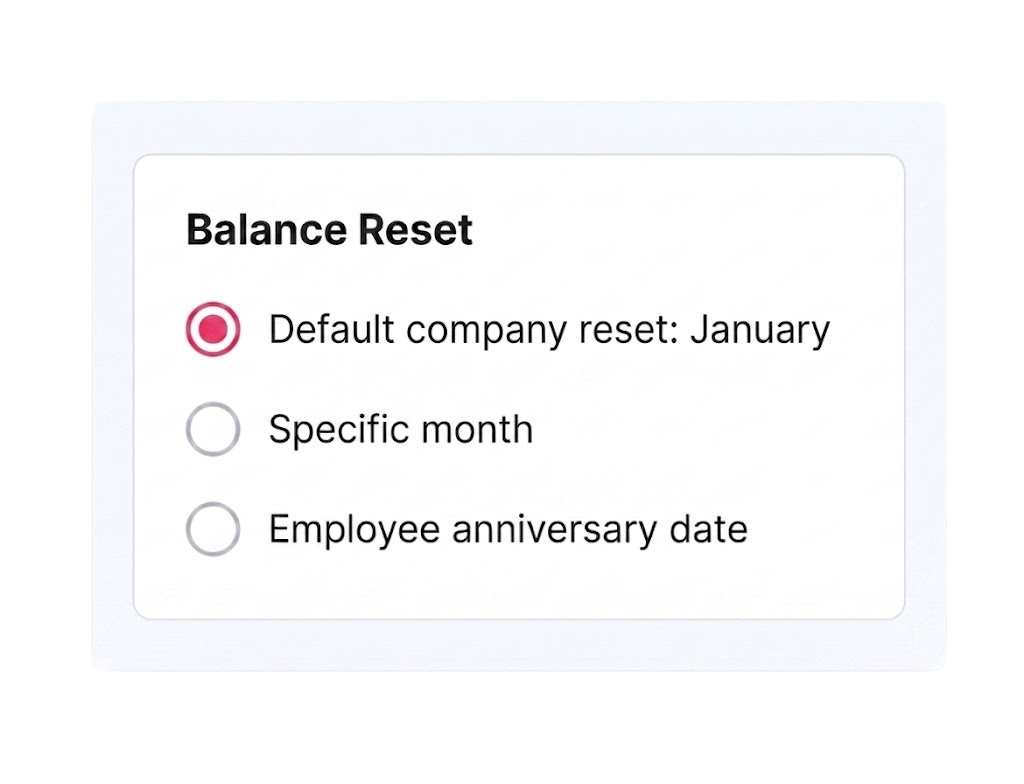
    Screenshot of the Day Off app's Balance Reset settings showing radio button options for default company reset, specific month, or employee anniversary date

    Within each leave type’s settings, you’ll find three mutually exclusive choices: Default company reset, which uses the standard reset month set for the whole company (in this case, January); Specific month, which opens a dropdown letting you choose any month of the year as the reset point for that particular leave type; and Employee anniversary date, which automatically resets the balance based on each individual employee’s hire date rather than a fixed calendar date.

    Example

    To achieve the setup you described, you would open the Annual Leave (vacation) type and select Specific month, choosing January from the dropdown. Separately, you would open the Sick Leave type and select Employee anniversary date instead. Since these settings are configured per leave type rather than globally, both rules can coexist within the same leave policy without conflict.

    Saving Your Changes

    After selecting the appropriate reset option for a leave type, click Save to apply it. Repeat this process for each leave type you want to customize, since each one retains its own independent reset configuration.

  • Is Leo available 24/7, or does the “Online” status mean it depends on availability?

    Knowing when you can rely on Leo for help affects how you might plan to use it for quick questions.

    The “Online” Indicator

    Every time the chat window was opened during testing, Leo displayed an “Online” status marked with a green dot next to its name.

    What This Likely Means

    Since Leo is an automated AI assistant rather than a live human agent, this “Online” status likely reflects constant availability rather than specific working hours, meaning you can probably reach Leo for basic guidance at any time, day or night.

  • Does Leo have access to my company’s specific policies and data, or does it give generic answers?

    Understanding whether Leo tailors its responses to your specific company setup is important for knowing how much to rely on it versus when to look elsewhere for answers.

    How it work

    Leo answer questions using general knowledge about how the Day Off platform works as a product, rather than pulling from your company’s actual internal setup, such as your specific leave policies, team structure, or configured settings.

    Why This Happens

    This makes sense given that Leo functions as a product assistant rather than a system with visibility into your organization’s private data. It can explain how features work and where to find them within Day Off, but it cannot see or reference your company’s unique configurations, records, or internal decisions, since that information isn’t something the chat assistant has access to.

    When to Use Support Instead

    For questions that depend on your company’s specific setup, such as your organization’s particular leave policy rules, custom settings, or account-level details, reaching out through the built-in “Support” link provided within Leo’s responses is a more reliable path, since human support staff can access and reference your actual account information.

  • Can I clear or delete my chat history with Leo?

    If you want to start a fresh conversation or remove previous questions from view, Leo provides a simple way to do this.

    Locating the Clear Option

    At the top of the chat window, next to Leo’s name and online status, there’s a trash/clear icon.

    What Happens When You Clear It

    Clicking this icon immediately resets the conversation, removing all previous messages and returning the chat to Leo’s initial greeting message. This confirmed behavior was observed directly during testing, making it a reliable way to tidy up your chat before asking a new, unrelated question.

  • How do I close the AI chat window?

    Once you’re finished with your conversation, closing the chat window is straightforward.

    Steps to Close

    Look to the top-right corner of the Leo chat panel, next to the trash icon, and click the X icon. This immediately closes the chat window and returns you to the full view of the page behind it.

    Reopening the Chat

    If you need to ask another question later, simply click the pink chat bubble icon again in the bottom-right corner to reopen Leo.

  • What kind of questions can I ask Leo, the virtual assistant?

    Leo is intended to help users navigate and understand how to use the Day Off platform.

    Testing Leo’s Capabilities

    During testing, asking “How do I add a task?” resulted in Leo explaining that task-related actions weren’t something it could handle directly, but it provided guidance by suggesting relevant sections of the app, along with clickable shortcut buttons for “Employees list” and “Support.”

    What This Suggests

    This behavior indicates that Leo functions best as a navigational and general-guidance tool, helping point users toward the correct section of the app or human support channels, rather than acting as a fully comprehensive knowledge base on its own.