




Mandatory PTO is a policy or practice in which an employer requires employees to use some of their available paid time off instead of allowing employees to decide entirely when to take vacation. It may happen during a company shutdown, a slow business period, a holiday week, certain types of leave, or when an employee has accumulated a large unused vacation balance.
But can employers actually force employees to use their vacation time?

In many situations in the United States, yes, an employer may be able to require employees to use available vacation or PTO. However, there is no single rule covering every workplace. The answer depends on federal wage rules, state and local laws, the employer’s written PTO policy, employment contracts, collective bargaining agreements, the employee’s classification, and the reason for the absence.
Federal law generally does not require private employers to provide paid vacation in the first place. The Fair Labor Standards Act (FLSA) does not require payment for time not worked because of vacation, sick leave, or holidays. Vacation benefits are generally established through an employer’s policies or agreements with employees.
Once an employer chooses to provide vacation, however, state law may regulate how earned vacation is treated. That is why employers should distinguish between requiring employees to take time off and forfeiting vacation employees have already earned.
This guide explains how mandatory PTO works, when employers may require vacation use, where legal problems can arise, and how HR teams can create a clearer policy.
Important: This article provides general information for U.S. employers and is not legal advice. Vacation, PTO, paid sick leave, wage, and leave laws vary by state and locality.
What Is Mandatory PTO?
Mandatory PTO means an employee is required to use paid vacation or another eligible PTO balance for a particular period of absence.
Instead of the employee requesting vacation voluntarily, the employer determines that PTO must be applied.
For example, a company might close between December 24 and January 1 and tell employees:
- the office will be closed;
- employees are not expected to work;
- employees with available vacation must use it for the scheduled working days during the closure.
Another employer might require employees to use available vacation before taking an otherwise unpaid personal leave.
Mandatory PTO can therefore describe several different situations. It does not necessarily mean that employees lose their PTO. In many cases, the employee actually receives paid time off and the corresponding hours are deducted from the employee’s available balance.
Can Employers Require Employees to Use PTO?
At the federal level, there is generally no law requiring private employers to provide ordinary vacation benefits. The U.S. Department of Labor states that the FLSA does not require employers to pay employees for time that is not worked, including vacation periods.
Because ordinary vacation benefits are generally created by employer policies rather than the FLSA, employers often have considerable flexibility in determining:
- when vacation may be taken;
- how vacation requests are approved;
- whether certain periods are blocked from vacation;
- whether employees must use PTO during planned closures;
- whether available PTO must be used before unpaid personal leave;
- how much vacation employees may take at one time.
However, that flexibility is not unlimited.
Employers still need to comply with applicable:
- state wage and vacation laws;
- state and local paid sick leave laws;
- the Family and Medical Leave Act when applicable;
- wage and hour requirements for exempt employees;
- collective bargaining agreements;
- employment contracts;
- company policies;
- anti discrimination and retaliation laws.
The safest answer to “Can an employer require PTO?” is therefore:
Often yes, but the employer must make sure the requirement is permitted under the applicable laws and the company’s own policy.
Requiring PTO Is Different From a “Use It or Lose It” Policy
One of the most important distinctions in PTO administration is the difference between requiring vacation to be taken and causing already earned vacation to disappear.
Consider two policies.
Policy A:
Employees must schedule at least five vacation days each year.
The employee actually takes those five days and receives vacation pay.
Policy B:
All vacation remaining on December 31 disappears automatically.
The second policy may create legal problems in states where earned vacation cannot be forfeited.
California provides a clear example. The California Department of Industrial Relations considers earned vacation to be wages. Employers may place reasonable caps on vacation accrual, but a “use it or lose it” policy that causes already earned vacation to be forfeited is not permitted. At the same time, California expressly recognizes an employer’s ability to control when vacation may be taken and how much may be taken at a particular time.
That creates an important principle for employers:
The ability to require an employee to take vacation does not automatically give an employer the ability to erase earned vacation.
State rules must be reviewed separately.
Common Situations Where Employers May Require PTO
Mandatory vacation policies appear in several different circumstances.
Company Shutdowns
One of the most common examples is a planned business shutdown.
A company might close:
- between Christmas and New Year’s Day;
- during an annual factory maintenance period;
- for a seasonal slowdown;
- during a company wide summer break;
- for several days surrounding a major holiday.
Rather than leaving the period unpaid, the employer may require employees to apply available PTO to scheduled working days.
For example:
An employee normally works Monday through Friday and has 80 hours of vacation available.
The company closes for five working days.
If the policy permits mandatory vacation use, the company may apply:
5 days × 8 hours = 40 hours of PTO
The employee receives normal pay for those 40 scheduled hours, while the PTO balance falls from 80 hours to 40 hours.
The situation becomes more complicated when employees do not have enough PTO available or are classified as salaried exempt employees.
Holiday Closures
Some companies close on days that are not designated as paid company holidays.
Suppose a business gives employees December 25 as a paid holiday but also closes on December 24 and December 26.
The policy may provide that:
- December 25 is paid as a company holiday;
- December 24 and December 26 must be covered with PTO.
Clear communication is particularly important here because employees may otherwise assume the entire closure is employer paid holiday leave.
Slow Business Periods
Businesses with highly seasonal demand sometimes schedule mandatory time off during periods when very little work is available.
Examples include certain businesses in:
- manufacturing;
- education;
- hospitality;
- construction;
- professional services;
- seasonal operations.
An employer may decide that scheduling vacation during these periods is better than maintaining normal staffing when demand is low.
However, wage rules still apply. Simply calling a period “mandatory PTO” does not automatically permit an employer to make deductions from an employee’s salary.
Before Unpaid Personal Leave
An employer’s policy may require employees to exhaust available vacation before moving to unpaid personal leave.
For instance, an employee requests six days away from work but has three vacation days available.
Under an applicable policy, the absence might be recorded as:
- Days 1–3: paid vacation;
- Days 4–6: unpaid personal leave.
Whether this approach is appropriate depends on the reason for the absence and applicable leave laws. Employers should not automatically apply a general vacation rule to legally protected sick, family, disability, military, or other protected leave without checking the relevant requirements.
FMLA Leave
The Family and Medical Leave Act creates a specific situation where employer-required paid leave can occur.
FMLA generally provides eligible employees of covered employers with job protected leave for qualifying family and medical reasons. Federal FMLA leave itself is generally unpaid.
Federal regulations allow an employee to choose to substitute accrued paid leave for otherwise unpaid FMLA leave. If the employee does not choose to do so, the employer may, under applicable circumstances, require the employee to substitute accrued paid leave for unpaid FMLA leave. The paid leave then runs concurrently with the FMLA leave.
The employee must generally satisfy the normal terms and conditions of the employer’s paid leave policy to receive that paid leave.
There are additional rules when an employee receives payments through a disability plan or workers’ compensation program because those periods are not considered unpaid in the same way. Federal regulations state that the normal FMLA substitution rule does not apply during those paid periods, although supplementation may sometimes be agreed upon where state law permits.
Employers should therefore avoid treating every medical absence as an ordinary mandatory PTO situation.
Mandatory PTO Examples
| Situation | Can PTO Potentially Be Required? | Key Consideration |
|---|---|---|
| Planned company shutdown | Often | State law, company policy, exempt salary rules |
| Extra days around a holiday closure | Often | Clearly distinguish holiday pay from PTO |
| Employee requests unpaid personal leave | Often | Policy may require available vacation first |
| Unpaid FMLA leave | Potentially | FMLA substitution rules apply |
| Partial-day absence by exempt employee | PTO balance may potentially be reduced | Salary generally cannot simply be reduced for the partial day |
| Employee has no PTO available | Depends | Employer must determine lawful pay/leave treatment |
| Company wants unused vacation to disappear | State-specific | Some states restrict forfeiture |
| Protected paid sick leave | State/local rules apply | Do not automatically treat statutory sick leave like ordinary vacation |
Can Employers Require Salaried Employees to Use PTO?
Yes, an employer may sometimes deduct time from a salaried exempt employee’s PTO bank, even when reducing the employee’s salary would not be permissible.
This distinction is extremely important.
Under federal salary-basis rules, an exempt employee generally must receive the full salary for any week in which the employee performs work, subject to permitted exceptions. An employer generally cannot reduce an exempt employee’s salary because the business was closed and no work was available when the employee was ready, willing, and able to work.
But reducing an employee’s leave balance is different from reducing salary.
The Department of Labor explains that when an employer provides paid leave for personal absences, deductions from an exempt employee’s accrued leave account can be made for an absence covered by the policy, including partial-day absences, without violating the federal salary-basis requirement.
Example
Assume Maria is an exempt salaried employee who earns $1,500 per week.
She leaves four hours early on Friday for a personal reason.
Her employer’s PTO policy allows PTO to be deducted in hourly increments.
The employer may potentially deduct four hours from Maria’s PTO bank while still paying her full weekly salary.
What employers should not do is assume that because four PTO hours can be deducted, four hours of salary can automatically be deducted as well.
Salary deductions and PTO deductions follow different rules.
What Happens If a Salaried Employee Has No PTO Left?
This is where mandatory PTO becomes more complicated.
Suppose the employer closes the office for one day, but an exempt employee has exhausted all PTO.
Under federal salary basis rules, if the absence results from the employer’s operating requirements and the employee is ready, willing, and able to work, the employer generally cannot deduct that day’s salary merely because no work was available.
The rule can differ when an employee takes a full day absence for personal reasons.
Employers should therefore avoid a policy that simply says:
“If PTO is unavailable, the employee will automatically be unpaid.”
That statement may not work correctly for every employee classification or every reason for the absence.
A better policy distinguishes between:
- hourly employees;
- nonexempt salaried employees;
- exempt salaried employees;
- employee requested absences;
- employer initiated closures;
- protected leave.
What About Hourly Employees?
Nonexempt hourly employees are generally paid for hours actually worked unless another law, policy, contract, or paid leave benefit requires payment for time away.
The FLSA does not itself require vacation pay for hours not worked.
For example, suppose an hourly employee is scheduled for eight hours on Friday, but the business closes for the day.
Depending on applicable law and company policy, the employer might:
- require eight hours of available PTO;
- provide paid company closure time;
- treat the day as unpaid;
- offer employees the ability to work another schedule.
The appropriate solution depends on the employer’s policy and applicable state or local requirements.
Can an Employer Require Employees to Use All Their PTO?
Potentially, but this is an area where employers should be careful.
There is a major difference between saying:
“Employees must take five vacation days during our annual shutdown.”
and saying:
“Employees must completely empty their PTO account by December 31.”
The second policy has much greater potential to conflict with state rules governing vacation accrual and forfeiture.
California, for example, does not permit forfeiture of vested vacation. Employers may use reasonable accrual caps, but earned vacation cannot simply disappear because an employee failed to use it by a deadline.
Employers with workers in multiple states should therefore avoid assuming that one mandatory vacation policy can be applied identically everywhere.
Mandatory PTO vs. Use It or Lose It PTO
| Policy | What Happens? | Main Concern |
|---|---|---|
| Mandatory PTO | Employee is required to take paid time away from work | Timing, notice, protected leave, wage rules |
| Use-it-or-lose-it | Unused balance disappears after a deadline | May violate state vacation laws |
| PTO accrual cap | Employee temporarily stops earning more PTO after reaching a limit | Cap must comply with applicable law |
| PTO payout | Unused vacation is converted into money | State law and employer policy |
| PTO carryover | Some or all unused balance moves into the next period | Carryover limits may be regulated |
Can Employers Require PTO During a Holiday Shutdown?
In many workplaces, yes, provided the arrangement complies with applicable laws and the employer’s established policy.
A well designed shutdown policy should specify:
- Which days the company will be closed.
- Which days are paid company holidays.
- Which days require PTO.
- How many PTO hours will be deducted.
- What happens if an employee does not have enough PTO.
- Whether employees hired shortly before the shutdown are treated differently.
- Whether remote work is permitted.
- How exempt employees are treated.
- How protected leave interacts with the closure.
Example
A company closes for the following week:
- Monday: normal working day
- Tuesday: normal working day
- Wednesday: company holiday
- Thursday: normal working day
- Friday: normal working day
The employee works eight hours per day.
If the company requires PTO for the non holiday closure days:
4 working days × 8 hours = 32 PTO hours
The employee should not normally be charged 40 PTO hours simply because the business was closed for five calendar days. The designated paid holiday should be handled according to the company’s holiday policy.
A schedule aware leave system can make this much easier because leave deductions can be based on the employee’s actual working schedule rather than simply counting calendar days.
Can an Employer Force Employees to Take Vacation When They Do Not Want To?
Potentially.
Employees often think that because vacation is “their” benefit, they have an unrestricted right to decide exactly when it will be used.
That is not necessarily the case.
For example, the California Labor Commissioner specifically states that employers may control when vacation is taken and the amount that may be taken at a particular time, even though California strongly protects vacation after it has been earned.
A company might therefore legally have both:
- rules preventing vacation during a critical business period; and
- rules requiring vacation during a scheduled shutdown.
The important question is whether those rules comply with applicable law and have been properly communicated.
Can Employees Refuse Mandatory PTO?
An employee’s ability to refuse will depend on the circumstances.
If the employer has a lawful policy stating that certain days are mandatory vacation days, an employee may not necessarily have the right to insist on working instead.
However, employers should investigate situations involving:
- protected medical leave;
- disability accommodations;
- religious accommodations;
- collective bargaining agreements;
- employment contracts;
- legally protected sick leave;
- state or local scheduling requirements.
A disagreement should not automatically be treated as misconduct before HR determines whether another legal protection applies.
Mandatory PTO and Paid Sick Leave Are Not Always the Same Thing
Employers should be particularly cautious when they maintain one combined PTO bank covering both vacation and legally required sick leave.
Paid sick leave is regulated differently from ordinary vacation in many jurisdictions.
The U.S. Department of Labor notes that although federal law generally does not guarantee paid sick leave to private-sector workers, numerous states and localities have enacted paid sick leave requirements.
Those laws may establish:
- qualifying reasons for leave;
- accrual requirements;
- minimum amounts employees must be able to use;
- notice rules;
- carryover requirements;
- documentation restrictions;
- retaliation protections.
Consequently, an employer should not assume it can require employees to spend the portion of a PTO bank that must remain available for legally protected sick leave purposes.
This is particularly important for employers operating in multiple states.
Advantages of Mandatory Vacation Policies
Mandatory vacation is not only an administrative rule. When designed properly, it can serve legitimate business and workforce goals.
Encouraging Employees to Actually Take Time Off
Some employees accumulate large balances because they continuously postpone vacation.
A structured minimum-vacation policy can encourage employees to disconnect from work rather than treating vacation as a benefit that exists only on paper.
Reducing Large PTO Liabilities
Where accrued vacation creates a financial liability, very large unused balances can become costly.
Encouraging regular use can help control those balances, provided the employer follows applicable state law.
Supporting Planned Business Closures
If demand is predictably low during a particular week, a planned shutdown may make more operational sense than trying to maintain normal staffing.
Improving Workforce Planning
A scheduled mandatory break may be easier to manage than dozens of individual requests scattered throughout a busy season.
However, these benefits do not justify ignoring wage or leave laws.
Potential Problems With Mandatory PTO
Poorly designed mandatory leave policies can create frustration and legal risk.
Employees Lose Flexibility
An employee receiving 15 vacation days per year may feel that five mandatory shutdown days effectively leave only 10 days for vacations they personally choose.
That may affect how employees perceive the value of the benefit.
New Employees May Have Insufficient PTO
An employee hired shortly before an annual shutdown may not have accumulated enough paid leave.
Policies should explain whether the company will:
- advance PTO;
- allow a negative balance where lawful;
- provide paid closure time;
- treat eligible days as unpaid;
- use another arrangement.
Part Time and Alternative Schedules Can Be Miscalculated
A five-day company closure does not necessarily equal five PTO days for every employee.
An employee who normally works Monday through Thursday should generally be evaluated according to the hours or days they were actually scheduled to work.
State Laws Can Conflict With a National Policy
A policy that works in one state may not work in another.
This becomes especially important for remote companies with employees spread across multiple jurisdictions.
Example: Calculating Mandatory PTO Correctly
Assume a company closes Thursday and Friday before a weekend.
Three employees have different schedules.
| Employee | Normal Schedule | Scheduled Closure Time | PTO Deduction |
|---|---|---|---|
| Employee A | 8 hours Thursday + 8 Friday | 16 hours | 16 hours |
| Employee B | 10 hours Thursday, Friday off | 10 hours | 10 hours |
| Employee C | Friday only | 8 hours | 8 hours |
Even though everyone experiences the same company closure, their PTO deductions are different.
This is why employers should calculate mandatory vacation using scheduled working time, not simply the number of calendar days in the closure.
How Much Notice Should Employers Give for Mandatory PTO?
Federal vacation law does not establish a universal notice period for ordinary mandatory vacation policies. Because vacation benefits are largely governed by employer policy at the federal level, notice requirements may instead come from state or local laws, contracts, collective bargaining agreements, or company policies.
Even when there is no specific statutory deadline, advance notice is good policy.
For predictable shutdowns, employers should consider announcing dates:
- at the beginning of the year;
- when the annual holiday calendar is published;
- when employees receive their PTO policy;
- well before employees begin making travel plans.
Avoid announcing a significant mandatory vacation period at the last minute unless circumstances genuinely require it.
How to Create a Fair Mandatory PTO Policy
A mandatory vacation policy should answer more than simply, “Employees must use PTO.”
Define When PTO Can Be Required
Specify the circumstances clearly.
For example:
- annual company shutdown;
- designated holiday closure;
- scheduled maintenance period;
- approved personal leave;
- qualifying FMLA leave when substitution is permitted.
Avoid wording that gives managers unlimited and unexplained discretion.
Define Which Balance Is Used
Specify whether the requirement applies to:
- vacation only;
- general PTO;
- personal leave;
- floating holidays.
Do not casually combine legally protected sick leave with ordinary vacation.
Explain How PTO Is Calculated
Deduct only the employee’s applicable scheduled working time.
For example:
An employee scheduled to work six hours should not automatically lose eight PTO hours simply because the company’s standard workday is eight hours.
Address Employees With Insufficient PTO
The policy should explain what happens when the employee has:
- enough PTO;
- only part of the required balance;
- zero PTO.
This avoids managers making inconsistent decisions.
Address Exempt Employees Separately
Do not assume that running out of PTO automatically means a salaried exempt employee’s salary can be reduced.
Federal salary-basis rules must still be followed.
Review State Requirements
Employers should review rules wherever employees actually work, particularly for remote teams.
Relevant questions include:
- Is vacation treated as earned wages?
- Is forfeiture allowed?
- Are accrual caps allowed?
- Is payout required when employment ends?
- Does the jurisdiction require paid sick leave?
- Can a combined PTO bank satisfy those requirements?
Publish Mandatory Dates Early
Employees should know how many of their annual vacation days are effectively reserved for company-required closures.
Track the Policy Consistently
If employees in similar roles are treated differently without a legitimate reason, the policy can quickly become difficult to manage and defend.
Good PTO records should show:
- balance before the deduction;
- date of the mandatory leave;
- scheduled hours;
- leave type;
- hours deducted;
- remaining balance.
Managing Mandatory PTO With Leave Management Software
Mandatory leave becomes harder to manage as an organization adds:
- employees with different schedules;
- part time staff;
- remote employees;
- multiple locations;
- different holiday calendars;
- hourly and salaried workers;
- multiple leave policies.
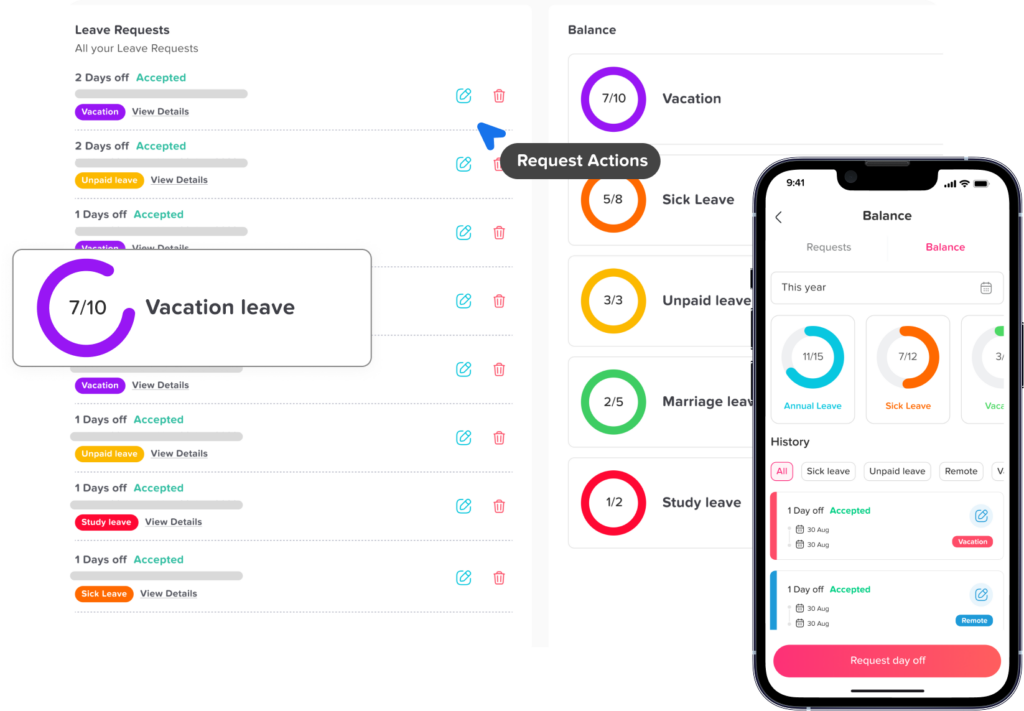
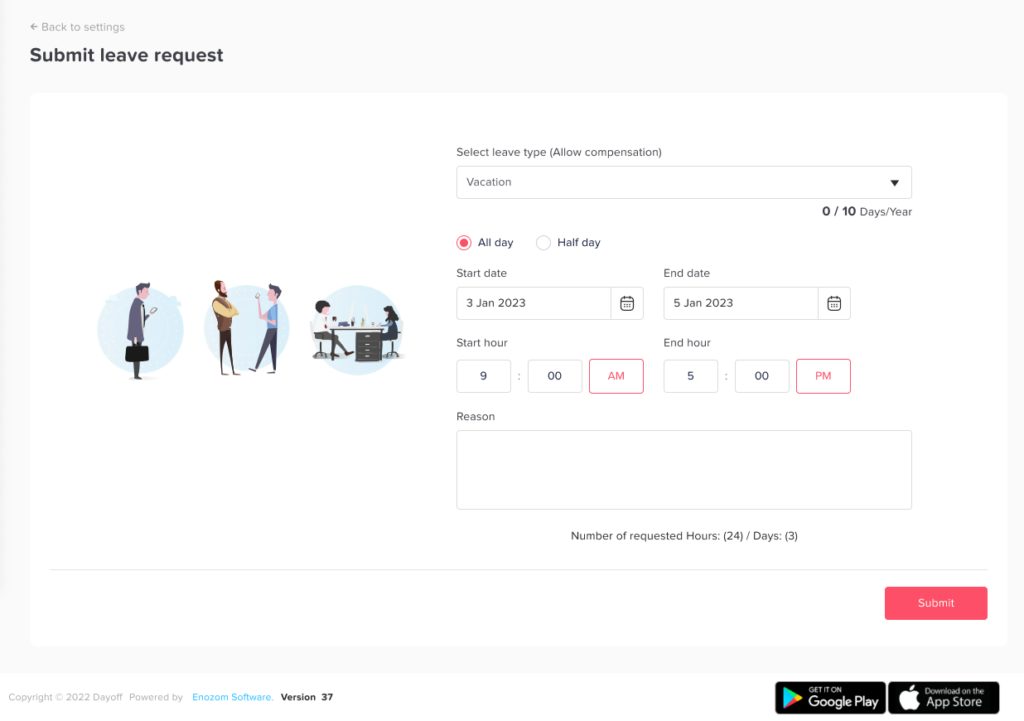
A leave management system such as Day Off can help companies keep PTO balances, work schedules, holidays, leave policies, and employee requests organized in one place.
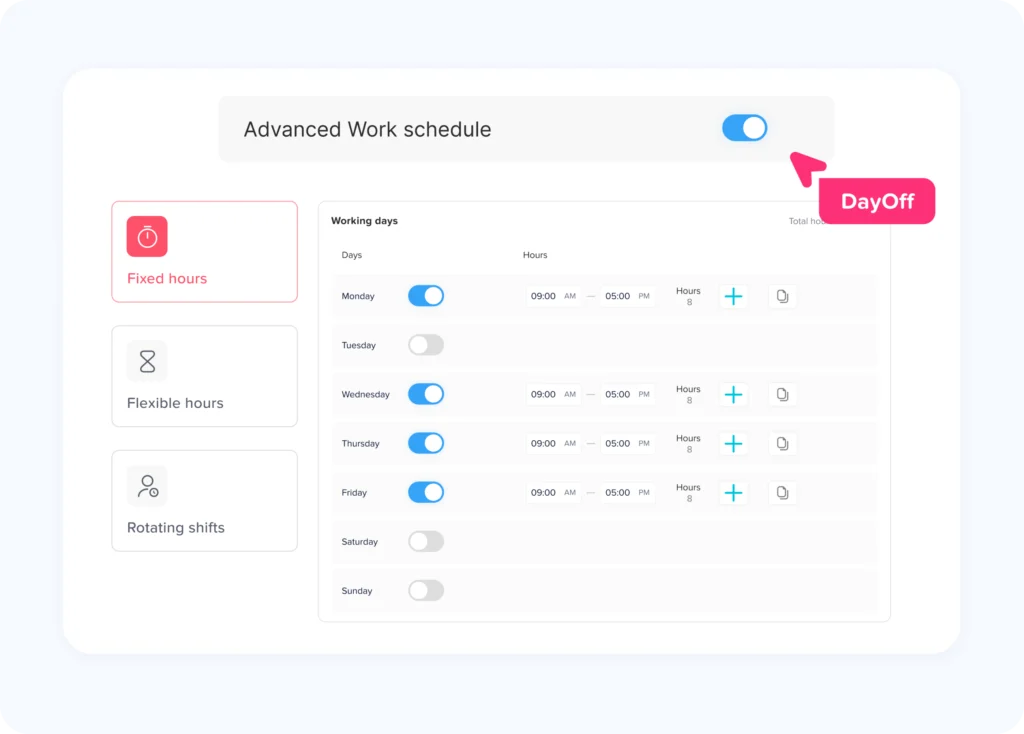
For example, HR teams can use work schedules to determine how much working time falls within a closure instead of applying the same deduction to every employee.
That matters when one employee works eight-hour days while another follows a compressed or part time schedule.
The underlying policy still needs to comply with applicable laws, but accurate leave tracking makes the policy much easier to administer consistently.
Mandatory PTO Policy Example
A company might use language similar to the following:
Company Closure and Required PTO
The company may designate specific working days as scheduled closure days. Employees will receive advance notice of planned closures whenever reasonably possible.
Employees may be required to use available vacation or eligible PTO for scheduled working hours that fall during a designated closure, subject to applicable law.
Paid company holidays will not be deducted from vacation balances unless specifically permitted by the applicable policy and law.
If an employee does not have sufficient PTO to cover the closure, HR will determine the appropriate treatment based on the employee’s classification, work location, available leave, and applicable wage and leave requirements.
Legally protected leave will be administered according to applicable federal, state, and local law.
This example should still be reviewed for the jurisdictions in which the company operates.
Best Practices for Employers
Before implementing mandatory PTO, employers should ask:
- Is the policy written clearly?
- Does it distinguish vacation from protected sick leave?
- Are employees given reasonable advance notice?
- Are deductions based on actual scheduled hours?
- Does the policy explain what happens when PTO is exhausted?
- Are exempt employees handled correctly?
- Have state and local laws been reviewed?
- Does the policy comply with employment contracts or collective bargaining agreements?
- Are managers applying the rule consistently?
- Can HR audit every PTO deduction later?
The goal should be predictable leave management rather than simply forcing employees to reduce their balances.
Frequently Asked Questions
Can my employer force me to use PTO?
In many circumstances, an employer may require employees to use available vacation or PTO according to a lawful company policy. Federal law does not generally require private employers to provide ordinary vacation benefits, so many vacation rules are established by employer policy. State and local laws can impose additional restrictions.
Can an employer require PTO during a company shutdown?
Potentially, yes. Employers may establish policies requiring available vacation to be used during planned shutdowns. However, they must still comply with state law and federal wage rules, particularly when dealing with salaried exempt employees.
Can a company force you to use PTO and then make you unpaid when it runs out?
Not automatically in every situation. The answer depends on the employee’s classification, the reason for the absence, applicable state law, and the employer’s policy. Special caution is necessary for exempt salaried employees because federal salary-basis rules restrict certain salary deductions.
Can an employer make you use vacation before unpaid leave?
Often, an employer policy may require available vacation to be used before ordinary unpaid personal leave. However, protected leave requires separate analysis. For eligible FMLA leave, federal rules specifically allow employers in certain circumstances to require accrued paid leave to run concurrently with unpaid FMLA leave.
Can an employer make you use PTO for FMLA?
Yes, in certain circumstances. Federal FMLA regulations allow employers to require substitution of accrued paid leave for otherwise unpaid FMLA leave. The paid leave and FMLA leave run concurrently rather than consecutively. The employee’s ability to use the paid leave remains subject to the applicable terms of the employer’s normal leave policy.
Can an employer force salaried employees to use PTO for a partial day?
An employer may generally reduce an exempt employee’s accrued leave balance for an absence covered by its policy, including a partial day absence, without automatically violating the FLSA salary basis test. That does not mean the employer can necessarily reduce the employee’s salary for those same hours.
Is mandatory PTO the same as use it or lose it PTO?
No. Mandatory PTO requires employees to actually take paid time off. A use it or lose it policy causes unused time to disappear after a deadline. State laws may treat those practices differently. California, for example, allows employers to control vacation scheduling but does not permit earned vacation to be forfeited through a use-it-or-lose-it policy.
Can an employer require employees to take a minimum amount of vacation each year?
An employer may be able to establish a minimum-vacation requirement, subject to state and local law, contracts, and other applicable requirements. Employers should make the requirement clear in the PTO policy and explain whether mandatory company closure days count toward the minimum.
Can employees be required to use PTO on company holidays?
A company should distinguish between an official paid holiday and an additional company closure day. Whether PTO may be required depends on the employer’s holiday and PTO policies and applicable law. The FLSA itself does not require private employers to provide paid holidays.
Can an employer take away unused vacation at the end of the year?
That depends heavily on state law. Some states regulate earned vacation as wages and restrict forfeiture. California, for example, prohibits policies that cause earned vacation to be lost merely because it was not used by a specified deadline.
Conclusion
Mandatory PTO can be a legitimate way to manage company shutdowns, encourage employees to take vacation, coordinate staffing, and manage large unused leave balances. But requiring vacation is not as simple as telling employees to empty their PTO accounts.
At the federal level, ordinary vacation benefits are generally determined by employer policy rather than required by the FLSA. Employers therefore often have flexibility to determine when vacation is used. At the same time, state laws may protect accrued vacation, regulate paid sick leave, require payouts, or restrict forfeiture. Federal salary-basis rules and FMLA requirements can also change how mandatory PTO should be handled.
A strong mandatory PTO policy should clearly explain when leave can be required, which balance is used, how many hours are deducted, what happens when an employee has insufficient PTO, and how protected leave is handled.
For employers managing different schedules, teams, locations, and leave balances, accurate PTO tracking is just as important as the policy itself. With Day Off, organizations can keep employee leave balances, work schedules, holidays, requests, and time-off records organized so managers can apply PTO rules more consistently.
The best approach is not simply to require employees to use vacation. It is to create a transparent policy employees understand, calculate every deduction correctly, and confirm that the policy complies with the laws that apply wherever employees work.