







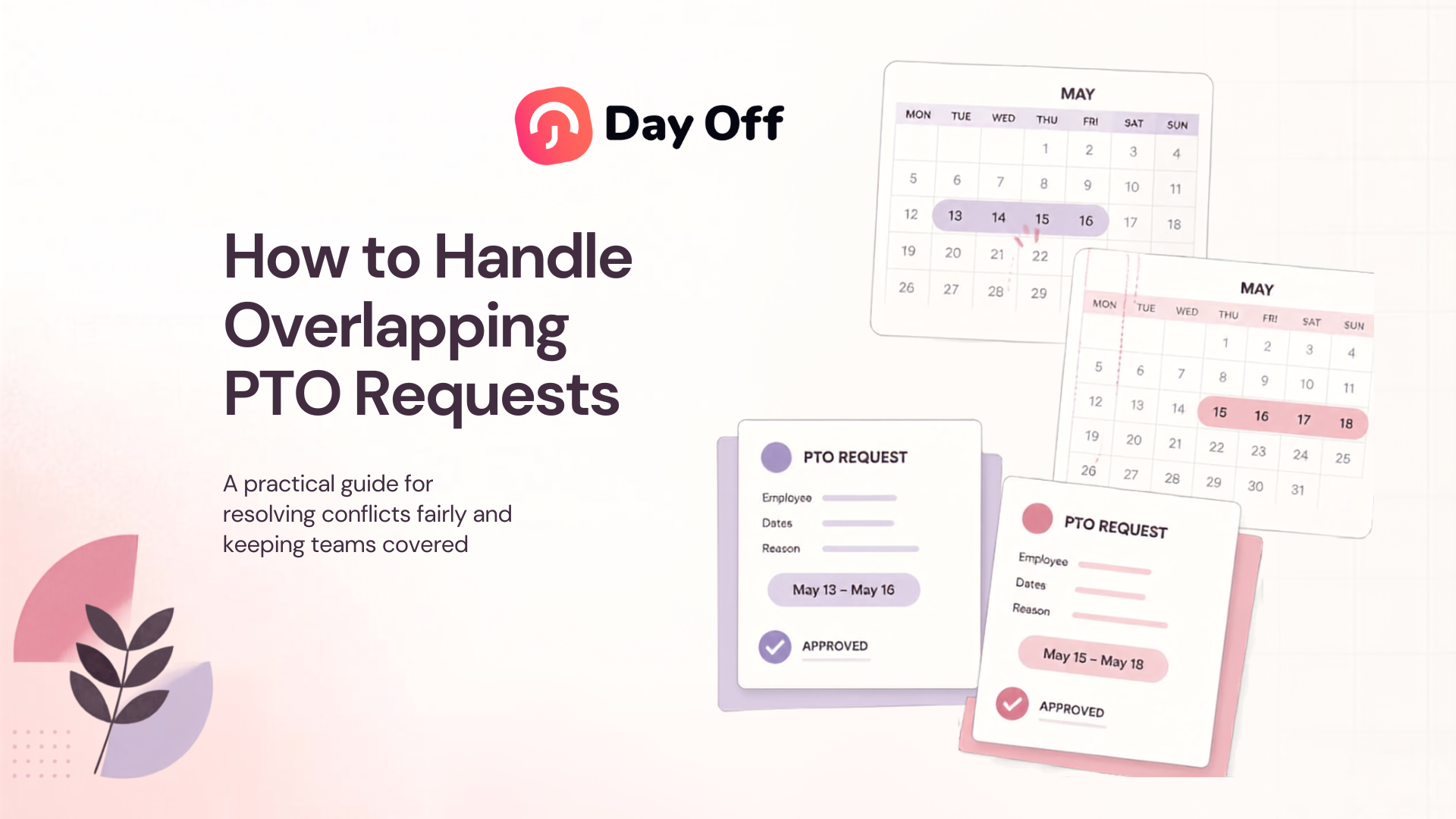
Overlapping PTO Requests happen when two or more employees ask to take time off during the same period, creating a potential staffing or coverage problem. The situation is especially common around summer vacations, school breaks, major holidays, long weekends, and other popular dates. For managers, the challenge is not simply deciding whose vacation request should be approved. It is finding a fair, consistent way to protect business operations while still giving employees reasonable access to their earned time off.

Poorly managed PTO conflicts can create frustration quickly. Employees may feel that managers are playing favorites, newer employees may believe they never get desirable dates, and teams may be left understaffed when too many requests are approved without checking coverage.
A clear process changes that.
Instead of making each decision independently, employers can define staffing requirements, set PTO request rules, establish a priority system, and give managers the information they need to compare requests fairly.
This guide explains how to handle overlapping PTO requests, which prioritization methods companies can use, when Overlapping PTO Requests may need different treatment, and how technology can make the process easier to manage.
What Are Overlapping PTO Requests?
Overlapping PTO requests occur when multiple employees request vacation or paid time off for dates that partially or completely overlap.
For example:
- Employee A requests August 10–14.
- Employee B requests August 12–18.
- Employee C requests August 14.
All three requests overlap on at least one date.
An overlap does not automatically mean one of the requests must be rejected. The real question is whether approving them together would leave the team without enough coverage.
Consider a customer support department with 15 employees. Having three people away at the same time may be completely manageable.
A four-person accounting team approaching a major reporting deadline may have far less flexibility.
That is why companies should avoid treating the number of overlapping requests as the only decision factor. Managers should consider the actual operational impact.
Why Overlapping PTO Requests Become Difficult
Most PTO conflicts are not difficult because employees want the same dates. They become difficult because the organization does not have clear rules for deciding what happens next.
Common problems include:
Too Many Employees Are Away at Once
If several people performing essential roles are absent simultaneously, remaining employees may struggle to maintain normal operations.
This can affect:
- Customer support
- Shift coverage
- Production
- Deliveries
- Payroll processing
- Project deadlines
- Sales operations
- Client services
- Technical support
- Management coverage
The issue becomes more serious when employees with the same skills or responsibilities request the same period.
Employees Expect Equal Access to Popular Dates
Certain days naturally attract more Overlapping PTO Requests
Christmas, New Year, Thanksgiving, summer holidays, school breaks, and long weekends are obvious examples.
If the same employees repeatedly receive those periods off, coworkers may begin to question whether the approval process is fair.
Managers Make Decisions Differently
One manager may approve requests strictly according to submission time.
Another may prioritize seniority.
Another may approve almost everything unless staffing becomes impossible.
Without a company wide framework, employees with similar circumstances can receive completely different treatment depending on their manager.
Requests Arrive Through Different Channels
One employee submits PTO through the official system. Another tells a manager verbally. Someone else sends a Slack message, and another adds vacation directly to a shared calendar.
When requests are scattered across different channels, accurately determining who requested a date first becomes difficult.
An effective PTO process needs a single source of truth.
Start With Minimum Staffing Requirements
Before deciding whose PTO should take priority, determine how much coverage the team actually needs.
Managers should identify the minimum number of employees required to operate normally or safely.
For example, suppose a team contains eight customer support representatives.
Management determines that at least five representatives should normally be available each weekday.
That means up to three employees may potentially be away simultaneously.
If two employees already have approved vacation, another request may still be approved.
If three are already away, another request may create a staffing problem.
A simple way to think about coverage is:
Available employees = Scheduled employees − Approved absences
Then compare the result with the team’s minimum required coverage.
However, headcount alone is not always enough.
Managers should also consider whether specific skills or responsibilities must remain covered.
For example, a six-person IT team could technically have four employees available, but operations may still be affected if the two people requesting PTO are the only employees responsible for the same critical system.
Coverage planning therefore needs to consider both quantity and capability.
Check Existing Approved Leave Before Reviewing New Requests
Managers should review existing absences before approving another request.
At minimum, check:
- Who is already approved for PTO
- Pending requests covering the same period
- Public holidays
- Employee work schedules
- Shift assignments
- Important projects
- Customer commitments
- Payroll or reporting deadlines
- Business critical events
- Whether essential responsibilities would remain covered
A shared PTO calendar makes this considerably easier.
Instead of relying on memory, managers can see upcoming employee absences before making a decision.
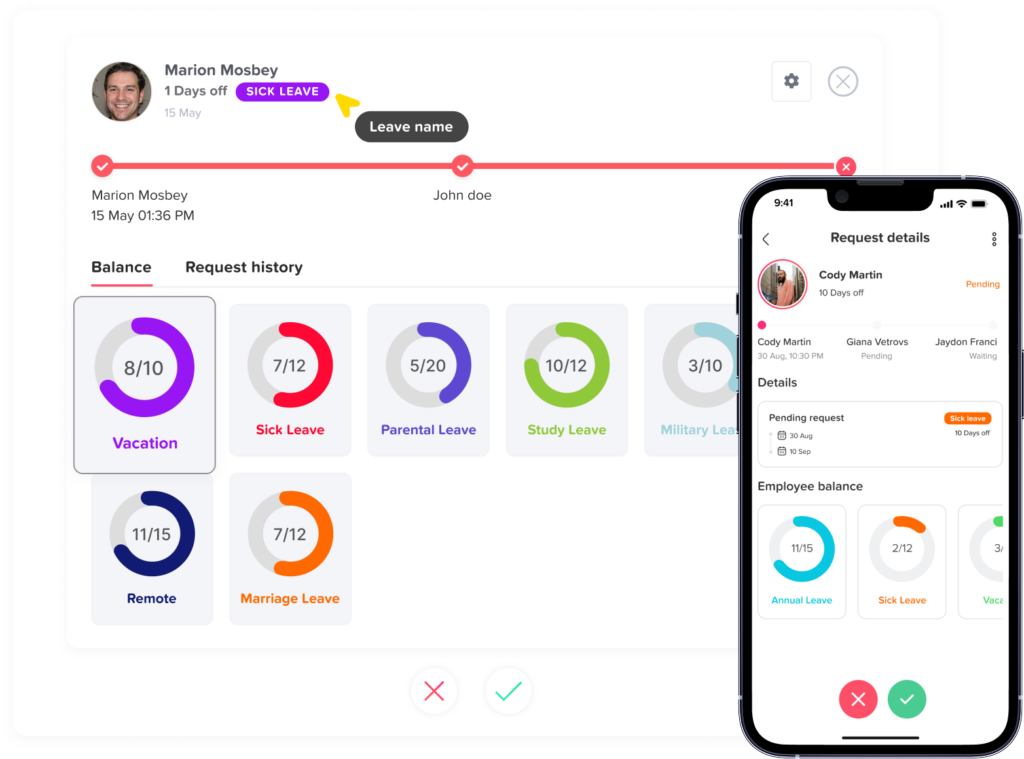
Day Off, for example, provides PTO request management, approval workflows, shared calendar visibility, leave policies, work schedules, and blockout dates in one system. This makes it easier for managers to review team availability before approving additional leave.
Choose a Fair PTO Priority System
When every request can be approved, no prioritization system is necessary.
The difficult situation occurs when operational requirements mean only some employees can take the requested dates.
Organizations should decide in advance how those conflicts will be resolved.
There is no single priority method that works best for every company.
| Priority Method | How It Works | Main Advantage | Potential Problem |
|---|---|---|---|
| First come, first served | Earlier requests receive priority | Simple and easy to understand | Employees able to plan earlier may gain an advantage |
| Seniority | Employees with longer service receive priority | Predictable and easy to administer | New employees may repeatedly lose popular dates |
| Rotation | Priority changes between employees over time | Distributes desirable dates more fairly | Requires accurate historical records |
| Lottery | Eligible employees are randomly selected | Removes manager discretion | Employees can still lose repeatedly by chance |
| Ranked preference | Employees submit first, second, and third choices | Helps accommodate more employees | Requires more coordination |
| Coverage based | Requests are evaluated according to roles and staffing needs | Protects operations | Rules must be clearly defined |
| Hybrid | Two or more methods are combined | More flexible and balanced | Can become confusing if poorly documented |
For many organizations, a hybrid approach works well.
For example:
- Requests submitted before a defined deadline are considered together.
- Managers determine how many employees can reasonably be absent.
- Previously approved dates are honored.
- Conflicting requests are evaluated using rotation or another predefined priority rule.
- Requests received after the deadline are processed according to availability.
The important part is consistency.
Whatever method the company chooses should be documented and applied in the same way to comparable situations.
Is First Come, First Served Always Fair?
First come, first served is one of the most common ways to manage overlapping PTO requests because it is simple.
If Maria submits a vacation request on March 1 and David requests the same dates on March 10, Maria receives priority.
That appears objective.
However, the method has weaknesses.
Some employees know their travel plans months in advance. Others cannot.
Parents may not receive school schedules immediately. Employees coordinating travel with a spouse may need additional time. New employees may not have been employed when early requests were submitted.
First come, first served can still be useful, but employers should understand what the rule actually rewards: submission speed.
For ordinary Overlapping PTO Requests, this may be perfectly acceptable if employees know the rule beforehand.
For extremely popular periods, another system may create a better balance.
Consider a Rotation for High Demand Holidays
Holiday PTO creates recurring conflicts because the same dates are popular every year.
Imagine five employees who all want the days between Christmas and New Year off, but the department can only approve two requests.
If seniority is always used, the same employees may receive those dates every year.
A rotating holiday priority system can distribute access more evenly.
For example:
2026
Priority:
- Employee A
- Employee B
- Employee C
- Employee D
- Employee E
Employees A and B receive the requested period.
2027
The employees who did not receive priority move ahead:
- Employee C
- Employee D
- Employee E
- Employee A
- Employee B
This does not guarantee that every employee receives every preferred date, but it prevents the same people from automatically winning every annual conflict.
Use PTO Request Windows for Extremely Popular Dates
Another useful approach is a PTO request window.
Rather than allowing employees to reserve Christmas vacation a year earlier simply because they submitted first, the company opens requests for a defined period.
For example:
Holiday Overlapping PTO Requests for December 20–31 must be submitted between September 1 and September 30.
Management reviews all eligible requests after the window closes.
This allows employees to compete for high-demand periods on more equal terms.
The company can then apply its established priority method, such as:
- Rotation
- Seniority
- Lottery
- Ranked preference
- Coverage requirements
- A combination of these methods
Requests submitted after the window can be considered according to remaining availability.
Ask Whether the Entire Request Creates a Conflict
A common mistake is rejecting an entire vacation because one or two dates create a staffing problem.
Suppose an employee requests Monday through Friday off.
Coverage is sufficient Monday through Wednesday, but too many employees are already away Thursday and Friday.
Instead of rejecting all five days, the manager could discuss alternatives.
For example:
- Approve Monday through Wednesday.
- Ask whether Thursday and Friday can move to another week.
- Move the entire vacation by several days.
- Find temporary coverage for the two conflicting days.
- Ask whether another employee is willing to change dates voluntarily.
This approach increases the chance that employees can still take meaningful time off while protecting operational requirements.
The goal should not be to reject PTO whenever a conflict appears. It should be to find the smallest adjustment necessary to resolve the conflict.
Evaluate Whether Work Can Be Redistributed
Before rejecting a request, determine whether coverage can reasonably be reorganized.
Possible options include:
- Temporarily reassigning responsibilities
- Cross training another employee
- Moving nonessential meetings
- Rescheduling internal deadlines
- Having another manager provide temporary coverage
- Adjusting shift assignments
- Using employees from another location or department where appropriate
- Completing critical work before the employee leaves
- Moving nonurgent work until after the employee returns
Managers should avoid creating unreasonable workloads for remaining employees simply to approve every PTO request.
However, some conflicts that initially appear impossible may be manageable with modest preparation.
Consider Role Coverage, Not Employee Importance
Managers should be careful when discussing why one request can or cannot be approved.
The question should be:
“What work must remain covered?”
not:
“Which employee is more important?”
For example, two employees may both perform valuable work, but they may be the only two people authorized to complete a particular daily process.
Approving both simultaneously could create a legitimate coverage problem.
Document the operational requirement rather than making subjective judgments about employees.
Example of Resolving Overlapping PTO Requests
Consider a six person finance department.
Three employees request April 6–10 off.
The team requires at least four employees available during that week because monthly reporting must be completed.
Existing situation:
| Employee | PTO Request | Role Coverage | Result |
|---|---|---|---|
| Employee A | April 6-10 | General accounting | Requested first |
| Employee B | April 6-10 | General accounting | Requested second |
| Employee C | April 8-10 | Payroll specialist | Only payroll specialist scheduled that week |
Approving all three would leave only three employees available.
The manager first determines that only two requests can be accommodated.
However, simply approving A and B because they submitted first could leave payroll responsibilities uncovered.
A better review would examine whether Employee C’s payroll responsibilities can be covered.
If another trained employee can perform the payroll work, the standard priority system can proceed normally.
If nobody else can perform the required work, the manager may need to discuss alternative dates with Employee C or arrange appropriate backup coverage before approving the request.
This example shows why PTO decisions should combine a consistent priority policy with genuine staffing requirements.
Distinguish Ordinary PTO Conflicts From Protected Leave
This is an important part of PTO administration.
Not every absence should be placed into the same competition for available vacation slots.
For U.S. employers, the Fair Labor Standards Act does not generally require employers to provide paid vacation. Vacation benefits are typically determined by employer policy or agreement, although state laws and other requirements may apply.
Other forms of leave can create different obligations.
For example, eligible employees and covered employers may have rights and responsibilities under the Family and Medical Leave Act. Qualifying FMLA leave may also run concurrently with applicable paid leave under certain circumstances.
A medical leave request can also raise obligations under the Americans with Disabilities Act. EEOC guidance explains that a request for leave related to a medical condition may need to be considered as a request for reasonable accommodation when applicable.
State and local laws may provide additional protections, including paid sick leave, family leave, or other forms of protected absence.
Therefore, managers should not automatically reject every request because the “PTO limit for the day has already been reached.”
When a request may involve legally protected leave, HR or the appropriate administrator should review it separately.
This article provides general operational guidance, not legal advice. Employers should review applicable federal, state, local, contractual, and collective bargaining requirements when creating or applying leave policies.
Avoid Asking Employees to Compete Based on Personal Reasons
Suppose two employees want the same Friday off.
One wants to attend a wedding.
The other wants to take a short vacation.
Managers may be tempted to decide which reason is more important.
That approach can become problematic.
Employees should not normally have to prove that their vacation is more deserving than someone else’s.
A consistent priority system is usually easier to defend and administer than comparing personal circumstances.
It also protects employee privacy.
Unless the nature of the request changes the employer’s legal responsibilities or the company’s policy specifically requires additional information, the decision should generally be based on objective PTO rules and staffing requirements rather than subjective judgments about whose plans matter more.
Never Encourage Employees to Pressure Each Other
Managers sometimes respond to PTO conflicts with:
“You can take the dates if you convince Sarah to cancel her vacation.”
This transfers the manager’s responsibility to employees and can create unnecessary tension.
Employees should be allowed to voluntarily swap dates if company policy permits, but nobody should feel pressured to surrender approved PTO.
The manager or HR team should remain responsible for the final decision.
Do Not Cancel Approved PTO Casually
There is an important difference between:
- A new request that conflicts with existing approved PTO
- Two requests that are both still pending
- Previously approved PTO that management now wants to cancel
Once employees receive approval, they may purchase flights, book hotels, arrange childcare, coordinate family travel, or make other commitments.
Revoking approved PTO should therefore be treated much more seriously than declining a new request.
Organizations should define whether approved leave can ever be cancelled and under what circumstances.
If cancellations are permitted, they should normally be reserved for exceptional situations rather than ordinary scheduling mistakes.
Managers should first investigate alternatives such as temporary coverage, workload redistribution, schedule adjustments, or management support.
Use Blockout Dates Carefully
Some organizations have periods during which vacation is difficult or impossible to accommodate.
Examples might include:
- Annual inventory counts
- Major product launches
- Peak retail periods
- Tax filing deadlines
- Major conferences
- Year-end financial closing
- Critical client implementations
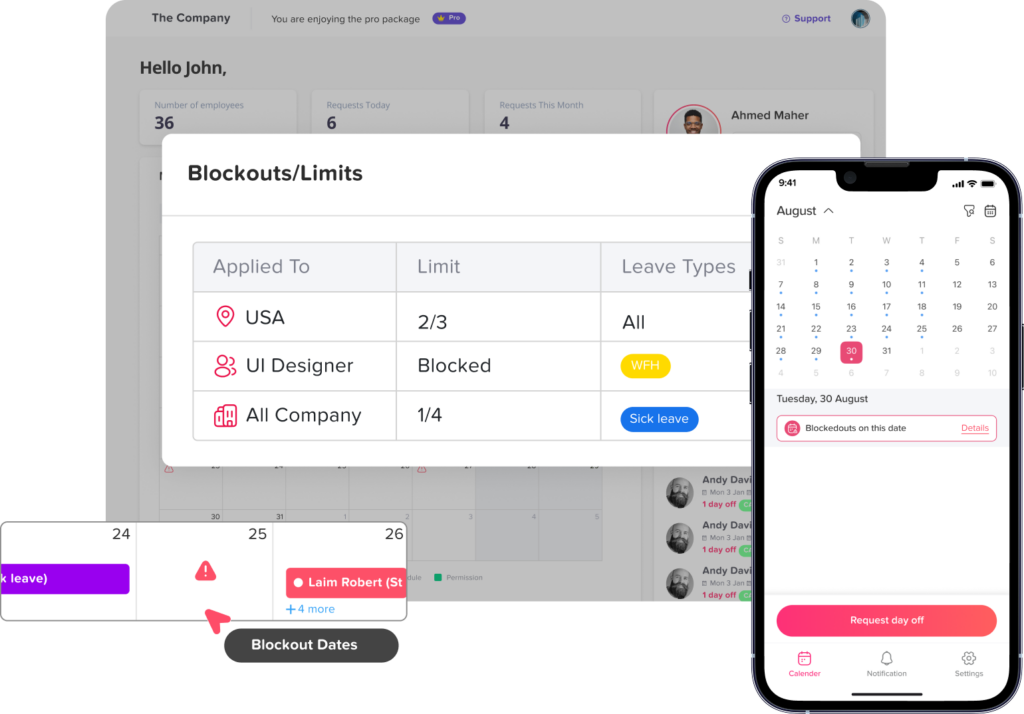
Companies can establish blockout dates or restricted PTO periods for predictable operational needs.
Day Off includes blockout-date functionality that can help organizations identify periods when leave needs to be restricted or limited.
However, blackout periods should be used carefully.
Blocking large portions of the year may prevent employees from reasonably using their PTO and can create additional operational or legal concerns depending on applicable rules.
Restrictions should have a legitimate operational purpose, be communicated early, and be reviewed periodically.
Set a Maximum Number of Simultaneous Absences Where Appropriate
Some teams benefit from a simple rule such as:
No more than two employees from the customer support morning shift may have planned vacation on the same day.
This can work well when staffing needs are predictable.
However, a fixed company wide limit may not work for every department.
Allowing two employees off simultaneously could be insignificant for a 30-person team and extremely disruptive for a three person team.
Coverage rules are often more useful when defined by:
- Department
- Team
- Shift
- Location
- Job function
- Required skill
- Busy period
The objective is to maintain sufficient coverage, not merely enforce an arbitrary number.
Set Reasonable PTO Notice Requirements
Advance notice gives managers more time to resolve overlapping requests.
A policy may establish different expectations depending on the amount of leave requested.
For example:
- One day off: request at least one week in advance when foreseeable.
- Two to four days: request two weeks in advance.
- Five or more days: request four weeks in advance.
Those are examples rather than universal standards. The appropriate notice period depends on the company, workforce, industry, and applicable law.
Unexpected sickness and emergencies should obviously not be treated the same way as a planned two-week vacation.
Policies should clearly distinguish planned PTO notice requirements from procedures for unplanned or legally protected absences.
Respond to Overlapping PTO Requests Quickly
Employees need time to make plans.
Allowing requests to remain pending for several weeks can create uncertainty and may make conflicts harder to resolve.
Organizations should establish an internal response target.
For example:
Managers should normally review planned Overlapping PTO Requests within three business days.
A consistent response process also means earlier requests can be properly recorded before additional employees attempt to book the same dates.
Day Off supports approval workflows that route requests to assigned approvers and provides request information and approval actions in one place. Multi-step and multi approver workflows can also be configured for organizations that require additional review.
Communicate the Reason for a Declined Request
A rejection with no context often feels arbitrary.
Instead of saying:
“PTO denied.”
Managers can explain the operational reason without revealing private information about coworkers.
For example:
“We already have the maximum planned absence coverage for August 12–14, so we cannot approve those dates. August 17–21 currently has availability if you would like to submit an alternative request.”
This gives the employee useful information and makes the decision easier to understand.
Managers should avoid disclosing another employee’s medical information or unnecessary personal details.
The employee only needs to know that coverage is already committed.
Keep a Record of PTO Decisions
Accurate records help HR understand whether the company’s policy is being applied consistently.
Useful records include:
- Request submission date
- Requested dates
- Approval or rejection
- Decision date
- Approver
- Applicable policy rule
- Approved alternatives
- Existing team coverage
- Any relevant administrative notes
Historical information is especially valuable when the company uses a rotating holiday priority system.
Without records, managers may struggle to remember who received priority during previous years.
Create a Written Policy for Overlapping PTO Requests
Employees should know how conflicts will be handled before they occur.
A good PTO policy can explain:
How Requests Must Be Submitted
Specify the official request channel.
How Far in Advance Employees Should Request Planned PTO
Different notice periods may apply to short and extended vacations.
When a Request Becomes Officially Approved
Employees should know that submitting a request does not automatically mean the leave is approved.
How Conflicting Requests Are Prioritized
State whether the organization uses:
- First come, first served
- Rotation
- Seniority
- Lottery
- Coverage requirements
- Another defined method
Whether High-Demand Dates Have Special Rules
Holiday request windows may need their own process.
Whether There Are Restricted Dates
Explain predictable periods when planned PTO availability may be limited.
Who Makes the Final Decision
Identify the manager, department head, HR administrator, or approval workflow responsible for reviewing requests.
Transparency makes the process easier for both employees and managers.
A Practical Workflow for Handling Overlapping PTO Requests
Organizations can use the following process whenever two or more employees request conflicting dates.
Step 1: Confirm the Requests
Make sure all requests were submitted through the official PTO process and record their submission times.
Step 2: Check Existing Approved Leave
Review approved absences and pending requests for the same dates.
Step 3: Review Employee Schedules
Determine who was actually scheduled to work.
An overlap may not be a problem if employees work different days or shifts.
Step 4: Calculate Minimum Coverage
Determine whether all requests can be approved while maintaining required staffing.
Step 5: Review Critical Responsibilities
Check whether approving multiple requests would remove essential skills, responsibilities, or decision-makers simultaneously.
Step 6: Identify Any Special Leave Requirements
Determine whether any request may involve protected leave or another category requiring separate review.
Step 7: Apply the Company’s Priority Rule
If not every request can be accommodated, use the documented priority method.
Step 8: Look for Alternatives
Before rejecting a request completely, consider partial approval, alternative dates, shift changes, or coverage arrangements.
Step 9: Communicate the Decision
Approve or decline requests promptly and explain any operational conflict clearly.
Step 10: Update the PTO Calendar
Once approved, make the absence visible to the appropriate team members and managers.
Step 11: Prepare the Coverage Plan
Assign responsibilities before the employees leave rather than waiting until the first day of the absence.
How Day Off Helps Manage Overlapping PTO Requests
Managing overlapping PTO through spreadsheets, emails, private calendars, and chat messages makes it easy to overlook existing absences.
A dedicated leave management system creates a more organized process.
With Day Off, companies can manage employee leave requests, approval workflows, leave balances, work schedules, team calendars, blockout dates, public holidays, and reporting from one platform. Managers can review team availability before making approval decisions instead of relying on memory or separate spreadsheets.
Approved leave can also be connected with calendars and workplace tools, helping teams maintain visibility after a request has been accepted. Day Off supports integrations including Google Calendar, Outlook Calendar, Slack, and Microsoft Teams.
For organizations with more complex approval structures, Day Off also supports multi-step and multi-approver workflows, allowing the appropriate managers or administrators to participate in the leave approval process.
The goal is not to automatically prevent employees from requesting the same dates.
It is to give managers enough information to make better decisions before a coverage problem occurs.
FAQ
Can two employees take PTO at the same time?
Yes. Employees taking PTO at the same time is not automatically a problem. The manager should determine whether sufficient staffing and required skills remain available. Larger teams may be able to accommodate several simultaneous absences without disruption.
Who gets priority when two employees request the same vacation dates?
Priority depends on the employer’s PTO policy. Companies may use first come, first served, seniority, rotation, lottery systems, coverage requirements, or a hybrid approach. The most important factor is establishing the rule beforehand and applying it consistently.
Can a manager deny PTO because another employee is already off?
For ordinary vacation requests, a manager may be able to deny or suggest alternative dates when approving another absence would create a genuine staffing problem, subject to company policy and applicable law. Employers should remember that protected forms of leave may require different treatment.
Should PTO be first come, first served?
First come, first served can be an effective system because it is simple and objective, but it is not the only option. Rotation or request windows may work better for highly competitive periods such as major holidays.
How many employees should be allowed to take PTO at once?
There is no universal number. The appropriate limit depends on team size, workload, job responsibilities, skills, schedules, shifts, deadlines, and operational requirements. Companies should define minimum coverage rather than applying one arbitrary company wide limit.
What should a manager do when too many employees request the same holiday?
First determine how many requests can actually be accommodated. If not every request can be approved, apply the company’s holiday priority rule. Rotation, ranked preferences, lotteries, or predefined request windows can be more equitable for recurring high-demand dates.
Can an employer cancel PTO after it has already been approved?
Company policy and applicable law matter. From an operational perspective, cancelling approved PTO should be treated differently from rejecting a new request because employees may already have made financial or personal commitments. Employers should explore other coverage options first and seek appropriate HR or legal guidance when necessary.
Should employees explain why they need PTO?
For ordinary vacation requests, employers generally do not need employees to compete by explaining whose personal reason is more important. Certain types of leave may require specific information or documentation under company policy or applicable law, but normal vacation conflicts are usually better resolved through objective rules.
How can companies prevent overlapping PTO?
Companies can reduce problematic overlaps by using shared PTO calendars, minimum staffing rules, advance notice requirements, holiday request windows, clear approval workflows, cross training, blockout dates where appropriate, and centralized leave management software.
Final Thoughts
Overlapping PTO requests are a normal part of managing a workforce. They become a serious problem only when the organization lacks the visibility or rules needed to handle them consistently.
The strongest approach is not simply to reject requests whenever several employees want the same dates.
Instead, companies should establish minimum staffing requirements, understand which responsibilities need coverage, choose a transparent priority system, respond quickly, document decisions, and look for reasonable alternatives when conflicts occur.
Most importantly, employees should understand the rules before popular vacation periods arrive.
A clear PTO policy combined with accurate scheduling and leave data allows managers to balance two legitimate needs: giving employees meaningful opportunities to use their time off and ensuring the business can continue operating while they are away.
Day Off helps bring those parts of the process together by centralizing PTO requests, balances, work schedules, calendars, approvals, and employee availability. Instead of discovering staffing conflicts after several vacations have already been approved, managers can review coverage during the decision making process and build a more predictable approach to employee time off.