







A paid time off policy should do more than tell employees how many vacation days they receive. It should explain how PTO is earned, when employees can use it, who approves requests, what happens to unused balances and how the policy interacts with protected leave.
When these questions are missing from an employee handbook, employees may rely on assumptions or inconsistent manager instructions. One manager may approve requests on a first-come, first-served basis, while another may prioritize seniority. One employee may believe unused PTO carries over automatically, while another expects it to be paid out at year-end.
A clear PTO policy FAQ gives employees one reliable source of information. It can reduce repetitive questions, help managers apply the policy consistently and give payroll the rules needed to calculate balances accurately.

Federal law does not generally require private employers to provide paid vacation, paid sick leave or general PTO. These benefits are usually governed by the employer’s policy, an employment agreement, a collective bargaining agreement or applicable state and local laws. However, other laws may affect how the policy is administered, including the Family and Medical Leave Act, disability accommodation requirements, military leave protections and state paid sick leave or vacation-pay rules.
This guide covers the questions every employee handbook should answer before a PTO policy is published or updated.
What Should a PTO Policy FAQ Include?
At minimum, an employee handbook should explain:
- Who is eligible for PTO
- When eligibility begins
- Whether PTO is granted or accrued
- How accrual is calculated
- Whether balances are measured in days or hours
- How employees request time off
- How much notice is required
- Who approves requests
- How competing requests are handled
- Whether half-day and hourly requests are allowed
- How weekends and holidays affect a request
- Whether unused PTO carries over or expires
- Whether the policy has an accrual cap
- Whether negative balances are permitted
- How PTO interacts with FMLA and other protected leave
- Whether PTO counts toward overtime
- What happens when employment ends
- How policy changes and balance corrections are communicated
The answers should match the employer’s actual payroll and leave-management setup. A handbook should not promise one calculation while the payroll system applies another.
What Does PTO Cover?
The handbook should define exactly what the company means by paid time off.
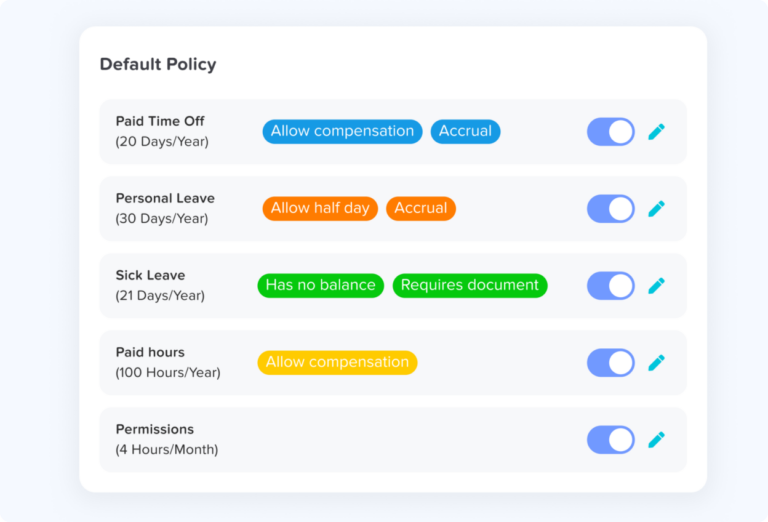
Some employers combine vacation, personal time and ordinary illness into one PTO bank. Others maintain separate balances for:
- Vacation
- Sick leave
- Personal leave
- Bereavement
- Parental leave
- Floating holidays
- Compensatory leave
- Volunteer leave
- Other company-specific absences
A combined PTO policy gives employees greater flexibility because they may not need to explain whether an absence is for vacation, illness or a personal appointment. Separate balances provide more control and may make it easier to protect legally required sick leave from being used for unrelated purposes.
The handbook should also state which absences are not deducted from general PTO. Examples may include public holidays, jury duty, military leave, approved unpaid leave or another separately administered benefit.
Suggested handbook wording
PTO may be used for vacation, personal needs and other approved absences. Statutory sick leave, bereavement leave, jury duty and other leave programs may be administered separately where required by law or company policy.
Who Is Eligible for PTO?
Employees should not have to guess whether the policy applies to them.
The FAQ should explain eligibility for:
- Full-time employees
- Part-time employees
- Temporary employees
- Seasonal employees
- Interns
- Hourly employees
- Salaried employees
- Remote employees
- Employees working in different countries or states
The Fair Labor Standards Act does not define whether an employee is full-time or part-time for purposes of receiving PTO. Employers generally establish those classifications through their policies, subject to applicable laws and agreements.
A company may provide one annual entitlement to full-time employees and a prorated amount to part-time employees. Another employer may provide PTO only after employees meet a minimum weekly-hours threshold.
The policy should use measurable eligibility rules. Phrases such as “regular employees receive PTO” are unclear unless the handbook also defines what “regular” means.
When Does PTO Eligibility Begin?
The handbook should distinguish between three dates:
- The date the employee becomes covered by the policy
- The date PTO begins accruing
- The date the employee may begin using the balance
These dates do not always have to be the same.
For example, an employee may begin accruing leave on the hire date but may be required to complete a 60-day waiting period before using it. Another policy may begin accrual only after the employee completes probation.
The policy should clearly explain whether a waiting period affects:
- Accrual
- Leave usage
- Both accrual and usage
- Only selected leave types
Eligibility restrictions should also be reviewed against protected-leave requirements. An employee who has not yet qualified for company PTO may still have rights under another law. For example, the EEOC explains that an employer may need to consider unpaid leave as a reasonable accommodation for an employee with a disability, even when the employee is not yet eligible under the employer’s ordinary leave policy, unless the accommodation would create an undue hardship.
Is PTO Front-Loaded or Accrued?
Employees should know whether they receive their full allowance at the beginning of the leave year or earn it gradually.
Front-loaded PTO
Under a front-loaded policy, the employee receives a defined balance at the start of the policy year, calendar year or employment anniversary.
For example:
An eligible employee receives 120 PTO hours on January 1.
This method is easy to understand, but the handbook should address what happens when an employee starts or leaves during the year.
Accrued PTO
Under an accrual policy, employees earn leave in smaller amounts over time.
PTO may accrue:
- Weekly
- Biweekly
- Semimonthly
- Monthly
- Quarterly
- Annually
- For each eligible hour worked
For example, an employee entitled to 120 hours annually might accrue approximately 4.62 hours during each of 26 biweekly periods.
The handbook should include the accrual frequency and explain when the new amount becomes visible in the employee’s balance. Day Off can automate fixed and recurring accrual rules for individual leave types and show employees their current and upcoming balances.
How Is PTO Calculated for New Employees?
A handbook should explain whether a new employee receives:
- The full annual balance
- A prorated balance
- Accrual only for completed pay periods
- Accrual beginning on the hire date
- Accrual beginning after a waiting period
- A balance based on eligible hours worked
Consider an employee hired on July 1 under a calendar-year policy that provides 120 hours annually. Depending on the policy, the employee might receive:
- 120 hours
- 60 prorated hours
- Accrual beginning with the first full pay period
- No usable balance until probation ends
The handbook should identify the company’s method rather than simply saying that new employees receive a “prorated allowance.” It should explain whether proration uses calendar days, workdays, full months or pay periods.
How Can Employees Check Their PTO Balance?
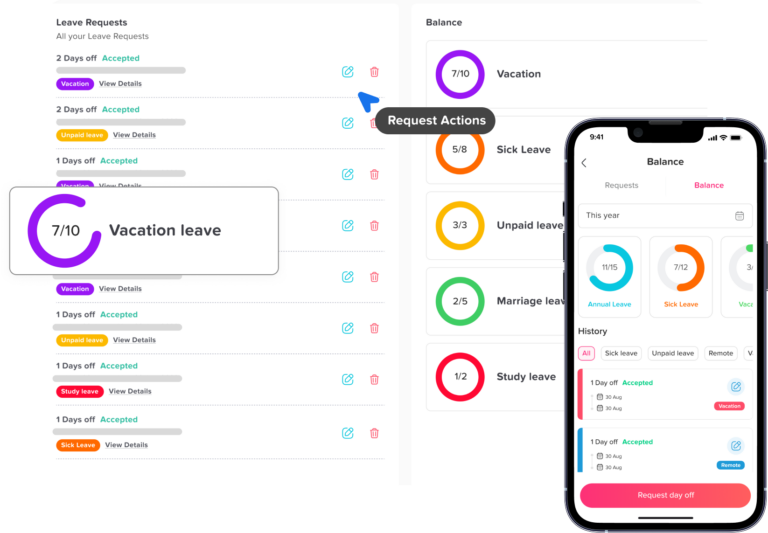
The policy should tell employees where to find their:
- Current available balance
- Pending requests
- Approved future leave
- Accrued leave
- Used leave
- Carryover balance
- Expiring balance
- Next scheduled accrual
Employees should also know whom to contact if the balance appears incorrect.
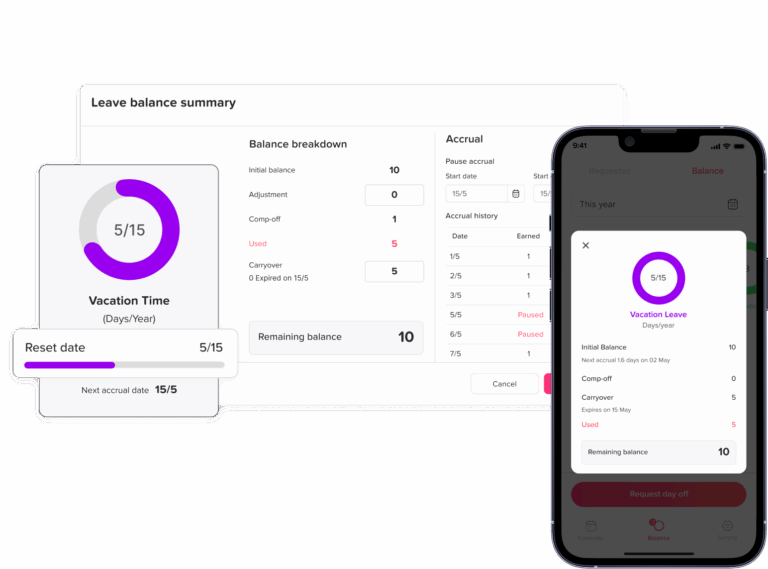
A clear balance display helps prevent employees from submitting requests based on an outdated total. Day Off allows employees to view policy details, current balances, carryover and expiry information through self-service access.
Suggested handbook wording
Employees are responsible for reviewing their available balance before submitting a request. A displayed balance may change when pending requests, adjustments, carryover or future accruals are processed.
How Should Employees Request PTO?
The handbook should describe the complete submission process.
It should explain:
- Which system or form employees must use
- Whether verbal requests are accepted
- What information must be included
- Whether a reason is required
- Whether documents may be requested
- Whether employees must arrange coverage
- How employees check the request status
A request should not be considered approved merely because it was mentioned in a conversation, added to a personal calendar or included in a team message.
Suggested handbook wording
Employees must submit PTO through the company’s designated leave-management system. A request is not approved until the employee receives confirmation from an authorized approver.
How Much Notice Is Required?
A strong PTO policy separates foreseeable and unexpected absences.
For planned vacations, the employer may require notice such as:
- Two working days
- One week
- Two weeks
- Thirty calendar days
For an unexpected illness or emergency, advance notice may not be possible. The policy should explain the call-in or notification procedure that applies in those situations.
The notice period may also vary according to the length of the request. For example:
| Request Duration | Example Notice Requirement |
|---|---|
| Less than one day | As early as reasonably possible |
| One or two days | At least three working days |
| Three to five days | At least two weeks |
| More than five days | At least thirty days |
These are policy examples, not universal legal requirements.
The handbook should avoid treating every late request as misconduct automatically. The reason may involve an emergency, protected sick leave, FMLA or another circumstance that requires separate review.
Day Off policies can include a minimum notice period so employees see the restriction before submitting a planned request.
Who Approves PTO Requests?
Employees should know whether requests are approved by:
- The direct manager
- A department manager
- HR
- A location manager
- Multiple approvers
- A two-step approval chain
- An alternative approver when the usual manager is absent
The FAQ should also explain what happens when the assigned approver is unavailable or leaves the company.
Without a backup process, a request may remain pending until the proposed leave dates have already passed.
Recommended policy rule
Requests should be reviewed within a defined number of working days. When the assigned approver is unavailable, the request may be reassigned to an authorized substitute or HR administrator.
How Are PTO Requests Evaluated?
The handbook should tell employees which factors managers may consider.
Common factors include:
- Minimum staffing requirements
- Previously approved leave
- Business deadlines
- Required employee skills
- Seasonal demand
- Number of employees already absent
- Request timing
- Availability of qualified coverage
The policy should also state how competing requests are prioritized. Possible methods include:
- First submitted
- First approved
- Rotating priority
- Seniority
- Business need
- Manager discretion using documented criteria
No single method fits every organization, but the employer should avoid changing the rule depending on the employee making the request.
Protected leave should not be treated as an ordinary discretionary vacation request. Managers should send medical, family, disability, military and other potentially protected absences to HR for appropriate review.
Can a PTO Request Be Denied?
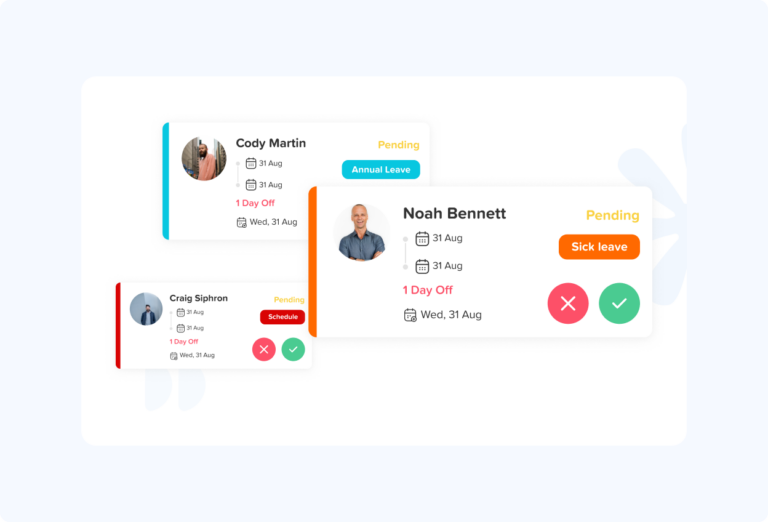
A request may be denied when the employee does not meet the policy rules or when approving the request would create a legitimate staffing or operational problem.
Possible reasons include:
- Insufficient balance
- Failure to meet the normal notice period
- A blockout period
- Too many employees already absent
- Missing required information
- The request exceeds the permitted duration
- The employee is not eligible for the selected leave type
The handbook should explain that a denial should not be based on favoritism, retaliation or another prohibited reason.
Managers should provide a clear response and, where practical, suggest alternative dates. A written record of the decision can help HR review patterns and resolve disputes.
Can Employees Take Half-Day or Hourly PTO?
The policy should state whether employees may request:
- Full days
- Half days
- Specific hours
- Minimum increments such as 15 minutes, 30 minutes or one hour
This question is especially important for appointments, school events, partial shifts and employees with nonstandard schedules.
The handbook should explain how a partial-day request affects the employee’s balance. An employee scheduled to work ten hours should not automatically have the same deduction as an employee scheduled to work eight hours.
For exempt employees, deducting hours from a PTO bank is different from reducing salary. Federal guidance permits employers to deduct from an exempt employee’s accrued leave account according to a leave policy without necessarily affecting the salary-basis test. However, deductions from guaranteed salary for partial-day absences are generally restricted, subject to specific exceptions.
Are Weekends Deducted From PTO?
The handbook should explain whether the request duration is based on:
- Calendar days
- Scheduled working days
- A fixed Monday-to-Friday workweek
- The employee’s individual work schedule
Normally, a day the employee was not scheduled to work should not reduce a balance unless the policy clearly uses calendar-day leave for a specific reason.
For example, an employee requesting Friday through Monday may use:
- Two PTO days when scheduled Monday through Friday
- Four leave days under a calendar-day policy
- A different amount when scheduled to work Saturday or Sunday
The same rule should be applied consistently to employees with rotating, compressed or part-time schedules.
What Happens When a Public Holiday Falls During PTO?
The policy should state whether an official holiday:
- Is excluded from the PTO deduction
- Is included in the leave period
- Depends on the employee’s location
- Depends on whether the employee was scheduled to work
- Depends on the specific leave type
For example, if an employee requests a full week containing a paid company holiday, the employer may deduct four PTO days instead of five.
Multi-location employers should assign the correct holiday calendar to each employee. An employee in one country or state may observe a different public holiday from another employee.
Are There PTO Blockout Dates?
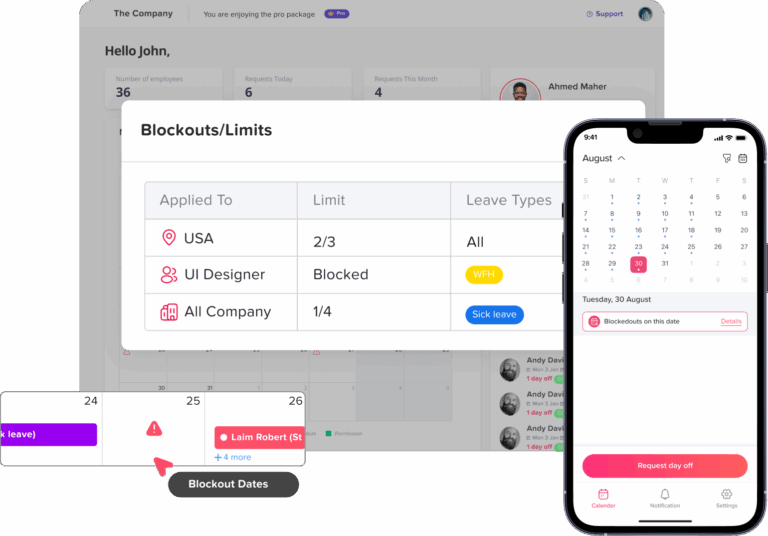
A blockout period is a date or range during which vacation requests are restricted because the business expects high demand, limited coverage or an important operational event.
The handbook should explain:
- Which dates are blocked
- Which leave types are affected
- Whether the restriction is company-wide
- Whether it applies only to selected teams or locations
- Whether emergency or protected leave is handled separately
- Whether administrators may approve exceptions
- Whether the company completely blocks requests or limits the number approved
Day Off can apply blockout dates across the company or to selected groups and can either prevent requests or limit how many employees may be absent.
A blockout policy should not imply that legally protected leave will automatically be denied.
Can Employees Use More PTO Than They Have Earned?
A negative balance policy allows an employee to use future PTO before it has been earned.
The handbook should answer:
- Whether negative balances are permitted
- The maximum negative amount
- Which employees are eligible
- Whether manager approval is required
- How future accruals repay the balance
- What happens if employment ends before repayment
For example, an employee with four available hours might be permitted to submit an eight-hour request, creating a balance of negative four hours.
State wage-deduction and vacation-pay rules may affect whether an employer can recover an outstanding balance from final wages. Employers should not assume that a handbook sentence automatically authorizes a payroll deduction.
Day Off allows negative balance rules to be configured separately for each leave type.
Does Unused PTO Carry Over?
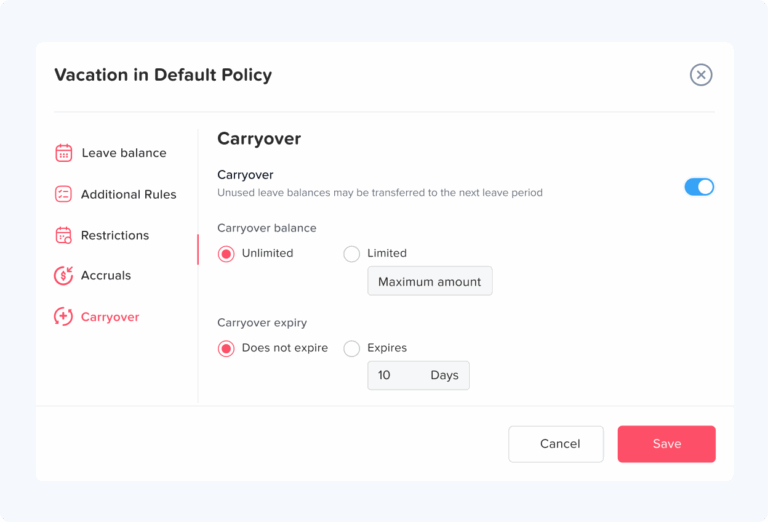
The handbook should clearly distinguish between carryover, expiration and an accrual cap.
Carryover
Unused PTO moves into the next policy period.
Expiration
Unused PTO is removed after a defined date where permitted.
Accrual cap
The employee stops earning additional PTO after reaching a maximum balance but retains the balance already earned.
A policy may combine these rules. For example:
Employees may carry over up to 40 hours. Carried-over hours expire on March 31, and the total balance may not exceed 160 hours.
State laws can limit use-it-or-lose-it rules. California, for example, treats earned vacation as vested wages and does not permit forfeiture of earned vacation, although reasonable accrual caps may be used.
The handbook should state:
- The carryover maximum
- The reset date
- Whether carried-over hours expire
- Which balance is deducted first
- What happens when the employee reaches the cap
When Does the PTO Balance Reset?
Employees should know whether balances reset according to:
- The calendar year
- The company’s fiscal year
- A specific month
- The employee’s hire-date anniversary
- A separate date for each leave type
The reset date affects accruals, carryover, expiration and requests that span two policy periods.
For example, if a request begins on December 29 and ends on January 3, the policy should explain whether the December dates use the old-year balance and the January dates use the new-year entitlement.
Day Off supports leave balance resets and tracks how carryover affects the balance when a new cycle begins.
Can Approved PTO Be Cancelled or Changed?
The handbook should explain whether:
- Employees may cancel pending requests
- Employees may cancel approved requests
- Managers must approve date changes
- The balance is restored automatically
- Payroll must correct a processed absence
- The employer may cancel approved leave because of an emergency
Cancelling approved leave can create significant disruption for employees who have booked travel, childcare or other commitments. The employer should define the limited circumstances under which it may withdraw approval and who has authority to make that decision.
When dates change after payroll has been processed, HR may need to correct the leave record, attendance record and wages separately.
What Happens if an Employee Becomes Sick During Vacation?
The handbook should state whether vacation may be changed to sick leave when an employee becomes ill during approved PTO.
Possible rules include:
- The original vacation designation remains unchanged.
- The employee may request reclassification with medical documentation.
- Reclassification is permitted only where required by law.
- The employee may use sick leave for qualifying dates but must notify HR promptly.
A combined PTO bank may make reclassification unnecessary because the same balance covers both purposes. Separate vacation and sick leave policies require clearer rules.
Employers should also check whether state or local paid sick leave laws affect the employee’s right to use protected sick time.
Does PTO Run at the Same Time as FMLA Leave?
It may.
The FMLA generally provides eligible employees of covered employers with unpaid, job-protected leave for qualifying family and medical reasons. An employee may elect, or the employer may require, available paid leave to run concurrently with FMLA leave when the employee follows the employer’s normal paid-leave rules.
The handbook should explain:
- Whether the employer requires PTO substitution
- Which paid balances may be used
- Whether the employee may reserve any balance
- How intermittent leave is deducted
- That paid leave and FMLA are tracked separately
- That using PTO does not create extra FMLA entitlement
For example, an employee using two weeks of PTO during an FMLA-qualified absence may receive pay for those two weeks while the same two weeks count against the available FMLA entitlement.
Managers should not decide FMLA eligibility themselves. Potentially qualifying requests should be referred to HR.
What if an Employee Needs Leave After PTO Is Exhausted?
Exhausting PTO does not always end the leave analysis.
An employee may still qualify for:
- Unpaid FMLA leave
- State family or medical leave
- Disability-related leave
- Pregnancy-related accommodation
- Military leave
- Workers’ compensation leave
- Another protected absence
The EEOC explains that an employer may need to consider unpaid leave as a reasonable accommodation for a disability even when the employee has exhausted the leave normally provided, unless additional leave would create an undue hardship. A maximum-leave policy should therefore include an exception process rather than automatically terminating every employee who reaches the limit.
Leave may also be a reasonable accommodation under the Pregnant Workers Fairness Act when requested for a known limitation related to pregnancy, childbirth or a related medical condition, unless it creates an undue hardship.
Suggested handbook wording
Employees who need additional leave after exhausting available PTO should contact HR. Additional unpaid or protected leave may be available depending on the circumstances and applicable law.
Does PTO Count Toward Overtime?
Under federal rules, paid vacation, sick leave and other paid time off generally do not count as hours worked when calculating whether a nonexempt employee worked more than 40 hours during a workweek.
For example:
| Time Category | Hours |
|---|---|
| Hours actually worked | 36 |
| PTO hours | 8 |
| Total paid hours | 44 |
| Federal overtime hours | 0 |
The employee receives pay for 44 hours but has only 36 hours worked for the federal overtime calculation.
A state law, collective bargaining agreement or more generous company policy may produce a different result. The handbook should state whether the employer counts paid leave toward overtime beyond what federal law requires.
How Does PTO Work for Exempt Employees?
Exempt employees may still have PTO balances and may be required to request absences through the normal process.
An employer may generally reduce an exempt employee’s PTO bank for a partial-day absence without necessarily violating the federal salary-basis requirement. However, reducing the employee’s guaranteed salary for a partial-day personal absence is generally not permitted, except in specific circumstances such as qualifying unpaid FMLA leave.
The handbook should distinguish between:
- Deducting hours from the PTO balance
- Deducting money from salary
- Recording the absence
- Applying attendance rules
These are separate actions.
Can Employees Use PTO During Military Leave?
Employees performing uniformed service must be permitted, at their request, to use vacation leave accrued before military service. Employers generally cannot require employees to use that vacation instead of taking unpaid military leave.
USERRA may also affect whether leave benefits continue to accrue during military service. The employee must receive the same nonseniority rights and benefits provided to similarly situated employees on comparable nonmilitary leaves.
The handbook should direct military-leave questions to HR instead of treating them as ordinary vacation requests.
Can Employees Use PTO for Jury Duty?
The FLSA does not require private employers to pay employees for time not worked because of jury duty. However, some state laws require paid or protected jury-duty leave.
The handbook should explain:
- Whether jury-duty leave is paid
- Whether employees must use PTO
- Whether the company pays the difference between regular wages and jury fees
- What documentation is required
- Whether employees must return to work when released early
- Whether state-specific rules apply
Jury duty should normally have its own policy section because it involves civic obligations and location-specific requirements.
Is PTO Paid Out When Employment Ends?
There is no single nationwide rule requiring every private employer to pay all unused PTO at separation. The answer may depend on:
- State law
- The wording of the employer’s policy
- Whether the balance is considered earned or vested
- The reason for separation
- The type of leave
- An employment or collective bargaining agreement
California requires earned and accrued vacation to be paid at the employee’s final rate when employment ends, unless a qualifying collective bargaining agreement provides otherwise.
Other jurisdictions may permit a clearly written policy to limit or deny payout.
The handbook should explain:
- Which balances are paid
- Which balances are excluded
- Whether payout differs for resignation and termination
- Whether advance notice is required
- Which pay rate is used
- How a negative balance is handled
The policy should be reviewed in every location where employees work.
Can Employees Use PTO During a Resignation Notice Period?
The handbook should state whether employees may:
- Submit new PTO requests after resigning
- Use previously approved PTO
- Use PTO to shorten the notice period
- Receive payout instead of taking leave
- Be required to complete a minimum handover period
An employer may restrict discretionary vacation during a notice period, subject to applicable law and existing approvals. However, the employer should not use a general restriction to deny protected sick leave, FMLA, disability accommodation or another legally protected absence automatically.
The policy should also explain whether approved PTO extends the official termination date.
Can the Company Change the PTO Policy?
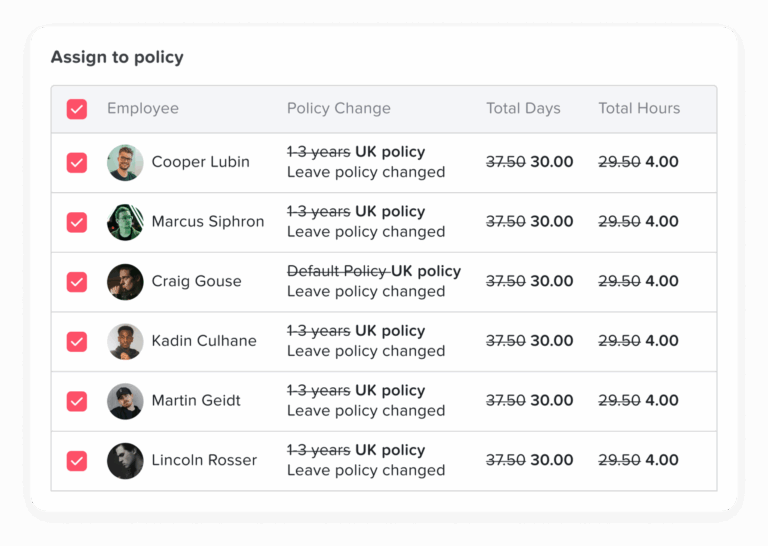
Employers may need to update a PTO policy because of legal changes, operational needs, payroll changes or benefit redesign.
The handbook should explain:
- Who may amend the policy
- When changes take effect
- How employees will be notified
- Whether already-earned balances are protected
- Whether employees are grandfathered under an old rule
- How pending and approved requests are treated
- Whether the change affects the current or next policy year
State law may restrict retroactive reductions or forfeiture of earned vacation. Policy changes should generally apply prospectively after appropriate review and communication.
Employees should receive more than a silent handbook update. A written notice should summarize the old rule, new rule, effective date and effect on current balances.
What Should Employees Do if Their PTO Balance Is Wrong?
The FAQ should provide a correction process.
Employees should know how to report:
- A missing accrual
- An incorrect deduction
- A request counted twice
- A holiday deducted incorrectly
- An incorrect carryover
- An expired balance that should remain available
- An adjustment made by the wrong manager
- An incorrect policy assignment
HR should preserve:
- The original balance
- The corrected balance
- The reason
- Supporting records
- The person who approved the correction
- The effective date
- Any payroll impact
Day Off provides balance, accrual and carryover reports that can help HR compare an employee’s policy, current balance, used leave and upcoming accruals.
PTO Policy FAQ Checklist
Before publishing the employee handbook, review the following questions:
| Policy Area | Question the Handbook Should Answer |
|---|---|
| Definition | What does PTO cover? |
| Eligibility | Which employee groups receive PTO? |
| Waiting period | When does accrual and usage begin? |
| Entitlement | How much PTO does each employee receive? |
| Accrual | How and when is PTO earned? |
| Proration | How are midyear hires handled? |
| Balance | Where can employees see available PTO? |
| Requests | How must employees submit leave? |
| Notice | How far in advance should employees apply? |
| Approval | Who reviews and approves requests? |
| Decision rules | How are competing requests prioritized? |
| Partial leave | Are hourly and half-day requests allowed? |
| Holidays | Are public holidays deducted? |
| Work schedules | Are weekends and nonworking days excluded? |
| Blockouts | Which dates have request restrictions? |
| Negative balance | Can employees use future PTO? |
| Carryover | How much unused PTO moves forward? |
| Expiration | Can unused or carried-over leave expire? |
| Cap | When does accrual pause? |
| Cancellation | Can approved leave be changed? |
| Protected leave | How does PTO interact with FMLA and accommodations? |
| Overtime | Does paid leave count as hours worked? |
| Separation | Is unused PTO paid out? |
| Notice period | Can PTO be used after resignation? |
| Corrections | How are balance errors reported and fixed? |
| Policy changes | How will employees be notified of updates? |
Common Employee Handbook PTO Mistakes
Using vague eligibility language
Terms such as “regular,” “permanent” or “active” employees should be defined.
Describing an accrual without the formula
Employees should know the frequency, rate, start date and cap.
Treating every absence as discretionary vacation
Medical, military, pregnancy, jury-duty and family-leave requests may require a separate legal review.
Omitting payout rules
Employees frequently expect unused PTO to be paid when the handbook is silent.
Combining PTO with statutory sick leave without reviewing local law
A general PTO bank must still satisfy any applicable paid sick leave requirements.
Allowing managers to create their own approval criteria
The same written standards should apply across teams.
Failing to explain how schedules affect deductions
Employees working four 10-hour days, rotating shifts or part-time schedules need to know how much leave a missed shift requires.
Publishing rules that do not match the system
If the handbook promises monthly accrual on the first day of the month, the leave system should not post balances on the final day of the pay period.
Applying a maximum-leave rule automatically
Employees may need additional unpaid leave as a reasonable accommodation or under another protected-leave law.
How to Make a PTO Policy Easy to Understand
A legally reviewed policy can still be difficult for employees to use. Improve clarity by:
- Writing in plain language
- Defining technical terms
- Providing calculation examples
- Showing screenshots of the request process
- Including a short approval timeline
- Explaining whom to contact
- Giving separate examples for hourly and salaried employees
- Linking to detailed sick, FMLA and accommodation policies
- Translating the policy where appropriate
- Reviewing the FAQ during onboarding
The handbook should provide the core rule, while a knowledge base or internal HR portal can provide step-by-step instructions and examples.
How Day Off Helps Apply PTO Policies Consistently
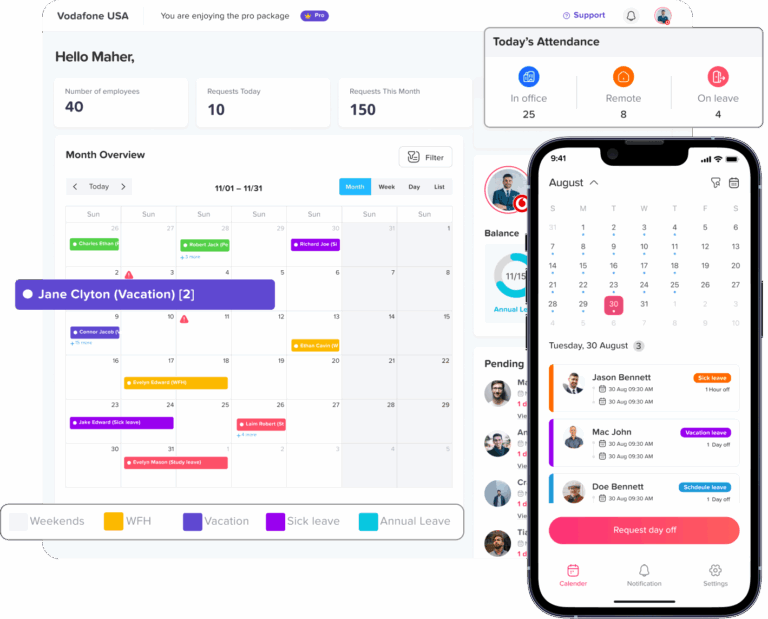
A written policy is useful only when the company can apply it consistently.
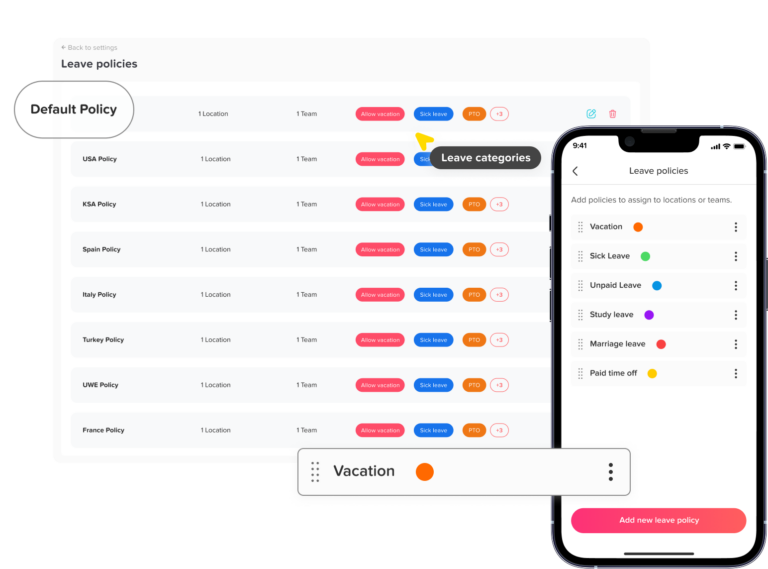
Day Off allows employers to create different leave policies and configure:
- Fixed or accrued balances
- Custom leave types
- Carryover rules
- Balance expiry
- Negative balances
- Probation restrictions
- Half-day requests
- Notice periods
- Blockout dates
- Approval workflows
- Holiday calendars
- Team and location assignments
Employees can submit requests, view balances and check policy details through self-service access. Managers can review requests and team availability, while HR can use balance, accrual and carryover reports to identify discrepancies.
The system configuration should follow the final, legally reviewed handbook. When the policy changes, HR should update the written FAQ, employee communication and system settings together.
Frequently Asked Questions About Employee Handbook PTO Policies
Is an employer required to provide PTO?
Federal law does not generally require private employers to provide paid vacation, paid sick leave or holidays. State and local laws may require paid sick leave or regulate employer-provided vacation and PTO.
Can an employer deny a PTO request?
An employer may generally deny discretionary vacation based on a consistently applied policy and legitimate operational needs. However, requests connected to FMLA, disability, pregnancy, military service, statutory sick leave or another protected reason require separate review.
Can an employer change an approved PTO request?
The handbook may reserve the right to cancel approved vacation in limited operational emergencies. The policy should identify who may do so and whether the company reimburses nonrefundable expenses. Protected leave should not be cancelled as if it were ordinary vacation.
Can employees lose unused PTO?
The answer depends on the policy and state law. Some jurisdictions allow properly communicated expiration rules, while others protect earned vacation from forfeiture. California treats earned vacation as vested wages and does not permit use-it-or-lose-it forfeiture.
Can an employer require employees to use PTO during FMLA?
An employer may require available paid leave to run concurrently with unpaid FMLA leave when the employee follows the employer’s normal leave-policy requirements.
Does PTO count as hours worked for overtime?
Under federal rules, paid vacation, sick leave and holidays generally do not count as hours worked for determining whether a nonexempt employee exceeded 40 hours in a workweek.
Can salaried employees have PTO deducted for partial days?
An employer may generally deduct from an exempt employee’s PTO bank according to the policy. Deducting from the employee’s guaranteed salary for a partial-day absence is generally restricted under the federal salary-basis rules, subject to specific exceptions.
What happens after an employee exhausts PTO?
The employee may move to unpaid status, but HR should first determine whether FMLA, a disability accommodation, pregnancy accommodation, military leave or another protected leave requirement applies.
Should a PTO policy be the same in every state?
Not necessarily. State and local rules can differ regarding paid sick leave, carryover, notice, documentation, payout and forfeiture. Multi-state employers may need a general company policy with location-specific supplements.
How often should a PTO policy be reviewed?
A practical approach is to review the policy at least annually and whenever the company enters a new location, changes payroll systems, restructures leave benefits or learns of a legal change. HR should also review the policy when reports show frequent balance corrections, delayed approvals or inconsistent usage between teams.
Conclusion
A PTO section in an employee handbook should not be limited to a balance and a request form.
Employees need clear answers about eligibility, accruals, waiting periods, notice, approvals, partial-day leave, holidays, carryover, expiration, overtime, protected leave and separation. Managers need consistent decision rules, while HR and payroll need calculations that match the written policy.
The most effective PTO policy FAQ uses plain language, includes realistic examples and directs protected-leave questions to HR. It also explains what happens when ordinary rules do not fit the situation, such as when an employee exhausts PTO, needs disability-related leave or works in a state with different vacation-pay requirements.
Day Off helps employers turn written PTO rules into consistent system settings, employee balances, approval workflows, calendars and reports. When the handbook and leave-management system match, employees receive clearer answers and HR spends less time correcting preventable errors.