







A clear Time Tracking Policy becomes increasingly important as a company grows, especially when paid time off, employee schedules, attendance, and payroll all depend on accurate working-hour records. What may work for a team of five people, such as sending vacation requests through chat and manually entering hours into a spreadsheet, can quickly become unreliable when the company expands across departments, work schedules, locations, and employment types.

The challenge is not simply deciding how employees should clock in and out. A growing company also needs clear rules for how PTO is earned, requested, approved, deducted, carried over, and recorded alongside actual working hours. Without those rules, managers may interpret policies differently, employees may be unsure about their balances, and HR or payroll teams can spend hours correcting records.
An effective PTO and time tracking policy creates one consistent framework for answering questions such as:
- Who needs to track working hours?
- When does paid working time begin and end?
- How are breaks recorded?
- How far in advance should vacation be requested?
- How are partial day absences handled?
- How much PTO should be deducted when an employee works an irregular schedule?
- What happens when an employee forgets to clock out?
- Does PTO count toward overtime calculations?
- Who can approve or modify time and leave records?
- How should remote employees record their time?
- What happens to unused PTO at the end of the year or when employment ends?
These decisions become more important, not less important, as headcount increases. The goal of this guide is to help growing companies build a policy that is clear enough for employees to follow, structured enough for managers to apply consistently, and flexible enough to continue working as the organization expands.
Why PTO and Time Tracking Policy Should Be Planned Together
Companies often create their PTO and Time Tracking Policy rules separately. In practice, however, the two systems constantly interact.
Consider an employee who is scheduled to work eight hours but takes three hours of PTO in the afternoon. The company’s records need to distinguish between:
- Hours actually worked
- PTO hours
- Scheduled hours
- Overtime hours
- Break time
- Any other paid or unpaid absence
If leave management and Time Tracking Policy operate independently, HR may have to reconcile these records manually.
The same issue appears with flexible schedules, rotating shifts, part-time employees, hourly PTO, overnight shifts, and employees working different weekly schedules.
A better approach is to create one operating framework that defines how scheduled time, worked time, and leave time relate to one another.
For example:
Scheduled hours – approved leave – unpaid absence = expected working hours
Actual working hours can then be compared with expected hours to identify late arrivals, early departures, overtime, missed punches, or attendance exceptions.
This creates a much more reliable foundation for attendance management and payroll.
Start With the Purpose of the Policy
Before deciding how many vacation days employees receive or how they should clock in, establish what the policy is designed to accomplish.
A growing company’s policy may have several objectives:
- Accurately record employee working hours
- Create consistent leave rules across teams
- Give employees visibility into PTO balances
- Establish predictable approval procedures
- Reduce payroll corrections
- Maintain reliable attendance records
- Support workforce planning
- Define responsibilities for employees and managers
- Protect employees from inconsistent treatment
- Maintain legally required employment records
- Provide reliable data for HR and management reporting
Include a short purpose statement near the beginning of the policy.
For example:
This policy establishes the company’s procedures for recording working time, requesting paid time off, managing attendance records, and approving changes to employee time and leave records. Its purpose is to maintain accurate records and provide employees and managers with a consistent process for managing working time and absences.
The policy should then explain who it covers.
Define Who the Policy Applies To
Not every employee necessarily needs to follow identical rules.
A growing company may have:
- Full time employees
- Part time employees
- Hourly employees
- Salaried employees
- Exempt employees
- Nonexempt employees
- Remote employees
- Hybrid employees
- Office employees
- Shift workers
- Temporary workers
- Contractors
Your policy should clearly distinguish between groups when the rules differ.
For example, nonexempt employees may be required to record every working period because their hours are used for wage and overtime calculations. Salaried exempt employees may still record attendance, leave, or project time, but the purpose of their records may be different.
Do not use one generic sentence such as “all employees must track time” without explaining what that means for different employee classifications.
Instead, define:
- Who records clock-in and clock-out times
- Who records task or project time
- Who records breaks
- Who submits timesheets
- Who is eligible for PTO
- Whether contractors use the same system
- Whether managers have different approval responsibilities
This becomes particularly important as companies introduce new roles and employment arrangements.
Choose the Structure of Your PTO Policy
One of the first decisions is how employees receive paid time off.
Companies commonly use either a combined PTO bank or separate leave categories.
Combined PTO bank
Vacation, personal time, and sometimes sick leave are combined into one balance.
An employee may receive, for example, 120 PTO hours that can be used for multiple types of absence.
The advantage is simplicity. Employees generally have more control over how they use their available days.
However, companies must verify whether local sick leave or other statutory leave rules require separate Time Tracking Policy or protections.
Separate leave balances
The company creates different balances for:
- Vacation
- Sick leave
- Personal leave
- Bereavement
- Parental leave
- Volunteer leave
- Compensatory time
- Other company specific leave
This structure provides more detailed reporting and allows different rules to apply to different types of leave.
For example, vacation might require advance notice while sick leave typically cannot.
Neither structure is automatically better. The right model depends on the company’s workforce, operating model, and applicable law.
Decide How PTO Is Granted
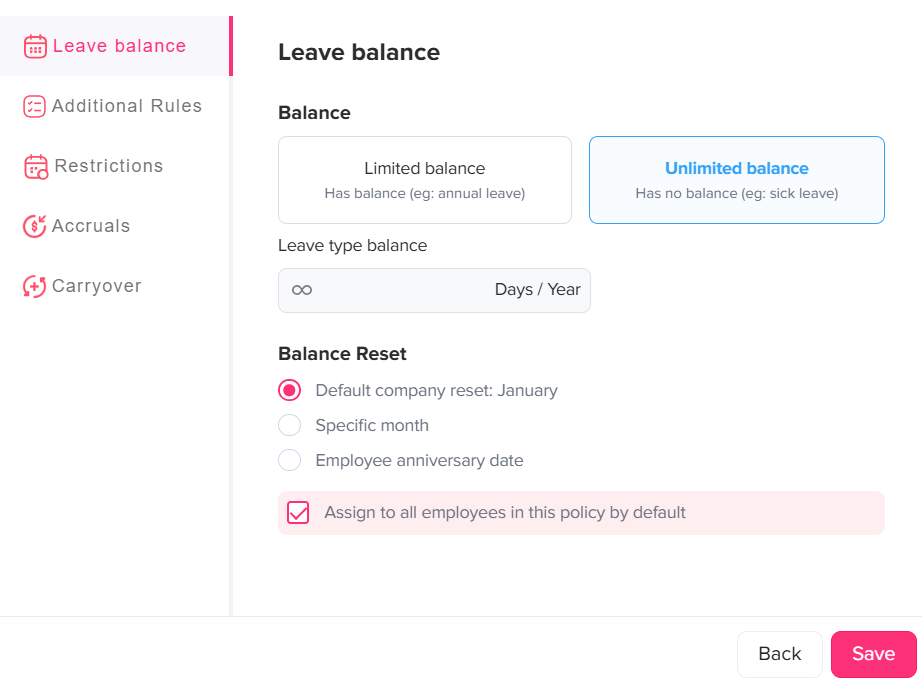
PTO can generally be provided through accrual or through a predetermined allocation.
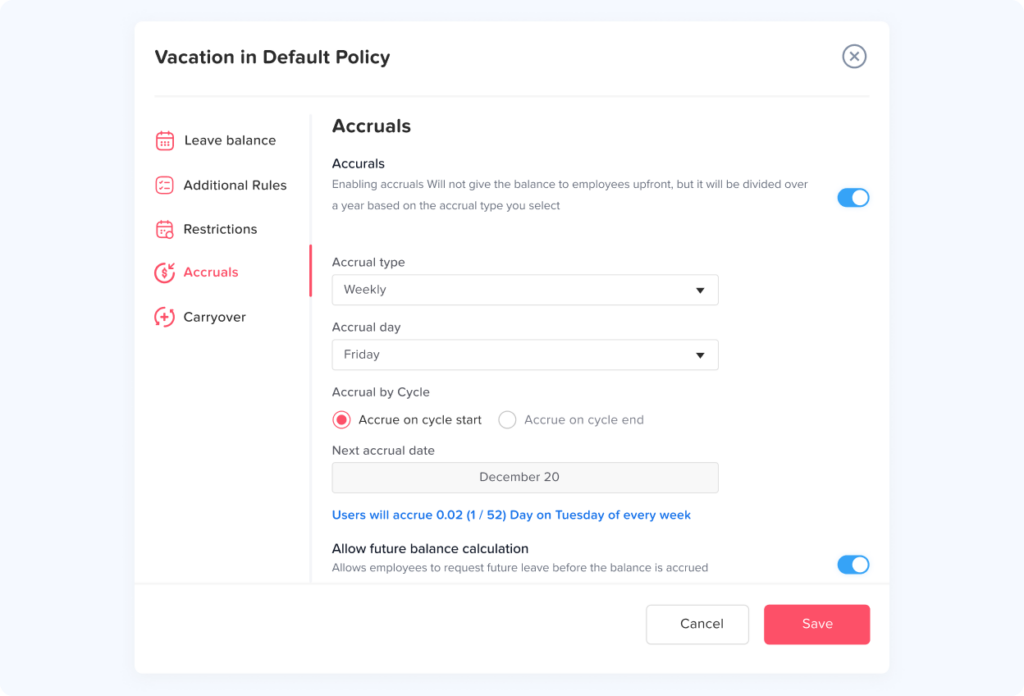
Accrued PTO
Employees earn leave gradually.
For example:
- 5 PTO hours each pay period
- 1 PTO hour for every 30 hours worked
- 10 hours per month
- 15 days annually accrued throughout the year
Accrual helps spread leave availability throughout the year and may reduce the risk of employees using an entire annual allowance immediately after receiving it.
When using accrual, define:
- Accrual frequency
- Accrual rate
- Maximum balance
- Whether part Time Tracking Policy employees accrue proportionally
- Whether accrual continues during unpaid leave
- Whether overtime hours affect accrual
- Whether employees can use leave before it is earned
Front loaded PTO
Another option is to provide the full annual allowance at the beginning of the policy year or another defined period.
For example:
January 1 balance: 120 PTO hours
The employee can then use that balance throughout the year.
Front loading is administratively simpler but requires clear rules regarding employees who join partway through the year.
For new hires, companies may prorate the balance according to the employee’s start date.
Document Every Important PTO Rule
A PTO policy becomes difficult to manage when major decisions exist only in the HR team’s knowledge.
Document the rules explicitly.
| Policy Area | Questions the Company Should Answer |
|---|---|
| Eligibility | Who receives PTO and when does eligibility begin? |
| Accrual | How quickly is PTO earned? |
| New hires | Is PTO prorated or subject to a waiting period? |
| Carryover | Can unused PTO move into the next year? |
| Balance cap | Is there a maximum amount employees can accumulate? |
| Minimum request | Can employees request one hour, half a day, or only full days? |
| Advance notice | How much notice is expected for planned leave? |
| Approval | Who approves requests? |
| Overlapping leave | How are multiple employees requesting the same dates handled? |
| Holidays | Are holidays deducted when they fall inside PTO periods? |
| Negative balance | Can an employee use more PTO than they have earned? |
| Cancellation | Can approved PTO be cancelled or changed? |
| Termination | How is unused PTO handled when employment ends? |
Avoid leaving these questions unanswered until a real employee situation forces a manager to make an immediate decision.
That usually creates inconsistent precedents.
Establish Clear Leave Request Procedures
Employees should know exactly how to request time off.
A standard process might be:
- Employee checks their available PTO balance.
- Employee selects the requested leave dates or hours.
- Employee chooses the appropriate leave type.
- Employee provides required information.
- The request is sent to the designated manager.
- The manager reviews staffing coverage and policy requirements.
- The request is approved or rejected.
- The employee receives confirmation.
- Approved leave appears on the company or team calendar.
- The balance is updated according to the company’s rules.
Avoid relying on verbal approvals.
If an employee asks a manager for vacation during a meeting and receives a verbal “yes,” there should still be an official request in the leave system.
That creates a reliable record for the employee, manager, HR team, and payroll team.
Separate Planned and Unplanned Leave Rules
Not every absence can follow the same notice requirements.
Vacation is usually foreseeable. Illness often is not.
Your policy should distinguish between them.
Planned PTO
For predictable absences such as vacation, the policy might require employees to submit requests a certain number of days in advance.
For example:
- 3 days’ notice for one PTO day
- 2 weeks’ notice for five consecutive days
- Manager approval before purchasing non-refundable travel
These are examples, not universal requirements. The company should establish rules appropriate for its operations and applicable laws.
Unplanned absences
Employees who become sick or experience an emergency may need to notify their manager as soon as reasonably possible.
The policy should explain:
- Who employees contact
- Which communication method to use
- Whether they must also submit a leave request
- When supporting documentation may be required
- How the absence will be recorded
Do not force unexpected sick leave through the same workflow as a vacation planned six months ahead.
Define How Partial-Day PTO Works
Partial day leave frequently causes confusion, particularly when the company tracks leave in days while payroll works in hours.
Suppose an employee works from 9:00 AM to 5:30 PM with a 30-minute unpaid break.
The employee’s scheduled work Time Tracking Policy is eight hours.
If the employee works from 9:00 AM until 1:00 PM and takes the remainder of the day as PTO, the system should determine exactly how much PTO is deducted.
Using hours instead of fractions of a day can make this easier for companies with variable schedules.
Instead of recording:
0.5 PTO day
the company can record:
4 PTO hours
This becomes particularly valuable when employees have different scheduled hours on different days.
Use the Employee’s Actual Schedule for PTO Deductions
Growing companies often move beyond a standard Monday-Friday, 9-to-5 schedule.
Employees may work:
- Four 10-hour days
- 9/80 schedules
- Flexible schedules
- Rotating shifts
- Split shifts
- Part-time schedules
- Different hours on different weekdays
In these situations, deducting a fixed eight hours for every PTO day can create inaccurate balances.
Consider two employees requesting Monday off.
Employee A is scheduled for eight hours.
Employee B is scheduled for ten hours.
If the company manages PTO in hours, the appropriate deductions may be:
- Employee A: 8 PTO hours
- Employee B: 10 PTO hours
The employee’s work schedule should therefore be connected to the leave calculation whenever possible.
Build the Time Tracking Policy Rules
Once PTO rules have been established, define how actual working Time Tracking Policy will be recorded.
A strong time tracking policy should answer five basic questions:
Who tracks Time Tracking Policy?
Define which employee groups must record working hours.
What should they track?
This may include:
- Clock-in time
- Clock-out time
- Breaks
- Projects
- Tasks
- Client work
- Overtime
- On-call time when applicable
Where should time be recorded?
Specify the official Time Tracking Policy system.
When must records be submitted?
For example, daily or at the end of each pay period.
Who reviews them?
Assign responsibility to employees, managers, HR, payroll, or a combination.
Define What Counts as Working Time Tracking Policy
This is one of the most important sections of a Time Tracking Policy.
Employees should understand that recorded working Time Tracking Policyshould reflect actual work, not only the hours they were originally scheduled.
For U.S. employers covered by the Fair Labor Standards Act, work that an employer “suffers or permits” an employee to perform can be compensable even if it was not specifically requested. The U.S. Department of Labor specifically notes that voluntarily continuing to work after a scheduled shift, such as finishing an assigned task, can still be compensable working time.
This is why policies such as the following can create problems:
Unauthorized overtime will not be paid.
A company may prohibit employees from working unauthorized overtime and address violations through its normal management procedures, but the time actually worked still needs to be accurately recorded and handled according to applicable wage laws.
A better operational rule is:
Employees must accurately record all working time. Employees should obtain required authorization before working overtime, but employees must never omit hours actually worked from their time record.
This separates two issues:
- Whether the employee followed the approval process.
- Whether the employee must be paid for compensable work performed.
Create Clear Clock In and Clock Out Rules
Your policy should specify when employees clock in and out.
For example:
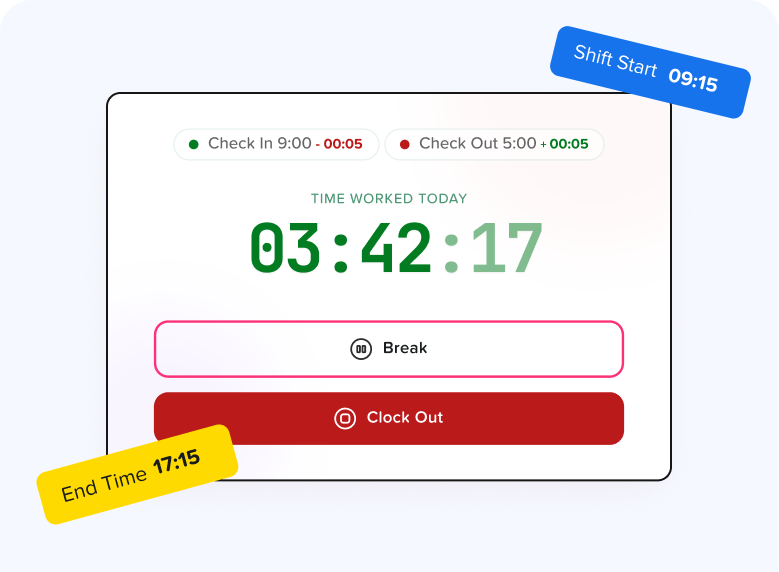
Employees should clock in when they begin performing work and clock out when they stop performing work.
Avoid creating incentives for employees to work before clocking in or after clocking out.
The policy should also address:
- Early clock ins
- Late clock outs
- Multiple shifts
- Split shifts
- Remote work
- Off site work
- Overnight shifts
- Business travel where applicable
- Training
- Meetings
- Required pre shift or post shift activities
The correct treatment of specific activities can depend on applicable wage laws, so companies should review unusual cases with qualified HR or legal professionals.
Establish Break Rules
Break rules can become complicated because legal requirements differ across jurisdictions.
Instead of assuming one break policy works everywhere, define:
- Which breaks employees receive
- Whether each break is paid or unpaid
- Whether employees clock out
- Minimum or expected break duration
- How missed or interrupted breaks are reported
- How employees correct an incorrectly recorded break
For remote employees, the same rules should generally be communicated just as clearly as they are for office employees.
Remote work should not mean informal timekeeping.
Establish a Missed Punch Procedure
Eventually, someone will forget to clock in or clock out.
A good policy assumes this will happen and provides a correction process.
For example:
- Employee identifies the missing or incorrect entry.
- Employee submits the correct start or end time.
- The correction is sent to the manager.
- The manager approves or rejects the edit.
- The original and updated values remain available in the audit history.
Employees should not be encouraged to invent approximate times simply to complete a timesheet.
The objective is an accurate record.
Repeated missed punches can be managed as an attendance or policy issue separately from the correction itself.
Create Rules for Editing Time Records
One of the most important controls in any growing company’s Time Tracking Policy system is determining who can change records.
Employees may need permission to correct their own mistakes, but unrestricted edits after manager approval or payroll processing can cause serious problems.
A better structure is role based.
| Action | Employee | Manager | HR/Admin |
|---|---|---|---|
| Clock in/out | Yes | Usually no | If correction is required |
| Submit missing time | Yes | Review | Review if necessary |
| Edit pending entry | Depending on policy | Yes | Yes |
| Approve employee hours | No | Yes | Yes |
| Modify approved hours | No | Limited | Yes |
| Approve PTO | No | Yes | Yes |
| Adjust PTO balance | No | Usually limited | Yes |
| View audit history | Own records | Team records | Company records |
The exact permissions will vary, but the principle should remain consistent:
The person whose pay or leave balance is affected should not be the only person controlling the final record.
Address Overtime Clearly
Overtime should never be an unwritten manager practice.
The policy needs to explain:
- Who is eligible for overtime
- Whether prior authorization is required
- How overtime is recorded
- Who approves it
- When overtime is reviewed
- Whether employees should report unrecorded working Time Tracking Policy immediately
For covered, nonexempt employees in the United States, the federal FLSA generally requires overtime at no less than one and one half times the regular rate after 40 hours of work in a workweek, although different rules and exceptions can apply in certain situations.
States and other jurisdictions may establish additional requirements.
A growing company should therefore avoid building its policy around the assumption that every employee or location follows the same overtime rule.
Define Whether PTO Counts Toward Overtime
Worked hours and paid hours are not always the same thing.
An employee could have:
- 32 hours actually worked
- 8 PTO hours
- 40 paid hours
For federal FLSA overtime purposes in the United States, paid vacation, holiday, and sick time when no work is performed generally do not need to be counted as hours worked when determining overtime.
Your system should therefore distinguish worked time from paid leave time.
Employers may offer policies that are more generous than legal minimums, but the rule should be documented so payroll calculations remain consistent.
Create a Policy for Remote and Hybrid Employees
Remote work makes accurate policies more important because managers cannot rely on physical presence to understand when work begins and ends.
Avoid policies based on constant monitoring.
Instead, focus on accurate work records.
Remote employees should know:
- When they are expected to be available
- How they clock in and out
- How breaks are recorded
- How overtime is approved
- How after-hours work is handled
- Whether task or project Time Tracking Policy is required
- How technical problems with the time system are reported
- Whether work across time zones changes the schedule
The objective is not to monitor every minute of an employee’s computer activity. It is to maintain reliable Time Tracking Policy records and clear expectations.
Connect PTO With Attendance
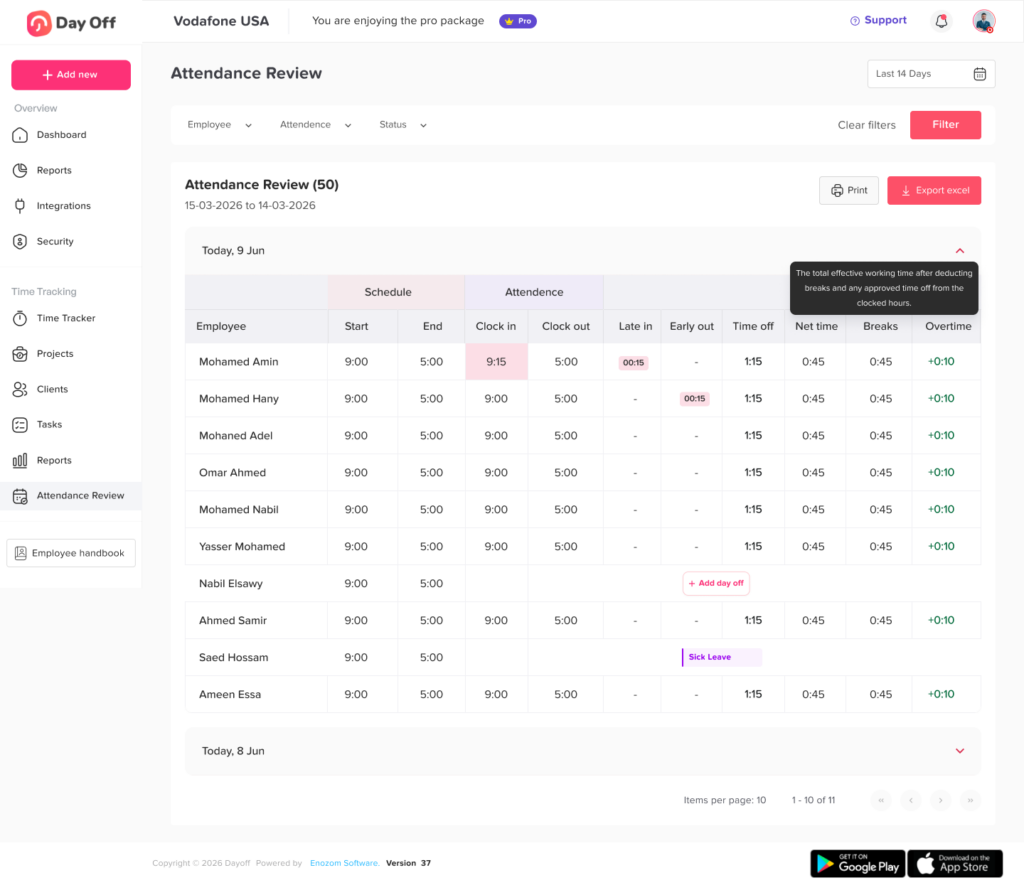
PTO and attendance should exchange information automatically whenever possible.
Suppose an employee is scheduled from 9:00 AM to 5:00 PM and has approved PTO for the entire day.
The attendance system should recognize the employee as On Leave, not Absent.
Likewise, if an employee has approved leave from 2:00 PM onward, the system should not incorrectly identify their scheduled departure as an early departure.
A reliable attendance record should consider:
Scheduled time + approved leave + actual working Time Tracking Policy
before assigning attendance statuses.
Without this connection, managers may receive false absence or lateness alerts.
Avoid Double Counting PTO and Working Hours
A common records problem occurs when an employee works during an approved PTO period.
For example, an employee has eight hours of vacation approved on Friday but later works two hours responding to an urgent request.
The company’s policy should explain what happens.
Depending on the organization’s rules, the record might be adjusted to:
- 2 worked hours
- 6 PTO hours
rather than:
- 2 worked hours
- 8 PTO hours
Otherwise, balances and payroll reports may no longer accurately reflect what occurred.
Employees should have a simple way to notify their manager when actual work conflicts with recorded leave.
Define Holidays Separately From PTO
Clarify whether company holidays are:
- Separate paid days
- Deducted from PTO
- Included in a combined annual allowance
- Dependent on employee location
- Dependent on work schedule
This becomes particularly important for companies operating internationally.
A public holiday in one employee’s country may be an ordinary workday for another.
Instead of maintaining one universal calendar, growing global companies may need holiday calendars by:
- Country
- State or region
- Office location
- Employee
The policy should also explain what happens when a public holiday occurs during a multi-day vacation.
Plan for Company Growth With Multiple Approval Levels
A five-person startup may only need one person approving leave.
That model rarely scales.
As the organization grows, approval responsibilities may be distributed among:
- Team leads
- Department managers
- HR
- Operations
- Payroll
- Senior management
For some requests, a two-step approval process may make sense.
For example:
Employee → Direct Manager → Department Head
The policy should define when additional approval is needed.
Long absences, unpaid leave, negative PTO balances, or exceptions to normal policy may require additional review.
Routine one day vacation requests generally should not require approval from several executives.
The goal is control without unnecessary bureaucracy.
Establish Rules for Conflicting PTO Requests
Growing companies eventually face situations where several employees request the same dates.
Managers should not invent a different rule each Time Tracking Policy.
The policy could consider:
- Request submission date
- Business coverage
- Essential role coverage
- Previously approved leave
- Rotation or fairness
- Peak operational periods
- Minimum staffing requirements
Avoid creating vague rules such as:
Management may reject any vacation request for any reason.
Instead, give managers criteria they can apply consistently.
Consistency reduces employee frustration and makes decisions easier to explain.
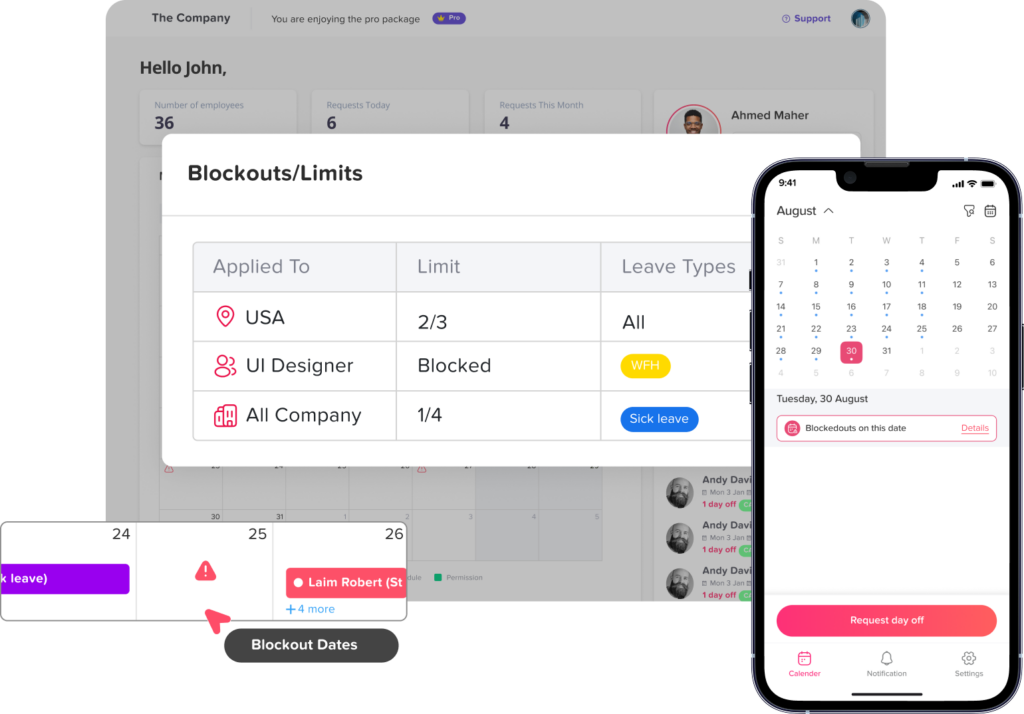
Use Blackout Dates Carefully
Some organizations have periods when vacation availability must be limited because of predictable business demand.
Examples might include:
- Retail holiday seasons
- Annual financial close
- Major product launches
- Important client events
- Inventory periods
If the company uses blackout dates, employees should know about them in advance whenever possible.
The policy should also explain whether exceptions are available.
Blackout dates should generally relate to legitimate staffing needs rather than being used as a substitute for workforce planning.
Establish Carryover, Expiration, and Balance Caps
Your PTO policy should clearly define what happens to unused leave.
Possible approaches include:
Full carryover
All remaining leave carries into the next year.
Limited carryover
Employees can carry forward only a certain amount.
For example:
Annual balance: 120 hours
Maximum carryover: 40 hours
Balance cap
Employees stop accruing additional PTO once their balance reaches a defined maximum.
Expiration
Unused leave expires after a certain date or period where legally permitted.
Employers need to verify applicable laws before implementing forfeiture, payout, accrual-cap, or use-it-or-lose-it provisions. PTO and vacation requirements can vary by jurisdiction.
In the United States, the FLSA itself does not require employers to provide vacation or sick pay, but state and local requirements can create additional obligations. The Department of Labor also notes that many states and localities have paid sick leave requirements.
For multi state companies, this means a single policy may require location-specific provisions.
Decide How PTO Works When Employment Ends
The policy should explain how remaining PTO is handled when an employee:
- Resigns
- Is terminated
- Retires
- Transfers between entities
- Changes from full time to parttime status
Do not assume unused PTO can simply be erased.
Rules regarding accrued vacation and final payment vary by jurisdiction and sometimes depend on the employer’s written policy.
Growing companies should establish this rule before the first termination creates a dispute.
Establish Recordkeeping Standards
Good policies depend on good records.
In the United States, the Department of Labor states that employers subject to FLSA recordkeeping requirements must maintain certain information regarding employees’ hours and wages. The DOL does not require employers to use a particular timekeeping method, but records must be complete and accurate.
Federal guidance generally requires relevant payroll records to be retained for at least three years, while records used to calculate wages, including Time Tracking Policy cards and work schedules, generally need to be retained for two years. Other laws may require longer retention periods.
Your internal policy should define:
- Where records are stored
- Who can access them
- How corrections are recorded
- How long records are retained
- Whether changes create audit logs
- Who can export records
- How payroll corrections are documented
Avoid relying exclusively on chat messages, emails, or spreadsheets distributed across different managers.
Maintain an Audit Trail
A useful Time Tracking Policy and leave system should show more than the final value.
Suppose an employee’s clock out Time Tracking Policy changes from 5:00 PM to 6:00 PM.
HR may later need to know:
- What the original record showed
- Who changed it
- When it was changed
- Why it was changed
- Who approved the correction
The same principle applies to PTO balances.
If an employee’s balance changes from 56 hours to 72 hours, the company should be able to identify why.
Audit history becomes increasingly valuable as HR responsibilities are distributed across multiple administrators.
Use One System for PTO, Attendance, and Time Tracking Policy
As employee numbers increase, connecting leave and time data reduces duplicate work.
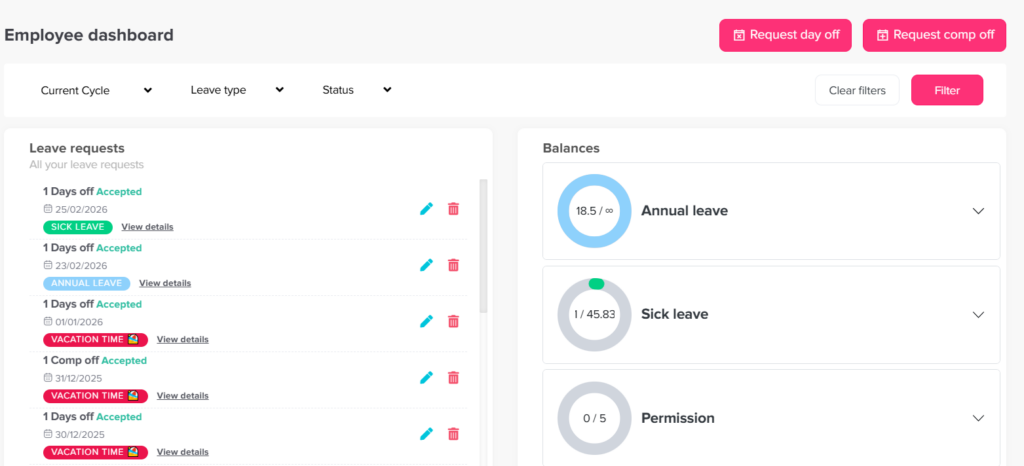
For example, Day Off allows growing teams to manage leave policies, PTO balances, approvals, employee work schedules, and Time Tracking Policy within the same environment.
Employees can request time off while managers can review availability and leave records. Companies that also track working time can use clock-in and clock out records, task Time Tracking Policy, attendance information, overtime, late time, and employee schedules alongside PTO data.
Connecting these areas is particularly useful when an employee has approved leave during part of a scheduled day.
Instead of treating the PTO system and attendance system independently, the company can compare:
Scheduled hours → Approved PTO → Actual worked hours → Attendance result
That creates a clearer employee record and reduces the need for HR teams to reconcile information across separate tools.
PTO and Time Tracking Policy Checklist
Before publishing your policy, confirm that it answers the following questions:
PTO
- Who is eligible for PTO?
- How is PTO earned?
- When can employees begin using it?
- What happens to unused PTO?
- Are balances capped?
- Can employees have negative balances?
- What request increments are allowed?
- How much notice is required?
- Who approves requests?
- How are conflicting requests handled?
- How are company holidays treated?
- How is partial-day leave calculated?
- What happens to PTO when employment ends?
Time Tracking Policy
- Who must track working time?
- When should employees clock in and out?
- How are breaks recorded?
- How is remote work tracked?
- How is overtime handled?
- What happens after a missed punch?
- Who can edit time records?
- Who approves records?
- What is the timesheet deadline?
- How are corrections documented?
Integration
- Does approved PTO update attendance?
- Does the employee schedule determine PTO deductions?
- Are worked hours separated from leave hours?
- Can payroll distinguish PTO, holidays, overtime, and regular work?
- Is there an audit history?
- Can employees review their balances and records?
If several of these questions do not have clear answers, the policy is probably not ready to scale.
FAQ
What should a Time Tracking Policy include?
A Time Tracking Policy should explain who must record working hours, how employees clock in and out, how breaks and overtime are handled, how incorrect entries are corrected, who approves time records, and when records must be submitted. It should also prohibit employees from intentionally omitting working time from their records.
Should PTO and Time Tracking Policy be part of the same policy?
They can be separate documents, but the rules should work together. PTO affects scheduled working time, attendance, payroll, and employee balances. Connecting the policies helps prevent situations where the leave system shows an approved absence while the attendance system incorrectly records the same employee as absent.
Should PTO be tracked in days or hours?
Either method can work, but hours are often more precise when employees have different schedules. If one employee works eight hours on Monday and another works ten, a one-day PTO request represents different amounts of scheduled working time.
Do employers have to offer PTO?
In the United States, federal FLSA rules do not generally require employers to provide paid vacation or sick leave. However, states and local jurisdictions may impose paid sick leave or other leave requirements, and other federal protections such as FMLA may apply in qualifying situations. Employers should check the laws applicable to each employee’s work location.
Does PTO count as hours worked for overtime?
Under the federal FLSA, vacation, sick leave, and holiday hours during which no work is performed generally do not need to be included as hours worked when calculating whether an employee has exceeded 40 worked hours in a workweek. State rules and employer policies may differ.
How should a company handle missed clock ins?
Employees should report missed punches and provide the actual time they started or stopped working. A manager or authorized administrator should review the correction, and the system should ideally retain an audit history showing what was changed.
How often should a PTO and time tracking policy be reviewed?
Companies should review the policy periodically and whenever their workforce, locations, schedules, payroll processes, or employment laws materially change. Fast growing companies may need more frequent operational reviews because their staffing structure can change quickly.
Conclusion
Building a PTO and time tracking policy is not simply an HR documentation exercise. It establishes how scheduled time, working time, leave, attendance, overtime, and payroll information move through the organization.
The strongest policies answer ordinary employee questions before they become disputes. Employees know how much leave they have, how to request it, when to record their hours, how to correct mistakes, and who is responsible for approving changes. Managers receive clear rules instead of making decisions case by case, while HR and payroll teams gain more reliable records.
As a company grows, this becomes increasingly important. Different work schedules, additional managers, remote employees, multiple locations, hourly PTO, and more complex attendance requirements can quickly overwhelm manual processes.
Using a system such as Day Off to connect PTO management, employee schedules, approvals, Time Tracking Policy, and attendance can help companies apply these rules consistently while maintaining a clearer record of both time worked and Time Tracking Policy away.
The goal should not be to create the strictest possible policy. It should be to create a policy employees can realistically follow, managers can consistently enforce, and the company can continue using as it grows.