




PTO Requests can create scheduling problems when too many employees ask for the same days off, especially during holidays, school breaks, summer vacations, product launches, or other busy periods. Employees should be able to use the leave they have earned, but managers must also make sure enough people are available to serve customers, complete essential work, meet deadlines, and respond to emergencies.

The solution is not to reject leave requests whenever staffing becomes difficult. Instead, companies need clear staffing rules that explain how many employees may be absent, how requests are prioritized, which roles require minimum coverage, and when exceptions may be approved.
Well designed staffing limits help employers balance operational needs with fair access to time off. They also give employees more confidence because leave decisions are based on documented rules rather than personal preference or inconsistent management decisions.
This guide explains how to set practical team limits for PTO requests, calculate minimum staffing requirements, manage overlapping requests, and create a fair approval process.
What Are Staffing Rules for PTO Requests?
Staffing rules for PTO requests are internal guidelines that determine how much employee leave a team can support at one time.
These rules may define:
- The minimum number of employees who must remain available
- The maximum number or percentage of employees who can be absent
- The roles or skills that must always be covered
- Dates when leave availability is limited
- How overlapping requests are prioritized
- Who may approve exceptions
- How employees are notified when a date reaches capacity
For example, a customer support department may require at least eight agents to be working during business hours. If the department has ten scheduled agents, only two may normally take PTO on the same day.
A software team may use a different rule. It may allow several employees to take leave as long as at least one engineer with production access and one person familiar with each critical system remain available.
Staffing limits should reflect how the team actually operates. A single company-wide number will not work for every department, location, shift, or job function.
Why Companies Need Team Limits for PTO Requests
Without clear staffing rules, managers often make leave decisions individually. This can create delays, unfair outcomes, and unnecessary conflict.
One manager may approve every request until the team becomes understaffed. Another may reject requests too quickly because they are worried about possible coverage problems. Employees may also feel that requests are approved based on favoritism, seniority, or who asks first.
Documented team limits provide a consistent starting point.
Maintain Essential Business Coverage
Every team has work that must continue even when employees are away. Staffing limits help managers protect essential tasks such as:
- Responding to customers
- Processing payroll
- Monitoring critical systems
- Opening or closing a location
- Handling security or compliance activities
- Completing scheduled production
- Supervising employees
- Meeting contractual service levels
The purpose of a staffing limit is not to keep the entire team available. It is to identify the minimum coverage required for safe and reliable operations.
Reduce Subjective Approval Decisions
Employees are more likely to accept a denied request when the reason is clear and consistently applied.
For example, “Your request was denied because the manager preferred another employee’s dates” appears arbitrary.
A clearer explanation would be: “The team’s leave capacity for that date has already been reached, and approving another request would reduce coverage below the documented minimum.”
The second explanation connects the decision to a known policy.
Prevent Last Minute Scheduling Problems
A team may be able to handle one planned absence easily. However, several overlapping vacations combined with illness, training, or unexpected resignations can create major coverage problems.
Team limits allow managers to identify high risk dates early and arrange:
- Shift exchanges
- Temporary coverage
- Cross-training
- Deadline adjustments
- Reduced appointment capacity
- Overtime, where appropriate
- Support from another department or location
Give Employees Better Planning Visibility
Employees should not have to guess whether a date is available.
When leave limits are clearly communicated, employees can:
- Request popular dates earlier
- Consider alternative days
- Coordinate with colleagues
- Avoid booking nonrefundable travel before approval
- Understand why a request may remain pending
- See when the team calendar is already crowded
Visibility improves planning for both employees and managers.
Common Ways to Set PTO Team Limits
| Limit Method | How It Works | Best Suited For |
|---|---|---|
| Maximum number absent | A fixed number of employees may take leave at the same time | Small teams with similar roles |
| Percentage-based limit | A maximum percentage of scheduled employees may be absent | Larger or changing teams |
| Minimum staffing level | Leave is allowed as long as a minimum number remain available | Customer service, healthcare, retail, operations |
| Role-based coverage | Certain roles, skills, or certifications must remain covered | Technical, regulated, or specialized teams |
| Shift-based limit | Separate leave limits apply to each shift | Retail, hospitality, manufacturing, support centers |
| Workload-based limit | Capacity changes according to expected demand or deadlines | Seasonal or project-based teams |
| Combined rule | Several limits are checked together | Complex teams with multiple coverage needs |
Maximum Number of Employees Absent
This is the simplest method.
A company may decide that no more than two employees from a particular team can take PTO on the same day.
This approach works well when:
- The team is relatively small
- Employees perform similar work
- Staffing levels do not change significantly
- All employees work similar schedules
However, a fixed number can become inaccurate when team size changes.
Allowing two employees to be absent from a four-person team means 50 percent of the team is away. Allowing two employees to be absent from a twenty person team means only 10 percent is away.
For growing teams, percentage based or minimum coverage rules may be more reliable.
Percentage Based PTO Limits
A percentage-based rule adjusts automatically as the team grows or shrinks.
For example, a department may allow up to 20 percent of scheduled employees to be on planned leave at the same time.
If 15 employees are scheduled:
15 × 20% = 3 employees
The team could normally support three planned absences.
Companies should define how rounding works. If the calculation produces 2.4 employees, the policy should state whether the result is rounded down to two or up to three.
Rounding down is generally safer when the percentage represents a maximum absence limit. However, extremely small teams may need a minimum allowance so that employees still have a realistic opportunity to use their PTO.
Minimum Staffing Requirements
Instead of focusing on how many employees may be absent, the company defines how many must remain working.
The basic formula is:
Maximum planned absences = Scheduled employees – Minimum required staffing
For example:
- Scheduled employees: 12
- Minimum required staffing: 9
- Maximum planned absences: 3
This method is useful when workload and service levels depend on having a specific number of people available.
Minimum staffing may vary by:
- Day of the week
- Time of day
- Location
- Shift
- Season
- Customer demand
- Expected sales
- Scheduled appointments
- Project stage
A restaurant may need more employees during Friday evening service than on Tuesday afternoon. A support team may need more coverage during a product launch than during a quiet internal planning week.
Role Based Coverage Requirements
Headcount alone does not always provide enough protection.
A ten person team may technically meet its minimum staffing number while still lacking the skills required to operate. For example, all employees with approval authority, system access, first aid certification, or specialized knowledge could request the same day off.
A role based rule might require:
- At least one supervisor on every shift
- At least one payroll specialist during payroll processing
- At least one employee with access to critical systems
- At least one certified operator for specific equipment
- At least one person trained to open and close the location
- At least one employee who can handle escalated customer issues
Role based coverage should be used carefully. The same employees should not be prevented from taking leave repeatedly because only they possess a critical skill.
When coverage depends heavily on one person, that is often a cross training problem rather than a PTO problem.
Shift Based Limits
Organizations with multiple shifts should calculate leave capacity separately for each shift.
A company may have enough employees overall but still become understaffed during the night shift or weekend shift.
For example:
- Morning shift: Maximum two employees absent
- Evening shift: Maximum one employee absent
- Night shift: Maximum one employee absent
Shift-based limits should consider employees who can move between shifts. However, companies should not assume that an employee can change shifts without considering contracts, availability, rest periods, personal commitments, or local employment requirements.
Workload Based Limits
Some teams need flexible limits because workload changes throughout the year.
A tax team may have limited leave capacity before a filing deadline. A retail business may need additional coverage before major holidays. A software team may restrict overlapping leave during a planned release.
Workload based rules may create different capacity levels, such as:
- Normal capacity
- Reduced capacity
- Peak period capacity
- Critical event capacity
The company should publish important dates as early as possible and avoid creating unexpected restrictions after employees have already made plans.
How to Calculate a Reasonable Team Limit
A good staffing limit starts with actual operational data, not an arbitrary percentage.
Step 1: Identify Essential Work
List the work that must continue when employees are absent.
Separate tasks into three groups:
- Work that must be completed immediately
- Work that can be delayed for a short period
- Work that can be reassigned or paused
The staffing limit should protect the first group. It should not be designed to keep every normal activity running at full capacity during every absence.
If a team cannot support any employee taking leave without falling behind, the underlying problem may be staffing, workload, or process design.
Step 2: Review Historical Demand
Look at previous staffing and workload information, including:
- Customer volume
- Sales by day and hour
- Support ticket volume
- Project deadlines
- Production targets
- Absence patterns
- Overtime use
- Service-level performance
- Busy seasons
- Unexpected absence rates
Historical data can show how many employees are normally required to operate effectively.
For example, if a support team consistently meets service targets with eight employees but misses them with seven, eight may be a reasonable minimum staffing level.
Step 3: Include Unplanned Absence Risk
Planned PTO is not the only reason employees may be unavailable.
Teams may also experience:
- Sick leave
- Family emergencies
- Training
- Business travel
- Jury duty
- Protected leave
- Technical outages
- Vacancies
- New employee onboarding
A staffing rule should leave some room for unexpected absences. Approving planned leave until the team reaches its absolute operational minimum creates a high risk of understaffing when another employee calls in sick.
For example, if eight employees are needed to maintain normal service, the company may set the planned-leave minimum at nine employees to preserve a small buffer.
Step 4: Identify Critical Roles and Skills
Count the number of employees who can perform each essential responsibility.
If only one employee can complete a critical task, the organization should prioritize cross-training. Relying on that employee indefinitely can lead to burnout and make it difficult for them to use their leave.
A strong coverage plan usually includes:
- A primary owner
- A trained backup
- Clear process documentation
- Temporary access where appropriate
- An escalation contact
Step 5: Test the Rule Against Real Scenarios
| Scenario | Questions to Test |
|---|---|
| Normal workday | Can the team meet essential responsibilities? |
| One unexpected absence | Is there still enough coverage? |
| Peak-demand day | Does the limit reflect higher workload? |
| Multiple employees with the same role away | Are critical skills still available? |
| Manager on leave | Is another approver or supervisor available? |
| Small team | Does the rule still allow employees to use PTO? |
| Long vacation | Can work be reassigned for several days? |
| Partial-day requests | Are hourly absences counted consistently? |
Step 6: Review the Limit Regularly
Staffing limits should not remain unchanged indefinitely.
Review them when:
- Team size changes
- Work schedules change
- A new location opens
- Customer demand changes
- New technology is introduced
- Roles are reorganized
- Employees are cross-trained
- Service expectations change
- The company enters a new busy season
A review every six or twelve months may be appropriate for stable teams. Rapidly changing teams may need more frequent updates.
Sample Staffing Limits by Team Type
| Team Type | Example Staffing Rule | Important Consideration |
|---|---|---|
| Customer support | At least 80% of scheduled agents must remain available | Ticket volume and response targets |
| Retail store | At least one supervisor and required opening or closing staff must be present | Coverage should be calculated by shift |
| Software engineering | At least one person familiar with each critical system must be available | Avoid relying on one employee permanently |
| Payroll team | Limited overlapping leave during payroll processing dates | Publish restricted periods in advance |
| Sales team | Maximum 25% absent, with account handovers required | Consider quarter-end and renewal dates |
| Healthcare administration | Minimum daily headcount plus role-specific coverage | Separate planned PTO from legally protected leave |
| Small business team | One employee absent at a time unless backup coverage is arranged | Rules must still allow reasonable leave access |
| Manufacturing team | Minimum certified operators per production line | Consider maintenance and safety requirements |
How to Handle Multiple PTO Requests for the Same Dates
Even with a clear capacity limit, managers need a fair way to decide between competing requests.
First Come, First Served
Under this approach, requests are prioritized based on the date and time they were submitted.
Advantages include:
- Easy to understand
- Easy to administer
- Encourages early planning
- Reduces manager discretion
However, employees who cannot plan far in advance may be disadvantaged. It may also allow the same employees to secure popular dates every year.
Rotation for Popular Dates
A rotation system gives employees fair access to highly requested periods.
For example, employees who received the week around a major holiday last year may receive lower priority this year when several requests overlap.
Rotation can work well for:
- School holidays
- Year end holidays
- Long weekends
- Annual local events
- Peak summer weeks
The company should keep accurate records and explain how rotation is applied.
Seniority Based Priority
Some organizations prioritize employees with longer service.
This method may be required by a collective agreement or established workplace policy. However, it can make it difficult for newer employees to access desirable leave dates.
Employers should not introduce seniority-based approval informally. It should be clearly documented and applied consistently.
Business Need Priority
Managers may prioritize requests based on the work scheduled for that period.
For example, one employee may be required for a specific client meeting, while another employee’s work can be reassigned.
Business need decisions should be supported by objective information. Managers should avoid making assumptions about whose leave is more important based on the employee’s reason for taking time off.
Lottery or Random Selection
A lottery can be useful when several employees request the same popular dates and no other fair distinction applies.
The process should be transparent and documented.
Hybrid Priority System
Many companies combine several methods.
For example:
- Check minimum staffing and role coverage
- Approve requests in submission order
- Use rotation for designated peak dates
- Escalate unresolved conflicts to HR
- Document any exception
A hybrid approach provides structure while allowing limited flexibility.
Should Managers Consider the Reason for a PTO Request?
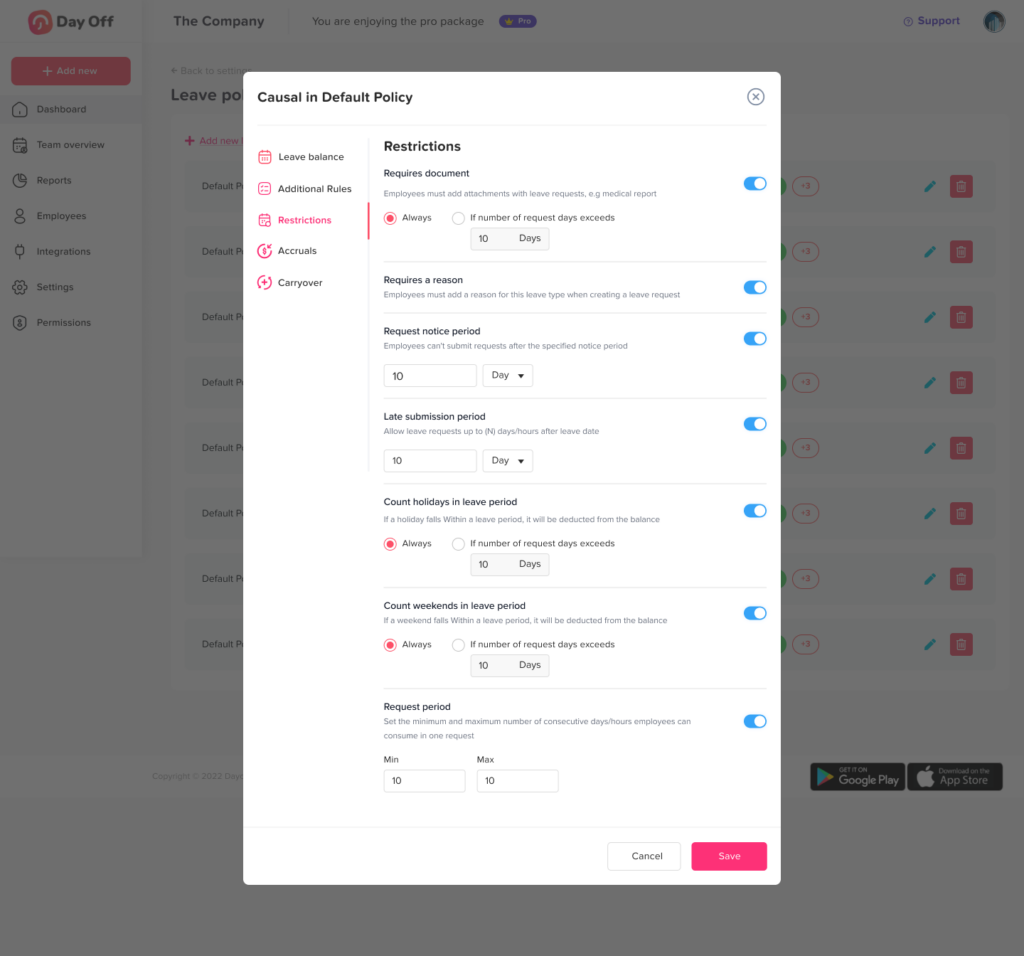
For ordinary vacation or personal PTO, managers usually do not need detailed personal information. The approval decision should focus on available balance, notice requirements, scheduling capacity, and the applicable policy.
Asking employees to prove that one vacation is more important than another can create privacy concerns and subjective decisions.
A honeymoon, family visit, rest day, personal appointment, or trip may all be meaningful to the employee. Managers should not rank personal reasons unless a different leave category or legal requirement applies.
Requests involving protected leave, disability accommodation, medical needs, religious accommodation, or other legally regulated situations may require a separate process. They should not automatically be treated as ordinary discretionary vacation requests.
Employers should consult qualified HR or legal professionals when local requirements may apply.
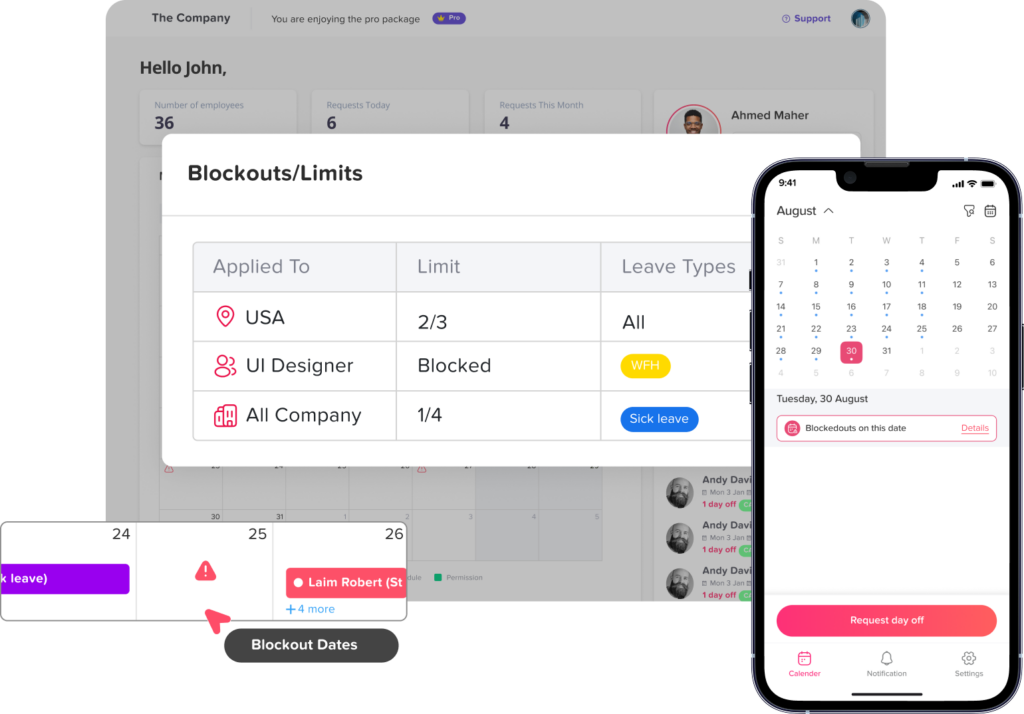
How to Manage Peak Periods and Blackout Dates
A blackout date is a period when planned leave is restricted because of unusually high operational demand.
Examples may include:
- Retail holiday periods
- Financial year-end
- Payroll processing
- Inventory counts
- Product launches
- Major client events
- Annual conferences
- Seasonal demand
- System migrations
Blackout dates should be used carefully. A company should not label every busy period as unavailable or create so many restrictions that employees cannot reasonably use their earned leave.
Better Alternatives to a Complete Blackout
Instead of blocking all leave, consider:
- Allowing a smaller number of employees to be absent
- Requiring earlier notice
- Shortening the maximum leave duration
- Using a rotation system
- Offering alternative dates
- Arranging temporary staffing
- Cross-training employees
- Dividing the period into separate request windows
A limited capacity period is often more balanced than a total ban.
Communicate Restricted Dates Early
Employees should know about expected restrictions before making plans.
Publish peak periods:
- In the employee handbook
- In the leave policy
- On the shared calendar
- During annual planning
- Before opening holiday request windows
- When project dates are confirmed
Avoid announcing a restriction after employees have already received approval or booked travel.
Partial Day PTO and Team Limits
Companies must decide how partial day leave affects capacity.
A half day request may have little effect on coverage if the employee is away during a quiet period. It may have a major effect if it overlaps with the busiest shift hours.
Possible methods include:
- Counting any absence as one full capacity slot
- Counting leave according to hours
- Applying separate morning and afternoon limits
- Calculating coverage by shift
- Reviewing partial-day requests manually
Hourly limits provide greater accuracy but require better scheduling data.
For example, a team may allow:
- Two employees away from 9:00 a.m. to 12:00 p.m.
- One employee away from 12:00 p.m. to 5:00 p.m.
This may be more useful than applying one limit to the entire day.
How to Handle Small Teams
Small teams face a difficult balance. One absence may represent a large percentage of the workforce, but employees must still be able to take meaningful time off.
A three person team cannot always apply a rule requiring 80 percent attendance because one absence would reduce attendance to about 67 percent.
Small teams may need flexible coverage strategies, such as:
- Training employees to cover each other’s essential tasks
- Temporarily transferring work to another department
- Using contractors or temporary staff
- Reducing nonessential work
- Rescheduling internal meetings
- Creating emergency coverage procedures
- Documenting key processes
- Allowing remote support where appropriate
The rule should not effectively mean that employees can take leave only when the manager finds it convenient.
If one person’s absence stops the department from operating, the organization should address the operational dependency.
Avoiding Unfair or Discriminatory PTO Decisions
Staffing rules must be applied consistently.
Managers should not approve or reject requests based on:
- Personal relationships
- Assumptions about family status
- Whether an employee is traveling
- How the employee plans to use the leave
- Whether the manager considers the reason important
- An employee’s willingness to work unpaid overtime
- Informal promises that are not available to others
Companies should also review whether a neutral rule creates repeated disadvantages for certain employees.
For example, always giving priority to employees who can submit requests exactly one year in advance may disadvantage employees with less predictable family or caregiving responsibilities.
Consistency does not always mean using the simplest rule. It means applying a documented process fairly and reviewing whether the results remain reasonable.
When Managers Should Approve Exceptions
A staffing limit should guide decisions, but organizations may allow exceptions when coverage can still be arranged.
Possible exceptions include:
- Another qualified employee agrees to cover
- Work can be completed early
- A project deadline changes
- Customer demand is lower than expected
- Temporary support is available
- The request involves an urgent personal situation
- The employee has been repeatedly unable to use accrued leave
- The absence is covered under a different policy or legal requirement
The policy should identify who can approve exceptions, such as:
- Department manager
- HR manager
- Operations director
- Location manager
- Senior leadership
Exceptions should be documented to prevent confusion and ensure similar cases are handled consistently.
What to Include in a Staffing and PTO Approval Policy
A clear policy should answer the following questions:
Scope
- Which employees and departments are covered?
- Are contractors, temporary workers, or part-time employees included?
- Are rules different by location or shift?
Notice Requirements
- How far in advance should employees submit requests?
- Are shorter notice periods allowed?
- What happens with urgent or unexpected needs?
Capacity Rules
- What is the maximum number or percentage absent?
- What minimum staffing level must remain?
- Which roles or skills require coverage?
- Are partial-day requests counted differently?
Priority Rules
- Are requests handled first-come, first-served?
- Is there a rotation for popular dates?
- Does seniority apply?
- How are identical submission times handled?
Restricted Periods
- Are there blackout dates?
- Are limits reduced during peak periods?
- When will employees be notified?
Decision Timeline
- How quickly should managers respond?
- What happens when an approver is unavailable?
- Can pending requests be escalated?
Exceptions and Appeals
- Who may approve exceptions?
- Can an employee request a review?
- How are decisions documented?
Cancellations and Changes
- Can employees edit approved leave?
- When is the balance restored?
- What happens when an employee returns early?
- Can approved leave ever be canceled by the employer?
Using Leave Management Software to Enforce Team Limits
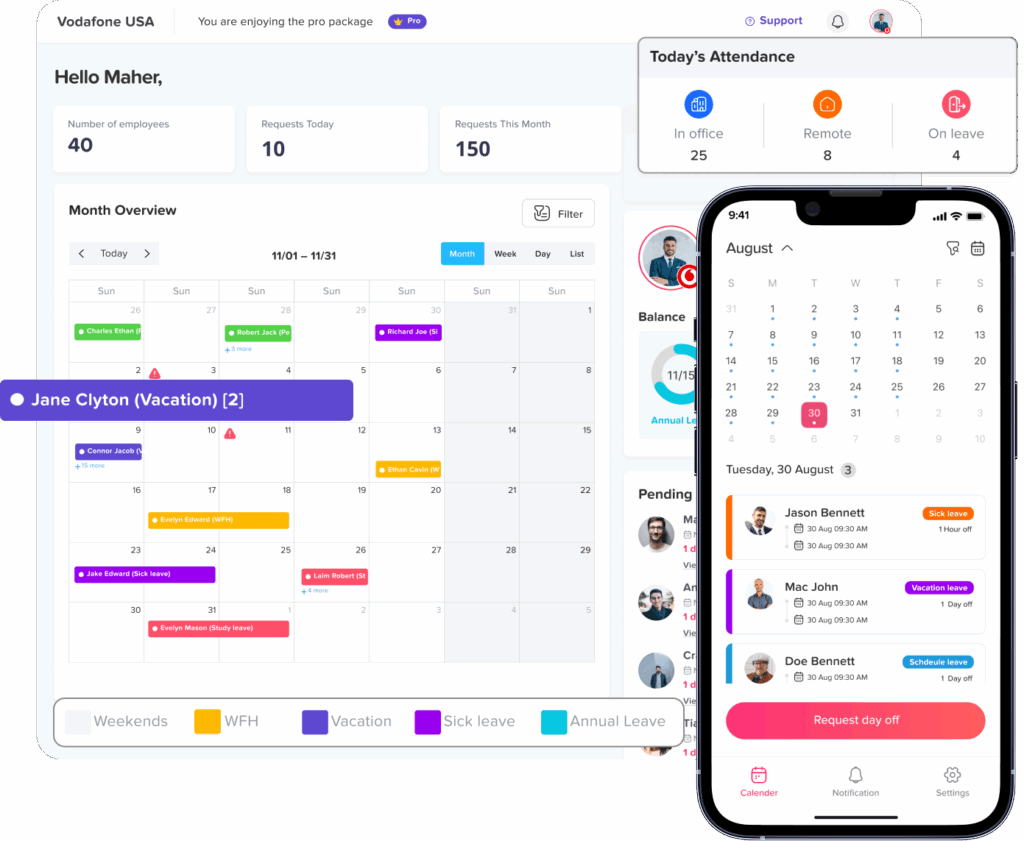
Manual spreadsheets and email approvals make it difficult to see overlapping leave, remaining balances, and team coverage.
A leave management system can help by providing:
- A centralized request process
- Shared team calendars
- Employee balance tracking
- Manager approval workflows
- Department and location filters
- Holiday calendars
- Notifications
- Request histories
- Blackout date settings
- Reports for reviewing absence patterns
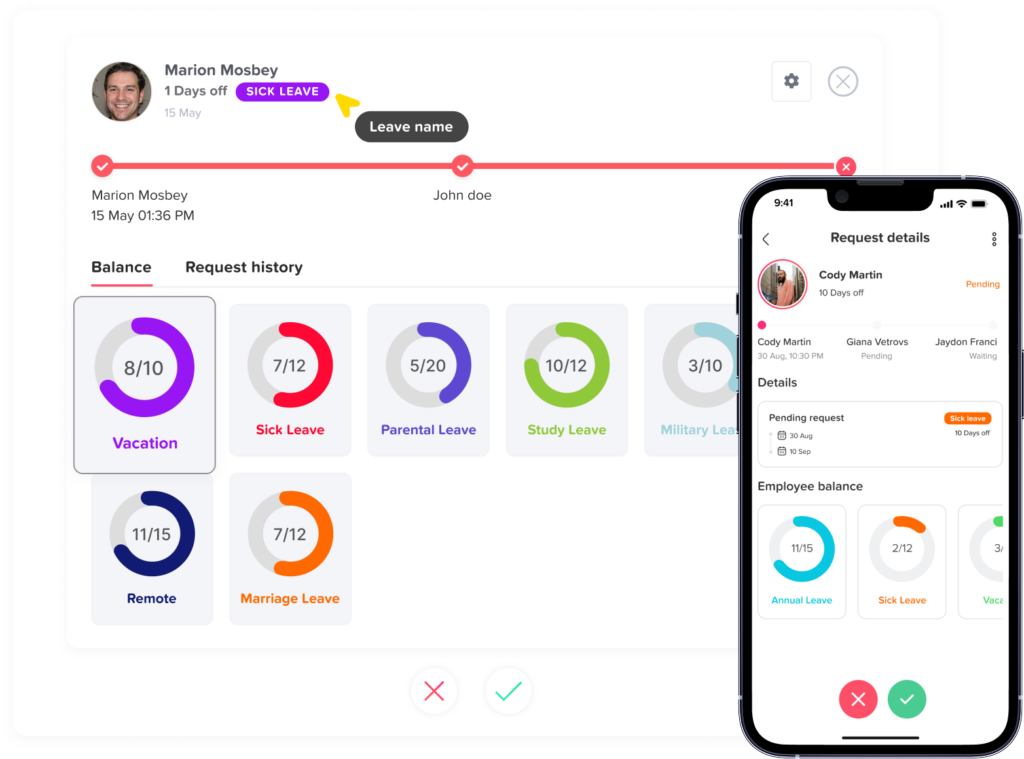
With Day Off, employees can submit leave requests from the web, iOS, or Android app, while managers can review requests alongside team schedules and approved absences. Centralized visibility helps managers identify overlapping leave before approving a request and reduces the risk of relying on outdated spreadsheets or scattered messages.
Software should support the company’s policy, not replace management judgment. The organization still needs to define fair limits, identify essential coverage, and create a process for exceptions.
Common Mistakes When Setting PTO Team Limits
Using the Same Limit for Every Department
A 20 percent absence limit may work for a large administrative team but fail for a small technical team with specialized roles.
Create limits based on actual team needs.
Setting Limits Without Reviewing Demand
An arbitrary rule may allow too many absences during busy periods or unnecessarily restrict leave during quiet periods.
Use scheduling and workload data whenever possible.
Ignoring Skills and Responsibilities
A team may meet its headcount target while lacking a required supervisor, specialist, or certified employee.
Include role-based coverage where necessary.
Allowing No Staffing Buffer
Approving planned PTO down to the absolute minimum leaves no room for sickness or emergencies.
Build a reasonable buffer into the planned leave calculation.
Applying the Rule Inconsistently
A policy loses credibility when managers make exceptions for some employees but not others without a clear reason.
Document decisions and train approvers.
Restricting Too Many Dates
Employees may accumulate large balances when leave is repeatedly denied.
Review whether staffing shortages, insufficient cross-training, or unrealistic workloads are creating the problem.
Responding Too Slowly
A clear limit does not help if requests remain pending for weeks.
Set a manager response expectation and provide backup approvers.
Canceling Previously Approved Leave
Canceling approved PTO can create financial and personal consequences for employees. It should be rare and handled according to company policy and applicable local requirements.
Managers should explore every reasonable alternative before changing an approved request.
Best Practices for Fair PTO Staffing Rules
To create a fair and practical system:
- Calculate limits using real staffing and workload information.
- Set different rules for departments, shifts, or locations where necessary.
- Protect essential roles without making one employee permanently unavailable for leave.
- Publish peak periods and blackout dates early.
- Use a clear method for competing requests.
- Avoid judging the personal reason behind ordinary PTO.
- Build a buffer for unexpected absences.
- Provide backup approvers.
- Document exceptions.
- Review denial patterns regularly.
- Cross-train employees to reduce single-person dependencies.
- Use a shared leave calendar for visibility.
- Explain decisions promptly and respectfully.
- Update limits when staffing or business conditions change.
Frequently Asked Questions
How many employees should be allowed to take PTO at the same time?
There is no universal number. The appropriate limit depends on team size, workload, required skills, customer demand, shifts, and the minimum number of employees needed to maintain essential operations.
Companies may use a fixed number, a percentage of scheduled employees, a minimum staffing level, or a combination of these methods.
Can a manager deny PTO because the team is understaffed?
A manager may be able to deny or suggest different dates for ordinary vacation leave when approving the request would create a genuine coverage problem, subject to the company’s policy and applicable laws.
The decision should be based on documented staffing needs and applied consistently. Protected or legally regulated leave may require a separate process.
Is first-come, first-served the fairest PTO approval rule?
First-come, first-served is simple and transparent, but it is not always the fairest method for highly popular dates. Some employers combine submission order with rotation, minimum coverage rules, or a lottery system.
The best method is one that employees understand and managers apply consistently.
Can an employer create blackout dates for PTO?
Employers may establish periods when ordinary vacation leave is limited, depending on local requirements and company policy. Blackout dates should be based on legitimate operational needs, communicated early, and used reasonably.
A reduced leave capacity may be more balanced than a complete restriction.
Should partial-day PTO count toward the team limit?
It can, but the company should define how it is counted. Some employers treat any absence as one capacity slot, while others calculate limits by hours, shift, or part of the day.
Hourly or shift-based calculations are often more accurate for teams with changing schedules.
What happens when several employees request the same holiday?
The company should apply its documented priority method. This may include first-come, first-served approval, rotation from previous years, seniority where applicable, random selection, or another consistent process.
Managers should avoid deciding based on whose personal reason appears more important.
How can small teams approve PTO without losing coverage?
Small teams can use cross-training, temporary support, workload adjustments, documented handovers, backup arrangements, and flexible scheduling.
If the team cannot function whenever one employee takes leave, the organization may need to address staffing or process risks.
How often should PTO staffing limits be reviewed?
Review limits whenever staffing, schedules, responsibilities, or workload change. Stable organizations may review the rules annually, while growing or seasonal teams may need more frequent reviews.
Conclusion
Staffing rules for PTO requests should protect business continuity without making it unnecessarily difficult for employees to use their earned time off.
The most effective policies do more than set a simple limit. They consider minimum staffing, critical roles, shifts, workload, unexpected absences, peak periods, and fair priority rules. They also explain how exceptions are handled and how employees can plan around dates that have reached capacity.
A clear process reduces approval delays, limits inconsistent decisions, and gives managers the information they need to maintain coverage. At the same time, cross-training, early planning, and shared leave visibility help employees take meaningful breaks without creating avoidable disruption.
By combining documented staffing limits with a centralized leave management system such as Day Off, organizations can manage overlapping requests more efficiently, improve transparency, and create a more balanced PTO experience for employees and managers.