








Managing PTO For Employees who perform multiple roles or follow different work schedules can be more complicated than managing leave for employees with one fixed position. A single employee may work in customer service on certain days, cover warehouse shifts on others, receive different pay rates by assignment, or alternate between short and long workweeks. Without clear rules, the organization may struggle to determine how much PTO For Employees earns, how many hours to deduct, which manager approves the request, and what rate of pay applies during the absence.

These situations are increasingly common in healthcare, hospitality, retail, manufacturing, education, professional services, and other industries that depend on flexible staffing. Employees may divide their time between departments, locations, projects, job classifications, or shifts. Others may move between full time and part time schedules during the year.
A reliable PTO policy should treat the employee as one person while still accounting for the different assignments and schedules attached to that person. The goal is to create a process that is accurate, predictable, understandable, and compliant with applicable employment requirements.
This guide explains how employers can calculate, approve, pay, and record PTO for employees with multiple roles or changing work schedules.
Compliance note: This article provides general information, primarily from a United States employment perspective. PTO For Employees requirements can vary by state, city, industry, contract, collective bargaining agreement, and leave type. Employers should review their policies with qualified payroll, HR, and legal professionals.
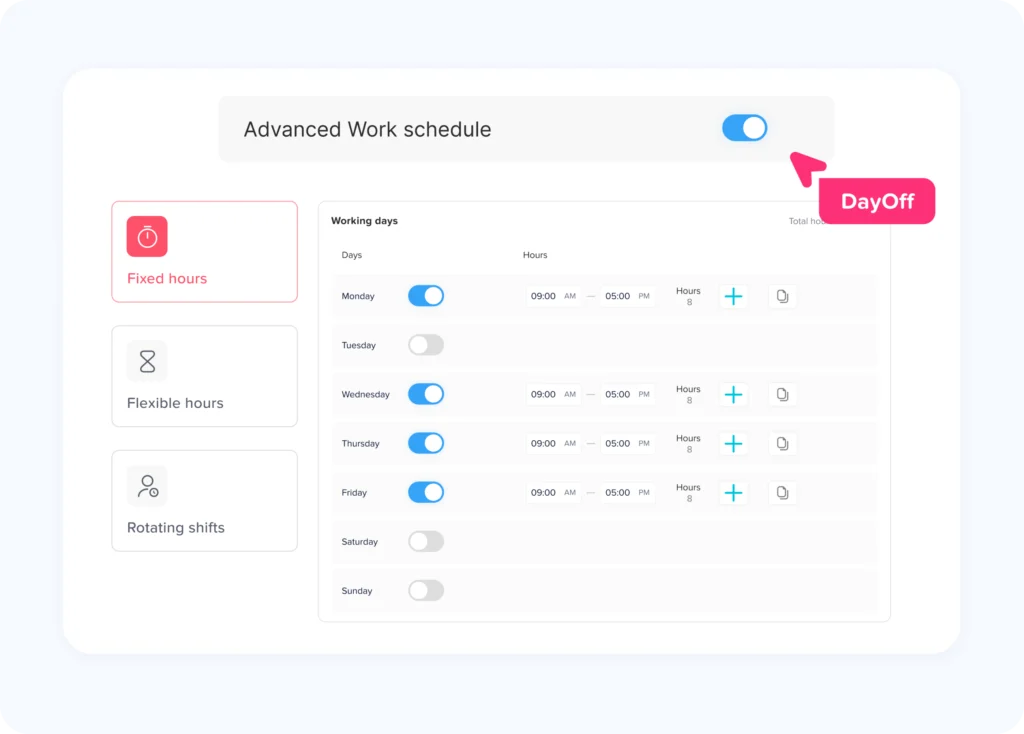
What Does “Multiple Roles or Work Schedules” Mean?
An employee may fall into this category whenever their responsibilities, working hours, pay rates, or reporting relationships are not consistent across every workweek.
Common situations include:
| Employee Situation | Example | Main PTO Challenge |
|---|---|---|
| Multiple job roles | A retail employee works as both a cashier and shift supervisor | Determining the applicable PTO pay rate |
| Different departments | An employee divides time between customer support and administration | Identifying the correct approver and coverage requirements |
| Multiple locations | A nurse works at two clinics | Coordinating schedules and avoiding conflicting approvals |
| Rotating shifts | An employee alternates between 8-hour and 12-hour shifts | Calculating the number of PTO hours used |
| Variable weekly hours | A part-time employee works between 20 and 32 hours | Determining accruals and scheduled hours |
| Seasonal schedule changes | An employee works full-time during peak season and part-time afterward | Updating accrual rates and policy eligibility |
| Different pay rates | A technician earns one rate for regular work and another for specialized assignments | Selecting the rate paid during PTO |
| Project-based work | A consultant divides time among several client projects | Recording leave without charging it to a project |
| On-call responsibilities | An employee has regular shifts plus scheduled on-call periods | Deciding whether PTO covers on-call obligations |
| Mixed exempt and nonexempt duties | An employee performs managerial and operational work | Reviewing the employee’s correct classification |
The employee should not normally be created as a separate person in the PTO For Employees system for every role. Duplicate employee profiles can create multiple balances, conflicting requests, inaccurate seniority records, and reporting errors.
Instead, the organization should maintain one employee record with multiple assignments, schedules, managers, or pay codes connected to it.
Why PTO For Employees Becomes More Complicated for Multi Role Employees
A basic PTO For Employees process assumes that the employee:
- Has one manager
- Works the same schedule each week
- Performs one job
- Receives one pay rate
- Belongs to one department
- Takes either a full day or half day off
Multi role employment breaks several of these assumptions.
For example, an employee may request Friday off. However, Friday could include four hours as a receptionist and four hours as an administrative assistant. One role may report to the office manager, while the other reports to the operations manager. The organization must decide whether both managers need to approve the request, whether eight hours should be deducted, and whether the employee is paid at one rate or two.
The complexity increases when schedules are published late, changed frequently, or managed in a different system from PTO For Employees balances.
A strong policy should answer five fundamental questions:
- How does the employee earn PTO?
- How many hours are deducted when PTO For Employees is used?
- What rate is paid for the absence?
- Who approves the request?
- Which system contains the official schedule?
Start With One Employment Relationship
An employee with two internal roles is usually still one employee of the organization. Unless the person has genuinely separate employment relationships, PTO For Employees administration should begin with a combined view of their service.
This means using one:
- Employee identification number
- Hire date or recognized service date
- PTO balance
- Leave history
- Eligibility record
- Carryover calculation
- Approval history
- Termination or rehire record
The organization may still track the employee’s assignments separately for scheduling, payroll costing, permissions, or departmental reporting.
For example, the employee record could include:
- Primary role: Customer service representative
- Secondary role: Weekend shift coordinator
- Primary manager: Customer support manager
- Secondary manager: Operations manager
- Standard schedule: Monday through Thursday
- Additional schedule: Two Saturdays per month
The PTO For Employees system should recognize all applicable working hours without creating two independent leave banks unless there is a valid policy or legal reason to maintain separate entitlements.
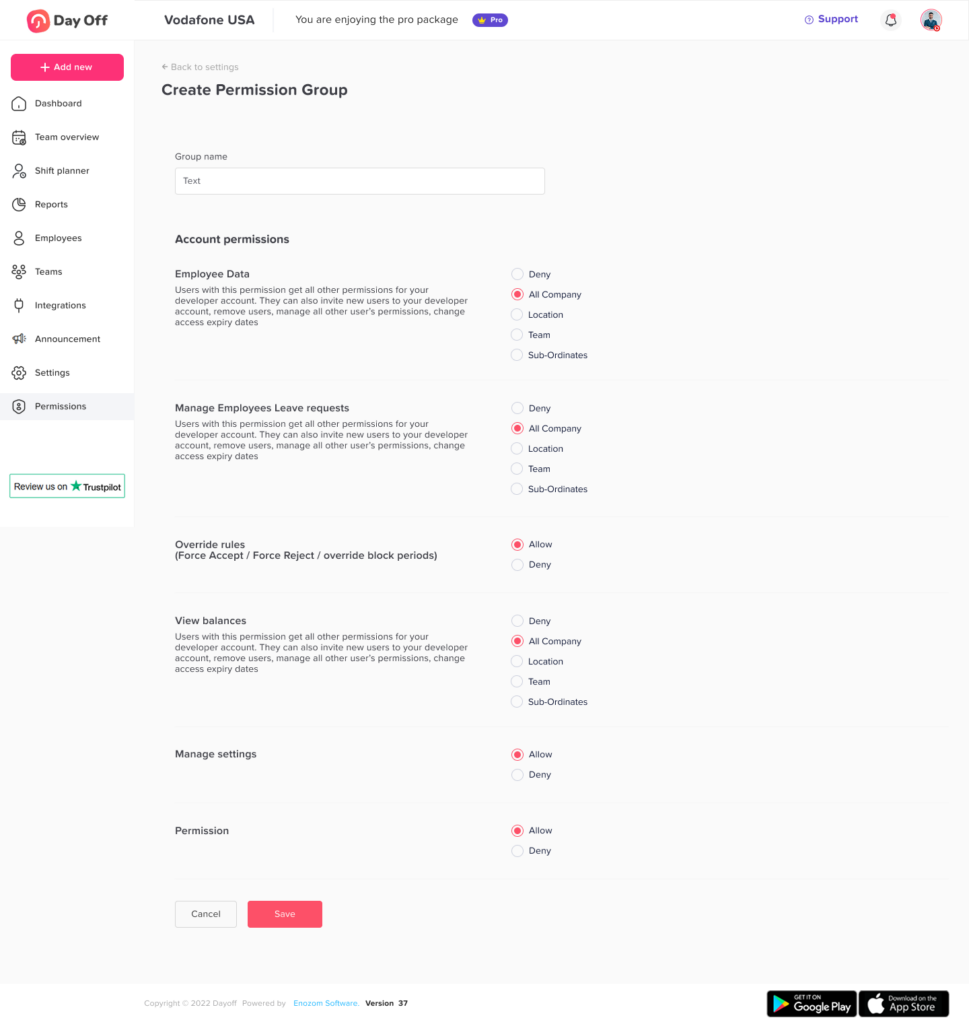
Decide How PTO For Employees Earned
PTO For Employees can be granted through a front loaded allowance or earned gradually through accruals. Employees with multiple roles require additional rules because their hours, status, or eligibility may differ between assignments.
Option 1: Accrue PTO For Employees Based on Total Hours Worked
Under this method, the employee earns PTO according to all eligible hours worked across every internal role.
Suppose an employee earns one hour of PTO For Employees for every 30 eligible hours worked:
- 18 hours worked as a cashier
- 12 hours worked as an inventory assistant
- Total eligible hours: 30
- PTO earned: 1 hour
This is often the clearest method for variable hour and part time employees because accrual follows actual work.
The employer must define which hours count. Depending on the policy and applicable requirements, the calculation may include or exclude:
- Regular working hours
- Overtime hours
- Training time
- Paid holidays
- Existing PTO For Employees hours
- Unpaid leave
- On call hours
- Travel time
- Nonproductive paid time
Do not leave these decisions to individual managers. The accrual rules should be written and applied automatically.
Option 2: Accrue PTO For Employees Based on Employment Status
An employer may place the employee into an eligibility category such as:
- Full time
- Part time
- Variable hour
- Seasonal
- Temporary
- Per diem
The employee then receives the allowance assigned to that category.
This method can be easier to administer, but the policy must explain how status is determined. For example, does the organization use scheduled hours, actual hours, a monthly average, or a measurement period?
A multi role employee working 20 hours in one department and 20 hours in another should not be classified as a 20 hour employee if the organization treats both assignments as part of one employment relationship.
Option 3: Accrue PTO For Employees Separately by Assignment
Some organizations calculate leave separately for each role because the roles are covered by different contracts, bargaining agreements, funding arrangements, locations, or employment classifications.
For example:
- Role A provides 80 hours of annual vacation.
- Role B provides one hour of sick leave for every 30 hours worked.
- The employee works in both roles.
This approach may be necessary in limited situations, but it is harder to administer. The employer must determine whether balances can be combined, transferred, or used across assignments.
Separate accruals should not be introduced only because the payroll system cannot handle multiple assignments properly. The policy decision should come first, followed by the system configuration.
Choose a Clear Accrual Model
| Accrual Model | Best Suited For | Advantages | Risks to Manage |
|---|---|---|---|
| Total hours across all roles | Hourly, part-time, and variable-hour employees | Reflects the employee’s complete workload | Requires accurate hours from every assignment |
| Employment status allowance | Employees with stable full-time or part-time classifications | Easy for employees to understand | Status changes must be handled promptly |
| Primary role policy | Employees whose secondary duties are occasional | Simple administration | May become unfair if the secondary role becomes substantial |
| Separate accrual by role | Roles governed by different agreements or rules | Supports distinct entitlements | Can create confusing balances and usage restrictions |
| Average schedule model | Employees with predictable rotating schedules | Produces a stable entitlement | Average period must be clearly defined |
| Front-loaded allowance | Employees receiving a fixed annual bank | Reduces recurring accrual calculations | Proration and midyear schedule changes require rules |
Track PTO For Employees in Hours Instead of Days
Hours are usually more accurate than days for employees who work different shift lengths.
A “day” could mean:
- Four hours for one employee
- Eight hours for another
- Ten hours under a compressed schedule
- Twelve hours for a healthcare or security employee
If every absence is recorded as one day, employees working longer shifts may receive substantially more paid time away than employees working shorter shifts, even when both have the same numerical allowance.
For example:
- Employee A works five 8 hour shifts.
- Employee B works four 10 hour shifts.
- Both receive 15 PTO “days.”
Employee A’s allowance equals 120 hours. Employee B’s allowance equals 150 hours if each scheduled day is treated as one PTO day.
An hour based balance avoids this inconsistency. The employer can grant both employees 120 hours and deduct the hours each employee was scheduled to work.
The balance can still be displayed in days for convenience, but hours should normally remain the underlying unit of calculation.
Deduct the Hours the Employee Was Scheduled to Work
The most reliable usage rule is:
Deduct the number of hours the employee was scheduled to work during the approved absence.
Examples:
- A four hour scheduled shift uses four hours of PTO For Employees.
- An eight hour scheduled shift uses eight hours.
- A twelve hour scheduled shift uses twelve hours.
- A two hour partial absence uses two hours.
- A day with no scheduled work uses no PTO For Employees.
This rule prevents employers from applying a standard eight hour deduction to every employee, regardless of the actual schedule.
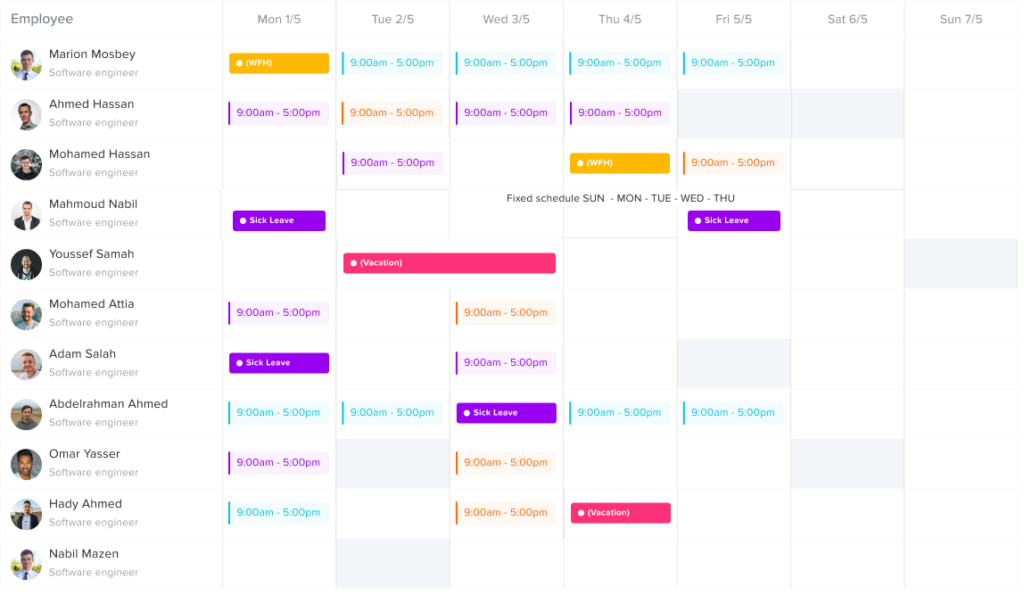
What if the Employee Has Two Roles on the Same Day?
If an employee is scheduled for two assignments on the requested date, the PTO request should cover both assignments when the employee is unavailable for the entire period.
Example:
- 8:00 a.m. to 12:00 p.m.: Reception role
- 1:00 p.m. to 5:00 p.m.: Administrative role
- Total scheduled working time: 8 hours
A full day absence would normally use eight hours of PTO. The employer may record four hours against each assignment for labor cost reporting, but the employee’s central PTO balance should be reduced by eight hours only once.
What About Unpaid Breaks?
Unpaid meal periods should generally not be deducted from the employee’s PTO For Employees balance.
For example, an employee is scheduled from 8:00 a.m. to 5:00 p.m. with a one hour unpaid lunch. The scheduled paid working time is eight hours, so the absence would normally use eight PTO For Employees hours rather than nine.
Use the Published Schedule as the Source of Truth
PTO For Employees cannot be calculated accurately when managers, payroll staff, and employees are using different schedules.
The organization should identify one official source for scheduled working time. This may be:
- A workforce scheduling system
- A time and attendance platform
- An HRIS
- A PTO For Employees management system
- An approved shift planner
The schedule should be published before the PTO For Employees request is processed whenever possible.
A reliable integration should send the following information to the leave system:
- Scheduled date
- Shift start and end time
- Unpaid break duration
- Role or assignment
- Location
- Department
- Shift status
- Required or voluntary overtime
- Schedule revision history
The system should also preserve the schedule that existed when the request was approved. Otherwise, a later schedule change may alter the PTO For Employees deduction without a clear audit trail.
How to Handle PTO For Employees Before the Schedule Is Published
Employees often need to request leave weeks or months before variable schedules are created. Employers need a provisional calculation method.
Possible methods include:
Use the Employee’s Expected Schedule
If the employee regularly follows a known rotation, the employer can apply the hours expected for the requested date.
Example:
- Week one: Three 12 hour shifts
- Week two: Four 12 hour shifts
The rotation can determine whether the requested date would have been a working day.
Use an Average Workday
The employer may calculate an average day based on the employee’s normal weekly hours divided by their normal number of working days.
For example:
- Average weekly schedule: 30 hours
- Average working days: 5
- Provisional PTO For Employees deduction: 6 hours per day
The deduction should be reviewed when the final schedule is published.
Reserve the Dates Without Deducting Hours Immediately
The organization may approve the dates provisionally and calculate the exact hours later. This can work when schedule data is reliable and payroll reviews occur before payment.
However, the employee should be told that the estimated balance may change.
Practical PTO For Employees Calculation Examples
| Scenario | Calculation | PTO Used or Earned |
|---|---|---|
| Employee works 16 hours in Role A and 24 in Role B, earning 1 PTO hour per 40 hours worked | 16 + 24 = 40 eligible hours | 1 hour earned |
| Employee misses a 10-hour scheduled shift | Deduct scheduled working time | 10 hours used |
| Employee misses two assignments of 4 hours each on one day | 4 + 4 scheduled hours | 8 hours used |
| Employee works an alternating 36-hour and 48-hour schedule | Average weekly schedule is 42 hours | Policy can base a weekly allowance on 42 hours |
| Employee requests a half shift from a 12-hour shift | 12 ÷ 2 | 6 hours used |
| Employee moves permanently from 40 to 24 hours per week | Apply policy’s status-change or proration rule | Future accrual may be reduced |
| Employee requests an unscheduled day off | No scheduled hours were missed | Usually 0 PTO hours |
| Employee misses an 8-hour shift with a 30-minute unpaid break already outside paid hours | Deduct paid scheduled hours | 8 hours used |
Determine the Correct PTO For Employees Pay Rate
PTO For Employees usage and PTO payment are separate calculations.
The balance answers:
How many hours should be deducted?
The payroll rule answers:
How much should the employee receive for those hours?
An employee who performs multiple jobs may receive different hourly rates. The organization should specify how PTO For Employees is paid before an absence occurs.
Common options include:
Pay the Rate of the Missed Assignment
If the employee was scheduled to perform a specific role, the PTO For Employees hours are paid at the rate assigned to that role.
Example:
- Cashier rate: $18 per hour
- Supervisor rate: $22 per hour
- The employee misses a six-hour supervisor shift
- PTO payment: 6 × $22 = $132
This method closely matches the earnings the employee would have received.
Pay the Employee’s Base Rate
The policy may define one base rate for all PTO For Employees, regardless of the scheduled assignment.
This is easier to administer, but the policy should explain whether premiums, differentials, commissions, or special assignment rates are included.
Use an Average or Blended Rate
The organization may calculate an average from a defined lookback period, such as the previous pay period, month, quarter, or 90 days.
For example:
- $18 rate for 60 hours
- $22 rate for 20 hours
- Total compensation: $1,520
- Total hours: 80
- Average rate: $19 per hour
A blended method may be appropriate for employees whose assignments change frequently. However, the calculation period and included compensation must be clearly defined.
Follow the Required Paid Leave Rate
State or local paid sick leave requirements may prescribe how covered leave must be paid. There is no general federal law guaranteeing paid sick leave, but many states and localities have adopted their own requirements. Employers must therefore check the laws applying to the employee’s work location.
A general vacation or PTO For Employees rule should not automatically be applied to legally protected sick leave without a compliance review.
PTO For Employees and Overtime for Employees With Multiple Pay Rates
For covered nonexempt employees, federal overtime is generally required after 40 hours actually worked in a workweek. PTO For Employees, vacation, holiday, and sick leave are typically not treated as hours worked for federal overtime calculations.
Consider this example:
- Hours actually worked: 38
- PTO hours: 8
- Total paid hours: 46
Under the general federal rule, the employee has 38 hours worked, so the eight PTO For Employees hours do not create federal overtime by themselves.
State law, a collective bargaining agreement, an employment contract, or company policy may provide a more generous rule.
Employees Working at Two or More Rates
When a nonexempt employee performs different types of work at different pay rates during the same workweek, the federal regular rate is generally calculated as a weighted average of those rates.
For example:
- 30 hours at $20 per hour = $600
- 15 hours at $24 per hour = $360
- Total straight time earnings = $960
- Total hours worked = 45
- Weighted regular rate = $960 ÷ 45 = $21.33
The overtime premium would generally be based on that regular rate, subject to the applicable payroll method and legal requirements.
PTO For Employees payments for periods when no work is performed may generally be excluded from the federal regular rate calculation.
Employers should not use PTO For Employees hours to hide overtime or reduce actual hours worked. Timekeeping must capture all hours the employee performs work across every role, department, and location.
Handle Schedule Changes Carefully
Employees may change schedules temporarily or permanently. The PTO For Employees policy should explain how each change affects accruals and usage.
Permanent Change
Suppose an employee permanently moves from 40 hours per week to 24 hours.
The employer must determine:
- Whether the existing balance remains unchanged
- Whether future accruals change immediately
- Whether the annual allowance is prorated
- Whether carryover limits change
- Whether eligibility changes
- Which effective date applies
A common approach is to preserve the hours already earned and apply the new accrual rate prospectively.
For example:
- Balance before schedule change: 60 hours
- New part time accrual rate begins on the effective date
- Existing 60 hours remain available
- Future earnings follow the part time rule
Reducing an already earned balance may be restricted in some jurisdictions or inconsistent with the employer’s written policy.
Temporary Change
A temporary schedule change may not justify changing the employee’s underlying allowance.
Examples include:
- Short term project assignment
- Temporary coverage for an absent employee
- Seasonal overtime
- Reduced schedule for four weeks
- Temporary transfer to another department
The policy should establish how long a schedule change must continue before PTO For Employees eligibility or accrual rates are recalculated.
Schedule Change After PTO For Employees Approval
Managers should not change an employee’s schedule merely to increase or reduce a previously approved PTO For Employees deduction.
The system should keep:
- The original schedule
- The revised schedule
- The reason for the change
- Who made the change
- The PTO For Employees adjustment
- Who approved the adjustment
This audit trail protects both the employee and the employer.
Coordinate Multiple Managers and Approvers
An employee with multiple roles may report to several managers. A request approved by one manager can still leave another department without coverage.
There are several approval models employers can use.
Primary Manager Approval
One manager has final authority over all PTO For Employees requests.
This is simple, but the primary manager must be able to view every assignment and communicate with the other departments.
Approval From Every Affected Manager
Each manager whose schedule is affected must approve.
This improves coverage review but can delay decisions. The policy should explain what happens if one manager approves and another rejects.
Multi Level Approval
A first level manager confirms immediate coverage. A department head, HR representative, or operations manager provides final approval.
This is useful when employees work in safety sensitive, client facing, or operationally critical roles.
Manager Approval With Watchers
One manager approves the request while other affected managers receive notifications.
This can be efficient when secondary managers need visibility but do not require formal approval authority.
Whatever method is used, the employee should not have to submit separate requests for the same absence unless the roles are administered under genuinely separate employment arrangements.
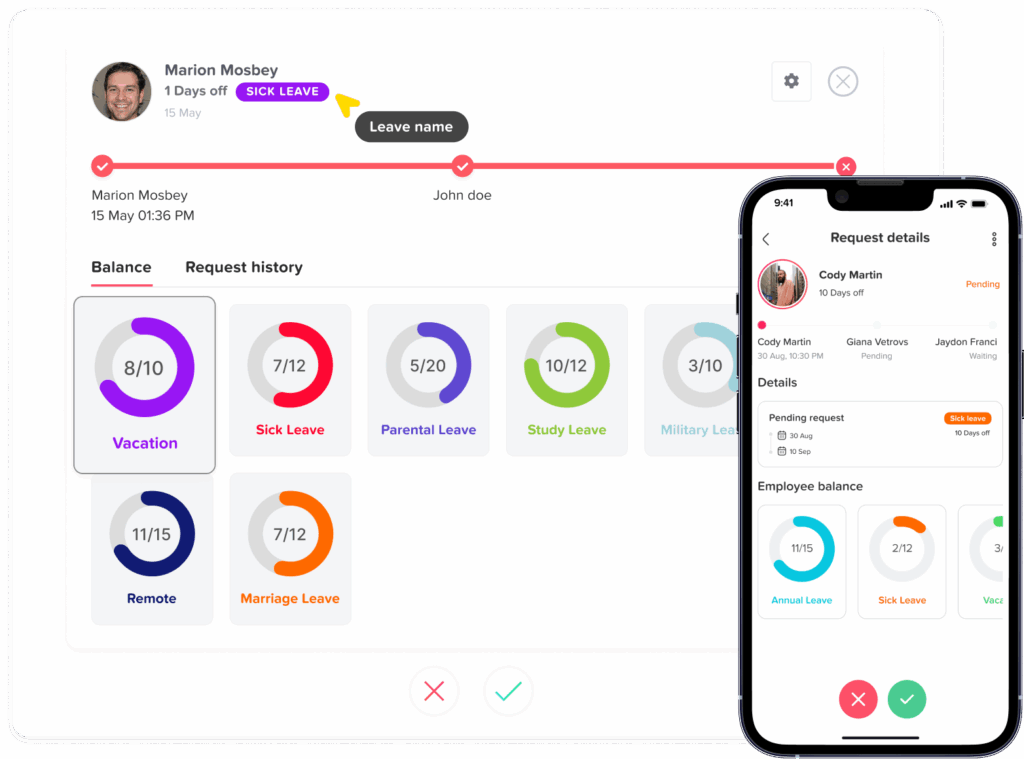
Apply Coverage Rules Across All Roles
Leave approval should consider the employee’s entire schedule.
For example, a hospital employee may work:
- Three nursing shifts
- One training shift
- One administrative shift
Approving leave based only on the nursing department calendar could cause the organization to overlook training obligations or administrative deadlines.
Coverage controls may include:
- Minimum employees required per shift
- Minimum employees with a specific certification
- At least one supervisor available
- Maximum percentage of a team absent
- Location specific staffing requirements
- Restricted payroll or reporting dates
- Required client or project handovers
- Rules for opening and closing shifts
- Restrictions during inventory counts or peak seasons
Coverage rules should be based on legitimate operational needs, applied consistently, and designed so employees still have a reasonable opportunity to use their leave.
Manage Rotating and Compressed Schedules
Rotating and compressed schedules require hour based deductions.
Four 10 Hour Days
An employee works Monday through Thursday for ten hours per day.
- Monday absence: 10 PTO hours
- Friday absence: 0 PTO hours because Friday is not scheduled
- Half of Monday: 5 PTO hours
Alternating 36 Hour and 48 Hour Weeks
An employee works three 12 hour shifts one week and four 12 hour shifts the next.
The PTO For Employees deduction should be based on the specific shifts missed, not a standard eight hour day.
Rotating Weekends
An employee works every second weekend.
A request covering Saturday and Sunday should use PTO For Employees only when those dates fall within the employee’s scheduled rotation.
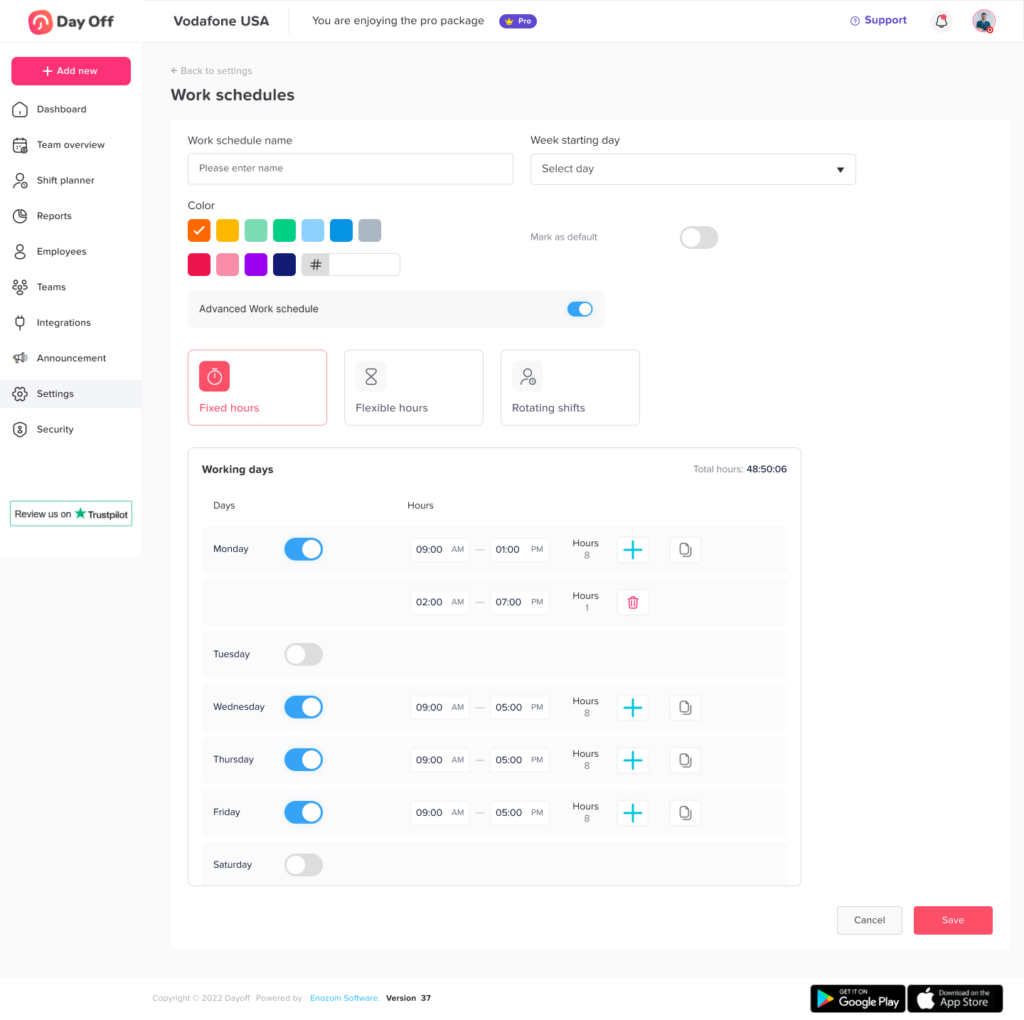
Split Shifts
An employee works:
- 7:00 a.m. to 11:00 a.m.
- 4:00 p.m. to 8:00 p.m.
Missing both portions normally uses eight PTO For Employees hours. Missing only the evening assignment uses four.
Protected Leave and Variable Schedules
Employer provided PTO For Employees is different from legally protected leave, although the two may run at the same time in some circumstances.
The federal Family and Medical Leave Act provides eligible employees of covered employers with unpaid, job protected leave for qualifying reasons. Employer provided paid leave may run concurrently with FMLA leave when the applicable conditions are met.
For intermittent or reduced schedule FMLA leave, the employee’s actual workweek is used to determine the proportion of leave taken. If the employee normally works 30 hours and takes 10 hours of qualifying leave, the employee has used one-third of a workweek.
When an employee’s schedule varies so much that the employer cannot determine what the employee would otherwise have worked, federal FMLA regulations provide for using a weekly average of scheduled hours over the previous 12 months, including hours for which the employee took leave.
Required overtime that the employee cannot work because of an FMLA-qualifying reason may count against the employee’s FMLA entitlement. Voluntary overtime not worked generally may not be counted.
Employers should keep PTO For Employees, FMLA, paid sick leave, disability leave, workers’ compensation, and accommodation processes distinguishable even when they overlap.
PTO For Employees for Salaried Exempt Employees With Multiple Duties
Some salaried employees divide their time among management, professional, administrative, operational, or technical duties.
The employer should not assume that a managerial title automatically makes the employee exempt from overtime requirements. Classification depends on applicable salary and duties tests, not the title alone.
Under federal salary basis rules, improper partial day salary deductions can threaten an employee’s exempt status. Partial day deductions from the employee’s PTO For Employees bank may be permissible when the employee still receives the full guaranteed salary, but deductions from salary are subject to stricter requirements and exceptions.
Employers should separate these two actions:
- Deducting hours from a PTO For Employees balance
- Deducting money from an employee’s salary
They are not automatically governed by the same rule.
Handle On Call and Standby Assignments
Employees may have a regular schedule plus on call responsibilities.
The PTO policy should answer:
- Does PTO automatically remove the employee from the on call list?
- Must the employee submit a separate on call coverage request?
- Are scheduled on call hours included in PTO deductions?
- What happens if the employee is called to work during approved PTO?
- Can an employee remain voluntarily available while on PTO?
- Who assigns the replacement?
An employee on approved full day PTO should not normally remain responsible for responding to calls unless the policy clearly treats the time as partial leave and the arrangement is lawful.
The scheduling system should remove or flag on call assignments when PTO is approved.
Deal With Holidays and PTO Correctly
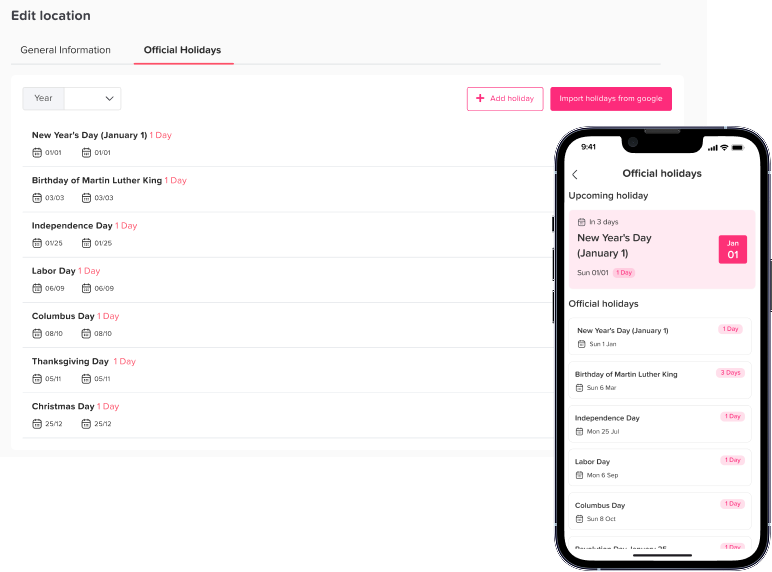
When a holiday overlaps with PTO, the policy should explain whether:
- The holiday is paid separately
- PTO is deducted
- The employee receives a replacement holiday
- The result depends on whether the employee was scheduled
- The rule differs by location or role
Example:
An employee requests an entire week off, and one day is a company holiday.
If the organization normally pays holidays without requiring PTO, the employee might use PTO only for the remaining scheduled workdays.
Employees with multiple roles may have different holiday calendars because they work in different locations or business units. The system should apply the calendar associated with the scheduled assignment rather than automatically using the employee’s primary department.
Avoid These Common PTO Mistakes
Creating Duplicate Employee Profiles
This can produce duplicate balances, inconsistent seniority dates, and two overlapping requests for the same absence.
Deducting Eight Hours for Every Full Day
This disadvantages employees who work shorter shifts and misrepresents absences for employees who work longer shifts.
Ignoring Secondary Assignments
The request may appear fully covered in one department while creating a staffing problem in another.
Using Only the Primary Role’s Hours
All eligible hours should be included when the policy bases accruals on total hours worked.
Allowing Managers to Choose the Pay Rate
The PTO pay rate should be determined by a written payroll rule, not by individual preference.
Counting PTO as Hours Worked for Federal Overtime
Paid leave is generally not treated as hours worked under the FLSA, although a policy, agreement, or state rule may provide more generous treatment.
Changing Schedules After Approval Without an Audit Trail
Schedule changes should not silently change the employee’s leave deduction.
Failing to Update Accrual Rules After a Permanent Status Change
Employees who move between full time and part time schedules need a clear effective date and proration rule.
Mixing Protected and Unprotected Leave
A normal vacation request should not be administered as FMLA leave, and an FMLA qualifying absence should not be treated only as ordinary attendance misconduct.
What a Multi Role PTO Policy Should Include
A complete policy should address:
Employee Eligibility
Define whether eligibility is based on:
- Total employment status
- Primary role
- Hours worked
- Scheduled hours
- Length of service
- Employment category
- Collective bargaining coverage
- Work location
Accrual Rules
State:
- How PTO is earned
- Which hours count
- Whether hours from all assignments are combined
- Whether overtime hours generate additional PTO
- When accruals are posted
- Whether accrual caps apply
- How schedule changes affect future accruals
Usage Rules
Explain:
- Whether PTO is tracked in hours
- The smallest permitted increment
- How full and partial shifts are calculated
- How unpaid breaks are handled
- What happens before a schedule is published
- Whether employees can use PTO on unscheduled days
- How split shifts are handled
PTO Payment
Specify:
- Base rate, scheduled role rate, or average rate
- Treatment of shift differentials
- Treatment of commissions and bonuses
- Treatment of tips
- Treatment of special assignment premiums
- Required paid sick leave calculations
- Payroll correction procedures
Approval Workflow
Identify:
- Primary approver
- Secondary approvers
- Managers who receive notifications
- Coverage checks
- Escalation procedures
- Approval deadlines
- Rules for conflicting decisions
Schedule and Assignment Data
Identify:
- The official schedule system
- Who may edit schedules
- When schedules become final
- How PTO affects assigned shifts
- How later schedule changes affect leave
- How records are retained
Status Changes
Explain how the organization handles:
- Full time to part time changes
- Part time to full time changes
- Temporary transfers
- Permanent transfers
- Seasonal changes
- Promotions
- Additional assignments
- Removal of a secondary role
How PTO Software Can Support Employees With Multiple Schedules
Spreadsheets and manual calendars become difficult to maintain when one employee has multiple schedules, managers, policies, or locations.
A PTO management system should be able to:
- Maintain one employee profile
- Assign a defined work schedule
- Support fixed, flexible, and rotating schedules
- Calculate leave in hours
- Apply different leave policies
- Route requests through multiple approval levels
- Notify relevant managers
- Display absences on a shared calendar
- Apply location specific holidays
- Record partial day requests
- Preserve approval history
- Export balance and usage reports
- Integrate with calendars and communication tools
Day Off helps organizations centralize leave balances, work schedules, approvals, employee availability, holiday calendars, and PTO reports. This makes it easier to manage employees who work across teams or follow schedules that do not fit a standard Monday to Friday pattern.
Technology does not replace a clear policy, but it can ensure that the chosen rules are applied consistently.
Implementation Checklist
Before launching or updating a multi role PTO policy:
- List every employee with more than one role, rate, location, or schedule.
- Confirm that each person has only one master employee record.
- Identify the system that owns schedule data.
- Decide whether PTO is earned from total hours or employment status.
- Convert day based balances to hours where appropriate.
- Define how PTO is paid for multiple rate employees.
- Document how split shifts and rotating schedules are handled.
- Create an approval workflow for multiple managers.
- Separate schedule approval from payroll calculation.
- Test full day, partial day, holiday, and schedule change scenarios.
- Review state and local paid leave requirements.
- Review overtime and salary basis rules.
- Train managers before applying the policy.
- Give employees written examples.
- Audit balances and payroll results after implementation.
Frequently Asked Questions
How is PTO calculated for an employee with two jobs at the same company?
The employer should first determine whether both jobs form one employment relationship. In most internal multi role situations, eligible hours from both roles should be combined when PTO accrues according to hours worked. Separate calculations may be appropriate when different agreements or legal rules apply.
Which manager should approve PTO for an employee working in two departments?
The organization may assign one primary approver, require approval from every affected manager, or use a multi level workflow. The best method depends on staffing needs, but all affected departments should at least be able to see the approved absence.
What rate should be used to pay PTO when the employee has multiple pay rates?
The policy may use the rate of the missed assignment, a defined base rate, or an average rate. The rule should be written, consistent, and reviewed against state or local paid leave requirements.
Should PTO be deducted in hours or days for rotating shift employees?
Hours are usually more accurate. The employer should deduct the hours the employee was scheduled to work, such as 8, 10, or 12 hours, rather than treating every shift as one identical day.
Does PTO count toward overtime?
Under the general federal FLSA rule, PTO is not considered time actually worked and does not create overtime by itself. State law, a contract, a union agreement, or an employer policy may provide a different or more generous result.
What happens if the schedule has not been published when PTO is requested?
The employer can use an expected rotation, an average scheduled day, or provisional approval. The exact hours should be confirmed when the final schedule becomes available.
Should existing PTO be reduced when an employee moves to part time work?
A common approach is to preserve the hours already earned and change future accruals from the effective date. However, the employer should check applicable law and its written policy before reducing an accrued balance.
Can an employee use PTO for only one of two roles scheduled on the same day?
Yes, when the employee remains available to perform the other assignment. The request should identify the exact absence period, and the employer should deduct only the scheduled hours missed.
How should holidays be handled for employees working in multiple locations?
The holiday calendar associated with the employee’s scheduled location or assignment should generally be applied. The policy should explain which calendar controls when locations observe different holidays.
Can PTO be deducted from a salaried exempt employee for part of a day?
An employer may generally reduce an exempt employee’s PTO bank for a partial day absence while continuing to pay the full salary. Reducing the employee’s actual salary for a partial day absence is more restricted under federal salary basis rules.
Conclusion
PTO for employees with multiple roles or work schedules requires more than a standard vacation request form. Employers need to connect the employee’s complete schedule, assignments, pay rules, managers, and leave eligibility within one consistent process.
The most reliable approach is usually to maintain one employee record, track PTO in hours, combine eligible service across internal roles, deduct the hours actually scheduled, and define the PTO pay rate in writing. Approval workflows should consider every affected team, while schedule and payroll systems should exchange accurate information.
Clear rules protect employees from inconsistent deductions and help employers avoid duplicate balances, coverage gaps, payroll errors, and compliance problems. When the policy is supported by accurate scheduling and PTO software, even complex work arrangements can be managed fairly and efficiently.