







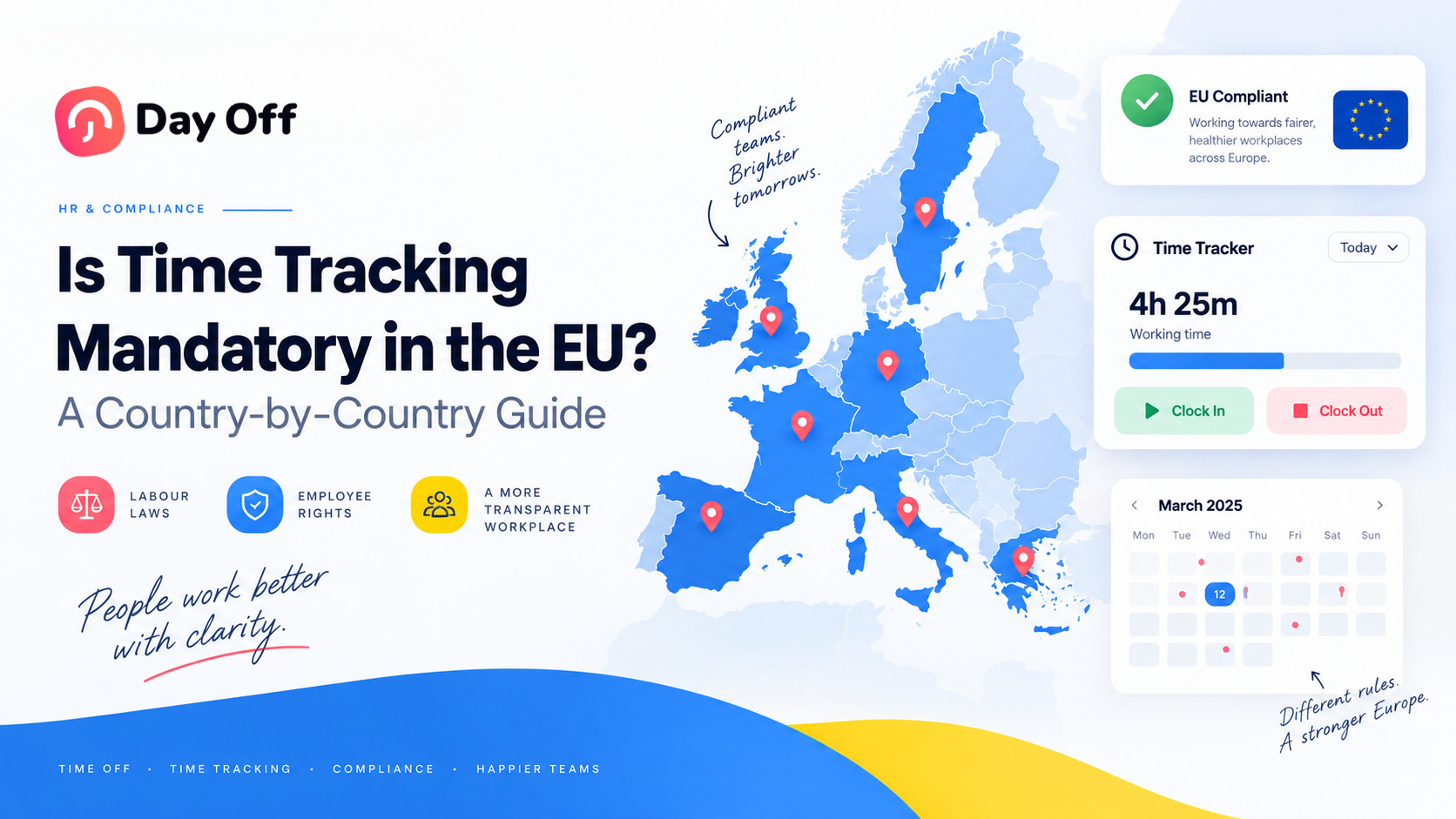
If you employ people in the European Union, recording working hours is more than a useful HR practice. In many cases, it is a legal requirement. The short answer is yes, time tracking in the EU is mandatory. Following a landmark 2019 ruling by the Court of Justice of the European Union (CJEU), EU member states must require employers to have a system that measures each employee’s daily working time.

But there is an important detail: the exact rules are not identical in every country.
Spain requires specific start and end times. Germany requires employers to record working time but currently allows flexibility in how it is recorded. Greece has introduced a government-connected Digital Work Card. Other countries have different requirements for breaks, record retention, employee access, and reporting.
For companies with employees in several European countries, that can quickly become difficult to manage.
This guide explains:
- What EU law says about working time
- Why the 2019 CJEU ruling matters
- How time tracking rules differ between European countries
- Which employees need to be tracked
- What can happen when records are missing
- How to build a practical time recording process for your team
What Does EU Law Say About Working Time?
The foundation of EU working time law is the Working Time Directive 2003/88/EC.
Its purpose is mainly to protect employee health and safety by setting minimum standards for working hours, breaks, rest periods, and annual leave.
Under the directive, employees are generally entitled to:
- An average maximum working week of 48 hours, including overtime
- At least 11 consecutive hours of rest during every 24-hour period
- A minimum weekly rest period of 24 hours, in addition to the daily 11-hour rest
- A rest break when the working day exceeds six hours, with the exact duration determined by national law
- At least four weeks of paid annual leave each year
These rules are difficult to enforce, however, if there is no reliable record of how many hours employees actually work.
That issue led to one of the most important European working time decisions in recent years.
Why Did Time Tracking Become Mandatory in the EU?
On 14 May 2019, the Court of Justice of the European Union issued its judgment in Federación de Servicios de Comisiones Obreras (CCOO) v Deutsche Bank SAE, Case C-55/18.
The case involved a Spanish trade union that argued employers should be required to record employees’ actual daily working hours.
Why?
Because without accurate records, employees may find it difficult to prove:
- How many hours they worked
- Whether overtime was performed
- Whether maximum working time limits were respected
- Whether legally required rest periods were provided
The Court agreed.
It held that EU member states must require employers to establish an:
“objective, reliable and accessible system”
for measuring each worker’s daily working time.
The decision did not create one identical time tracking system for the entire European Union. Instead, individual member states were given flexibility to determine how the requirement should work under national law.
That is why the basic obligation exists across the EU, while the exact rules can differ considerably from one country to another.
What Does “Objective, Reliable and Accessible” Mean?
These three words are important when choosing or designing a time tracking process.
Objective
The system should reflect the hours employees actually work.
A planned schedule saying an employee works from 9:00 AM to 5:00 PM is not necessarily proof that those were the employee’s real working hours.
The system should therefore capture actual working time rather than relying only on contractual schedules.
Reliable
Working time records should be accurate and trustworthy.
Employees should record their hours when they work them or shortly afterward. Any corrections should also follow a clear process so that records cannot simply be changed without explanation.
Accessible
Employees and, where applicable, worker representatives and labour authorities should be able to access the records when necessary.
A system should not store working time information somewhere that employees or inspectors cannot reasonably review.
For these reasons, relying only on contracts, scheduled shifts, or an editable spreadsheet may not provide the strongest evidence of actual working time.
Is Time Tracking Mandatory in Every EU Country?
The general obligation applies throughout the European Union, but national implementation differs.
Some countries had detailed time recording requirements even before the 2019 judgment. Others introduced new requirements afterward. In some countries, court decisions currently play an important role while additional legislation is still being developed.
Here is a general overview of several major EU markets.
| Country | Main Legal Basis | What Is Generally Recorded | Record Retention |
|---|---|---|---|
| Spain | Workers’ Statute, Article 34.9 | Specific start and end time of the working day | 4 years |
| Germany | Federal Labour Court ruling, 13 September 2022; Working Time Act | Start, end, and duration of daily working time | At least 2 years for Working Time Act records |
| Portugal | Labour Code, Article 202 | Start and end times, including breaks | 5 years |
| Greece | Law 4808/2021, Digital Work Card | Electronic clock-in and clock-out information | Stored electronically through ERGANI |
| Italy | Libro Unico del Lavoro | Daily hours, overtime, and absences | 5 years |
| France | Labour Code, Article L3171-2 | Daily and weekly hours for employees outside a single collective schedule | Depends on applicable requirements |
| Netherlands | Working Hours Act | Working and rest times | Generally 52 weeks |
| Ireland | Organisation of Working Time Act 1997 and Records Regulations | Start and finish times, daily hours, and weekly hours | 3 years |
| Denmark | Working time recording requirements effective from 1 July 2024 | Daily working time | 5 years |
Because national employment rules can change, employers should verify the current requirements before relying on this table for compliance decisions.
Spain: Detailed Time Recording Requirements
Spain was one of the first countries to introduce a clear nationwide daily time registration requirement.
Royal Decree-Law 8/2019 added Article 34.9 to the Workers’ Statute, making the registro de jornada, or working time register, mandatory from 12 May 2019.
Employers must generally record the specific:
- Start time of the employee’s working day
- End time of the employee’s working day
These records must be retained for four years.
They must also be available to employees, their legal representatives, and the Labour Inspectorate.
The method used to record working time may be determined through collective bargaining or a company agreement. Where no agreement exists, the employer establishes the system after consulting worker representatives.
Employers operating in Spain should also monitor regulatory developments because the country has considered further reforms relating to digital working time records and inspector access.
Germany: Time Tracking Is Already Required
Germany provides a useful example of why employers should not wait for a new statute before taking action.
On 13 September 2022, Germany’s Federal Labour Court, the Bundesarbeitsgericht, ruled in case 1 ABR 22/21 that employers already have an obligation to record employees’ total working time.
The judgment relied on Germany’s occupational health and safety framework interpreted in line with the CJEU’s 2019 decision.
Employers generally need to record:
- When the working day starts
- When the working day ends
- The total duration of daily working time
The obligation also applies to employees working remotely.
At present, employers have flexibility over the format used for recording working time, meaning electronic systems are not universally required under the existing framework.
Germany’s Working Time Act also contains separate obligations relating to certain working hours, including work exceeding eight hours per day and work performed on Sundays or public holidays.
For employers, the important point is that the time recording obligation already exists. Waiting for future legislation before implementing a system can leave a business without adequate working time records in the meantime.
Greece: The Digital Work Card
Greece has taken a more technology-driven approach.
Under Law 4808/2021, Greece introduced the Digital Work Card, which allows employee clock-in and clock-out information to be recorded electronically and connected to the government’s ERGANI employment system.
Implementation has been expanded gradually across different industries.
This approach provides authorities with more direct visibility into actual working hours and makes accurate clocking practices particularly important for employers covered by the system.
Companies operating in Greece should verify whether their sector currently falls within the Digital Work Card requirements and what reporting rules apply.
Portugal, Italy, and France
Portugal
Article 202 of the Portuguese Labour Code requires employers to maintain working time records.
These records generally include employees’ start and end times as well as breaks.
Working time records must generally be kept for five years.
Italy
Italy uses the Libro Unico del Lavoro, or Single Employment Register, as an important part of employment and payroll recordkeeping.
Records can include:
- Hours worked
- Overtime
- Absences
- Other employment information
These records are closely connected to payroll administration.
France
French rules depend partly on the employee’s working arrangement.
When employees do not all work according to the same collective schedule, employers generally need to keep records that allow daily working time and weekly totals to be monitored.
Employees working under a forfait-jours arrangement are managed differently because their working time is generally measured in days rather than hours.
This is another reason businesses should avoid assuming that one time tracking policy will automatically satisfy every European jurisdiction.
Netherlands, Ireland, and Denmark
Netherlands
Under the Dutch Working Hours Act, employers must keep sufficient records to demonstrate employees’ working and rest times.
Records are generally retained for 52 weeks.
Ireland
Irish employers are required to maintain records showing compliance with working time requirements.
These records can include:
- Start times
- Finish times
- Daily working hours
- Weekly working hours
Employers may use an electronic clocking system or another compliant method, and records generally need to be kept for three years.
Denmark
Since 1 July 2024, employers in Denmark must have an objective, reliable, and accessible system for recording each employee’s daily working time.
Records generally need to be retained for five years.
For Danish employers, this means having a consistent process for documenting working time rather than relying solely on planned schedules.
Do All Employees Need to Track Their Time?
Working time recording requirements can apply to many different types of employees, including:
- Full-time employees
- Part-time employees
- Remote employees
- Hybrid employees
- Shift workers
- Employees with flexible working hours
- Employees working across different offices or locations
Remote work does not automatically remove the employer’s responsibility to monitor working time.
In fact, remote work can make accurate recording even more important because managers cannot physically see when someone begins or ends their working day.
A clear time tracking process helps both employers and employees understand actual hours worked and whether required rest periods are being respected.
Are Managers Exempt From Time Tracking?
Sometimes, but not automatically.
Article 17 of the Working Time Directive allows member states to create exceptions for certain workers whose working time is not measured or predetermined because of the nature of their role.
This may include some:
- Managing executives
- Employees with substantial autonomous decision-making authority
- Certain family workers
- Workers whose schedules are genuinely self-determined
However, the scope of these exceptions depends on national law and is generally interpreted carefully.
A job title such as “manager” does not automatically mean the employee is exempt.
Employers should confirm whether a specific exemption applies before excluding an employee from working time records.
Do Remote Employees Need to Track Their Time?
Yes, remote work does not generally create a separate exemption from working time requirements.
Employees working from home still have:
- Working hour limits
- Daily rest requirements
- Weekly rest requirements
- Overtime rules
- Break requirements
The practical challenge is making the process simple enough that remote employees actually use it.
Instead of relying on messages such as “I started working” or manually reconstructed timesheets at the end of the month, employers can use a consistent clock-in and clock-out process regardless of where the employee works.
This gives both the employer and employee a clearer record of the working day.
What Happens If an Employer Does Not Track Working Time?
Missing time records can create several problems beyond a single compliance fine.
Labour Inspection Penalties
Depending on the country, missing, inaccurate, or incomplete working time records may be treated as an administrative offence.
Authorities may request records during an inspection, making it important that employers can retrieve them quickly.
Overtime Disputes
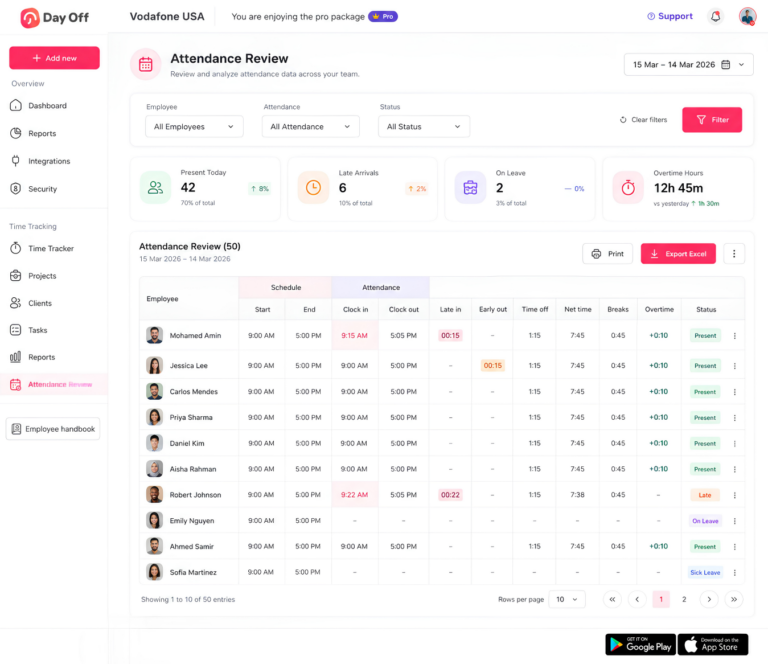
If an employee claims that they regularly worked additional hours, accurate records can help establish what actually happened.
Without reliable records, responding to overtime disputes becomes much more difficult.
Working Time and Rest Violations
Employers need working time data to determine whether employees are exceeding working hour limits or missing required rest.
Without that information, it becomes harder to identify problems before they become serious.
Payroll Errors
Hours worked can affect:
- Overtime pay
- Night work premiums
- Public holiday pay
- Shift premiums
- Payroll calculations
Poor time records therefore create payroll risks as well as compliance risks.
How to Build a Better EU Time Tracking Process
There is no single time tracking system that automatically guarantees compliance in every EU country.
However, employers can create a strong foundation by following a few practical steps.
Identify the Rules in Every Country Where You Employ People
Start by listing every country where you have employees.
For each location, determine:
- What information must be recorded
- Whether breaks need to be included
- Whether electronic recording is required
- How long records must be retained
- Who needs access
- Whether information must be reported to a government system
Do not assume that the requirements for an employee in Madrid are identical to those for an employee in Berlin, Paris, or Athens.
Record Actual Working Time
A work schedule and a time record are not the same thing.
An employee may be scheduled from 9:00 AM to 5:00 PM but actually work from 8:47 AM to 5:26 PM.
If the purpose of the system is to document real working time, the record should reflect what actually happened.
Make Clocking In and Out Simple
The more complicated the process is, the more likely employees are to forget it.
Employees should clearly understand:
- When to clock in
- When to clock out
- Whether breaks are recorded
- What happens if they forget a punch
- How incorrect entries are corrected
- Who approves changes
A simple process usually produces more reliable records.
Connect Employees to Their Work Schedules
Time records are more useful when they can be compared with an employee’s expected schedule.
For example, an employee may work:
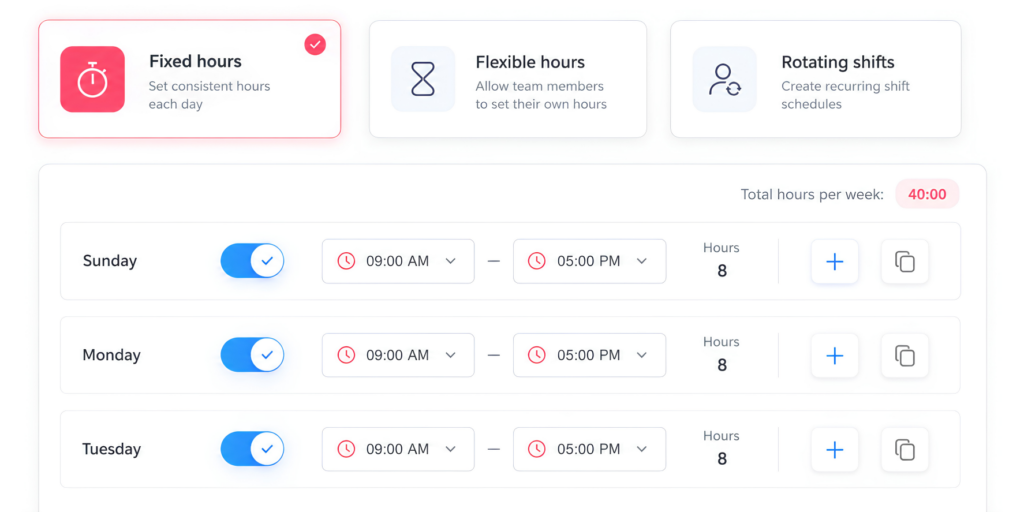
- Fixed hours
- Flexible hours
- Rotating shifts
- Split shifts
- Different schedules on different days
Connecting recorded time to the correct schedule helps employers identify overtime, lateness, early departures, and missed punches.
Connect Time Tracking With Leave
A missing clock-in does not always mean an employee was absent without explanation.
The employee may have been:
- On annual leave
- On sick leave
- On parental leave
- Taking another approved day off
- Observing a public holiday
When leave and attendance are managed separately, managers may need to investigate every missing timesheet entry manually.
Connecting the two creates a clearer picture of what happened on each working day.
Give Employees Access to Their Records
Employees should be able to review their own working time records where required.
This also gives them an opportunity to identify mistakes early rather than discovering them weeks or months later.
Create a Written Time Tracking Policy
Technology alone is not enough.
Employees should know the rules for using the system.
A time tracking policy can explain:
- When employees must clock in
- Whether breaks must be recorded
- Whether employees may work before clocking in
- How missed punches are corrected
- Who can edit a time entry
- Who approves corrections
- How overtime is handled
Clear rules make the system more consistent and easier to manage.
Review the Records Regularly
Do not wait for a payroll problem or labour inspection to discover missing records.
Managers or HR teams should periodically look for:
- Missing clock-outs
- Unusual working hours
- Repeated edits
- Excessive overtime
- Missing breaks
- unexplained absences
Regular reviews make it easier to correct problems while the information is still fresh.
How Day Off Can Help With Working Time Records
Managing time tracking becomes more complicated when working hours, schedules, leave, and attendance are stored in different systems.
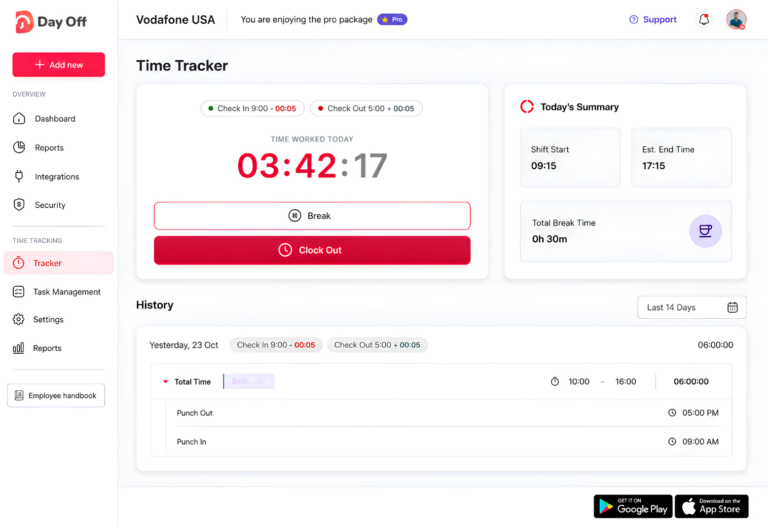
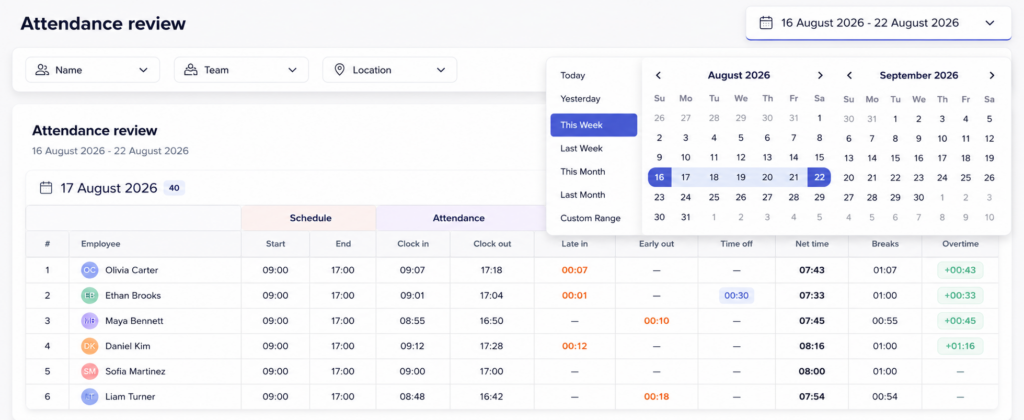
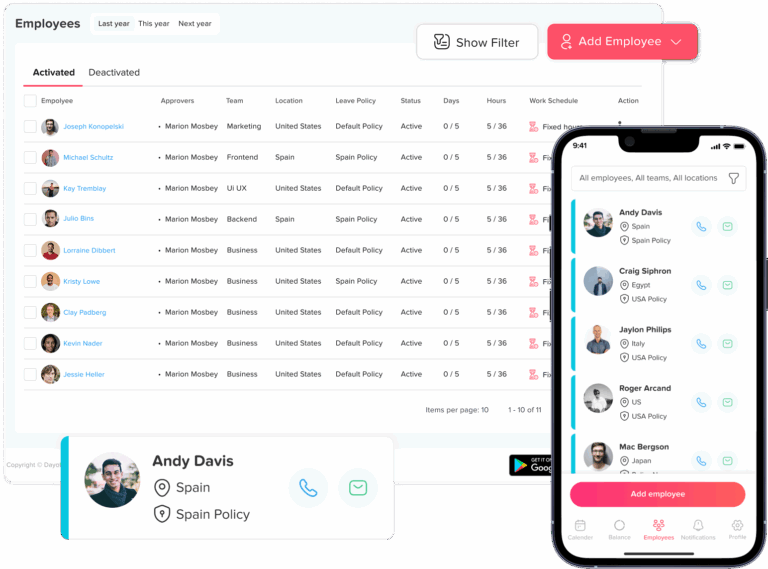
Day Off Time Tracker brings working time and leave management together so managers can see not only when an employee worked, but also why they did not work on a scheduled day.
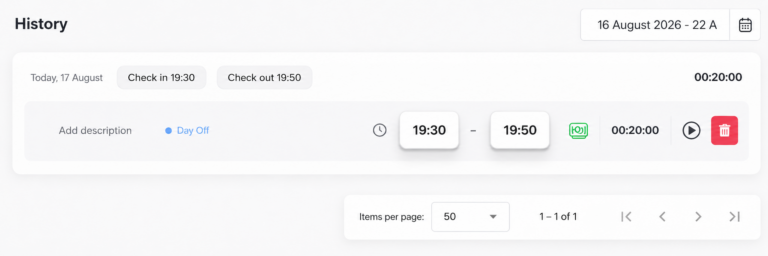
Record Actual Clock-In and Clock-Out Times
Employees can record when their working day starts and ends, giving managers a record based on actual activity rather than simply relying on scheduled hours.
Support Different Work Schedules
Teams can be assigned schedules that match the way they actually work, including fixed, flexible, and rotating arrangements.
Recorded working time can then be compared with the employee’s expected hours to identify:
- Late arrivals
- Early departures
- Overtime
- Missed working time
See Attendance More Clearly
Managers can review attendance information to understand who is working, who has recorded time, and where an attendance entry may be missing.
Connect Attendance With Leave
Because time tracking and leave management sit together, an employee who does not record working time on a scheduled day may already have an approved leave request explaining the absence.
This reduces the need to reconcile two separate systems.
Export Attendance Records
Attendance data can be exported for further review, payroll preparation, or recordkeeping.
Reports can include information such as:
- Clock-in and clock-out times
- Hours worked
- Late time
- Overtime
- Absences
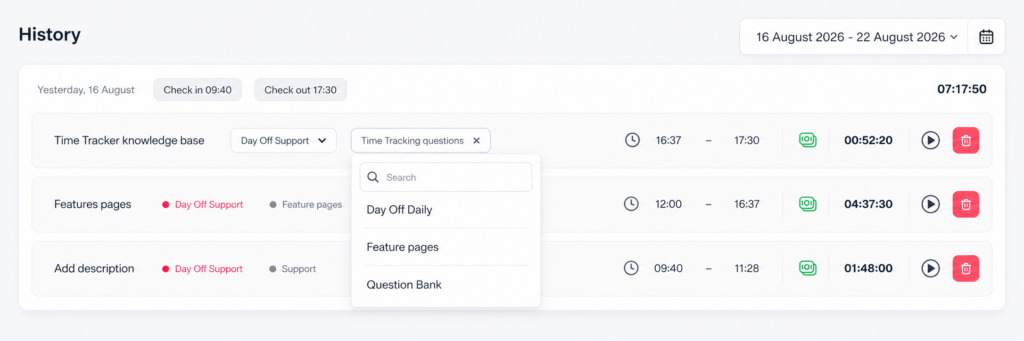
Track Tasks and Work Logs
Teams that need more detailed work records can also use task-based tracking to understand how working time is distributed across different activities or projects.
Manage International Teams
Companies with employees in several countries also need to consider different public holidays and work schedules.
Using location-specific calendars alongside employee schedules can make it easier to understand whether someone was expected to work on a particular day.
Time tracking software does not replace local legal advice or country-specific requirements, especially where government reporting systems are mandatory. However, having consistent working time, attendance, schedule, and leave records in one place can make day-to-day compliance management much easier.
Frequently Asked Questions About EU Time Tracking
Do employers need to track what employees are working on, or only their working hours?
EU working time rules generally focus on how long an employee works, rather than requiring employers to document every task they perform.
For basic working time records, start times, end times, total working hours, and sometimes breaks may be more important than a detailed activity log.
However, companies may choose to track projects or tasks separately for billing, productivity, project management, or payroll purposes. Those additional records should not be confused with the legal requirement to record working time
Do employee breaks need to be recorded separately?
This depends on the country and the time recording system being used.
Because EU working time rules include minimum rest and break requirements, employers should be able to distinguish working time from periods when an employee is genuinely on a break where national rules require it.
For example, a system that simply records an eight-hour shift without showing that an employee took a required break may not provide enough information in some jurisdictions.
Employers should check whether local law requires the duration, timing, or both the start and end of breaks to be recorded.
How should overnight shifts be recorded?
Overnight shifts can create additional complexity because the employee begins work on one calendar day and finishes on another.
For example, an employee may clock in at 10:00 PM on Monday and clock out at 6:00 AM on Tuesday.
A good time tracking system should preserve the actual start and end times rather than artificially splitting or changing the entry.
Employers should also make sure overnight work is assessed correctly for daily rest, weekly working time, night work rules, and any applicable pay requirements.
What should happen if an employee forgets to clock in or clock out?
A missed punch should normally be corrected through a documented process rather than simply ignored or guessed.
For example, an employee could submit the correct start or end time, and a manager could review and approve the correction.
The important point is maintaining a trustworthy record of what happened.
Companies should therefore establish a missed punch policy explaining:
- How employees report missing entries
- Who can correct them
- Who approves the correction
- Whether the original entry and subsequent change are recorded
- How repeated missed punches are handled
This helps keep the time record reliable while giving employees a practical way to fix genuine mistakes.
Can managers change an employee’s recorded working hours?
Corrections may sometimes be necessary, but employers should avoid allowing working time records to be changed without a clear reason or process.
For example, a manager may need to correct an accidental clock-in or confirm a missed clock-out.
Ideally, the system should make it possible to understand:
- What was changed
- What the original record showed
- Who made the change
- When the change was made
- Why it was corrected
Keeping a clear history of corrections helps protect the reliability of the records and reduces disputes about whether working hours were altered after the fact.
Can employers round employees’ clock-in and clock-out times?
Employers should be careful with time rounding.
If an employee clocks in at 8:57 AM, for example, automatically changing the record to 9:00 AM means the stored time no longer represents the exact time recorded.
Whether rounding is permitted, and under what conditions, can depend on national employment and payroll rules.
For compliance purposes, keeping the actual recorded time is generally the clearer approach. Employers can then apply payroll rules separately where legally permitted rather than changing the original attendance data.
Does travel time count as working time?
Sometimes.
Whether business travel counts as working time depends on the circumstances, the employee’s normal workplace, the type of travel involved, and applicable national and EU rules.
Travel between two customer locations during the working day, for example, may be treated differently from an employee’s normal commute between home and a fixed office.
Employees who have no fixed workplace can also raise different working time questions.
Companies with employees who regularly travel should establish clear rules for recording travel time and confirm how the relevant jurisdiction classifies it.
How should on-call or standby time be recorded?
On-call arrangements can be more complicated than ordinary working hours.
Whether standby time qualifies as working time can depend on the restrictions placed on the employee.
For example, an employee who must remain at a specific workplace while waiting to be called may be treated differently from an employee who can stay at home and use their time relatively freely.
Response-time requirements and other restrictions may also affect the analysis.
Employers using on-call schedules should therefore determine how those periods are treated under the applicable national rules and configure their time records accordingly.
Does employee time tracking need to comply with GDPR?
Yes. Working time records contain information connected to identifiable employees, which means employers should also consider their obligations under the General Data Protection Regulation (GDPR).
Employers should think about:
- Why the data is being collected
- Which information is actually necessary
- Who can access the records
- How the data is protected
- How long the information is retained
- What employees are told about the processing of their data
A time tracking system should collect the information needed for legitimate employment and compliance purposes without unnecessarily monitoring employees.
Can employers use GPS, facial recognition, fingerprints, or other tracking technologies for clocking in?
Technology can make time recording easier, but more monitoring does not automatically mean better compliance.
GPS location tracking, fingerprint scanners, facial recognition, and similar technologies can raise significant employee privacy and data protection questions.
Biometric information can receive particularly strong protection under GDPR.
An employer that only needs to know when an employee started and finished work may need to consider whether collecting additional location or biometric information is necessary and proportionate.
Before introducing these technologies, businesses should evaluate local employment law, employee privacy rules, GDPR requirements, and any consultation obligations that may apply.
Conclusion
So, is time tracking mandatory in the EU?
At the EU level, employers need a reliable way to measure employees’ daily working time. Since the CJEU’s 2019 ruling, member states have been responsible for ensuring that employers use systems that are objective, reliable, and accessible.
What changes from country to country is how that obligation is implemented.
Spain has detailed daily registration rules. Germany’s courts have confirmed that employers must already record working time. Greece uses its Digital Work Card system. Denmark introduced specific daily recording requirements in 2024, while other countries follow their own recordkeeping frameworks.
For employers, the safest practical approach is to stop thinking about time tracking as simply a payroll task.
A good system should help you answer three basic questions:
- When was the employee expected to work?
- When did the employee actually work?
- If they did not work, was there an approved reason?
Connecting work schedules, actual working hours, attendance, leave, and holidays makes those questions much easier to answer.
With Day Off, teams can manage time tracking and leave information together, giving HR and managers a clearer record of both working time and time away from work.
Want to simplify working time and attendance management? Start using Day Off Time Tracker and keep your team’s hours, schedules, and leave in one place.