







A PTO Blackout Policy gives employers a structured way to manage time off requests during periods when employee coverage is especially important. Rather than reacting to staffing shortages after too many employees request the same dates, businesses can identify critical periods in advance, communicate restrictions clearly, and create a consistent process for handling vacation requests while still respecting employees’ need for time away from work.

Blackout periods are particularly common in industries affected by seasonal demand, major sales periods, financial deadlines, product launches, events, inventory counts, or other predictable business peaks. However, simply telling employees that “no time off is allowed” during certain dates can create frustration and, depending on the type of leave involved, may conflict with applicable leave laws.
A good PTO blackout policy should therefore do more than restrict vacation. It should explain why restrictions exist, which types of leave are affected, how long the restriction lasts, whether exceptions are available, and how competing requests will be handled fairly.
This guide explains how PTO blackout periods work, when businesses may need them, how to create a practical policy, and how HR teams can manage restricted dates without turning necessary staffing controls into an unnecessarily rigid leave system.
What Is a PTO Blackout Policy?
A PTO blackout policy is a workplace rule that restricts or limits employees from using certain types of paid time off during specified periods.
For example, a retailer experiencing its highest sales volume between Thanksgiving and Christmas might restrict vacation requests during part of that period. An accounting firm may limit vacation during important tax deadlines, while a software company could establish temporary restrictions during a major product launch.
The goal is generally not to prevent employees from taking PTO altogether. Instead, the business identifies specific dates when having enough employees available is particularly important.
A blackout policy may:
- Prevent new discretionary vacation requests during specified dates.
- Limit the number of employees who can be away simultaneously.
- Restrict PTO only for specific departments or job roles.
- Allow requests but require additional approval.
- Create exceptions for previously approved vacation.
- Separate discretionary vacation from legally protected or qualifying leave.
- Establish priority rules when several employees request the same dates.
The exact approach should depend on the organization’s staffing requirements, workforce structure, industry, and applicable employment laws.
What Is a PTO Blackout Period?
A PTO blackout period is the specific date range during which normal vacation approval rules are modified because the organization expects unusually high staffing needs.
A blackout period might last:
- One day.
- Several days.
- A week.
- A specific holiday period.
- Several weeks during a seasonal peak.
- Certain recurring dates every year.
For example, a company could establish December 15 through December 31 as a vacation blackout period. Another organization might restrict PTO during the final three business days of every quarter.
Blackout periods should ideally be specific and predictable rather than indefinite. Telling employees that PTO may be unavailable “whenever the company is busy” gives employees very little ability to plan their leave.
Clearly defined dates make workforce planning easier for both employees and managers.
PTO Blackout Period vs. Normal PTO Approval Rules
Most organizations already reserve the right to approve or decline vacation requests based on staffing requirements. A blackout period goes one step further by identifying dates when restrictions are known in advance.
| Normal PTO Approval | PTO Blackout Period |
|---|---|
| Requests are evaluated individually | Restrictions are established for defined dates |
| Approval usually depends on current staffing | Staffing concerns are anticipated beforehand |
| Employees can normally submit requests throughout the year | Some requests may be restricted during designated periods |
| Conflicts are resolved as requests arrive | Rules can be communicated before requests are submitted |
| Availability may be difficult for employees to predict | Employees know which periods may be restricted |
Blackout policies can therefore make PTO management more predictable, provided the rules are communicated early and applied consistently.
Why Do Companies Use PTO Blackout Periods?
Blackout periods usually address predictable operational risks rather than ordinary staffing fluctuations.
Seasonal Demand
Some organizations experience dramatic increases in workload at specific times of year.
Examples include:
- Retail businesses during holiday shopping periods.
- Hotels and tourism businesses during peak travel seasons.
- E-commerce companies during major promotional events.
- Accounting firms around important filing deadlines.
- Logistics companies during high-volume shipping periods.
Allowing too many employees to take vacation simultaneously could leave the organization unable to meet customer demand.
Major Business Events
Temporary PTO restrictions may also be appropriate around significant events such as:
- Product launches.
- Software migrations.
- Store openings.
- Conferences.
- Annual inventory counts.
- Audits.
- Large customer implementations.
- Office relocations.
The restriction can be limited to the employees whose presence is genuinely needed rather than automatically applying company-wide.
Critical Project Deadlines
Teams sometimes have periods when specific employees are essential to delivering a project.
Instead of denying vacation unpredictably as the deadline approaches, management can identify the critical period earlier and discuss availability with the team.
Minimum Staffing Requirements
Certain workplaces cannot operate safely or effectively below a defined staffing level.
Healthcare, customer support, security, hospitality, manufacturing, and operations teams may need minimum coverage every day.
In these situations, employers may choose to limit the number of simultaneous PTO approvals rather than completely block requests.
Year End or Quarter End Processes
Finance, payroll, HR, sales, and accounting teams may have recurring deadlines that make certain dates difficult for vacation.
Examples include:
- Payroll processing.
- Year end closing.
- Financial reporting.
- Benefits enrollment.
- Tax preparation.
- Quarterly sales closing.
Recurring blackout dates can be included in an annual leave calendar so employees know about them well in advance.
Should a PTO Blackout Policy Apply to All Types of Leave?
Usually, no.
One of the most important parts of designing a blackout policy is distinguishing discretionary vacation requests from other forms of leave.
At the federal level in the United States, the Fair Labor Standards Act does not require employers generally to provide paid vacation benefits. Vacation benefits are normally governed by the employer’s policy, employment agreement, collective bargaining agreement, and applicable state or local rules.
That does not mean every absence can simply be prohibited during a blackout period.
Different legal protections may apply to sick leave, family leave, disability-related leave, military leave, pregnancy related leave, jury duty, and other types of absence.
For example, eligible employees of covered employers may have job-protected leave rights under the Family and Medical Leave Act for qualifying family and medical reasons. Employers cannot interfere with employees exercising FMLA rights simply because the requested leave falls during an inconvenient business period.
State and local paid sick leave laws may create additional requirements. California, for example, protects qualifying use of accrued paid sick leave and generally prohibits employers from denying the right to use available sick leave for covered purposes or disciplining employees for valid use.
New York also requires qualifying employers to provide sick leave and establishes rules governing employee use of that leave.
For this reason, a blackout policy should clearly identify which leave categories are subject to the restriction instead of treating every absence as ordinary vacation.
What Should a PTO Blackout Policy Include?
A useful policy should answer the questions employees are likely to ask before they submit leave.
Purpose of the Policy
Start by explaining why blackout periods exist.
For example:
Certain periods of the year require increased staffing due to seasonal demand, operational deadlines, or important business activities. The company may designate limited PTO blackout periods when discretionary vacation requests are restricted or subject to additional approval.
Providing the reason makes the policy easier to understand than simply stating that time off is prohibited.
Who the Policy Applies To
Specify whether restrictions apply to:
- All employees.
- Particular departments.
- Specific locations.
- Certain teams.
- Specific roles.
A company wide restriction may be unnecessary if only one department is experiencing increased demand.
Blackout Dates
Provide exact dates whenever possible.
Instead of:
PTO may be restricted during the holiday season.
Use:
Vacation requests may be restricted between December 15 and December 31.
Employees can then plan around the period.
Types of PTO Affected
State clearly whether the restriction applies to:
- Vacation.
- Personal days.
- Floating holidays.
- General PTO.
- Compensatory time.
- Other discretionary leave.
Also explain that legally protected or otherwise qualifying leave will continue to be handled according to applicable law and company policy.
Previously Approved PTO
The policy should explain what happens when vacation was approved before a blackout period was announced.
In most situations, announcing restrictions early enough to avoid this conflict is better than attempting to cancel approved vacations.
If approved leave can ever be reconsidered, the circumstances should be extremely clear and reviewed carefully.
Exceptions
There may be legitimate situations where management wants the ability to approve leave despite a blackout period.
Examples could include:
- Important personal events.
- Travel booked before the restriction was announced.
- Significant family circumstances.
- Special manager-approved exceptions.
- Situations where sufficient staffing remains available.
Exceptions should have a defined approval process so decisions do not appear arbitrary.
Request Priority
If some vacation can still be approved during blackout periods, establish how competing requests will be evaluated.
Possible approaches include:
- First requested, first considered.
- Rotating holiday priority.
- Minimum staffing calculations.
- Manager review based on operational coverage.
- Voluntary team coordination.
Each method has advantages and drawbacks.
The most important issue is consistency.
Notice Requirements
Explain how far in advance employees should request vacation during high-demand periods.
For example, the company could open holiday PTO requests on September 1 and establish an October 1 deadline for initial consideration.
A structured request window can be more equitable than allowing employees to compete by submitting requests months or years ahead.
Example PTO Blackout Policy
The exact wording should be reviewed against applicable laws and company policies, but a general internal policy might look like this:
Sample Policy
Purpose
To maintain adequate staffing during periods of unusually high business demand, the company may designate specific dates as PTO blackout periods.
Covered Leave
Blackout restrictions generally apply to discretionary vacation or personal PTO. Sick leave, protected family or medical leave, and other legally protected absences will be handled according to applicable laws and company policies.
Blackout Dates
Blackout periods will be announced as early as reasonably possible. Whenever practical, employees will receive at least 60 days’ notice.
PTO Requests
Vacation requests that include blackout dates may be declined or subject to additional approval based on operational requirements and staffing availability.
Existing Approvals
Vacation approved before the announcement of a blackout period will normally remain approved unless exceptional circumstances require further review.
Exceptions
Employees may request an exception from their manager and HR when significant personal circumstances exist. Approval is not guaranteed and will depend on applicable policy, legal requirements, and operational coverage.
Fair Application
Managers must apply blackout restrictions consistently among employees in comparable roles and circumstances.
How to Create a PTO Blackout Policy
Introducing blackout periods should be a workforce-planning process rather than a last-minute reaction.
Step 1: Analyze Historical Staffing Needs
Review previous years and determine when staffing shortages actually occurred.
Useful data includes:
- Number of PTO requests.
- Percentage of employees absent.
- Overtime hours.
- Missed service targets.
- Customer volume.
- Sales volume.
- Project deadlines.
- Staffing coverage.
- Employee workload.
Avoid creating blackout dates simply because a period “feels busy.”
Data can reveal whether an actual restriction is necessary.
Step 2: Identify the Minimum Coverage Required
Determine how many employees or which skills must remain available.
Suppose a customer support team has 15 employees but needs at least 10 people working during normal business hours.
Instead of preventing all vacation, the organization could allow up to five simultaneous absences.
This approach preserves more employee flexibility while protecting operational requirements.
Step 3: Choose the Narrowest Necessary Restriction
Blackout periods should generally be limited to the dates, teams, and roles that genuinely require them.
For example:
| Business Need | More Restrictive Approach | More Flexible Approach |
|---|---|---|
| Holiday retail demand | Ban vacation for the entire company for six weeks | Limit simultaneous vacation for store teams on specific peak dates |
| Product launch | Block PTO for every department | Restrict critical launch-team members during launch week |
| Quarter end reporting | Company wide blackout | Restriction for finance staff responsible for closing |
| Customer support peak | No vacation allowed | Maintain a minimum coverage threshold |
| Annual inventory | Week-long restriction | Limit leave on inventory count days |
The narrowest practical restriction can reduce disruption to employees without compromising business needs.
Step 4: Review Legal Requirements
Before implementing the policy, HR should review:
- Federal leave protections.
- State leave laws.
- Local paid sick leave rules.
- Employment contracts.
- Collective bargaining agreements.
- Company handbooks.
- Existing PTO commitments.
- Industry-specific requirements.
This becomes especially important for organizations operating across multiple states or countries.
The same blackout rule may not be appropriate everywhere.
Step 5: Define Exception Rules
Employees should know how exceptions work before they need one.
Determine:
- Who receives an exception request?
- What information is required?
- Who makes the final decision?
- How quickly will the employee receive an answer?
- What happens if managers disagree?
Documenting this process reduces inconsistent treatment.
Step 6: Publish Dates Early
Advance notice is one of the most effective ways to reduce conflict.
If a company knows every year that the final two weeks of December are critical, employees should not discover the restriction after they have booked flights.
Publish recurring blackout periods in:
- PTO policies.
- Employee handbooks.
- Company calendars.
- HR platforms.
- Manager communications.
- Annual planning documents.
Step 7: Configure Your Leave Management System
Leave management software can make blackout dates easier to enforce consistently.
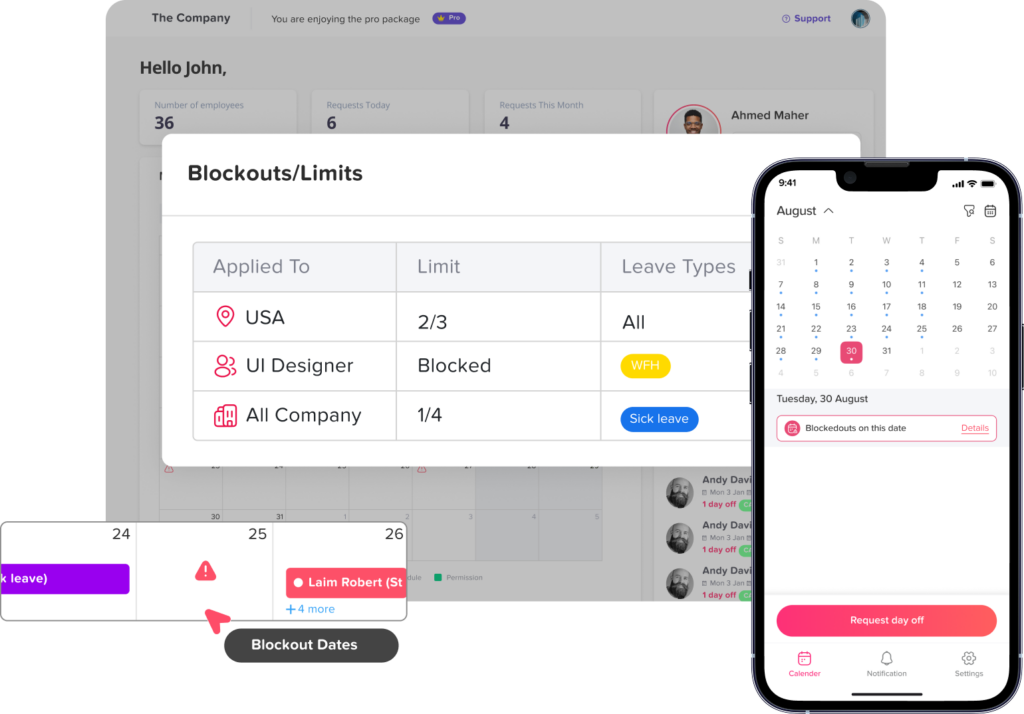
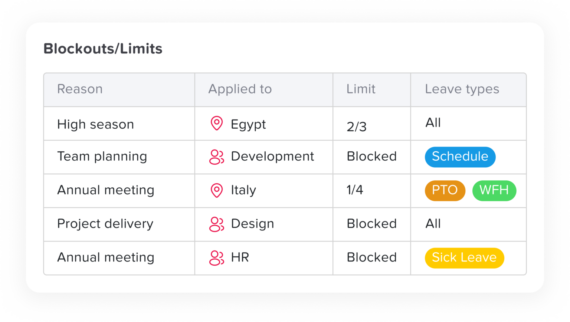
For example, organizations using Day Off can configure blockout dates as part of their leave management process, helping HR teams communicate restricted periods while employees request PTO through the same system they use to check balances and track leave.
Rather than expecting every manager to remember restricted dates manually, the policy can become part of the normal PTO workflow.
How to Handle PTO Requests During Blackout Periods
Blackout periods do not necessarily need to mean automatic rejection.
Companies can use several models.
Model 1: Complete Vacation Restriction
No discretionary vacation is approved during the blackout dates.
This approach may be appropriate for extremely short critical periods but becomes harder to justify operationally and culturally when blackout periods are lengthy or frequent.
Model 2: Limited PTO Availability
A defined number of employees may be off simultaneously.
For example:
A maximum of three customer support employees may take vacation during December 20 to December 31.
Once the limit is reached, additional requests are declined or waitlisted.
Model 3: Minimum Coverage Rule
Instead of limiting the number of absences directly, the organization requires a certain number of qualified employees to remain available.
This model works well when different employees have different skills.
Model 4: Manager Approval Required
Requests remain possible but require additional review.
This provides flexibility but requires clear manager guidance to prevent inconsistent decisions.
Model 5: Priority Request Window
Employees submit requests during a defined period rather than competing indefinitely on a first-come basis.
Management then reviews all requests together and determines how coverage can be maintained.
This can be particularly useful for popular holiday dates.
How to Handle Multiple Employees Requesting the Same Blackout Dates
Competition for popular vacation dates is almost inevitable.
Organizations should decide how conflicts will be resolved before they occur.
First Come, First Served
The earliest request receives priority.
This system is simple but may disadvantage employees who cannot plan vacation far in advance.
Rotating Priority
Employees who received priority during one high-demand holiday period receive lower priority the following year.
For example, an employee who received Christmas week off this year might have lower priority for the same period next year.
This can improve perceived fairness over time.
Seniority
Some organizations use seniority to determine priority, particularly when required by collective bargaining agreements.
However, using seniority voluntarily can repeatedly disadvantage newer employees.
Operational Coverage
Managers approve whichever combination of employees allows the team to maintain required skills and coverage.
This approach can work well, but the criteria should be transparent.
Voluntary Coordination
Teams can sometimes solve conflicts themselves.
One employee may prefer Christmas Eve while another prefers New Year’s Eve. Giving employees visibility into team availability can help them choose less crowded dates without management intervention.
How Managers Should Communicate PTO Blackout Dates
Communication has a significant impact on how employees perceive restrictions.
Compare these two messages:
Poor communication:
No PTO will be accepted during December.
Better communication:
Customer demand is historically highest between December 18 and December 31. To maintain support coverage, we will limit discretionary vacation during this period. At least eight support team members must remain available each working day. Requests can still be submitted and will be approved where coverage allows.
The second approach explains:
- The reason.
- The dates.
- The affected leave.
- The staffing requirement.
- Whether requests remain possible.
Employees may not like every restriction, but they are more likely to understand one that is specific and transparent.
Ways to Reduce the Need for PTO Blackout Periods
Blackout periods are sometimes necessary, but organizations should also look for ways to reduce dependence on them.
Cross Train Employees
When only one employee can perform a critical task, vacation becomes difficult to approve.
Training backup employees reduces this risk.
Improve Leave Forecasting
A shared team calendar makes it easier to identify periods where several employees are already planning leave.
Managers can address conflicts early instead of discovering them days before an absence.
Encourage Earlier Requests
Advance planning gives managers more options for adjusting:
- Schedules.
- Deadlines.
- Workloads.
- Shifts.
- Project assignments.
Use Temporary Coverage
Seasonal businesses may be better served by increasing staffing during peak periods rather than preventing permanent employees from taking vacation.
Spread Knowledge Across Teams
Critical knowledge concentrated in one person creates unnecessary PTO dependency.
Documentation, cross-training, and clear processes make teams more resilient when employees are unavailable.
Track Patterns
HR should periodically review whether blackout dates are still necessary.
A peak period from three years ago may no longer create the same staffing pressure today.
Managing Restricted PTO With Leave Management Software
Manual blackout management can quickly become complicated.
HR may need to track:
- Leave balances.
- Restricted dates.
- Existing approvals.
- Team availability.
- Department staffing.
- Employee schedules.
- Holiday calendars.
- Overlapping requests.
When this information sits across spreadsheets, emails, and calendars, managers can easily approve conflicting requests or overlook policy restrictions.
A dedicated leave management system such as Day Off brings PTO requests, employee balances, approval workflows, team calendars, leave policies, and blockout dates into a centralized process.
Employees can see their available balance and submit requests, while managers can review team availability before making an approval decision.
This is particularly useful when blackout rules differ between locations, departments, or teams.
PTO Blackout Policy Checklist
Before implementing a new blackout period, HR teams should confirm:
- The operational reason is clearly defined.
- The restricted dates are specific.
- The restriction is no broader than necessary.
- Affected employees and departments are identified.
- Covered PTO types are clearly stated.
- Protected or legally required leave is treated appropriately.
- Previously approved requests are addressed.
- An exception process exists.
- Approval criteria are consistent.
- Managers understand the rules.
- Employees receive sufficient advance notice.
- Blackout dates are documented in the leave system.
- The policy is reviewed under applicable federal, state, local, contractual, and collective bargaining requirements.
FAQ
Can an Employer Have PTO Blackout Dates?
Employers may often establish restrictions around discretionary vacation benefits, subject to applicable employment laws, employment agreements, collective bargaining agreements, company policies, and state or local requirements.
The FLSA itself does not generally require employers to provide paid vacation, which means many vacation rules are determined through employer policy or agreements.
However, a vacation blackout policy should not be assumed to override protected leave rights.
Can an Employer Deny PTO During a Blackout Period?
A company may be able to decline discretionary vacation requests during a properly established blackout period, depending on applicable policies and laws.
However, the answer can differ when the absence involves protected sick leave, FMLA leave, or another legally protected reason.
HR should therefore evaluate the type of leave being requested, not simply whether the dates fall inside a blackout period.
Can a Company Black Out PTO During Holidays?
Yes, companies sometimes restrict discretionary vacation around holidays when staffing requirements are unusually high.
However, completely prohibiting vacation is not the only option. Organizations can instead:
- Limit simultaneous requests.
- Establish minimum staffing levels.
- Rotate holiday priority.
- Divide holiday periods between employees.
- Use temporary staffing.
How Far in Advance Should PTO Blackout Dates Be Announced?
There is no single notice period that works for every organization. As a practical policy matter, blackout dates should be communicated as early as reasonably possible, especially when they relate to predictable annual events.
Recurring restrictions should ideally appear in the annual PTO calendar rather than being announced shortly before the affected dates.
Specific legal or contractual notice obligations may also apply depending on the jurisdiction and workplace.
Does a PTO Blackout Include Sick Leave?
It should not automatically be assumed to do so.
Sick leave may be governed by federal, state, or local protections that differ significantly from ordinary vacation policies. California’s paid sick leave rules, for example, protect qualifying employee use of accrued sick leave.
Employers should clearly distinguish vacation blackout restrictions from legally protected leave.
Can Employees Use FMLA During a PTO Blackout?
Eligible employees of covered employers may take FMLA leave for qualifying reasons when FMLA requirements are met. Employers are prohibited from interfering with an employee’s FMLA rights.
A normal vacation blackout policy does not eliminate those statutory protections.
Should Previously Approved PTO Be Cancelled Because of a Blackout?
Organizations should avoid creating this situation by announcing restrictions before vacation requests are approved.
A policy should clearly explain how existing approvals are handled. Applicable contracts, company policies, state laws, and other circumstances should also be reviewed before changing an existing approval.
Can Blackout Dates Apply to Only One Department?
Yes. In many cases, department-specific restrictions are more practical than company-wide blackout dates.
If finance employees are required for year-end closing, there may be little reason to restrict vacation for unrelated departments.
Are PTO Blackout Periods the Same as Blockout Dates?
The terms are often used interchangeably in leave management. Both generally describe dates when vacation requests are restricted, unavailable, or subject to additional approval.
The exact meaning should be defined in the organization’s PTO policy.
Final Thoughts
A PTO Blackout Policy can help organizations maintain staffing during predictable periods of unusually high demand, but restrictions should be carefully designed rather than used as a default response whenever scheduling becomes difficult.
The strongest policies identify a genuine operational need, restrict only the employees and dates necessary, clearly distinguish discretionary vacation from protected leave, explain how exceptions work, and give employees enough notice to plan around restricted periods.
Businesses should also look beyond blackout dates. Cross-training, better staffing forecasts, shared leave calendars, minimum coverage rules, and automated PTO management can often solve scheduling problems while preserving greater flexibility for employees.
With a leave management platform such as Day Off, organizations can centralize leave policies, configure blockout dates, review team availability, manage approvals, and track PTO balances in one place. Instead of discovering overlapping requests after schedules are already affected, HR teams and managers can plan ahead and make more consistent time-off decisions.