







An Unauthorized Overtime Policy gives employers a clear process for controlling unexpected labor costs while making sure employees understand when overtime requires manager approval. But there is an important legal distinction every employer should understand: requiring advance approval for overtime does not generally mean an employer can refuse to pay a covered non-exempt employee for overtime that was actually worked.
That distinction is where many overtime policies go wrong.
A policy might say, “Overtime will not be paid unless approved in advance.” The intention may be to control scheduling and payroll costs, but under the Fair Labor Standards Act, that wording can create a serious problem.

The U.S. Department of Labor states that covered non-exempt employees generally must receive overtime pay at not less than one and one-half times their regular rate for hours worked over 40 in a workweek. The Department also specifically explains that announcing that overtime will not be paid unless authorized in advance does not remove an employee’s right to compensation for compensable overtime that was actually worked.
The better approach is straightforward:
Require approval before overtime is worked, but require employees to record all time they actually work.
If an employee violates the approval rule, management can address the policy violation separately. Payroll should still reflect compensable hours worked.
This guide explains how to create an unauthorized overtime policy, how pre-approval should work, what managers should do when unauthorized overtime occurs, how to prevent employees from working unrecorded hours, and how tools such as Day Off can help businesses compare schedules, attendance, and overtime more accurately.
What Is Unauthorized Overtime?
Unauthorized overtime is overtime an employee works without receiving the approval required by the employer’s overtime policy.
For example, imagine an employee is scheduled from 9:00 a.m. to 5:30 p.m. Monday through Friday.
The company requires employees to obtain approval before working beyond their scheduled hours.
On Thursday, the employee stays an extra 90 minutes to finish a customer request without asking a manager.
That additional work may be unauthorized under company policy, but that does not automatically mean it becomes unpaid time.
This creates two separate questions:
This creates two separate questions:
Was the employee allowed to work overtime under company policy?
Did the employee actually perform compensable work that must be recorded and paid?
Employers should not treat those questions as if they are the same.
The employee may have violated the company’s overtime approval procedure while still being entitled to payment for the time actually worked.
Can Employers Require Overtime Pre-Approval?
Yes.
Employers can generally establish scheduling rules that require employees to obtain manager authorization before:
Staying beyond their scheduled shift
Arriving early to begin work
Working through an unpaid meal period
Performing work from home after hours
Working on a normally scheduled day off
Exceeding a specified weekly hour threshold
Taking additional shifts that could create overtime
A pre-approval system can help managers control staffing and labor costs.
It can also encourage managers to solve workload problems before they become overtime problems.
For example
When an employee asks for two additional hours to finish a project, the manager can decide whether to:
Approve the overtime
Move the deadline
Reassign part of the work
Adjust another shift
Add temporary coverage
Prioritize only the most important tasks
The approval process is therefore an operational tool, not a way to erase overtime after it has been worked.
Does Unauthorized Overtime Have to Be Paid?
For covered non-exempt employees under the FLSA, overtime that qualifies as hours worked generally must be paid even when the employee failed to obtain advance approval.
The Department of Labor’s overtime guidance states that when an employer requires or permits an employee to work overtime, the employer is generally required to pay the applicable overtime premium. It also specifically notes that a rule stating overtime will not be paid unless authorized in advance does not eliminate an employee’s right to compensation for compensable overtime hours that were actually worked.
This is one of the most important principles to include in an unauthorized overtime policy.
A safer policy says:
Employees must obtain manager approval before working overtime. However, employees must accurately report all hours actually worked, whether or not the overtime was approved in advance.
This allows the company to enforce its approval process without encouraging employees to hide their actual working time.
The Difference Between Unauthorized and Unpaid Overtime
These terms should not be confused.
An effective overtime policy should prevent all five situations from becoming confused.
How the FLSA Defines the Employer’s Responsibility
Federal wage-and-hour rules look at work that an employer requires or permits, not only work that appears on the official schedule.
Department of Labor guidance explains that hours worked generally include time during which employees are required or allowed to perform work, regardless of whether that work happens at the workplace, at home, or somewhere else.
The Department also explains that employers are responsible for exercising control when they do not want work to be performed. Simply creating a rule prohibiting unauthorized work is not enough if management continues accepting the benefit of that work.
That means a business should not rely on a written overtime policy while managers routinely allow employees to stay late.
For example:
A company publishes a policy requiring overtime approval.
However, a department manager regularly watches employees continue working for 30 minutes after their shifts. The manager never tells employees to stop and does not correct the timesheets when those additional minutes are missing.
The written policy alone does not solve the problem.
Managers must actually enforce scheduling expectations while still ensuring employees report all work they perform.
Overtime Is Generally Calculated by Workweek
Another common source of confusion is assuming overtime is determined by a two-week payroll period.
Under the FLSA, covered non-exempt employees generally receive overtime after working more than 40 hours in a defined workweek.
The workweek is a fixed and regularly recurring period of seven consecutive 24-hour periods. Hours normally cannot be averaged across two weeks simply because employees are paid biweekly.
For example:
| Week | Hours Worked | Federal FLSA Result |
|---|---|---|
| Week 1 | 46 | 6 overtime hours |
| Week 2 | 34 | 0 overtime hours |
| Two-week total | 80 | Still 6 overtime hours |
The employer cannot normally average the two weeks into 40 hours each to eliminate the overtime from Week 1.
State or local rules can impose additional overtime requirements, so employers should also review the laws that apply where each employee works.
Why Businesses Need an Unauthorized Overtime Policy
Overtime itself is not necessarily a problem.
Sometimes additional hours are exactly what the business needs.
The real problem is unplanned overtime.
Without an approval process, managers may discover additional labor costs only after payroll closes.
A clear policy helps organizations:
Control Labor Costs
Managers know about potential overtime before the additional work occurs and can decide whether the expense is justified.
Improve Staffing
Frequent overtime requests can reveal an understaffed team, unrealistic workload, scheduling problem, or inefficient process.
Set Clear Expectations
Employees know when overtime requires approval and who can approve it.
Protect Time Records
A well-written policy makes it clear that employees must record all hours worked even when they accidentally violate the approval procedure.
Improve Payroll Accuracy
Managers, HR, and payroll teams have a clearer record showing scheduled hours, approved additional work, and actual attendance.
Create Consistent Enforcement
Instead of individual managers creating their own overtime rules, the company can apply one documented process.
What a Good Overtime Pre-Approval Process Looks Like
An overtime approval system should be simple enough that employees will actually use it.
A complicated process can encourage employees to solve problems themselves by staying late without asking.
A practical workflow might look like this:
Step 1: Employee Identifies the Need
The employee realizes that completing assigned work will require additional time.
They should raise the issue before the scheduled shift ends whenever reasonably possible.
Step 2: Employee Requests Approval
The request should identify:
Why overtime is needed
Estimated additional time
Deadline or business need
Whether the work can be postponed
Whether another employee could provide coverage
Step 3: Manager Reviews the Request
The manager decides whether overtime is necessary.
They might approve it, reject it, reduce it, or solve the workload another way.
Step 4: Decision Is Documented
The business should keep a simple record of who approved the overtime and when.
Documentation helps HR and payroll understand why the additional hours occurred.
Step 5: Employee Records Actual Time
Approval might be for two hours, but the employee may finish in 75 minutes.
The timesheet should reflect the actual time worked, not automatically the amount originally approved.
Step 6: Manager Reviews the Timesheet
Managers should compare approved overtime with actual attendance and investigate unusual differences.
Who Should Be Allowed to Approve Overtime?
Your policy should identify specific approval authority.
Depending on the organization, authorized approvers might include:
Direct managers
Department managers
Location managers
HR
Operations managers
Senior management
Avoid vague wording such as “management approval.”
Employees should know exactly who they need to contact.
For example:
Non-exempt employees must receive approval from their direct manager before working overtime. If the direct manager is unavailable, approval may be provided by the department manager.
Clear authority reduces inconsistent decisions.
How Far in Advance Should Employees Request Overtime?
There is no single approval window that works for every business.
The right rule depends on how predictable the work is.
An office team may be able to request overtime several hours or days in advance.
A restaurant, retail store, healthcare operation, customer support team, or field service business may experience unexpected demand.
A practical policy can therefore say:
Employees must request approval as soon as they reasonably become aware that additional working time may be necessary.
This is usually more realistic than requiring every overtime request exactly 24 hours in advance.
What Happens When an Employee Works Unauthorized Overtime?
Suppose an employee was specifically told not to work overtime but stayed 90 minutes late anyway.
A good response has two parts.
First: Correct the Payroll Issue
Determine whether the additional time qualifies as compensable working time.
If it does, it should be included in the employee’s recorded hours and any required overtime calculation.
Second: Address the Policy Violation
Separately, determine why the employee ignored the approval process.
Depending on company policy and circumstances, the response might include:
Coaching
Retraining
A reminder of the approval procedure
A documented warning
Progressive discipline for repeated violations
This separation is important.
The employee’s failure to follow the approval procedure should not be corrected by deleting the hours from the timesheet.
What Managers Should Never Do With Unauthorized Overtime
Managers are often the people most responsible for whether an overtime policy works.
They should never respond to unauthorized overtime by saying:
“You weren’t approved, so don’t put it on your timesheet.”
“Change your clock-out back to 5:00.”
“Move those hours to next week.”
“Take a longer lunch tomorrow instead.”
“We can’t afford overtime this pay period, so remove it.”
“Just finish this after clocking out.”
These responses can create inaccurate time records and unpaid-work problems.
Managers should instead report what happened and allow HR or payroll to process the actual working time correctly.
Do Employees Need Approval to Work Early?
An overtime policy should address early work as well as late work.
An employee who regularly arrives 20 minutes before the scheduled shift might begin:
Opening software
Preparing equipment
Reading emails
Serving customers
Organizing work
Preparing a register
Reviewing assignments
If those activities constitute compensable work, simply labeling them “unapproved” does not necessarily make the time disappear.
A practical policy should tell employees not to begin work before their scheduled start time unless authorized, while also requiring them to report any work they actually perform.
What About Employees Working Through Lunch?
Meal periods are another place where unauthorized overtime can develop.
Imagine an employee is approaching 40 hours for the week.
The manager tells them not to work overtime.
Instead of staying late, the employee works through lunch to finish everything.
If that work is not recorded, the company has not solved the overtime problem. It may simply have moved the work to an unrecorded period.
Managers should therefore look beyond clock-out times.
An effective attendance review should consider:
Start times
End times
Break duration
Interrupted meal periods
Additional shifts
Weekend work
After-hours activity
Unauthorized Overtime for Remote Employees
Remote work makes overtime approval more complicated because employees can perform work almost anywhere.
An employee may finish the scheduled day and later:
Answer a customer email
Respond to a manager’s chat message
Update a report
Finish a presentation
Log into a project management system
Join an unexpected call
Remote teams need particularly clear expectations.
Your policy should explain:
When employees are expected to be available.
Whether after-hours messages require an immediate response.
How employees request authorization for additional work.
How unscheduled work should be recorded when it does occur.
Managers should also avoid sending messages that create an implied expectation that hourly employees must continue working after their shifts.
What About Exempt Employees?
The FLSA overtime requirements discussed in this article primarily concern covered non-exempt employees.
Certain executive, administrative, professional, outside sales, and computer employees may qualify for exemptions when all applicable requirements are satisfied. Job titles alone do not determine exemption status. The employee’s actual duties and applicable compensation requirements matter.
Employers should therefore avoid assuming someone is exempt simply because their title includes words such as “manager,” “administrator,” or “supervisor.”
Classification questions should be reviewed separately from your overtime approval process.
Common Unauthorized Overtime Policy Mistakes
Even well-intentioned policies can cause problems when the wording or management process is unclear.
Mistake 1: Saying Unauthorized Overtime Will Not Be Paid
This is one of the biggest problems.
Instead, explain that overtime requires approval, but all hours actually worked must still be reported.
Mistake 2: Allowing Managers to Edit Hours to Match the Schedule
Schedules show what was planned.
Timesheets should show what actually happened.
The two will not always match.
Mistake 3: Ignoring Small Amounts of Extra Work
Five minutes today and seven minutes tomorrow may not feel important individually.
Repeated across an entire workforce, those minutes can become significant.
Mistake 4: Treating Every Overtime Incident as an Employee Problem
Repeated overtime may indicate:
Understaffing
Poor scheduling
Unrealistic deadlines
Excessive workloads
Inefficient processes
A manager assigning work too late in the day
Before disciplining employees repeatedly, look at the underlying pattern.
Mistake 5: Giving Managers Different Rules
One manager allows overtime freely.
Another refuses all overtime.
A third tells employees to work but not record the hours.
The result is inconsistent enforcement.
Managers should receive the same training and written procedures.
Mistake 6: Forgetting Remote Work
An overtime policy that only talks about staying late at the office is incomplete.
Include remote work, emails, calls, messages, and work performed outside the normal workplace.
How to Reduce Unauthorized Overtime
The goal should not simply be to punish employees after overtime occurs.
A better strategy is to reduce unnecessary overtime before it happens.
Compare Scheduled Hours With Actual Hours
Look for employees who frequently work beyond their assigned schedule.
One isolated incident may mean little.
A repeated pattern probably deserves investigation.
Review Overtime by Team and Manager
If one department generates much more overtime than others, ask why.
The issue may be workload, staffing, scheduling, or manager behavior.
Schedule Coverage Before Peak Periods
Use past attendance patterns to identify busy days or seasons.
Adding coverage in advance can be cheaper than relying on unplanned overtime.
Set Workload Priorities
Employees sometimes stay late because they believe everything must be finished immediately.
Managers should make priorities clear.
Sometimes the right answer is:
“This can wait until tomorrow.”
Review Breaks
A team with no recorded overtime but consistently shortened breaks may still have a workload problem.
Give Employees an Easy Approval Channel
Employees should not need to send three emails and wait two days to receive a simple overtime decision.
A clear manager and approval process works better.
Sample Unauthorized Overtime Policy
The following template can be adapted to fit your company. Employers should review the final version against applicable federal, state, local, contractual, and collective bargaining requirements.
Unauthorized Overtime and Pre-Approval Policy
Purpose
[Company Name] manages overtime to support proper staffing, accurate payroll, and responsible labor-cost planning. Non-exempt employees are required to obtain approval before working overtime or outside their assigned schedule.
Overtime Approval
Employees must receive approval from [Manager/Department Manager] before working overtime whenever approval can reasonably be requested in advance.
This includes:
Beginning work before the scheduled start time
Continuing work beyond the scheduled end time
Working during an unpaid meal period
Performing work on a scheduled day off
Performing unscheduled work remotely
Accepting additional shifts that may create overtime
Recording Time
Employees must accurately record all working time.
Employees must not:
Work before clocking in
Continue working after clocking out
Delete or hide unauthorized overtime
Move hours between workweeks
Underreport working time because approval was not obtained
All compensable working time must be reported, including overtime that was not authorized in advance.
Unauthorized Overtime
Working overtime without required approval may violate company policy.
However, employees must still report all hours actually worked.
The company will review the circumstances surrounding unauthorized overtime and may address repeated failure to follow the approval procedure through its normal corrective-action process.
Manager Responsibilities
Managers must:
Review overtime requests promptly
Clearly communicate whether additional work is approved
Never instruct employees to perform unrecorded work
Never remove legitimate hours from timesheets because overtime was not approved
Review repeated overtime for possible staffing or workload problems
Escalate unusual patterns to HR when appropriate
Reporting Errors
Employees should report missed punches, incorrect timesheet entries, or unrecorded working time to [Manager/HR/Payroll Contact] as soon as possible.
Employees will not be instructed to underreport hours because work was not approved in advance.
Acknowledgment
I have read and understand the company’s overtime approval and timekeeping requirements.
Employee Name: ______________________
Signature: ___________________________
Date: _______________________________
Manager Checklist for Overtime Pre-Approval
Before approving overtime, managers can ask:
Is the work genuinely urgent?
Can the task be completed during the employee’s next scheduled shift?
Can the work be reassigned?
Could the schedule be adjusted before overtime occurs?
How many additional hours are expected?
Will the employee exceed an applicable overtime threshold?
Has the approval been documented?
Will payroll be able to see the actual additional hours worked?
Has this employee or team needed overtime repeatedly?
Does the pattern suggest a larger staffing or workload problem?
How Day Off Helps Manage Schedules, Attendance, and Overtime
A written overtime policy becomes much easier to manage when HR can compare what employees were scheduled to work with what they actually worked.
Day Off combines work schedules, attendance information, time tracking, and time off management in one system.
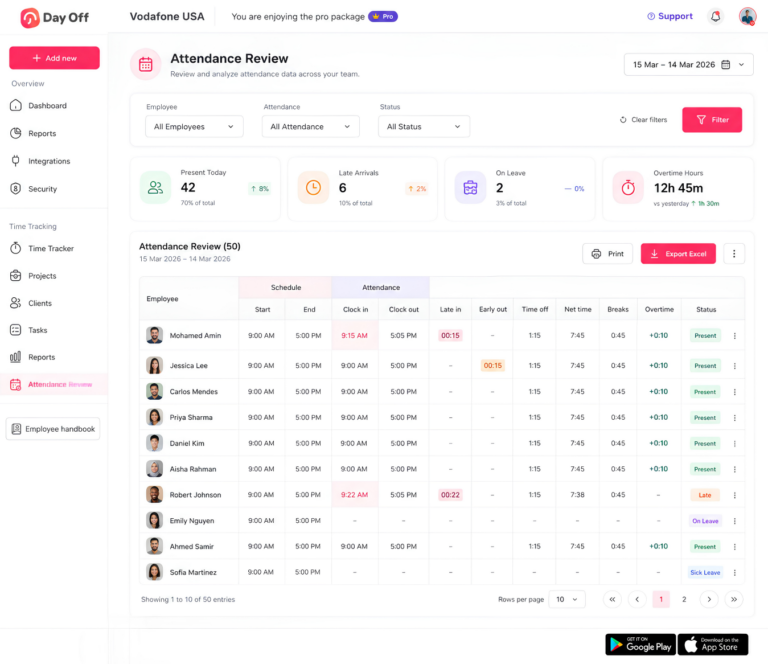
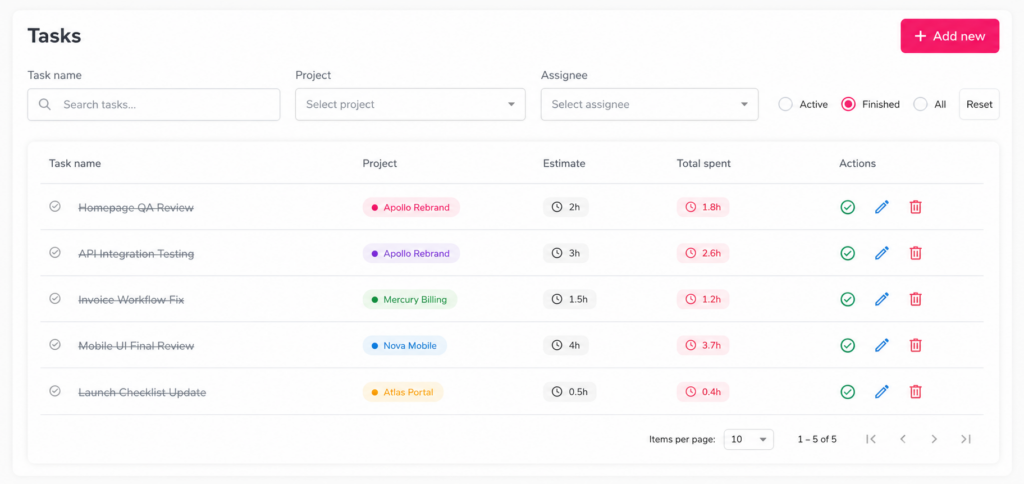
Its time tracking features include a start/stop timer linked to projects and tasks, while Attendance Review compares scheduled hours against actual attendance, including working hours, breaks, time off, and overtime.
Work Schedules
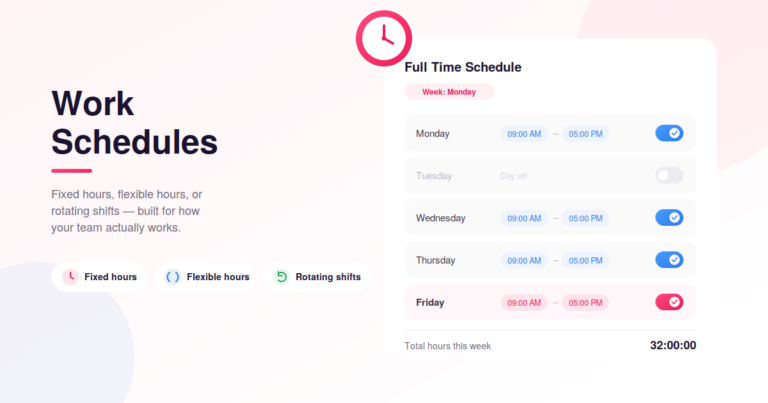
Day Off lets companies create working schedules that match how different employees actually work.
Teams can use:
Fixed working hours
Flexible hours
Rotating shifts
Different schedules for different employees
Having an accurate schedule gives managers a baseline for identifying when employees are working outside expected hours.
Attendance Review
An overtime policy is much easier to enforce when managers can see schedule and attendance information side by side.
Day Off’s Attendance Review includes scheduled start and end times together with actual clock-in and clock-out information. It also displays information such as late arrival, early departure, time off, net time, breaks, and overtime. Managers can filter the information by employee, team, or location.
That makes it easier to identify patterns such as:
Employees repeatedly clocking out later than scheduled
Unexpected overtime
Shortened breaks
Employees starting earlier than planned
Teams consistently working beyond their assigned hours
Instead of discovering overtime only when payroll is processed, managers can review attendance patterns earlier.
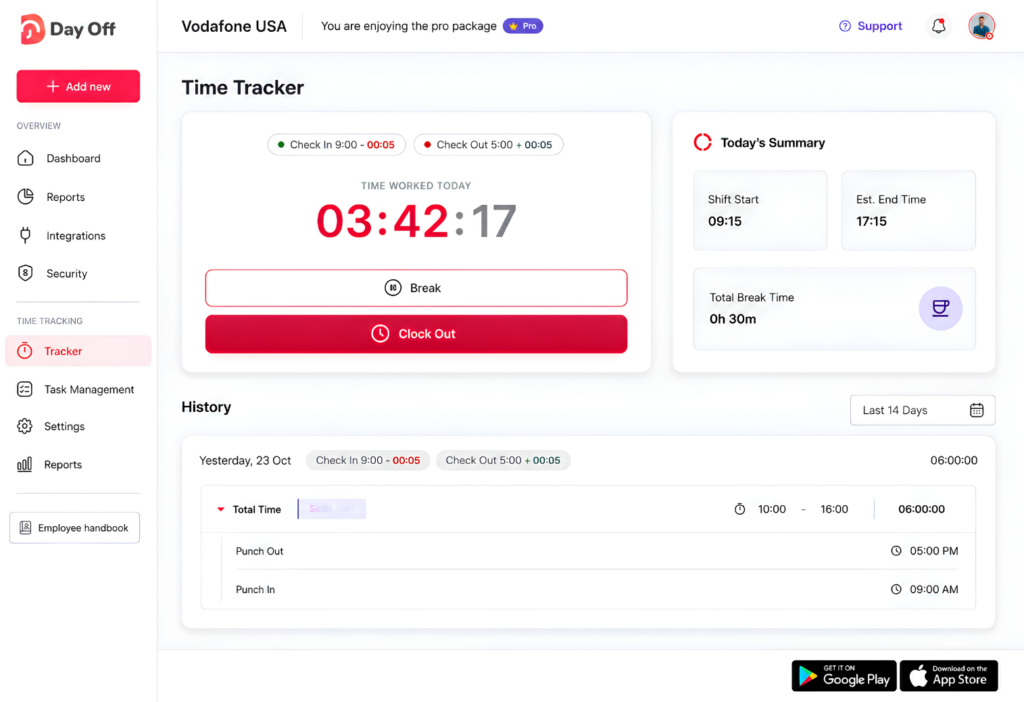
Time Tracker
Day Off’s Time Tracker records work using start and stop times linked to projects and tasks.
Each session creates a clearer record of when work happened and how long it lasted.
That can be especially useful for teams where work does not always happen in one physical location.
Shift Planner
The Shift Planner gives managers a weekly view of employee schedules.
Managers can see who is expected to work and plan coverage before gaps create unnecessary overtime.
For example, if one employee is already approaching a full week of scheduled hours, managers can consider assigning an additional shift to someone else rather than creating avoidable overtime.
Time Off and Attendance in the Same System
Overtime decisions should also consider absences.
A manager needs to know whether a staffing gap exists because someone is:
On vacation
Taking sick leave
Working a partial day
Observing a holiday
Following a different work schedule
Keeping time off and attendance data together can give managers a more complete picture before approving additional hours.
Using Overtime Data to Improve Workforce Planning
The most useful overtime report is not simply a list of employees who exceeded 40 hours.
Managers should ask why overtime occurred.
For example:
If one employee repeatedly needs overtime, the issue might be workload.
If an entire department needs overtime every Friday, the schedule may not match demand.
If overtime increases when employees take PTO, staffing coverage may need improvement.
If employees continually start early, required preparation work may not be reflected in the official schedule.
If employees regularly work through lunch, managers may need to reduce workload or improve break coverage.
Overtime data becomes much more valuable when it is used as a workforce-planning signal rather than only a payroll number.
Frequently Asked Questions About Unauthorized Overtime Policies
Can a company require employees to get approval before working overtime?
Yes. Employers can require non-exempt employees to obtain approval before working overtime or outside their normal schedule. The policy should clearly explain who can approve overtime and how employees should request it.
Does unauthorized overtime still have to be paid?
In many cases, yes. If a covered non-exempt employee actually performs compensable work, the employer generally must pay for that time even if the employee failed to get approval first. The policy violation can be addressed separately.
Can an employee be disciplined for working overtime without permission?
Yes. Employers can enforce overtime approval rules through coaching, warnings, or other appropriate disciplinary steps. However, the employee’s actual working time should still be recorded and paid correctly.
Can a manager change a timesheet to remove unapproved overtime?
A manager should not remove legitimate working time simply because it was not approved. Timesheet corrections should reflect what actually happened and should be supported by a valid reason.
What should happen if an employee repeatedly works unauthorized overtime?
The employer should first determine why the overtime keeps happening. It may be caused by workload, staffing shortages, scheduling issues, or unclear expectations. If the employee is repeatedly ignoring a clear approval policy, the company can address that behavior separately.
Should employees request overtime approval in writing?
Written approval is a good practice because it creates a clear record for the employee, manager, HR, and payroll. This could be handled through email, a scheduling system, HR software, or another documented workflow.
Can employers require approval for early starts and late finishes?
Yes. An overtime policy can require employees to get approval before starting work early, staying late, working through breaks, or working on scheduled days off. Employees should still record any work they actually perform.
Can overtime be denied because the employee exceeded the approved amount?
If an employee was approved for one hour of overtime but worked longer, the employer should still review and record the actual compensable time worked. The extra time may violate policy, but it should not simply be removed from the timesheet.
How often should employers review unauthorized overtime?
Employers should review overtime patterns regularly, ideally during each payroll cycle. Frequent unauthorized overtime can reveal staffing shortages, unrealistic workloads, poor scheduling, or managers who are not enforcing the policy consistently.
What records should employers keep for overtime approvals?
Employers should keep records showing the employee’s schedule, actual hours worked, overtime request, manager approval or denial, and any timesheet adjustments. Keeping these records together makes payroll reviews and audits much easier.
Conclusion
An effective Unauthorized Overtime Policy should give employers control over when overtime is approved without creating confusion about how actual working time must be recorded and paid.
The most important rule is simple: employees can be required to get approval before working overtime, but they should still report every hour they actually work. If an employee ignores the approval process, the policy violation can be handled separately through coaching, warnings, or other appropriate action.
A strong overtime policy should also help managers prevent unnecessary extra hours before they happen. Clear approval procedures, realistic workloads, accurate schedules, regular timesheet reviews, and consistent manager training can all reduce unexpected overtime and improve payroll accuracy.
Employers should also look at repeated overtime as a workforce planning signal. Frequent extra hours may point to understaffing, poor scheduling, workload problems, missed breaks, or teams that regularly need more coverage than the current schedule provides.
By combining a clear pre-approval policy with accurate time tracking and attendance data, businesses can manage overtime more effectively while keeping employee records transparent and reliable. Tools like Day Off can support this process by helping managers compare work schedules, actual attendance, overtime, breaks, shifts, and time off in one place.
The goal is not simply to reduce overtime. It is to make sure overtime is planned when possible, recorded accurately when it happens, and reviewed in a way that helps the business make better staffing and scheduling decisions.