







Managing employee time off becomes more difficult when everyone wants to take leave during the same busy periods. PTO Blackout Dates can help employers protect essential staffing levels by identifying specific dates when vacation requests are restricted or unavailable. However, blackout periods need to be planned carefully. If they are too broad, announced too late, or applied inconsistently, they can create frustration and make employees feel that their paid time off is difficult to use.

A well designed blackout policy should balance two legitimate needs: employees need reasonable opportunities to use their earned time off, while businesses need enough people available to maintain operations.
This guide explains what PTO blackout dates are, when employers may use them, how to create a fair policy, what mistakes to avoid, and how HR teams can manage high demand periods without turning PTO into a source of conflict.
What Are PTO Blackout Dates?
PTO blackout dates are specific dates or periods during which an employer restricts some types of employee time off requests.
For example, a retailer may restrict vacation requests during the busiest days before a major holiday. A restaurant may need additional staff during a local festival or major event. An accounting firm may experience periods when client deadlines make staffing particularly important.
Blackout dates do not necessarily mean that every form of absence is prohibited. A company’s policy may distinguish between discretionary vacation requests and other types of leave.
This distinction is important because company PTO rules do not override applicable employment laws or protected leave requirements. Employers should review the laws that apply in the jurisdictions where their employees work before implementing restrictions.
A typical blackout policy might state:
Vacation requests may be restricted during designated high demand periods. Blackout periods will be communicated in advance and applied consistently according to the company’s time off policy.
The exact wording and rules should reflect the organization’s operations, workforce, and applicable legal requirements.
Why Do Companies Use PTO Blackout Dates?
Blackout dates are primarily a workforce planning tool.
Without some form of capacity planning, a company could approve too many overlapping vacation requests and later discover that there are not enough employees available to operate normally.
Common reasons organizations establish blackout periods include:
Seasonal increases in customer demand
Major product launches
Financial closing periods
Inventory counts
Important client deadlines
Company wide events
Peak travel seasons
Major sales periods
Industry specific busy seasons
Critical projects or migrations
The purpose should be tied to a genuine staffing or operational requirement rather than simply making leave harder to take.
PTO Blackout Dates vs. Normal PTO Restrictions
Not every PTO restriction needs to become a blackout period.
Employers already have several ways to manage employee leave, including advance-notice requirements, minimum staffing rules, approval workflows, maximum leave duration, and limits on simultaneous absences.
| Rule | Purpose | Example |
|---|---|---|
| Blackout dates | Restrict requests during specific periods | Vacation restricted during a peak sales week |
| Notice period | Require advance planning | Requests must be submitted 14 days ahead |
| Concurrent leave limit | Control overlapping absences | Maximum two employees from a team off |
| Maximum duration | Limit length of individual requests | Maximum 10 consecutive workdays |
| Approval workflow | Require review before leave is confirmed | Manager approval required |
| Minimum staffing | Maintain operational coverage | At least 70% of the team must be scheduled |
A blackout period is one of the strongest restrictions available. For that reason, it should generally be reserved for periods when normal approval and staffing controls are not sufficient.
Are PTO Blackout Dates Legal?
There is no single universal rule because requirements depend on the country, state, province, employment agreement, type of leave, and circumstances.
In the United States, employers often have substantial discretion over how vacation policies are administered, but that discretion is subject to applicable federal, state, and local laws. Some jurisdictions regulate earned vacation or paid sick leave differently.
A blackout policy also should not be treated as a way to deny leave that employees are legally entitled to take.
For example, depending on the employee and circumstances, separate legal protections may apply to certain medical, family, disability related, military, sick, or other protected absences.
Employers with employees in multiple jurisdictions should therefore avoid assuming that one blackout rule can automatically be applied everywhere.
Before introducing a policy, HR should consider:
Where each employee works.
Whether the restriction applies to vacation only or other leave types.
Applicable federal, state, local, or national leave requirements.
Employment contracts or collective bargaining agreements.
Whether employees have a reasonable opportunity to use accrued PTO.
Whether the policy is being applied consistently.
For jurisdiction specific questions, employers should consult qualified HR or legal professionals.
What Makes a PTO Blackout Policy Fair?
The existence of blackout dates is not necessarily what frustrates employees. Problems often come from how those dates are created and enforced.
A fair policy should generally be necessary, limited, predictable, transparent, and consistent.
Use Blackout Dates Only When Necessary
Start with a simple question:
Does the entire period actually need to be blocked?
Suppose a company experiences its highest demand from December 18 through December 23. Blocking PTO from December 1 through January 5 may be much broader than the operational need.
Before creating a blackout period, examine:
Historical staffing requirements
Customer demand
Previous absence patterns
Workload forecasts
Required skills or roles
Project deadlines
Minimum coverage requirements
If the problem can be solved through normal scheduling or concurrent leave limits, a full blackout may not be necessary.
Keep Blackout Periods as Short as Possible
Long restrictions can significantly reduce employees’ ability to use PTO when it is valuable to them.
Instead of declaring an entire month unavailable, identify the actual high risk days.
For example:
Broad restriction:
No vacation requests during December.
More targeted restriction:
Vacation requests are restricted from December 18 through December 23 because of peak operational demand.
The second rule provides employees with substantially more flexibility while still addressing the business requirement.
Announce Blackout Dates Early
Employees make plans around their time off.
They may book flights, reserve hotels, coordinate childcare, schedule family events, or arrange travel months ahead.
Announcing a blackout period after employees have already made plans can create avoidable disputes.
Whenever possible, communicate known blackout dates at the beginning of the year or as soon as the business can reasonably identify them.
For recurring busy periods, include them directly in the company’s PTO policy and employee handbook.
Explain Why the Restriction Exists
Employees are more likely to understand a restriction when there is a clear operational reason behind it.
Instead of:
No PTO requests will be approved November 20-30.
Provide context:
November 20-30 is one of our highest volume periods. Vacation requests during these dates may be restricted to maintain required customer support coverage.
The explanation does not need to be lengthy. It simply needs to make the business reason understandable.
Define Which Leave Types Are Affected
A common policy mistake is using “PTO blackout” as though every absence should be treated identically.
Your policy should specify what is restricted.
For example:
Vacation
Personal days
Floating holidays
Unpaid discretionary leave
Other planned time off
Then separately explain how sick leave, emergencies, legally protected leave, or other applicable absences are handled.
This prevents employees and managers from interpreting “blackout” as “nobody can ever be absent.”
Establish Rules for Requests Submitted Before the Blackout Is Announced
Imagine an employee receives approval for December 22 in July. In October, management announces that December 20-23 will become blackout dates.
What happens to the previously approved leave?
The policy should answer this before the situation occurs.
Organizations may choose to honor already approved requests unless exceptional circumstances require another approach. Whatever approach is selected, it should be documented and applied consistently, subject to applicable law and contractual obligations.
Create a Fair System for Competing PTO Requests
Sometimes a complete blackout is unnecessary. The real problem is that too many employees want the same dates.
In that case, limiting simultaneous absences may be more practical.
Common methods include:
First Come, First Served
Requests are considered in the order they are submitted.
This approach is easy to understand but can disadvantage employees who cannot plan far in advance.
Rotating Priority
Employees who received a high-demand period one year receive lower priority for the same period the following year.
This can be useful for recurring holidays or seasonal periods.
Minimum Coverage Rules
Requests are approved until the team reaches a predefined staffing threshold.
For example:
At least four members of the customer support team must be scheduled each business day.
This focuses the decision on staffing requirements rather than an arbitrary number of PTO requests.
Manager Review
Managers evaluate requests according to operational needs, skills coverage, and existing absences.
If manager discretion is used, the company should establish clear guidelines to reduce inconsistent decisions.
Apply the Rules Consistently
A written policy loses credibility if employees see exceptions being made without understandable reasons.
Suppose two employees request the same blackout date under similar circumstances. One request is rejected while the other is approved.
If there is a legitimate reason, such as different staffing requirements, protected leave, or a previously approved request, that distinction may be appropriate. But arbitrary differences can create distrust.
Managers should therefore document why exceptions or unusual decisions were made.
Create an Exception Process
Even during a critical business period, unusual situations happen.
Employees may experience:
Family emergencies
Unexpected personal circumstances
Important events that cannot be rescheduled
Medical needs
Other situations requiring special consideration
A policy can allow employees to request an exception without guaranteeing approval.
For example:
Employees who need time off during a designated blackout period may submit an exception request to their manager and HR for review. Requests will be evaluated based on the circumstances, staffing requirements, company policy, and applicable leave requirements.
This provides flexibility without eliminating the purpose of the blackout.
How to Create a PTO Blackout Policy Step by Step
A structured process makes blackout periods easier to justify and administer.
Step 1: Analyze Historical Demand
Review previous years to identify periods when staffing shortages actually caused problems.
Look at:
PTO request volume
Absence rates
Overtime
Customer demand
Project schedules
Revenue patterns where relevant
Staffing shortages
Service levels
Historical evidence can help distinguish genuine peak periods from assumptions.
Step 2: Calculate Minimum Staffing Requirements
Determine how many employees or which roles must be present.
Instead of saying “everyone needs to work,” identify actual coverage requirements.
For example, a team of 12 employees may function normally with nine employees present. If so, restricting all PTO may be unnecessary.
Step 3: Consider Alternatives
Before creating a blackout, evaluate less restrictive options:
Limit concurrent PTO
Require earlier notice
Adjust shifts
Use voluntary schedule changes
Cross-train employees
Temporarily redistribute work
Create an on-call rotation where appropriate
A blackout should solve a real scheduling problem rather than replace workforce planning.
Step 4: Define the Exact Dates
Avoid vague wording such as:
PTO may not be available during our busy season.
Instead, specify exact dates whenever possible.
Vacation requests will be restricted from November 23 through November 30.
Employees should be able to look at the policy or calendar and know whether a planned date is affected.
Step 5: Define the Scope
Specify:
Employees or departments affected
Locations affected
Leave types affected
Start and end dates
Existing request treatment
Exception process
Approval authority
A company wide blackout may be unnecessary if the staffing issue affects only one department.
Step 6: Review Legal and Contractual Requirements
Before publishing the policy, verify that it complies with requirements applicable to the affected workforce.
This is particularly important for organizations operating across multiple states or countries.
Step 7: Publish the Dates
Employees should have one reliable place where blackout periods can be checked.
This might be:
Employee handbook
HR portal
Shared calendar
Leave management system
Company policy page
Using a centralized system reduces the chance that employees plan leave without knowing a restriction exists.
Step 8: Configure the Leave Management System
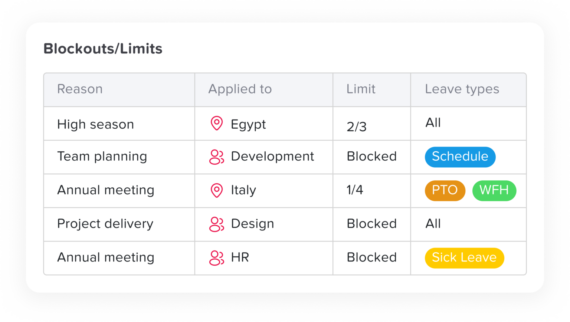
If your PTO software supports blackout dates, add them directly to the system.
Employees can then see the restriction while planning or submitting leave instead of discovering it only after a manager rejects the request.
Step 9: Review the Policy Regularly
Operational needs change.
A blackout period that was necessary two years ago may no longer be necessary after hiring additional employees, automating processes, or changing business operations.
Review blackout dates at least periodically rather than automatically copying them from year to year.
Example PTO Blackout Policy
The following is a general example and should be adapted to the organization’s circumstances and applicable requirements:
PTO Blackout Period Policy
To maintain adequate staffing during periods of unusually high operational demand, the company may designate certain dates as vacation blackout periods.
Blackout periods will be communicated to affected employees as early as reasonably possible and will identify the specific dates, departments, locations, or teams affected.
During a designated blackout period, discretionary vacation requests may be restricted or subject to additional approval based on staffing requirements.
Blackout periods do not automatically apply to legally protected leave or other absences that must be handled differently under applicable law or company policy.
Employees who have exceptional circumstances may contact their manager or HR to request individual review.
Previously approved leave will be handled according to company policy, applicable requirements, and the circumstances of the request.
Managers are expected to apply blackout rules consistently and document approved exceptions when appropriate.
This example provides a framework, but organizations should tailor their policies rather than copying generic language without review.
PTO Blackout Dates Example
Consider a customer support department with 15 employees.
Historical data shows that customer volume increases significantly during the final five business days of November. Management determines that at least 12 employees must be available each day.
Instead of prohibiting PTO for the entire month, the company could establish the following system:
| Policy Element | Example |
|---|---|
| Blackout period | Final five business days of November |
| Affected team | Customer Support |
| Minimum staffing | 12 employees |
| Restricted leave | Planned vacation |
| Announcement | Published January 15 |
| Existing approvals | Honored unless exceptional circumstances apply |
| Exceptions | Reviewed by manager and HR |
What Happens If an Employee Already Has Approved PTO?
Previously approved PTO deserves careful handling.
Canceling approved leave can create significant problems because employees may already have paid for transportation, accommodation, events, or other arrangements.
Before changing approved leave, employers should consider:
Why the cancellation is necessary
Whether alternative staffing arrangements are available
Company policy
Applicable employment requirements
Employment or union agreements
Whether costs have already been incurred by the employee
How similar cases have been handled previously
Whenever possible, organizations should identify blackout periods before employees begin making requests.
PTO Blackout Dates and Sick Leave
Vacation and sick leave should not automatically be treated as interchangeable.
Vacation is generally planned. Illness is often unexpected.
Depending on the jurisdiction, employees may also have specific rights concerning paid sick leave or other protected absences.
A company therefore should not assume that declaring a vacation blackout allows it to prohibit every type of absence during the same period.
Policies and leave management systems should distinguish between leave categories rather than applying a single rule to all time off.
PTO Blackout Dates for Remote Teams
Remote work does not eliminate staffing requirements.
Distributed teams may actually require more careful planning because employees can work across different:
Countries
States
Time zones
Holiday calendars
Workweeks
Cultural holidays
A date that is ordinary in one country may be a major public holiday in another.
For international teams, HR should review blackout periods alongside employee locations and holiday calendars before applying restrictions globally.
A global company might need separate blackout rules for specific teams or locations instead of one universal company wide calendar.
PTO Blackout Dates vs. Blockout Dates
You may encounter both blackout dates and blockout dates in HR software and company policies.
In practice, the terms are often used to describe similar functionality: dates when certain leave requests are restricted.
“Blackout dates” is common general terminology, while a particular PTO platform may use another label such as blocked dates, restricted dates, or blockout dates.
Regardless of terminology, employees should understand exactly what happens when they attempt to request leave on those dates.
How PTO Software Helps Manage Blackout Dates
Managing blackout dates through emails, spreadsheets, or manager memory creates unnecessary room for errors.
A leave management system can centralize these restrictions.
With Day Off, companies can configure blockout dates alongside their leave policies and broader PTO management processes. Instead of relying on managers to remember restricted periods manually, organizations can incorporate the rules into their leave management workflow.
A centralized system can also help HR teams manage:
Leave balances
Vacation requests
Approval workflows
Accrual policies
Carryover rules
Work schedules
Company holidays
Team availability
Employee leave history
PTO reports
This becomes particularly useful when different teams, policies, or locations have different scheduling requirements.
Blackout Dates Should Not Replace Workforce Planning
This is one of the most important principles when creating a fair policy.
If a company constantly needs to prohibit employees from taking vacation because operations cannot tolerate normal absences, the underlying issue may be staffing rather than PTO.
Frequent blackout periods can indicate:
Insufficient staffing
Lack of cross training
Poor capacity planning
Unrealistic deadlines
Too much dependence on individual employees
Ineffective scheduling
PTO restrictions can protect genuinely critical periods, but they should not become a permanent solution for chronic understaffing.
How Managers Should Communicate PTO Blackout Dates
Good communication can prevent many disputes before they happen.
When announcing a blackout period, communicate four things clearly:
What: Which types of PTO are restricted?
When: What are the exact start and end dates?
Who: Which teams, locations, or employees are affected?
Why: What operational requirement makes the restriction necessary?
Employees should also know where to find the policy and whom to contact with questions.
A Better Approach to High Demand PTO Periods
The objective of a PTO policy should not be to minimize time off. It should be to make time off predictable and manageable.
For some organizations, the best solution may be a combination of:
A small number of genuine blackout dates
Minimum staffing requirements
Advance notice
Limits on overlapping requests
Early communication
Fair priority rules
Manager approval
Exception procedures
Accurate leave tracking
This gives employers more flexibility than simply declaring long periods unavailable.
PTO Blackout Policy Checklist
Before implementing PTO Blackout Dates, HR teams can review the following questions:
| Question | Why It Matters |
|---|---|
| Is there a genuine operational reason? | Prevents unnecessary restrictions |
| Are the dates as limited as possible? | Preserves employee flexibility |
| Are affected teams clearly defined? | Avoids unnecessary company-wide restrictions |
| Are affected leave types specified? | Prevents confusion about sick or protected leave |
| Were employees given reasonable notice? | Helps employees plan ahead |
| Are existing approvals addressed? | Prevents disputes |
| Is there an exception process? | Allows unusual circumstances to be reviewed |
| Are managers using consistent rules? | Supports fairness |
| Have applicable requirements been reviewed? | Reduces compliance risk |
| Can employees easily see restricted dates? | Reduces avoidable requests |
FAQ
What are PTO blackout dates?
PTO blackout dates are designated periods when an employer restricts certain planned time-off requests because the organization needs additional staffing or coverage.
Can an employer have PTO blackout dates?
Employers may be able to establish restrictions on vacation scheduling, but the rules vary by jurisdiction and type of leave. Blackout policies must still comply with applicable employment laws, protected-leave requirements, contracts, and company policies.
How long should PTO blackout dates last?
There is no universal duration. A useful approach is to restrict only the period supported by a genuine staffing need. If five days create the operational problem, there may be little reason to block an entire month.
Should blackout dates apply to sick leave?
Not automatically. Sick leave and other types of protected absence may be subject to different policies and legal requirements. Employers should define exactly which leave types a blackout affects.
Can previously approved PTO be canceled because of a blackout period?
The answer depends on company policy, applicable law, contracts, and the circumstances. From a workforce-management perspective, announcing blackout dates before requests are approved is generally much easier than trying to change approved leave later.
How far in advance should employees know about blackout dates?
As early as reasonably possible. Predictable annual peak periods can often be communicated at the beginning of the year, while unexpected operational events may require shorter notice.
Is it better to limit PTO requests or create blackout dates?
It depends on the staffing problem. If some employees can still be absent without affecting operations, a concurrent leave limit or minimum staffing rule may provide more flexibility than a complete blackout.
Can different departments have different blackout dates?
Yes. Department specific restrictions may make more sense when busy periods affect only certain functions. Organizations should still ensure the rules are based on legitimate operational requirements and applied consistently.
How can businesses track PTO blackout dates?
Companies can publish restricted dates through their employee handbook, HR portal, shared calendar, or leave management software. Using a PTO system can make restrictions visible within the same workflow employees use to submit requests.
Should PTO blackout dates be reviewed every year?
Yes. Staffing, workloads, processes, and business demand can change. Reviewing blackout periods periodically helps ensure that restrictions remain necessary rather than becoming permanent simply because they existed previously.
Final Thoughts
PTO Blackout Dates can be an effective way to protect staffing during genuinely critical periods, but they work best when they are limited, predictable, clearly communicated, and consistently applied.
The strongest policies do not simply tell employees when they cannot take vacation. They explain why restrictions exist, identify exactly who and what they affect, provide reasonable notice, distinguish vacation from other types of leave, and establish a process for exceptional circumstances.
Employers should also remember that blackout dates are only one part of effective leave planning. Minimum staffing rules, better scheduling, cross-training, advance notice, and accurate PTO tracking can often reduce the need for broad restrictions.
With a centralized leave management platform such as Day Off, organizations can manage PTO policies, blockout dates, leave requests, approvals, balances, schedules, and team availability in one place. That makes it easier to protect important business periods while giving employees clear information about when and how they can plan their time off.