







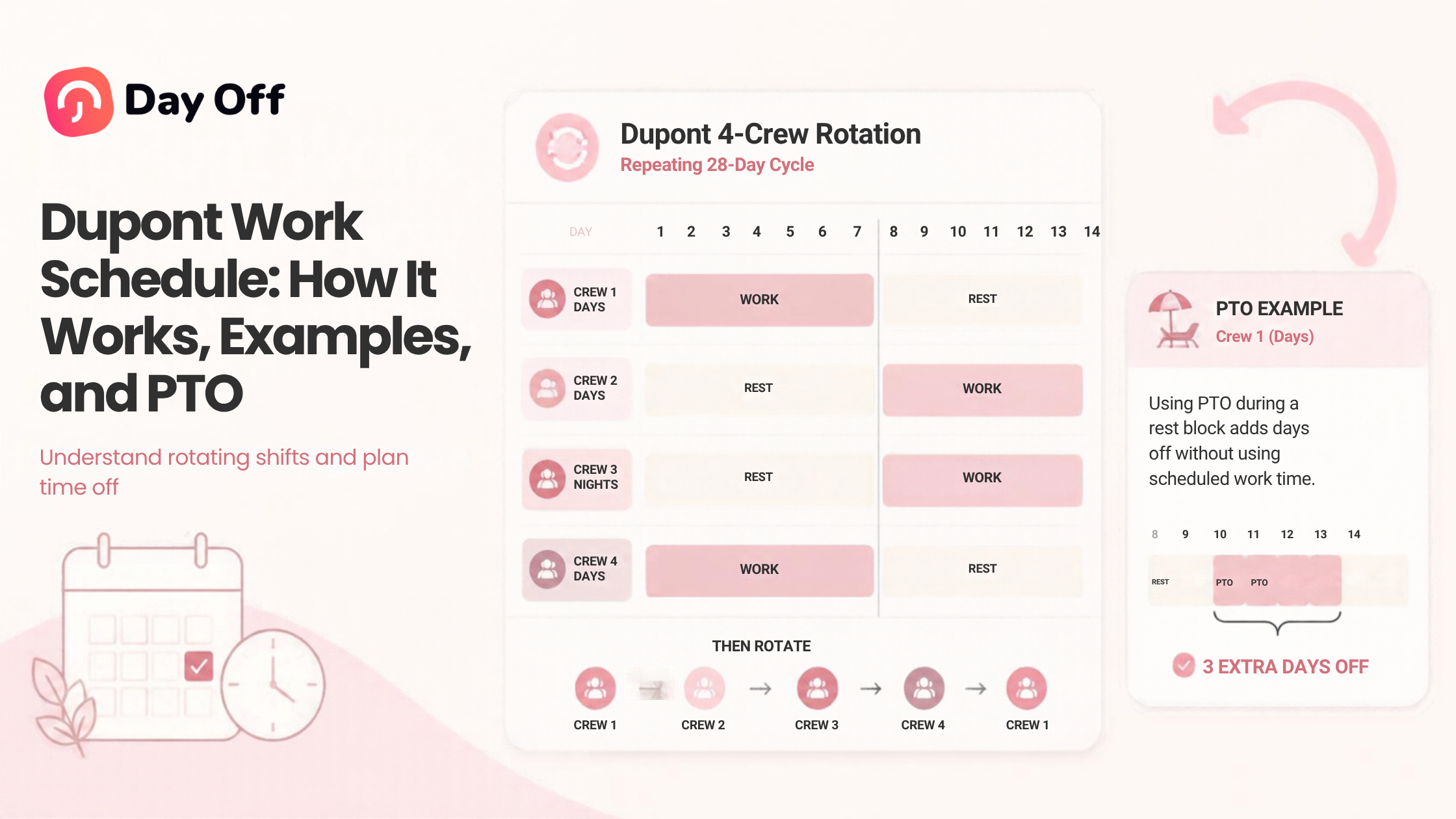
The DuPont Work Schedule is a rotating shift pattern designed for organizations that need continuous, 24/7 staffing. Instead of employees working a traditional Monday-to-Friday schedule, four crews rotate between 12-hour day shifts, 12-hour night shifts, and scheduled days off over a repeating 28-day cycle. The schedule is particularly recognizable because employees receive seven consecutive days off during each rotation, but that benefit comes with demanding work periods and important considerations for PTO, overtime, fatigue, and workforce planning.

For employers operating manufacturing facilities, utilities, processing plants, security operations, emergency services, or other workplaces that cannot simply shut down overnight, the DuPont rotation can provide predictable around the clock coverage.
However, implementing it successfully requires more than creating four teams and assigning 12-hour shifts. Employers also need clear rules for PTO deductions, holidays, absences, overtime, shift swaps, and coverage.
This guide explains exactly how the DuPont schedule works, provides practical examples, and explores how employers can manage PTO fairly when a normal working day is 12 hours rather than eight.
What Is the DuPont Work Schedule?
The DuPont work schedule is a four team rotating schedule built around a 28 day cycle and 12 hour shifts.
Each crew follows the same rotation but begins at a different point in the cycle. This staggering allows the organization to maintain continuous day and night coverage.
The standard sequence for one crew is:
4 night shifts → 3 days off → 3 day shifts → 1 day off → 3 night shifts → 3 days off → 4 day shifts → 7 days off
Across the complete cycle, an employee is scheduled for:
- 14 total shifts
- 7 day shifts
- 7 night shifts
- 14 scheduled days off
- 168 scheduled work hours
- An average of 42 scheduled hours per week
The average can be misleading, however. Employees do not simply work 42 hours every week. Depending on where the employer’s defined workweek falls relative to the rotation, weekly scheduled hours can vary substantially.
That distinction becomes especially important when calculating overtime.
How Does a DuPont Schedule Work?
A DuPont schedule normally divides the workforce into four crews, commonly labeled Crew A, Crew B, Crew C, and Crew D.
Employees work 12 hour shifts, such as:
Day shift: 7:00 AM to 7:00 PM
Night shift: 7:00 PM to 7:00 AM
The exact start and end times can vary between organizations.
At a basic level, the rotation works because crews are positioned at different stages of the 28-day pattern. While one crew is working days, another can cover nights and the remaining crews are in their scheduled off portions of the rotation.
Standard 28 Day DuPont Schedule Example
The following table shows the rotation from the perspective of one employee or crew.
| Cycle Days | Schedule | Number of Shifts | Scheduled Hours |
|---|---|---|---|
| Days 1-4 | Night shifts | 4 | 48 |
| Days 5-7 | Off | 0 | 0 |
| Days 8-10 | Day shifts | 3 | 36 |
| Day 11 | Off | 0 | 0 |
| Days 12-14 | Night shifts | 3 | 36 |
| Days 15-17 | Off | 0 | 0 |
| Days 18-21 | Day shifts | 4 | 48 |
| Days 22-28 | Off | 0 | 0 |
| Total | 28-day cycle | 14 shifts | 168 hours |
This produces the schedule’s defining characteristic: seven consecutive scheduled days off at the end of the cycle.
After Day 28, the pattern begins again.
Why Do Companies Use the DuPont Work Schedule?
The primary reason is straightforward: continuous coverage.
Some businesses cannot operate effectively using standard eight-hour weekday schedules. A production facility, utility operation, control center, or similar environment may require staffing 24 hours a day.
Using four rotating crews makes it possible to provide that coverage while giving employees substantial blocks of scheduled time away from work.
The model can therefore provide several operational advantages.
Predictable 24/7 Coverage
Once the four crews are established, managers have a repeating framework for determining which team should cover each day and night shift.
Employees can also see their schedules well in advance because the underlying cycle repeats every 28 days.
Fewer Shift Handovers
A 24 hour period can be covered by two 12 hour shifts rather than three eight hour shifts.
That means fewer daily shift changes and potentially fewer handovers between employees.
More Full Days Away From Work
An employee works only 14 scheduled shifts during the 28-day cycle.
That does not mean employees work fewer hours overall. Those shifts are 12 hours long. But employees receive larger blocks of uninterrupted time away from the workplace.
A Seven Day Break Every Cycle
The seven consecutive scheduled days off are one of the most distinctive features of the DuPont rotation.
Employees can potentially use this period for travel, family responsibilities, appointments, or extended rest without using PTO.
The Biggest Challenge: The Schedule Is Uneven
The same structure that creates long periods away from work can also create demanding stretches.
One particularly challenging section of the standard rotation is:
3 day shifts → 1 day off → 3 night shifts
That means an employee transitions from daytime work to nighttime work after only one scheduled day off.
The rotation also includes 12 hour shifts, which can be physically or mentally demanding depending on the employee’s responsibilities.
This should not be treated solely as a scheduling inconvenience. The National Institute for Occupational Safety and Health notes that work-related fatigue is associated with factors including night work and extended working hours. Fatigue can reduce attention, slow reaction time, impair judgment, and affect worker safety.
NIOSH guidance on shift work also notes that long stretches involving extended shifts can build fatigue and recommends careful attention to recovery periods around 12 hour shifts.
Organizations considering a DuPont rotation should therefore evaluate not only staffing efficiency but also workload, rest periods, safety requirements, commuting time, employee preferences, and the physical demands of the job.
How Does PTO Work With a DuPont Schedule?
PTO is where DuPont scheduling becomes more complicated.
With a traditional eight hour schedule, taking one full working day off commonly means using eight hours of PTO.
But a DuPont employee is normally scheduled for a 12-hour shift.
If the organization’s leave policy tracks PTO in hours and deducts leave according to scheduled working time, missing an entire scheduled 12 hour shift would generally require 12 hours of PTO, subject to the employer’s policy and applicable law.
This distinction matters.
Suppose two employees each receive 120 hours of annual vacation.
An employee working eight-hour shifts could theoretically cover:
120 ÷ 8 = 15 full scheduled shifts
An employee working 12-hour shifts could cover:
120 ÷ 12 = 10 full scheduled shifts
The employees have the same number of PTO hours, but those hours cover a different number of scheduled workdays.
That is why organizations using nontraditional schedules should define PTO in a way that employees can easily understand.
PTO Hours vs. PTO Days on a DuPont Schedule
Tracking leave only as “days” can create ambiguity when employees have different shift lengths.
Consider an organization with employees working both eight-hour and 12-hour schedules.
What exactly does “10 PTO days” mean?
It could mean:
- 80 PTO hours for everyone
- 120 PTO hours for DuPont employees
- 10 scheduled shifts regardless of length
- A prorated amount based on scheduled hours
Those approaches can produce very different results.
For organizations with multiple schedules, tracking PTO in hours can make deductions clearer because leave can correspond to the employee’s scheduled working hours.
The company’s written policy should clearly explain how PTO is earned and deducted.
DuPont Schedule PTO Example
Assume an employee has 96 hours of available PTO and works 12 hour DuPont shifts.
Here is how different requests might affect the employee’s balance if the employer deducts PTO based on scheduled hours:
| Leave Request | Scheduled Hours Missed | PTO Used | Remaining PTO |
|---|---|---|---|
| Starting balance | – | – | 96 |
| One full 12-hour shift | 12 | 12 | 84 |
| Two scheduled shifts | 24 | 24 | 60 |
| Half of a 12-hour shift | 6 | 6 | 54 |
| One additional full shift | 12 | 12 | 42 |
This approach makes the calculation directly reflect scheduled working time.
But employers should define whether partial-day PTO is permitted and, if so, the smallest increment employees can request.
Do Employees Need PTO During Their Seven Days Off?
Normally, PTO is intended to cover time an employee was otherwise expected to work.
If an employee’s seven day break is already part of the DuPont rotation, those are scheduled nonworking days.
For example:
Monday: Off
Tuesday: Off
Wednesday: Off
Thursday: Off
Friday: Off
Saturday: Off
Sunday: Off
An employee generally would not submit seven days of vacation simply because they are traveling during this period. They were not scheduled to work.
This creates one of the schedule’s major practical advantages.
An employee could potentially combine scheduled days off with a relatively small amount of PTO to create a much longer period away from work.
How PTO Can Extend the DuPont Seven Day Break
Imagine an employee reaches the portion of the cycle that includes:
4 day shifts → 7 days off → 4 night shifts
If company policy permits and the employee receives approval to take the four scheduled shifts immediately before the seven-day break as PTO, the employee could create an extended period away from work.
Those four shifts would represent:
4 × 12 = 48 PTO hours
The seven already scheduled days off require no PTO.
The result can be a substantial continuous break while only using PTO for scheduled work hours.
This is attractive for employees, but it creates a coverage issue for employers. A single approved request could remove an employee from several consecutive 12 hour shifts.
For that reason, leave approval rules become especially important in continuous operations.
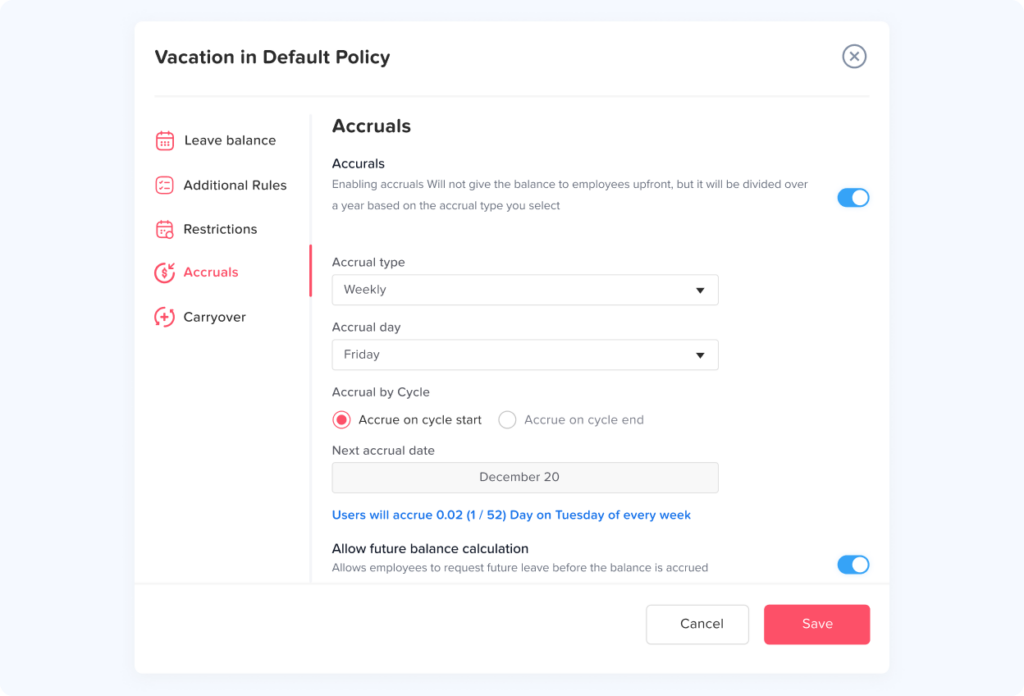
How Should PTO Accrual Work?
Employers generally use one of several methods to provide PTO.
Annual PTO Grant
Employees receive a defined amount at the beginning of a benefit year.
For example:
120 hours per year
The employee’s balance decreases whenever qualifying paid leave is taken.
Pay Period Accrual
Employees earn PTO gradually each pay period.
For example, an employer might allocate an annual entitlement across 26 biweekly payroll periods.
Hours Worked Accrual
PTO can also accrue according to hours worked, depending on the employer’s policy and applicable legal requirements.
This approach can be particularly relevant for employees whose working hours vary.
Whatever method is selected, employers should clearly document:
- Accrual rate
- Maximum balance
- Carryover rules
- Waiting periods
- PTO eligibility
- Treatment of overtime hours
- Treatment of paid leave
- PTO deduction increments
- Rules for partial shifts
- Rules for schedule changes
The method should also comply with applicable state and local requirements.
Does PTO Count Toward Overtime on a DuPont Schedule?
This is an important distinction for U.S. employers.
Under the federal Fair Labor Standards Act, covered nonexempt employees generally must receive overtime for hours worked over 40 in a workweek. The workweek is a fixed, regularly recurring period of 168 hours, and hours generally cannot simply be averaged across multiple weeks to avoid overtime obligations.
The Department of Labor also explains that the FLSA itself does not require employers to provide vacation, holiday, or sick pay. Those benefits are generally determined by employer policies, agreements, and applicable state or local laws.
This means employers should distinguish between:
hours worked and paid leave hours.
For example, suppose an employee receives:
- 36 hours for time actually worked
- 12 hours of PTO
The employee receives compensation covering 48 hours, but that does not automatically mean all 48 hours are “hours worked” for federal overtime purposes.
Company policies, collective bargaining agreements, state laws, or other rules can provide benefits beyond federal minimum requirements.
Because DuPont schedules create unusual distributions of hours, employers should configure payroll and time tracking around their actual defined workweek rather than simply relying on the schedule’s 42-hour weekly average.
Holidays and the DuPont Work Schedule
Holidays present another challenge because continuous operations may remain open on days when traditional offices close.
Imagine Christmas falls on a Tuesday.
For one DuPont employee, Tuesday may be a scheduled 12-hour day shift.
For another, it may already be a scheduled day off.
Organizations therefore need a clear holiday policy explaining:
- Whether employees are expected to work holidays
- Whether holiday pay is provided
- Whether employees working holidays receive additional compensation
- Whether employees receive alternative paid time off
- What happens when a holiday falls on a scheduled day off
- Whether PTO can be requested on holidays
- How holiday hours interact with overtime calculations
Under federal FLSA rules, premium pay simply because work occurs on a weekend or holiday is not generally required, although overtime requirements still apply when applicable. Employers may provide holiday premiums through their own policies or agreements, and state or local rules may also be relevant.
Clear policies are especially valuable when multiple crews experience the same holiday differently.
Managing Sick Leave and Unexpected Absences
Planned vacation is only one part of leave management.
An employee may become sick immediately before a scheduled 12-hour shift.
That absence can be more difficult to cover than an eight hour absence because the organization must potentially replace 12 hours of staffing.
Managers should establish a clear process for:
- Reporting an unexpected absence.
- Determining whether the employee has available sick leave or PTO.
- Finding qualified replacement coverage.
- Recording the correct number of absence hours.
- Tracking whether another employee works additional or overtime hours.
- Updating payroll and attendance records.
Organizations should also distinguish ordinary company PTO from legally protected or mandated leave where applicable. Company scheduling rules should not be used to improperly restrict leave rights provided by applicable law.
Managing PTO Requests Fairly Across Four Crews
A DuPont schedule depends heavily on adequate staffing.
Approving too many employees from the same crew for the same shift can create a serious coverage problem.
However, simply rejecting requests whenever staffing becomes inconvenient can also create frustration.
Employers should establish objective approval rules.
Possible factors include:
- Minimum staffing levels
- Required skills or certifications
- Number of employees already approved for leave
- Request submission date
- Seniority, if established by policy or agreement
- Rotating holiday priority
- Emergency exceptions
- Protected leave requirements
The important point is consistency.
Employees should understand how requests are evaluated before they submit them.
Using Day Off to Manage PTO for Rotating Schedules
Managing a DuPont rotation with spreadsheets becomes increasingly difficult as teams grow.
A PTO request is not simply “Tuesday off.” Managers need to know whether Tuesday is actually a working day for that employee, how many scheduled hours are affected, who else is absent, and whether sufficient coverage remains.
Day Off helps organizations manage leave alongside different employee work schedules.
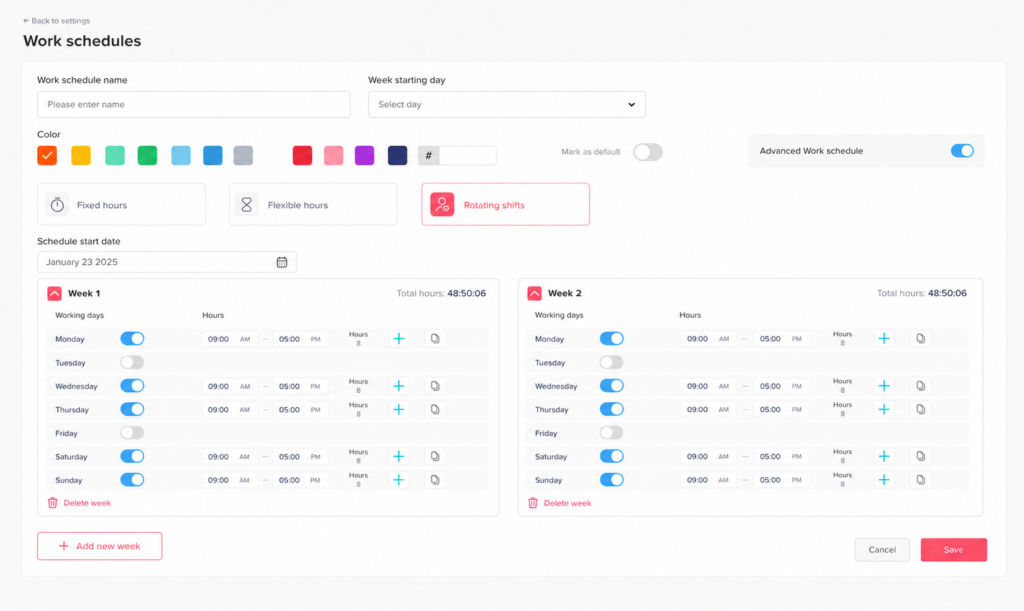
For teams using rotating or nontraditional schedules, organizations can configure employee work schedules so leave calculations better reflect when employees are actually expected to work.
With Day Off, teams can manage areas such as:
- Employee leave balances
- Vacation and sick leave policies
- Full-day, half-day, and hourly leave
- Approval workflows
- Team leave calendars
- Work schedules
- Leave accruals
- Carryover policies
- Blockout dates
- Holidays
- Employee leave history
- Leave reports
- Notifications and integrations
This becomes especially useful when one employee works a conventional Monday to Friday schedule while another works rotating shifts.
Instead of assuming every employee has an eight hour workday, organizations can maintain leave processes that better reflect each employee’s actual schedule.
DuPont Schedule vs. Traditional 8-Hour Schedule
The differences become clearer when the two models are compared directly.
| Feature | DuPont Schedule | Traditional 5-Day Schedule |
|---|---|---|
| Typical shift | 12 hours | 8 hours |
| Cycle | 28-day rotation | Usually 7 days |
| Day/night rotation | Common | Usually no |
| Scheduled shifts per 28 days | 14 | Usually about 20 |
| Scheduled hours per 28-day cycle | 168 | Usually about 160 |
| Longest built-in break | Typically 7 days | Usually 2 days |
| 24/7 coverage | Designed for it | Requires additional shifts |
| Full-shift PTO deduction when based on scheduled hours | Typically 12 hours | Typically 8 hours |
| Scheduling complexity | Higher | Lower |
Neither schedule is universally better.
The appropriate model depends on the nature of the work, staffing requirements, employee preferences, safety considerations, applicable labor rules, and operational needs.
Advantages of the DuPont Work Schedule
Seven Consecutive Days Off
Employees receive a substantial scheduled break every 28 day cycle without necessarily needing vacation time.
Predictable Rotation
Once employees understand their position in the cycle, they can potentially plan appointments, travel, and personal responsibilities far in advance.
Continuous Coverage
The four crew system is designed specifically for organizations that need round the clock staffing.
Fewer Days Commuting
Although shifts are longer, employees report to work on fewer calendar days than someone following a conventional five day workweek.
Equal Rotation Between Days and Nights
In the standard pattern, each crew works seven day shifts and seven night shifts per cycle rather than assigning one crew permanently to nights.
Longer Blocks of Personal Time
Multiple consecutive days off can make it easier to plan activities that would otherwise require PTO.
Disadvantages of the DuPont Work Schedule
Twelve Hour Shifts Can Be Demanding
Long shifts can become difficult in jobs requiring sustained concentration, physical activity, or safety-critical decisions.
Employees Rotate Between Days and Nights
Frequent changes in sleeping patterns can make adaptation difficult.
NIOSH specifically identifies night shifts and extended working hours as factors associated with workplace fatigue.
Some Portions of the Rotation Are Intensive
The middle of the cycle contains three day shifts, one day off, and three night shifts.
Even though the full cycle provides significant time off, workload is not evenly distributed.
Absence Coverage Can Be Difficult
One absence can create a 12-hour staffing gap.
Organizations may need cross-trained employees, relief staff, voluntary overtime, or another coverage strategy.
PTO Administration Requires More Care
A “day” does not necessarily mean eight hours.
PTO systems need to understand employee schedules to avoid inaccurate deductions.
Overtime Can Become Complicated
The average of 42 scheduled hours per week does not replace workweek based overtime calculations for employees subject to the standard FLSA overtime rule.
Best Practices for Implementing a DuPont Schedule
Organizations considering this schedule should establish the operational rules before launching the rotation.
Define the 28-Day Cycle Clearly
Employees should be able to see exactly where they are within the repeating rotation.
Avoid relying on employees to manually calculate future shifts.
Publish Schedules Well in Advance
Predictability is one of the biggest potential benefits of rotating schedules.
Employees should have easy access to upcoming day shifts, night shifts, scheduled days off, holidays, and approved leave.
Track PTO in Appropriate Units
For 12-hour employees, hourly leave tracking can reduce ambiguity.
Instead of recording “one vacation day,” the system can record the scheduled hours missed.
Establish Minimum Staffing Requirements
Determine how many employees and which roles must remain available before approving leave.
Create Clear Shift Swap Rules
Employees may want to exchange shifts rather than use PTO.
Define:
- Who can swap
- Whether managers must approve swaps
- Qualification requirements
- Overtime implications
- How changes are recorded
Monitor Fatigue
Managers should pay particular attention to long shifts, night work, workload, overtime, and recovery periods.
Safety should take priority over maintaining a schedule pattern exactly as written.
Keep Accurate Time Records
For covered employees, the FLSA requires employers to maintain accurate records of hours worked and wages.
A planned shift schedule should therefore not be treated as proof of the employee’s actual working hours. Actual clock in, clock out, overtime, missed shifts, PTO, and schedule adjustments may need to be tracked separately.
Is the DuPont Work Schedule Right for Your Organization?
The DuPont schedule is primarily suited to workplaces that genuinely require continuous 24/7 coverage.
It may make sense for operations where shutting down overnight is impractical or impossible and where employees can safely perform 12-hour rotating shifts.
Before implementing it, employers should evaluate:
- Whether 24/7 staffing is necessary
- Whether employees can safely work 12-hour shifts
- Whether day/night rotation is appropriate
- Required staffing levels
- Overtime costs
- Absence coverage
- Employee preferences
- PTO administration
- Payroll configuration
- State and local labor requirements
- Fatigue management
- Shift change procedures
A schedule that looks efficient mathematically can still create problems if employees are exhausted, PTO calculations are unclear, or managers cannot find coverage for absences.
FAQ
How many hours do you work on a DuPont schedule?
A standard DuPont rotation contains 14 twelve-hour shifts during a 28-day cycle, totaling 168 scheduled hours. That equals an average of 42 hours per week across the full cycle, although individual workweeks may contain substantially different scheduled hours.
How many days off are in a DuPont schedule?
Employees have 14 nonworking days during the standard 28-day rotation. The schedule includes several shorter breaks plus one seven-day block of consecutive days off.
Why does the DuPont schedule have seven days off?
The long break results from concentrating 168 scheduled work hours into fourteen 12 hour shifts across the 28-day rotation. The seven day break is therefore built into the repeating schedule rather than being vacation leave.
Do you use PTO during the seven days off?
Normally, scheduled days off do not require PTO because the employee was not expected to work. PTO is generally used when an employee takes leave during time they otherwise would have been scheduled to work, subject to the organization’s policy.
How much PTO is needed for one DuPont shift?
If an employee is scheduled for 12 hours and the employer deducts PTO according to scheduled hours, taking the entire shift off would normally require 12 hours of PTO.
Can you take half a DuPont shift as PTO?
That depends on the employer’s leave policy. If hourly or partial day leave is permitted, half of a 12-hour shift would normally represent six scheduled hours.
Does PTO count toward the 40 hours required for federal overtime?
Under the FLSA’s general overtime rule, overtime is based on hours worked, while vacation and sick pay concern time not worked. Employer policies or other applicable laws may provide more generous treatment.
Is the DuPont schedule always exactly the same?
No. Organizations may modify shift start times, rotation dates, crew assignments, relief arrangements, or other aspects of the pattern. Employers should document their actual schedule rather than assuming every system called “DuPont” operates identically.
Is the DuPont schedule suitable for every 24/7 business?
Not necessarily. Twelve-hour shifts and repeated day/night transitions may be inappropriate for some workloads or workforces. Organizations should evaluate staffing, fatigue, safety, overtime, employee preferences, and legal requirements before adopting the schedule.
How can companies make PTO easier for DuPont employees?
The key is connecting leave management to the employee’s actual work schedule. A system such as Day Off can help organizations manage work schedules, PTO balances, leave requests, approvals, holidays, and employee availability in one place rather than calculating rotating-shift leave manually.
Conclusion
The DuPont Work Schedule provides a structured way to maintain 24/7 operations using four crews, 12-hour shifts, and a repeating 28 day rotation. Its most recognizable benefit is the seven consecutive days off built into each cycle, while its biggest challenges include long shifts, day to night transitions, uneven weekly workloads, absence coverage, and overtime administration.
PTO deserves particular attention. When employees work 12-hour shifts, employers should avoid assuming that a “PTO day” automatically equals the traditional eight hours. Leave policies should clearly define how PTO accrues, how many hours are deducted for a missed shift, how partial shifts are handled, how holidays interact with the rotation, and how scheduled days off are treated.
Using a leave and workforce management system such as Day Off can make these rules easier to administer by connecting employee work schedules with leave balances, requests, approvals, calendars, and reporting.
Ultimately, a DuPont rotation works best when the schedule is predictable, PTO rules are transparent, staffing remains adequate, actual working hours are accurately recorded, and employee rest and safety are treated as core parts of workforce planning rather than afterthoughts.