







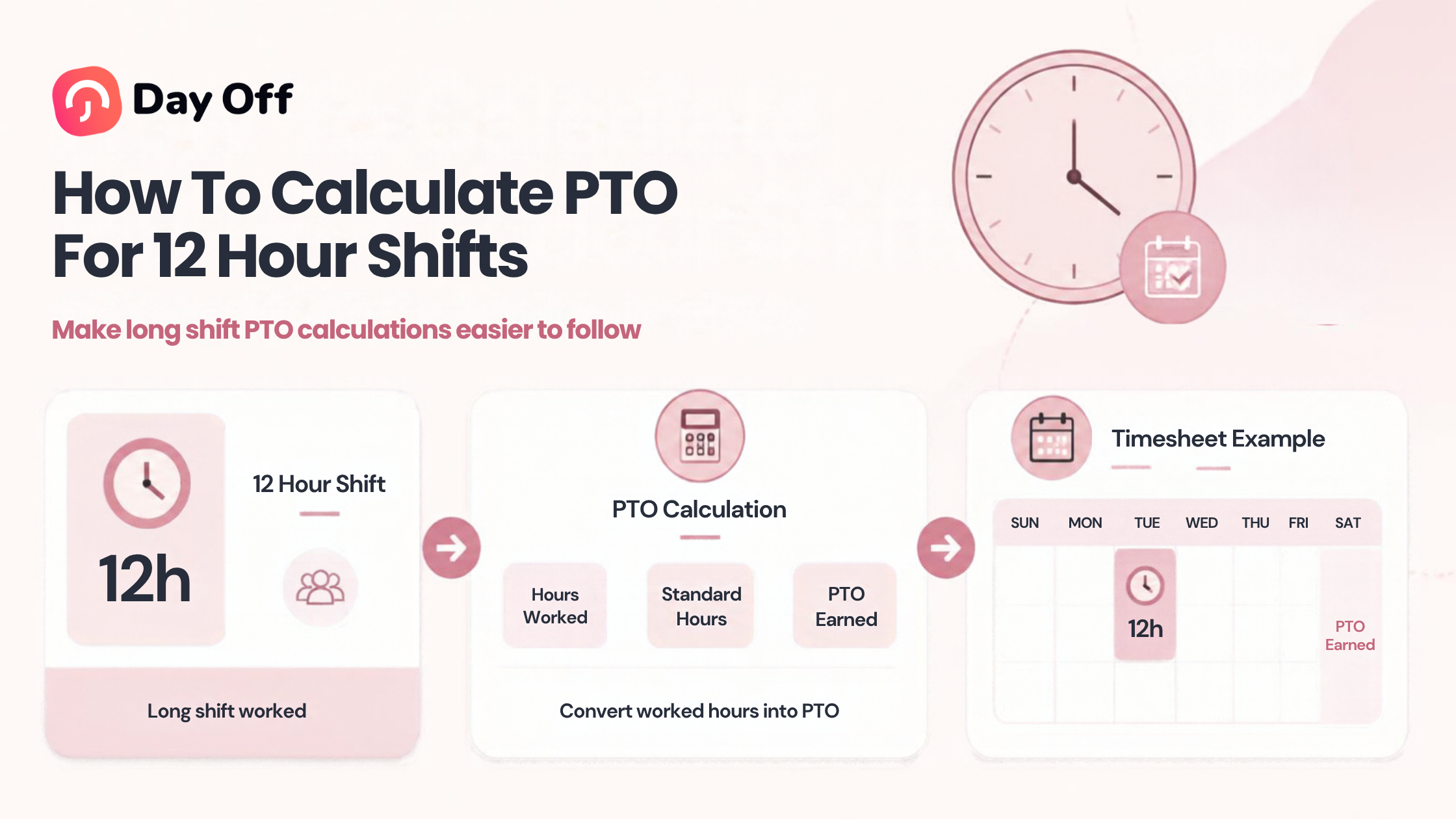
Knowing how to Calculate PTO for employees working 12 hour shifts is essential when a company tracks paid time off in hours. A standard eight hour PTO day does not automatically cover a 12-hour scheduled shift, and using the wrong conversion can leave employees with incorrect balances, unexpected unpaid hours, or inconsistent deductions. The basic principle is simple: PTO should reflect the employee’s scheduled hours for the time they are taking off, while accrual rules should follow the company’s written PTO policy.

Twelve hour shifts are common in healthcare, manufacturing, security, emergency services, utilities, hospitality, and other workplaces that need extended or continuous coverage. These schedules can also involve compressed workweeks, rotating shifts, or patterns in which employees work different numbers of hours from one week to another.
That makes PTO administration more complicated than simply calling every absence “one day.”
This guide explains how PTO works with 12 hour shifts, how to calculate PTO deductions and accruals, how to handle partial days, and how employers can keep PTO balances accurate when employees work nontraditional schedules.
Why PTO for 12 Hour Shifts Requires Special Attention
The main issue is the difference between a calendar day and a scheduled workday.
Consider two employees:
- Employee A works five 8-hour shifts per week.
- Employee B works three 12-hour shifts in a particular week.
If both request one full scheduled shift off, Employee A misses 8 scheduled working hours while Employee B misses 12.
If the employer simply deducts “one PTO day” from both employees without defining how many hours that day represents, the PTO records can become confusing or inconsistent.
For organizations with alternative schedules, tracking PTO in hours is often clearer because the deduction can correspond directly to scheduled working time.
The Basic Formula for PTO on a 12 Hour Shift
When PTO is tracked in hours, calculating a full shift absence is straightforward:
PTO used = Scheduled work hours missed
If an employee is scheduled to work 12 hours and takes the entire shift off:
12 scheduled hours missed = 12 PTO hours used
If the employee takes only part of the shift off:
PTO used = Scheduled hours missed because of PTO
For example, if the employee works 7 hours of a scheduled 12-hour shift and uses PTO for the remaining 5 scheduled hours:
12 – 7 = 5 PTO hours
This approach keeps PTO connected to the work schedule rather than treating every absence as an identical “day.”
PTO Examples for 12 Hour Shifts
| PTO Situation | Scheduled Shift | Hours Worked | PTO Used |
|---|---|---|---|
| Full shift off | 12 hours | 0 | 12 hours |
| Half of shift off | 12 hours | 6 | 6 hours |
| Leaves 3 hours early | 12 hours | 9 | 3 hours |
| Arrives 2 hours late using PTO | 12 hours | 10 | 2 hours |
| Full 8-hour shift off | 8 hours | 0 | 8 hours |
| Not scheduled | 0 hours | 0 | 0 hours |
The final example is important. An employee normally should not need PTO to cover a day on which they were not scheduled to work, unless a specific policy or applicable rule operates differently.
How to Calculate PTO for a Full 12-Hour Shift
Suppose an employee is scheduled:
7:00 AM to 7:00 PM
Assume for this example that the employee’s compensable scheduled time is 12 hours and there is no unpaid break that reduces the scheduled hours.
The employee requests the entire shift off.
The calculation is:
12 scheduled hours × 1 missed shift = 12 PTO hours
If the employee’s available PTO balance is 72 hours:
72 – 12 = 60 hours remaining
After the absence, the employee has 60 PTO hours left.
This is more precise than simply deducting “one day,” because a day can mean different amounts of working time for employees with different schedules.
What If the Shift Includes an Unpaid Break?
This is where employers need to distinguish between the shift span and paid scheduled hours.
An employee could be present at the workplace for 12 hours without having 12 compensable scheduled hours.
For example:
- Shift begins: 7:00 AM
- Shift ends: 7:00 PM
- Total elapsed time: 12 hours
- Unpaid meal period: 30 minutes
- Paid/scheduled hours under the employer’s setup: 11.5 hours
If the company’s PTO policy replaces scheduled paid working hours rather than unpaid meal periods, a full shift PTO deduction could be:
12 – 0.5 = 11.5 PTO hours
Employers should configure PTO deductions according to the actual work schedule and their policy rather than assuming that every “12-hour shift” always equals exactly 12 PTO hours.
How to Calculate Partial Day PTO for a 12 Hour Shift
Partial-day PTO becomes much easier when leave is tracked in hours.
Suppose an employee has a 12-hour scheduled shift but needs the last four hours off.
The employee works:
8 hours
The scheduled hours remaining are:
12 – 8 = 4 hours
Therefore:
PTO deduction = 4 hours
The employee’s attendance record can then show:
8 hours worked + 4 PTO hours = 12 scheduled hours accounted for
The same logic works when an employee arrives late.
If an employee misses the first three scheduled hours but works the remaining nine:
3 PTO hours + 9 worked hours = 12 scheduled hours accounted for
This gives HR a more accurate record than automatically deducting a half day.
Is Half Day PTO Always 6 Hours for a 12 Hour Shift?
Not necessarily.
Mathematically, half of 12 hours is six hours:
12 ÷ 2 = 6
But companies should not automatically assume that a “half day” means half of every employee’s scheduled shift.
A company’s policy or leave management system might define half-day leave differently. For example, the organization might use specific half day periods, fixed leave units, or hourly PTO.
For employees with variable or nonstandard schedules, hourly leave can often provide more precise deductions.
PTO Hours vs PTO Days for 12-Hour Employees
A common source of confusion is giving employees PTO in “days” without specifying the number of hours represented by a PTO day.
Suppose a policy gives an employee 15 PTO days per year.
If one PTO day is defined as eight hours:
15 × 8 = 120 PTO hours
An employee working 12-hour shifts could cover:
120 ÷ 12 = 10 full 12-hour shifts
That does not necessarily mean the employee has somehow lost five days of PTO. It means the policy grants 120 hours, while each of that employee’s scheduled shifts consumes 12 hours when fully missed.
This is why PTO policies should clearly explain what a “day” means.
| PTO Situation | Scheduled Shift | Hours Worked | PTO Used |
|---|---|---|---|
| Full shift off | 12 hours | 0 | 12 hours |
| Half of shift off | 12 hours | 6 | 6 hours |
| Leaves 3 hours early | 12 hours | 9 | 3 hours |
| Arrives 2 hours late using PTO | 12 hours | 10 | 2 hours |
| Full 8-hour shift off | 8 hours | 0 | 8 hours |
| Not scheduled | 0 hours | 0 | 0 hours |
This comparison also demonstrates why employers should avoid comparing PTO only by the number of shifts an employee can miss. Employees with longer shifts work more hours each scheduled day and often have fewer scheduled workdays.
How to Calculate PTO Accrual for 12-Hour Shift Employees
PTO usage and PTO accrual are different calculations.
Usage determines how much PTO is deducted when an employee takes leave.
Accrual determines how PTO is earned.
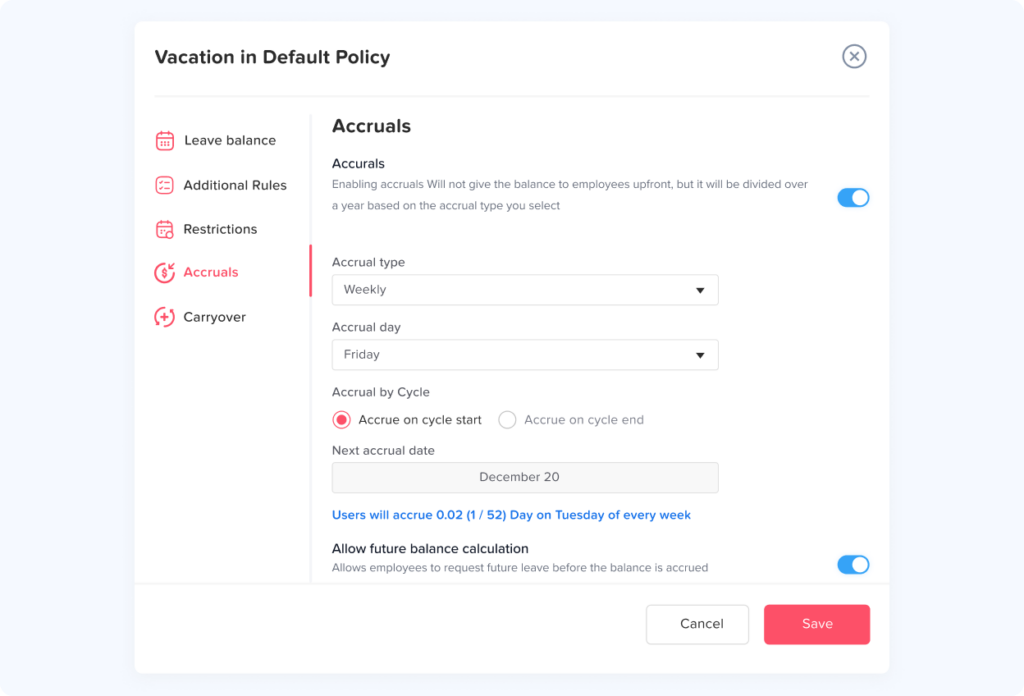
Employers may use several accrual structures, depending on their policy and applicable law.
Common approaches include:
- Fixed annual allowance
- Monthly accrual
- Biweekly accrual
- Semimonthly accrual
- Weekly accrual
- Accrual based on hours worked
The fact that an employee works a 12-hour shift does not automatically determine their accrual method.
Example 1: Annual PTO Grant
Suppose an employee receives 120 PTO hours at the beginning of the year.
They work 12-hour shifts.
The number of complete 12-hour shifts the balance can cover is:
120 ÷ 12 = 10 shifts
The employee therefore has enough PTO for ten complete 12-hour scheduled shifts.
If they use one full shift:
120 – 12 = 108 hours
Example 2: Monthly Accrual
Suppose the policy provides 120 PTO hours per year, accrued evenly over 12 months.
The monthly accrual is:
120 ÷ 12 = 10 PTO hours per month
After six months, assuming no special waiting periods, caps, adjustments, or PTO usage:
10 × 6 = 60 PTO hours accrued
At 12 hours per full scheduled shift, that balance could cover:
60 ÷ 12 = 5 full 12-hour shifts
Example 3: Accrual Per Hour Worked
Some policies award PTO according to hours worked.
Suppose an employee earns:
0.05 PTO hours per eligible hour worked
If the employee has 36 eligible hours in a week:
36 × 0.05 = 1.8 PTO hours
If the employee has 48 eligible hours in another week:
48 × 0.05 = 2.4 PTO hours
The exact calculation depends on the policy’s definition of eligible hours. Employers should specify whether overtime hours, PTO hours, holidays, or other paid nonworking hours count toward accrual.
How to Convert an Accrual Rate Into PTO Hours
Another way to express accrual is:
PTO accrual rate = Annual PTO hours ÷ Annual eligible working hours
For example, suppose a policy provides 120 PTO hours annually and the relevant annual eligible hours are 2,080.
120 ÷ 2,080 = 0.05769
That means approximately 0.0577 PTO hours are earned per eligible hour, if that is how the policy is designed.
For 36 eligible hours:
36 × 0.05769 ≈ 2.08 PTO hours
For 48 eligible hours:
48 × 0.05769 ≈ 2.77 PTO hours
However, employers should not create an hourly accrual rate from an annual allowance unless the policy actually provides for accrual in this way. A front-loaded annual policy operates differently from an hours-worked accrual policy.
How PTO Works With a 36-Hour Week
A common 12-hour schedule is:
- Monday: 12 hours
- Wednesday: 12 hours
- Friday: 12 hours
Total:
36 scheduled hours
If the employee takes Wednesday off, the employee misses 12 scheduled hours.
Therefore:
12 PTO hours are needed to cover Wednesday
The week’s accounted-for hours could then be:
- Monday: 12 worked
- Wednesday: 12 PTO
- Friday: 12 worked
Total:
24 worked hours + 12 PTO hours = 36 scheduled hours accounted for
Notice that PTO hours and hours actually worked should remain conceptually separate.
That distinction becomes particularly important when considering overtime.
Does PTO Count Toward Overtime?
Under the federal Fair Labor Standards Act in the United States, overtime for covered nonexempt employees is generally based on hours actually worked over 40 in a workweek. Paid time off for vacation, holidays, or illness is generally not counted as hours worked for purposes of determining FLSA overtime.
For example, imagine an employee has:
- 36 hours actually worked
- 12 hours of PTO
The employee has 48 paid/accounted-for hours, but only 36 hours were actually worked.
Under the federal FLSA calculation, those 12 PTO hours generally would not turn the week into 48 hours worked for statutory overtime purposes.
However, an employer’s policy, collective bargaining agreement, state law, industry specific rules, or other requirements may provide different or more generous treatment.
Employers should therefore keep worked hours and PTO hours distinguishable in their time records.
How PTO Works With a 48-Hour Week
Twelve-hour shift patterns can produce weeks with more than 40 scheduled hours.
For example:
- Monday: 12 hours
- Tuesday: 12 hours
- Thursday: 12 hours
- Friday: 12 hours
Total scheduled time:
48 hours
Suppose the employee takes Monday off using 12 hours of PTO and works the remaining three shifts.
The records would show:
12 PTO hours + 36 hours actually worked
The employee has 48 scheduled hours accounted for, but only 36 hours actually worked.
Again, PTO and hours worked should not automatically be treated as interchangeable for overtime calculations.
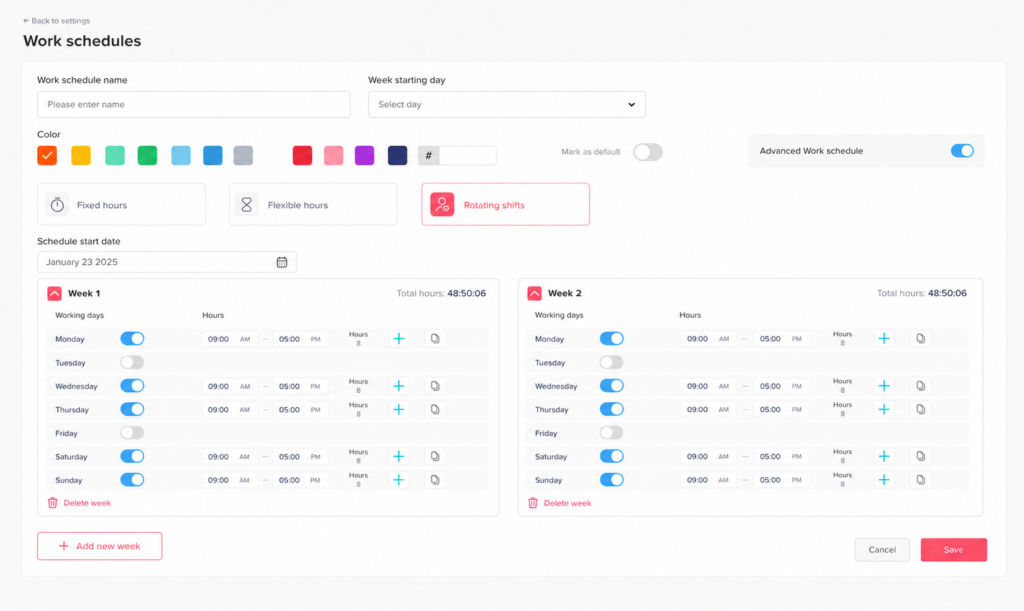
How to Calculate PTO for Rotating 12-Hour Shifts
Rotating schedules require special attention because an employee’s weekly schedule can change.
For example:
Week A: 36 scheduled hours
Week B: 48 scheduled hours
Instead of calculating PTO from an “average day,” calculate the leave based on the employee’s actual scheduled shift on the requested date.
If the employee requests a scheduled 12-hour Thursday off:
12 PTO hours
If Friday is a scheduled rest day:
0 PTO hours
If another date contains an 8-hour training shift:
8 PTO hours, assuming the policy replaces those scheduled hours.
The PTO deduction should follow the schedule associated with the actual absence.
This is one reason integrating work schedules with PTO tracking can significantly reduce manual calculation errors.
How to Calculate PTO Across Multiple 12-Hour Shifts
Suppose an employee requests three scheduled shifts off.
Each shift contains 12 PTO eligible scheduled hours.
The calculation is:
3 × 12 = 36 PTO hours
If the employee has 50 PTO hours available:
50 – 36 = 14 PTO hours remaining
The employee can cover all three scheduled shifts and retains 14 hours.
But suppose the requested calendar period also contains four nonscheduled days.
Those rest days should not automatically consume PTO simply because they fall between the beginning and end of the leave period.
A leave management system should identify which dates are working days according to the employee’s schedule.
Example: A Seven Day Vacation for a 12 Hour Shift Employee
This demonstrates why counting calendar days can be misleading.
Assume an employee works:
- Monday: 12 hours
- Tuesday: 12 hours
- Wednesday: Off
- Thursday: Off
- Friday: 12 hours
- Saturday: Off
- Sunday: Off
The employee requests the entire Monday-to-Sunday period away from work.
Although the vacation lasts seven calendar days, the employee was scheduled for only three shifts.
PTO required:
12 + 12 + 12 = 36 hours
Not:
7 × 12 = 84 hours
And not automatically:
7 × 8 = 56 hours
The PTO calculation should be driven by scheduled working time covered by the request, according to the employer’s policy.
What If an Employee Does Not Have Enough PTO for a 12-Hour Shift?
Suppose an employee has:
9 PTO hours available
But needs:
12 hours off
There is a:
12 – 9 = 3-hour shortfall
What happens to those three hours depends on the employer’s policy and applicable law.
Possible policy outcomes might include:
- Use 9 hours of available PTO and treat 3 hours as unpaid
- Allow a negative PTO balance
- Permit PTO to be borrowed or advanced
- Use another eligible leave balance
- Deny or modify the request where legally permitted
- Apply another applicable protected leave rule
Employers should not improvise the rule for each request. The policy should explain what happens when an employee’s available balance is lower than the scheduled time they want to take off.
Should PTO Be Deducted on an Employee’s Day Off?
Generally, PTO systems should distinguish between scheduled working days and nonscheduled days.
If an employee works three 12-hour shifts per week and requests an entire calendar week off, only their scheduled working hours normally need to be covered by PTO under a schedule-based PTO policy.
For example:
Monday: 12-hour scheduled shift
Tuesday: Off
Wednesday: 12-hour scheduled shift
Thursday: Off
Friday: 12-hour scheduled shift
Saturday: Off
Sunday: Off
PTO required for all scheduled work that week:
36 hours
The four nonscheduled days do not automatically create another 48 hours of PTO deductions.
How Should Holidays Affect PTO on 12-Hour Shifts?
Holidays can make PTO calculations more complicated because employers use different holiday policies.
Suppose an employee requests a week of PTO, and one scheduled 12-hour shift falls on a company holiday.
Possible policies include:
- The holiday is excluded from PTO deductions.
- The employee receives a fixed number of holiday hours, with PTO covering the remainder.
- Holiday treatment depends on the employee’s schedule or location.
- The employer uses a separate holiday balance.
For example, if a scheduled 12-hour shift falls on a holiday and the company provides eight holiday hours, the policy may need to explain what happens to the remaining four scheduled hours.
There is no universal calculation that fits every company. The PTO and holiday policies need to define the interaction clearly.
How Should Employers Handle PTO When Schedules Change?
Schedule changes can create incorrect PTO deductions when leave is calculated before the employee’s final schedule is known.
For example:
- Employee is initially scheduled for an 8-hour shift.
- Employee requests the entire shift as PTO.
- The schedule is later changed to 12 hours.
- The PTO request still shows an 8-hour deduction.
The employee now has four scheduled hours that are not accounted for.
The opposite can happen as well. A 12-hour PTO deduction may remain after the employee’s schedule is changed to eight hours.
Employers should establish a process for recalculating leave when a schedule change affects the hours covered by an existing request.
This becomes particularly important for rotating shifts and employees who regularly move between different work schedules.
Building a Clear PTO Policy for 12 Hour Shifts
A good policy should remove ambiguity before an employee submits a request.
Consider defining:
PTO Unit
Will PTO be tracked in:
- Hours
- Days
- Half days
- A combination of units
For nonstandard schedules, hours can provide greater precision.
Full Shift Deduction
Explain whether a full scheduled shift requires PTO equal to the employee’s PTO-eligible scheduled hours.
Partial Shift Leave
Define whether employees can request PTO by hour and whether there is a minimum increment.
Break Treatment
Clarify whether unpaid meal periods are excluded when calculating PTO for a full shift.
Accrual Method
State whether PTO is:
- Front loaded
- Accrued weekly
- Accrued biweekly
- Accrued semimonthly
- Accrued monthly
- Earned according to eligible hours worked
Schedule Changes
Explain how already approved PTO will be handled when an employee’s work schedule changes.
Holidays
Define how holidays that fall during PTO interact with the employee’s balance.
Insufficient Balances
Explain what happens when the employee does not have enough PTO to cover the requested scheduled hours.
Clear definitions reduce disputes because employees can understand how their balance will be affected before requesting leave.
How Day Off Simplifies PTO for 12-Hour Shifts
Calculating PTO manually becomes increasingly difficult when employees have different schedules, rotating shifts, hourly leave, holidays, and changing balances.
Day Off helps companies connect leave management with employee work schedules so that PTO can be managed around the way employees actually work.
For employees with nontraditional schedules, companies can configure work schedules instead of assuming everyone follows the same Monday to Friday pattern.
Day Off supports different schedule structures, including fixed and rotating schedules. Organizations can also manage leave balances, accrual rules, carryover, holidays, and other PTO policy settings from the same system.
For teams that need more precise leave deductions, hourly leave allows an employee to request part of a working day rather than forcing every request into a full-day or half day unit.
That becomes especially useful with 12-hour shifts.
Instead of treating a four-hour absence as a vague partial day, the company can account for the actual four scheduled hours covered by PTO.
Day Off also combines PTO management with attendance and time tracking, helping managers distinguish between:
- Scheduled hours
- Hours worked
- Approved time off
- Late time
- Overtime
- Absence
- Breaks
This creates a clearer picture of an employee’s workday than managing schedules, PTO, and attendance in disconnected spreadsheets.
A Simple PTO Calculation Checklist
When calculating PTO for an employee working a 12 hour schedule, check these questions in order:
- Was the employee scheduled to work on the requested date?
- How many PTO eligible hours were scheduled?
- Is the employee taking the entire shift or only part of it?
- Does the shift contain unpaid time?
- Is there a holiday or another type of paid leave involved?
- How much PTO does the employee currently have available?
- Does the request affect overtime or attendance reporting?
- Has the employee’s schedule changed since the leave was requested?
Then apply the basic principle:
PTO used = PTO eligible scheduled work hours covered by the leave request
This gives employers a consistent starting point while allowing company specific policy rules to be applied afterward.
FAQ
How much PTO should I use for a 12-hour shift?
If an employee misses an entire 12-hour scheduled shift and the full 12 hours are PTO eligible under the company’s policy, the deduction would normally be 12 PTO hours. If unpaid breaks are excluded, the deduction may be lower.
Is one PTO day 8 hours or 12 hours?
That depends on how the employer defines a PTO day. If PTO is stored in hours, a full-shift absence can be deducted according to the employee’s scheduled hours. Employers should clearly define the conversion if their policy expresses PTO in days.
How many 12-hour shifts can 120 hours of PTO cover?
120 ÷ 12 = 10 full 12-hour shifts.
Any partial-shift usage would change the number of complete shifts that could subsequently be covered.
How much PTO is half of a 12-hour shift?
Mathematically, half of 12 hours is six hours. However, employers should follow their actual partial-day PTO policy rather than assuming every half-day request automatically equals half of the scheduled shift.
How do you calculate PTO for a 36-hour workweek?
The weekly total does not determine the deduction for an individual absence. If an employee works three 12-hour shifts and misses one full scheduled shift, the schedule based deduction would generally be 12 PTO hours.
Do you use PTO on days you are not scheduled to work?
Under a schedule based PTO system, nonscheduled days generally do not require PTO because there are no scheduled working hours to replace. Company policy and applicable leave rules should still be checked.
Does 12 hours of PTO count as 12 hours worked for overtime?
Under the federal FLSA, paid vacation, holiday, and sick time generally are not treated as hours actually worked when determining whether a covered nonexempt employee exceeded 40 hours in a workweek. Employer policies or other applicable requirements may be more generous.
What happens if I only have 8 PTO hours for a 12-hour shift?
There is a four-hour difference. How those hours are handled depends on the employer’s policy. They might be unpaid, covered by another eligible balance, or handled through an approved PTO advance or negative balance where permitted.
Should unpaid lunch be deducted from PTO?
If the meal period is genuinely unpaid and is not part of the PTO-eligible scheduled hours, the employer’s policy may exclude it from the PTO deduction. Employers should base the calculation on their actual schedule and policy configuration.
How do you calculate PTO for rotating 12 hour shifts?
Use the employee’s actual scheduled hours on each requested date rather than assuming every calendar day is a workday. This prevents PTO from being deducted for scheduled rest days.
Conclusion
Learning how to Calculate PTO for 12 hour shifts starts with one important distinction: PTO should account for scheduled working time, not simply calendar days.
When an employee misses a full 12-hour scheduled shift, a schedule based hourly policy will generally account for the PTO eligible hours associated with that shift. When the employee takes only part of the shift off, the deduction can reflect the scheduled working hours actually missed.
Employers also need to consider unpaid breaks, rotating schedules, holidays, schedule changes, accrual methods, overtime calculations, and insufficient PTO balances.
The simplest approach is to define these rules clearly and track PTO in a system that understands each employee’s schedule.
With Day Off, companies can manage PTO balances, work schedules, hourly leave, accruals, attendance, holidays, and time tracking in one place. This helps reduce manual calculations while giving employees and managers a clearer understanding of how much PTO is available and how much a request will use.
For teams working 12 hour shifts, that accuracy matters. A PTO “day” should never be ambiguous when the actual schedule can provide the answer.