







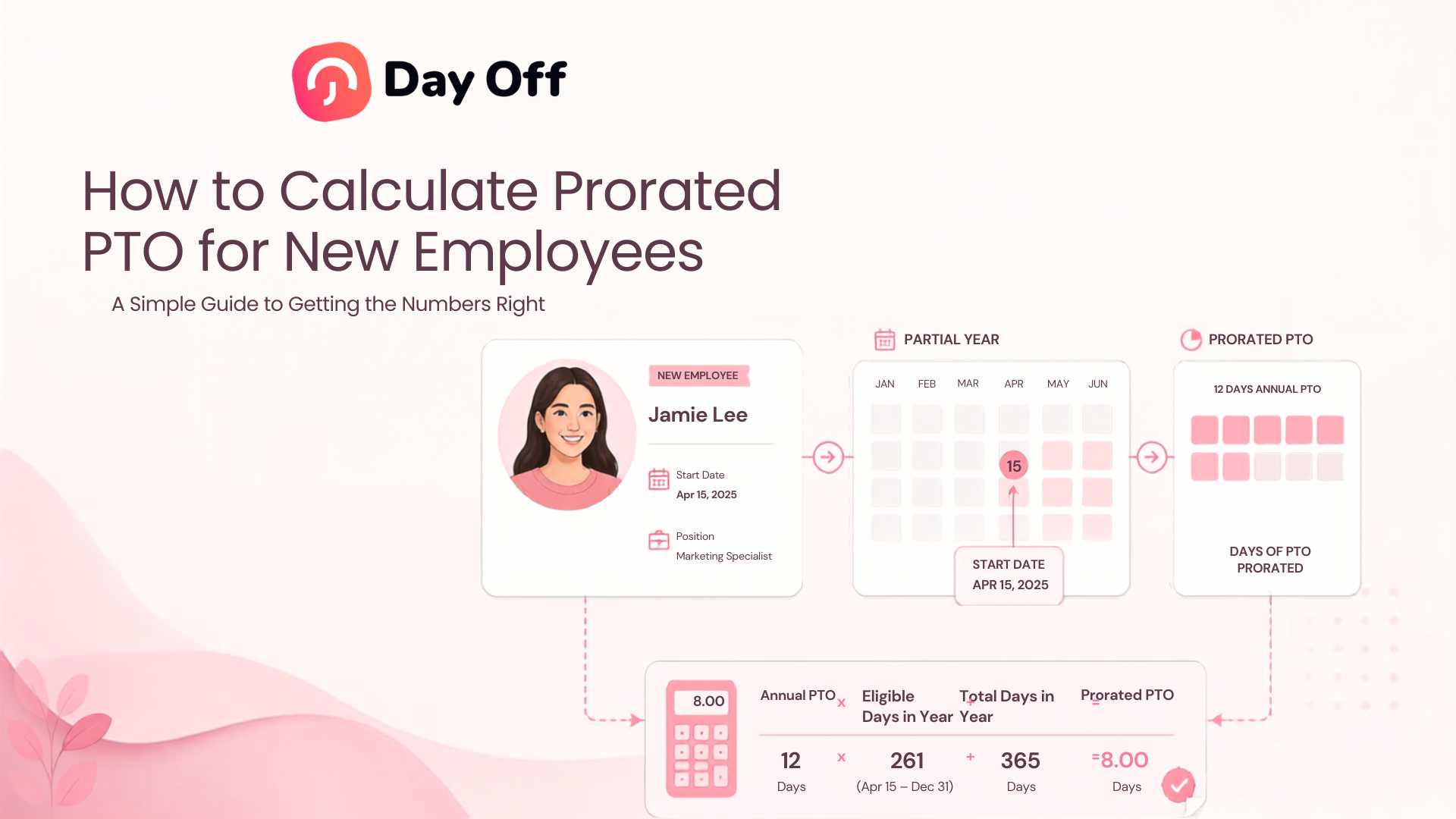
Calculating prorated PTO is important when a new employee joins after the beginning of the company’s leave year and should receive only the portion of paid time off that applies to their remaining eligible time. Instead of granting the same annual allowance given to an employee who worked the entire year, employers can prorate the balance based on months, calendar days, pay periods, hours worked, or another method defined in the company’s PTO policy.

The calculation itself is usually straightforward. The challenge is deciding exactly what portion of the year should count.
For example, imagine employees normally receive 120 hours of PTO each calendar year. Someone hired on January 1 may be eligible for the full 120 hours, while someone joining on July 1 might receive 60 hours under a simple monthly proration policy.
However, a different employer could calculate that employee’s PTO by pay period instead. Another might allow PTO to accrue based on hours worked. A company could also impose a waiting period before accrual or before employees can actually use their balance.
That is why the correct prorated PTO calculation should always begin with the written PTO policy.
What Is Prorated PTO?
Prorated PTO is a reduced paid time off entitlement calculated according to how much of a PTO year, employment period, or work schedule applies to an employee.
In simple terms:
Prorated PTO = Full annual PTO allowance × Eligible portion of the PTO year
If employees normally receive 20 days of PTO per year but a new employee is eligible for only half of that year:
20 × 6 ÷ 12 = 10 days
The new employee would receive 10 PTO days for that year under a monthly proration method.
Proration is commonly used when:
- An employee joins during the middle of a calendar year.
- PTO eligibility starts after a waiting period.
- An employee becomes eligible partway through a leave year.
- Employees work different weekly schedules.
- A part time employee receives PTO proportional to working hours.
- An employee changes from part-time to full-time or vice versa.
- A company front-loads PTO rather than allowing employees to accrue it gradually.
Not every PTO policy needs manual proration. When employees earn PTO each week, month, pay period, or hour worked, new hires can simply begin accruing from the date specified by the policy.
That distinction is important.
Prorated PTO vs PTO Accrual
Prorated PTO and PTO accrual are closely related, but they are not exactly the same thing.
A prorated PTO allowance usually means calculating a reduced portion of an annual entitlement.
For example:
Annual entitlement = 120 hours
Employee eligible for 50% of the year
120 × 50% = 60 hours
An accrual policy, on the other hand, adds PTO gradually.
For example, an employee receiving 120 PTO hours annually under a monthly accrual policy could receive:
120 ÷ 12 = 10 hours per month
If the employee becomes eligible on July 1, they simply receive six monthly accruals from July through December:
10 × 6 = 60 hours
Both systems produce 60 hours in this simple example, but they are administratively different.
With front loaded PTO, HR may need to calculate a new hire’s reduced balance when they join.
With recurring accruals, the system can normally begin accumulating PTO from the employee’s applicable accrual date.
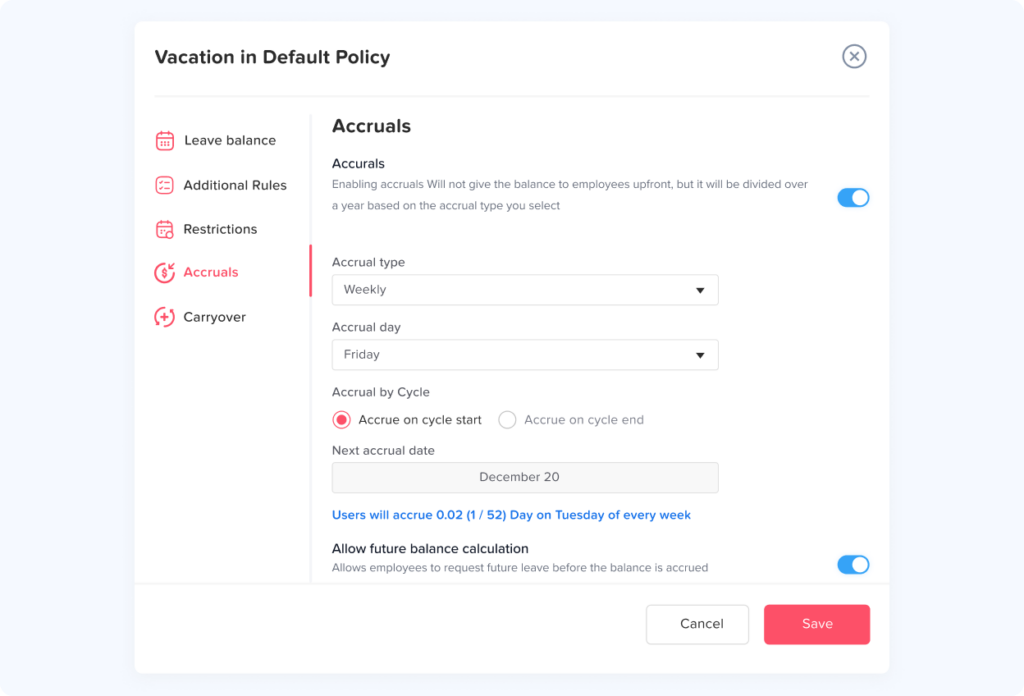
Day Off, for example, supports recurring accrual schedules such as weekly, biweekly, semimonthly, and monthly accruals, allowing leave to build over time instead of requiring the entire annual allowance to be issued at once.
The Basic Prorated PTO Formula
A general formula is:
Prorated PTO = Annual PTO Entitlement × Eligible Time ÷ Total Time in PTO Year
The definition of “time” depends on your policy.
It could mean:
- Months
- Calendar days
- Workdays
- Pay periods
- Weeks
- Eligible hours worked
For example, suppose an employee receives 15 PTO days per year and will be eligible for eight months.
15 × 8 ÷ 12 = 10 days
The employee’s prorated PTO allowance would be 10 days.
If PTO is tracked in hours and the annual entitlement is 120 hours:
120 × 8 ÷ 12 = 80 hours
The employee would receive 80 hours.
Why the Formula Alone Is Not Enough
Before performing the calculation, HR needs to determine:
- What is the company’s PTO year?
- When does PTO eligibility begin?
- Does PTO accrue immediately?
- Does a waiting period affect accrual, usage, or both?
- Are partial months included?
- Are partial pay periods included?
- Is PTO measured in days or hours?
- How are decimals rounded?
- Is the employee full time or part time?
- Does applicable law impose different rules?
Without these definitions, two HR administrators could calculate different balances for the same employee while both believing their calculation is correct.
4 Common Methods for Calculating Prorated PTO
There is no single proration method that fits every organization. The right approach depends on how the company’s leave policy is designed.
| Method | Basic Formula | Common Use |
|---|---|---|
| Monthly proration | Annual PTO × eligible months ÷ 12 | Simple annual or front-loaded PTO policies |
| Daily proration | Annual PTO × eligible calendar days ÷ days in leave year | Precise hire-date calculations |
| Pay-period proration | PTO per pay period × eligible pay periods | Payroll-aligned accrual policies |
| Hours-worked accrual | Eligible hours worked × PTO accrual rate | Hourly, variable-hour, or part-time employees |
Method 1: Calculate Prorated PTO by Month
Monthly proration is one of the easiest methods to administer.
Use:
Annual PTO × Eligible Months ÷ 12
Suppose employees receive 18 vacation days annually.
A new employee starts July 1.
Six months remain:
July, August, September, October, November, and December.
The calculation is:
18 × 6 ÷ 12 = 9 PTO days
The employee receives 9 days for their first partial year.
Example With PTO Hours
Suppose the annual entitlement is 160 hours.
The employee starts October 1, leaving three months in the year.
160 × 3 ÷ 12 = 40 hours
The employee receives 40 PTO hours.
Monthly Proration Examples
Assume a calendar year PTO policy providing 120 hours annually:
| Start Date | Eligible Full Months | Calculation | Prorated PTO |
|---|---|---|---|
| January 1 | 12 | 120 × 12 ÷ 12 | 120 hours |
| April 1 | 9 | 120 × 9 ÷ 12 | 90 hours |
| July 1 | 6 | 120 × 6 ÷ 12 | 60 hours |
| October 1 | 3 | 120 × 3 ÷ 12 | 30 hours |
This approach is simple when employees start on the first day of the month.
The policy needs more detail when someone starts in the middle of a month.
What Happens With a Partial Month?
Consider an employee starting September 15.
Should September count?
There are several possible rules.
A company might:
- Count the entire month.
- Exclude the partial month and start PTO in October.
- Prorate September separately based on calendar days.
- Begin accrual on the next scheduled accrual date.
- Begin accrual on the hire date.
None of these should be chosen on an employee by employee basis.
The PTO policy should specify the rule and apply it consistently.
Method 2: Calculate PTO Based on Calendar Days
Employers wanting more precision can prorate an annual balance by calendar days.
Use:
Annual PTO × Eligible Calendar Days ÷ Total Calendar Days in the PTO Year
For a standard year, the denominator is 365.
For a leap year, it is 366.
Example
Suppose:
- Annual PTO = 120 hours
- Hire date = September 15
- PTO year ends December 31
- Hire date counts as an eligible day
- Eligible calendar days remaining = 108
- Year length = 365 days
The calculation is:
120 × 108 ÷ 365 = 35.51 hours
The employee receives approximately 35.51 PTO hours, subject to the company’s rounding policy.
This method produces a more precise result than simply counting full months.
Monthly vs Daily Proration
Imagine the same September 15 employee receives 120 PTO hours annually.
If the employer ignores the partial September and counts only October through December:
120 × 3 ÷ 12 = 30 hours
Using calendar day proration:
120 × 108 ÷ 365 = 35.51 hours
Neither calculation is automatically the “correct” one for every company.
The correct result depends on the policy.
What matters most is that the company defines its method in advance and applies it consistently.
Method 3: Prorate PTO by Pay Period
Some companies align PTO with payroll.
Instead of calculating how many months remain, determine how much PTO is earned per pay period.
The basic formula is:
Annual PTO ÷ Number of Pay Periods = PTO Per Pay Period
Common payroll schedules include approximately:
- Weekly: 52 pay periods
- Biweekly: 26 pay periods
- Semimonthly: 24 pay periods
- Monthly: 12 pay periods
Suppose an employee receives 120 PTO hours annually and is paid biweekly.
120 ÷ 26 = 4.6154 hours per pay period
Rounded to two decimal places:
4.62 hours per pay period
If the new employee completes eight eligible pay periods before the PTO year ends:
4.6154 × 8 = 36.92 hours
The employee would earn approximately 36.92 hours.
An important detail is that biweekly and semimonthly payroll are not the same. A standard biweekly schedule generally results in 26 pay periods, while semimonthly payroll means twice per month, normally 24 periods.
What About a Partial Pay Period?
Again, the written policy should decide.
Common approaches include:
- No accrual until the first complete pay period.
- Prorate the first pay period.
- Accrue from the employee’s hire date.
- Credit the full scheduled accrual if the employee is active on the accrual date.
For example, if an employee joins three days before payroll closes, one employer might award the full 4.62-hour accrual while another might wait until the next full pay period.
Both approaches can create very different first year balances, so the rule should not be left ambiguous.
Method 4: Calculate PTO Based on Hours Worked
For hourly employees, variable schedules, or part time workers, PTO can be earned according to eligible hours worked.
Suppose the company wants a full time employee to earn 120 PTO hours after completing 2,080 eligible hours.
The accrual rate would be:
120 ÷ 2,080 = 0.057692
That means the employee earns approximately:
0.0577 PTO hours for each eligible hour worked
If a new employee completes 1,000 eligible hours:
1,000 × 0.057692 = 57.69 PTO hours
The employee earns approximately 57.69 PTO hours.
Another way of expressing this is approximately:
1 PTO hour for every 17.33 eligible hours worked
An hours worked approach can be useful when employees do not have predictable schedules because PTO automatically reflects the amount of eligible work performed.
However, the policy should define exactly which hours count.
For example:
- Do regular working hours count?
- Do overtime hours count?
- Do paid holidays count?
- Does PTO used count toward additional accrual?
- Does paid sick time count?
- Does unpaid leave stop accrual?
- Is there an annual accrual cap?
These decisions can significantly affect the employee’s balance.
How to Calculate PTO for a New Employee Step by Step
Instead of immediately applying a formula, HR teams can use the following process.
Step 1: Determine the Full Annual PTO Entitlement
Start with the amount the employee would receive if they were eligible for the entire year.
For example:
Annual entitlement = 15 days
If the company tracks PTO in hours and employees normally work eight hour days:
15 × 8 = 120 hours
Using hours can often make calculations easier, particularly when employees work different shift lengths or use partial days.
Step 2: Identify the PTO Year
Your organization might use:
- Calendar year: January 1 to December 31
- Fiscal year
- Employee anniversary year
- Another fixed benefit year
This matters because you need to know how much of the relevant year remains.
Day Off allows accrual policies to operate according to a fiscal year or an employee anniversary year, depending on the organization’s policy structure.
Step 3: Determine the Employee’s Accrual Start Date
The hire date and PTO accrual date are not necessarily the same.
For example:
Hire date: March 10
PTO accrual begins: March 10
But another company might use:
Hire date: March 10
Accrual begins: April 1
Or:
Hire date: March 10
Waiting period: 90 days
Accrual begins: June 8
The PTO policy must distinguish between when PTO starts accruing and when employees are allowed to use it.
Some organizations allow employees to begin earning PTO immediately but prevent them from using the balance until a probationary or waiting period has ended. Others delay both accrual and usage. These rules result in different balances.
Step 4: Select the Proration Method
Choose the method established in your PTO policy:
- Monthly
- Daily
- Weekly
- Pay period
- Hours worked
Do not switch methods simply because one produces a more convenient result for a particular employee.
Consistency makes PTO easier to administer and easier for employees to understand.
Step 5: Calculate the Eligible Portion
Suppose:
- Annual allowance = 120 hours
- Employee starts July 1
- Calendar year policy
- Monthly proration
Six of 12 months remain.
6 ÷ 12 = 50%
The employee is eligible for 50% of the annual entitlement.
Step 6: Apply the Percentage
120 × 50% = 60 hours
The employee receives 60 hours.
Step 7: Apply the Company’s Rounding Rules
PTO calculations often create decimals.
For example:
100 hours ÷ 12 months = 8.333333 hours
You need a consistent rule for storing and displaying those values.
Options include:
- Keep the full decimal internally.
- Round to two decimal places.
- Round to the nearest quarter hour.
- Round only when displaying the balance.
Avoid repeatedly rounding each intermediate calculation if doing so causes the annual total to drift away from the intended entitlement.
For example, rounding 8.333333 to 8.33 each month produces:
8.33 × 12 = 99.96 hours
The difference is small, but similar errors across thousands of employees or multiple years can create unnecessary balance discrepancies.
Example: Employee Starts Halfway Through the Year
Suppose a company provides:
- 20 PTO days annually
- Calendar year leave policy
- No waiting period
- PTO front loaded on eligibility
- Monthly proration
- New employee starts July 1
Six months remain.
The calculation is:
20 × 6 ÷ 12 = 10 days
If the organization tracks PTO in hours and one PTO day equals eight hours:
10 × 8 = 80 PTO hours
The employee receives 80 hours for their first year.
On January 1 of the following year, assuming continued eligibility, the employee can move to the normal full year entitlement.
Example: Employee Starts Mid Month
Suppose:
- Annual PTO = 120 hours
- Start date = August 16
- Calendar year
- PTO prorated by calendar days
If the policy counts August 16 through December 31, calculate the eligible number of days and divide that amount by the total number of days in the year.
This produces a more precise result than deciding arbitrarily whether August should count as a full month.
If the company’s policy instead states that PTO begins on the first day of the next full month, accrual would begin September 1.
That policy would create a different balance.
The key is not to mix both approaches.
Example: New Employee Has a 90 Day Waiting Period
Waiting periods are one of the most common sources of PTO calculation errors.
Suppose:
- Hire date = January 15
- Annual PTO allowance = 120 hours
- Waiting period = 90 days
Before calculating anything, determine what the waiting period actually means.
Policy A: Employee accrues immediately but cannot use PTO
Accrual starts January 15.
The employee’s PTO balance grows during the waiting period, but requests cannot be made until the waiting period has ended.
Policy B: Employee does not accrue during the waiting period
The employee begins earning PTO only after becoming eligible.
The first year PTO entitlement would therefore be lower.
Policy C: Employee receives a prorated front loaded balance after 90 days
Once eligibility begins, calculate PTO based on the remaining portion of the PTO year.
These policies are not interchangeable.
A handbook that simply says “Employees are eligible for PTO after 90 days” can therefore create confusion.
It should specify whether the 90 days affect:
- Accrual
- Availability
- Request eligibility
- Or all three
Should New Employees Receive the Full Annual PTO Balance?
They can, if that is how the employer’s policy is structured.
There is no universal rule requiring private U.S. employers to reduce a new hire’s ordinary vacation allowance simply because they join during the year. At the federal level, the Fair Labor Standards Act does not require employers to provide vacation or general PTO benefits. These benefits are generally established through company policy or an agreement between the employer and employee. State and local requirements may impose additional obligations.
An employer might therefore decide that every eligible employee receives the full annual allowance, regardless of hire date.
For example:
Employee hired October 1
Annual PTO allowance = 15 days
First-year allowance = 15 days
Another company might provide:
15 × 3 ÷ 12 = 3.75 days
Neither approach should be assumed automatically. The company’s written policy and applicable law determine how the benefit should operate.
Legal Considerations When Prorating PTO
For U.S. employers, federal law generally does not require ordinary paid vacation benefits. However, employers should not treat that as meaning PTO policies have no legal considerations.
The U.S. Department of Labor notes that there is currently no general federal law guaranteeing paid sick leave for private-sector employees, but various states and localities have adopted paid sick leave requirements.
This becomes particularly important when an employer combines vacation, personal leave, and sick leave into one PTO bank.
Depending on the jurisdiction, rules may affect:
- Minimum sick leave accrual rates
- Eligibility periods
- Waiting periods
- Permitted uses
- Carryover
- Accrual caps
- Recordkeeping
- PTO payout at termination
- Treatment of earned vacation as wages
- Whether accrued time can expire
For employers operating across multiple states or countries, using the same mathematical formula everywhere without checking local requirements can create compliance problems.
A PTO calculation policy should therefore be reviewed against the laws applicable to each employee’s work location.
How to Prorate PTO for Part Time New Employees
Part time employees introduce another variable because two different types of proration may apply:
- Proration based on the employee’s reduced weekly schedule.
- Proration based on joining partway through the year.
Suppose:
- Full time schedule = 40 hours per week
- Full time PTO allowance = 120 hours
- Part time employee works 20 hours per week
First calculate the annual part-time entitlement:
120 × 20 ÷ 40 = 60 hours
The employee would receive 60 PTO hours for a full year under a proportional schedule-based policy.
Now assume they start July 1.
Only half of the year remains:
60 × 6 ÷ 12 = 30 hours
The employee’s first-year prorated PTO would be:
30 hours
This two step approach prevents HR from accidentally prorating only for the hire date while forgetting that the employee also works a reduced schedule.
What If Employees Work Different Length Days?
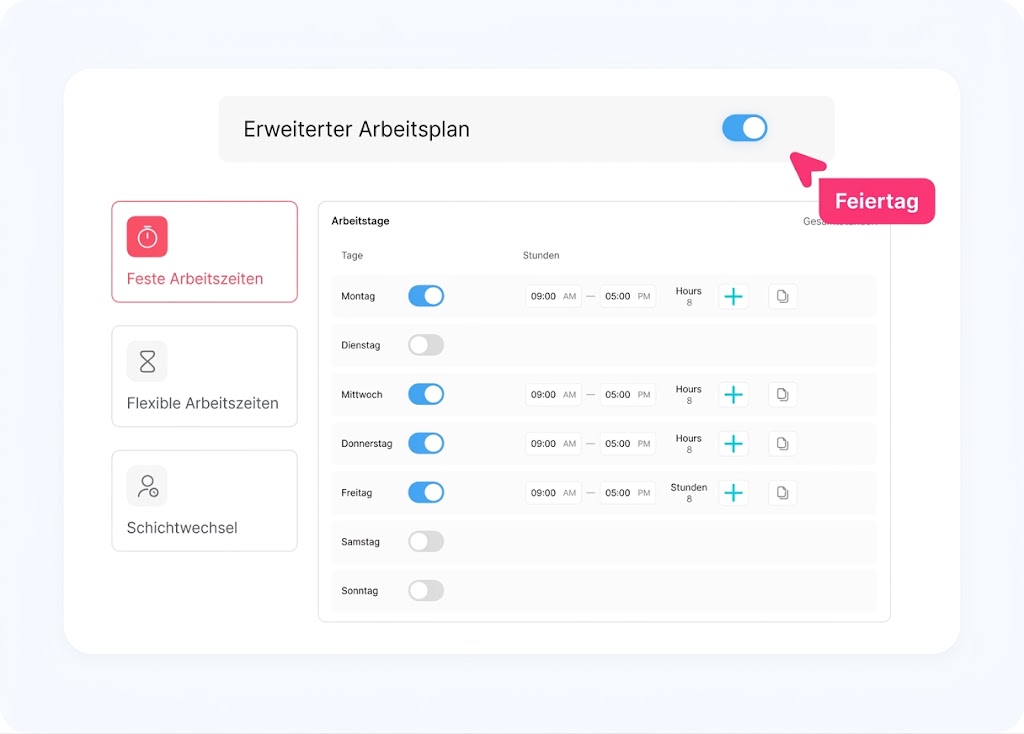
Tracking PTO only in “days” can become difficult when schedules vary.
For example:
Employee A works five 8-hour days.
Employee B works four 10-hour days.
Both work 40 hours per week.
If each receives 15 PTO “days,” those days may represent very different numbers of hours unless the policy clearly defines how a PTO day is valued.
For organizations with flexible, compressed, or rotating schedules, tracking PTO in hours can provide greater precision.
Instead of granting:
15 PTO days
the employer might grant:
120 PTO hours
When an employee takes time off, the amount deducted can reflect the hours they were actually scheduled to work.
Prorated PTO for Employees Joining Near the End of the Year
Employees hired in November or December can create awkward balances under a front loaded PTO policy.
Suppose annual PTO is 120 hours and an employee starts December 1.
Monthly proration gives:
120 × 1 ÷ 12 = 10 hours
A December 20 hire creates a more difficult question.
Should they receive:
- 10 hours for December?
- A calendar day prorated amount?
- No PTO until January?
- PTO from their first full pay period?
- An hours worked accrual only?
The answer should already exist in the PTO policy.
Creating a new rule every time an unusual hire date appears is one of the easiest ways to create inconsistent PTO balances.
How to Write a Clear New Hire PTO Proration Policy
A useful PTO policy should answer more than “PTO is prorated for new employees.”
That sentence leaves several questions unanswered.
A clearer policy might state:
“Employees receive 120 hours of PTO per calendar year. Employees who become eligible after January 1 receive a prorated first-year allowance based on the number of full calendar months remaining in the year. PTO eligibility begins on the first day of the month following the employee’s hire date. Prorated balances are calculated to two decimal places.”
This wording clarifies:
- Annual entitlement
- Leave year
- Eligibility date
- Proration method
- Treatment of partial months
- Rounding rule
Another company might use:
“Employees accrue 4.6154 hours of PTO after each completed biweekly pay period, up to 120 hours per year. New employees begin accruing PTO with their first complete eligible pay period.”
This removes the need for a separate annual proration calculation because the employee simply begins earning PTO once eligible.
Front Loaded PTO vs Accrued PTO for New Hires
Companies often need to choose between two main approaches.
Front Loaded PTO
The employee receives a balance at once.
For a new hire, HR may calculate:
Annual PTO × remaining eligible portion of year
Advantages include:
- Employees know their available balance immediately.
- Administration can be simple.
- Employees may have enough leave available for unexpected situations early in employment.
Potential challenges include:
- New hire proration is required.
- Policies need rules for employees who leave shortly after receiving a balance.
- Mid-year changes can require manual adjustments.
Accrued PTO
Employees earn smaller amounts periodically.
For example:
120 annual hours ÷ 12 months = 10 hours per month
Advantages include:
- New hires naturally earn less during a partial year.
- PTO builds as employment continues.
- Calculations align more closely with time worked or pay periods.
Potential challenges include:
- Employees may have little PTO available early in employment.
- More accrual transactions must be tracked.
- Waiting periods and partial periods still need clear rules.
Neither approach is inherently better for every organization. The policy should fit the organization’s workforce, leave philosophy, payroll processes, and applicable laws.
How Day Off Helps Manage New Hire PTO Accruals
As companies grow, manually calculating every new employee’s PTO in a spreadsheet becomes harder to maintain.
Day Off helps organizations manage leave policies, accrual schedules, balances, requests, carryover, and employee leave history in one system.
HR teams can configure recurring accruals such as:
- Weekly
- Biweekly
- Semimonthly
- Monthly
Organizations can also manage accruals according to fiscal or employee anniversary years and view information such as an employee’s current balance, accrued amount, and upcoming accrual.
Admins can review an employee’s balance and customize individual leave settings when adjustments are required.
This is particularly useful when employees have different:
- Hire dates
- Leave policies
- Accrual frequencies
- Annual entitlements
- Work schedules
- Locations
- Carryover rules
Instead of calculating balances separately in multiple spreadsheets, HR can maintain leave policies and employee balances in a centralized PTO tracking system.
Best Practices for Managing Prorated PTO
A reliable PTO proration process should be easy for both HR and employees to understand.
Define the PTO year
State whether PTO follows the calendar year, fiscal year, or employee anniversary.
Define the eligibility date
Do not assume that hire date, accrual date, and usage date are identical.
Choose one proration method
Use months, calendar days, pay periods, or hours worked according to the policy.
Explain partial periods
Specify how partial months, weeks, and payroll periods are handled.
Define rounding
Document whether PTO balances are rounded and at what stage.
Use hours when schedules vary
Hours can provide more precision for part time employees and teams working nonstandard shifts.
Document waiting periods carefully
Specify whether the waiting period delays accrual, usage, or both.
Check applicable employment laws
PTO and paid sick leave requirements differ by jurisdiction.
Keep employee balances visible
Employees should be able to understand how much PTO they have available before submitting requests.
Audit balances periodically
Review new hire PTO calculations, adjustments, carryover, and accrual transactions to catch errors before they continue into the next PTO year.
FAQ
What does prorated PTO mean?
Prorated PTO means an employee receives a portion of the normal annual paid time off entitlement based on the amount of the PTO year for which they are eligible.
For example, an employee entitled to 20 PTO days annually who is eligible for six months may receive:
20 × 6 ÷ 12 = 10 PTO days
if the company uses monthly proration.
How do you calculate prorated PTO for a new hire?
A common formula is:
Annual PTO × Eligible Months ÷ 12
For example, if annual PTO is 120 hours and a new employee has nine eligible months remaining:
120 × 9 ÷ 12 = 90 hours
However, employers may instead prorate PTO by calendar day, pay period, or eligible hours worked.
Do you prorate PTO from the hire date?
Not necessarily.
Some policies begin PTO accrual on the hire date. Others begin on the first full month, first complete pay period, or after a waiting period.
The company’s written policy should define the accrual start date.
Should PTO be prorated by days or months?
Either method can be used when permitted by the applicable policy and law.
Monthly proration is easier to administer.
Daily proration produces a more precise result for employees joining in the middle of a month.
The company should select a consistent method rather than switching between them for individual employees.
How do you prorate PTO after a 90-day waiting period?
First determine whether the waiting period delays accrual or only delays the employee’s ability to use accrued PTO.
If accrual starts only after 90 days, calculate PTO beginning from the employee’s eligibility date.
If PTO accrues immediately but cannot be used for 90 days, the employee may already have an accumulated balance when the waiting period ends.
How do you calculate prorated PTO for part time employees?
One method is to first calculate the employee’s full-year part-time entitlement:
Full-Time PTO × Part-Time Weekly Hours ÷ Full-Time Weekly Hours
Then prorate that result for the remaining portion of the year.
For example:
Full time PTO = 120 hours
Full time schedule = 40 hours
Employee schedule = 20 hours
120 × 20 ÷ 40 = 60 annual hours
If the employee starts halfway through the year:
60 × 6 ÷ 12 = 30 hours
The employee would receive 30 PTO hours under this method.
Does federal law require employers to provide prorated PTO?
For most private sector employment in the United States, the FLSA does not require employers to provide ordinary vacation or PTO benefits. PTO is generally established by company policy or agreement. However, state and local laws can impose requirements involving paid sick leave and other forms of leave, so employers should check the rules that apply where their employees work.
Conclusion
Calculating prorated PTO for new employees starts with a simple idea: employees joining partway through the PTO year may receive only the portion of the annual benefit that applies to their eligible period.
The basic calculation can be as simple as:
Annual PTO × Eligible Portion of the Year = Prorated PTO
The more important decision is determining how the eligible portion is measured.
Employers may prorate PTO by months, calendar days, payroll periods, scheduled hours, or actual eligible hours worked. They also need clear rules for partial periods, waiting periods, rounding, part time schedules, and the date on which accrual begins.
A well-written policy removes uncertainty by explaining these rules before a new employee joins.
As an organization grows, automated PTO tracking can also reduce the amount of manual calculation required. Day Off helps businesses manage PTO policies, recurring accruals, employee balances, requests, carryover, work schedules, and leave reporting in one place, giving HR teams and employees a clearer view of available time off.
When the policy, calculation method, and PTO tracking system all follow the same rules, new hire PTO becomes much easier to calculate accurately and consistently.