




PTO for a split shift can be more complicated than calculating leave for an employee who works one continuous eight-hour day. A split-shift employee may work several hours in the morning, leave work for a significant period, and return later for another scheduled block of work.
For PTO purposes, the employer should focus on the working hours the employee was actually scheduled to miss, not the total number of hours between the beginning and end of the employee’s day.

For example, an employee may work from 7:00 a.m. to 11:00 a.m. and again from 4:00 p.m. to 8:00 p.m. Although the overall span from the first start time to the final finish time is 13 hours, the employee actually works only eight hours. A full-day absence would therefore usually require eight hours of PTO, not 13.
The same principle becomes even more important when the employee takes only one part of the shift, works unequal morning and evening segments, has an unpaid meal period, works across midnight, or follows a rotating schedule.
This guide explains how to calculate PTO accurately for split shifts, how to handle partial absences and breaks, and how employers can create a policy that keeps leave balances, schedules, attendance, and payroll records consistent.
What Is a Split Shift?
A split shift is a work schedule in which an employee’s working day is divided into two or more separate periods with a longer non-working period between them.
For example:
- First work period: 7:00 a.m. to 11:00 a.m.
- Off-duty period: 11:00 a.m. to 4:00 p.m.
- Second work period: 4:00 p.m. to 8:00 p.m.
The employee works four hours in the morning and four hours in the evening, for a total of eight working hours.
The five-hour period in the middle is normally not part of the employee’s scheduled working time if the employee is genuinely free from work responsibilities during that period.
Split shifts are commonly used when a business has strong demand during certain parts of the day but lower demand in between. They are often found in:
- Restaurants and cafés
- Hotels and hospitality
- School transportation
- Public transportation
- Healthcare
- Security
- Cleaning services
- Recreation and entertainment
- Retail
- Customer-facing service businesses
For example, a restaurant may need more employees during breakfast and dinner but fewer employees during the afternoon. A split shift allows an employee to work during both busy periods without remaining scheduled throughout the quieter hours.
Split Shift vs. Meal Break: What Is the Difference?
A split shift and a meal break are not the same thing, and the distinction matters when calculating PTO.
A normal meal break is usually a relatively short break inside one continuous workday.
For example:
- 8:00 a.m. to 12:00 p.m.: Work
- 12:00 p.m. to 12:30 p.m.: Unpaid lunch
- 12:30 p.m. to 4:30 p.m.: Work
The employee is scheduled for eight paid working hours.
A split shift usually includes a much longer gap that separates two distinct periods of work.
For example:
- 7:00 a.m. to 11:00 a.m.: Work
- 11:00 a.m. to 4:00 p.m.: Off duty
- 4:00 p.m. to 8:00 p.m.: Work
The employee again works eight hours, but those hours are divided across two separate periods.
Under federal wage-and-hour guidance, bona fide meal periods generally do not count as hours worked when the employee is completely relieved from duty. Short rest periods, however, are generally treated as paid working time.
For PTO purposes, the important rule is similar: do not deduct PTO for time the employee was not scheduled to work.
The five-hour gap in the second example should therefore not automatically be charged against the employee’s leave balance.
Why Split Shifts Make PTO Calculations More Difficult
A traditional PTO system may assume that:
- One workday equals eight hours
- Employees work one continuous shift
- Everyone has the same start and finish time
- A half day always equals four hours
Those assumptions may be incorrect for split-shift employees.
A split-shift employee might work:
- 5 hours in the morning and 3 hours in the evening
- 3 hours in the morning and 6 hours at night
- Two equal four-hour blocks
- Different shift lengths on different days
- Several split-shift patterns in a rotating schedule
As a result, HR cannot simply label the request as “half day” or “full day” without looking at the schedule.
The most accurate calculation is based on scheduled hours missed.
PTO Formula for a Split Shift
When leave is tracked in hours, the basic formula is:
PTO deduction = Total scheduled working hours covered by the approved absence
This means the employer should calculate PTO only for the employee’s scheduled work periods that overlap with the leave request.
Example
Scheduled work:
- 7:00 a.m. to 11:00 a.m. = 4 hours
- 4:00 p.m. to 8:00 p.m. = 4 hours
If the employee takes the entire day off:
4 + 4 = 8 PTO hours
The gap between 11:00 a.m. and 4:00 p.m. is not deducted because the employee was already off duty.
Step 1: Identify Every Working Period
The first step is to look at the employee’s actual schedule for the date of the absence.
Do not calculate PTO based only on:
- The first start time
- The final end time
- A default company workday
- A standard eight-hour assumption
Instead, identify each scheduled work period individually.
For example:
- 6:00 a.m. to 10:00 a.m. = 4 hours
- 3:00 p.m. to 7:00 p.m. = 4 hours
Total scheduled hours = 8
The employee may be associated with the workplace for a 13-hour span, but only eight of those hours are scheduled work.
This distinction prevents PTO from being deducted for off-duty time.
Step 2: Identify Exactly What Time the Employee Is Taking Off
Next, determine whether the employee is missing:
- The entire workday
- Only the first shift
- Only the second shift
- Part of the morning shift
- Part of the evening shift
- Portions of both shifts
The more precise the request, the more accurate the PTO deduction can be.
For example, an employee may not need “half a day.” They may specifically need 9:00 a.m. to 11:00 a.m. off.
If they are scheduled to work during those two hours, the correct PTO deduction may be exactly two hours.
Step 3: Find the Overlap Between PTO and Scheduled Work
The employee should only be charged for time when:
- The employee requested or was approved for leave, and
- The employee was scheduled to work.
For example:
Scheduled work:
- 7:00 a.m. to 11:00 a.m.
- 4:00 p.m. to 8:00 p.m.
Leave request:
- 10:00 a.m. to 5:00 p.m.
The PTO overlaps with:
- 10:00 a.m. to 11:00 a.m. = 1 hour
- 4:00 p.m. to 5:00 p.m. = 1 hour
Total PTO deduction = 2 hours
The five-hour gap from 11:00 a.m. to 4:00 p.m. is not deducted because the employee was not scheduled to work.
Step 4: Add All Missed Scheduled Hours
If the request affects several parts of the split shift, add the missed working periods together.
For example:
- 2 morning hours missed
- 3 evening hours missed
Total:
5 PTO hours
This method is more accurate than treating the employee’s absence as a generic half day or full day.
How to Calculate Full-Day PTO for a Split Shift
When an employee takes every scheduled part of the workday off, add all working periods.
Example
The employee works:
- 7:00 a.m. to 11:00 a.m. = 4 hours
- 4:00 p.m. to 8:00 p.m. = 4 hours
Total scheduled time:
8 hours
The employee takes the entire day off.
PTO deduction:
8 hours
The employer should not calculate:
7:00 a.m. to 8:00 p.m. = 13 hours
because the employee was never scheduled to work during the five-hour gap.
How to Calculate PTO for Only One Part of a Split Shift
Employees may sometimes need only one part of their schedule off.
Suppose the employee works:
- 6:00 a.m. to 10:00 a.m.
- 3:00 p.m. to 7:00 p.m.
The employee works the morning shift but requests PTO for the afternoon shift.
The employee misses:
3:00 p.m. to 7:00 p.m. = 4 hours
PTO deduction:
4 hours
The morning work period remains recorded as worked.
This approach gives HR, payroll, and attendance records a more accurate picture of the employee’s day.
What if the Two Shift Segments Are Different Lengths?
Split shifts do not always divide evenly.
Consider this schedule:
- 6:00 a.m. to 11:00 a.m. = 5 hours
- 4:00 p.m. to 7:00 p.m. = 3 hours
Total working time = 8 hours.
If the employee misses only the evening portion, the correct deduction is:
3 PTO hours
Calling the evening segment “half a day” and deducting four hours would overcharge the employee by one hour.
Similarly, if the employee misses the morning segment, the deduction would be five hours.
This is why hourly PTO is usually more accurate for employees whose working periods are not evenly divided.
What if the Employee Misses Part of Both Shift Segments?
An employee may work part of each segment rather than missing one complete portion.
Example
Scheduled:
- 7:00 a.m. to 11:00 a.m.
- 4:00 p.m. to 8:00 p.m.
Actual work:
- 7:00 a.m. to 9:00 a.m.
- 5:00 p.m. to 8:00 p.m.
Missed working time:
- 9:00 a.m. to 11:00 a.m. = 2 hours
- 4:00 p.m. to 5:00 p.m. = 1 hour
Total:
3 PTO hours
The gap between the shifts remains excluded.
Split-Shift PTO Examples
| Situation | Schedule | PTO Deduction |
|---|---|---|
| Employee takes entire day off | 7–11 a.m. + 4–8 p.m. | 8 hours |
| Employee misses morning segment | 7–11 a.m. + 4–8 p.m. | 4 hours |
| Employee misses evening segment | 7–11 a.m. + 4–8 p.m. | 4 hours |
| Employee misses final 2 morning hours | 7–11 a.m. + 4–8 p.m. | 2 hours |
| Employee arrives 2 hours late for evening shift | 7–11 a.m. + 4–8 p.m. | 2 hours |
| Employee requests only the gap | 7–11 a.m. + 4–8 p.m. | 0 hours |
| Morning shift is 5 hours, evening shift is 3 hours, employee misses evening | 6–11 a.m. + 4–7 p.m. | 3 hours |
| Employee misses 1 hour from each segment | 8 total scheduled hours | 2 hours |
The consistent rule is to deduct only the scheduled working hours the employee does not work.
What Happens if PTO Is Tracked in Days Instead of Hours?
Day-based PTO is easier to administer for traditional schedules, but it can create problems for split shifts.
Suppose an employee works:
- 5 hours in the morning
- 3 hours in the evening
If the employee misses only the evening segment, is that:
- Half a PTO day?
- 0.375 of a day?
- Three hours?
- Another fixed amount?
Without a clear policy, different managers may calculate the same situation differently.
One approach: define a full day by schedule
A full PTO day equals every scheduled working hour on that date.
If the employee has an eight-hour split shift, one full PTO day equals eight hours.
Another approach: allow partial days
The company may define:
- Full day = all scheduled segments
- Half day = one defined portion
- Hourly PTO = smaller absences
This works best when the split portions are consistent.
Best option for complex schedules
If employees regularly work unequal shifts, rotating schedules, or partial absences, tracking PTO in hours generally creates a clearer and fairer calculation.
How to Handle the Gap Between Split Shifts
The off-duty period between two work segments should not normally reduce the employee’s PTO balance.
For example:
- 7:00 a.m. to 11:00 a.m.: Work
- 11:00 a.m. to 4:00 p.m.: Off duty
- 4:00 p.m. to 8:00 p.m.: Work
If the employee requests PTO from 10:00 a.m. until 5:00 p.m., the leave overlaps:
- 10:00 a.m. to 11:00 a.m. = 1 hour
- 4:00 p.m. to 5:00 p.m. = 1 hour
Total PTO = 2 hours
The five-hour gap is excluded.
This avoids a situation where employees lose PTO for time they were already scheduled to be away from work.
What if the Employee Is Required to Work During the Gap?
A gap should only be treated as non-working time when the employee is actually free from work responsibilities.
If employees are required to:
- Answer calls
- Monitor systems
- Remain on-site
- Perform administrative tasks
- Respond to customers
- Remain significantly restricted by the employer
then the employer should review whether that time qualifies as working time under applicable wage-and-hour rules.
The PTO calculation should be based on an accurate schedule. If the schedule incorrectly labels working time as an unpaid gap, both leave calculations and payroll records may become inaccurate.
How Do Unpaid Meal Breaks Affect PTO?
A split-shift segment may contain its own unpaid meal period.
For example:
- 7:00 a.m. to 12:00 p.m. = 5 hours
- 3:00 p.m. to 9:00 p.m., including a 30-minute unpaid meal
The second period contains 5.5 paid working hours.
Total paid work:
5 + 5.5 = 10.5 hours
If the employee takes the full day off, the PTO deduction would normally be based on 10.5 scheduled paid hours, not 11.
This helps keep PTO aligned with the employee’s actual work schedule rather than the total time they are physically associated with the workplace.
Can Employees Take PTO During the Gap Between Split Shifts?
Usually, employees do not need PTO for time they are already scheduled to be off.
If the employee is free between 11:00 a.m. and 4:00 p.m., a PTO request covering only that period would normally require:
0 PTO hours
There is no scheduled work to replace.
This distinction is important when employees submit requests based on clock times rather than selecting a whole workday.
How Does PTO Work for an Overnight Split Shift?
Split shifts become more complicated when one portion happens before midnight and another occurs after midnight.
For example:
- 6:00 p.m. to 10:00 p.m.
- 2:00 a.m. to 6:00 a.m.
The employee works eight hours across two calendar dates.
The employer should establish a consistent method for deciding which workday the shift belongs to.
Possible approaches include:
- Assign the entire shift to the date it starts
- Split each work period according to the calendar date
- Use the organization’s defined workday rather than midnight
There is no single approach appropriate for every employer. What matters is consistency across:
- Scheduling
- PTO
- Attendance
- Timesheets
- Overtime
- Payroll
An employee should not have the shift assigned to Monday for PTO purposes but Tuesday for payroll unless the systems are intentionally designed that way.
How Should PTO Be Handled When a Public Holiday Falls on a Split-Shift Day?
Public holidays can create another layer of complexity.
Suppose an employee normally works:
- 8:00 a.m. to 12:00 p.m.
- 5:00 p.m. to 9:00 p.m.
Total scheduled work = 8 hours.
If that day becomes a company holiday, the employer’s written policy should determine whether:
- All eight hours are paid as holiday time
- A standard eight-hour holiday credit applies
- The employee receives another day off
- Some hours require PTO
- The employee is still expected to work part of the schedule
Private employers are generally not required by federal law to offer paid holidays or vacation benefits. These benefits are primarily created through employer policies, contracts, or applicable state law.
The company should therefore define holiday treatment before employees start requesting PTO around holiday dates.
Does PTO Count Toward Overtime on a Split Shift?
PTO and overtime should be tracked separately.
Under federal law, overtime for covered nonexempt employees is generally based on hours actually worked over 40 in a workweek.
Paid vacation, sick time, and holiday hours generally do not have to be counted as hours worked for federal overtime purposes.
Example 1
Employee has:
- 32 hours actually worked
- 8 PTO hours
Total paid hours = 40
For federal overtime purposes, the employee generally has:
32 hours worked
There is no federal overtime solely because paid time totals 40 hours.
Example 2
Employee has:
- 42 actual working hours
- 8 PTO hours
The employee has 42 hours worked.
Federal overtime may therefore apply to two hours, assuming the employee is nonexempt and covered by the FLSA.
State rules may be different or more generous.
Split-Shift Pay and PTO Are Separate Calculations
A common mistake is assuming that once PTO has been calculated correctly, all split-shift compensation issues have been resolved.
They have not.
Two separate questions may apply:
Question 1: How much PTO should be deducted?
This depends primarily on the scheduled working hours missed and the employer’s PTO policy.
Question 2: Does the split shift trigger additional wage obligations?
This depends on applicable wage-and-hour law.
For example, California has specific split-shift premium rules that may require additional compensation for certain employees.
The employer may therefore correctly deduct eight PTO hours while still needing to review:
- Split-shift premiums
- Daily overtime
- Minimum wage
- Meal-period rules
- Reporting-time pay
PTO software should support accurate leave records, but it cannot replace payroll or legal compliance.
What Happens if the Employee’s Schedule Changes?
PTO should generally reflect the schedule that applies to the date of the leave.
Suppose an employee previously worked:
- 8:00 a.m. to 12:00 p.m.
- 4:00 p.m. to 8:00 p.m.
Total = 8 hours.
Beginning September 1, the employee changes to:
- 7:00 a.m. to 12:00 p.m.
- 3:00 p.m. to 8:00 p.m.
Total = 10 hours.
A new full-day PTO request for September would normally be based on the new 10-hour schedule.
However, employers should establish a separate rule for PTO that was already approved before the schedule change.
Possible approaches include:
- Keep the original deduction
- Recalculate the request
- Require manager or HR review
- Notify the employee before changing the balance
Schedule history and effective dates are important because changing an employee’s current schedule should not automatically rewrite previous PTO calculations.
What if the Employee Swaps One Part of the Shift?
Split-shift employees may swap only one portion of their workday.
For example:
Original schedule:
- 7:00 a.m. to 11:00 a.m.
- 4:00 p.m. to 8:00 p.m.
The employee swaps the evening segment with a coworker.
If the schedule is officially updated before the PTO request is processed, the employee may no longer need PTO for the evening portion because another employee is now scheduled to work it.
The company should decide which record takes priority:
- The published schedule
- The approved shift swap
- The PTO approval
- The employee’s actual attendance
A centralized schedule and leave system helps prevent the same hours from being recorded as both PTO and a transferred shift.
Should Split-Shift PTO Be Tracked in Hours or Days?
For most split-shift environments, hourly PTO provides greater accuracy.
Hourly PTO works particularly well when:
- Morning and evening shifts have different lengths
- Employees regularly request only one portion
- Partial-hour or partial-shift leave is allowed
- Employees work different daily hours
- Schedules rotate
- Employees change between shift patterns
Day-based PTO may still work when:
- Split shifts always have the same total hours
- Employees usually take complete days
- Partial-day requests are rare
- The employer has clearly defined what one day and half a day mean
The key is consistency.
An employer should not deduct three hours from one employee and half a day from another employee for identical missed working time unless the difference is explained by the applicable policy.
Common Split-Shift PTO Mistakes
Deducting the full span between the first and last shift
If an employee works 7:00 a.m. to 11:00 a.m. and 4:00 p.m. to 8:00 p.m., the scheduled work totals eight hours.
The 13-hour overall span is not the correct PTO amount.
Assuming every workday equals eight hours
Split-shift employees may work six, seven, nine, 10, or 12 scheduled hours.
The calculation should use the assigned schedule.
Treating one shift segment automatically as half a day
A five-hour first shift and three-hour second shift are not equal halves.
Using hours prevents inconsistent deductions.
Deducting PTO for the gap
The off-duty period is not normally leave because the employee was not expected to work.
Forgetting unpaid meal periods
A 30-minute unpaid meal should not automatically be included in the PTO deduction.
Using the employee’s current schedule for old leave
Historical requests should normally remain connected to the schedule that applied when the absence occurred.
Mixing PTO with overtime hours
PTO should be separated from hours actually worked when calculating overtime.
Ignoring state and local split-shift rules
An accurate PTO deduction does not replace compliance with wage, overtime, break, or split-shift premium laws.
How to Create a Clear Split-Shift PTO Policy
A good policy should explain exactly how leave is handled before employees encounter a complicated situation.
Define a full PTO day
Explain that a full day covers all scheduled working periods for that date.
For example, if the employee works four hours in the morning and four hours in the evening, the full-day deduction is eight hours.
Allow partial requests when possible
Employees should be able to request:
- One complete shift segment
- Part of a segment
- The entire split-shift day
This reduces unnecessary PTO usage.
Explain how unequal shifts are calculated
If morning and evening portions are different lengths, clarify that the actual scheduled hours will be used.
Exclude non-working gaps
State clearly that scheduled off-duty periods between work segments are not charged against PTO.
Explain meal-break treatment
Unpaid meal periods should generally be excluded from the leave calculation.
Define schedule-change rules
The policy should explain what happens if an employee’s schedule changes after leave has already been approved.
Address holidays
Explain whether holidays are covered by:
- Holiday pay
- PTO
- An alternative day
- A combination of benefits
Provide a correction process
Employees should know how to report an incorrect PTO deduction and who is authorized to correct it.
Sample Split-Shift PTO Policy
Employees assigned to split shifts will have PTO deducted according to the scheduled working hours covered by the approved absence. Scheduled off-duty periods between work segments will not normally reduce the employee’s PTO balance.
Employees may request leave for the entire scheduled workday, one individual work segment, or a portion of a scheduled segment when permitted by the applicable leave policy.
Where PTO is tracked in hours, the deduction will equal the actual scheduled working time missed. Unpaid meal periods, scheduled breaks that are not working time, and non-working gaps between split shifts will be excluded.
If the employee’s work schedule changes after PTO has already been approved, the request will be reviewed before any balance adjustment is made.
PTO calculations are separate from overtime, split-shift premiums, meal-break requirements, and other wage-and-hour obligations.
Employers should adapt the policy to applicable state, local, contractual, and industry requirements.
How Leave Management Software Helps With Split-Shift PTO
Split-shift calculations become difficult when schedules and leave are managed separately.
A spreadsheet may show that the employee requested 10:00 a.m. through 6:00 p.m. off, but without the employee’s schedule, HR may not know that only part of that window was actually working time.
A schedule-aware leave system can compare:
- Employee working periods
- Requested leave times
- Breaks
- Non-working gaps
- Public holidays
- Temporary schedule changes
- Historical schedules
Example
Employee schedule:
- 8:00 a.m. to 12:00 p.m.
- 5:00 p.m. to 9:00 p.m.
PTO request:
- 10:00 a.m. to 6:00 p.m.
Scheduled time missed:
- 10:00 a.m. to 12:00 p.m. = 2 hours
- 5:00 p.m. to 6:00 p.m. = 1 hour
Correct deduction:
3 PTO hours
A simple calendar might incorrectly interpret the request as eight hours long. A schedule-aware system can recognize that only three scheduled working hours were actually missed.
Managing Split Shifts With Day Off
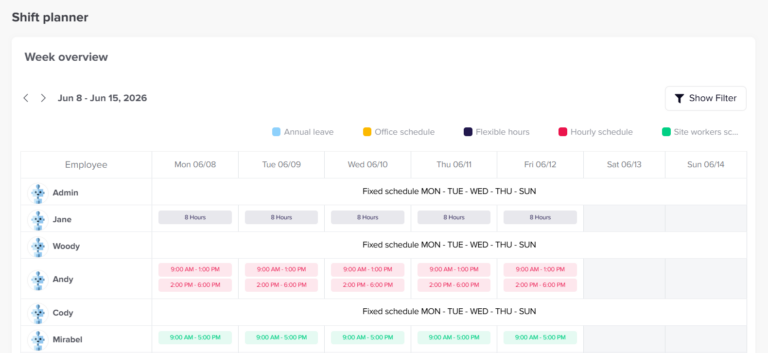
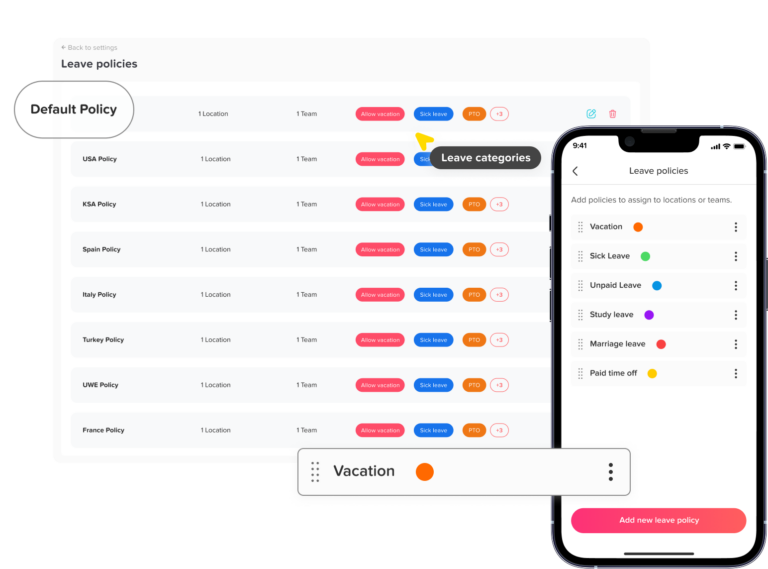
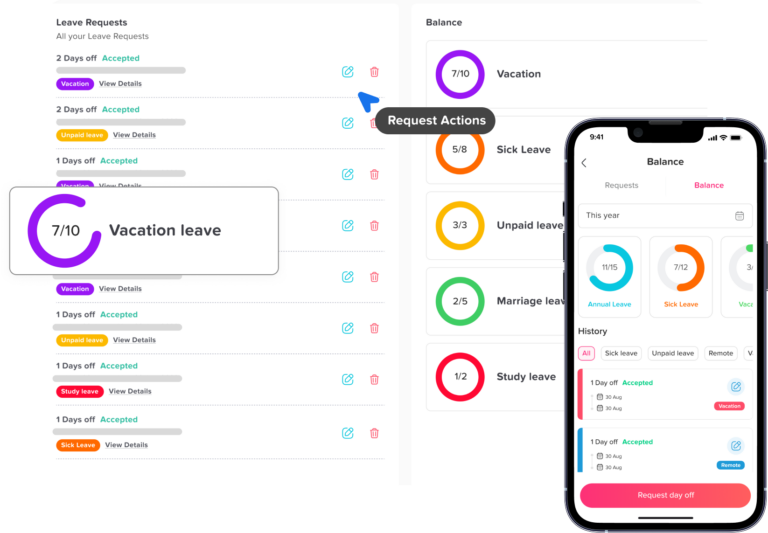
Day Off connects employee work schedules with leave calculations so PTO requests can reflect each employee’s real working pattern.
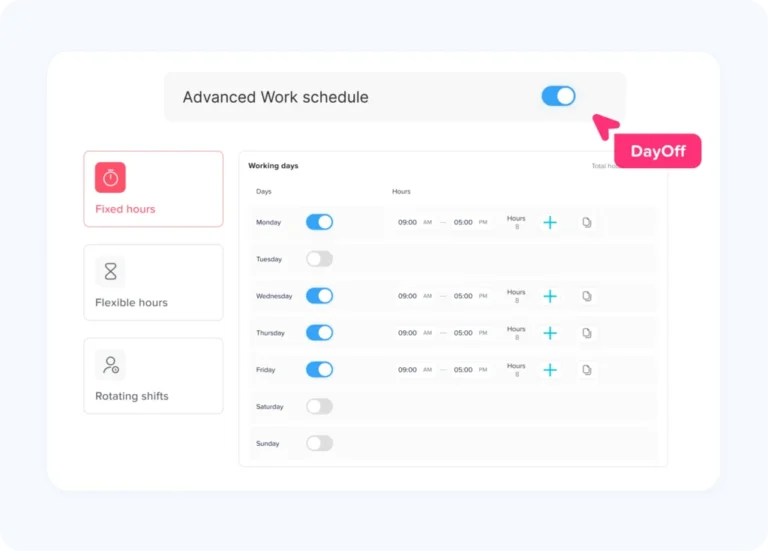
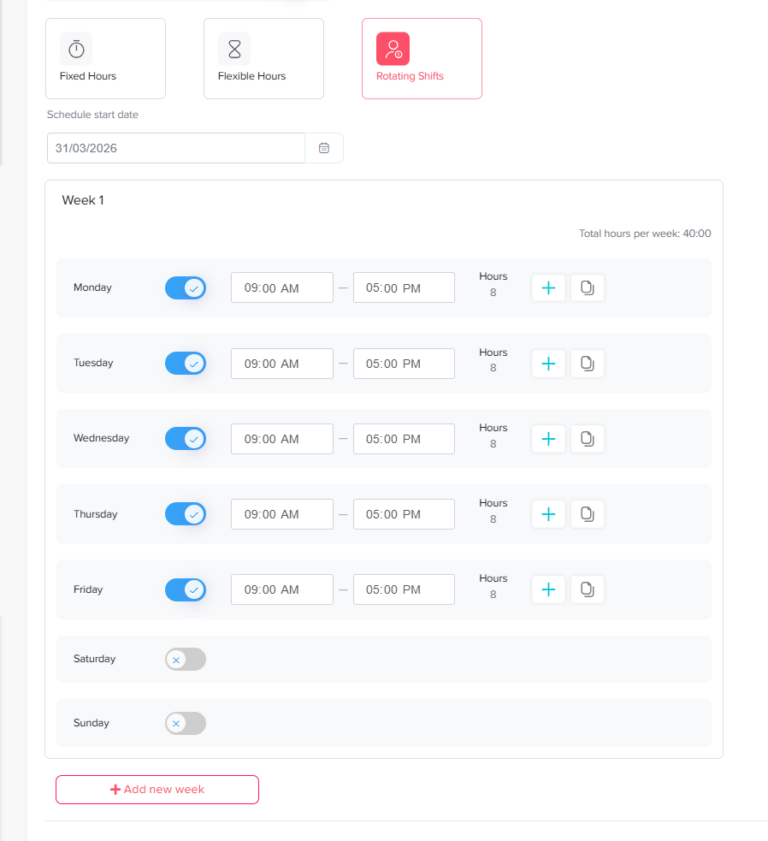
Organizations can configure different schedules for employees, including Fixed Days, Fixed Hours, Flexible Hours, and Rotating Shifts.
Fixed-hour and rotating schedules can include multiple working periods within the same day, allowing businesses to represent schedules such as:
- 8:00 a.m. to 12:00 p.m.
- 5:00 p.m. to 9:00 p.m.
This makes the schedule more accurate than treating the employee as working continuously from 8:00 a.m. until 9:00 p.m.
For organizations that need precise deductions, leave can also be tracked in hours. This is particularly helpful for:
- Split-shift employees
- Part-time workers
- 10- and 12-hour shifts
- Partial-day requests
- Rotating schedules
- Flexible working arrangements
Connecting employee schedules with PTO helps HR avoid charging leave for non-working gaps while giving employees a clearer view of how their balance is calculated.
Frequently Asked Questions About PTO for Split Shifts
How do you calculate PTO for a split shift?
Calculate PTO based on the scheduled working hours the employee actually misses, not the total span between the beginning and end of the day.
For example, if an employee works:
- 7:00 a.m. to 11:00 a.m. = 4 hours
- 4:00 p.m. to 8:00 p.m. = 4 hours
a full-day absence would normally require 8 PTO hours, not 13. The five-hour gap is excluded because it is not scheduled working time.
Can you use PTO for only part of a shift?
Yes, if the employer’s PTO policy allows hourly or partial-shift leave. The amount deducted should generally correspond to the scheduled work the employee misses.
For example, an employee who misses three hours of a 10-hour scheduled shift would typically use three PTO hours rather than an entire day’s balance.
How many PTO hours do you use for a 12-hour shift?
If an employee is scheduled to work 12 hours and takes the entire shift off, an hours-based PTO policy would commonly deduct 12 PTO hours. Workplace policies can differ, so employers should clearly define how longer shifts are treated. Real-world employer policies and HR discussions commonly distinguish between eight-hour and 12-hour scheduled days for this reason.
Do you have to use PTO for the time between split shifts?
Normally, no. If the employee is completely off duty and not scheduled to work during the gap, there is no scheduled working time to replace with PTO.
For example, an employee working 7:00–11:00 a.m. and 4:00–8:00 p.m. would not normally need PTO for the 11:00 a.m.–4:00 p.m. gap.
What happens if a PTO request includes the gap between split shifts?
Only the portions of the request that overlap scheduled working hours should normally reduce the PTO balance.
For example, if an employee works 8:00 a.m.–12:00 p.m. and 5:00–9:00 p.m. but requests leave from 10:00 a.m.–6:00 p.m., the request overlaps only:
- 10:00 a.m.–12:00 p.m. = 2 hours
- 5:00–6:00 p.m. = 1 hour
The PTO deduction would therefore be 3 hours, not eight.
Can I use PTO if I leave work early?
An employer may allow employees to use PTO to cover scheduled working time missed because of an early departure. The exact rules, including minimum PTO increments, depend on the employer’s policy.
For example, an employee scheduled until 8:00 p.m. who leaves at 6:00 p.m. may use two PTO hours if hourly leave is permitted.
Can PTO be used if you are late for work?
Some employers allow or require available PTO to cover scheduled time missed because of a late arrival, while others treat tardiness separately under an attendance policy. The employer should clearly explain whether PTO can be used for lateness and the minimum increment that may be requested.
Search results show this is a common employee question, particularly when workers are only a few minutes or hours late.
If I work half my shift, do I need a full day of PTO?
Usually not under an hours-based PTO system. If an employee works part of the scheduled shift, PTO can be used for only the remaining scheduled hours when the policy permits partial-day leave.
For example, an employee scheduled for eight hours who works four and takes the remaining four off would normally use 4 PTO hours, not eight.
What if one half of a split shift is longer than the other?
Use the actual hours rather than automatically calling each portion “half a day.”
For example:
- Morning shift: 6:00–11:00 a.m. = 5 hours
- Evening shift: 4:00–7:00 p.m. = 3 hours
Missing the evening shift would normally require three PTO hours, while missing the morning shift would require five.
This is one reason hourly PTO tracking is more precise for split-shift employees.
Does PTO cover unpaid lunch breaks?
An unpaid meal period should not normally be included in the PTO deduction because it is not working time.
Federal guidance generally treats a bona fide meal period as non-working time when the employee is completely relieved from duty.
Do scheduled days off require PTO?
Normally, no. Employees generally should not need PTO for a day when they were already scheduled not to work.
This principle is reflected in employer leave policies that do not charge PTO when a designated closure or leave date falls on an employee’s regular scheduled day off.
What happens if I miss one part of a split shift but work the other?
Only the missed scheduled portion should normally require PTO under an hours-based policy.
For example:
- Morning: 7:00–11:00 a.m. — worked
- Evening: 4:00–8:00 p.m. — absent
The employee worked four scheduled hours and missed four, so the PTO deduction would normally be 4 hours.
Does PTO count toward overtime?
Under federal Fair Labor Standards Act rules, overtime for covered nonexempt employees is generally based on hours actually worked, not vacation or other paid time off.
For example, an employee with 32 hours actually worked and eight PTO hours generally has 32 hours of work for the federal 40-hour overtime test, even though the employee receives pay for 40 hours.
State laws and employer policies may provide different or more generous rules.
Conclusion
Calculating PTO for a split shift is most accurate when employers focus on scheduled working hours missed rather than the total span of the employee’s day.
If an employee works several separate periods, each period should be reviewed individually. Off-duty gaps and unpaid meal periods should generally not reduce the PTO balance, while partial absences should be calculated according to the actual hours missed.
For companies with split shifts, rotating schedules, or different daily hours, tracking PTO in hours and connecting leave requests with employee schedules can significantly reduce balance errors and manual corrections.
A clear written policy, accurate work schedules, and consistent recordkeeping help ensure that split-shift employees receive the right PTO deduction every time.