




Paid Time Off (PTO) is meant to give employees time to rest, recharge, and manage personal responsibilities without financial stress. However, the value of PTO doesn’t come only from how much time is offered it also depends on how unused time is treated. This is where carry over limits come into play.

Carry over limits define whether unused PTO can be saved, how much can be kept, and what happens when limits are exceeded. These rules directly affect employee satisfaction, burnout prevention, financial planning, and legal compliance. Yet, many organizations still rely on vague or outdated carry over policies.
This article provides a comprehensive breakdown of PTO carry over limits, including how they work, why they exist, how laws affect them, and how to design a clear and fair policy.
What Carry Over Limits Actually Control
Carry over limits define three critical outcomes for unused PTO:
Whether unused PTO survives the end of the leave year
How much of that unused PTO remains available
What happens to PTO that exceeds the allowed limit
These limits are applied at a specific cutoff point, usually at the end of a calendar year, fiscal year, or employee anniversary. Without explicit rules, PTO management becomes inconsistent, prone to disputes, and difficult to audit.
Carry over limits do not exist to take time away from employees they exist to ensure PTO is used as intended, rather than treated as a savings account.

Why Unlimited PTO Carry Over Creates Problems
At first glance, allowing unlimited carry over may seem generous. In reality, it often creates the opposite outcome.
When employees believe PTO can always be saved for later, many postpone taking time off indefinitely. Workloads grow, stress increases, and breaks are delayed. Over time, this leads to:
Chronic overwork
Higher burnout risk
Large unused PTO balances
Sudden long absences that disrupt teams
From a business perspective, unlimited carry over also creates a growing financial obligation. In many jurisdictions, unused PTO must be paid out when an employee leaves. Large balances can result in unexpected and costly payouts.
Carry over limits are therefore a safeguard not a restriction.
The Most Common PTO Carry Over Models
Capped Carry Over (The Standard Approach)
This is the most widely used model because it balances flexibility and control.
Employees can carry over unused PTO, but only up to a predefined limit. Anything beyond that limit expires.
Example
Annual PTO: 20 days
Carry over limit: 10 days
Unused at year end: 14 days
Result: 10 carried over, 4 lost
Capped carry over encourages employees to use PTO while still giving them breathing room for future needs.
Carry Over with Expiration Window
This model allows carry over but prevents long term accumulation by adding a deadline.
Employees carry unused PTO into the new year, but they must use it within a set timeframe often 30, 60, or 90 days.
This approach works well when:
Employees struggle to take PTO during busy seasons
Companies want flexibility without long term liability
Teams need predictable PTO usage early in the year
Use It or Lose It Policies
Under this model, unused PTO expires immediately at the end of the leave year.
While effective at encouraging PTO usage, this policy must be handled carefully. In some regions, it is restricted or entirely prohibited. Even where legal, it often causes a surge of PTO requests at year end, which can disrupt operations.
Use it or lose it works best when:
PTO allowances are generous
Workloads are evenly distributed
Managers actively encourage time off throughout the year

PTO Payout Instead of Carry Over
Some companies replace carry over with payouts. Employees receive cash compensation for unused PTO rather than transferring it into the next year.
This model:
Reduces future PTO liability
Increases short term payroll costs
Appeals to employees who value flexibility
Many organizations combine payouts with limited carry over to balance cost and choice.
How Many PTO Days Can You Reasonably Carry Over?
There is no universal number, but industry patterns are consistent.
Most organizations allow employees to carry over between one and two weeks of PTO. This range is enough to protect employees from losing earned time without encouraging hoarding.
Typical limits include:
5 days for hourly or shift based roles
10 days for salaried employees
15+ days for leadership or long tenured employees
Some companies increase carry over limits based on years of service, rewarding retention while maintaining boundaries.
Legal Realities That Shape Carry Over Limits
Carry over policies cannot be designed in isolation from labor laws.
In some jurisdictions, accrued PTO is considered earned compensation. This means it may:
Need to be paid out upon termination
Be protected from forfeiture
Require minimum carry over allowances
Other regions allow expiration but require employers to give employees a reasonable opportunity to use PTO before it expires.
For companies with remote or international teams, this often means maintaining localized carry over rules rather than a single global policy.
Carry Over Limits and PTO Reset Timing
Carry over limits are enforced at reset points, which define when balances are recalculated.
Calendar year resets are the most common and easiest to communicate
Fiscal year resets align PTO with budgeting cycles
Anniversary resets spread PTO usage and reduce end of year congestion
The reset structure directly affects how carry over limits feel to employees and how manageable they are for HR teams.

Real World Scenarios That Require Special Handling
Strong policies account for edge cases, including:
Employees on long medical or parental leave
Government mandated absences
Company shutdowns that prevent PTO usage
Roles with blackout periods or seasonal constraints
Ignoring these scenarios can make carry over limits feel unfair or even unlawful.
How Carry Over Limits Shape Employee Behavior
Employees respond directly to carry over rules.
High limits encourage saving
Low limits encourage usage
Unclear limits create anxiety
Inconsistent enforcement destroys trust
When employees understand exactly how many days they can keep and by when they plan time off more confidently and use PTO more evenly throughout the year.
Best Practices for Designing a Strong Carry Over Policy
A well designed carry over policy should:
Clearly define limits and deadlines
Align with local labor laws
Encourage regular time off
Prevent excessive accumulation
Be easy to track and explain
Automation plays a critical role here. Manual tracking often leads to errors, missed expirations, and disputes. Automated leave systems ensure carry over rules are applied consistently and transparently.
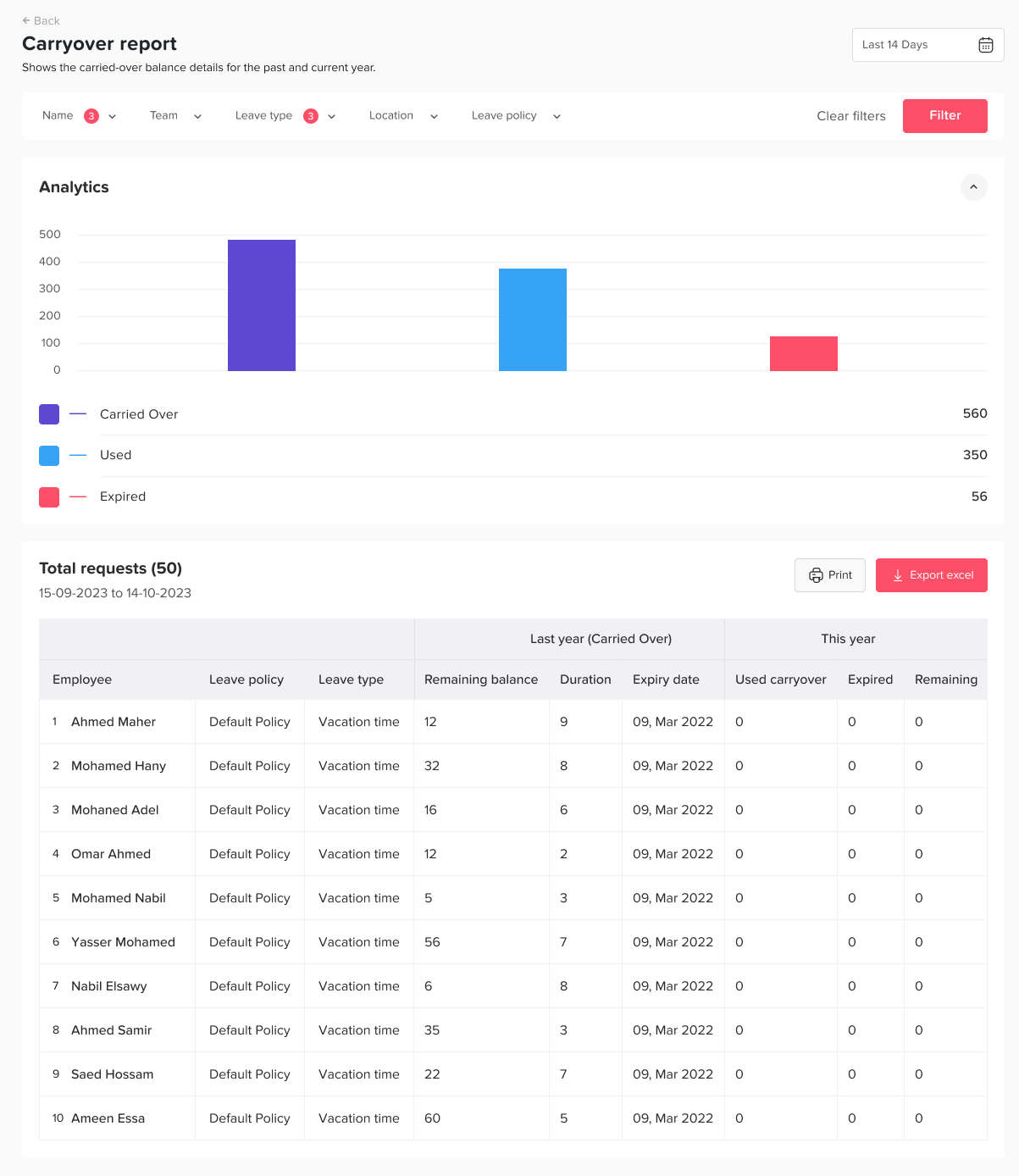
PTO carry over report
A PTO carry over report is a summary that shows how much unused PTO each employee has at the end of a leave period and how those balances are handled. It typically includes carried over days, expired PTO, and remaining balances after reset. Carry over reports help HR and finance teams verify policy enforcement, forecast liability, and ensure accurate payroll and compliance records.
FAQ
How many PTO days can I usually carry over?
Most companies allow employees to carry over between 5 and 10 PTO days, though this varies by company size, role, and seniority. Some organizations allow higher limits for long tenured or leadership employees, while others use percentage based caps tied to annual accrual.
What happens if I don’t use my PTO before the carry over limit?
If unused PTO exceeds the allowed carry over limit, the extra days typically expire at the end of the leave year or reset period. Some employers offer alternatives such as partial payout or a short grace period to use excess days before they are lost.
Is PTO carry over required by law?
In many regions, PTO carry over is not legally required, but once PTO is offered, its management must comply with local labor laws. Some jurisdictions restrict use it or lose it policies or require accrued PTO to be treated as earned wages, which can affect carry over rules.
Can employers force employees to lose unused PTO?
It depends on local labor laws. In some regions, employers may enforce expiration policies if they are clearly communicated and lawful. In others, forfeiting accrued PTO may be restricted or prohibited. Employers should always align carry over rules with applicable regulations.
Can unused PTO be paid out instead of carried over?
Yes, many companies allow unused PTO to be paid out, either automatically or at the employee’s request. Payouts are often capped to control costs and may be offered as an alternative to carry over rather than in addition to it.
Do carry over limits apply to all types of leave?
Not always. Carry over limits typically apply to vacation or general PTO, while other leave types such as sick leave, parental leave, or statutory leave may follow different rules or may not carry over at all.
What happens to carried over PTO if I leave the company?
In some jurisdictions, unused accrued PTO must be paid out upon termination, regardless of carry over limits. In others, payout depends on company policy. Employees should review both their employment contract and local labor laws.
How can companies track PTO carry over accurately?
Accurate carry over tracking requires clear policy rules, defined reset dates, and automated calculations. Many organizations use leave management software to ensure carry over limits are applied consistently, balances are accurate, and records are audit ready.
Why do companies limit PTO carry over instead of allowing unlimited accumulation?
Unlimited carry over often leads to PTO hoarding, burnout, and high financial liability. Carry over limits encourage employees to take time off regularly while helping companies manage costs and staffing needs more effectively.
How can employees avoid losing unused PTO?
Employees can avoid losing PTO by monitoring their balance regularly, planning time off throughout the year, understanding carry over limits and deadlines, and using carried over PTO early if expiration windows apply.
Conclusion
Carry over limits are not just a technical detail of PTO policy they are a powerful tool that shapes workplace culture, employee wellbeing, and financial sustainability.
The best carry over policies protect employees from losing earned time while encouraging them to actually take breaks. They reduce liability without sacrificing trust. And most importantly, they turn PTO into what it was always meant to be: time to rest, not time to worry about losing.
When carry over limits are thoughtfully designed and clearly communicated, everyone benefits employees, managers, and the organization as a whole.