







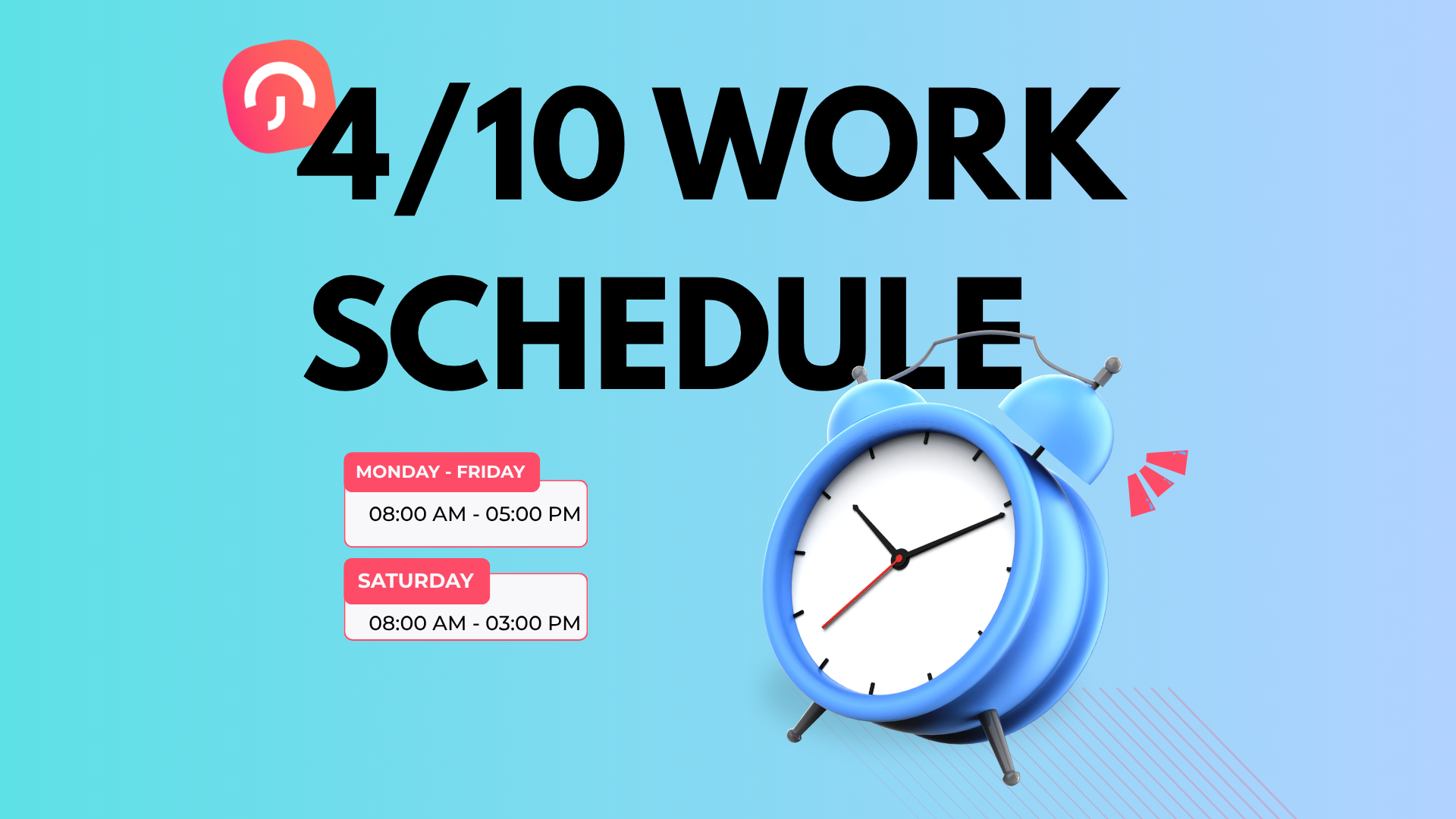
A 4/10 work schedule allows an employee to complete a standard 40-hour workweek by working four 10-hour days instead of five eight-hour days. The employee receives three days away from work each week without reducing their scheduled weekly hours.
This arrangement is also called a compressed workweek because the same number of working hours is compressed into fewer days. A typical schedule might run from Monday through Thursday, with Friday, Saturday, and Sunday off. However, organizations can select different working days based on their staffing requirements.

A 4/10 schedule can reduce commuting days, provide longer periods of uninterrupted work, extend business coverage, and offer employees a recurring weekday off. It can also create challenges, including longer and more tiring shifts, coverage gaps, childcare difficulties, overtime risks, and complicated PTO calculations.
This guide explains how a 4/10 work schedule works, provides examples and a reusable template, and covers the practical issues employers should review before implementing one.
What Is a 4/10 Work Schedule?
A 4/10 work schedule is an alternative schedule in which an employee works:
- Four days per week
- Ten working hours per day
- Forty scheduled working hours per week
- Three days away from work
The name comes from the schedule’s two defining numbers:
- 4 working days
- 10 working hours per day
For example, an employee might work from 7:00 a.m. to 5:30 p.m., Monday through Thursday, with a 30-minute unpaid meal period each day. The employee completes 10 paid hours per day and 40 paid hours by the end of Thursday.
A 4/10 schedule changes how the weekly hours are distributed. It does not automatically reduce the employee’s workload, weekly hours, or pay.
The U.S. Department of Labor describes flexible schedules as alternatives to the traditional five-day, 40-hour workweek. Compressed schedules are one form of alternative scheduling in which employees complete their expected hours over fewer workdays.
How Does a 4/10 Schedule Work?
Under a standard 5/8 schedule, an employee works five eight-hour days:
- Monday: 8 hours
- Tuesday: 8 hours
- Wednesday: 8 hours
- Thursday: 8 hours
- Friday: 8 hours
Total: 40 hours
Under a 4/10 schedule, the same employee might work:
- Monday: 10 hours
- Tuesday: 10 hours
- Wednesday: 10 hours
- Thursday: 10 hours
- Friday: Off
Total: 40 hours
The employee works two additional hours on each scheduled day but receives one additional day off.
Standard 4/10 schedule example
| Day | Start Time | Meal Break | End Time | Paid Hours |
|---|---|---|---|---|
| Monday | 7:00 a.m. | 30 minutes unpaid | 5:30 p.m. | 10 |
| Tuesday | 7:00 a.m. | 30 minutes unpaid | 5:30 p.m. | 10 |
| Wednesday | 7:00 a.m. | 30 minutes unpaid | 5:30 p.m. | 10 |
| Thursday | 7:00 a.m. | 30 minutes unpaid | 5:30 p.m. | 10 |
| Friday | Off | — | — | 0 |
| Weekly Total | 40 | |||
Employers should distinguish between scheduled presence and paid working hours. If the employee has an unpaid 30-minute meal period, a 10-hour paid shift requires the employee to be present for 10 hours and 30 minutes.
Is a 4/10 Schedule the Same as a Four-Day Workweek?
Not always.
The terms are sometimes used interchangeably, but they can describe different arrangements.
A traditional 4/10 schedule usually means employees still work 40 hours per week. They simply complete the hours over four days.
A reduced-hour four-day workweek may involve employees working fewer total hours, such as 32 hours, while retaining the same salary or receiving prorated pay.
4/10 schedule
- Four working days
- Ten hours per day
- Forty hours per week
- Usually no reduction in workload or weekly hours
Reduced-hour four-day workweek
- Four working days
- Often seven or eight hours per day
- Usually 28 to 32 hours per week
- May involve redesigned workloads and productivity expectations
Employers should use precise wording in job descriptions, policies, and recruitment materials. Saying “four-day workweek” without explaining the daily and weekly hours can create incorrect expectations.
Common Types of 4/10 Work Schedules
A 4/10 schedule does not require every employee to work Monday through Thursday. Companies can organize the schedule in several ways.
Monday through Thursday
Employees work four 10-hour days and receive Friday off.
This is one of the simplest arrangements and can be attractive to employees who want a three-day weekend.
Tuesday through Friday
Employees receive Monday off and work through Friday.
This can help an organization maintain Friday coverage while giving employees a weekday off for appointments or personal responsibilities.
Staggered 4/10 schedule
Different groups receive different days off.
For example:
- Team A works Monday through Thursday.
- Team B works Tuesday through Friday.
This allows the business to remain staffed five days per week while each employee still works four days.
Rotating weekday off
Employees work four 10-hour days, but the day off changes according to a rotation.
This may improve fairness when certain days off are more desirable, but it creates additional scheduling complexity.
Weekend-inclusive schedule
Employees may work days such as Wednesday through Saturday or Sunday through Wednesday.
This can support businesses that operate seven days per week, including healthcare, hospitality, retail, customer support, and technical operations.
Benefits of a 4/10 Work Schedule
A 4/10 work schedule can benefit employees and employers when it matches the type of work, customer demand, and staffing model.
Three days away from work
The most visible benefit is a recurring three-day break.
Employees may use the additional day for:
- Appointments
- Family responsibilities
- Education
- Personal errands
- Travel
- Rest and recovery
- Reduced childcare needs
- Activities that are difficult to schedule on weekends
A weekday away from work may be especially valuable because banks, government offices, healthcare providers, and other services often operate during traditional business hours.
Fewer commuting days
Employees commute four times per week instead of five.
This may reduce:
- Transportation expenses
- Fuel use
- Parking costs
- Travel time
- Exposure to traffic
- The number of days spent preparing for an on-site shift
Remote employees may also benefit from having fewer transitions between workdays and personal days.
Longer uninterrupted working periods
A 10-hour day can give employees more time to complete complex tasks without carrying them into the next day.
This may be useful for:
- Engineering work
- Software development
- Field service
- Manufacturing
- Construction
- Laboratory work
- Maintenance
- Project-based assignments
- Roles requiring setup and shutdown time
When each workday includes significant preparation, travel, or equipment setup, reducing the number of weekly starts and stops may improve efficiency.
Longer customer coverage
A company using 10-hour shifts can extend its daily operating window.
For example, staggered teams might provide coverage from 7:00 a.m. until 7:00 p.m. without requiring every employee to work the entire period.
This can improve service for:
- Customers in different time zones
- Employees needing early or late appointments
- Facilities with long operating hours
- Teams supporting extended production periods
Potentially fewer unplanned absences
A regular weekday off may give employees more opportunity to schedule personal responsibilities without missing work.
However, employers should not assume a compressed schedule will automatically eliminate absenteeism. Its effect will depend on workload, fatigue, flexibility, workplace culture, and employee circumstances.
Recruitment and retention value
Alternative schedules can be attractive to candidates who value flexibility.
A 4/10 schedule may help differentiate an employer when:
- The position cannot be fully remote
- Employees travel significant distances
- Competitors use traditional schedules
- Workers value predictable personal time
- The organization needs to improve schedule flexibility without reducing weekly hours
Disadvantages of a 4/10 Work Schedule
A compressed schedule is not suitable for every employee, team, or business.
Longer workdays can cause fatigue
A 10-hour shift may be physically or mentally demanding.
Fatigue can become especially significant in jobs involving:
- Driving
- Patient care
- Physical labor
- Machinery
- Repetitive tasks
- High concentration
- Customer conflict
- Safety-sensitive decisions
Employers should consider whether employees can maintain safe and accurate performance throughout the longer shift.
Childcare and transportation may be harder to arrange
Some childcare providers, school programs, and public transportation routes are designed around standard working hours.
An employee may find that working from 7:00 a.m. until 5:30 p.m. creates more difficulty than working five shorter days.
Offering a 4/10 schedule without evaluating these practical barriers may benefit some employees while creating disadvantages for others.
Customer and team coverage can suffer
A company that closes every Friday may be unavailable when customers, vendors, or partners expect support.
Coverage problems can also arise when:
- A public holiday falls on a scheduled workday
- Several employees request the same day off
- A team member is absent during a 10-hour shift
- Meetings are scheduled on employees’ non-working days
- Departments use different workweeks
A staggered model may reduce these problems.
Longer absences require more PTO
If PTO is tracked in hours, an employee normally needs 10 hours of PTO to cover a full scheduled day on a 4/10 schedule.
An employee on a traditional eight-hour schedule may use eight hours for a full day off. This does not necessarily mean the 4/10 employee receives less leave, but the policy must calculate leave consistently.
Overtime can be triggered unexpectedly
An employee scheduled for 40 hours may exceed the weekly overtime threshold by:
- Staying late
- Working on the normal day off
- Attending required meetings
- Answering messages after the shift
- Performing setup or closing work off the clock
- Working through an unpaid meal period
Covered nonexempt employees must generally receive overtime pay for hours worked over 40 in a defined workweek under federal law.
State law may impose additional daily overtime or alternative-workweek requirements.
Meetings can recreate a five-day schedule
A 4/10 arrangement loses much of its value when employees are regularly expected to attend meetings or answer messages on their scheduled day off.
Employers should treat the day off as a genuine non-working day unless an exception is necessary and properly recorded.
Is a 4/10 Work Schedule Legal?
A 4/10 work schedule can be lawful, but employers must comply with federal, state, local, industry-specific, and contractual requirements.
Under federal law, covered nonexempt employees generally receive overtime after working more than 40 hours in a workweek. Federal law does not generally require overtime merely because an employee works more than eight hours in one day.
This means a nonexempt employee may often work four 10-hour days under federal law without receiving overtime when the employee works exactly 40 hours in the workweek.
However, employers must also check state law.
California 4/10 schedule rules
California generally requires daily overtime for many nonexempt employees who work more than eight hours in a workday. A valid alternative workweek arrangement may allow eligible employees to work a regularly scheduled day of up to 10 hours without daily overtime, but the employer must follow specific legal procedures.
California guidance explains that employees covered by a validly adopted alternative workweek schedule may work no more than 10 regularly scheduled hours per workday within a 40-hour workweek without daily overtime.
The state’s requirements can include employee voting, disclosures, reporting, scheduling restrictions, and rules for hours worked outside the approved schedule. Employers should not simply announce a California 4/10 schedule and assume daily overtime no longer applies.
California also maintains a database of filed alternative-workweek election results.
Other states may have their own overtime, break, scheduling, reporting-time, or day-of-rest requirements. Employers should review the rules in every location where affected employees work.
How Does Overtime Work on a 4/10 Schedule?
For a covered nonexempt employee under the federal Fair Labor Standards Act, overtime is generally based on hours worked over 40 in the employer’s established workweek.
Example 1: Exactly 40 hours
The employee works:
- Monday: 10 hours
- Tuesday: 10 hours
- Wednesday: 10 hours
- Thursday: 10 hours
Total: 40 hours
Under the federal weekly rule, the employee has not exceeded 40 hours.
Example 2: Employee stays two hours late
The employee works:
- Monday: 10 hours
- Tuesday: 10 hours
- Wednesday: 12 hours
- Thursday: 10 hours
Total: 42 hours
Under the federal rule, two hours are generally overtime for a covered nonexempt employee.
Example 3: Employee works on the day off
The employee completes four 10-hour shifts and then works five hours on Friday.
Total: 45 hours
The additional five hours generally exceed the federal 40-hour threshold and must be paid at the applicable overtime rate for a covered nonexempt employee.
Employers cannot avoid overtime simply because the additional work was not scheduled. When an employer requires or permits work, the time may be compensable. Employees should be instructed to record all time worked, including early starts, late finishes, interrupted meal periods, remote messages, and required meetings.
Breaks and Meal Periods on a 10-Hour Shift
A 10-hour shift makes break compliance particularly important.
Federal law does not generally require adult employees to receive meal or rest breaks. However, state laws may require them. When short breaks of approximately five to 20 minutes are provided, federal guidance generally treats them as paid working time. A bona fide meal period, typically lasting at least 30 minutes, may be unpaid when the employee is fully relieved from duty.
If an employee is required to answer calls, monitor equipment, assist customers, or remain responsible for duties during the meal period, the time may need to be treated as working time.
Employers should define:
- The length of the meal period
- Whether it is paid or unpaid
- Required rest breaks
- When breaks should be taken
- How missed or interrupted meals are reported
- Whether employees may leave the worksite
- Who provides coverage during breaks
State rules may require additional or differently timed breaks during a 10-hour shift.
How Does PTO Work on a 4/10 Schedule?
PTO should generally reflect the working time the employee was scheduled to miss.
If an employee is scheduled for 10 paid hours and takes the full day off, the employer would normally deduct 10 PTO hours.
If the employee takes half of the shift off, the employer might deduct five hours.
PTO calculation examples
| Situation | Scheduled Working Time Missed | Typical PTO Deduction |
|---|---|---|
| Employee takes one full 10-hour shift off | 10 hours | 10 hours |
| Employee takes half of a 10-hour shift off | 5 hours | 5 hours |
| Employee leaves two hours early | 2 hours | 2 hours |
| Employee requests Friday off but Friday is already non-working | 0 hours | 0 hours |
| Public holiday falls on a scheduled 10-hour day | Depends on holiday policy | Policy should define whether 8 or 10 hours are credited |
| Employee changes from 5/8 to 4/10 | Weekly hours remain 40 | Existing balance may remain in hours without conversion |
Tracking PTO in hours is often clearer for compressed schedules because a “day” may represent eight hours for one employee and 10 hours for another.
Example
Two employees each have 80 PTO hours.
- Employee A works five eight-hour days and can cover 10 full scheduled days.
- Employee B works four 10-hour days and can cover eight full scheduled days.
Both employees receive 80 paid hours away from work. The difference is caused by their daily schedules.
A policy that grants a fixed number of “days” without defining the number of hours may create unequal or confusing results.
How Do Public Holidays Work on a 4/10 Schedule?
Public holiday treatment is one of the most important policy decisions when introducing a compressed schedule.
Suppose an employee normally works Monday through Thursday and a public holiday falls on Friday. The employer must decide whether:
- The employee receives no additional time because Friday was already off
- The employee receives another day off
- The employee receives holiday hours in a separate balance
- The employee’s schedule is temporarily adjusted
A second issue arises when the employer’s standard holiday credit is eight hours, but the employee is scheduled for 10 hours.
Possible approaches include:
- Credit 10 holiday hours
- Credit eight holiday hours and require two PTO hours
- Credit eight holiday hours and allow two unpaid hours
- Adjust the employee’s schedule within the workweek
- Create a holiday rule specifically for compressed schedules
There is no single universal policy answer. The company should choose a method that is lawful, consistent, easy to administer, and clearly communicated.
Which Businesses Can Benefit From a 4/10 Schedule?
A 4/10 schedule may work well when the organization can accommodate long shifts and fewer weekly handoffs.
Potential examples include:
- Technology teams
- Engineering departments
- Manufacturing operations
- Construction companies
- Maintenance teams
- Warehouses
- Government offices
- Laboratories
- Healthcare support roles
- Field-service businesses
- Customer-support departments
- Professional services teams
The schedule may be less suitable when:
- Customers require consistent five-day access to specific employees
- Work is physically exhausting
- Ten-hour shifts create safety concerns
- Demand is concentrated late in the week
- Employees have limited schedule flexibility
- Handoffs must occur frequently
- The workday cannot be extended
- State rules make implementation impractical
The decision should be based on operational evidence rather than the popularity of the schedule.
Free 4/10 Work Schedule Template
The following template can be adapted for a team or individual employee.
Weekly 4/10 schedule template
Employee: [Employee name]
Department: [Department]
Manager: [Manager name]
Effective date: [Date]
Workweek: [Defined seven-day workweek]
| Day | Start Time | Meal Period | End Time | Paid Hours | Status |
|---|---|---|---|---|---|
| Monday | 7:00 a.m. | 12:00–12:30 p.m. | 5:30 p.m. | 10 | Working |
| Tuesday | 7:00 a.m. | 12:00–12:30 p.m. | 5:30 p.m. | 10 | Working |
| Wednesday | 7:00 a.m. | 12:00–12:30 p.m. | 5:30 p.m. | 10 | Working |
| Thursday | 7:00 a.m. | 12:00–12:30 p.m. | 5:30 p.m. | 10 | Working |
| Friday | — | — | — | 0 | Scheduled day off |
| Total | 40 | ||||
Policy notes to add
- Employees must record their actual starting and finishing times.
- Work outside scheduled hours requires authorization but must still be recorded and paid when performed.
- Employees must report interrupted or missed meal periods.
- A full scheduled day of PTO equals 10 hours.
- Meetings should not normally be scheduled on the employee’s day off.
- Holiday treatment follows the company’s compressed-schedule holiday policy.
- The schedule may be reviewed after a defined trial period.
- Business needs, employee performance, attendance, and legal compliance may be considered during review.
How to Implement a 4/10 Work Schedule
A compressed schedule should be planned carefully rather than introduced as a simple calendar change.
Review business demand
Identify:
- Busy days
- Customer service hours
- Required staffing levels
- Weekly deadlines
- Peak production periods
- Days with the highest absence rates
- Roles that require daily coverage
Determine whether the company can close for one day or needs staggered teams.
Check legal requirements
Review:
- Federal overtime rules
- State daily overtime rules
- Alternative-workweek procedures
- Meal and rest requirements
- Predictive scheduling laws
- Industry-specific restrictions
- Collective bargaining agreements
- Rules for minors or safety-sensitive roles
Employees working in more than one state may require different arrangements.
Ask employees for input
Employee feedback can reveal issues involving:
- Childcare
- Transportation
- Medical conditions
- Religious obligations
- Education
- Second jobs
- Commuting
- Shift preferences
A schedule that appears attractive in theory may not suit the entire team.
Choose a coverage model
The company may use:
- One shared weekday off
- Staggered teams
- Rotating days off
- Department-specific schedules
- Voluntary participation
- A hybrid of traditional and compressed schedules
Define the workweek
Overtime is calculated using an established workweek, not merely the employee’s visible schedule.
Under federal guidance, a workweek is a fixed and regularly recurring period of seven consecutive 24-hour periods.
Employers should not move the workweek from one period to another to avoid overtime.
Update PTO and holiday rules
Clarify:
- How many PTO hours cover a full day
- How partial-day leave is calculated
- How holidays are credited
- What happens when a holiday falls on the day off
- How sick leave is deducted
- Whether employees may swap days
- How schedule changes affect approved PTO
Configure time tracking
The system should capture:
- Scheduled hours
- Actual clock-in and clock-out times
- Breaks
- Overtime
- Missed punches
- Work on scheduled days off
- PTO hours
- Holiday hours
- Schedule exceptions
Run a trial period
A trial of approximately two or three months can help the organization evaluate:
- Productivity
- Customer coverage
- Overtime
- Absences
- Employee satisfaction
- Service quality
- Safety incidents
- Missed deadlines
- Staffing gaps
Review measurable results
Do not evaluate the schedule only by asking whether employees like the extra day off.
Compare results before and during the trial, including:
- Output
- Error rates
- Customer response times
- Overtime costs
- Absence rates
- Turnover
- Schedule-change requests
- Employee fatigue
- Workplace incidents
Document the final arrangement
The written policy should identify:
- Eligible employees
- Scheduled days and hours
- Break rules
- Overtime approval
- PTO deductions
- Holiday treatment
- Schedule-swapping rules
- Trial and review periods
- Reasons the arrangement may be changed
- Accommodation request procedures
Sample 4/10 Work Schedule Policy
Eligible employees may work a compressed schedule consisting of four 10-hour working days within the company’s defined workweek. Participation must be approved in writing by the employee’s manager and Human Resources.
Employees must accurately record all working time, including work performed before or after the scheduled shift, during meal periods, remotely, or on a scheduled day off. Working outside the approved schedule may result in corrective action, but all time worked must still be reported.
A full day of PTO will be deducted according to the employee’s scheduled working hours. An employee scheduled for a 10-hour day will normally use 10 PTO hours for a full-day absence.
Holiday pay, meal periods, rest breaks, overtime, and schedule changes will be administered according to applicable law and company policy.
The company may review, modify, or discontinue a compressed schedule based on business coverage, employee performance, attendance, safety, legal requirements, or operational needs. The company will provide reasonable notice when practicable.
The policy should be reviewed by qualified legal counsel before use.
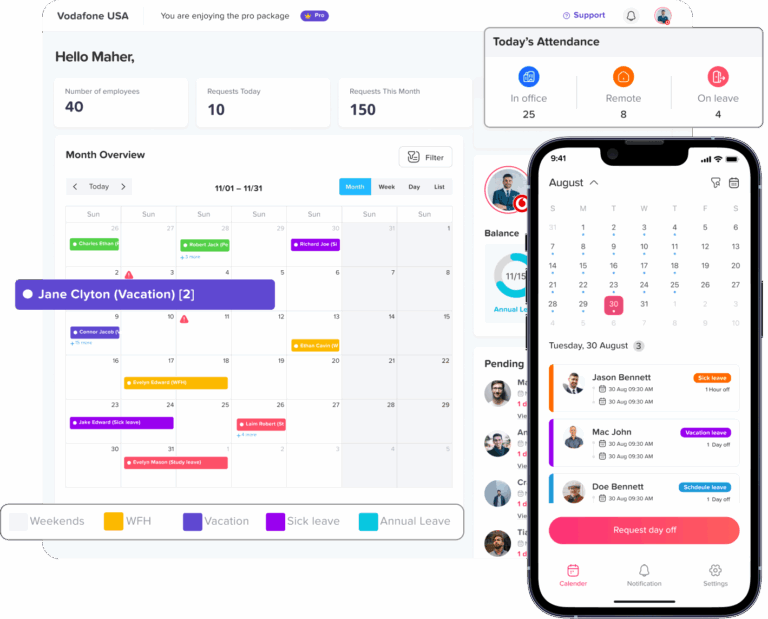
How Day Off Helps Manage 4/10 Schedules
A 4/10 schedule becomes difficult to administer when work schedules, PTO requests, attendance, and timesheets are maintained in separate spreadsheets.
Day Off can help teams centralize:
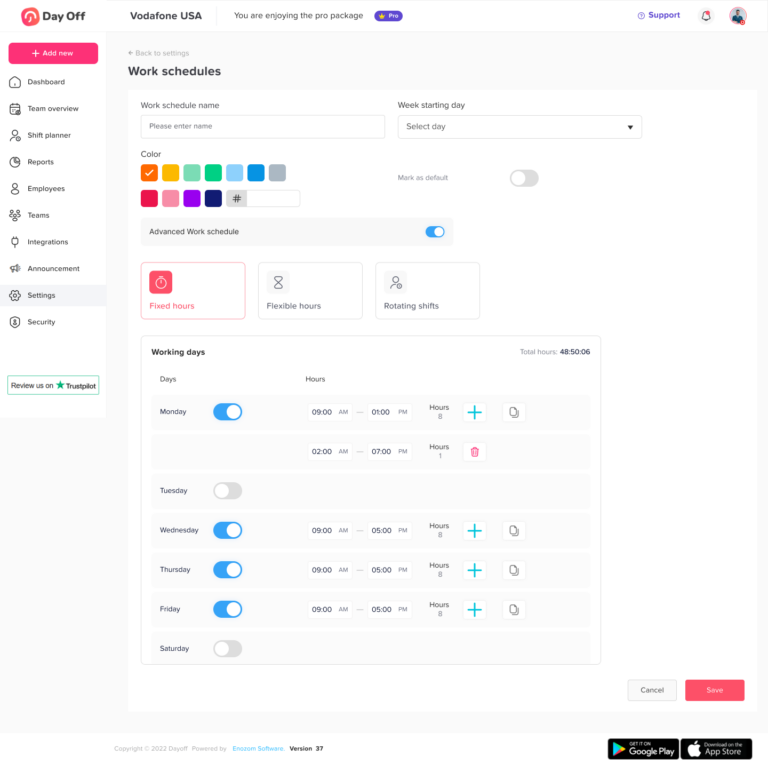
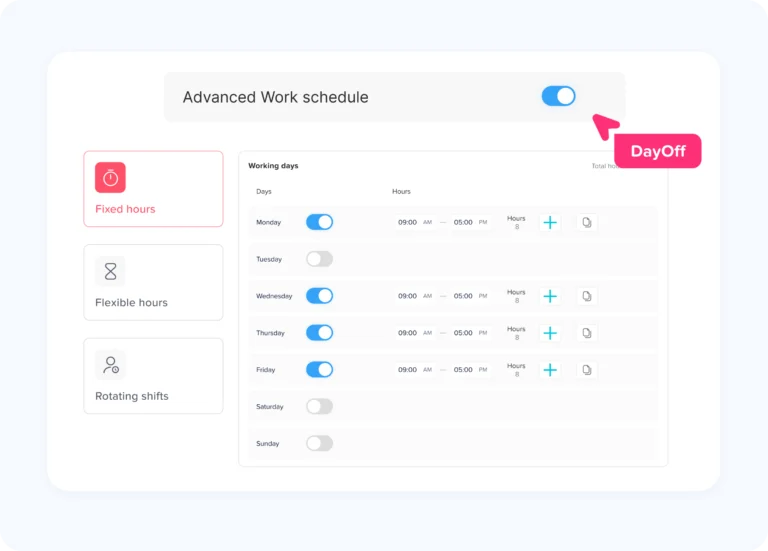
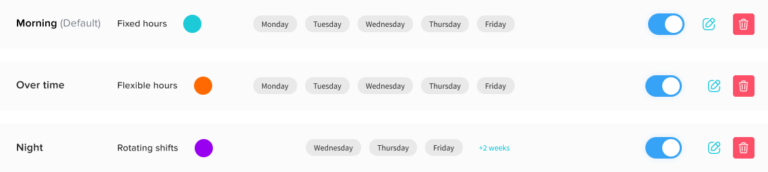
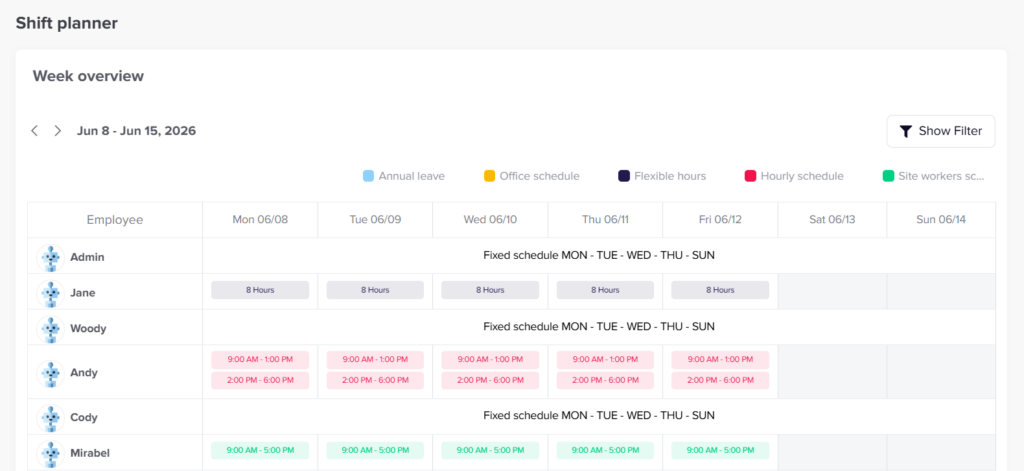
- Fixed and flexible work schedules
- Employee working days
- PTO requests and approvals
- Hour-based leave deductions
- Shared absence calendars
- Public holidays
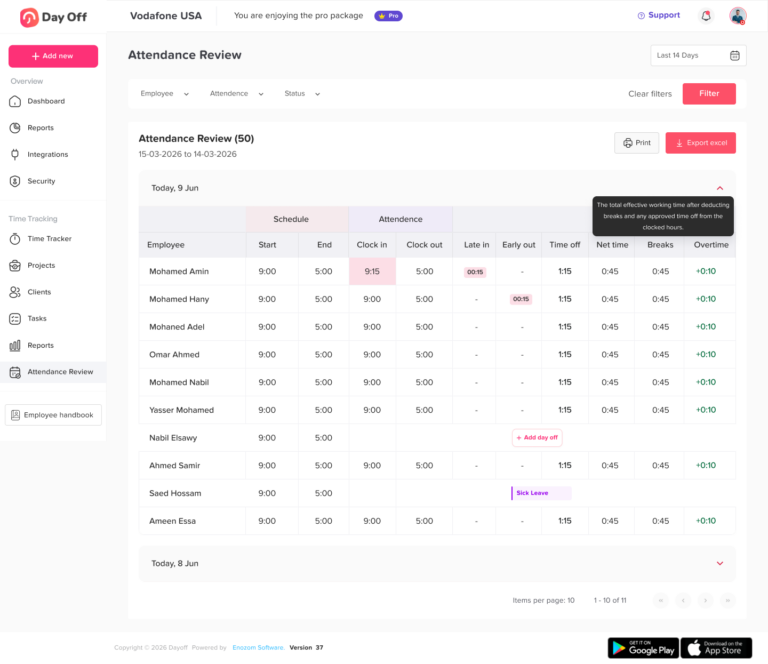
- Attendance status
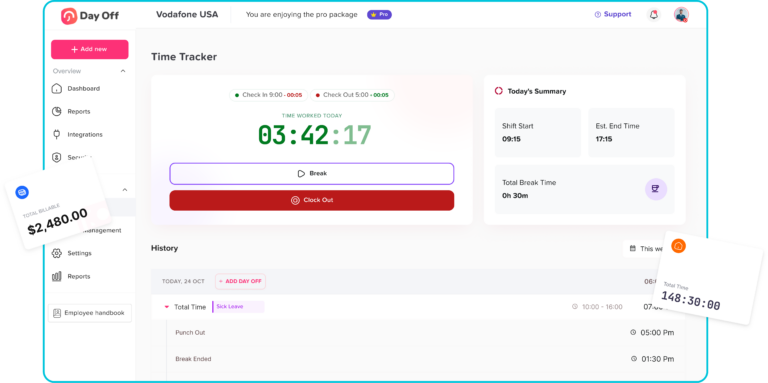
- Clock-in and clock-out records
- Timesheets
- Balance and leave reports
When an employee requests a full scheduled day off, the system should use the employee’s actual schedule rather than assuming that every working day equals eight hours.
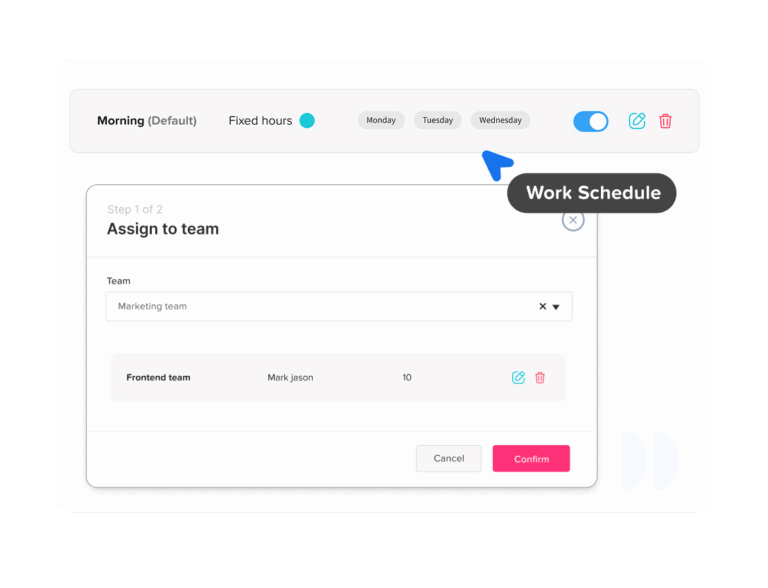
Centralized scheduling and leave tracking can also help managers identify coverage gaps before approving requests and keep PTO, attendance, and timesheet records aligned.
Frequently Asked Questions About 4/10 Work Schedules
What is a 4/10 work schedule?
A 4/10 work schedule means working four days per week for 10 hours each day. The employee completes 40 scheduled hours and normally receives three days off. It is a compressed schedule because the standard workweek is completed in fewer days.
How many hours do you work on a 4/10 schedule?
Employees normally work 10 paid hours per day and 40 paid hours per week. When the schedule includes an unpaid 30-minute lunch, the employee may be at work for 10 hours and 30 minutes each day.
What are typical hours for a 4/10 work schedule?
Common 4/10 schedule hours include:
- 6:00 a.m. to 4:30 p.m.
- 7:00 a.m. to 5:30 p.m.
- 8:00 a.m. to 6:30 p.m.
Each example includes 10 working hours and a 30-minute unpaid meal period. Employers can choose different start and finish times based on staffing, customer demand, and applicable break rules.
Is a 4/10 schedule the same as a four-day workweek?
Not necessarily. A 4/10 schedule compresses 40 hours into four days, so employees still work the same number of weekly hours. Some four-day workweek programs reduce the workweek to 32 hours without extending each day to 10 hours.
Do you get overtime when working four 10-hour days?
Under federal law, covered nonexempt employees generally receive overtime after working more than 40 hours in a workweek. Working exactly four 10-hour days does not exceed that federal weekly threshold. However, state law may require daily overtime or impose additional rules.
What happens if you work on your fifth day?
An employee who has already completed four 10-hour shifts has worked 40 hours. Additional hours worked on the fifth day will generally be overtime under federal law for a covered nonexempt employee.
For example, an employee who works 40 hours from Monday through Thursday and another five hours on Friday generally has five federal overtime hours.
Is a 4/10 work schedule legal in every state?
A 4/10 schedule can be lawful, but employers must check federal and state wage-and-hour rules. Federal law generally calculates overtime after 40 hours in a workweek, while some states impose daily overtime requirements or special procedures for compressed schedules.
Is a 4/10 work schedule legal in California?
California employers generally must follow the state’s alternative-workweek procedures before many nonexempt employees can regularly work 10-hour days without daily overtime. Depending on the applicable wage order, the schedule may require a secret-ballot election approved by at least two-thirds of the affected employees.
Employers should confirm which wage order applies and complete the required election, reporting, and scheduling procedures before introducing the arrangement.
Does a 10-hour workday include lunch?
A 10-hour workday normally refers to 10 paid working hours. An unpaid meal period is usually added to those hours.
For example, an employee working from 7:00 a.m. to 5:30 p.m. with a 30-minute unpaid lunch completes 10 paid hours. Under federal guidance, a bona fide meal period is generally unpaid when the employee is completely relieved from work duties.
How many breaks do you get during a 10-hour shift?
Federal law does not generally require meal or rest breaks for adult employees, although state laws may require them. When employers provide short breaks of approximately five to 20 minutes, federal rules generally treat them as paid working time. Bona fide meal periods may be unpaid when the employee is fully relieved from duty.
Employers should check the meal- and rest-break laws in every state where affected employees work.
How does PTO work on a 4/10 schedule?
PTO should normally cover the hours the employee was scheduled to work. An employee taking a complete 10-hour shift off would usually use 10 PTO hours. Taking three hours off would normally require three PTO hours.
Tracking PTO in hours helps prevent confusion because one full workday may equal 10 hours for a 4/10 employee but eight hours for an employee on a traditional schedule.
Do you use 8 or 10 hours of PTO on a 4/10 schedule?
An employee would normally use 10 PTO hours when missing a full scheduled 10-hour shift. However, the employer’s written policy should explain how vacation, sick leave, holidays, and other paid absences are credited.
Using only eight PTO hours for a 10-hour absence may require the employee to work the remaining two hours, use another leave balance, or take the time unpaid.
What happens when a holiday falls on a 4/10 workday?
Private-sector holiday treatment generally depends on the employer’s written policy. The company may credit 10 holiday hours, provide eight holiday hours and require another arrangement for the remaining two, or temporarily adjust the employee’s schedule.
For federal employees on a compressed schedule, a holiday that falls on a scheduled 10-hour workday generally covers the employee’s full 10-hour basic work requirement.
What happens when a holiday falls on the employee’s regular day off?
The answer depends on the employer’s policy and applicable law. A private employer may provide an alternative day off, holiday hours, a schedule adjustment, or no additional benefit unless another rule or agreement applies.
Full-time federal employees generally receive an “in lieu of” holiday when a federal holiday falls on a non-working day under an alternative work schedule.
Is a 4/10 schedule better than a 5/8 schedule?
Neither schedule is automatically better for every workplace.
A 4/10 schedule offers three days off and fewer weekly commutes, but each workday is longer. A 5/8 schedule provides shorter shifts and may be easier for childcare, transportation, evening responsibilities, and customer coverage.
The better option depends on the employee’s role, workload, commute, personal responsibilities, and ability to maintain performance during a 10-hour shift.
Conclusion
A 4/10 work schedule gives employees three days off each week while preserving a standard 40-hour workload. It can reduce commuting, extend daily coverage, and provide longer periods for focused work, but it can also increase fatigue, complicate childcare, create overtime risks, and require larger PTO deductions for full-day absences.
Before implementing the schedule, employers should review wage-and-hour laws, employee needs, customer coverage, break requirements, holiday rules, and time-tracking processes. A written policy, a defined trial period, and accurate scheduling and PTO records can help determine whether a compressed workweek is sustainable for both the business and its employees.