





Overtime Hours can increase an employee’s PTO balance, but they do not automatically do so in every workplace. Whether extra hours earn additional paid time off depends on the employer’s accrual formula, the type of leave involved, applicable state or local laws, collective bargaining agreements, and any limits written into the PTO policy.

For example, a policy that awards PTO for every hour worked may include overtime in the calculation. A policy that provides a fixed amount of PTO each pay period may not change at all when an employee works additional hours. Statutory paid sick leave may follow a different rule from company provided vacation time.
This guide explains when overtime hours earn PTO, how employers can calculate the additional accrual, what employees should look for in their policies, and how HR teams can prevent payroll and leave balance errors.
Important: This article focuses primarily on employment practices in the United States. State and local leave laws may impose additional requirements, so employers should review the rules that apply wherever their employees work.
Do Overtime Hours Earn PTO?
The answer is: sometimes.
Overtime hours generally earn additional PTO when all of the following are true:
- PTO is accrued according to actual hours worked.
- The policy includes all hours worked in the accrual calculation.
- The employee has not reached a weekly, annual, or total accrual cap.
- No separate policy provision excludes hours above the employee’s regular schedule.
- Applicable sick leave laws require those hours to be included.
Overtime may not generate additional PTO when:
- PTO is frontloaded at the start of the year.
- Employees receive a fixed amount each pay period.
- Accrual is based on scheduled hours rather than actual hours.
- The policy limits eligible accrual hours to 40 per week.
- The employee has reached the maximum PTO balance.
- The employee is covered by a different leave policy, contract, or collective bargaining agreement.
The employee’s overtime pay and PTO accrual should therefore be treated as two separate calculations.
Federal Overtime Rules and PTO Accrual Are Different
Under the federal Fair Labor Standards Act, covered nonexempt employees generally must receive overtime pay at no less than one and one-half times their regular rate for hours worked beyond 40 in a workweek. The federal rule does not automatically require overtime merely because an employee works on a weekend, holiday, or regular day off. The employee must exceed the applicable hours worked threshold.
The FLSA does not generally require employers to provide vacation time, sick leave, holiday leave, or other forms of paid time off. These benefits are usually established through company policy, an employment agreement, or a collective bargaining agreement.
This creates an important distinction:
- Overtime pay is regulated by wage and hour law.
- Company provided PTO accrual is usually determined by the employer’s written policy.
- Legally required paid sick leave may be governed by state or local law.
An employee can therefore be entitled to overtime pay without earning additional vacation time. The opposite may also occur under a generous policy that allows PTO to accumulate for every hour worked.
What Determines Whether Extra Hours Earn PTO?
The Accrual Method
| PTO Method | How It Works | Effect of Overtime Hours |
|---|---|---|
| Per hour worked | PTO is earned for each eligible work hour | Overtime may increase accrual |
| Per hour paid | PTO is earned for eligible paid hours | Overtime and some paid absences may count |
| Regular hours only accrual | Accrual is limited to scheduled hours or 40 hours per week | Overtime normally does not add PTO |
| Fixed amount per pay period | The same amount is credited each payroll cycle | Overtime usually has no effect |
| Monthly accrual | A set amount is credited each month | Overtime usually has no effect |
| Annual frontloading | The full entitlement is provided at once | Overtime does not create extra accrual |
| Milestone based allowance | PTO depends on tenure, classification, or policy tier | Overtime generally has no effect |
The Definition of Eligible Hours
A policy should define which hours count toward PTO accrual.
Possible definitions include:
- All hours actually worked
- Straight time and overtime hours worked
- Hours worked up to 40 per week
- Regularly scheduled hours
- All paid hours
- Productive hours, excluding leave and holidays
- Hours recorded and approved through payroll
The phrases hours worked and hours paid are not interchangeable.
If an employee works 40 hours and takes eight hours of paid vacation, the employee has:
- 40 hours worked
- 48 hours paid
A policy based on hours worked would use 40 hours. A policy based on hours paid might use 48 hours.
The Type of Paid Leave
Vacation, company sick leave, statutory sick leave, personal leave, and combined PTO banks may follow different rules.
An employer may provide:
- Vacation based on length of service
- Sick leave based on hours worked
- Personal days as an annual fixed allowance
- Floating holidays provided at the beginning of the year
- A combined PTO bank covering vacation and illness
Employers should not assume that one accrual rule applies to every leave type. A vacation bank may exclude overtime while a legally required sick leave bank includes all eligible hours worked.
State and Local Requirements
Although federal law does not generally require private employers to provide vacation or paid sick leave, numerous states and local jurisdictions have their own paid leave requirements.
For example, New York requires covered sick leave accruals to account for all time worked, including time worked in increments of less than 30 hours.
California allows employers to use an accrual or upfront method for paid sick leave. Under the standard accrual method, employees generally earn at least one hour of paid sick leave for every 30 hours of work. California currently requires covered employees to receive or be permitted to use at least 40 hours or five days of paid sick leave per year, subject to the applicable rules.
These requirements apply to statutory sick leave, not automatically to every vacation benefit an employer offers. Employers should review state and local rules before excluding overtime hours from an hours-based paid sick leave calculation.
Collective Bargaining and Employment Agreements
Union agreements may contain specific rules about:
- PTO accrual on overtime
- Seniority based vacation
- Shift premiums
- Compensatory time
- Holiday work
- Maximum leave balances
- Carryover and payout
An individual employment agreement may also promise a particular accrual formula. When a policy, offer letter, or agreement gives employees a more generous benefit than the legal minimum, the employer may be required to follow that commitment.
Accrual Caps
Overtime may qualify for PTO accrual while producing no visible balance increase because the employee has reached a cap.
Common limits include:
- A maximum number of eligible hours per week
- A maximum amount earned during the year
- A maximum total balance
- A maximum amount that may carry into the next year
For example, an employee may be eligible to accrue PTO on 50 hours worked but receive no new PTO because the balance has already reached the policy’s 160-hour cap.
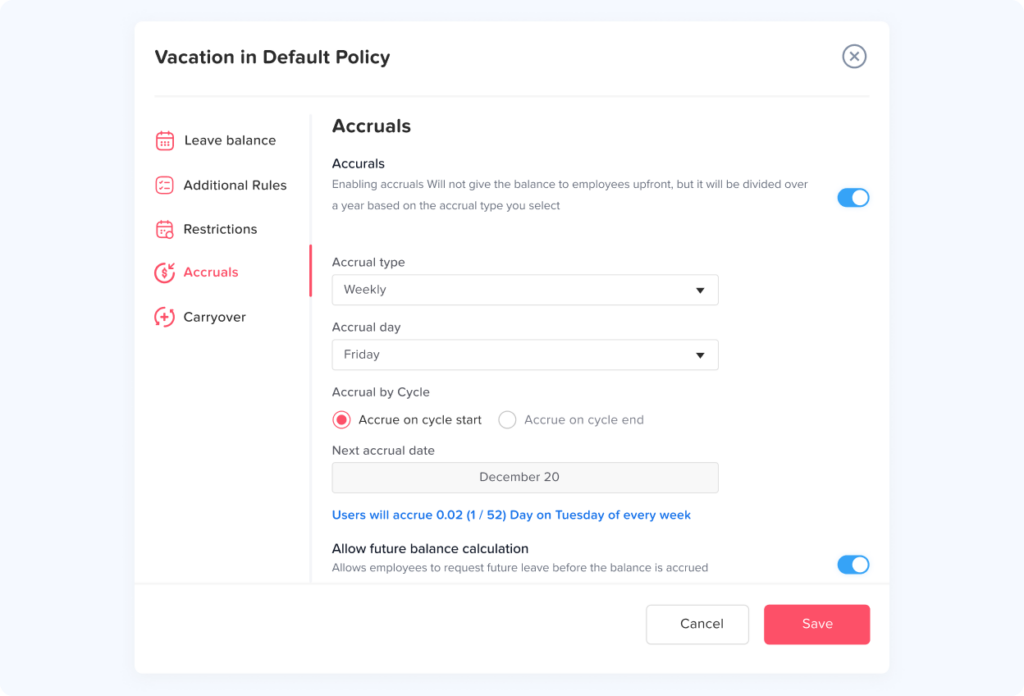
How to Calculate PTO Accrual on Overtime Hours
An hours based calculation normally uses the following formula:
Eligible hours worked × PTO accrual rate = PTO earned
The calculation depends on the definition of eligible hours.
Example 1: One PTO Hour for Every 40 Hours Worked
Suppose the policy provides:
- One hour of PTO for every 40 hours worked
- All overtime hours are eligible
- No weekly accrual limit
An employee works 50 hours.
50 ÷ 40 = 1.25 hours of PTO
The employee earns 1.25 PTO hours for the week.
If the policy limits eligible accrual hours to 40 per week, the calculation would instead be:
40 ÷ 40 = 1 hour of PTO
The employee would still receive overtime pay for the 10 extra hours, but those hours would not increase the PTO balance.
Example 2: Decimal Accrual Rate
An employer wants a full-time employee to earn approximately 80 PTO hours over 2,080 working hours.
The hourly accrual rate is:
80 ÷ 2,080 = 0.03846 PTO hours per eligible hour
If the employee works 45 eligible hours:
45 × 0.03846 = 1.73 PTO hours
If only the first 40 hours are eligible:
40 × 0.03846 = 1.54 PTO hours
The five-hour difference increases accrual by approximately 0.19 hours.
Example 3: Fixed Pay Period Accrual
An employee receives 3.08 PTO hours every two weeks.
During one pay period, the employee works:
- 80 regular hours
- 12 overtime hours
Because the policy provides a fixed 3.08 hours per pay period, the employee still earns 3.08 PTO hours. The additional 12 work hours do not change the leave credit.
Example 4: Annual Frontloading
An employee receives 120 PTO hours on January 1.
The employee works significant overtime during March and April. The overtime does not create additional PTO because the employee’s annual entitlement was already provided.
The employee may still receive additional time if the company separately offers:
- Compensatory time
- A special overtime leave benefit
- Additional floating days
- An attendance incentive
Those benefits would need to be defined separately from the standard PTO allowance.
Comparison of Common Scenarios
| Policy Scenario | Hours Worked | Hours Used for Accrual | PTO Result |
|---|---|---|---|
| All hours worked count | 48 | 48 | Overtime increases PTO |
| Accrual limited to 40 weekly hours | 48 | 40 | No PTO on the extra 8 hours |
| Fixed biweekly credit | 92 | Not hour-dependent | Employee receives the normal fixed credit |
| Annual PTO frontload | 48 | Not hour-dependent | No additional PTO |
| Employee has reached the balance cap | 48 | 48 may technically qualify | Accrual pauses under the cap rule |
| Statutory leave uses all time worked | 48 | 48 | Extra hours generally affect statutory accrual |
Does Time and a Half Mean 1.5 Times the PTO?
No, Overtime compensation and PTO accrual use different units.
Suppose an employee works 10 overtime hours and is paid at one and one half times the regular rate. Those 10 hours remain 10 hours worked. They do not become 15 hours for PTO purposes merely because the employee receives 15 hours’ worth of straight-time compensation.
For example:
- Regular hours worked: 40
- Overtime hours worked: 10
- Total actual hours worked: 50
- Overtime compensation equivalent: 15 straight-time pay units
An hours worked PTO policy would normally use 50 hours, not 55 hours and not 15 extra hours.
A different result would require explicit policy language stating that overtime earns PTO at an enhanced rate.
Does PTO Count Toward Overtime?
Usually not under the federal overtime calculation.
The FLSA generally bases overtime on hours actually worked. Paid vacation, sick leave, holidays, and other paid time during which no work is performed generally do not need to be included as hours worked for federal overtime purposes.
Consider this example:
- Monday through Thursday: 32 hours worked
- Friday: 8 hours of PTO
- Saturday: 8 hours worked
- Total hours paid: 48
- Total hours actually worked: 40
Under the general federal rule, the employee has not worked more than 40 hours. The eight PTO hours do not automatically create an overtime obligation.
Now consider a second example:
- Actual hours worked: 44
- PTO used: 8 hours
- Total hours paid: 52
The employee has four federal overtime hours because the employee actually worked 44 hours. The calculation is not based on the 52 total paid hours.
An employer may adopt a more generous rule that counts PTO, holiday time, or other paid absences toward an internal overtime calculation. A collective bargaining agreement may also require a different result.
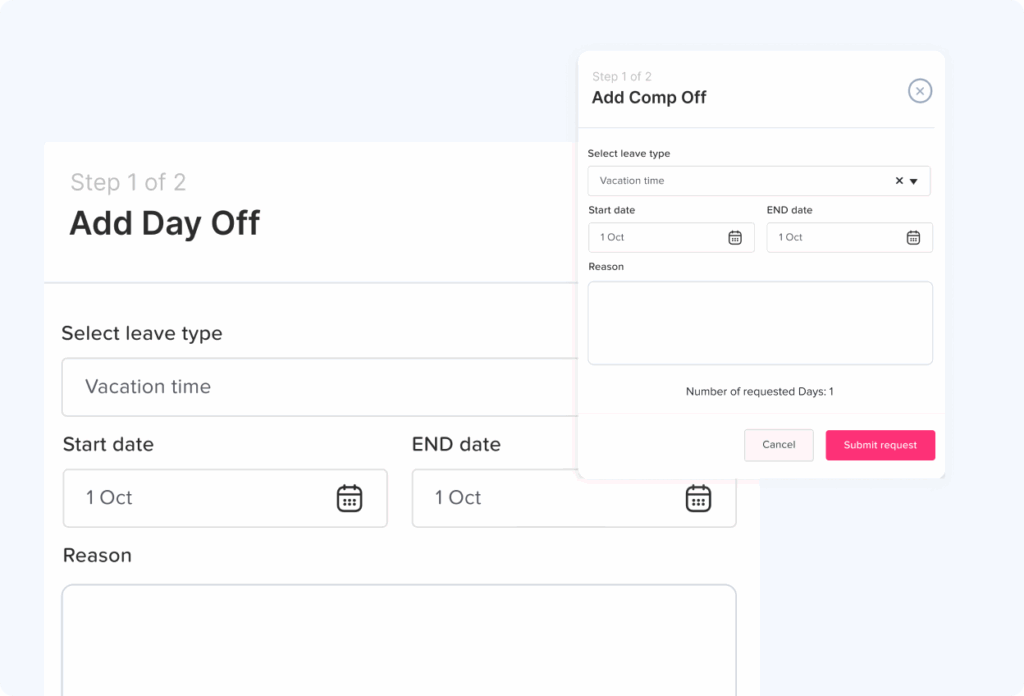
Overtime Accrual for Nonexempt Employees
Nonexempt employees are usually the group most affected by overtime based PTO questions because their work hours are recorded and their overtime eligibility is based on hours worked.
When PTO accrues by the hour, employers should clarify whether the calculation includes:
- Regular hours
- Approved overtime
- Unapproved but compensable overtime
- Training time
- Travel time that qualifies as work
- On call or waiting time that qualifies as work
- Additional remote work completed outside the normal schedule
Employers should not erase compensable hours merely because the employee failed to obtain advance approval. A company may address unauthorized overtime as a performance or disciplinary issue, but its timekeeping, wage, and leave practices must still be consistent with applicable law.
Overtime Accrual for Exempt Employees
Properly classified exempt employees generally do not receive overtime pay under the standard FLSA overtime rule. However, their PTO can still be tracked in hours, days, pay periods, or annual allowances.
Common exempt employee PTO methods include:
- A fixed monthly accrual
- A fixed annual allowance
- Frontloaded PTO
- Unlimited PTO
- Tenure based leave tiers
- A standard weekly assumption for statutory sick leave
Working 45 or 50 hours in a week does not necessarily provide an exempt employee with additional PTO. The policy may treat the employee as working a standard schedule for leave purposes.
Employers with hours based statutory sick leave obligations should check whether their jurisdiction establishes a presumed workweek for exempt employees.
What About Salaried Nonexempt Employees?
Being paid a salary does not automatically mean an employee is exempt from overtime.
A salaried nonexempt employee may still be entitled to overtime compensation and may have actual working hours recorded. For PTO purposes, the employer should apply the rule written for that employee’s classification.
For example, the policy might say:
- Nonexempt employees accrue PTO on all recorded hours worked.
- Accrual is limited to 40 hours per workweek.
- Exempt employees receive a fixed monthly amount.
The employee’s pay method alone should not be used to determine the PTO calculation.
Do Part Time Employees Earn PTO on Extra Hours?
Part time employees may earn additional PTO when their leave is based on hours worked.
Suppose a part time employee is scheduled for 20 hours but works 28 hours. Those extra eight hours may not be legally classified as overtime under the federal 40-hour standard, but they are still additional work hours.
If the employee earns one PTO hour for every 30 hours worked, all 28 eligible hours may move the employee closer to the next accrual increment.
This highlights another distinction:
- Extra hours are hours beyond the employee’s normal schedule.
- Overtime hours are hours that cross the applicable legal or policy threshold.
An employee can work extra hours without receiving overtime pay while still earning additional PTO under an hours-worked policy.
Can an Employer Exclude Overtime From PTO Accrual?
For company provided vacation or personal leave, an employer may often define reasonable eligibility and accrual rules, subject to applicable laws, contracts, and existing commitments.
A policy may state that vacation accrues:
- On all hours worked
- On the first 40 hours each week
- On regularly scheduled hours only
- At a fixed rate regardless of hours
- Only after a waiting period
- Until a maximum balance is reached
However, an employer should not apply an exclusion when doing so would cause a statutory paid leave plan to fall below the applicable minimum.
Employers should also be cautious when changing an established vacation policy. Some states regulate earned vacation once it accrues. In California, for example, earned vacation is treated as accrued compensation that cannot be forfeited, although employers may impose a reasonable accrual cap.
A policy can generally change how employees earn vacation in the future, subject to notice and legal requirements, but retroactively removing already earned leave may create significant risk.
Sample PTO Policy Language
Policy language should clearly state whether overtime affects accrual. The following examples illustrate different approaches.
Option 1: All Hours Worked Count
Eligible nonexempt employees accrue PTO for each hour actually worked, including eligible overtime hours, until the employee reaches the applicable annual or balance cap. Overtime premium pay does not increase the number of hours used in the PTO calculation.
Option 2: Accrual Is Limited to Regular Hours
Eligible employees accrue PTO based on hours worked, up to a maximum of 40 hours per workweek. Hours worked beyond 40 in a workweek are compensated in accordance with applicable overtime requirements but do not generate additional vacation accrual.
Option 3: Fixed Accrual
Eligible employees receive a fixed PTO credit each pay period based on their assigned employment classification. Working additional or overtime hours does not increase the pay period PTO credit.
These examples should be reviewed against state and local leave laws before being adopted, particularly when a combined PTO bank is also used to satisfy paid sick leave requirements.
How HR Teams Can Track Overtime and PTO Correctly
Create One Definition of Eligible Hours
HR, payroll, and managers should use the same definition. The policy and software configuration should not contradict each other.
Keep Work Hours and Leave Hours Separate
A timekeeping system should distinguish among:
- Regular work
- Overtime work
- Vacation
- Sick leave
- Holidays
- Unpaid absences
- Other paid leave
This makes it easier to determine which categories feed the accrual formula.
Configure Each Leave Policy Separately
Do not assume every employee or leave type uses the same formula.
Policies may differ by:
- Location
- Employment status
- Work schedule
- Full time or part-time classification
- Exempt or nonexempt status
- Union membership
- Length of service
- Leave type
Reconcile Time and Leave Records
At the end of each payroll cycle, employers can compare:
- Recorded work hours
- Overtime hours
- Eligible accrual hours
- PTO credited
- Manual adjustments
- Current balances
Federal law requires covered employers to maintain certain time and payroll records for covered nonexempt workers. State sick leave rules may impose additional recordkeeping duties.
For example, California requires employers to maintain records showing paid sick leave earned and used for three years.
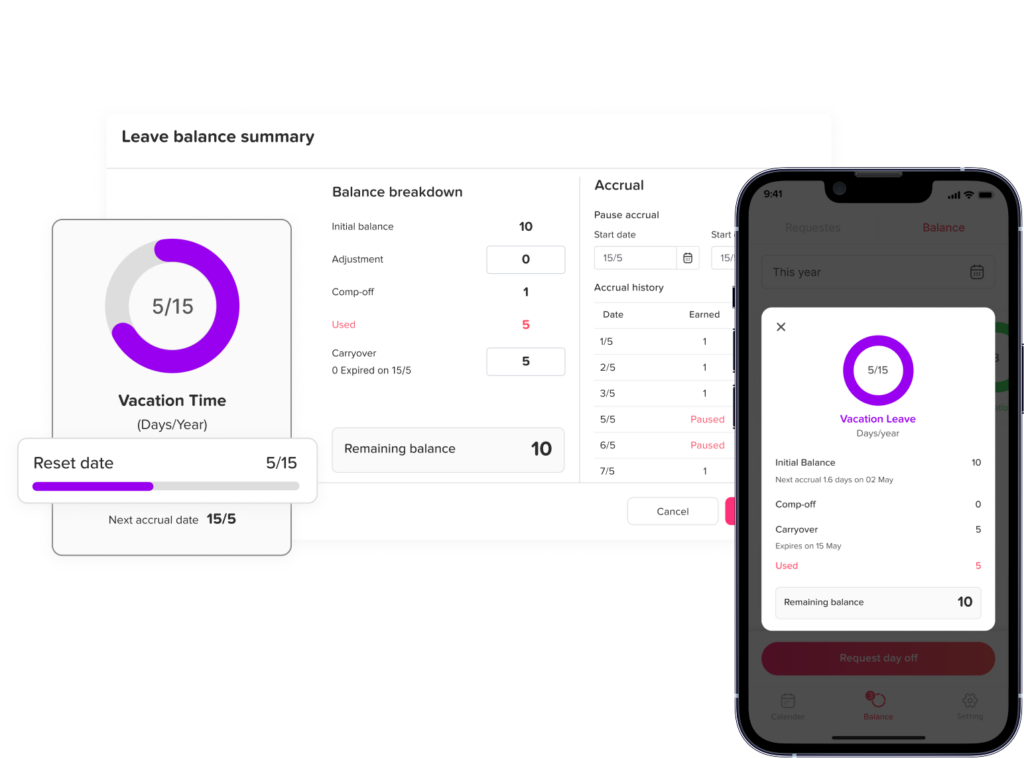
Give Employees Balance Visibility
Employees should be able to see:
- Current balance
- PTO earned during the period
- PTO used
- Adjustments
- Carryover
- Expiring leave
- Maximum balance
Visibility makes it easier to identify an incorrect overtime calculation before the issue continues across several pay periods.
Use a Centralized PTO System
A leave management platform such as Day Off can help organizations centralize policy assignments, balances, requests, approvals, carryover rules, and leave reports.
When PTO depends on actual hours worked, timekeeping and leave records should be connected or reconciled through a consistent process. HR teams should verify that the PTO configuration reflects the exact wording of the company policy, including whether overtime hours are eligible.
Frequently Asked Questions
Are employers federally required to provide PTO for overtime hours?
No. Federal law generally does not require private employers to provide vacation or paid sick leave. Whether overtime earns company provided PTO usually depends on the employer’s policy, contract, or collective bargaining agreement. State or local paid leave laws may impose separate requirements.
Do overtime hours increase vacation accrual?
They may. Overtime increases vacation accrual when vacation is earned according to all hours worked and the policy does not exclude hours above the regular schedule. Fixed, frontloaded, and capped policies may produce no additional vacation.
Does an employee earn PTO at one and one-half times the normal rate during overtime?
Not automatically. Time and a half is an overtime pay calculation. Ten overtime hours generally remain 10 hours for an hours based PTO formula unless the employer’s policy provides an enhanced PTO rate.
Can a company limit PTO accrual to 40 hours per week?
A company provided vacation policy may often limit eligible accrual hours to 40 per week, subject to applicable state laws, contracts, and policy commitments. That limit should not be used when it would violate a statutory paid sick leave requirement.
Does PTO count toward the 40-hour overtime threshold?
Under the general federal rule, paid leave during which no work is performed does not need to count as hours worked for overtime. An employer, state rule, or collective bargaining agreement may provide a more generous standard.
Do extra hours worked by a part-time employee earn PTO?
They may. If PTO accrues according to actual hours worked, extra hours can increase the employee’s accrual even when the employee does not cross the legal overtime threshold.
Do exempt employees earn more PTO when they work long weeks?
Not necessarily. Exempt employees commonly receive a fixed monthly or annual allowance. The written policy should explain whether their actual weekly hours affect PTO.
Can overtime count for sick leave but not vacation?
Yes. A company may provide vacation under a fixed or regular hours only formula while statutory sick leave is earned according to all hours worked. Each leave type must be evaluated separately.
What should an employee do if overtime is missing from a PTO calculation?
The employee should review the written policy, compare the time record with the PTO statement, and ask HR or payroll which hours were considered eligible. The employee should also check whether a state or local paid leave law applies.
Conclusion
So, do overtime hours earn PTO? The answer depends on how the leave benefit is structured.
When PTO is based on all hours actually worked, overtime will often increase accrual. When PTO is frontloaded, credited at a fixed rate, limited to regular hours, or subject to a cap, extra work may not change the balance.
Employers should clearly define eligible hours, separate overtime compensation from leave accrual, and configure each vacation or sick leave policy according to its own requirements. Employees should not have to guess whether extra hours affect their balances.
Accurate time records, transparent policy language, and consistent PTO tracking help prevent disputes while ensuring employees receive the leave they have earned.