







PTO Requests can become difficult to manage when several employees want the same high demand dates off. Retail businesses may need full staffing during holiday shopping periods, accounting teams may restrict vacation around year end closing, and hospitality companies may experience their highest demand during summer or major events.

To protect business operations, employers sometimes establish PTO blackout dates. These are specific periods when vacation requests are either prohibited, limited, or subject to additional approval.
However, a blackout period should not mean that every absence is automatically rejected. Employers must distinguish between discretionary vacation requests, emergency absences, legally protected leave, disability or religious accommodations, and requests that were already approved before the restriction was announced.
A well designed blackout policy balances two legitimate needs:
- The company’s need to maintain adequate staffing
- The employee’s need to use earned time off fairly and predictably
This guide explains how PTO requests during blackout dates should be reviewed, which exceptions may apply, how request limits can be designed, and what approval rules employers should document.
What Are PTO Blackout Dates?
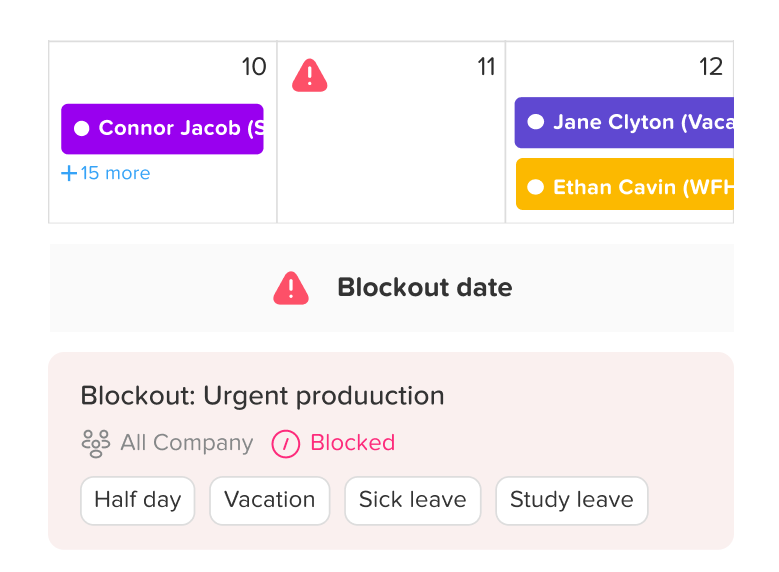
PTO blackout dates are predetermined dates or periods during which an employer restricts the use of vacation time or other discretionary leave.
They are also sometimes called:
- Blockout dates
- Restricted vacation periods
- Peak season leave restrictions
- No vacation periods
- Limited leave windows
- Critical staffing periods
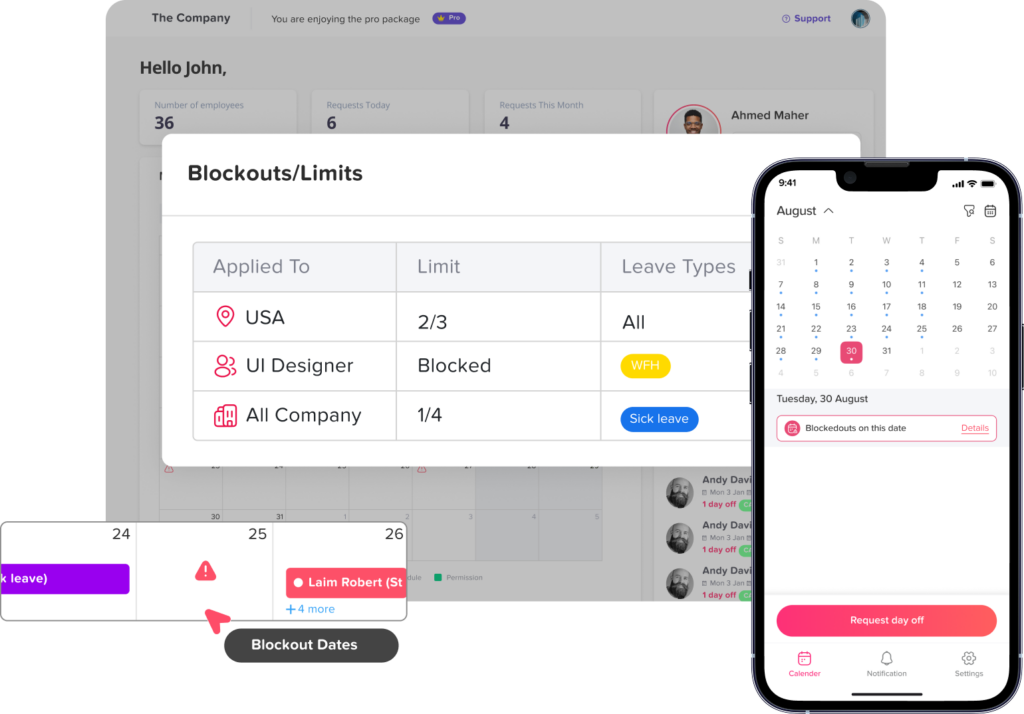
A blackout does not always have to prohibit time off completely. Some companies use a limited capacity rule instead, allowing a certain number or percentage of employees to be away at the same time.
For example, a customer support department may allow no more than two employees to take vacation during a product launch. A retail location may prohibit ordinary vacation during the final two weeks of December but still review emergencies and protected leave separately.
Common Reasons for Blackout Dates
Employers may establish restricted periods around:
- Holiday shopping seasons
- Product launches
- Financial year end closing
- Tax filing deadlines
- Annual audits
- Inventory counts
- Major customer projects
- Company wide events
- Seasonal demand
- School enrollment or examination periods
- Healthcare staffing shortages
- Scheduled maintenance or system migrations
- Industry conferences
- Regulatory reporting deadlines
The reason should be specific and connected to a genuine operational requirement. A broad rule such as “management may block any date at any time” gives employees little predictability and increases the risk of inconsistent decisions.
Complete Blackout vs Limited PTO Requests
| Restriction Type | How It Works | Appropriate Use |
|---|---|---|
| No request blackout | Ordinary vacation requests cannot be submitted or approved during the selected dates | Short periods when nearly all employees are essential |
| Limited request period | A defined number of employees may be approved for leave | Busy periods where some absence can be managed |
| Minimum staffing rule | Requests remain available while staffing stays above a required level | Teams with measurable coverage requirements |
| Role-based restriction | Only employees in essential roles are restricted | Projects that depend on specific skills or responsibilities |
| Location-based restriction | The blackout applies only to selected offices, stores, or worksites | Regional events or location-specific demand |
| Conditional approval | Requests require additional approval or a coverage plan | Important periods where exceptions are possible |
| Partial-day restriction | Full-day absences are restricted, but shorter appointments may be allowed | Busy periods where limited schedule adjustments are manageable |
Are PTO Blackout Dates Legal?
In the United States, federal wage law generally does not require private employers to provide paid vacation. Vacation benefits and approval procedures are usually established through company policy, employment agreements, collective bargaining agreements, and state or local laws. The U.S. Department of Labor notes that the Fair Labor Standards Act does not require employers to provide vacation, holiday, or sick leave, although other laws may create separate leave rights.
This means employers can often restrict ordinary vacation use during legitimate peak periods. However, the blackout rule must not override:
- Federal, state, or local protected leave laws
- Disability accommodation requirements
- Pregnancy accommodation requirements
- Religious accommodation obligations
- Military leave protections
- Collective bargaining agreements
- Employment contracts
- Previously approved leave, unless the policy clearly permits reconsideration
- Company policies that promise specific leave rights
Laws differ considerably between countries, states, and cities. Employers should review local requirements before implementing a blackout policy, especially when the policy affects sick leave, family leave, pregnancy related leave, or accrued vacation balances.
A blackout policy should therefore state that restrictions apply to discretionary vacation requests, subject to legally required exceptions.
Which PTO Requests May Require an Exception?
Employees may request time off during blackout dates for many different reasons. Some requests may remain discretionary, while others require a separate legal or policy review.
Managers should not reject a request solely because the dates appear inside a blackout period. They should first identify the type of leave involved.
Protected Family and Medical Leave
An absence that qualifies under the Family and Medical Leave Act should not be denied merely because it falls during a busy period.
The FMLA prohibits covered employers from interfering with, restraining, or denying an eligible employee’s exercise or attempted exercise of FMLA rights.
An employer may still apply lawful notice, certification, and call-in requirements. However, operational inconvenience by itself does not convert protected leave into an ordinary vacation request.
Managers do not need to make the final legal determination themselves. They should be trained to recognize when a request may need to be referred to HR.
For example, an employee may not use the phrase “FMLA leave.” A statement that the employee needs time away for surgery, ongoing treatment, pregnancy, or care of a seriously ill family member may be enough to trigger further review. The Department of Labor explains that employees do not have to mention the FMLA by name when initially requesting potentially qualifying leave.
Disability Related Leave or Accommodation
Time off may sometimes qualify as a reasonable accommodation under disability discrimination law.
The Equal Employment Opportunity Commission explains that leave can be a reasonable accommodation under the Americans with Disabilities Act, unless providing the accommodation would create an undue hardship. Employees with disabilities must also have access to ordinary leave policies on the same basis as similarly situated employees.
A standard blackout rule should not replace the required accommodation process.
The employer may need to discuss:
- The expected duration of the absence
- Whether the dates are predictable
- Whether a schedule adjustment could meet the need
- Whether remote work is possible
- Whether intermittent leave is appropriate
- Whether another effective accommodation is available
- Whether the request creates an undue hardship under the applicable legal standard
Medical information should be handled confidentially and only shared with people who need it for the leave or accommodation process.
Pregnancy, Childbirth, and Related Conditions
Pregnancy related requests may require review under the Pregnant Workers Fairness Act or applicable state laws.
The EEOC identifies schedule changes, time off for healthcare appointments, and leave related to pregnancy, childbirth, miscarriage, or recovery as potential reasonable accommodations. Covered employers generally must provide a reasonable accommodation unless it would create an undue hardship.
Managers should not classify a pregnancy related medical appointment as an ordinary vacation request without referring it to the appropriate HR or accommodation process.
Religious Observances
A requested day off may relate to a sincerely held religious belief or practice.
The EEOC identifies schedule changes and scheduling around religious observances as possible religious accommodations. Employers may need to consider adjustments such as voluntary shift swaps, flexible schedules, or excused time away, subject to the applicable undue hardship standard.
A company should not assume that a blackout automatically defeats every religious accommodation request. The request should be considered individually.
Possible alternatives include:
- Voluntary shift exchanges
- Adjusted start and end times
- Working a different day
- Using available paid or unpaid leave
- Temporarily reassigning nonessential duties
- Dividing the absence between multiple employees
Military Service
Military leave must be reviewed separately from ordinary vacation.
USERRA protects employment and reemployment rights for qualifying absences related to uniformed service. It also prohibits discrimination based on past, present, or future military obligations.
An employer generally cannot require an employee to use vacation during military service, although an employee may request to use available vacation credits.
Statutory Sick Leave
State and local sick leave laws may give employees the right to use accrued sick time for specific reasons.
A company may be able to restrict ordinary vacation during a peak period while still being required to allow qualifying sick leave. The exact rules depend on the employee’s work location.
Employers with workers in multiple states or countries should avoid using one universal blackout rule without checking local requirements.
Emergencies and Unexpected Events
Not every emergency is legally protected, but employers may still choose to create a policy exception.
Examples include:
- A death in the employee’s immediate family
- A sudden childcare breakdown
- A household emergency
- Evacuation caused by severe weather
- An urgent court appearance
- An accident involving the employee or a family member
- A serious transportation disruption
- Domestic violence, stalking, or safety related leave
The employer should define which cases are handled as vacation, emergency leave, sick leave, bereavement leave, unpaid leave, or another leave category.
Requests Approved Before the Blackout Was Announced
Previously approved leave should normally remain approved.
Canceling an employee’s vacation after travel has been booked can cause financial loss and damage trust. It may also create issues under company policy, employment agreements, union rules, or local law.
Before canceling approved leave, the company should consider:
- When the request was submitted
- When it was approved
- When the blackout was announced
- Whether the employee made nonrefundable arrangements
- Whether alternative staffing is available
- Whether the employee voluntarily agrees to change the dates
- Whether the company will reimburse documented losses
- Whether comparable requests are being treated consistently
Retroactive blackouts should be avoided whenever possible.
Exception Review Guide
| Request Situation | Apply Normal Blackout Automatically? | Recommended Action |
|---|---|---|
| Planned vacation | Usually yes | Apply the published restriction and approval criteria |
| Medical appointment | No | Determine whether sick leave, FMLA, disability, or pregnancy accommodation rules apply |
| Employee illness | No | Review applicable sick leave and protected-leave requirements |
| Family medical need | No | Refer for FMLA or local family-leave review where applicable |
| Religious observance | No | Begin an individual accommodation review |
| Military duty | No | Refer to HR for USERRA review |
| Bereavement | Depends on policy | Apply the company’s bereavement and emergency exception rules |
| Previously approved vacation | Usually no | Preserve the approval unless exceptional circumstances justify reconsideration |
| Wedding, trip, or personal event | Usually yes | Apply ordinary blackout and priority rules |
| Unplanned personal emergency | Depends on policy and law | Review the facts, leave category, and available alternatives |
| Employee with no available PTO | Not automatically relevant | Determine whether unpaid or protected leave may apply |
| Request exceeding the staffing limit | Yes, unless an exception applies | Place on a waiting list, offer alternative dates, or escalate for exception review |
How to Set Reasonable PTO Request Limits
A request limit should be based on staffing needs rather than an arbitrary number.
For example, allowing two employees to be away may work for a team of twenty but could create serious problems for a team of four.
Use Minimum Staffing Requirements
Start by identifying the minimum number of employees needed to maintain essential operations.
Consider:
- Required opening hours
- Customer service response times
- Safety requirements
- Legally required staffing ratios
- Essential skills and certifications
- Shift coverage
- On call responsibilities
- Manager or supervisor coverage
- Payroll and financial deadlines
- Critical project roles
- Expected customer demand
The result may be a percentage, a headcount, or a role-specific requirement.
Examples include:
- At least 80 percent of the support team must be available.
- At least one qualified supervisor must be present on every shift.
- No more than two employees from the payroll team may be away during processing week.
- At least three certified technicians must remain scheduled.
- One employee from each essential function must be available.
Apply Limits to the Correct Group
A company wide blackout may be unnecessarily broad.
The restriction could apply only to:
- One team
- One department
- One shift
- One location
- One country
- One employee group
- Employees assigned to a particular project
- Employees with a specific certification
- Managers or approvers
- Customer-facing roles
A finance department may need restrictions during year-end closing while the design team does not. Applying the same rule to both teams may be difficult to justify operationally.
Limit the Duration
Blackout periods should last only as long as necessary.
Instead of blocking an entire month, consider whether the operational need exists only during:
- The final five business days
- Payroll processing dates
- Launch week
- Specific event days
- Inventory count days
- Several high demand weekends
- A known reporting deadline
Short, targeted restrictions are easier to communicate and create fewer conflicts.
Decide Which Leave Types Are Restricted
A blackout should not necessarily apply to every leave type.
The restriction may apply to:
- Vacation
- Personal days
- Floating holidays
- Compensatory time
- Optional unpaid leave
- Sabbatical leave
It may need to exclude or separately review:
- Sick leave
- FMLA leave
- Disability related leave
- Pregnancy accommodation leave
- Military leave
- Bereavement leave
- Jury duty
- Statutory family leave
- Emergency leave
Combining all absence categories under one automated denial rule can cause serious policy and compliance problems.
Fair Approval Rules for PTO Requests
Once the company decides that some vacation requests may be approved during a blackout, it needs objective rules for choosing between employees.
Managers should not rely entirely on personal preference, seniority, or which employee makes the strongest complaint.
Approval Rule 1: Confirm Whether the Request Is Subject to the Blackout
Before comparing employees, determine:
- Does the blackout apply to this employee’s team or location?
- Does it cover the requested dates?
- Does it apply to the selected leave type?
- Is the employee requesting ordinary vacation or another form of leave?
- Does the request need legal or HR review?
- Was the leave already approved before the restriction began?
Only ordinary requests that are genuinely subject to the restriction should enter the normal priority process.
Approval Rule 2: Check Minimum Coverage
The manager should review actual staffing, not simply count approved requests.
Two employees may have very different effects on coverage. Approving two employees who perform the same essential task may create a greater problem than approving three employees from different functions.
Review:
- Scheduled shifts
- Required skills
- Project deadlines
- Existing approved leave
- Public holidays
- Training days
- Remote and onsite coverage
- Part time schedules
- Employees temporarily assigned elsewhere
- Expected workload
- Available replacements
Approval Rule 3: Use a Published Priority Method
| Priority Method | Advantage | Risk or Limitation |
|---|---|---|
| First submitted, first reviewed | Simple and easy to document | Employees with earlier access may always receive preferred dates |
| Rotating priority | Distributes desirable dates more evenly over time | Requires accurate historical records |
| Seniority | Easy to administer in some workplaces | New employees may repeatedly lose access to popular dates |
| Business coverage | Protects essential operations | Requires consistent definitions of essential coverage |
| Hardship review | Allows exceptional personal circumstances to be considered | Can become subjective without written criteria |
| Lottery | Neutral when requests are equally valid | May feel impersonal and requires a transparent process |
| Manager discretion | Flexible | Creates the highest risk of inconsistency and favoritism |
| Combined model | Balances fairness and operations | Requires more documentation |
A combined model is usually the most practical.
For example:
- Protected and accommodation related requests are reviewed separately.
- Previously approved leave remains valid.
- Minimum staffing must be maintained.
- Requests received before the deadline are considered together.
- Employees who did not receive priority during the previous holiday period receive preference.
- If requests remain equal, the earlier complete request is approved.
- Remaining employees are placed on a waiting list.
Approval Rule 4: Document the Reason
Every approval, denial, and exception should include a clear reason.
A useful record may include:
- Requested dates
- Leave type
- Date submitted
- Applicable blackout rule
- Existing approved absences
- Required staffing level
- Actual available staffing
- Approval criterion applied
- Exception category, when applicable
- Alternative dates offered
- Approver’s name
- Decision date
- Supporting documents, where legally appropriate
- Any HR or legal review
Avoid notes such as:
- “Bad timing”
- “Manager said no”
- “Too busy”
- “Not convenient”
- “We need everyone”
- “Unfair to the team”
Instead, use an objective explanation:
The request was not approved because the customer support team would have fallen below the published minimum of six available employees on December 23. Two earlier requests had already been approved under the rotating holiday priority rule. The employee was offered December 26 through December 29 as an alternative.
Approval Rule 5: Respond Within a Defined Period
Employees need enough time to make travel, childcare, and personal arrangements.
The policy should establish an expected response period, such as:
- Three business days for ordinary requests
- Five business days during high volume planning periods
- Immediate referral for emergencies
- A defined HR review period for accommodation or protected-leave requests
A request should not remain pending until the dates have nearly arrived.
Approval Rule 6: Offer Alternatives
A denial does not need to end the conversation.
Managers may offer:
- Different dates
- A shorter absence
- Partial day leave
- A shift exchange
- Remote work, where appropriate
- A split vacation period
- A waiting list position
- Approval if coverage is found
- Unpaid time off, where policy permits
- Use of another eligible leave category
Employees should not be pressured to reveal private medical details to their manager to receive an alternative. Protected and accommodation-related requests should follow the appropriate confidential process.
Should PTO Requests Be First Come, First Served?
First come, first served is easy to understand, but it should not be the only rule.
It can disadvantage:
- New employees who do not know when requests open
- Employees who cannot plan a year in advance
- Parents waiting for school schedules
- International employees waiting for visa or travel information
- Employees who were working when the request window opened
- Employees who previously gave up popular dates to support coverage
A better system may combine submission order with rotating priority.
For example, the company could open a holiday request window from July 1 through July 15. All complete requests submitted during that window are treated as having been received together. Priority is then based on who did not receive their preferred dates during the previous year.
Requests submitted after July 15 can be handled in submission order, subject to remaining availability.
How to Handle Multiple Requests for the Same Dates
When several employees request the same restricted dates, use the following process:
Step 1: Separate Protected and Discretionary Requests
Do not rank medical, military, religious accommodation, or other potentially protected requests against ordinary vacations without proper review.
Step 2: Preserve Earlier Approvals
Confirm whether any leave was approved before the blackout or before the competing requests were received.
Step 3: Measure Coverage
Calculate who is scheduled to work and whether essential roles remain covered.
Step 4: Apply the Published Priority Rule
Use the same criteria for every employee in the affected group.
Step 5: Review Possible Alternatives
Consider different dates, shorter periods, shift swaps, or partial-day arrangements.
Step 6: Record the Decision
Document the applicable rule and the operational reason.
Step 7: Create a Waiting List
If an approved employee cancels, offer the date to the next eligible employee using the same priority method.
Can Managers Make Exceptions?
Yes, but manager discretion should have limits.
Exceptions may be appropriate when:
- A legal or accommodation requirement applies
- A serious personal emergency occurs
- The employee had already made commitments based on an earlier approval
- Staffing circumstances improve
- A qualified replacement becomes available
- The restriction applies to the employee’s team but not their actual duties
- The employee agrees to complete critical work before leaving
- The employee needs only part of the restricted period
- Denying the request would produce an unusually severe hardship
- The request supports a significant company or community obligation
An exception should not be granted merely because:
- The employee is personally close to the manager
- The employee has a higher job title
- The employee complains more forcefully
- The manager prefers one employee over another
- The employee promises unofficial favors
- Similar requests from others were not considered
For significant exceptions, require a second approver or HR review.
What Happens When the Request Limit Has Been Reached?
When the maximum number of approved requests has been reached, the system or manager should not simply close the request without explanation.
The employee should be told:
- That the limit has been reached
- Which rule applies
- Whether the request was denied or waitlisted
- Whether alternative dates are available
- Whether the employee can arrange a shift swap
- Whether an exception process exists
- Who to contact if the request may involve protected leave
- When the employee can expect a final decision
A waiting list should follow a defined order. It should not be managed through informal conversations or personal messages.
Should Approved PTO Be Canceled During a Staffing Emergency?
Canceling approved vacation should be a last resort.
Before doing so, consider:
- Overtime
- Temporary staff
- Cross-training
- Manager coverage
- Shift exchanges
- Reassigning nonessential work
- Delaying a noncritical deadline
- Allowing partial remote work
- Requesting volunteers to change their dates
- Offering an incentive for voluntary rescheduling
When an employee voluntarily changes approved leave, record the agreement and restore any deducted PTO balance.
The policy should also state whether the employer reimburses reasonable nonrefundable costs caused by a company requested cancellation. Even where reimbursement is not legally required, it may reduce conflict and demonstrate good faith.
How to Communicate Blackout Dates
Blackout periods should be announced as early as reasonably possible.
Communication should include:
- The exact start and end dates
- The operational reason
- The teams, roles, or locations affected
- The leave types covered
- Whether requests are prohibited or limited
- The number of requests allowed
- The approval priority method
- The request submission deadline
- The exception process
- How protected leave is handled
- Whether existing approvals remain valid
- Who employees should contact with questions
Use multiple communication methods:
- Employee handbook
- PTO policy
- Leave management system
- Email announcement
- Team meeting
- Shared calendar
- Manager reminders
- Onboarding materials
- Internal knowledge base
Employees should see the restriction before selecting dates, not after completing the entire request.
Managing Blackout Dates With Leave Tracking Software
Manual blackout management can create inconsistent decisions, especially when requests are submitted through email, spreadsheets, chat messages, and paper forms.
A leave management system can help employers:
- Publish restricted dates in advance
- Apply restrictions to selected teams or locations
- Set a maximum number of requests
- Block submissions when no requests are permitted
- Track existing approvals
- Route requests to the correct manager
- Preserve decision history
- Notify employees of approvals and denials
- Maintain a shared absence calendar
- Record administrator overrides
- Restore balances after cancellations
- Export records for HR review
Day Off allows administrators to create blockout periods using either a No Request setting or a defined limit on how many requests may be allowed. Restrictions can be applied to the entire company, selected locations, or specific teams.
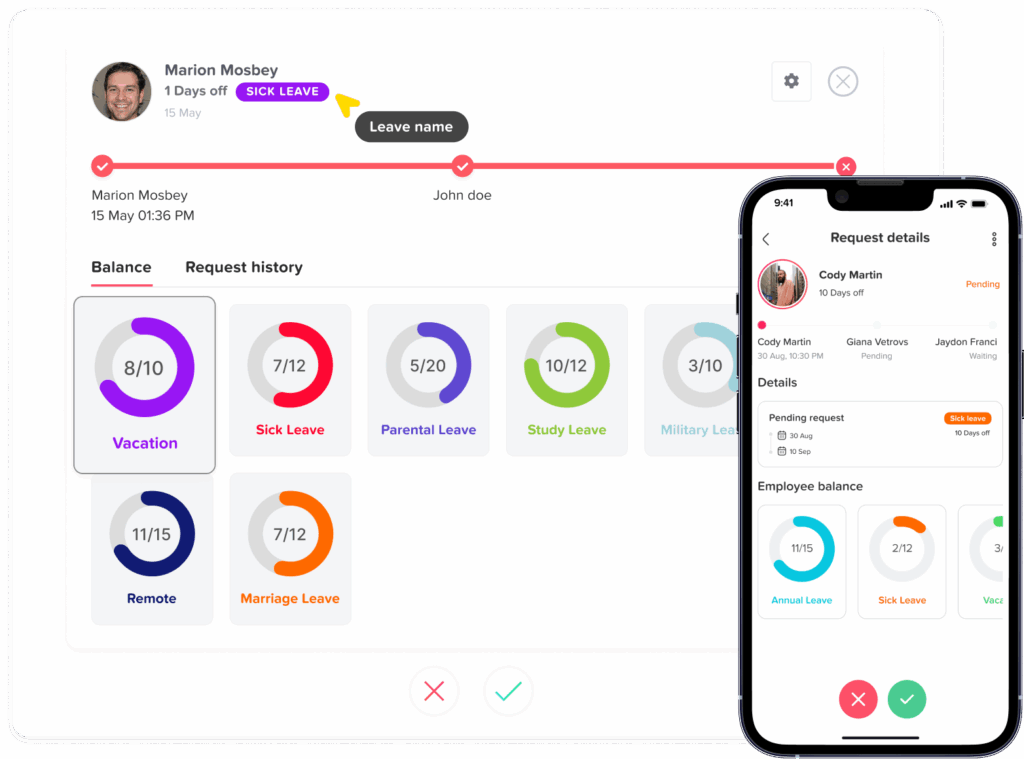
Administrators can also override a request limit when a reviewed exception should be approved. This makes it possible to enforce the normal staffing rule while preserving controlled flexibility for exceptional cases.
Automated restrictions should still include a route for employees to contact HR when their absence may involve protected leave, an accommodation, or an emergency.
Blackout Date Policy Checklist
Before launching a blackout period, HR should confirm that:
- The restriction has a documented business reason.
- The dates are no longer than necessary.
- The correct teams, shifts, and locations are included.
- The policy identifies which leave types are restricted.
- Protected leave is excluded from automatic denial.
- Minimum staffing requirements are defined.
- Request limits are realistic.
- Approval priority rules are written.
- Previously approved leave is addressed.
- Managers know when to refer requests to HR.
- An exception and escalation process exists.
- Employee privacy will be protected.
- Decisions will be recorded.
- Employees will receive timely responses.
- Alternative dates or arrangements will be considered.
- The blackout is visible in the leave management system.
- Local laws, contracts, and collective bargaining agreements have been reviewed.
Frequently Asked Questions
Can an employer deny PTO requests during blackout dates?
An employer can often deny ordinary vacation requests during a properly communicated blackout period, subject to company policy, employment contracts, collective bargaining agreements, and applicable law. Potentially protected leave and accommodation requests require separate review.
Can employees call in sick during a PTO blackout?
A vacation blackout does not eliminate genuine illness or statutory sick leave rights. The employee should follow normal call-in procedures, and the employer may apply lawful documentation requirements. The absence should be recorded under the correct leave category rather than automatically treated as unauthorized vacation.
Can a company create a blackout after PTO has been approved?
A company may announce a new restricted period, but previously approved leave should normally remain valid. Retroactively canceling approval can create employee-relations, policy, contractual, and possible legal issues.
How long should a PTO blackout last?
The period should be limited to the dates genuinely affected by the operational need. A five-day closing period may justify a short restriction, while a three-month blanket prohibition may be unnecessarily broad unless the employer can demonstrate a continuing staffing requirement.
Should blackout dates apply to sick leave?
Ordinary vacation restrictions should not automatically be applied to qualifying sick leave. Sick leave rights differ by location, and some state or local laws regulate how accrued sick time may be used.
Can an employee request unpaid leave during a blackout?
The employee may request it, but unpaid leave is not automatically guaranteed. The employer should determine whether the absence is discretionary, protected by law, covered by an accommodation obligation, or permitted under company policy.
Can managers override blackout dates?
A policy may allow authorized managers or administrators to approve exceptions. Overrides should require a documented reason and, where appropriate, HR or second-level approval.
Is first come, first served fair for holiday PTO?
It is simple, but it may repeatedly favor employees who can submit requests earliest. A rotating priority rule or annual request window may distribute popular dates more fairly.
What happens if two employees submit PTO requests at the same time?
The employer should apply the published tie-breaking rule. This could consider previous holiday approvals, essential role coverage, rotating priority, seniority where permitted, or a transparent random selection.
Should employees be allowed to swap shifts during a blackout?
Shift swaps may be allowed when both employees are qualified, coverage remains adequate, working-time rules are followed, and a manager approves the change. A swap should not be treated as complete until it is formally recorded.
Can a PTO blackout apply to only one department?
Yes. In many cases, a department-specific restriction is more appropriate than a company-wide rule. The scope should match the actual operational need.
Can an employer discipline an employee who takes unapproved vacation during a blackout?
The employer may apply its attendance and leave policies, provided the absence is not legally protected and the rule is enforced consistently. Before discipline, HR should confirm that the absence does not involve illness, family leave, disability, pregnancy, religion, military service, or another protected reason.
Do employees still accrue PTO during a blackout period?
A restriction on using PTO does not automatically stop accrual. Accrual should continue according to the employee’s policy unless that policy or applicable law provides otherwise.
What should happen when an approved employee cancels?
The company should restore any deducted balance and offer the available dates to the next eligible employee on the waiting list according to the published priority rule.
How far in advance should employers announce blackout dates?
Employers should provide as much advance notice as reasonably possible. Annual or predictable peak periods can often be published at the beginning of the year. Unexpected operational restrictions should be communicated immediately and should preserve existing approvals where possible.
Conclusion
PTO blackout dates can help businesses maintain essential coverage during peak seasons, deadlines, launches, and other critical periods. However, the policy should do more than state that no one may take time off.
An effective blackout policy defines the affected dates, employees, leave types, staffing limits, approval rules, exception process, and treatment of existing approvals. It also separates discretionary vacation from protected leave, accommodations, emergencies, and other absences that require individual review.
Consistency is essential. Employees are more likely to accept a denied vacation request when the reason is specific, the same rules apply to everyone, and the company offers alternatives where possible.
Day Off helps teams publish blockout dates, restrict or limit PTO requests, manage approval workflows, track balances, and maintain a clear record of every decision. By combining documented policies with an organized leave tracking system, employers can protect coverage without making the PTO process confusing or unfair.