







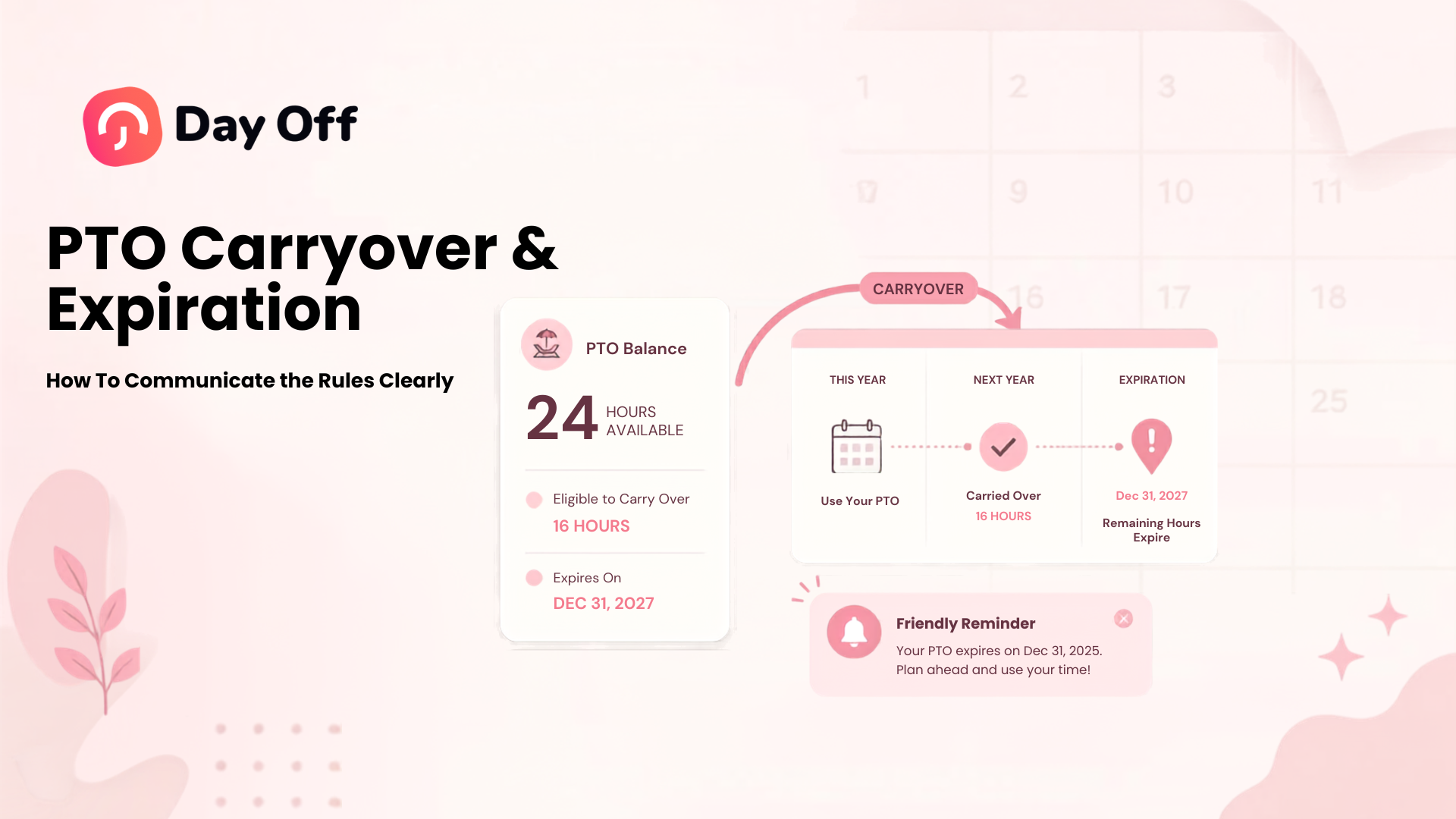
PTO Carryover rules determine what happens to an employee’s unused paid time off when one leave year ends and another begins. While the calculation itself may seem simple, communicating the rule clearly can be much harder. Employees need to understand how much time they can carry forward, whether carried-over leave expires, when it expires, and what happens to any remaining balance that cannot be transferred.

Poor communication can quickly turn a reasonable PTO policy into an HR problem. Employees may assume all unused days will move into the next year, managers may give inconsistent answers, and HR may receive a wave of questions just before the leave year closes.
A well communicated PTO carryover policy gives employees enough information and enough time to make decisions about their leave. It also helps managers plan coverage and allows HR teams to apply the same rules consistently across the organization.
This guide explains how to communicate PTO carryover and expiration rules clearly, when employees should receive reminders, what information every announcement should contain, and how leave management software such as Day Off can make the process easier to understand and manage.
What Is PTO Carryover?
PTO carryover allows employees to transfer some or all of their unused paid time off from one leave period into the next.
For example, suppose an employee receives 20 vacation days per year and has 6 days remaining when the leave year ends. Under a policy allowing up to 5 days of PTO carryover, 5 days would move into the following leave year.
The remaining 1 day would be handled according to the employer’s policy and applicable employment law.
Carryover policies can take several forms. Some organizations allow employees to carry their entire unused balance forward. Others set a maximum number of days or hours. Some allow carried-over PTO to remain available throughout the next leave year, while others require employees to use the transferred balance within a shorter period.
That final point is particularly important because carryover and expiration are not the same thing.
PTO Carryover vs PTO Expiration
PTO carryover determines how much unused leave moves from one leave period into another.
PTO expiration determines whether that carried-over balance must be used within a particular period.
Consider an employee who finishes the year with 8 unused PTO days. Their employer allows a maximum carryover of 5 days, and carried-over PTO expires after 90 days.
The employee starts the next leave year with 5 carried-over days in addition to their new annual entitlement. If those 5 days are not used within the 90-day period, the company’s expiration rule may apply, subject to applicable law.
An employer could also allow 5 days to carry over without any expiration date. In that case, the carryover limit still exists, but the transferred balance does not automatically expire.
Employees need to understand both rules independently.
| Policy Element | Question Employees Need Answered | Example |
|---|---|---|
| Carryover eligibility | Can unused PTO move into next year? | Yes |
| Carryover limit | How much can be transferred? | Up to 5 days |
| Leave year | When does the current balance reset? | January 1 |
| Expiration | Does transferred PTO expire? | Yes |
| Expiration deadline | When must carried PTO be used? | March 31 |
| Excess balance | What happens above the limit? | Depends on policy and applicable law |
| Usage order | Which balance is used first? | Carried PTO first |
Why PTO Carryover Communication Matters
Employees often think about PTO in terms of the number shown in their current balance. HR teams, however, have to consider accrual rules, reset dates, carryover limits, expiration periods, different leave types, employee locations, and policy eligibility.
That difference can cause confusion.
An employee seeing 12 unused days in November might assume all 12 will still be available in January. If the policy allows only 5 days to carry forward, that employee needs enough notice to understand what will happen to the remaining balance.
Waiting until the final week of the leave year creates several problems. Employees may submit last-minute leave requests, managers may struggle to maintain staffing coverage, and HR may spend significant time explaining policies individually.
Clear communication encourages employees to review and plan their leave earlier.
It also helps organizations avoid a situation where employees only discover the rule after a balance changes.
Start With a PTO Policy Employees Can Actually Understand
Communication cannot fix a policy that is vague.
Before sending reminders, HR should review the written PTO policy and make sure the carryover section answers the questions employees are likely to ask.
Instead of writing:
“Unused annual leave may be subject to the company’s carryover policy.”
Use specific language such as:
“Employees may carry over up to 5 unused PTO days into the next leave year. Carried-over days must be used by March 31. After that date, the company’s expiration rules will apply, subject to applicable employment law.”
The second version tells employees exactly what they need to know.
Policy language should also define the leave year. Some organizations use January 1 through December 31, while others use an employee’s anniversary date or another company-defined period.
Simply saying that leave expires at “year end” can therefore be unclear.
Explain the Difference Between New PTO and Carried PTO
One common source of confusion occurs when employees receive a new annual entitlement while still having PTO carried over from the previous year.
For example, an employee could begin January with:
20 days of new annual PTO plus 5 carried over days.
Their displayed balance may therefore be 25 days, but those days may not all follow the same rules.
The 5 carried over days might expire on March 31, while the 20 newly allocated days remain available throughout the normal leave year.
Employees should be able to see that distinction.
This becomes even more important when the organization’s policy uses the carried balance first. If employees know that an upcoming vacation will consume expiring carryover before their new entitlement, they can plan with greater confidence.
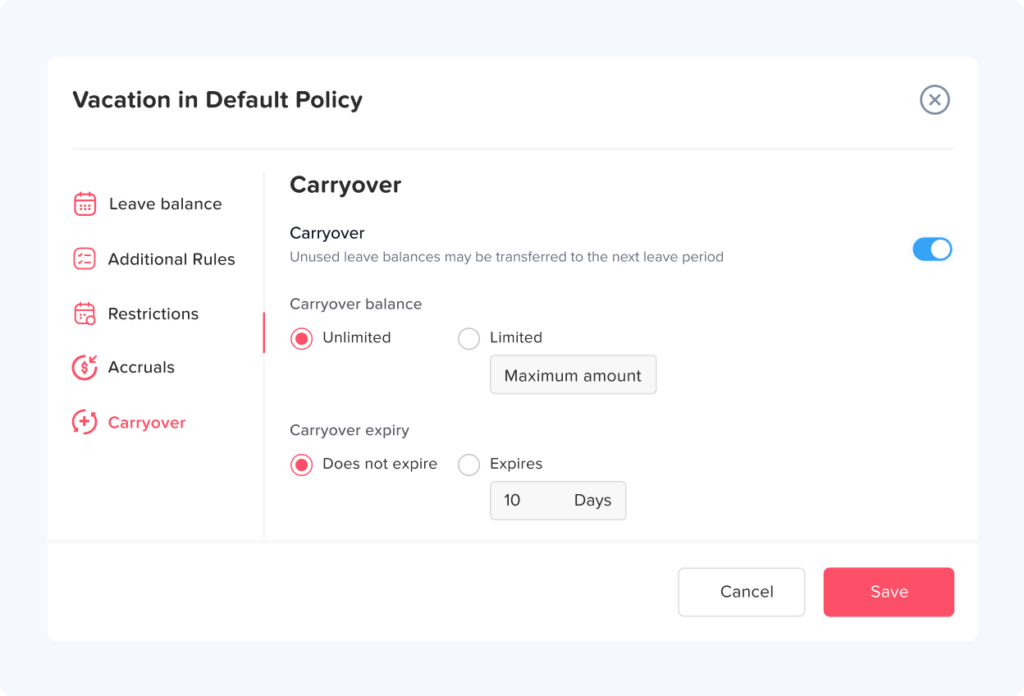
Day Off, for example, can display carried-over balances within an employee’s leave information and show whether the transferred balance has an expiration period. Administrators can configure either unlimited or limited carryover and determine whether the carried balance expires after a specified period.
Tell Employees Exactly What Will Happen to Their Balance
Do not assume employees understand terms such as carryover cap, accrual ceiling, reset date, or expiration window.
Communication should use actual numbers wherever possible.
For example:
An employee has 9 days remaining.
The company allows 5 days to carry over.
The leave year ends December 31.
Those 5 carried days expire March 31.
That is much easier to understand than simply saying, “Our annual carryover limit is five days.”
Whenever possible, employees should also be able to see their own current leave balance rather than having to calculate it manually.
Communicate PTO Carryover Before the Year End Rush
A single December email is usually not enough.
PTO should be treated as an ongoing workforce planning process rather than an administrative task completed at the end of the year.
A communication schedule can gradually increase urgency as the leave-year deadline approaches.
| Timing | Communication Goal | Example Message |
|---|---|---|
| Start of leave year | Explain the policy | Remind employees of annual allowance, carryover limits, and expiration rules |
| Mid-year | Encourage balance review | Ask employees to check unused PTO and plan larger breaks |
| 90 days before reset | Start active planning | Show current balance and explain what can carry forward |
| 30 to 60 days before reset | Reduce last-minute requests | Remind teams to schedule remaining PTO and coordinate coverage |
| Shortly before reset | Confirm consequences | State the carryover limit, reset date, and expiration rule |
| Start of new leave year | Confirm transferred balance | Show employees what carried over and when it expires |
| Before carryover expiry | Prevent accidental loss | Remind employees about remaining carried-over PTO |
Make PTO Balance Visibility Part of the Communication
An employee cannot make a useful decision about unused PTO if they do not know how much leave they have.
Instead of requiring employees to ask HR for a balance, organizations should provide self-service visibility wherever possible.
Employees should be able to identify their current entitlement, leave already used, scheduled future leave, remaining balance, carried-over balance, and applicable expiration date.
This is one of the advantages of using PTO tracking software instead of relying on spreadsheets or email records.
With Day Off, employees can view information about their leave policies, including carried-over balances, remaining leave, used leave, and whether carryover has an expiration period.
When this information is accessible throughout the year, a reminder such as “check your remaining PTO before November 30” becomes actionable.
Give Managers the Same Information
PTO carryover communication should not come only from HR.
Managers are often the first people employees ask about taking leave. If managers misunderstand the policy, employees may receive conflicting information.
For example, one manager might tell employees they will lose all unused PTO at year-end while another tells their team they can carry everything forward.
Even if HR later corrects the information, the inconsistency can damage trust.
Before major year-end communications are sent, managers should receive a short explanation of the policy and guidance on how to answer common questions.
Managers should know the carryover maximum, relevant expiration deadline, leave request process, team coverage expectations, whether exceptions can be approved, and where employees can see their official balance.
There should also be a clear escalation point for questions managers cannot answer.
Avoid Creating a Use It or Lose It Panic
Poorly timed PTO communication can unintentionally encourage dozens of employees to request the same period off.
Imagine sending this message on December 10:
“You have unused PTO that may expire December 31. Please use it before the end of the year.”
Employees may immediately try to book the final two weeks of December.
Managers then have to decide between rejecting requests and operating with insufficient staff.
A better approach is to communicate earlier and encourage leave planning throughout the year.
Employers can also use a shared team calendar to identify periods when several employees are already away. Managers can then discuss alternatives with employees before requests pile up around the same dates.
The objective should not simply be to reduce unused PTO. It should be to make time off predictable enough for both employees and the organization.
Explain What Happens When an Employee Cannot Use PTO
There will be situations where employees want to use leave before an expiration deadline but cannot reasonably do so.
Perhaps several requests have already been approved, an employee is supporting a critical deadline, or management has asked them to postpone leave.
The policy should explain how those situations are handled.
If exceptions are possible, employees should know who can approve them and whether unused PTO may receive an extended expiration date, additional carryover treatment, or another outcome permitted by the policy and applicable law.
This is especially important when the employer itself prevents the employee from using available time.
A company should avoid promising exceptions informally and then applying them differently between teams.
Review Local Law Before Communicating Expiration Rules
PTO carryover and expiration rules should never be created solely around administrative convenience.
In the United States, the Fair Labor Standards Act does not generally require employers to provide paid vacation time. Vacation and similar benefits are typically determined by employer policy, employment agreements, and applicable state or local requirements.
However, state and local rules can significantly affect how unused leave must be treated.
California provides a useful example. The California Division of Labor Standards Enforcement states that earned vacation is treated as wages and cannot be forfeited through a traditional “use it or lose it” vacation policy. Employers may instead establish a reasonable cap that stops additional vacation from accruing once the employee reaches the limit.
Different rules may apply to statutory sick leave. California’s paid sick leave guidance, for example, distinguishes between accrual, carryover, and annual use limits and provides specific carryover rules for qualifying accrual methods.
This illustrates why companies operating across multiple jurisdictions should not assume that one expiration rule works for every employee.
HR teams should review applicable national, state, provincial, local, contractual, and collective bargaining requirements before implementing or changing a PTO expiration policy.
Do Not Treat Every Leave Type the Same
Vacation, sick leave, general PTO, personal leave, compensatory leave, and statutory leave may be governed by different company rules or legal requirements.
For example, an organization may allow vacation days to carry forward while personal days expire at the end of the leave year. Statutory sick leave may follow separate legal rules.
Communication should therefore identify the specific leave type instead of using vague phrases such as “your leave will expire.”
A clearer message would say:
“You currently have 6.5 vacation days remaining. Under the vacation policy, up to 5 days can carry forward into the new leave year.”
This reduces the chance that an employee incorrectly assumes the same rule applies to every balance shown in their account.
Use Examples Instead of Policy Language Alone
Examples are one of the simplest ways to make PTO carryover rules understandable.
Suppose the policy allows up to 5 days of carryover.
Employee A has 3 days remaining. All 3 days carry forward.
Employee B has 5 days remaining. All 5 days carry forward.
Employee C has 8 days remaining. The carryover rule allows 5 days to move into the next leave year. The treatment of the remaining 3 days follows the company’s policy and applicable law.
If the transferred balance expires after 90 days, explain that separately.
Employees can then compare the example with their own balance.
What Should a PTO Carryover Announcement Include?
An effective announcement does not need to be long, but it should be complete.
At minimum, the communication should cover:
- The date the current leave year ends
- Which PTO or leave type the rule applies to
- The maximum amount employees can carry over
- Whether carried over leave expires
- The exact expiration date or expiration period
- What happens to balances above the carryover limit
- Where employees can view their current balance
- How employees submit PTO requests
- Who to contact if a balance appears incorrect
- How exceptions are handled
- A reminder that location specific legal rules may apply
Avoid burying the deadline at the bottom of a long policy email.
Employees should be able to understand the action they need to take within a few seconds.
Example of Clear PTO Carryover Communication
Consider a company with a calendar year PTO policy.
Instead of saying:
“Please remember that PTO balances are subject to our annual carryover and expiration requirements.”
A more useful message would be:
“Your current PTO leave year ends December 31. You may carry up to 5 unused PTO days into the new leave year. Carried-over days must be used by March 31 under our current policy. Please review your remaining balance and submit planned time off requests early so your manager can coordinate team coverage. You can view your current PTO balance in the leave management system.”
The second version tells employees what the rule is, when it applies, and what they should do next.
Communicating a Change to the PTO Carryover Policy
Changing an existing rule requires more care than simply reminding employees about an established policy.
Suppose employees were previously allowed to carry over 10 days but the organization plans to reduce the limit to 5.
Employees need to know when the change becomes effective and how previously earned balances will be handled.
HR should explain why the policy is changing, which employees are affected, when the new rule takes effect, how existing balances will be treated, and where employees can find the updated written policy.
The company should also confirm that the change is permitted under applicable employment laws and contractual obligations before implementation.
Retroactive surprises should be avoided.
An employee should not find out in January that a rule changed in December and affected leave they had already earned.
PTO Carryover Communication for Global Teams
Global employers face an additional challenge because leave laws and common practices vary significantly between jurisdictions.
A single company wide announcement may therefore need location-specific versions.
| Communication Area | Single-Location Team | Multi-Location Team |
|---|---|---|
| Carryover rule | One company rule may apply | Rules may differ by jurisdiction |
| Expiration | One deadline may apply | Expiration may be restricted in some locations |
| Leave year | Usually consistent | Could vary by policy or location |
| Statutory leave | One legal framework | Multiple legal requirements |
| Employee message | Standard communication | Location-specific communication may be needed |
| HR review | Internal policy review | Legal and regional policy review may be necessary |
A leave management system that supports different policies for different employee groups can reduce the need for manual calculations.
It also allows HR to communicate the rule relevant to a particular employee rather than trying to explain every regional variation in one announcement.
How Day Off Helps Manage PTO Carryover
Managing PTO carryover manually becomes increasingly difficult as employee count, locations, policies, and leave types increase.
Day Off provides carryover settings that allow administrators to determine how unused leave moves into the next leave period.
Organizations can configure a limited amount of days or hours to carry forward or allow the full remaining balance to transfer. Carryover can also be configured to remain available or expire after a defined period.
Employees can see carried over leave in their balance information, while administrators can access leave data and reports instead of maintaining separate year end calculations in spreadsheets. Day Off also provides carryover reporting to track transferred, used, and expired balances.
This creates a clearer process for both HR and employees.
Instead of an employee asking, “How much PTO did I carry over?” HR can direct them to a current balance that reflects the policy configuration.
For organizations managing several leave policies, automated rules also reduce the risk of manually transferring the wrong balance or forgetting an expiration period.
Common PTO Carryover Communication Mistakes
One of the biggest mistakes is communicating too late. Employees should not discover an important deadline only days before it arrives.
Another is using policy terminology without examples. Terms such as “maximum accrual,” “carryover allowance,” and “expiration period” may be obvious to HR professionals but unclear to employees.
A third problem is failing to distinguish leave types. Saying “your PTO expires” may be inaccurate when different balances follow different rules.
Organizations should also avoid displaying a total leave balance without making expiring time identifiable. If an employee has 25 days available but only 5 are carried-over days that expire in March, that distinction matters.
Finally, managers should not be expected to interpret the policy independently. HR should provide a consistent source of truth.
How to Know Whether Your Communication Is Working
HR teams can evaluate the process after each leave year transition.
Look at the types of questions employees asked, how many employees waited until the final weeks to request leave, how many carryover corrections HR had to make, whether managers gave conflicting answers, and how many employees were surprised by an expiration or balance adjustment.
Recurring questions usually reveal gaps in the communication.
For example, if several employees ask why their January balance is different from their December balance, the year end message may not have explained the carryover calculation clearly enough.
If employees repeatedly ask which days expire first, the policy may need to explain how carried over and newly earned PTO are used.
Carryover communication should improve each year based on real employee questions.
FAQ
What does PTO carryover mean?
PTO carryover means that eligible unused paid time off from one leave period is transferred into the following leave period. Employers may allow full carryover or limit the number of days or hours that can move forward, depending on company policy and applicable law.
Does carried-over PTO expire?
It depends on the employer’s policy and the laws that apply to the employee. Some employers allow carried PTO to remain available indefinitely, while others establish an expiration period. Certain jurisdictions may restrict the forfeiture of earned vacation or impose specific rules for statutory leave.
When should employees be told about PTO expiration?
Employees should learn the rule when the policy is introduced and receive reminders well before the expiration deadline. A good process includes reminders throughout the year, before the leave-year reset, after balances are carried over, and before any carried balance expires.
What is the difference between a PTO carryover limit and an accrual cap?
A carryover limit determines how much unused PTO can move into the next leave period. An accrual cap determines the maximum balance an employee can accumulate before additional PTO stops accruing. They are different policy mechanisms and should be explained separately.
How can HR prevent year end PTO confusion?
HR can reduce confusion by maintaining clear written rules, showing employees their current balances, sending reminders early, providing practical examples, training managers on the policy, and using a leave tracking system that automatically applies carryover and expiration settings.
Conclusion
Communicating PTO carryover and expiration rules effectively is not just about sending a reminder at the end of the year. Employees need to understand how their leave works from the beginning of the policy period and have enough visibility to make informed decisions throughout the year.
A clear process explains the PTO Carryover limit, leave year reset date, expiration period, treatment of excess balances, applicable exceptions, and where employees can check their current leave information. It should also give managers the same information so employees receive consistent answers across the company.
Most importantly, employees should never be surprised by what happens to their unused time.
Using a leave management platform such as Day Off can make that process easier by automatically applying carryover settings, displaying current and carried balances, managing expiration rules, and giving HR a more reliable view of employee leave.
Clear policy, early communication, accurate balances, and consistent tracking create a much better experience than trying to resolve unused PTO at the last minute.