







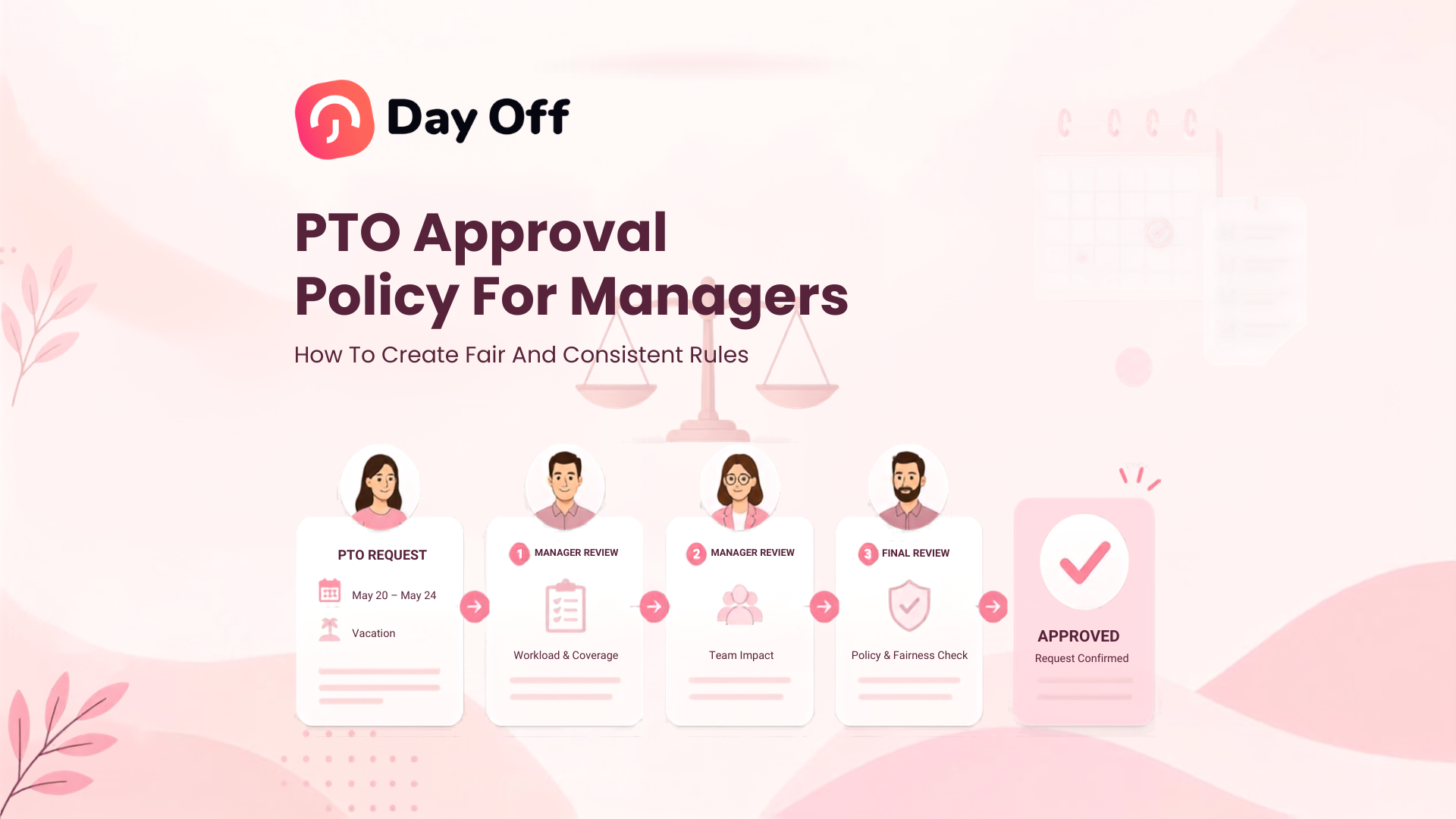
A clear PTO Approval Policy gives managers a consistent way to review employee time off requests without relying on personal judgment, informal conversations, or last minute decisions. It explains what managers should check, how quickly they should respond, when a request can reasonably be declined, how competing requests are handled, and when HR should become involved. For employees, it creates greater transparency because they know what to expect before submitting vacation or other paid time-off requests.

Without defined approval rules, two employees making similar requests can receive completely different responses depending on their manager. One manager may approve leave immediately, another may delay the decision for a week, while another may reject it because the department is busy without explaining what qualifies as insufficient coverage.
A well designed policy reduces these inconsistencies while still allowing managers to protect business operations.
This guide explains how to create a PTO approval process that is practical for managers, fair for employees, and easier for HR teams to administer.
What Is a PTO Approval Policy?
A PTO approval policy is a written set of rules explaining how employee paid time-off requests are reviewed, approved, declined, escalated, and documented.
It normally answers questions such as:
- Who is responsible for approving PTO?
- How far in advance should employees request time off?
- What information should managers review before making a decision?
- How quickly must managers respond?
- How should overlapping PTO requests be handled?
- Can managers decline PTO because of staffing needs?
- What happens if the manager is unavailable?
- How should urgent or last-minute requests be handled?
- When should HR review a request?
- What happens after a request is approved?
The goal is not to remove all manager discretion. Different teams have different staffing requirements. Instead, the policy defines the boundaries within which that discretion should be used.
For example, a customer support manager may need minimum coverage throughout the week, while a software development team may have more flexibility about how many people are away at the same time.
Both teams can operate under the same company PTO framework while applying appropriate department level coverage requirements.
Why Managers Need Clear PTO Approval Rules
Time off approval may appear simple when a company has only a few employees. As the organization grows, the process becomes more complicated.
A manager might simultaneously receive:
- A two week vacation request
- Several requests around a public holiday
- An employee asking for tomorrow off
- Two team members requesting the same week
- A request during an important project deadline
- An employee with a large unused PTO balance
- A manager’s own upcoming vacation
Without clear rules, decisions can quickly become inconsistent.
A PTO approval policy improves consistency
Employees should not have to determine whether their vacation will be approved based on which manager they report to.
Clear approval criteria create a common framework across departments.
Managers still consider operational requirements, but they are evaluating requests against defined standards rather than personal preferences.
It makes workforce planning easier
Approving PTO without checking other absences can leave a department understaffed.
A structured process encourages managers to review:
- Existing approved leave
- Work schedules
- Team capacity
- Critical projects
- Customer coverage
- Deadlines
- Shift requirements
- Seasonal workload
Managers can then approve leave while planning coverage in advance.
It helps employees plan confidently
Employees may need to arrange travel, childcare, appointments, or family commitments.
Waiting several weeks for a PTO decision creates unnecessary uncertainty.
Your policy should therefore define not only how employees submit requests but also how quickly managers are expected to respond.
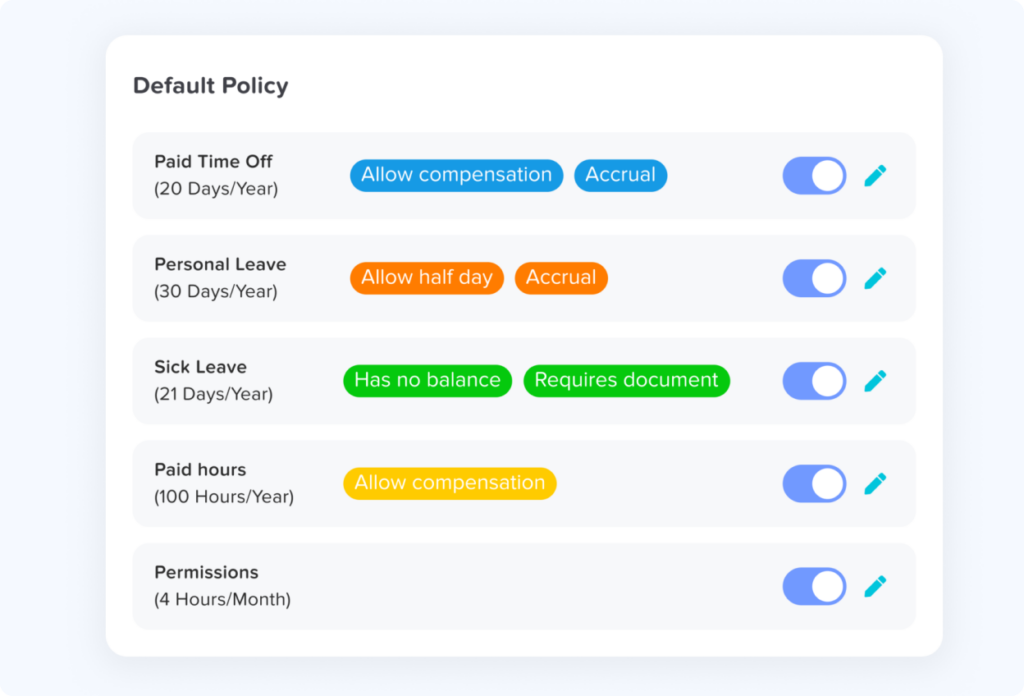
Separate Ordinary PTO Approval From Protected Leave
One of the most important parts of designing a PTO Approval Policy is defining what the approval process actually applies to.
Ordinary vacation requests are not always treated the same way as legally protected leave.
In the United States, for example, the Fair Labor Standards Act does not generally require employers to provide paid vacation. Vacation benefits are generally determined by the agreement or policy between the employer and employee.
However, an absence may also qualify under laws such as the Family and Medical Leave Act. Eligible employees of covered employers may be entitled to job-protected FMLA leave for qualifying circumstances. Paid vacation, sick leave, or other accrued paid leave may sometimes run concurrently with FMLA leave, but using PTO does not remove the employee’s FMLA protection.
State and local laws can create additional requirements.
California provides a useful example. Employers can generally manage when vacation is taken, but earned vacation is treated as wages and cannot simply be forfeited through a traditional “use it or lose it” policy.
Therefore, managers should not be expected to personally determine whether every request involves a protected legal right.
Your policy should establish an escalation route such as:
If a request may involve medical leave, family leave, disability accommodation, statutory sick leave, pregnancy related leave, military leave, or another legally protected absence, managers must refer the case to HR rather than treating it as a normal discretionary vacation request.
Companies operating across multiple states or countries should have their policies reviewed for the jurisdictions where employees work.
How to Create a PTO Approval Policy for Managers
A strong policy should move managers through the same basic decision process every time.
Define Who Can Approve PTO
Start by clearly identifying approval authority.
Depending on your organization, PTO approval may belong to:
- Direct managers
- Department managers
- Team leaders
- HR
- Business owners
- Multiple approval levels
Avoid vague language such as:
“PTO must be approved by management.”
Employees need to know which manager is responsible, and managers need to understand the limits of their authority.
A clearer rule would be:
“PTO requests are reviewed by the employee’s direct manager. Requests exceeding 10 consecutive working days also require department head approval.”
Companies can adjust the threshold based on their own structure.
Create Clear PTO Approval Criteria
Managers should know exactly what factors they are allowed to consider.
A practical framework might look like this:
| Approval Factor | What the Manager Should Check | What to Avoid |
|---|---|---|
| PTO availability | Whether the employee has sufficient available leave under the applicable policy | Guessing balances manually |
| Team coverage | Whether enough employees remain available | Automatically rejecting every overlapping request |
| Existing leave | Previously approved absences | Canceling earlier approvals without a serious operational reason |
| Workload | Major deadlines, launches, projects, or seasonal demand | Using vague claims that the team is “too busy” |
| Request timing | Whether required notice was provided | Applying different notice rules to different employees |
| Business-critical roles | Whether required skills or responsibilities remain covered | Preventing one employee from ever taking meaningful leave |
| Request conflicts | Other requests for the same dates | Favoritism or subjective preference |
Set PTO Notice Requirements
Employees need to know how early they should submit requests.
The required notice may depend on the length of the absence.
For example:
| Requested Time Off | Example Notice Guideline |
|---|---|
| Partial day or 1 day | 3 working days |
| 2 to 3 working days | 1 week |
| 4 to 5 working days | 2 weeks |
| More than 5 working days | 3 to 4 weeks |
These are examples, not universal requirements. A restaurant, hospital, retail company, software business, and professional services firm may need very different rules.
The important thing is to create realistic requirements and communicate them clearly.
Your policy should also explain that notice requirements apply to foreseeable PTO, not unexpected situations such as emergencies or certain protected absences.
Establish a Manager Response Time
Companies often define when employees must submit PTO but forget to define when managers must respond.
This creates requests that sit in “pending” status indefinitely.
A useful policy might require managers to review ordinary PTO requests within:
2 to 3 working days of submission.
Complex requests may require additional review, but employees should still receive an update.
For example:
“Managers should approve or decline PTO requests within three working days. If additional review is required, the employee should be informed that the request remains under review.”
The exact timeframe is less important than having a consistent standard.
Define Minimum Staffing or Coverage Requirements
Managers need an objective way to determine whether approving leave would create a genuine operational problem.
Instead of saying:
“Managers may decline leave if too many employees are off.”
Define what that means.
For example:
- At least two customer support employees must be available per shift.
- At least one employee trained in payroll must be available during payroll processing.
- At least one department supervisor must be working during normal operating hours.
- No more than two members of a five person team may take planned PTO simultaneously.
Not every department needs numerical rules.
Some teams may use role-based coverage instead.
The objective is to connect approval decisions to actual operational needs.
Decide How Overlapping PTO Requests Are Prioritized
One of the hardest situations for managers occurs when several employees request the same dates.
Holiday periods, school breaks, summer months, and long weekends commonly create these conflicts.
Your PTO policy should define the company’s approach.
Possible methods include:
First submitted, first reviewed
Earlier requests receive priority when all other conditions are equal.
This system is easy to understand and administer.
However, it can disadvantage employees who cannot plan vacations many months in advance.
Rotation system
Priority for high demand periods rotates between employees.
For example, if one employee receives the Christmas holiday period this year, another employee may receive priority the following year.
This can work well in teams where holiday conflicts happen frequently.
Business coverage plus request order
Managers first determine which employees or roles must remain available. Remaining requests are then considered based on submission time.
Case by case review
Managers consider the circumstances of each request individually.
This provides flexibility but creates more risk of inconsistent treatment.
Whichever method you choose, document it.
Managers should not invent a new priority system each time requests conflict.
Create Rules for Peak Periods and Blockout Dates
Some organizations have periods when approving large amounts of discretionary vacation is difficult.
Examples include:
- Year end financial closing
- Major product launches
- Annual inventory counts
- Tax deadlines
- Retail holiday seasons
- Major conferences
- School enrollment periods
- Planned system migrations
A company may establish restricted periods or blockout dates for ordinary vacation requests where appropriate and legally permitted.
However, blockout rules should be communicated before employees make plans whenever possible.
They should also be narrow and connected to genuine business needs.
Declaring several months of every year unavailable for PTO can create a policy that technically provides vacation while making it extremely difficult for employees to use.
Protected leave and other statutory rights must also be handled separately from ordinary vacation restrictions.
Define When Managers Can Decline PTO
The policy should clearly explain legitimate reasons for declining an ordinary PTO request.
Potential reasons may include:
- Insufficient available PTO
- Required notice was not provided
- Too many employees already have approved leave
- Essential role coverage would be unavailable
- A documented blockout period applies
- A critical operational requirement cannot reasonably be covered
- The request conflicts with another request that has priority under the company’s rules
Managers should avoid rejecting PTO simply because:
- The employee recently took another vacation if sufficient PTO remains
- The manager personally dislikes the timing
- The manager believes the employee does not “need” the vacation
- The employee’s reason is considered unimportant
- Other employees have voluntarily avoided taking PTO
- The manager has not planned sufficient team coverage
The manager’s role is usually to assess policy eligibility and operational feasibility, not to decide whether an employee’s personal vacation plans are worthwhile.
Do Not Require Unnecessary Personal Information
For ordinary vacation, employees generally should not need to provide a detailed explanation of how they plan to spend their time away.
A request can usually contain:
- Leave type
- Start date
- End date
- Duration
- Optional note or reason if required by company policy
Managers should avoid asking intrusive questions merely to decide whether one employee’s vacation is “more important” than another’s.
Different documentation rules may apply to sick leave, protected leave, or other regulated absences, so HR should define those processes separately.
Explain What Happens When a Request Is Declined
“Rejected” should not be the end of the workflow.
Managers should provide a clear reason when declining an ordinary PTO request.
For example:
“Your request for August 10-14 cannot currently be approved because two members of the support team already have approved leave and minimum coverage would not be maintained.”
That is much better than:
“We are too busy.”
When appropriate, managers can suggest alternatives:
“August 17-21 currently has full team coverage and could be approved.”
This turns PTO management into a scheduling process rather than a simple yes or no decision.
Define What Happens After PTO Is Approved
Approval should trigger a clear next step.
Depending on the organization, the employee may need to:
- Update project responsibilities
- Complete a handover
- Assign an emergency contact
- Update a shared calendar
- Notify relevant customers
- Delegate recurring tasks
- Set an out-of-office message
- Transfer approval responsibilities
- Complete payroll or timesheet requirements
The level of preparation should correspond to the length and nature of the absence.
A one day vacation should not require a five page handover document.
A three week absence for a department manager probably should include more detailed coverage planning.
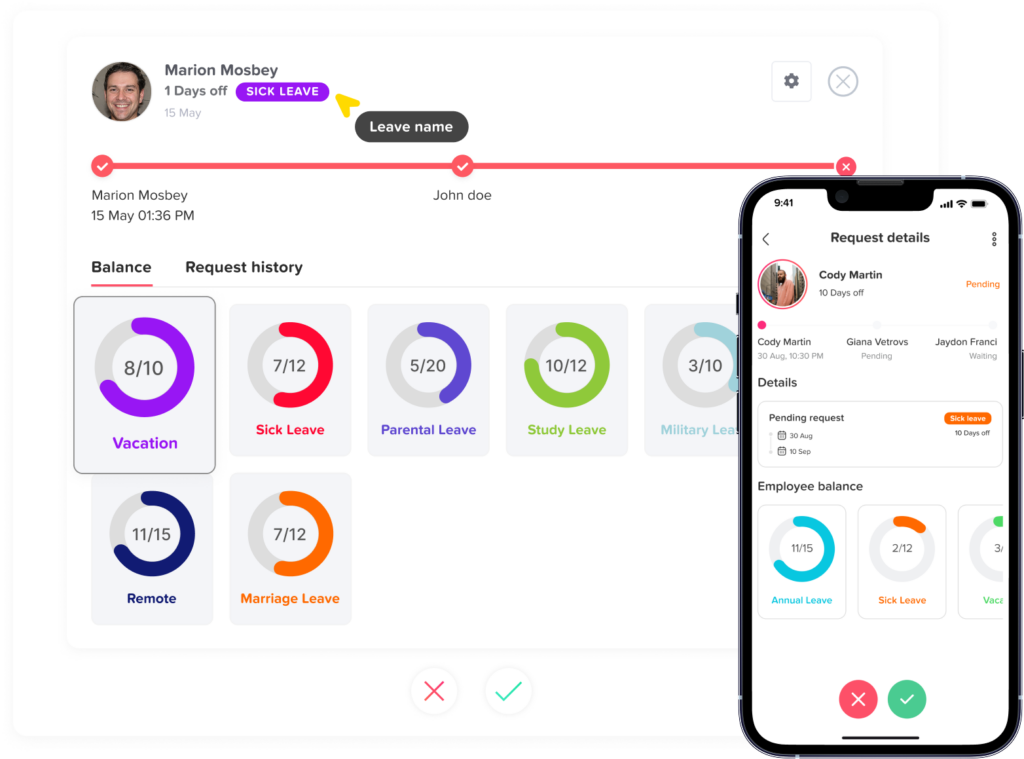
Create an Escalation Process for Difficult PTO Decisions
Managers should not have to resolve every edge case alone.
The policy should identify situations requiring HR or senior management involvement.
Examples include:
- Suspected protected leave
- Repeated conflicts involving the same employees
- Requests exceeding a defined duration
- Exceptions to normal notice requirements
- Disputes about available PTO
- Allegations of unfair treatment
- Requests during extended restricted periods
- A manager wanting to reverse previously approved leave
- Unusual staffing emergencies
- Situations that may create legal or compliance concerns
Escalation creates consistency across departments and prevents individual managers from making high risk decisions without guidance.
Should Managers Be Allowed to Cancel Approved PTO?
Canceling previously approved PTO should be rare.
Once employees receive approval, they may book:
- Flights
- Accommodation
- Events
- Childcare
- Transportation
- Family arrangements
Reversing approval can therefore create significant consequences.
A strong PTO Approval Policy should state that approved PTO should only be reconsidered in exceptional circumstances, according to applicable company policy and law.
Before canceling approved PTO, organizations should consider alternatives such as:
- Temporary staffing
- Redistributing workload
- Moving internal deadlines
- Cross training employees
- Using another department for temporary coverage
- Having managers provide short term coverage
If cancellation is unavoidable, HR should usually be involved.
How to Handle Last Minute PTO Requests
Not every vacation request will arrive weeks in advance.
Employees may ask for short notice PTO because of:
- Personal appointments
- Family commitments
- Unexpected travel
- Changes in personal circumstances
- Emergencies
Your policy can state that managers should make a reasonable effort to accommodate short-notice requests when coverage permits.
The request should not automatically be rejected simply because the normal notice period was missed.
At the same time, employees should understand that planned PTO submitted with insufficient notice may be harder to accommodate.
Emergency, sick, statutory, or protected leave should be routed through the applicable leave rules rather than treated as an ordinary late vacation request.
Avoid Automatic PTO Approval Based Only on Balance
Having enough PTO does not necessarily mean an employee can take any dates they choose.
Consider an employee with 15 available vacation days who requests two weeks off during the company’s busiest operational period.
The employee may have sufficient balance, but staffing requirements may prevent those exact dates from being approved.
The manager should therefore evaluate both:
Eligibility: Does the employee have the required leave balance?
Availability: Can the requested dates reasonably be supported?
Separating these questions makes the decision process clearer.
Avoid the Opposite Problem: Repeatedly Preventing PTO Use
Managers should also avoid treating operational pressure as a permanent reason to deny vacation.
If every request is rejected because the department is always understaffed, the underlying problem may be workforce planning rather than employee PTO.
HR should look for patterns such as:
- One team approving far less PTO than other departments
- Managers repeatedly delaying decisions
- Employees carrying unusually large balances
- Repeated cancellations
- Employees unable to schedule longer vacations
- The same people receiving preferred dates each year
PTO data can reveal management and staffing issues that individual requests may not show.
Use a Shared PTO Calendar Before Approving Requests
Managers should have visibility into existing absences before deciding.
A team leave calendar can show:
- Approved PTO
- Pending requests
- Public holidays
- Team availability
- Department absences
- Work schedules
This is significantly more reliable than checking email threads or maintaining a separate spreadsheet.
Managers can immediately see whether approving another request will create a conflict.
Automate PTO Approval With Day Off
As the number of employees increases, manually applying a PTO Approval Policy becomes harder.
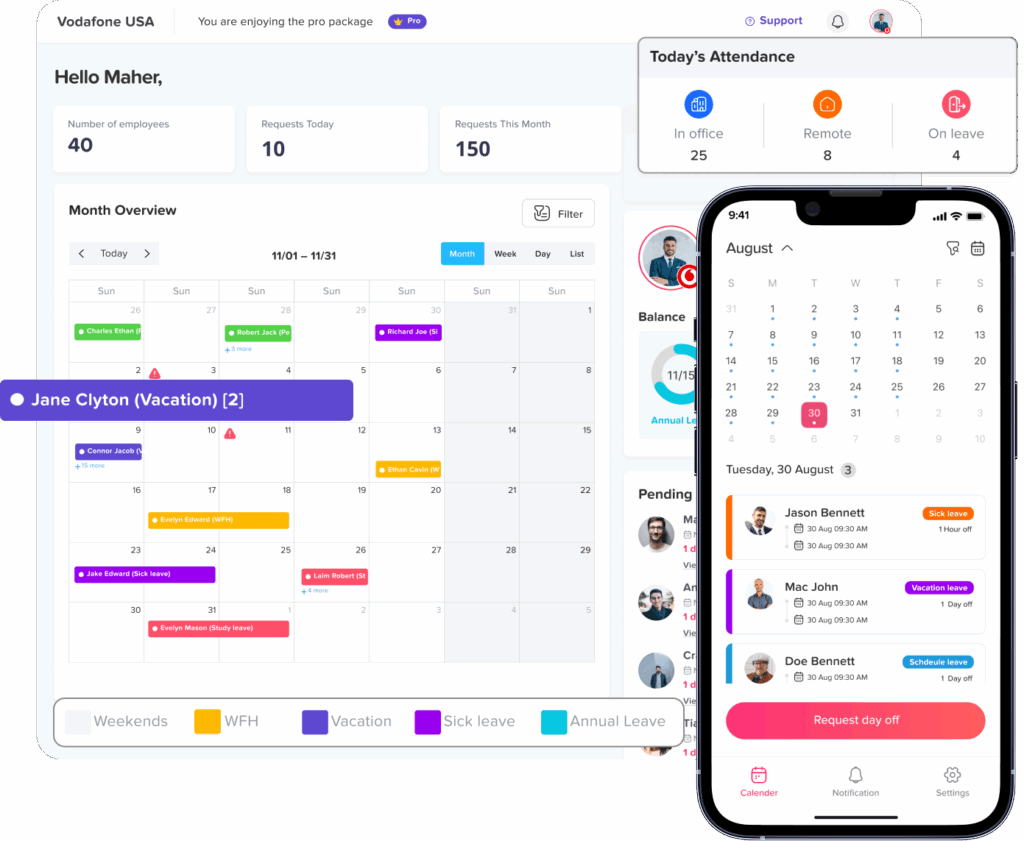
A leave management platform such as Day Off can centralize requests, balances, approvals, policies, schedules, and team availability so managers have the information they need when reviewing time off.
Instead of receiving requests through email, chat messages, and spreadsheets, employees can submit requests through one system.
Day Off’s approval workflow gives approvers access to request details including the employee, leave type, duration, request status, and approval flow. Managers can approve or reject requests directly from the platform, while authorized administrators can also perform override actions where needed.
This makes it easier to apply consistent approval rules because managers can review requests alongside accurate leave information instead of collecting data manually.
Organizations can also use shared leave visibility to identify overlapping absences before making decisions.
For managers, the workflow becomes:
Employee submits request → Manager reviews request and coverage → Manager approves or declines → Employee receives the decision → Calendar and leave records remain updated.
This creates a traceable approval history and reduces the risk of requests being forgotten in inboxes or messaging channels.
PTO Approval Policy Example for Managers
The following example can be adapted to your organization.
Purpose
The purpose of this PTO approval policy is to ensure employee time-off requests are reviewed consistently, fairly, and within a reasonable timeframe while maintaining adequate business coverage.
Request Submission
Employees should submit foreseeable PTO requests through the company’s designated leave management system.
Employees are encouraged to request planned vacations as early as reasonably possible.
Requests requiring extended time away may require additional advance notice.
Manager Review
Managers should review requests based on:
- Available leave balance
- Existing approved absences
- Department staffing
- Required role coverage
- Business critical activities
- Applicable request notice requirements
- Previously submitted competing requests
Managers should not prioritize requests based on their personal opinion of how an employee intends to use PTO.
Response Time
Managers should respond to ordinary PTO requests within three working days whenever possible.
If additional review is necessary, the employee should be informed that the request remains under consideration.
Conflicting Requests
When multiple employees request the same dates and all requests cannot reasonably be accommodated, priority will normally be based on existing approved leave, operational coverage requirements, and the order in which eligible requests were received.
Departments with recurring high demand periods may establish an alternative rotating system with HR approval.
Declined Requests
If a request cannot be approved, managers should provide the employee with a clear operational or policy-based reason.
Where practical, managers should help identify alternative dates.
Approved Requests
Once PTO is approved, it should not normally be withdrawn except in exceptional business circumstances.
Any proposed cancellation of previously approved PTO should be escalated to HR before action is taken.
Protected Leave
Requests that may qualify as legally protected leave, statutory sick leave, family leave, disability accommodation, or another regulated absence must be referred to HR and handled under the applicable policy and law.
Escalation
Managers should contact HR when:
- The correct decision is unclear
- A policy exception is requested
- The employee disputes a PTO decision
- Protected leave may apply
- Previously approved leave may need to be changed
- Multiple requests create a significant staffing conflict
PTO Approval Checklist for Managers
Before approving or declining a request, managers can work through this checklist:
Is this an ordinary PTO request?
Determine whether the request should be handled through the standard PTO process or referred to HR.
Does the employee have sufficient available PTO?
Check the employee’s current balance and applicable leave policy.
Was appropriate notice provided?
Compare the submission date with company notice requirements.
Who is already off?
Review approved and pending leave during the requested period.
Will essential responsibilities remain covered?
Identify whether necessary roles, skills, shifts, or customer responsibilities remain available.
Are there important business events?
Check deadlines, launches, payroll dates, inventory periods, projects, or other operational requirements.
Are there competing requests?
Apply the company’s documented priority rules.
Can the request reasonably be approved?
If yes, approve it promptly.
If not, what is the specific reason?
Avoid vague explanations.
Is an alternative available?
Suggest another date when practical.
Does HR need to review the situation?
Escalate unusual, sensitive, protected, or disputed cases.
FAQ
Can a manager deny a PTO request?
For ordinary discretionary vacation, an employer may often control scheduling subject to its own policies, contracts, and applicable law. Rules vary significantly by jurisdiction and by the type of leave involved.
Managers should decline requests only for legitimate policy or operational reasons and should refer potentially protected leave to HR.
How quickly should managers approve PTO?
There is no single universal response period for ordinary company vacation requests. Many organizations create an internal target such as two or three working days.
The important principle is to establish a reasonable timeframe and apply it consistently.
Should PTO be approved on a first come, first served basis?
It can be, but it does not have to be the only factor.
Organizations may consider business coverage, essential roles, existing approvals, rotating holiday priority, or other objective criteria.
Whatever method is chosen should be documented and consistently applied.
Can two employees take PTO at the same time?
Yes, if staffing and operational requirements can still be met.
Instead of automatically banning overlapping PTO, managers should determine whether the team has sufficient coverage.
Should employees explain why they are taking PTO?
For ordinary vacation or personal PTO, requiring extensive personal explanations is often unnecessary.
Managers usually need the requested dates, duration, applicable leave type, and any information required under company policy.
Different documentation requirements may apply to medical, statutory, or protected leave.
Can managers approve PTO if an employee does not have enough balance?
This depends on company policy.
Some employers allow advance or negative PTO balances while others require employees to have sufficient accrued or available leave before approval.
Managers should follow the company’s documented policy rather than creating individual exceptions.
What should happen if a manager is on vacation?
Organizations should designate an alternate approver or escalation route.
Employees should not have requests delayed simply because their normal manager is unavailable.
Can an employer cancel PTO after it has been approved?
Policies and legal requirements vary, but companies should generally treat cancellation of previously approved vacation as an exceptional action.
HR review is advisable before reversing approval because employees may have already made financial or personal commitments.
Final Thoughts
A successful PTO Approval Policy should do more than tell employees that manager approval is required. It should give managers a repeatable decision framework covering notice periods, staffing, competing requests, response times, rejection reasons, escalation, and post approval responsibilities.
The strongest policies balance two legitimate needs: employees need a realistic opportunity to use their time off, while managers need enough visibility and control to maintain business operations.
Consistency is especially important. Similar requests should be evaluated using similar rules, and unusual or legally sensitive situations should be escalated rather than left entirely to manager discretion.
Using a leave management system such as Day Off can make that process easier by keeping requests, approval workflows, balances, schedules, and team availability in one place. Managers can make faster decisions with better information, while HR gains a clearer record of how PTO is being managed across the organization.
When policy, manager training, and accurate leave data work together, PTO approval becomes less about negotiating individual requests and more about creating a fair, predictable process for everyone.