







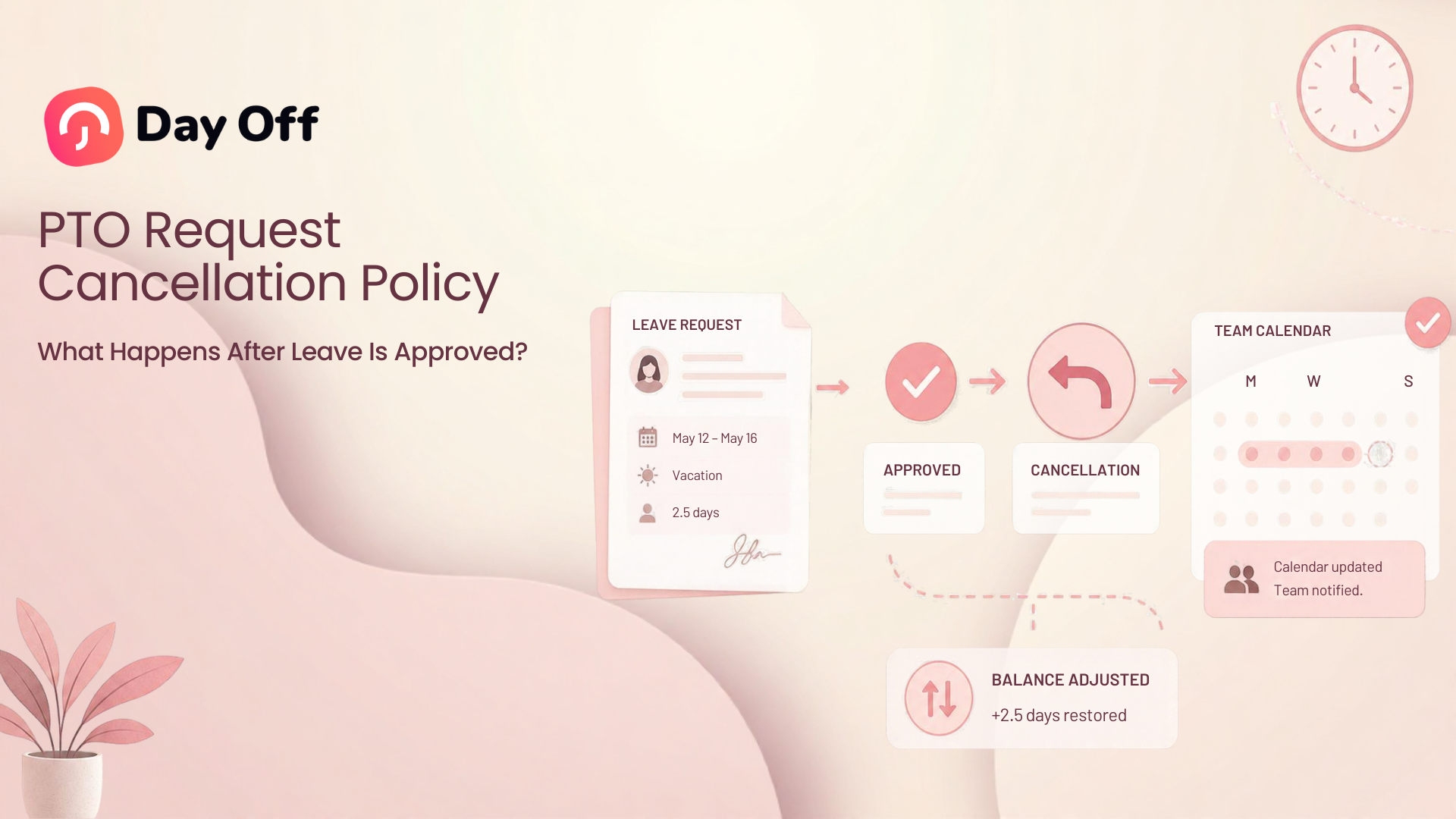
A PTO Request Cancellation can seem simple when an employee changes vacation plans, but cancelling time off after it has already been approved affects more than the employee’s calendar. The company may need to restore PTO balances, update staffing schedules, notify managers, adjust payroll records, remove calendar entries, and determine whether the cancellation itself needs approval.

This becomes even more important when the situation works in the opposite direction. What happens if the employer wants to cancel leave that has already been approved? Can an employee simply return to work early? What if the approved absence is connected to FMLA, disability accommodation, sick leave, or another legally protected reason?
A clear PTO request cancellation policy answers these questions before they create confusion.
This guide explains what should happen when approved leave changes, how employers can build a fair cancellation process, and how HR teams can keep PTO balances, schedules, calendars, and records accurate.
What Is a PTO Request Cancellation?
A PTO request cancellation happens when previously requested time off is withdrawn after the request has already been submitted.
The exact process depends on the status of the request.
If a request is still pending, cancellation is usually straightforward because the time off has not yet been formally approved. Once approval has been granted, however, the absence may already affect:
- The employee’s available PTO balance
- Manager staffing plans
- Shift schedules
- Team calendars
- Project assignments
- Payroll information
- Customer coverage
- Other employees’ PTO requests
For this reason, an approved PTO request should generally be treated as an established scheduling decision rather than an informal calendar entry.
That does not mean an approved request can never change. It means the change should follow a documented process.
Can an Employee Cancel Approved PTO?
In many workplaces, yes.
An employee may need to cancel approved PTO because travel plans changed, an appointment was rescheduled, a family event was cancelled, the employee no longer needs the time away, or another personal circumstance changed.
The company should define whether cancellation requires manager approval.
One common approach is:
- The employee submits a cancellation request.
- The manager or assigned approver receives the request.
- The manager reviews any staffing or scheduling consequences.
- The cancellation is approved or rejected.
- The original leave request is updated or removed.
- The PTO balance is restored when applicable.
- Calendars, schedules, and reports are updated.
The important distinction is that the employee is requesting cancellation, rather than simply deleting an approved absence without informing anyone.
This helps prevent cases where the manager still expects the employee to be absent while the employee unexpectedly arrives for work.
Why Should Approved PTO Cancellation Require a Process?
Before approval, a PTO request primarily represents the employee’s intention to take leave.
After approval, other decisions may have been made around that absence.
A manager may have:
- Changed another employee’s schedule
- Assigned temporary coverage
- Moved a project deadline
- Approved another employee’s leave based on staffing availability
- Arranged overtime
- Scheduled temporary workers
- Rescheduled meetings
- Changed customer coverage
- Updated payroll or attendance records
Allowing approved leave to disappear without notification can therefore create operational problems.
A cancellation workflow creates a clear record showing that the original leave was approved, a cancellation was requested, and the final schedule was confirmed.
What Happens After Approved PTO Is Cancelled?
Several records may need to change after cancellation.
The PTO Balance Should Be Reviewed
If the company’s leave system deducted PTO when the original request was approved, the cancelled amount generally needs to be returned to the employee’s available balance.
For example:
An employee has 15 vacation days available and requests five days off.
After approval:
15 days – 5 days = 10 days remaining
If the full five-day request is later cancelled before the leave is used:
10 days + 5 cancelled days = 15 days available
The calculation becomes more complicated when only part of the leave is cancelled.
Suppose the employee originally requested Monday through Friday but now only needs Monday through Wednesday.
Instead of cancelling the entire request, the company may edit the approved request so that only three days are deducted.
Accurate balance restoration matters because an incorrect balance can affect future requests, carryover calculations, payroll, and leave reporting.
The Team Calendar Should Be Updated
Approved PTO often appears on a shared team calendar.
Once the leave is cancelled, the employee should no longer appear as unavailable for those dates.
Leaving cancelled PTO on the calendar can cause colleagues to:
- Avoid scheduling meetings unnecessarily
- Assign work to someone else
- Assume the employee is unavailable
- Change deadlines
- Contact the wrong person for coverage
The PTO system should therefore be treated as the source of truth for the employee’s final leave status.
Work Schedules May Need to Change
For shift-based businesses, cancelling PTO may affect more than visibility.
A replacement employee may already have been assigned the shift.
Managers need to determine whether:
- The original employee returns to the shift
- The replacement continues working
- The schedule needs to be rebuilt
- Overtime has already been committed
- Another employee’s working hours must change
This is one reason companies may require approval before an employee cancels leave shortly before the scheduled absence.
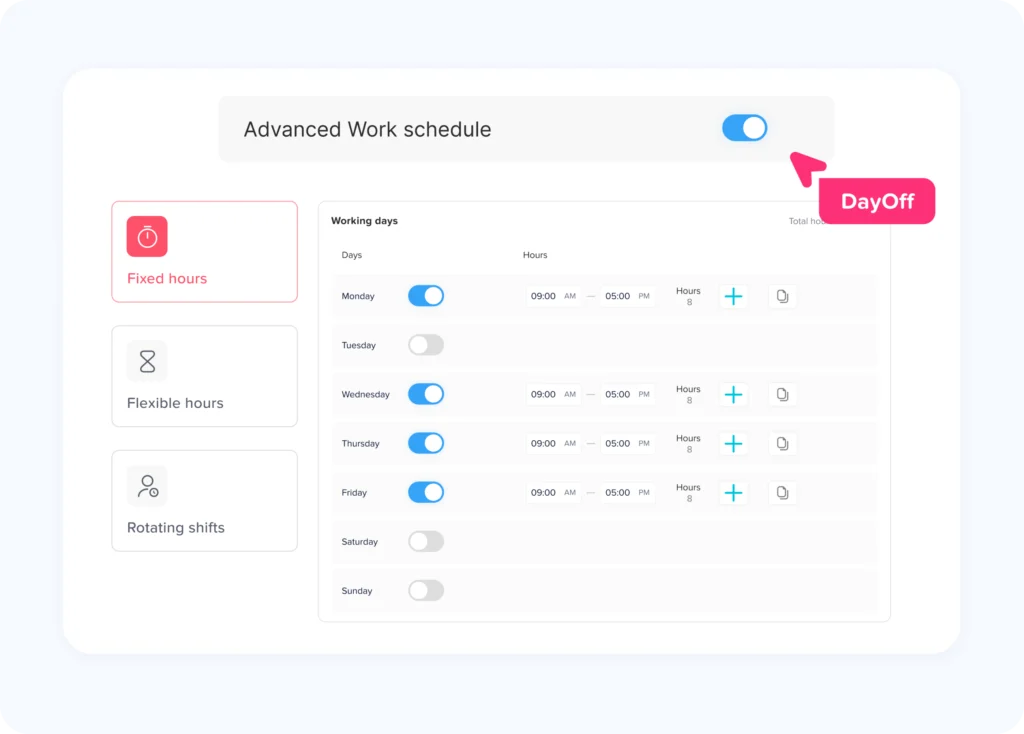
Payroll May Need an Adjustment
If cancellation happens before payroll is processed, the correction may be simple.
However, if payroll has already included paid leave, HR or payroll may need to adjust the record.
For example, an employee scheduled for eight hours of paid vacation might return to work and actually work those eight hours.
The payroll system must avoid treating those hours as both worked hours and PTO.
The exact correction will depend on payroll timing, employee classification, the company’s payroll process, and applicable law.
Connected Calendars and Systems Should Be Updated
PTO data may also appear in:
- Google Calendar
- Outlook Calendar
- Slack
- Microsoft Teams
- Shift scheduling software
- HR systems
- Payroll systems
- Attendance reports
A cancellation process should ensure these records do not continue showing an absence that no longer exists.
PTO Cancellation Before Leave vs. After Leave Starts
| Situation | Typical Action | Main Considerations |
|---|---|---|
| Cancellation weeks before leave | Approve cancellation and restore balance | Usually limited operational impact |
| Cancellation several days before leave | Review staffing before confirming | Schedules or coverage may already have changed |
| Cancellation the day before | Manager review may be needed | Replacement shifts or workload plans may already exist |
| Employee returns early | Modify remaining leave | Attendance, payroll, and balance must be corrected |
| Employee cancels part of the request | Edit approved dates | Restore only unused PTO |
| Cancellation after payroll processing | Correct leave and payroll records | May require payroll adjustment |
What If an Employee Returns From PTO Early?
Consider an employee who has approved PTO from Monday through Friday but decides to return on Thursday.
The company should not necessarily delete the entire leave request.
Instead, the actual absence should normally reflect Monday through Wednesday.
The unused Thursday and Friday PTO can then be restored according to company policy.
This produces a more accurate historical record.
Instead of showing:
5 days PTO
the record should show:
3 days PTO + 2 days returned to balance
Attendance records should also show that the employee worked Thursday and Friday.
This becomes particularly important when the company tracks leave in hours rather than full days.
Can an Employer Cancel PTO After Approval?
This is more sensitive than an employee requesting cancellation.
For ordinary vacation or discretionary PTO in the United States, federal law generally does not require private employers to provide paid vacation. The U.S. Department of Labor explains that the Fair Labor Standards Act does not require payment for time not worked, including vacation, sick leave, or holidays. These benefits are generally governed by agreements and policies, while state and local requirements may also apply.
That does not mean employers should routinely cancel approved PTO.
Once leave has been approved, employees may have made financial and personal commitments based on that approval.
They may have purchased:
- Flights
- Hotels
- Event tickets
- Rental cars
- Tours
- Childcare
- Pet care
Repeatedly reversing approved leave can also reduce employees’ confidence in the approval process.
For that reason, employer-initiated cancellation should generally be reserved for exceptional operational situations and handled consistently under a written policy.
When Might an Employer Consider Cancelling Approved PTO?
Possible situations could include:
- A major operational emergency
- Unexpected critical staffing shortages
- A serious business continuity problem
- An unexpected safety issue
- A critical project or customer incident
- A previously unknown scheduling conflict
Even in these cases, employers should first consider alternatives.
For example:
- Can responsibilities be reassigned?
- Can another qualified employee provide coverage?
- Can the deadline be adjusted?
- Can the employee work before or after the leave instead?
- Can another team temporarily support the workload?
- Can the approved leave remain unchanged?
Cancelling approved time off should not become the default solution to poor workforce planning.
Employee Cancellation and Employer Cancellation Are Not the Same
| Employee-Initiated Cancellation | Employer-Initiated Cancellation |
|---|---|
| Employee’s plans have changed | Business needs have changed |
| Employee requests to withdraw or edit leave | Employer asks employee to change approved leave |
| PTO may be restored | PTO should remain available if leave is cancelled |
| Manager confirms schedule changes | HR or management should review the reason |
| Usually lower employee-relations risk | Can significantly affect trust and employee plans |
| Process should still be documented | Should be exceptional and carefully documented |
What About Non Refundable Travel Costs?
Companies should decide in advance how they will handle expenses created by an employer-initiated cancellation.
For example, suppose an employee receives approval for a vacation and purchases a non-refundable $900 flight.
A week before departure, the company asks the employee to cancel because of a staffing problem.
The company policy should answer questions such as:
- Will the employer reimburse non-refundable expenses?
- What documentation is required?
- Is there a reimbursement limit?
- Who approves reimbursement?
- Does the policy cover flights only, or also hotels and other reservations?
There is no single universal reimbursement rule for every employer and jurisdiction. Organizations should review applicable laws, contracts, collective bargaining agreements, and their own written policies.
Even where reimbursement is not legally required, addressing the issue in advance makes the policy clearer and reduces disputes.
Approved PTO Is Different From Legally Protected Leave
One of the most important parts of a PTO request cancellation policy is recognizing that not every absence should be treated as ordinary vacation.
An absence may involve rights under:
- The Family and Medical Leave Act
- The Americans with Disabilities Act
- The Pregnant Workers Fairness Act
- State paid sick leave laws
- State family or medical leave programs
- Workers’ compensation laws
- Military leave protections
- Local leave requirements
- Collective bargaining agreements
For example, eligible employees covered by the FMLA may receive job-protected leave for qualifying family and medical reasons.
The U.S. Department of Labor notes that if an employee’s need for FMLA leave changes while the employee is on leave, an employer may require reasonable notice. This can include situations where a doctor determines that the employee can return earlier than originally expected.
Disability-related leave may also require separate consideration. The EEOC explains that leave or changes to attendance policies may, in appropriate circumstances, qualify as reasonable accommodations under the ADA unless they create an undue hardship.
As a result, managers should not automatically treat a protected medical or family leave change as an ordinary vacation cancellation.
HR may need to review the situation first.
Can an Employer Force an Employee to Return Early?
For ordinary vacation, the answer depends heavily on company policy, employment agreements, applicable state law, and the circumstances.
For protected leave, different rules may apply.
Managers should therefore avoid making an informal statement such as:
“We are short-staffed, so your leave is cancelled.”
Instead, the manager should determine:
- What type of leave is involved?
- Is the absence legally protected?
- What company policy applies?
- Has the employee already relied on the approval?
- Are there alternative staffing options?
- Should HR review the decision?
- Are any contracts or collective bargaining agreements involved?
This creates a much safer and more consistent decision-making process.
What Should a PTO Request Cancellation Policy Include?
A strong policy should explain the entire lifecycle of a cancellation rather than simply stating that employees can cancel PTO.
How Employees Request Cancellation
Define where employees should submit their cancellation.
Ideally, they should use the same PTO management system used for the original request rather than sending an email or chat message.
This creates one reliable record.
Whether Cancellation Requires Approval
Companies should define whether approved PTO can be cancelled automatically or must be reviewed.
For example:
Pending request: Employee may withdraw without approval.
Approved request: Employee submits a cancellation request that requires manager approval.
This structure provides flexibility without sacrificing schedule control.
Cancellation Notice
A company may ask employees to provide notice as early as reasonably possible.
The policy can distinguish between:
- Advance cancellations
- Last-minute cancellations
- Partial cancellations
- Early returns from leave
Avoid rules that are so rigid that employees cannot reasonably respond to changing circumstances.
PTO Balance Restoration
The policy should explain when unused PTO returns to the employee’s balance.
Normally, cancelled PTO that was not actually used should not remain recorded as consumed leave.
However, organizations must ensure that their practice complies with applicable state and local leave requirements.
Partial Cancellations
Employees should be able to modify only the portion that changed.
For example:
Original request: July 6-10
Updated request: July 6-8
Only July 9 and 10 should be restored.
Early Return Procedures
Explain what an employee should do if they are ready to return before the approved leave ends.
They may need to:
- Notify their manager
- Submit a leave modification
- Confirm their work schedule
- Complete return to work requirements where legally permitted and applicable
- Update attendance records
Employer Initiated Cancellation
The policy should identify who has authority to change approved leave.
This might require approval from:
- Department manager
- HR
- Senior management
Restricting this authority helps prevent inconsistent decisions.
Protected Leave
The policy should state that statutory, medical, disability-related, family, military, or other protected leave may be subject to different rules.
Managers should escalate these cases to HR rather than applying ordinary vacation rules automatically.
Payroll Corrections
Explain what happens if PTO cancellation occurs after payroll has already been calculated.
The procedure might require HR or payroll to correct the leave code during the current or next payroll cycle, subject to applicable law.
Documentation
Every cancellation should create a record showing:
- Original request
- Original approval
- Cancellation request date
- Person requesting the change
- Reason, if collected
- Approver
- Final leave dates
- Balance adjustment
- Final request status
An audit trail is particularly useful when employees, managers, HR, and payroll later need to determine what actually happened.
A Practical PTO Request Cancellation Workflow
A straightforward workflow might look like this:
Step 1: Employee Opens the Approved Request
The employee selects the leave request that needs to change.
Step 2: Employee Chooses Edit or Cancel
If the entire absence is no longer required, they select cancellation.
If only certain dates changed, they edit the request.
Step 3: Manager Receives the Change Request
The manager reviews the updated dates and confirms whether any staffing changes are required.
Step 4: Cancellation Is Approved
The original absence is removed or modified.
Step 5: PTO Balance Is Recalculated
Unused PTO returns to the employee’s available balance where applicable.
Step 6: Calendars and Schedules Are Updated
The employee’s availability is corrected across relevant planning systems.
Step 7: Payroll and Attendance Records Are Updated
Any PTO hours that are no longer being used are corrected.
Step 8: The Change Is Stored in Request History
HR retains a clear record of the original request and subsequent cancellation.
This workflow provides much better control than allowing managers and employees to make informal changes through email or chat.
How Day Off Handles Changes to Approved Leave
A leave management system can make this process easier by keeping the cancellation connected to the original request.
In Day Off, employees can request to edit or delete an approved leave request. The change is not applied immediately. Instead, it is submitted through the approval workflow so the appropriate approver can review it. Once approved, an edited request is updated or a deleted request is removed.
This distinction is useful because pending and approved requests represent different stages of the leave process. Day Off allows pending requests to be edited or deleted, while changes to approved requests go through a new approval process.
Centralizing the process also helps HR keep request history, PTO records, and team availability organized instead of relying on separate messages between employees and managers.
Day Off also provides shared leave calendars and integrations with tools such as Google Calendar and Outlook Calendar for approved time off.
For growing teams, keeping cancellations in the same leave management platform as the original request reduces the risk of one system showing the employee at work while another still shows them on vacation.
Example PTO Request Cancellation Policy
The following can be adapted as an internal policy starting point:
Employees who no longer need previously approved paid time off should submit a cancellation or modification request as soon as reasonably possible through the company’s designated leave management system. Approved leave will remain scheduled until the cancellation or modification has been confirmed.
If only part of the approved leave is no longer required, employees should modify the original dates rather than cancel the entire request. Unused PTO associated with an approved cancellation will be restored to the employee’s available balance in accordance with company policy and applicable law.
Employees who wish to return from leave earlier than expected should notify their manager before returning so that schedules, attendance records, and PTO balances can be updated.
The company may request changes to approved discretionary PTO only in exceptional operational circumstances and subject to applicable law, employment agreements, and company policy. HR review may be required. Leave protected by federal, state, or local law will be handled according to the applicable legal requirements.
This should be customized to match the organization’s actual approval structure, payroll processes, jurisdiction, workforce, and leave policies.
Best Practices for Managing PTO Request Cancellations
A reliable policy should follow several principles.
Keep one source of truth.
Employees, managers, HR, payroll, and scheduling teams should use the same final leave record.
Make approved leave changes visible.
Managers should receive notification when employees request to modify or cancel approved PTO.
Restore balances accurately.
Only leave that is actually cancelled should return to the employee’s balance.
Keep an audit trail.
Do not overwrite important history without recording what changed.
Separate ordinary PTO from protected leave.
Escalate medical, disability-related, family, military, pregnancy-related, or statutory leave questions when required.
Use employer cancellations sparingly.
Approved PTO should provide employees with reasonable confidence that they can make plans around their leave.
Update every connected record.
PTO balances, team calendars, schedules, attendance, payroll, and integrations should reflect the same final outcome.
FAQ
Can employees cancel PTO after it has been approved?
Usually, company policy determines the procedure for ordinary PTO. Many employers allow employees to request cancellation or modification of approved leave, but may require manager approval before the schedule changes.
Does cancelled PTO return to the employee’s balance?
If the PTO was deducted but never used, the unused amount would generally be expected to return to the available balance under the company’s policy. Employers should also consider applicable state and local rules.
Can employees change the dates instead of cancelling the entire request?
Yes. When only part of the absence changes, editing the approved request usually creates more accurate leave records than deleting it and starting over.
Can an employer cancel previously approved PTO?
Ordinary vacation benefits are largely governed by employer policy, agreements, and applicable state or local law in the United States because the FLSA does not generally require paid vacation. However, employers should distinguish discretionary vacation from legally protected leave and should review applicable laws, contracts, and policies before reversing an approval.
What happens if an employee returns early from PTO?
The remaining unused leave should be reviewed, the work schedule should be updated, and attendance, payroll, calendar, and PTO balance records should reflect the employee’s actual return date.
Should PTO cancellations require manager approval?
Requiring approval for changes to already approved leave can help employers maintain staffing accuracy, especially when schedules or coverage arrangements have already changed.
What happens if payroll has already processed the PTO?
HR or payroll may need to correct the PTO and worked-hours records. The appropriate correction depends on payroll timing, company procedures, employee classification, and applicable wage laws.
Should an employee give a reason for cancelling PTO?
For ordinary vacation, employers can decide what information is reasonably necessary under their policy. Companies should avoid collecting unnecessary medical or sensitive information and should handle protected or accommodation-related leave separately.
Final Thoughts
A PTO Request Cancellation Policy should do more than tell employees whether they can cancel a vacation request. It should explain what happens to the employee’s balance, schedule, payroll record, calendar, approval status, and request history after plans change.
The key is consistency.
Employees should know how to request a cancellation. Managers should know when approval is required. HR should be able to see what changed. Payroll should receive accurate information. And legally protected leave should never be handled as if it were simply an ordinary vacation request.
As organizations grow, managing these changes through emails, spreadsheets, and chat messages becomes increasingly difficult. A centralized leave management platform such as Day Off can keep PTO requests, approvals, changes, balances, calendars, and leave history connected in one place.
When PTO cancellation rules are clear before a problem occurs, employees have greater certainty about their time off and managers have a much more reliable picture of who will actually be available for work.