







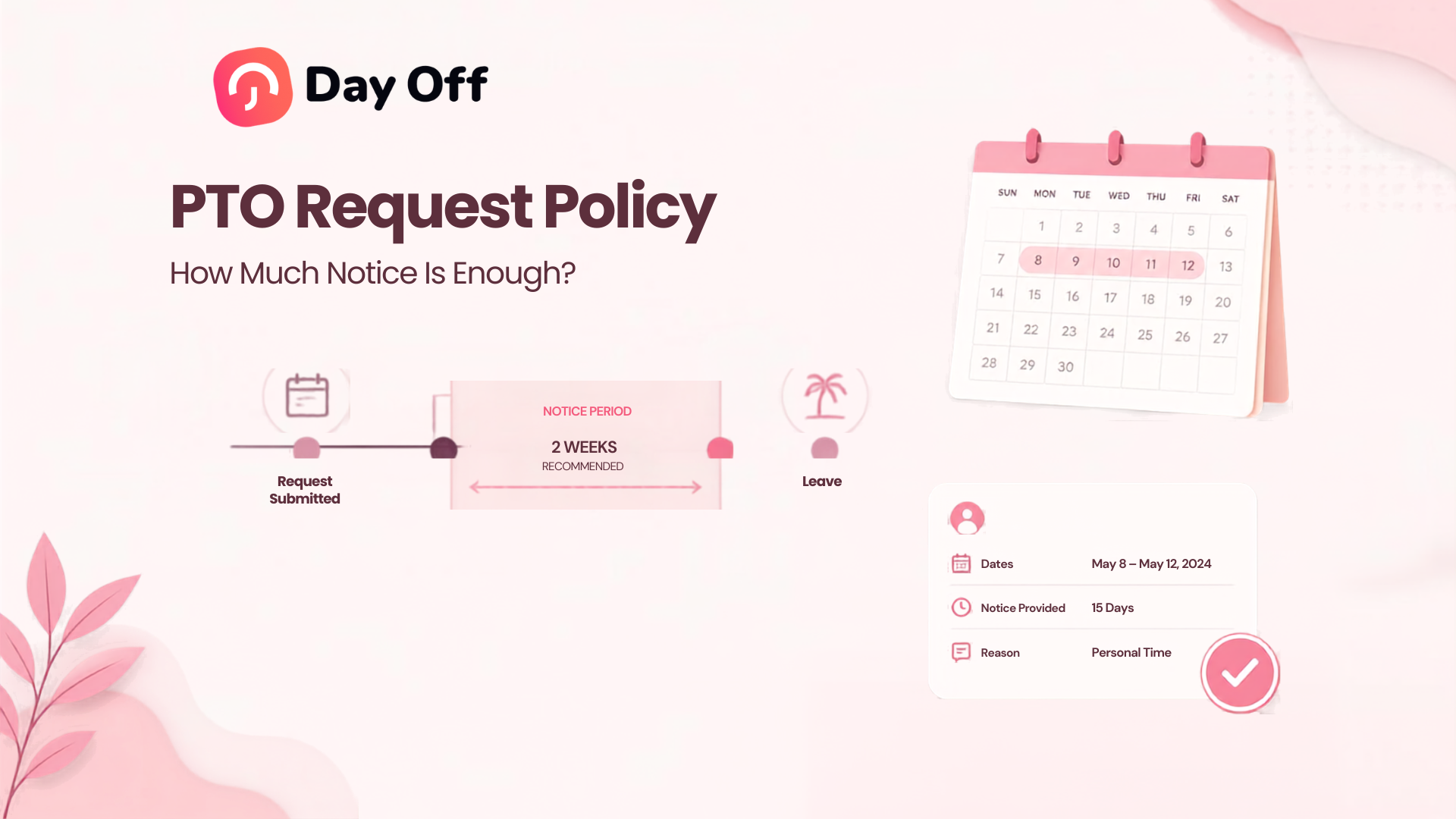
A clear PTO Request Policy tells employees how far in advance they should request time off, how requests are reviewed, what happens when several employees want the same dates, and when exceptions apply. Without clear notice rules, employees may submit vacation requests too late for managers to arrange coverage, while overly strict requirements can make employees feel that their earned time off is difficult to use.

The challenge is deciding what “enough notice” actually means.
Should employees request PTO three days in advance? One week? Two weeks? A month?
There is no single notice period that works for every company or every type of absence. A one-day personal appointment should not necessarily require the same notice as a three week international vacation. Similarly, an unexpected illness cannot realistically follow the same process as a vacation planned six months ahead.
A practical PTO request policy therefore needs to distinguish between planned leave, extended leave, short absences, emergencies, sick leave, and legally protected leave.
This guide explains how employers can establish reasonable PTO notice requirements, how different notice periods affect staffing, what managers should consider before approving requests, and how leave management software such as Day Off can make the entire process easier to manage.
What Is a PTO Request Policy?
A PTO request policy is a set of company rules explaining how employees request paid time off and how those requests are handled.
The policy usually covers more than simply telling employees where to submit a request. It should answer questions such as:
- How far in advance should PTO be requested?
- Does the notice requirement depend on the length of the absence?
- Who approves the request?
- How quickly should the manager respond?
- What happens when multiple employees request the same dates?
- Are there minimum staffing requirements?
- Are certain dates restricted?
- Can employees request PTO during busy periods?
- What happens when an employee becomes sick unexpectedly?
- How should emergencies be reported?
- Is an employee allowed to change or cancel approved PTO?
- What happens when the normal notice requirement cannot be met?
The more clearly these questions are answered, the less room there is for inconsistent decisions.
A good policy should create predictability, not simply give the employer another reason to deny leave.
How Much Notice Should Employees Give for PTO?
For ordinary planned vacation, many employers use notice periods ranging from several business days to several weeks.
The appropriate period depends on factors such as:
- Length of the requested absence
- Number of employees on the team
- Difficulty of finding coverage
- Employee responsibilities
- Work schedule
- Seasonal demand
- Customer or operational requirements
- Whether projects must be handed over
- Whether employees work shifts
- How quickly managers can review requests
Instead of requiring the same notice for every request, companies can create a tiered notice system.
Example PTO Notice Periods
| Requested Time Off | Example Minimum Notice |
|---|---|
| A few hours or half day | 1 to 3 business days when foreseeable |
| 1 day | 3 to 5 business days |
| 2 to 3 consecutive days | About 1 week |
| 4 to 5 consecutive days | About 2 weeks |
| More than 1 week | 3 to 4 weeks |
| Extended planned leave | 30 days or as early as reasonably possible |
| Unexpected illness or emergency | As soon as reasonably practical |
These are policy examples rather than universal legal requirements. Companies should adjust them based on their workforce and applicable employment laws.
A business with easily interchangeable schedules may operate effectively with shorter notice. A company where one employee’s absence requires substantial client handover or shift replacement may need more advance planning.
There Is No Universal “Two Week PTO Rule”
Two weeks is one of the most commonly discussed PTO notice periods, but companies should not automatically make it their rule.
Two weeks may work well for a standard vacation because it gives managers enough time to:
- Review existing absences
- Check staffing
- Rearrange deadlines
- Reassign responsibilities
- Coordinate coverage
- Approve or reject the request
- Allow the employee to prepare a handover
But requiring two weeks for every type of leave can become unreasonable.
For example, requiring 14 days’ notice for a two-hour appointment may create unnecessary administration. Requiring the same notice for illness would make even less sense because employees cannot normally predict when they will become sick.
A better approach is to match the notice requirement to the predictability and operational impact of the absence.
Minimum Notice vs Preferred Notice
One improvement companies can make is to distinguish between minimum notice and preferred notice.
For example:
Employees should submit planned vacation requests as early as possible. The minimum notice for vacation of three or more consecutive working days is 14 calendar days. Earlier requests are encouraged, especially during peak vacation periods.
This gives employees two useful pieces of information.
They know the minimum requirement, but they also understand that submitting earlier may make scheduling easier.
The distinction is particularly useful around:
- Summer vacations
- School holidays
- Christmas and New Year
- Major religious holidays
- Long weekends
- Product launches
- Retail peak periods
- Financial closing periods
- Major company events
Employees may know their vacation dates months in advance. There is little reason to make them wait until exactly two weeks before the trip to submit the request.
Planned PTO and Unexpected Absence Should Follow Different Rules
One of the biggest mistakes in a PTO request policy is treating every absence as foreseeable.
Consider two employees.
The first books a vacation for August six months ahead.
The second wakes up with a high fever on Tuesday morning.
Technically, both employees may use time from the same PTO balance under a combined PTO policy. Operationally, however, the situations are completely different.
Planned PTO
Planned PTO can include:
- Vacations
- Weddings
- Family events
- Planned appointments
- Travel
- Personal days known in advance
- Scheduled procedures
- Graduation ceremonies
An employer can reasonably ask employees to provide advance notice for this type of leave.
Unexpected PTO
Unexpected absences may involve:
- Sudden illness
- Sick child
- Family emergency
- Accident
- Emergency medical appointment
- Bereavement
- Transportation emergency
- Other unforeseen situations
A policy should normally require employees to report these situations as soon as reasonably practical, rather than attempting to enforce an impossible advance-notice requirement.
PTO Notice Rules and U.S. Employment Law
Employers should distinguish an ordinary company PTO rule from leave protected by federal, state, or local law.
There is no general federal law requiring private employers to provide ordinary paid vacation or establishing a universal notice period for ordinary PTO. Paid time off policies are generally matters of employer policy, although state and local requirements may affect particular forms of leave.
Protected leave can follow different rules.
FMLA Notice Requirements
For employees and employers covered by the U.S. Family and Medical Leave Act, foreseeable FMLA leave generally requires at least 30 days’ advance notice when providing that notice is possible and practical.
When the need becomes known fewer than 30 days in advance, employees generally must provide notice as soon as practicable. Unexpected FMLA leave also requires notice as soon as possible and practical under the circumstances.
Employees also generally need to follow the employer’s usual call-in and leave procedures unless unusual circumstances prevent them from doing so.
This is important because an employer should not automatically treat every request submitted outside its normal vacation notice period as an ordinary “late PTO request.”
The absence might involve:
- FMLA
- Statutory sick leave
- Disability-related leave or accommodation
- Pregnancy-related protections
- Military leave
- Other legally protected circumstances
Applicable requirements vary by jurisdiction.
Companies operating across multiple states or countries should review PTO and absence policies with qualified HR or legal professionals rather than relying on one universal notice rule.
Should PTO Notice Depend on the Length of the Leave?
Usually, yes.
A longer absence creates more planning requirements.
An employee taking Friday afternoon off may require almost no operational preparation. An employee taking three consecutive weeks off may require project transfers, temporary coverage, schedule changes, customer communication, and approval from multiple managers.
That is why proportional notice policies are often more practical than a single requirement.
For example:
Short absence:
Three business days when foreseeable.
Two or three days:
One week.
Full workweek:
Two weeks.
Multiple weeks:
Thirty days or as early as practical.
This structure is easy for employees to understand and gives managers more preparation time when the operational impact is greater.
Consider the Business Before Choosing a Notice Period
There is no perfect PTO request policy because organizations operate differently.
A company should examine how an employee’s absence actually affects its operations.
| Workplace Situation | PTO Notice Consideration |
|---|---|
| Remote software team | Project deadlines and handovers may matter more than physical coverage |
| Restaurant | Shift coverage can make advance notice particularly important |
| Retail store | Holiday seasons and minimum staffing levels may affect approval |
| Healthcare | Patient coverage and required staffing can require significant planning |
| Customer support | Coverage should account for expected ticket or call volume |
| Construction | Skills, certifications, and project schedules may affect availability |
| Small business | One absence can represent a significant percentage of the workforce |
| Large office team | Coverage may be easier, allowing more flexibility |
The objective should be to identify the shortest notice period that gives the organization enough time to prepare without unnecessarily restricting employees.
Avoid Making Notice Requirements Too Long
Long notice periods may sound easier for managers, but they create other problems.
Imagine requiring employees to request every vacation at least 60 days in advance.
Some employees will simply not know their plans that early.
Others may avoid using PTO because requesting it becomes inconvenient.
Extremely long requirements can also generate unnecessary exception requests.
A good rule should reflect actual operational needs, rather than assuming that more notice is always better.
Ask:
- How long does a manager genuinely need to assess coverage?
- How long does it take to arrange replacements?
- How far ahead are work schedules published?
- How often are PTO requests actually denied because of insufficient notice?
- Would a shorter notice period create a real business problem?
If managers can normally reorganize coverage within five days, requiring employees to provide a full month of notice for a one day vacation may be difficult to justify operationally.
Do Shift Workers Need Different PTO Notice Rules?
Sometimes.
Shift based businesses often publish work schedules several weeks ahead.
If an employee requests PTO after the schedule has already been published, managers may need to:
- Find another employee
- Change shifts
- Prevent overtime
- Verify skill requirements
- Maintain minimum staffing
- Communicate schedule changes
For these businesses, aligning the PTO deadline with the scheduling process can make sense.
For example:
Planned PTO requests should be submitted before the monthly schedule is finalized, whenever the employee knows about the absence in advance.
That rule is more meaningful than choosing an arbitrary number of days.
It connects PTO planning directly to how the business operates.
Should Employees Need More Notice During Busy Seasons?
Companies may require earlier planning during periods when demand is predictable.
Examples include:
- Retail holiday season
- Restaurant festivals or major events
- Accounting year end
- Tax season
- Product launches
- School terms
- Manufacturing peaks
- Annual conferences
- Major customer projects
A business might normally require two weeks’ notice but encourage or require requests four weeks ahead for certain high demand periods.
However, these rules should be published in advance.
Employees should not learn that December has special PTO restrictions only after submitting a December vacation request.
Blackout Dates Are Different From Notice Periods
A notice requirement answers:
“When must the employee submit the request?”
A blackout period answers:
“Can planned PTO normally be approved during these dates?”
They are not the same rule.
For example, a company might require two weeks’ notice throughout the year but limit planned vacation during an annual inventory week.
Companies using blackout dates should clearly define:
- Which employees are affected
- Which dates are restricted
- Why the restriction exists
- Whether all PTO is prohibited or only limited
- Whether exceptions can be approved
- Who can approve exceptions
- How protected or emergency leave is handled
Blackout rules should target legitimate staffing requirements rather than becoming a broad restriction on employees using PTO.
What Should Happen When Employees Request PTO Late?
A late request does not automatically have to be denied.
Managers should first determine why the request is late.
Possible situations include:
The employee simply forgot
The manager can review coverage and decide whether the request can still be accommodated.
Plans changed unexpectedly
The employee may have learned about the event only recently.
The absence involves illness or an emergency
Normal planned-vacation notice rules may not be appropriate.
The request may involve protected leave
HR may need to review the situation before applying an ordinary PTO policy.
The employee repeatedly ignores the policy
Repeated failure to follow a clearly communicated process can be handled separately through normal attendance or performance procedures, subject to applicable law.
The important principle is that late submission and approval eligibility should not always be treated as exactly the same question.
If a manager can easily accommodate a late vacation request, automatically rejecting it simply because it arrived one day after the internal deadline may produce unnecessary frustration.
PTO Notice Does Not Guarantee Approval
Employees should also understand that meeting the notice requirement does not necessarily mean the PTO request is automatically approved.
Imagine three employees submit requests six months ahead for the same week, but the department can only operate with two of them absent.
All three followed the notice policy.
The employer still needs a fair method for deciding which requests are approved.
Factors may include:
- Minimum staffing
- Existing approvals
- Essential roles
- Request submission date
- Previous holiday allocations
- Rotational priority
- Business deadlines
- Availability of replacement coverage
The PTO policy should explain how overlapping requests are evaluated.
First Come, First Served Is Not the Only Option
Some companies use first come, first served because it is simple.
However, it can create problems during highly desirable periods.
An employee who requests every Christmas holiday twelve months ahead could repeatedly receive priority over colleagues.
Alternatives include:
- Rotation
- Seniority, where appropriate
- Random selection
- Ranked vacation preferences
- Minimum staffing rules
- Historical holiday allocation
- Hybrid systems
Whatever method is selected, consistency and transparency are more important than complexity.
Employees should understand why one overlapping request was approved while another was not.
Managers Also Need an Approval Deadline
A PTO request policy should not put all responsibility on employees.
If employees must provide two weeks’ notice but managers regularly take ten days to review requests, most of the planning benefit disappears.
Companies should establish an internal approval target.
For example:
- Standard requests: within 2 business days
- Requests involving scheduling conflicts: within 3 to 5 business days
- Urgent requests: as soon as practical
- Requests requiring HR review: employee receives an update while review is ongoing
The exact timeframe can vary.
The important point is that employees should not be expected to make travel arrangements while a request remains pending indefinitely.
Build a Complete PTO Request Workflow
A well designed process can look like this:
| Step | Responsibility |
|---|---|
| 1. Employee checks balance and team calendar | Employee |
| 2. Employee submits PTO before the notice deadline | Employee |
| 3. System routes request to the correct approver | PTO system |
| 4. Manager checks staffing and existing leave | Manager |
| 5. Manager approves, rejects, or escalates | Manager |
| 6. Employee receives the decision | System/Manager |
| 7. Approved leave appears on the shared calendar | PTO system |
| 8. Employee completes any required handover | Employee |
| 9. PTO balance and records are updated | PTO system |
Having one defined workflow prevents requests from becoming scattered across email, Slack messages, spreadsheets, and verbal conversations.
What Information Should Employees Include in a PTO Request?
For routine vacation requests, the employee normally does not need to write a long explanation.
The request process should collect the information managers actually need.
That may include:
- Employee name
- Leave type
- Start date
- End date
- Full day, half day, or hourly absence
- Requested duration
- Optional reason, depending on company policy
- Required documentation where applicable
- Coverage or handover notes, if necessary
Managers should avoid requesting unnecessary medical or personal details.
Different rules may apply when HR needs information for legally protected leave, certification, or accommodation processes.
Should Employees Be Required to Find Their Own PTO Coverage?
Usually, the employer or manager should remain responsible for determining whether sufficient staffing exists.
Some organizations ask employees to coordinate handovers or shift swaps, which can be practical.
However, there is a difference between:
“Please document your active projects before vacation.”
and:
“You may only use PTO if you personally convince another employee to work your shift.”
The first establishes a reasonable preparation requirement.
The second shifts a staffing responsibility onto the employee and may create inconsistent access to leave.
Policies should clearly define what employees are expected to prepare before planned absences.
Use Calendar Days or Business Days Clearly
Small wording details can create major confusion.
Consider:
PTO must be requested seven days in advance.
Does “seven days” mean calendar days or working days?
If an employee requests Friday off on the previous Friday, is that seven days?
Companies should explicitly write:
- 7 calendar days, or
- 5 business days
rather than simply saying “one week’s notice.”
The same rule should specify whether the request date itself counts toward the notice period.
Clear wording makes automated enforcement much easier.
How to Write a Fair PTO Request Policy
A practical policy should contain several elements.
Define Which Absences Require Advance Notice
Explain that the notice rule applies to foreseeable or planned time off.
Do not imply that employees are expected to predict emergencies.
State the Minimum Notice
Use exact language such as:
Requests for three or more consecutive working days should normally be submitted at least 14 calendar days before the first requested day.
Encourage Earlier Requests
Employees planning major vacations should not need to wait until the minimum deadline.
Explain Approval Criteria
List factors such as coverage, previously approved leave, deadlines, and operational requirements.
Create an Emergency Exception
Explain how employees should report unforeseen absences.
Address Overlapping Requests
Tell employees how competing requests will be prioritized.
Set Manager Response Expectations
Approval procedures work both ways.
Explain What Counts as Approval
Submitting a request should not automatically mean it is approved unless the company intentionally uses automatic approval.
Employees should wait for confirmation before treating the dates as approved.
Establish an Exception Process
Managers or HR should have a defined way to handle unusual circumstances instead of ignoring the policy whenever something unexpected happens.
Review the Policy Regularly
If managers approve nearly every late request because the notice period is unnecessarily long, the policy probably needs adjustment.
Example PTO Request Policy
The following example can be adapted to the organization’s schedule and workforce:
PTO Request Notice
Employees are encouraged to submit planned PTO requests as early as reasonably possible.
For foreseeable PTO:
- Requests for one working day should normally be submitted at least 3 business days in advance.
- Requests for 2 to 3 consecutive working days should normally be submitted at least 7 calendar days in advance.
- Requests for 4 to 5 consecutive working days should normally be submitted at least 14 calendar days in advance.
- Requests exceeding one workweek should normally be submitted at least 30 calendar days in advance when reasonably possible.
Providing the required notice does not guarantee approval. Requests are reviewed based on employee eligibility, available PTO, existing approved absences, staffing needs, and operational requirements.
Employees who experience an unexpected illness, family emergency, or other unforeseeable circumstance should notify their manager or follow the company’s absence-reporting procedure as soon as reasonably practical.
Requests that may involve legally protected leave will be reviewed according to applicable laws and company procedures.
Employees should not consider planned PTO approved until they receive confirmation through the company’s designated leave management process.
This example should be reviewed and adapted for local employment laws before being placed into an employee handbook.
How Day Off Helps Manage PTO Notice Periods
A written policy becomes much easier to follow when the same rules are reflected in the system employees actually use to request leave.
With Day Off, companies can centralize leave requests instead of managing them through email, spreadsheets, or scattered messages.
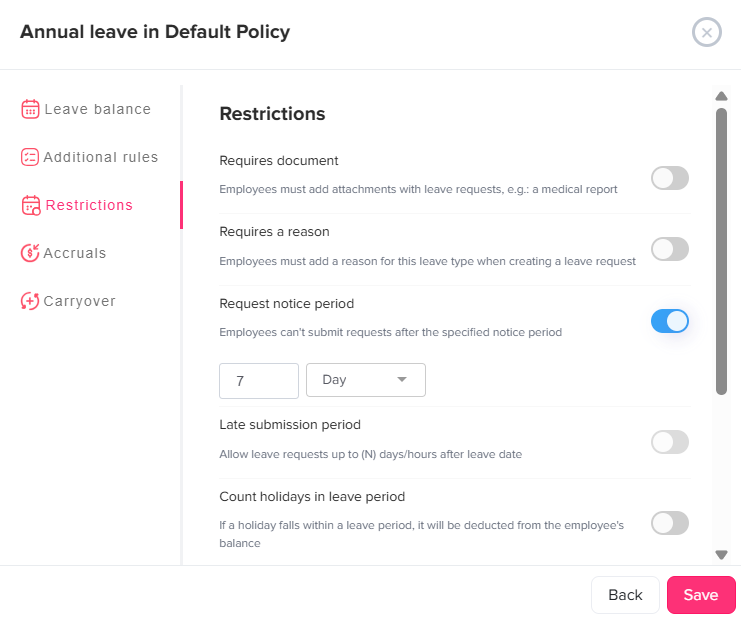
Day Off policies can include a minimum notice period, helping organizations apply their planned-leave rules directly to the request process.
Employees can submit leave requests through the Day Off web platform or the iOS and Android apps, while requests are routed through the configured approval workflow.
Organizations can also use features such as:
- Real-time PTO balances
- Leave request approvals
- Multiple approval steps
- Team and company calendars
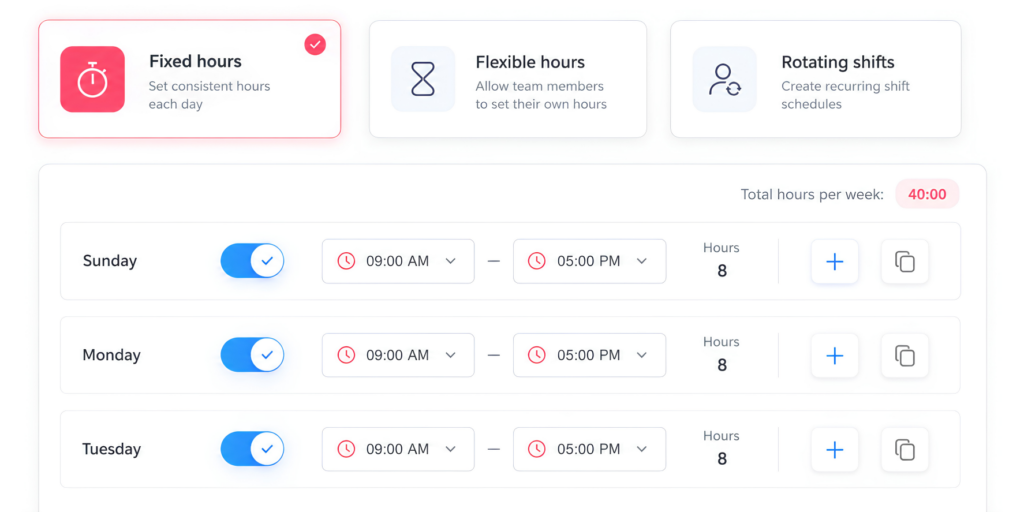
- Work schedules
- Leave policies
- Minimum notice requirements
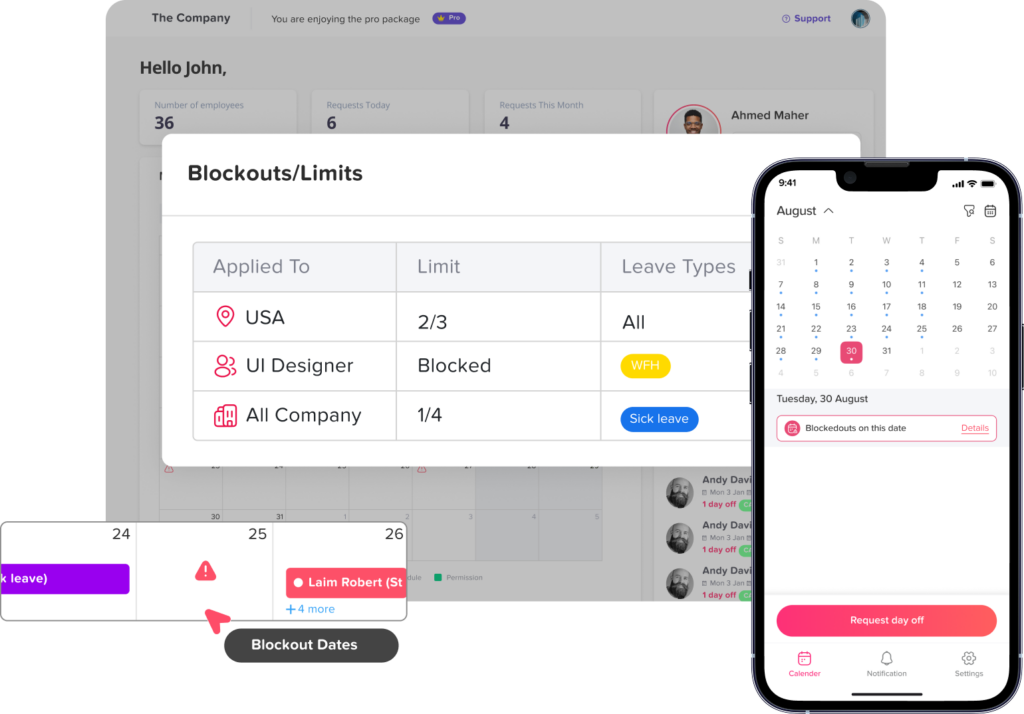
- Blockout dates
- Request limits
- Employee and manager notifications
- Leave reports
- Team and location filters
Blockout periods in Day Off can also be configured to prevent requests or limit how many requests are permitted for selected dates, teams, locations, or the company, while administrators can manage exceptions where appropriate.
Centralizing these rules helps managers see who is already off, whether the employee has sufficient balance, whether the dates meet the policy rules, and whether coverage may be affected before making the decision.
Software does not decide what the company’s notice policy should be. It helps apply the policy consistently once the organization has defined it.
How Often Should a PTO Request Policy Be Reviewed?
PTO rules should not remain unchanged simply because they were written years ago.
Review the process at least annually and whenever there is a major change such as:
- Significant workforce growth
- New locations
- Remote or hybrid work
- New shift structures
- Business expansion
- Changes to leave laws
- New scheduling software
- New PTO plans
- Major changes in seasonal demand
HR teams can also review actual request data.
Look at:
- How early employees normally request leave
- How many requests are submitted late
- How often late requests are approved
- Most common months for overlapping leave
- Average approval time
- Reasons for PTO denial
- Departments with frequent coverage problems
- Employees carrying unusually large unused balances
If most employees follow the rule easily, it is probably working.
If managers constantly make exceptions, the policy may not reflect how the organization actually operates.
FAQ
How far in advance should employees request PTO?
For planned PTO, many companies use notice periods ranging from several business days for short absences to two or more weeks for longer vacations. Extended leave may reasonably require 30 days’ notice when possible. The best requirement depends on the length of the absence, staffing needs, work schedules, and how difficult coverage is to arrange.
Can an employer deny PTO because the employee did not give enough notice?
For ordinary vacation PTO, an employer may generally apply reasonable request and approval rules subject to applicable laws, contracts, and company policies. However, employers should determine whether a late absence involves sick leave, FMLA, another protected leave entitlement, or an emergency before applying an ordinary vacation rule.
Is two weeks’ notice required for PTO?
There is no universal U.S. federal rule requiring employees to give two weeks’ notice for ordinary vacation PTO. Two weeks is a common internal policy choice because it gives managers time to arrange coverage, but employers may use shorter or longer periods based on operational needs. Federal FMLA rules are separate and can require 30 days’ notice for foreseeable qualifying leave when practical.
Can an employee request PTO at the last minute?
Yes, an employee can submit a last-minute request, but whether ordinary vacation PTO is approved will depend on company policy, available staffing, the reason for the absence, and applicable law. Unexpected illness and emergencies should normally be handled differently from a vacation that could reasonably have been requested earlier.
Does requesting PTO mean it is automatically approved?
Not usually. Unless the company uses an automatic approval process, submitting PTO generally creates a request that still needs to be reviewed by an authorized manager or approver. Employees should understand when a request becomes officially approved and where they can check its status.
Final Thoughts
There is no perfect number of days that every company should use for a PTO request.
The strongest PTO Request Policy is one that gives managers enough time to prepare while still making paid time off realistically accessible to employees.
For many organizations, that means moving away from one universal rule and using a proportional approach:
- Short planned absences require shorter notice.
- Longer vacations require more planning.
- Extended leave should be communicated as early as reasonably possible.
- Sick leave and emergencies need separate procedures.
- Protected leave must be reviewed under applicable legal requirements.
Just as importantly, employees should receive decisions promptly. Requiring early requests provides little value if managers leave them pending until the requested dates are approaching.
Clear rules, transparent approval criteria, defined exceptions, and centralized leave tracking create a better process for both employees and managers.
With a leave management platform such as Day Off, organizations can put these rules into practice by managing notice periods, PTO balances, requests, approvals, team availability, work schedules, and shared calendars from one place.
The result is not simply better PTO tracking. It is a leave process employees can understand and managers can consistently operate.