







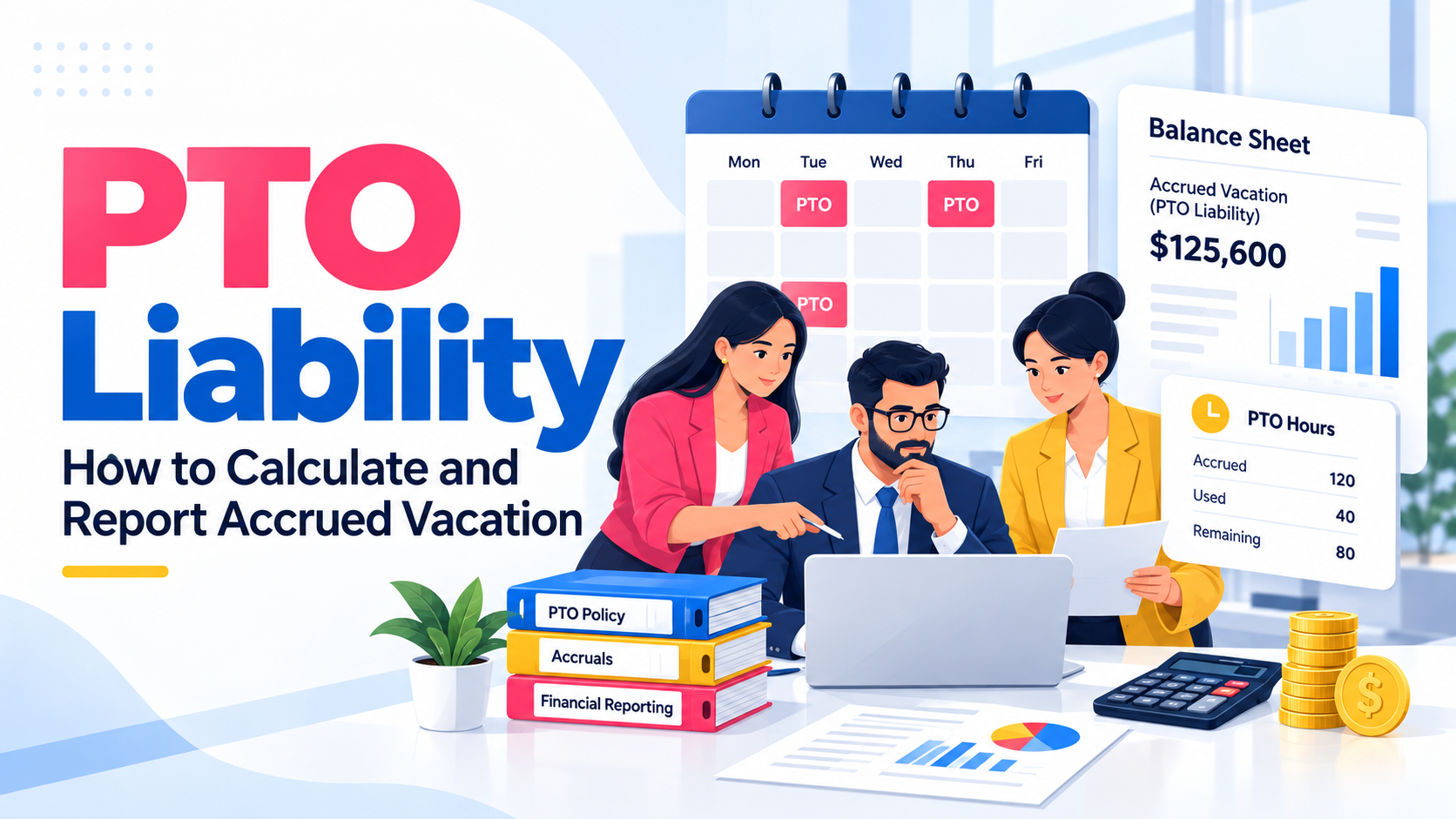
PTO liability is the financial obligation a company may have for paid time off that employees have earned but have not yet used. For organizations with accrued vacation or PTO policies, these unused balances can represent a meaningful employee compensation cost that must be tracked carefully for payroll, accounting, budgeting, and financial reporting.
For HR teams, an unused PTO balance may look like a leave-management issue. For finance teams, the same balance can represent a future compensation obligation.

Accurate PTO liability calculations therefore depend on more than simply knowing how many vacation days employees have left. Employers need reliable PTO balances, correct pay rates, clear accrual and carryover policies, and an understanding of the accounting rules that apply to compensated absences.
This guide explains what PTO liability is, how to calculate accrued vacation liability, when unused PTO may need to appear on the balance sheet, how accounting standards treat compensated absences, and how a PTO management system such as Day Off can help businesses maintain the accurate leave records needed for financial reporting.
What Is PTO Liability?
PTO liability, also known as accrued PTO liability, vacation accrual liability, or accrued vacation liability, represents the financial value associated with paid time off employees have earned but have not yet used.
Three related terms are important:
Accrued PTO
Accrued PTO is the amount of paid leave an employee has earned according to the company’s PTO policy.
For example, an employee might earn 10 hours of vacation each month. After six months, the employee would have earned 60 hours before considering any leave already taken.
Unused PTO
Unused PTO is the portion of an employee’s earned balance that remains available.
If the employee has earned 60 hours but already used 24 hours, the employee has:
60 earned hours – 24 used hours = 36 unused PTO hours
PTO Liability
PTO liability converts the applicable unused PTO balance into a monetary amount.
If those 36 hours are valued at $30 per hour:
36 × $30 = $1,080
The company may therefore have a $1,080 accrued vacation obligation associated with that employee, subject to its accounting policies and the applicable financial reporting rules.
Why PTO Creates an Accounting Liability
The underlying accounting issue is timing.
Employees often earn vacation through service performed today but use that vacation weeks or months later. Accounting standards therefore consider whether the cost relates to services employees have already provided.
Under US GAAP, ASC 710 addresses compensated absences such as vacation, PTO, holidays, and certain sick leave arrangements.
A liability for future compensated absences is generally accrued when:
The employee’s right to the benefit relates to services already performed.
The right vests or accumulates.
Payment is probable.
The amount can be reasonably estimated.
These are the core recognition conditions under ASC 710.
A vested benefit is generally one the employer must compensate even if employment ends.
An accumulating benefit is one that employees can carry into a later period rather than losing immediately at the end of the current period.
This distinction matters because not every type of paid absence creates the same accounting obligation.
PTO Liability Under US GAAP
Under ASC 710, vacation plans frequently create accrued compensation liabilities because vacation commonly accumulates or vests.
Consider an employee who earns vacation every pay period and can carry unused hours into the following year. The employee has provided the work necessary to earn those hours, and the benefit survives into a future accounting period.
That situation can meet the criteria for an accrued compensated absence.
However, companies should not assume that every form of leave must be treated identically.
What About Sick Leave?
Sick leave can receive different accounting treatment.
If sick leave does not vest and employees cannot receive cash for unused balances, US GAAP may not require the same accrual as vacation. ASC 710 also contains specific guidance concerning nonvesting accumulating sick leave.
That is why businesses should distinguish vacation, PTO, sick leave, parental leave, personal leave, and other leave categories instead of automatically assigning the same accounting treatment to every balance.
PTO Liability Under IFRS
IFRS addresses short-term paid absences through IAS 19, Employee Benefits.
IAS 19 distinguishes between accumulating and non-accumulating paid absences.
For accumulating paid absences, an entity recognizes the expected cost as employees provide services that increase their entitlement to future paid leave.
For non-accumulating absences, the cost is generally recognized when the absence occurs.
IAS 19 also makes an important distinction between:
Vesting accumulating absences, where employees may receive cash for unused entitlement when leaving.
Non-vesting accumulating absences, where employees can carry the benefit forward but are not entitled to a cash payment upon termination.
Even non-vesting accumulating leave can create an obligation under IFRS because employees have earned a future paid absence through their service.
Companies operating internationally should therefore avoid assuming that the same calculation and accounting treatment applies in every jurisdiction.
How to Calculate PTO Liability
A basic PTO liability calculation starts with two pieces of information:
unused PTO hours
applicable employee pay rate
A simplified formula is:
PTO Liability = Unused PTO Hours × Applicable Hourly Rate
For multiple employees:
Total PTO Liability = Sum of each employee’s individual PTO liability
The calculation may become more complex depending on company policy, financial reporting rules, forfeiture assumptions, expected pay rates, local law, payroll practices, and other compensation considerations.
Step 1: Determine Each Employee’s PTO Balance
Start with the employee’s earned and unused PTO balance as of the reporting date.
This date matters.
If finance is preparing the December 31 year-end balance sheet, the PTO report should reflect balances as of December 31 rather than an earlier export.
For each employee, identify:
beginning PTO balance
PTO earned during the period
PTO taken
approved balance adjustments
carryover
expired leave, where legally permitted
compensatory time or other applicable leave balances
A simplified balance calculation may look like:
Beginning Balance + PTO Earned – PTO Used ± Adjustments = Ending PTO Balance
For liability calculations, hours are generally more convenient than days because employees may have different schedules.
If an employee has five unused PTO days and works eight hours per day:
5 × 8 = 40 unused hours
Do not automatically assume that every employee’s workday is eight hours. Employees working 4/10 schedules, part-time schedules, flexible schedules, or other arrangements may have different daily hours.
Step 2: Determine the Applicable Pay Rate
Next, determine the compensation rate used by the company’s accounting methodology.
For hourly employees, this may be straightforward.
Suppose an employee has:
48 unused PTO hours
$25 hourly pay
The base value would be:
48 × $25 = $1,200
Salaried employees require an hourly equivalent if the calculation is being performed in hours.
For example, if an employee earns $78,000 annually and the organization uses 2,080 working hours as the appropriate annual basis:
$78,000 ÷ 2,080 = $37.50 per hour
If that employee has 64 unused hours:
64 × $37.50 = $2,400
Organizations should apply their accounting policy consistently and consult their accountant regarding the appropriate compensation rate and measurement assumptions.
Step 3: Consider Vesting, Forfeiture, Carryover, and Policy Rules
The balance shown in a PTO system does not automatically equal the accounting liability in every situation.
Finance may also need to consider:
whether PTO carries forward
whether unused PTO vests
whether employees receive payout at termination
expected forfeitures
maximum accrual limits
statutory vacation requirements
company payout policies
local restrictions on forfeiture
ASC 710 specifically requires anticipated forfeitures to be considered when applicable in measuring certain compensated absence liabilities.
The correct calculation therefore depends on both the PTO data and the rules governing what employees are actually entitled to receive or use.
PTO Liability Calculation Example
Suppose a company has five employees with the following unused PTO balances:
| Employee | Unused PTO Hours | Hourly Rate | Base PTO Value |
|---|---|---|---|
| Ana | 80 | $30 | $2,400 |
| Ben | 40 | $45 | $1,800 |
| Chloe | 120 | $25 | $3,000 |
| Dev | 24 | $60 | $1,440 |
| Emma | 60 | $35 | $2,100 |
| Total | 324 | — | $10,740 |
The company’s base accrued PTO amount is therefore:
$10,740
That calculation is intentionally simple.
The final accounting balance may require additional adjustments based on the company’s accounting policy, expected forfeitures, applicable payroll costs, payout rules, or other considerations.
Should Employer Payroll Taxes Be Added to PTO Liability?
This question deserves separate treatment because accounting practices can differ.
It may seem logical to automatically add payroll taxes, insurance, and benefits to every employee’s PTO balance. However, ASC 710 does not necessarily require all fringe benefits to be included in the compensated absence liability.
KPMG’s interpretive guidance, for example, states that Topic 710 does not require fringe benefits such as health insurance to be included in the measurement of compensated absences.
Employers should therefore avoid using a universal formula such as:
PTO hours × pay rate × benefits percentage
without confirming that it matches their accounting policy.
Instead, finance teams should determine which additional employer costs, if any, should be accrued separately or included under their accounting methodology.
PTO Liability Journal Entry
When accrued vacation needs to be recognized, a simplified adjusting entry may look like:
Debit: Compensation or PTO Expense
Credit: Accrued PTO Liability
Suppose the calculated liability at year end is $10,740.
The entry might be:
| Account | Debit | Credit |
|---|---|---|
| PTO or Compensation Expense | $10,740 | — |
| Accrued PTO Liability | — | $10,740 |
In later reporting periods, the company normally recalculates the required liability and adjusts the general ledger to the new balance rather than blindly recording the entire PTO balance again.
Example of a Period-End Increase
Assume the liability was previously $10,740 and has increased to $12,200.
The required increase is:
$12,200 – $10,740 = $1,460
The adjusting entry may therefore be:
Debit: PTO Expense $1,460
Credit: Accrued PTO Liability $1,460
Actual journal entries depend on the company’s accounting system, chart of accounts, payroll process, and accounting policy.
How PTO Liability Appears on the Balance Sheet
Accrued PTO is generally presented as an employee compensation liability.
For many organizations, amounts expected to be settled within the normal operating cycle or within the applicable current-liability period are classified as current liabilities.
Depending on the company’s financial statements, PTO may appear under categories such as:
Accrued compensation
Accrued payroll
Accrued employee benefits
Accrued expenses
Other current liabilities
The exact presentation depends on materiality and the company’s reporting structure.
What matters most is that the recorded amount reconciles with the employee-level calculation supporting it.
Why PTO Liability Changes Over Time
PTO liability is not static.
Even when employees do not take vacation, the dollar value of the liability can change.
Employees Earn More PTO
As employees work, additional vacation may accrue.
If an employee earns 6.67 hours per month, their unused balance can increase every month they use less leave than they earn.
Employees Take Vacation
When employees use PTO, their unused balance decreases.
That generally reduces the leave balance supporting the liability.
Pay Rates Increase
Pay raises can increase the value of outstanding PTO depending on the applicable measurement method.
For example:
80 unused hours × $25 = $2,000
After a raise:
80 unused hours × $28 = $2,240
The employee has exactly the same number of unused hours, but the monetary value has increased by $240.
Employees Leave the Company
Termination can cause unused vacation balances to become immediately payable, depending on company policy and local law.
This is especially important for multi-state employers.
PTO Payout Laws Vary by State
Employers should not assume that unused vacation can always be forfeited.
Vacation payout laws differ considerably across the United States.
California is one important example.
The California Labor Commissioner’s Office states that earned vacation is considered wages. Earned vacation cannot be forfeited, although employers may establish reasonable caps that stop additional vacation from accruing once a maximum balance has been reached.
California also generally requires earned and unused vacation to be paid at the employee’s final rate of pay when employment ends.
California specifically distinguishes a lawful accrual cap from an unlawful “use it or lose it” policy.
Other states have different rules.
Employers with workers in multiple jurisdictions should review state-specific requirements before designing:
carryover limits
PTO expiration rules
termination payout policies
accrual caps
combined PTO policies
The PTO system should then be configured to match the actual policy and applicable law.
How Carryover Rules Affect PTO Liability
Carryover policies can significantly affect an organization’s accumulated PTO exposure.
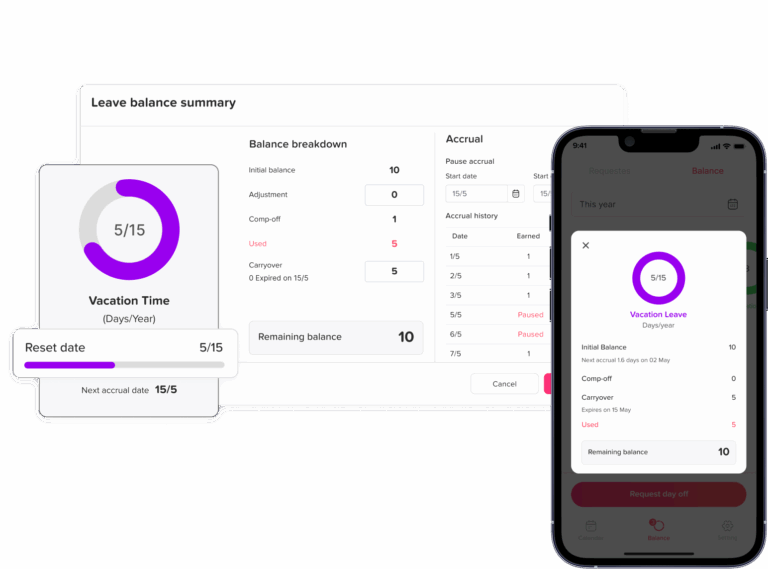
Imagine an employee earns 120 vacation hours each year but typically uses only 80.
Without an effective cap, the balance could grow:
Year 1: 40 unused hours
Year 2: 80 unused hours
Year 3: 120 unused hours
As unused hours grow, the associated compensation obligation may grow as well.
Organizations often address this through legally compliant policies such as:
maximum accrual caps
limited carryover
scheduled vacation planning
annual PTO payouts
accrual pauses after reaching a balance ceiling
The appropriate policy depends on the jurisdiction and the organization’s workforce strategy.
Does Unlimited PTO Create PTO Liability?
Unlimited PTO changes the accounting question because employees generally do not build a traditional bank of earned vacation hours.
If there is no accrued entitlement, there may be no unused hour balance to multiply by an employee’s pay rate.
That does not mean every unlimited PTO arrangement automatically has zero accounting implications.
Employers still need to consider:
contractual obligations
state or national law
how the policy operates in practice
whether another form of compensation obligation exists
Finance teams should review the specific policy with their accountant rather than assuming that calling a policy “unlimited PTO” automatically eliminates all possible liability.
Why Accurate PTO Records Matter for Finance
The accounting calculation may be simple. Obtaining accurate data is often harder.
Common problems include:
PTO requests buried in email
managers forgetting to record approved leave
manual spreadsheet formulas
incorrect accrual rates
missing carryover adjustments
employees assigned to the wrong PTO policy
different working schedules
retroactive PTO corrections
employees changing locations or policies
balances not matching the reporting date
Even a correct accounting formula produces the wrong answer if the starting leave balance is inaccurate.
This is why PTO liability is not exclusively a finance problem. It is also a leave-data problem.
How Day Off Helps Businesses Track PTO Balances
Day Off is a PTO and leave management platform that helps companies manage the employee leave information finance and HR teams rely on when reviewing unused PTO.
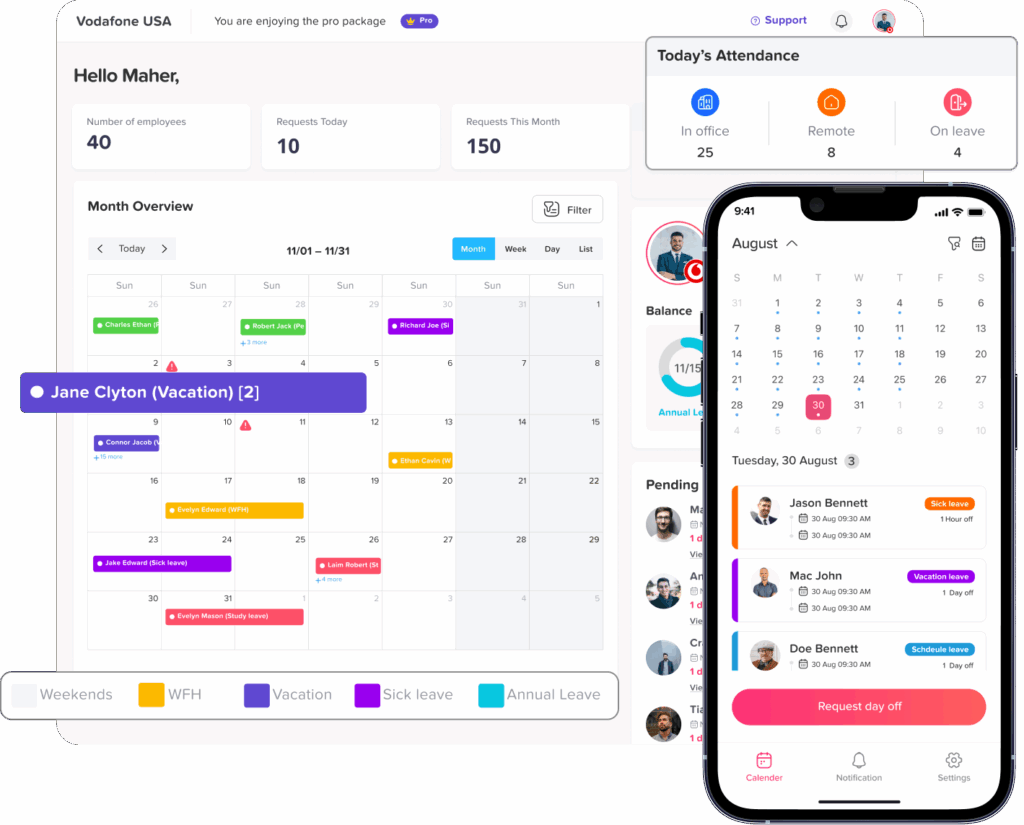
Instead of tracking vacation through spreadsheets, emails, and disconnected manager approvals, businesses can maintain leave policies, balances, requests, schedules, and reports in one system.
Automated PTO Accruals
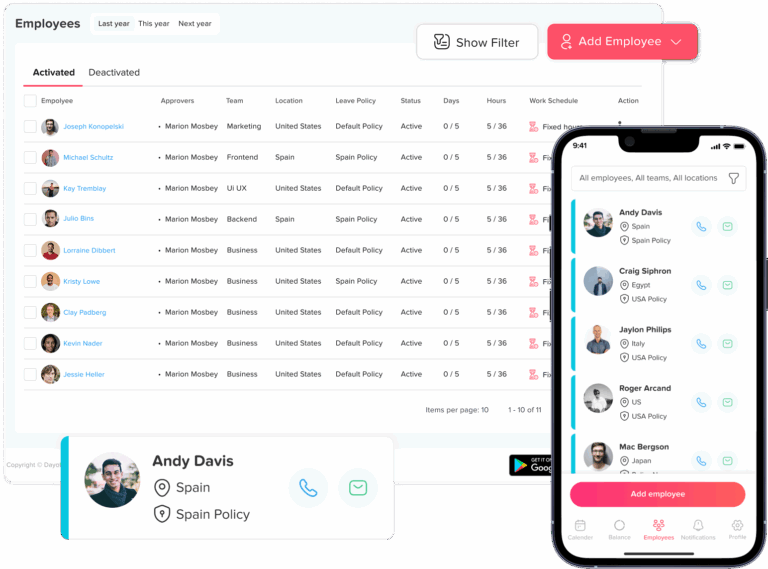
Day Off supports configurable accrual policies, helping businesses calculate employee leave balances according to their PTO rules.
Organizations can manage different accrual frequencies and policy structures instead of manually updating balances every month.
This is particularly useful when employees have different:
leave policies
accrual rates
work schedules
locations
seniority levels
Carryover Rules
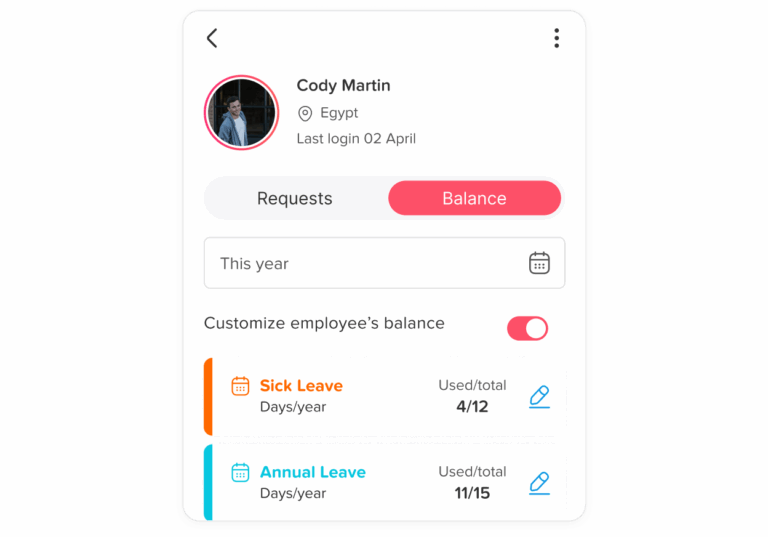
Companies can configure carryover limits so employee balances reflect their actual PTO policy.
For finance teams, this is important because carryover directly affects the amount of leave remaining available in future periods.
Employee PTO Balances
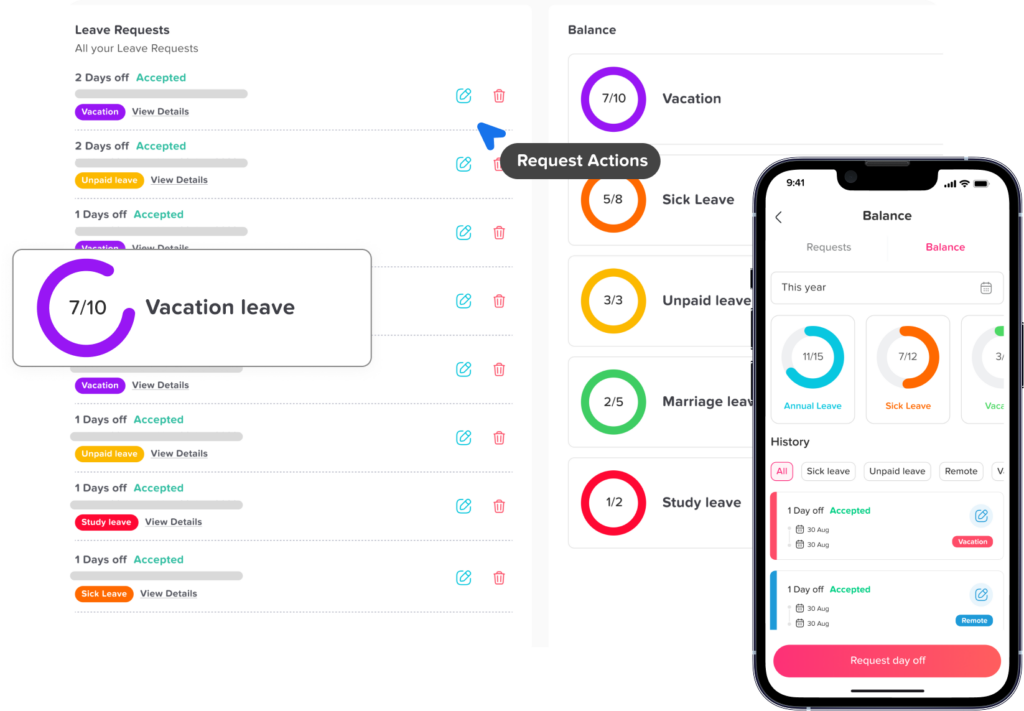
Day Off provides visibility into employee leave balances so HR teams do not have to reconstruct unused PTO from calendars, emails, and spreadsheets at reporting time.
Accurate balances provide finance with a cleaner starting point for PTO liability calculations.
Leave Requests and Approvals
Employees can submit leave requests through Day Off, while managers review and approve them within the platform.
Once leave is recorded properly, the organization’s PTO data is easier to reconcile because approved absences and employee balances remain connected.
Multiple Leave Types
Businesses can maintain different leave types rather than mixing all paid and unpaid absences into a single spreadsheet.
This distinction is particularly valuable for accounting because vacation, sick leave, unpaid leave, parental leave, compensatory time, and other absence types may not receive identical financial treatment.
Work Schedules
Day Off supports different employee work schedules.
This matters when converting PTO between days and hours.
An employee working an eight-hour day should not necessarily be treated the same as someone working four 10-hour days each week.
Having the employee’s actual work schedule connected to leave management improves the accuracy of PTO calculations.
PTO Reports
Day Off provides leave-related reporting that can help HR and finance review employee balances, usage, accruals, carryover, and leave history.
Finance can then combine the appropriate unused PTO balances with compensation data from payroll or the company’s accounting system.
Day Off does not replace the company’s accountant or determine how a liability should be measured under GAAP, IFRS, or local law. Its role is to help ensure that the underlying PTO data used in the calculation is structured, current, and easier to verify.
A Better Monthly PTO Liability Process
Companies do not need to wait until year end to discover a large unused vacation obligation.
A simple monthly or quarterly process can make PTO liability easier to manage.
Set a Reporting Date
Use a consistent month-end, quarter-end, or year-end date.
Export PTO Balances
Pull employee leave balances as of that exact reporting date.
Review Exceptions
Check:
negative balances
unusually large balances
manual adjustments
terminated employees
policy changes
new employees
employees who changed schedules
Match Compensation Data
Combine PTO hours with the compensation rates required by the company’s accounting methodology.
Apply Accounting Assumptions
Consider expected forfeitures, vesting, payout policies, accrual caps, and other relevant accounting factors.
Calculate the Required Liability
Calculate the employee-level amounts and total them.
Reconcile to the General Ledger
Compare the new required liability with the existing balance-sheet amount.
Record the Adjustment
Book the difference according to the company’s accounting policy.
Keep Supporting Documentation
Retain the employee-level report and calculation so finance can explain how the liability was determined.
How Employers Can Control Growing PTO Liability
Managing PTO liability should not mean discouraging employees from taking vacation.
A better approach is to create predictable leave policies and encourage employees to use the time they have earned.
Encourage Employees to Schedule Leave
Large PTO balances sometimes build because employees continually postpone vacations.
Regular balance reminders can encourage employees to plan leave throughout the year.
Monitor High Balances
HR teams can periodically identify employees approaching carryover or accrual limits.
Early visibility is easier to manage than discovering hundreds of unused hours at year end.
Use Legally Compliant Accrual Caps
Where permitted, companies may establish reasonable maximum balances.
Once an employee reaches the cap, additional vacation may stop accruing until the employee uses enough leave to fall below the limit.
Always verify local law before implementing a cap.
Keep PTO Policies Consistent
Employees should know:
how PTO accrues
whether it carries over
whether balances expire
whether there is a maximum balance
whether unused PTO is paid at termination
how different leave types are treated
Clear rules improve both employee understanding and accounting accuracy.
Replace Manual Spreadsheets
Spreadsheets can work for a very small team, but the risk of errors increases as organizations add employees, policies, work schedules, locations, and accrual rules.
Automated PTO management reduces the number of manual calculations that HR needs to maintain.
Common PTO Liability Mistakes
Using Vacation Days Without Considering Work Schedules
Ten PTO days do not always equal 80 hours.
Convert leave using the employee’s actual schedule.
Using Outdated Balances
Always calculate liability using PTO balances as of the reporting date.
Mixing Every Leave Type Together
Vacation, sick leave, parental leave, unpaid leave, and other benefits may receive different accounting treatment.
Ignoring Local Law
A policy that is permitted in one state may not be permitted in another.
Forgetting Pay Changes
Compensation changes can affect the monetary value of accrued leave depending on the company’s accounting methodology.
Automatically Adding Every Benefit Cost
Do not assume that health insurance, payroll taxes, retirement contributions, and other employer costs automatically belong in the ASC 710 compensated absence liability.
Follow your accounting policy and professional guidance.
Treating the PTO Tracker as the Accounting System
A leave management system provides the hours and policy information.
Payroll and accounting systems provide other financial inputs.
Accurate PTO liability reporting depends on using the appropriate data from each system.
PTO Liability FAQ
Can an employee have a negative PTO balance?
Yes. Some employers allow employees to use PTO before they have fully earned it, creating a negative balance. Whether that negative amount can offset other employees’ accrued PTO for accounting purposes depends on the company’s policy, employment agreements, applicable law, and accounting treatment. Businesses should generally track negative balances separately rather than automatically subtracting them from total PTO liability.
How should advanced or borrowed PTO be treated?
Advanced PTO occurs when an employer allows an employee to take more paid leave than they have accrued. The difference may be treated as an advance rather than an accrued employee benefit. Employers should clearly document how advanced PTO works, whether it must be repaid after termination, and whether local wage laws allow recovery from final pay.
Does PTO liability affect a company’s cash flow?
PTO liability does not necessarily create an immediate cash payment when it is recorded. However, it represents a potential future cash requirement when employees take paid leave or receive a payout for unused vacation. Companies with large accumulated balances may therefore want to consider PTO obligations when planning future payroll and working-capital needs.
Does PTO liability affect EBITDA or operating expenses?
Changes in accrued PTO can affect compensation expense and therefore may affect operating income and certain performance measures. The exact impact depends on how the organization records employee compensation and calculates its financial metrics. Finance teams should apply the company’s accounting policies consistently when analyzing these effects.
How is PTO liability handled when an employee changes from part-time to full-time?
A change in employment status can affect future PTO accrual rates, work schedules, and potentially the value of an employee’s existing leave balance. Employers should document how previously earned PTO is treated when an employee changes status and ensure that the employee’s leave balance, schedule, and policy assignment are updated correctly.
What happens to PTO liability when a company changes its PTO policy?
A policy change can affect future PTO accruals and, in some cases, existing balances. Employers should distinguish between leave employees have already earned and leave that will be earned under the new policy. Existing accrued vacation may be protected by employment law in some jurisdictions, so companies should review legal and accounting requirements before reducing or eliminating previously earned balances.
How should PTO liability be handled for employees paid in different currencies?
Companies with an international workforce may calculate employee PTO obligations in each employee’s local currency and then translate those amounts into the company’s reporting currency. Exchange-rate movements can change the reported value even when the number of unused PTO hours remains unchanged. The appropriate translation method depends on the company’s accounting framework.
Should small businesses track PTO liability?
Yes. Even if a business has only a few employees, unused vacation can become a meaningful financial obligation over time. Tracking accrued PTO can help small businesses understand future payroll commitments, prepare for employee departures, and maintain cleaner financial records.
What records should employers keep to support a PTO liability calculation?
Employers should maintain records showing employee PTO balances, accrual activity, leave taken, manual adjustments, policy assignments, work schedules, and relevant compensation information. Keeping a clear history makes it easier to explain changes in the liability, investigate discrepancies, and support accounting reviews or audits.
Conclusion
PTO liability connects HR policy, payroll data, employee compensation, and financial reporting.
The basic idea is straightforward: employees may earn paid leave through work already performed, and that unused entitlement can create a future financial obligation for the employer.
The difficult part is maintaining accurate information.
Businesses need to know exactly how much leave each employee has earned, how much has been used, which balances carry forward, what rules apply to each leave type, and which employees are approaching policy limits.
A PTO management platform such as Day Off helps keep these leave records centralized through automated accruals, configurable policies, carryover rules, employee balances, work schedules, approvals, and reporting. Finance teams can then combine reliable PTO data with payroll and accounting information to calculate the appropriate liability more efficiently.
Keeping PTO balances accurate throughout the year makes year-end reporting easier, improves financial planning, and gives both employees and employers a clearer picture of earned leave obligations.