







Accurate employee time records are more than an administrative convenience. They can help employers calculate payroll correctly, document overtime, investigate attendance issues, respond to wage disputes, and demonstrate compliance with labor laws.
But keeping accurate records raises another important question:
How long must employers keep timesheets and time records?
For employers in the United States, there is no single retention period that applies to every employment record. Under the federal Fair Labor Standards Act (FLSA), certain payroll records generally must be retained for at least three years, while records used to calculate employee wages, including time cards, work schedules, and similar documents, generally must be retained for two years.

That is only the federal starting point.
State laws, tax requirements, industry regulations, collective bargaining agreements, pending disputes, and company policies may require employers to keep records for longer.
For that reason, employers need a clear time record retention policy that explains what information is stored, how long it is kept, and how those records can be retrieved when needed.
This guide explains how long employers should keep timesheets and time records, what information employers should track, how federal and state requirements differ, and how a time tracking system such as Day Off can help maintain more reliable records.
How Long Do Employers Have to Keep Timesheets?
Under the FLSA, employers generally need to maintain two main categories of wage and hour records.
Payroll Records: At Least 3 Years
The U.S. Department of Labor states that employers must preserve certain payroll records for at least three years.
These include records containing information about employee wages, pay periods, and other payroll-related information.
Time Cards and Wage Calculation Records: At Least 2 Years
Records used to determine employee wages should generally be retained for at least two years.
The Department of Labor specifically lists examples such as:
Time cards
Piece-work tickets
Wage rate tables
Work schedules
Time schedules
Records of additions to wages
Records of deductions from wages
These records help demonstrate how the employer calculated the amount ultimately shown in payroll records.
Therefore, an employer asking, “How long should I keep employee timesheets?” should understand that the federal requirement depends partly on what the record contains and how it is used.
Many organizations choose to retain time records for longer than the two-year federal minimum, especially when a longer state requirement or another legal obligation applies.
Timesheet Retention Requirements at a Glance
A basic U.S. record retention structure looks like this:
| Record | General Federal Retention Period |
|---|---|
| Payroll records | At least 3 years |
| Time cards and timesheets used for wage calculations | At least 2 years |
| Work and time schedules | At least 2 years |
| Wage rate tables | At least 2 years |
| Records of additions or deductions from wages | At least 2 years |
| Employment tax records | At least 4 years |
The IRS separately instructs employers to keep employment tax records for at least four years after the tax becomes due or is paid, whichever is later.
These requirements overlap, which is one reason employers should not automatically delete every time or payroll record as soon as the shortest retention period expires.
Why Employers Must Keep Employee Time Records
The purpose of timesheet recordkeeping is not simply to show that an employee arrived at 9:00 a.m. and left at 5:00 p.m.
Time records can help establish:
How many hours an employee worked.
Whether overtime was earned.
Whether a break was taken.
Whether paid or unpaid time was recorded correctly.
How payroll was calculated.
Whether a time entry was later corrected.
Whether an employee worked outside their normal schedule.
Whether there were attendance exceptions.
Whether an employer complied with wage and hour requirements.
The Department of Labor requires covered employers to maintain accurate information about employees’ hours and wages. It does not require one specific type of timekeeping system. Employers may use time clocks, timekeepers, employee-entered records, or other methods as long as the records are complete and accurate.
That means employers can use digital time tracking software instead of traditional paper timesheets, provided the system produces reliable records.
What Employee Time Records Must Employers Keep?
For employees covered by FLSA recordkeeping requirements, employers generally need more than a simple total of hours worked.
According to the Department of Labor, required records include information such as:
Employee name.
Address.
Social Security number.
Occupation.
Birth date if the employee is under 19.
The day and time the employee’s workweek begins.
Hours worked each day.
Total hours worked each workweek.
The basis on which wages are paid.
Regular hourly pay rate where applicable.
Straight-time earnings.
Overtime earnings.
Additions to or deductions from wages.
Total wages paid each pay period.
Payment date.
Pay period covered by the payment.
From a practical HR perspective, employers may also find it useful to maintain:
Clock-in times.
Clock-out times.
Break records.
Schedule information.
Approved PTO.
Sick leave.
Time-entry corrections.
Overtime approvals.
Missed punch adjustments.
Manager approvals.
Attendance exceptions.
Some of these records may be required under state law or company policy even where federal law does not specifically require the individual data point.
Does the FLSA Require Employers to Use Timesheets?
No particular timekeeping format is required.
The Department of Labor explains that employers may choose their own timekeeping method as long as the system is complete and accurate.
For example, an employer might track time through:
Paper timesheets.
Punch cards.
A physical time clock.
Spreadsheet-based timesheets.
Web-based time tracking software.
Employee self-reported time.
Digital clock-in and clock-out systems.
The important issue is not whether the company uses paper or software.
The important issue is whether the employer can produce accurate records showing the hours employees actually worked.
How Long Should Employers Keep Digital Timesheets?
Electronic timesheets are generally subject to the same underlying retention requirements as paper records.
Moving records into an online time tracking system does not shorten the required retention period.
An employer should make sure digital records remain:
Accessible.
Readable.
Accurate.
Secure.
Backed up.
Retrievable when needed.
The Department of Labor notes that required records may be maintained at the workplace or at a central records office and must be available for inspection.
The IRS also recognizes electronic business recordkeeping and emphasizes that employment tax records need to remain available for review.
Therefore, switching payroll providers or time tracking systems should include a plan for preserving historical employee records.
Federal Timesheet Retention vs. State Requirements
One of the biggest mistakes employers can make is assuming that complying with the federal minimum automatically satisfies every state requirement.
States can impose longer recordkeeping periods.
California Time Record Retention
California requires employers to maintain certain records showing employees’ daily hours worked and wages paid for three years.
California guidance also identifies a three-year retention period for itemized wage statements and certain other wage-related records.
This means a California employer should not rely solely on the two-year federal period for supporting time records if state law requires the information to be kept longer.
New York Time Record Retention
New York has a substantially longer requirement.
New York Labor Law requires employers to maintain certain payroll records for at least six years, including records concerning hours worked and wages paid.
For employees who are not exempt from overtime requirements, applicable records include information about regular hours, overtime hours, regular rates, and overtime rates.
Why Employers Should Check State Law
An employer operating in multiple states may therefore face several different retention periods.
For example:
Federal requirement: 2 years for certain supporting wage calculation records.
California: 3 years for certain hours and wage records.
New York: 6 years for certain payroll records.
If employees work in different states, HR teams should determine which requirements apply to each workforce rather than creating a retention policy based only on the shortest federal period.
Employment Tax Records Have a Different Retention Period
Timesheets and payroll records are not the only employment documents an organization needs to preserve.
The IRS requires employers to retain employment tax records for at least four years after the tax becomes due or is paid, whichever is later.
These records may include information such as:
Wage payments.
Employee identifying information.
Employment dates.
Tax deposits.
Tax withholding certificates.
Reported tips.
Certain sickness or injury payments.
Copies of employment tax documentation.
Employers therefore need to think about timekeeping, payroll, and employment tax records as related but separate categories.
A two-year timesheet retention rule does not mean every related employment record can be destroyed after two years.
What About Timesheets for Former Employees?
Ending someone’s employment does not reset the employer’s recordkeeping obligations.
If an employee leaves the company, records still need to be retained for the applicable period.
For example, suppose an employee leaves in June 2026.
The employer should not delete all of that employee’s timesheets when their account is deactivated.
Instead, historical information should remain available according to the company’s applicable retention schedule.
This is important because questions about unpaid wages, overtime, payroll calculations, or attendance may arise after the employee has left.
A useful offboarding process should therefore
Distinguish between:
Removing access: Disabling the employee’s access to company systems.
and
Deleting records: Permanently removing the historical information associated with that employee.
These should not happen automatically at the same time.
Should Employers Keep Timesheets Longer Than the Legal Minimum?
In many cases, an employer may decide to keep records longer than the shortest statutory minimum.
For example, a company may adopt a longer standard because:
State law requires it.
Tax records need to be retained longer.
The company operates across multiple states.
An audit is underway.
A wage claim has been made.
Litigation is pending or reasonably anticipated.
A collective bargaining agreement requires longer retention.
Another employment regulation applies.
The organization prefers one consistent retention period.
However, keeping records indefinitely is not automatically the best approach either.
Employee time and payroll records can contain personal and sensitive information. Organizations should balance legal retention needs with privacy, cybersecurity, and data-minimization practices.
A written retention schedule can help establish when records should be archived and when they may safely be deleted.
Can Employers Delete Old Timesheets?
Employers can generally dispose of records after all applicable retention periods have expired, provided there is no other reason the records need to be preserved.
Before deleting timesheets, employers should check:
Federal wage and hour retention requirements.
State and local requirements.
Employment tax requirements.
Industry-specific requirements.
Collective bargaining agreements.
Company retention policies.
Pending investigations.
Audits.
Employee complaints or wage claims.
Existing or anticipated litigation.
If a legal dispute or investigation requires the records to be preserved, normal deletion schedules may need to be suspended.
How Should Employers Store Timesheets?
Employers should use a system that keeps time records organized and readily retrievable.
The system should make it possible to identify records by:
Employee.
Date.
Pay period.
Workweek.
Department.
Location.
Project, where relevant.
Paper Records
Paper records may satisfy recordkeeping requirements, but organizations need to consider:
Physical storage.
Fire or water damage.
Misfiling.
Unauthorized access.
Difficulty locating older records.
Manual calculations.
Spreadsheets
Spreadsheets can work for smaller teams, but they become harder to manage as the workforce grows.
Common problems include:
Accidental deletion.
Duplicate versions.
Formula errors.
Overwritten entries.
Limited approval history.
Difficulty identifying who changed a record.
Records scattered across devices or folders.
Digital Time Tracking Systems
A dedicated system can make it easier to centralize:
Time entries.
Employee schedules.
Attendance information.
Corrections.
Reports.
Historical records.
The technology itself does not create compliance. Employers still need appropriate policies and accurate processes, but better recordkeeping tools can reduce the amount of manual work required.
Should Employers Track Employee Breaks?
Break record requirements depend on the type of break and the applicable federal and state laws.
Under federal wage and hour rules, hours worked must be recorded correctly so employees receive appropriate compensation.
State laws may create additional meal and rest break requirements.
For employers, the practical issue is straightforward: if breaks affect compensable working time, the timekeeping process should make it possible to distinguish working time from legitimate unpaid periods.
Managers should also avoid automatically changing recorded time simply because an employee was expected to take a break.
Records should reflect what actually occurred.
What About Missed Clock-Ins and Clock-Outs?
Missed punches are common.
An employee may:
Forget to clock in.
Forget to clock out.
Select the wrong time.
Fail to record a break.
Accidentally leave a timer running.
Enter time against the wrong project or task.
Employers still need accurate records.
A good missed punch policy should explain:
How employees report errors.
Who can review the correction.
What information is required.
Who may edit a time entry.
Whether the original entry remains visible.
How the correction is documented.
Employees should be encouraged to report mistakes promptly rather than allowing inaccurate hours to remain in payroll records.
Can Employers Edit Employee Timesheets?
There may be legitimate reasons for correcting a timesheet, such as fixing an obvious missed punch.
However, employers should not alter records to eliminate time that an employee actually worked.
A strong process should create a clear record of:
The original entry.
The reason for the correction.
The corrected entry.
Who approved or made the change.
When the change occurred.
This becomes particularly important when a time record later becomes evidence in a payroll investigation or wage dispute.
Do Employers Need Timesheets for Salaried Employees?
The answer depends partly on the employee’s classification and applicable laws.
Being paid a salary does not automatically mean an employee is exempt from overtime.
Some salaried employees are still nonexempt and therefore need accurate records of hours worked for wage and overtime calculations.
Employers should determine an employee’s exemption status under the applicable legal tests rather than assuming that “salary” and “exempt” mean the same thing.
Even when detailed hours are not required for the same federal wage-calculation purposes, employers may still track time for other legitimate reasons.
Including
Attendance.
PTO.
Project costing.
Client billing.
Workforce planning.
Internal reporting.
Leave administration.
Why Accurate Time Records Matter During Wage Disputes
Good records can become especially important when an employee claims they were not paid for all hours worked.
Consider an employee who says they regularly worked an additional hour after their scheduled shift.
An employer with records showing:
Actual clock-in times.
Actual clock-out times.
Schedule information.
Time corrections.
Overtime.
Attendance history.
is in a much better position to investigate the claim than an employer relying on memory or an old spreadsheet.
Record retention is therefore not just about satisfying a document-storage rule.
It preserves the evidence necessary to understand what actually happened.
Common Timesheet Recordkeeping Mistakes
Deleting Records When an Employee Leaves
Employment termination does not cancel record retention requirements.
Historical records should remain available until the applicable retention periods expire.
Keeping Records for Only Two Years Everywhere
The FLSA’s two-year rule for certain supporting records is not a universal record-retention period.
Payroll records have a different federal period, tax records have another, and states may require longer retention.
Keeping Only Payroll Totals
A payroll record may show that an employee was paid for 42 hours, but employers may also need the underlying records showing how those hours were calculated.
Using Employee Schedules as Actual Time Records
A schedule shows when an employee was expected to work.
A time record should reflect what they actually worked.
Those numbers are not always the same.
Overwriting Corrected Time Entries
If a time entry needs to be corrected, keeping an understandable history of the change is better than making the original record disappear without explanation.
Ignoring Overtime Records
Employers should ensure overtime hours and related pay calculations are accurately documented.
Storing Records in Multiple Unconnected Systems
If schedules are in one system, clock-ins in another, PTO in a spreadsheet, and payroll elsewhere, investigating an old discrepancy becomes much more difficult.
How Day Off Helps With Employee Time and Attendance Records
A centralized system can make day-to-day recordkeeping much easier.
Day Off combines employee leave management with time tracking and attendance information, allowing businesses to maintain clearer records without relying entirely on spreadsheets.
Clock In and Clock Out
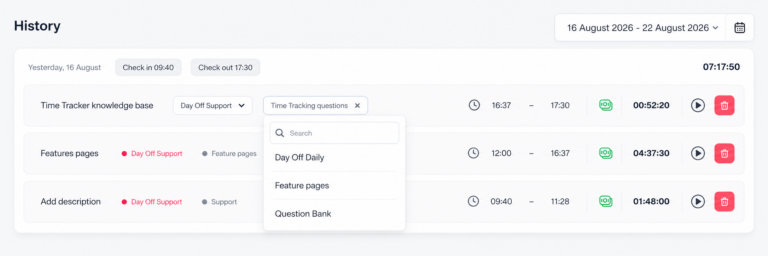
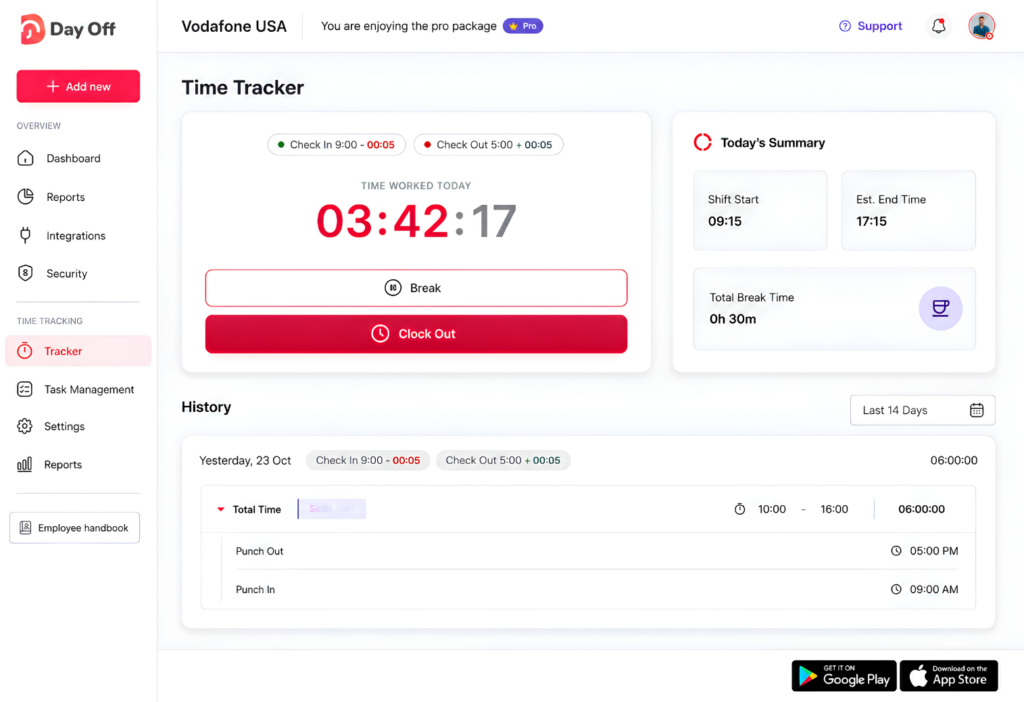
With Day Off’s Time Tracker, employees can record their working time through clock-in and clock-out activity.
This gives employers a clearer record of actual working time instead of relying only on planned schedules.
Task-Based Time Tracking
Businesses that need more detailed records can use task tracking to associate working time with specific projects and tasks.
This can be especially useful for teams that need to understand not only how long an employee worked, but also where that working time was spent.
Projects and Clients
Projects can be organized around clients, allowing businesses to maintain more structured time information for project-based work.
That can support internal reporting, productivity analysis, and billing workflows.
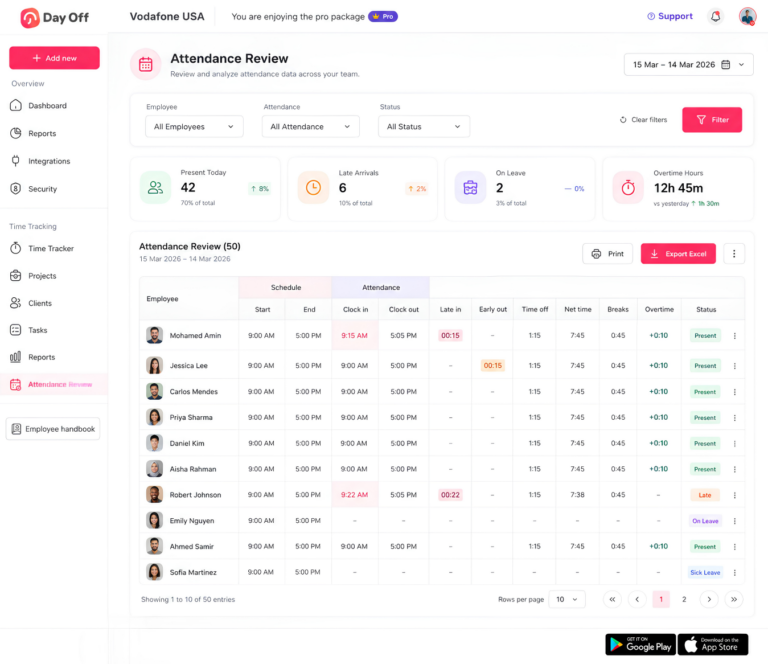
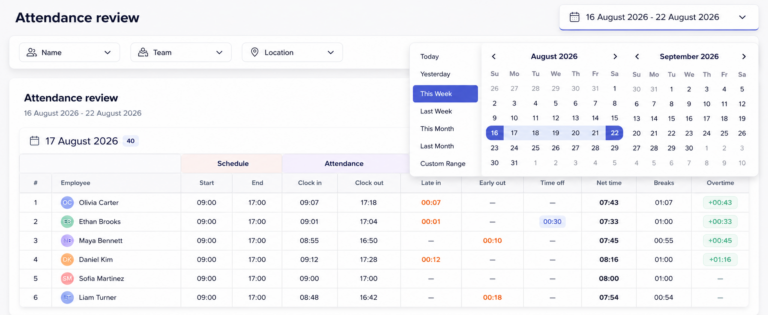
Attendance Review
Day Off can help managers compare scheduled work with actual attendance information.
Attendance records can provide visibility into:
Clock-in and clock-out activity.
Late arrival.
Early departure.
Breaks.
PTO.
Net working hours.
Overtime.
Attendance status.
This makes the employee’s workday easier to review without manually combining schedule and leave information from separate spreadsheets.
Work Schedules
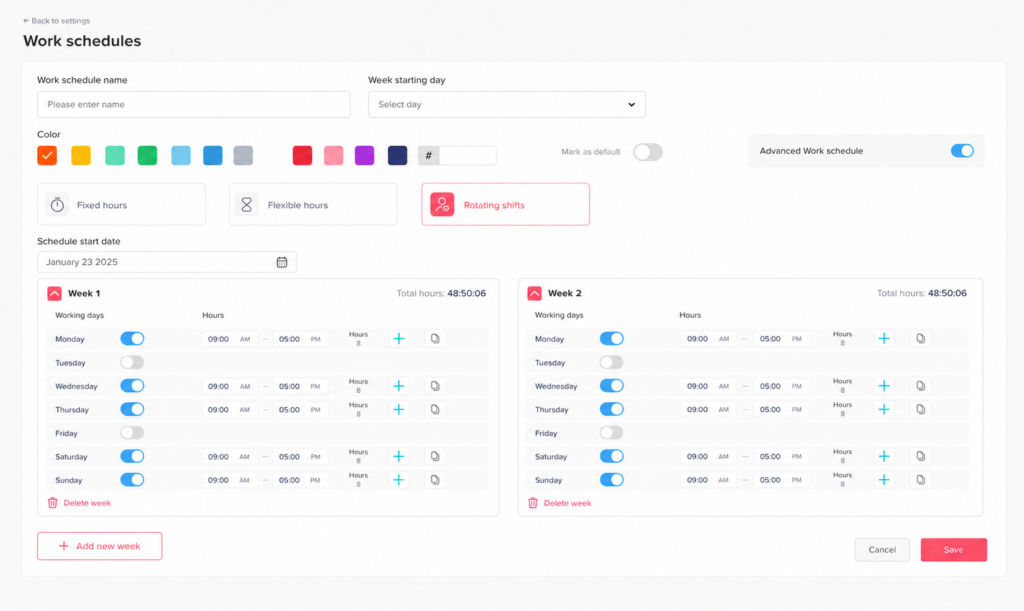
Employee schedules can be maintained alongside time records, helping managers compare scheduled hours with actual hours worked.
Day Off supports different work schedule configurations, including fixed days, fixed hours, flexible hours, and rotating shifts.
Time Reports
Employers can review time information by period and employee and use reports to understand time spent across tasks and projects.
Exportable records can also make it easier to prepare information for other HR, payroll, or administrative processes.
PTO and Attendance in the Same System
Time worked is only one part of an employee’s attendance record.
Employees may also be:
On vacation.
Sick.
On personal leave.
On another approved leave type.
Working a different schedule.
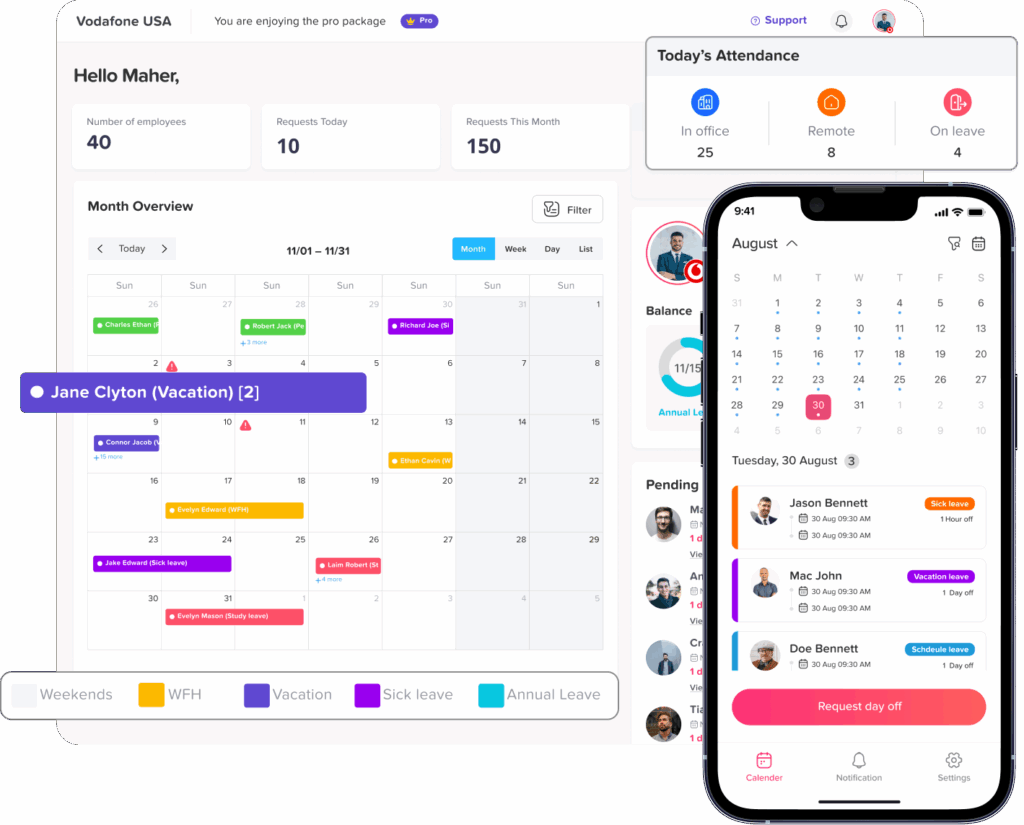
Managing PTO and attendance information together gives HR a more complete view of why an employee did or did not work scheduled hours.
Creating a Timesheet Retention Policy
Employers should document how employee time records are handled rather than making retention decisions individually.
A basic time record retention policy should answer:
What Records Are Covered?
List the documents included in the policy, such as:
Timesheets.
Clock-in and clock-out records.
Time cards.
Break records.
Work schedules.
Overtime records.
Time-entry corrections.
Payroll information.
How Long Are They Retained?
Set a retention period that accounts for federal, state, local, tax, and industry-specific requirements.
Where Are They Stored?
Identify the approved systems or storage locations.
Who Can Access Them?
Time and payroll records contain sensitive employee information, so access should be limited appropriately.
How Are Corrections Handled?
Establish a process for correcting missed punches or other errors without losing the history of the original record.
When Is Deletion Suspended?
Explain when normal deletion must stop because of an audit, investigation, legal claim, or other preservation obligation.
How Are Records Deleted?
When the retention period expires, records should be disposed of securely rather than simply abandoned in old systems, paper storage, or shared folders.
A Practical Employee Time Record Checklist
For each applicable employee, employers should consider maintaining records covering:
Employee identification.
Applicable pay period.
Workweek start.
Scheduled work.
Actual hours worked.
Daily clock-in and clock-out records.
Regular hours.
Overtime hours.
Breaks where relevant.
PTO or other leave.
Pay rate.
Wage calculations.
Timesheet adjustments.
Manager approvals.
Payroll totals.
Historical corrections.
Not every record on this list is required for every employee or jurisdiction, but maintaining a consistent structure makes time records much easier to manage.
Frequently Asked Questions About Timesheet Retention
How long does the FLSA require employers to keep timesheets?
Under Department of Labor guidance, payroll records generally need to be preserved for at least three years, while supporting wage-calculation records such as time cards and work schedules generally need to be retained for two years.
Do employers have to keep paper copies of timesheets?
Federal law does not require employers to use one particular timekeeping format. Employers may use electronic records as long as required information is accurate and can be produced when needed.
Can employers scan old paper timesheets and store them electronically?
Electronic storage can be a practical way to retain historical records as long as the records remain complete, readable, secure, and accessible for the required period.
Employers should also verify whether any specific state, industry, or contractual requirement affects the storage format.
Should employers keep time records after an employee resigns?
Yes. Recordkeeping periods continue to apply after the employment relationship ends. Employers should preserve records until all applicable retention requirements have expired.
How long should employment tax records be kept?
The IRS states that employers should retain employment tax records for at least four years after the tax becomes due or is paid, whichever is later.
Should employers keep records of timesheet corrections?
Maintaining a clear history of changes can make it easier to explain payroll calculations and investigate future disputes. A good system should document why an entry was corrected and who made or approved the correction.
Are schedules enough to prove how many hours an employee worked?
Not necessarily. A work schedule shows planned working time, while an actual time record shows what occurred. Employees may arrive early, stay late, miss work, take leave, or work outside their scheduled hours.
Do remote employees still need to track their working time?
If an employee is subject to timekeeping requirements, working remotely does not eliminate the employer’s responsibility to maintain accurate records of compensable working time.
Employers should provide remote workers with a clear process for recording all hours worked.
What happens if an employer does not have accurate time records?
Missing records can make wage disputes and government investigations significantly more difficult for an employer. Employers should maintain complete and accurate records instead of reconstructing employee hours only after a problem occurs.Can state law require employers to keep timesheets longer than federal law?
Yes. State requirements may be longer than federal requirements. For example, California requires certain hours-and-wage records to be maintained for three years, while New York requires certain payroll records to be maintained for at least six years.
Conclusion
So, how long must employers keep timesheets and time records?
Under federal FLSA rules, the answer is generally at least three years for payroll records and at least two years for supporting records used to calculate wages, including time cards and work schedules. Employment tax records are subject to a separate IRS requirement of at least four years. State laws may extend these periods considerably.
The safest approach is not to treat one retention period as a universal rule. Employers should identify the federal, state, local, tax, and industry requirements that apply to their workforce and create a written retention policy around the longest relevant obligation.
Accurate recordkeeping also begins long before records are archived. Employers need reliable processes for capturing hours worked, overtime, breaks, schedule differences, missed punches, corrections, and PTO.
Using a system such as Day Off can help centralize employee time tracking, work schedules, attendance information, PTO, projects, tasks, and reports. Keeping this information organized makes payroll reviews easier today and provides a clearer historical record when questions arise months or years later.