







A well designed PTO policy does more than explain how many vacation days employees receive. It determines how time off is earned, requested, approved, carried forward, tracked, and handled when employees change schedules or leave the company. As organizations prepare for 2027, HR teams should review these rules carefully instead of simply copying the same policy into another year.

The beginning of a new year is a natural point to review leave balances, accrual schedules, carryover rules, employee eligibility, approval workflows, work schedules, and legal requirements. It is also an opportunity to fix problems employees and managers experienced during 2026.
For organizations operating across several states, countries, locations, or employee groups, the review becomes even more important. A PTO rule that works for one employee population may not satisfy the requirements that apply somewhere else.
Preparing early gives HR teams time to identify those differences, configure their leave management system, communicate policy changes, and make sure employees understand what happens to their balances when January 1 arrives.
Why Review Your PTO Policy Before 2027?
PTO policies tend to become more complicated as companies grow.
A business may begin with a simple rule such as:
Employees receive 15 days of PTO each year.
Later, the company hires part-time workers, remote employees, people working different schedules, employees in additional states, and managers responsible for different teams.
Suddenly, 15 days is no longer the entire policy.
HR must answer questions such as:
- When does PTO begin accruing?
- Does PTO accrue during unpaid leave?
- Do part time employees receive PTO?
- What happens to unused balances on December 31?
- Can employees carry leave into 2027?
- Is there a maximum balance?
- Can employees take PTO before earning it?
- How are half days or hourly requests calculated?
- What happens when someone works a 10-hour shift instead of an 8-hour shift?
- Are company holidays deducted from PTO requests?
- Who approves requests?
- Can managers reject requests because several employees are already off?
- What happens to unused PTO when employment ends?
- How does company PTO interact with legally protected leave?
These are operational questions, but some can also create compliance issues when the written policy, payroll system, leave tracker, and actual company practice do not match.
A year end review helps bring all four back into alignment.
Start With a Legal Review of Your 2027 PTO Policy
The first step should be understanding which rules actually apply to your employees.
In the United States, there is no federal requirement under the Fair Labor Standards Act requiring private employers generally to provide paid vacation, paid holidays, or paid sick leave. Those benefits are generally established through employer policies, agreements, and applicable state or local law.
That does not mean employers can design every PTO policy however they want.
State and local laws can regulate:
- Paid sick leave
- General paid leave
- Accrual rates
- Carryover
- Employee eligibility
- Permitted uses
- Notice requirements
- PTO payout at termination
- Whether earned vacation can be forfeited
Requirements can vary considerably by location.
California PTO Example
California does not generally require employers to provide vacation. However, when an employer chooses to provide paid vacation, earned vacation is treated as wages.
California does not permit employers to take away already-earned vacation through a traditional “use it or lose it” policy. Employers may instead establish a reasonable accrual cap. Earned and unused vacation generally must also be paid when employment ends.
This makes year-end configuration particularly important.
Automatically deleting a California employee’s earned vacation balance simply because December 31 has passed can create a problem even if that same rule is permissible for another employee population.
Colorado PTO Example
Colorado similarly provides that when an employer offers vacation, vacation pay that is earned and determinable generally cannot be forfeited and must be paid when employment ends.
Illinois Paid Leave Example
Illinois provides another example of why HR teams need location-specific rules.
Under the Illinois Paid Leave for All Workers Act, covered employees can earn up to 40 hours of paid leave each year, generally at a rate of one hour for every 40 hours worked. The leave can be used for any reason, subject to the law’s requirements and exceptions.
These examples should not be treated as a complete list of U.S. leave laws. They demonstrate why companies preparing for 2027 should review every jurisdiction where employees actually work.
Remote work makes this especially important. The location of the company headquarters is not necessarily the only location that matters.
Audit Every Rule in Your Current PTO Policy
Before deciding what to change, document exactly how the current policy works.
Do not review only the employee handbook.
Compare four sources:
- Your written PTO policy
- Your leave management system
- Your payroll or HR system
- What managers and HR actually do in practice
If the handbook says employees accrue 10 hours per month but the leave system credits 120 hours every January, you already have a policy inconsistency.
Review each of the following areas.
| PTO Policy Area | Questions to Review Before 2027 |
|---|---|
| Eligibility | Who receives PTO? Full-time, part-time, temporary, probationary? |
| Accrual | How and when is leave earned? |
| Starting balance | Do new employees receive PTO immediately? |
| Waiting period | How long before employees can request leave? |
| Carryover | Can unused PTO move into 2027? |
| Carryover limit | How many hours or days can move forward? |
| Expiration | Does carried leave expire later? |
| Balance cap | Is there a maximum amount an employee can accumulate? |
| Request unit | Can employees request days, half days, or hours? |
| Notice | How far in advance should employees request planned leave? |
| Approval | Who approves the request? |
| Blackout dates | Are requests restricted during critical periods? |
| Holidays | Does a holiday inside a PTO period reduce the balance? |
| Work schedules | How is PTO deducted for different shift lengths? |
| Termination | What happens to unused leave when employment ends? |
| Rehire | Are previous balances or service periods restored? |
Decide How Employees Will Earn PTO in 2027
One of the most important policy decisions is how PTO becomes available.
Three common approaches are frontloading, periodic accrual, and hours-worked accrual.
Frontloaded PTO
Employees receive their entire allowance at the beginning of the policy year or another defined period.
For example:
Annual allowance: 120 hours
On January 1, the employee receives all 120 hours.
This method is easy for employees to understand and reduces ongoing accrual calculations. However, employers must determine what happens when someone joins or leaves during the year.
Possible rules include:
- Full annual entitlement immediately
- Prorated entitlement based on hire date
- Different allocations based on service date
- A waiting period before the balance becomes available
Periodic PTO Accrual
PTO is earned gradually.
For example, an employee entitled to 120 hours annually under a monthly accrual system might receive:
120 ÷ 12 = 10 hours per month
Alternatively, the company might accrue PTO:
- Weekly
- Biweekly
- Semimonthly
- Monthly
- Annually
The accrual interval should match what is written in the policy and configured in the leave system.
Hours Worked Accrual
For variable hour or part-time employees, PTO may instead be linked to actual eligible hours worked.
For example:
1 hour of PTO for every 30 eligible hours worked
An employee who works 90 eligible hours would earn:
90 ÷ 30 = 3 hours of PTO
Whether such a formula is appropriate depends on the company’s policy and any applicable law.
Compare the Options
| Accrual Method | How It Works | Useful For | Main Issue to Define |
|---|---|---|---|
| Frontloaded | Annual balance provided at once | Simple annual policies | Proration and termination |
| Monthly | Balance added every month | Salaried or regular schedules | Accrual timing |
| Pay-period based | PTO added each payroll cycle | Payroll-aligned policies | Number of pay periods |
| Hours worked | PTO based on eligible work hours | Variable-hour employees | Which hours count |
| Seniority based | Accrual increases with service | Retention-focused policies | Service milestones |
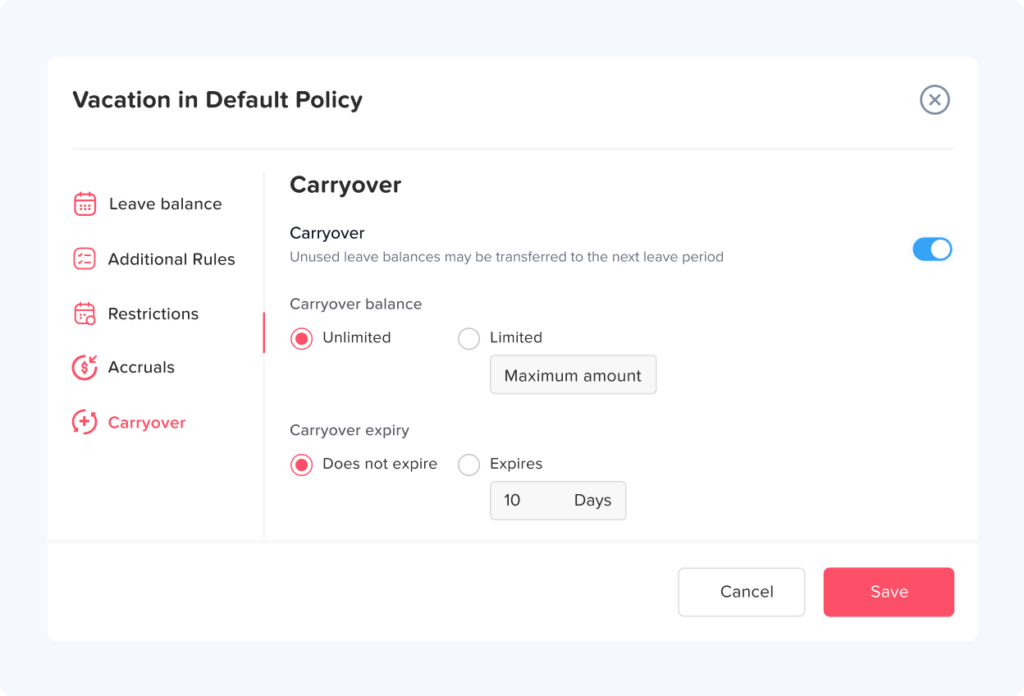
Review Carryover Before December 31
Carryover is one of the most important year-end PTO settings.
HR teams should know what will happen to every remaining balance before 2027 begins.
Possible approaches include:
Full Carryover
All remaining PTO moves into the next year.
Example:
- December 31 balance: 42 hours
- Carryover: 42 hours
- 2027 starting balance: 42 hours plus new accruals
Limited Carryover
Only part of the balance moves forward.
Example:
- Remaining balance: 60 hours
- Carryover limit: 40 hours
- Amount carried into 2027: 40 hours
Whether the other 20 hours may be forfeited depends on applicable law and how the PTO has been structured.
Carryover With Expiration
Some policies allow employees to carry PTO into the next year but require that carried balance to be used by a certain date.
For example:
Up to 40 hours may be carried into 2027 and must be used by March 31.
Again, employers should verify whether such expiration rules are permitted for the type of leave and jurisdiction involved.
Accrual Cap
Instead of removing leave at year-end, some organizations establish a maximum balance.
For example:
- Annual entitlement: 120 hours
- Maximum balance: 180 hours
Once an employee reaches 180 hours, additional accrual stops until the balance falls below the cap.
For employers operating in locations where earned vacation cannot simply be forfeited, accrual caps may be particularly important. California, for example, permits reasonable caps even though earned vacation cannot be eliminated through a use it or lose it rule.
Review PTO Rules for Part Time and Variable Hour Employees
A PTO policy written around a standard Monday to Friday, eight hour schedule can become inaccurate when the workforce becomes more flexible.
Imagine two employees.
Employee A
- Works 8 hours per day
- 5 days per week
Employee B
- Works 5 hours Monday
- 8 hours Tuesday
- 6 hours Thursday
- No scheduled work Wednesday or Friday
If both request Monday off, automatically deducting “one PTO day” creates ambiguity.
For Employee A, one scheduled day represents 8 hours.
For Employee B, Monday represents only 5 scheduled hours.
For companies using hourly PTO balances, a more precise approach is often to deduct the employee’s scheduled hours for the requested period.
This becomes particularly important for:
- Part time employees
- Variable hour employees
- 4/10 schedules
- 9/80 schedules
- Rotating shifts
- Split shifts
- Flexible schedules
Your 2027 policy should explain whether PTO is tracked in days or hours and how nonstandard work schedules affect deductions.
Decide Whether PTO Should Be Tracked in Days or Hours
Many companies begin by tracking leave in days because it appears simpler.
However, hourly tracking can provide greater accuracy when employees do not all work identical schedules.
Consider an employee working four 10-hour days each week.
If the company grants “15 PTO days,” HR needs to define what one PTO day actually represents.
Is it:
- 8 hours?
- 10 scheduled hours?
- One scheduled working day regardless of length?
Without a clear rule, employees with different schedules can receive inconsistent deductions.
Tracking PTO in hours can make policies easier to administer because the leave balance corresponds directly to scheduled working time.
For example:
Annual allowance: 120 PTO hours
If the employee misses:
- A 10-hour shift, deduct 10 hours
- A 6-hour shift, deduct 6 hours
- Half of an 8-hour shift, deduct 4 hours
The best approach depends on the organization’s work schedules, policy, payroll setup, and legal requirements.
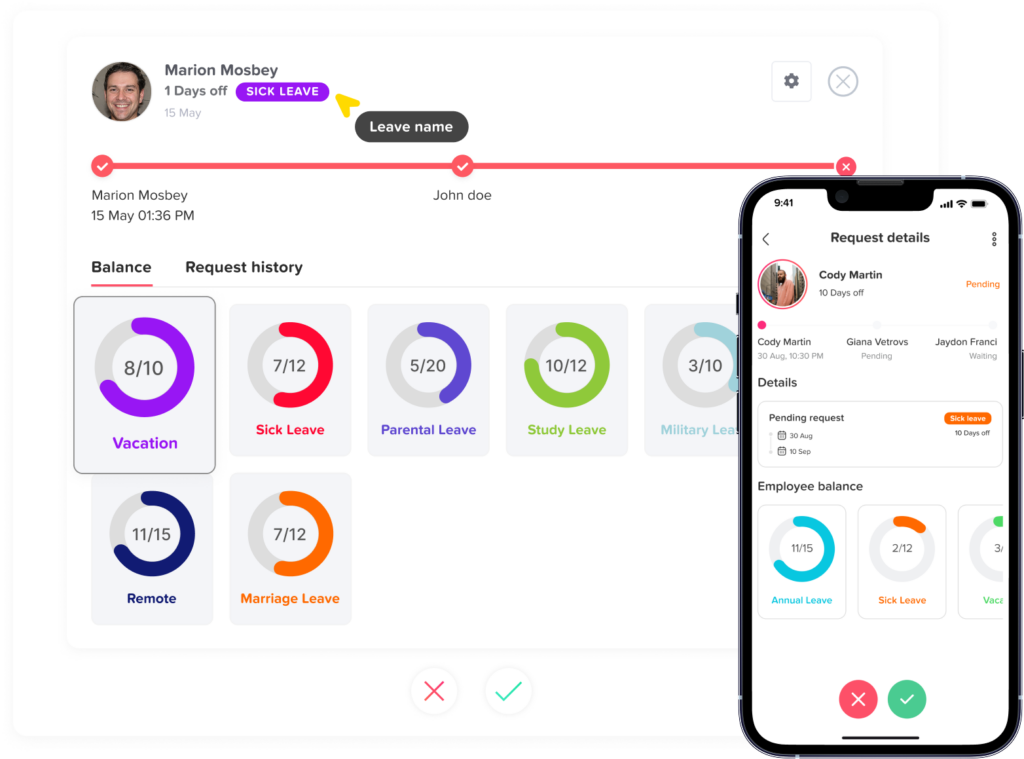
Revisit Your PTO Approval Process
A strong PTO policy should explain not only how employees earn leave but how they use it.
Questions to answer include:
- Who can approve leave?
- Is one approval sufficient?
- Does HR need to review certain requests?
- What happens if the manager is absent?
- Can another manager approve the request?
- What happens when several employees request the same date?
- What happens when the request remains unanswered?
- Are emergency absences handled differently?
- Are employees required to provide notice for foreseeable PTO?
Companies with multiple departments may need different approval workflows.
For example:
Employee → Team Manager → HR
Other organizations may require only:
Employee → Manager
There is no universal workflow. The important point is that employees know where their request goes and managers know what factors they are allowed to consider.
Set Fair Rules for Overlapping PTO Requests
Popular periods can create staffing problems.
Examples include:
- Summer vacations
- School holidays
- Thanksgiving week
- Christmas and New Year
- Major company launches
- Financial closing periods
- Seasonal business peaks
Your 2027 policy should explain how overlapping requests are evaluated.
Possible methods include:
- First requested, first considered
- Minimum staffing requirements
- Team specific limits
- Rotating priority during major holidays
- Manager review based on operational coverage
Avoid vague language that results in managers applying completely different standards.
A centralized team calendar can make this easier by allowing managers to see approved and pending absences before approving another request.
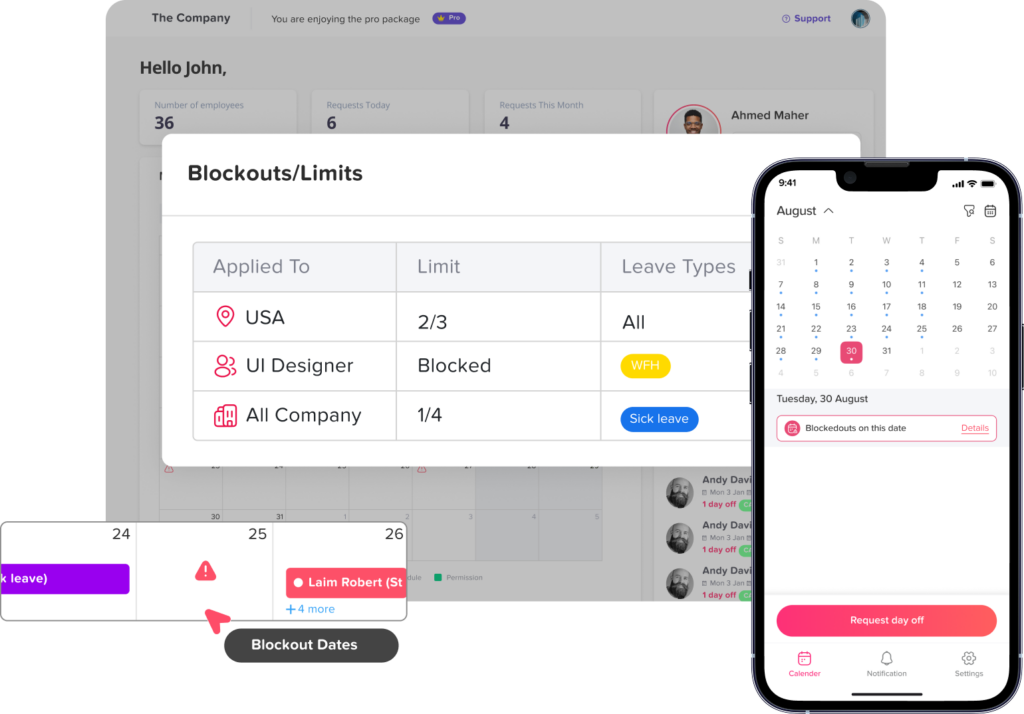
Review Your Blackout Date Rules
Some organizations use PTO blackout dates during periods when staffing is especially important.
For example, a retailer may restrict planned vacation requests during its highest volume shopping weeks.
A software company may establish restrictions around a major product launch.
If your company uses blackout dates in 2027, specify:
- Which dates are affected
- Which employees are affected
- Which leave types are restricted
- Whether existing approved requests remain valid
- How emergencies are handled
- Whether legally protected leave is excluded from the restriction
This final point matters.
A company scheduling restriction should not be written as though it overrides an employee’s statutory leave rights.
Keep Employer PTO Separate From Protected Leave
PTO and legally protected leave are not necessarily the same thing.
Under the federal Family and Medical Leave Act, eligible employees of covered employers may receive up to 12 workweeks of unpaid, job-protected leave during a 12-month period for qualifying family and medical reasons. The law also provides up to 26 workweeks in a single 12-month period for qualifying military caregiver leave.
In appropriate circumstances, accrued employer-provided paid leave may be used during FMLA leave. The Department of Labor explains that an employee may elect, or an employer may require, substitution of certain accrued paid leave when the applicable rules are satisfied.
Companies should therefore define how their PTO policies interact with:
- FMLA
- State paid family and medical leave
- Paid sick leave
- Parental leave
- Bereavement leave
- Jury duty
- Military leave
- Disability related leave
- Other legally protected absences
Do not assume that simply having a generous PTO allowance eliminates the need to administer these leave categories properly.
Pay Special Attention to Newer State Leave Programs
Companies with employees in multiple U.S. states should make reviewing state leave programs part of their annual PTO process.
For example, Minnesota’s statewide Paid Leave program began January 1, 2026 and provides payments and job protections for qualifying family and medical leave.
Minnesota also has separate earned sick and safe time requirements. As of 2026, covered employees generally must receive at least one hour of earned sick and safe time for every 30 hours worked, up to at least 48 hours accrued per year under the state requirements.
Illinois, meanwhile, has its Paid Leave for All Workers Act, which generally permits covered workers to earn up to 40 hours of paid leave that can be used for any reason.
These programs demonstrate why a nationwide company may need several leave policies instead of one identical configuration for everyone.
Before 2027 begins, create an employee location list and check the leave requirements applicable to each group.
Review Eligibility Rules
Your PTO policy should clearly identify who participates.
Possible classifications include:
- Full time employees
- Part time employees
- Temporary employees
- Seasonal employees
- Interns
- Hourly employees
- Salaried employees
- Employees in probationary periods
Avoid assuming employees understand terms such as “eligible employee.”
Define them.
For example:
Full time employees regularly scheduled to work at least 30 hours per week participate in the company’s vacation policy beginning on their first day of employment.
That is much clearer than:
Eligible employees receive PTO.
However, eligibility rules must still comply with applicable leave laws. Statutory paid sick or general paid leave may cover employees whom the employer would otherwise exclude from its voluntary vacation policy.
Review Waiting Periods
Some employers allow employees to earn PTO immediately but restrict when they may begin using it.
Example:
- Accrual begins: First day of employment
- PTO requests allowed: After 90 days
Other employers delay accrual itself.
These are different rules.
Your policy should distinguish:
Accrual eligibility
When PTO starts being earned.
Usage eligibility
When employees can start taking the PTO they have earned.
If you use a waiting period, review whether applicable state or local laws restrict how it may apply to statutory leave.
Clarify PTO Advance and Negative Balances
Another policy decision for 2027 is whether employees can use PTO before earning it.
Suppose an employee has:
Available balance: 16 hours
But requests:
24 hours
Possible policies include:
No Negative Balance
The employee can use only 16 paid hours. The remainder must be handled another way.
Limited PTO Advance
The employer allows the employee to reach a negative balance, perhaps down to:
-40 hours
Future accruals then repay that balance.
Manager Approved Advance
Negative PTO is permitted only after HR or management approval.
If your company allows PTO advances, define what happens if an employee leaves before earning back the advanced amount.
Do not automatically assume that the outstanding amount can be deducted from final wages. Wage deduction rules vary by jurisdiction.
Define How Holidays Affect PTO
Imagine an employee requests December 20 through December 31, 2027.
A company holiday occurs during that period.
Should the holiday consume PTO?
In many employer policies, it does not. The holiday is already a nonworking day.
But the written PTO policy should say so.
Also define how your system handles:
- Weekends
- Employee specific nonworking days
- Public holidays
- Location specific holidays
- Company wide holidays
This becomes increasingly important for international and distributed teams because employees may follow different holiday calendars.
Audit Employee Work Schedules Before the New Year
Even the best PTO rules produce incorrect balances if employee schedules are wrong.
Before January 2027:
- Confirm each employee’s assigned work schedule.
- Confirm scheduled working days.
- Confirm scheduled hours.
- Check part time schedules.
- Review rotating shifts.
- Check location holiday calendars.
- Verify employees who changed schedules during 2026.
- Check employees moving to new schedules in January.
This is particularly important when PTO is deducted by scheduled hours.
If an employee’s leave system still shows an old eight hour schedule after the employee moves to six hour shifts, future PTO deductions may be inaccurate.
Audit Current PTO Balances
Before carrying balances into a new year, confirm they are correct.
For each employee, review:
**Opening balance
- PTO earned
- Manual adjustments
- Carryover received
- PTO used
= Current balance**
Investigate unusual balances such as:
- Very large unused balances
- Negative balances
- Employees with no accrual history
- Employees above policy caps
- Recently hired employees with full annual balances
- Terminated employees still accruing leave
- Employees assigned to the wrong leave policy
Correcting these issues before January is much easier than trying to reconstruct balances several months later.
Review Carryover Separately From New Year Accrual
Carryover and new entitlement are two separate calculations.
Consider an employee who ends 2026 with:
32 unused hours
The company allows:
Up to 24 hours carryover
The employee also receives:
120 new PTO hours for 2027
The calculation becomes:
24 carryover hours + 120 new hours = 144 starting hours
If there is also a maximum balance of 130 hours, HR must determine how the cap interacts with those two amounts.
Policies should explain this explicitly instead of leaving employees to discover the answer from their January balance.
Decide How Seniority Affects PTO in 2027
Some companies provide additional PTO based on years of service.
Example:
| Length of Service | Annual PTO |
|---|---|
| Less than 1 year | 80 hours |
| 1-3 years | 120 hours |
| 4-6 years | 160 hours |
| 7+ years | 200 hours |
If you use this model, determine exactly when an employee moves into a new tier.
Possible rules include:
- January 1 of the qualifying year
- Employee anniversary date
- Beginning of the next pay period
- Beginning of the following month
For example, an employee reaches three years of service on May 17.
If the next tier begins at three years, does the employee receive the higher rate:
- January 1?
- May 17?
- June 1?
- Next year?
Document the answer and configure your accrual system accordingly.
Review PTO Rules for Rehired Employees
Rehiring raises several overlooked questions.
If an employee leaves in March and returns in September:
- Is the employee treated as a new hire?
- Is previous service recognized?
- Is the waiting period repeated?
- Does seniority resume?
- Are old PTO balances restored?
- Does previous leave history remain visible?
The correct policy may depend on company rules and applicable laws.
What matters operationally is that HR has a defined rehire process instead of making the decision individually for each returning employee.
Build a Consistent Request and Cancellation Process
Your 2027 PTO policy should explain the entire lifecycle of a request.
Employee Submits Request
The employee provides:
- Leave type
- Start date
- End date
- Partial day information if applicable
- Reason, if appropriate and permitted
- Supporting documents when legitimately required
Manager Reviews
The manager checks:
- Available balance
- Staffing
- Team calendar
- Request notice
- Existing absences
- Applicable policy
Request Is Approved or Rejected
The employee should receive a clear notification.
Balance Is Updated
Approved PTO should be reflected accurately.
Request Is Changed or Cancelled
If dates change, the system should return or recalculate the appropriate balance.
Defining this workflow reduces manual adjustments later.
Communicate 2027 PTO Changes Before They Take Effect
Changing the policy without explaining the change can create unnecessary employee confusion.
If possible, communicate important changes before the beginning of the policy year.
Explain:
What Is Changing
Example:
Beginning January 1, 2027, PTO will accrue monthly rather than being provided as one annual balance.
Why It Is Changing
Example:
The change is intended to align PTO earning with employee service throughout the year.
Who Is Affected
Example:
This change applies to U.S. full-time employees participating in the general PTO policy.
What Happens to Existing Balances
This is often the most important question.
Employees need to know:
- Whether 2026 balances carry over
- Whether there is a carryover cap
- Whether balances expire
- Whether previously earned PTO remains available
- When the first 2027 accrual occurs
Where Employees Can Ask Questions
Give employees a clear contact person or HR channel.
How PTO Management Software Can Help Prepare for 2027
The more policy rules you introduce, the harder manual PTO administration becomes.
A leave management platform can help centralize:
- PTO balances
- Accruals
- Carryover
- Employee work schedules
- Holiday calendars
- Leave requests
- Approval workflows
- Team availability
- Leave history
- Reports
With Day Off, companies can create different leave policies, configure accruals and carryover rules, manage employee schedules and locations, handle PTO requests and approvals, and give employees access to their current balances through the web, iOS, and Android apps.
Managers can also use a shared calendar to see employee availability before approving overlapping requests, while HR can review leave reports instead of calculating every balance manually.
For organizations managing more complex schedules, connecting leave management with accurate work schedules is particularly useful because PTO deductions can reflect the hours employees were actually scheduled to work.
FAQ
Do Employers Have to Provide PTO in 2027?
At the U.S. federal level, the FLSA does not generally require employers to provide paid vacation, sick leave, or holiday pay.
However, states and local jurisdictions may require paid sick leave, general paid leave, or other forms of leave. Employers therefore need to review the requirements applying where their employees work.
Can PTO Expire at the End of 2026?
It depends on the policy, the type of leave, and applicable law.
Some jurisdictions restrict forfeiture of earned vacation. California, for example, considers earned vacation wages and does not permit a use-it-or-lose-it approach for vested vacation.
Employers should review local requirements before implementing automatic year-end expiration.
How Much PTO Should Employees Receive in 2027?
There is no single PTO allowance that is appropriate for every employer.
Companies should consider factors such as:
- Applicable law
- Industry
- Employee classification
- Work schedule
- Company size
- Recruiting strategy
- Existing benefits
- Seniority
The important part is making the entitlement and calculation method clear.
Should PTO Be Tracked in Hours or Days?
Both methods can work, but hours are often easier when employees have different shift lengths or flexible schedules.
For example, an employee scheduled for six hours can have six PTO hours deducted rather than an ambiguous “one day.”
Can Employees Use PTO During FMLA Leave?
In qualifying circumstances, accrued employer-provided paid leave can run during FMLA leave. Federal rules allow employees to elect, or employers in certain circumstances to require, substitution of accrued paid leave while FMLA protections apply.
Employers should ensure their written policies and FMLA procedures explain how the two interact.
When Should Companies Review Their PTO Policy?
At minimum, a structured review before each new policy year is useful.
Companies should also review the policy when:
- Entering a new state or country
- Hiring remote employees in a new jurisdiction
- Introducing new work schedules
- Changing payroll frequency
- Changing accrual methods
- Introducing new leave types
- Changing carryover rules
- Expanding significantly
- Applicable leave laws change
Final Thoughts
Preparing your PTO policies for 2027 should involve more than updating a date in the employee handbook.
A useful policy connects legal requirements, employee eligibility, accrual rules, carryover, work schedules, approvals, holidays, staffing, reporting, and employee communication into one consistent process.
Start by auditing your 2026 setup. Verify employee balances, schedules, locations, accruals, carryover settings, and approval workflows. Then review the rules that apply in each jurisdiction where your employees work.
Most importantly, make the final policy easy for employees and managers to understand.
When employees can clearly see how much PTO they have, how they earn it, what happens at year-end, and how to request time off, HR spends less time correcting balances and answering repetitive questions.
Day Off helps companies manage PTO, vacation, sick leave, accruals, carryover, employee schedules, approvals, team calendars, and leave reports from one platform.
Prepare your 2027 leave policies before the new year begins, configure them correctly, and give employees a simpler way to manage their time off.