





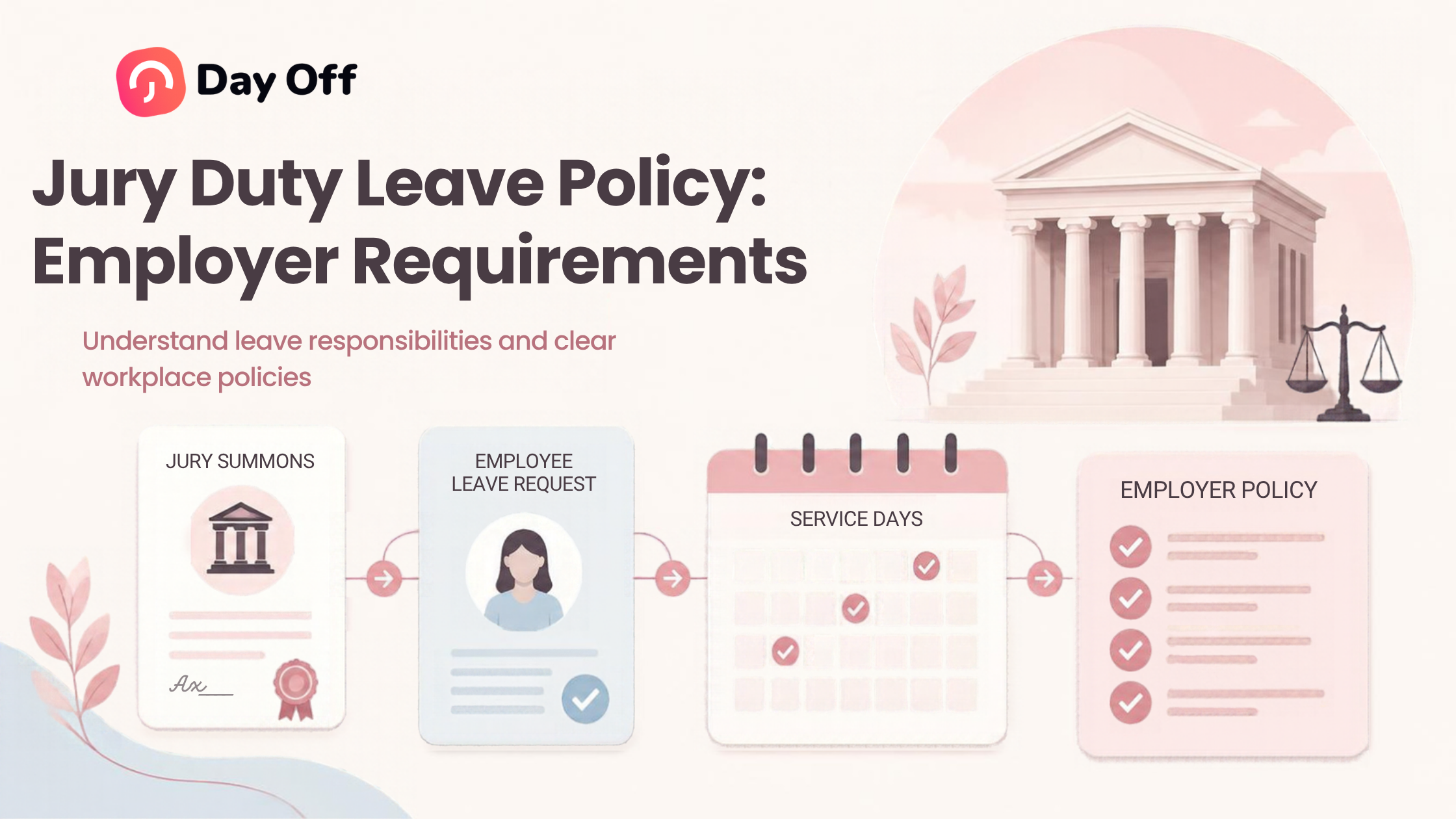
A Jury Duty Leave Policy explains how employees should notify their employer when they receive a jury summons, what documentation may be required, whether the leave is paid or unpaid, and how the employee’s job will be protected while they serve. For employers, having a clear policy is important because jury service is a civic obligation and is protected by law in many situations. At the federal level, employers may not discharge, threaten, intimidate, or coerce permanent employees because they serve or are scheduled to serve on a federal jury.

A good jury duty leave policy should balance legal compliance with practical workforce planning. Employees need enough flexibility to attend court, while managers need a reliable process for recording the absence, arranging coverage, and understanding whether wages must continue during the leave.
This guide explains the main employer requirements for jury duty leave in the United States, including federal protections, pay rules, documentation, exempt employee considerations, state-law differences, and recommended HR procedures.
What Is Jury Duty Leave?
Jury duty leave is time away from work that allows an employee to respond to a jury summons, report to court, participate in jury selection, or serve as a juror.
Depending on the circumstances, the employee may be away from work for:
- Part of one day
- Several full days
- Multiple consecutive weeks
- Intermittent periods while waiting to determine whether they must report
The length of jury service depends on the court, the type of case, and whether the employee is selected for a jury.
Employers should not treat jury duty the same way as ordinary vacation or discretionary personal leave. Jury service is a legal civic responsibility, and specific federal or state protections may apply.
Why Employers Need a Jury Duty Leave Policy
Without a clear policy, employees and managers may be unsure about what happens after a jury summons arrives.
Common questions include:
- How quickly must the employee notify the employer?
- Does the employee have to provide a copy of the summons?
- Will the employee continue receiving wages?
- Can PTO be required?
- What happens if the employee is dismissed from court early?
- Must the employee return to work?
- Can the company ask the court to excuse the employee?
- How should long jury trials be handled?
A written policy gives HR and managers a consistent process to follow.
It can also help prevent inappropriate decisions, such as disciplining an employee simply because jury service caused scheduling difficulties.
Federal Jury Duty Protections for Employees
Federal law provides important employment protections for employees serving on federal juries.
Under 28 U.S.C. § 1875, an employer may not discharge, threaten to discharge, intimidate, or coerce a permanent employee because of the employee’s federal jury service, attendance, or scheduled attendance.
Violating this protection can lead to consequences for the employer.
The law provides that an employer who violates the statute may be required to:
- Pay damages for lost wages or benefits
- Reinstate an employee who was unlawfully terminated
- Comply with an injunction preventing further violations
- Pay a civil penalty of up to $5,000 for each violation involving each employee
- Potentially perform community service.
This means an employer cannot simply tell an employee that jury service is inconvenient and that failure to report for work will result in termination.
Do Employers Have to Allow Employees Time Off for Jury Duty?
Employers generally must allow employees to comply with lawful jury service obligations.
For federal jury service, employees are protected against retaliation or coercion because they are serving or scheduled to serve. Federal courts also make clear that employers cannot fire employees because they are absent from work for federal jury service.
State laws may provide additional protections for state or local jury service.
Employers with employees in multiple states should review the laws in every jurisdiction where they operate because requirements can differ significantly.
Does Federal Law Require Paid Jury Duty Leave?
Generally, no.
The Fair Labor Standards Act does not require employers to pay employees for time that is not worked because of jury duty. According to the U.S. Department of Labor, jury duty pay is generally a matter of agreement between the employer and employee unless another law requires payment.
Federal courts also state that federal law does not generally require private employers to continue an employee’s regular salary during jury service.
However, this does not mean employers can automatically make every jury duty absence unpaid.
State law, local law, employment contracts, collective bargaining agreements, employer policies, and the employee’s exempt or nonexempt status may affect payment obligations.
Jury Duty Pay: Federal Rules vs. Employer Policy
The distinction between job protection and pay is important.
| Issue | General Federal Rule |
|---|---|
| Must employer allow federal jury service? | Employees are protected from retaliation because of federal jury service |
| Must employer pay hourly/nonexempt employee for jury duty? | Generally not required by the FLSA |
| Can employer voluntarily offer paid jury duty leave? | Yes |
| Are federal jurors paid by the court? | Yes, generally $50 per day |
| Can state law require additional employer pay? | Yes |
| Can special salary rules apply to exempt employees? | Yes |
Federal jurors generally receive $50 per day from the court. Certain jurors may receive a higher amount after extended service, and reimbursement may also be available for transportation and other qualifying expenses.
Jury Duty Pay for Nonexempt Employees
For nonexempt employees, federal wage law generally does not require employers to pay for hours the employee does not work because of jury duty.
For example, assume a nonexempt employee normally works eight hours on Tuesday but spends the entire day at court.
Under federal law alone, the employer generally would not be required to pay those eight hours unless:
- State or local law requires payment
- The employer’s jury duty policy provides paid leave
- A collective bargaining agreement requires it
- An employment agreement provides it
- The employee uses an available paid-leave benefit under an applicable policy
Many employers choose to offer a limited number of paid jury duty days even when it is not legally required.
Jury Duty Pay for Exempt Salaried Employees
Employers need to be more careful with deductions from the salary of exempt employees.
Under the FLSA salary basis rules, employers generally cannot deduct from an exempt employee’s salary for an absence caused by jury duty when the employee performs any work during that workweek.
The employer may, however, offset amounts the employee receives as jury fees against the salary owed for that week.
For example:
An exempt employee earns a fixed weekly salary and works Monday and Tuesday before serving on jury duty Wednesday through Friday.
The employer generally cannot deduct three days of salary merely because the employee was attending jury duty.
However, if the employee received qualifying jury fees, federal salary-basis rules may permit the employer to offset those fees against the salary due.
If an exempt employee performs no work at all during an entire workweek, different salary rules may apply.
Employers should review exempt-employee payroll decisions carefully before making deductions.
State Jury Duty Leave Laws Matter
Federal law is only one part of compliance.
States may establish additional jury duty requirements, including:
- Paid jury duty leave
- Minimum pay requirements
- Job reinstatement rights
- Rules about PTO use
- Restrictions on scheduling employees before or after jury service
- Documentation requirements
- Anti retaliation protections
- Criminal or civil penalties
Because these rules vary, employers should not create a nationwide jury duty policy based only on federal law.
A multi state employer may need a general company policy with state specific supplements.
Can Employers Require Employees to Use PTO for Jury Duty?
This depends on applicable law and the employer’s policy.
Some employers offer a separate paid jury duty leave benefit. Others allow employees to use vacation or PTO if the jury leave would otherwise be unpaid.
However, employers should review state law before requiring an employee to use accrued vacation or PTO.
A safer policy is often to clearly distinguish between:
Jury duty leave: The employee’s protected absence from work.
Pay during jury duty: Whether the employer provides wages, allows PTO, or treats the leave as unpaid.
An employee’s right to be absent should not automatically depend on whether the employee has PTO available.
What Should a Jury Duty Leave Policy Include?
A good Jury Duty Leave Policy should answer the main questions employees and managers will face.
Employee Eligibility
Explain who is covered by the policy.
For example:
Employees summoned for jury service will be provided leave in accordance with applicable federal, state, and local law.
Avoid limiting legally protected leave only to full time employees unless applicable law allows that distinction.
Employee Notification Requirements
Employees should notify HR or their manager as soon as reasonably possible after receiving a jury summons.
The policy might require employees to:
- Inform their supervisor
- Notify HR
- Submit a leave request
- Provide a copy of the jury summons
- Update the company if the dates change
Employees should not wait until the morning of jury service if they received the summons weeks earlier.
Documentation
Employers may reasonably request documentation showing that the employee has been called for jury service.
Common documents include:
- Jury summons
- Court notice
- Proof of attendance
- Jury service certificate
Federal courts may provide certificates or other proof of attendance when requested.
The policy should avoid requesting unnecessary information about the actual case.
Pay During Leave
Clearly state whether jury duty leave is:
- Fully paid
- Paid for a limited number of days
- Partially paid
- Unpaid unless required by law
- Supplemented by PTO
If rules differ between exempt and nonexempt employees, explain that clearly.
Treatment of Jury Fees
If the company continues regular pay during jury duty, it should explain whether employees may keep court-paid jury fees.
Some employers:
- Allow employees to keep the full jury fee
- Require employees to remit the jury fee
- Offset the jury payment against company paid jury leave where permitted
For exempt employees, federal salary rules allow employers to offset qualifying jury fees against salary in certain situations.
Employers should review state rules before adopting an offset policy.
Returning to Work
The policy should explain what employees should do if they are dismissed from court early.
For example:
Employees who are released from jury service significantly before the end of their scheduled workday should contact their manager to determine whether they are expected to return to work.
Avoid rigid return to work requirements that do not account for travel time, court schedules, fatigue, or state-law restrictions.
Long Term Jury Service
Some jury trials can last several weeks or longer.
Your policy should explain how employees should:
- Keep HR informed
- Provide updated court documentation
- Report expected service dates
- Communicate changes in the court schedule
HR should also plan for temporary coverage rather than pressuring the employee to avoid jury service.
Can an Employer Ask the Court to Excuse an Employee?
Employers generally should not assume they can remove employees from jury duty simply because their absence is inconvenient.
Federal courts commonly state that employers cannot request an excuse on behalf of an employee. The juror usually must request an excuse or postponement directly from the court.
The final decision belongs to the court.
If an employee’s absence would create significant hardship for the business, an employer may sometimes provide supporting information if the court permits it. However, employers should not pressure employees to avoid jury service.
Can an Employer Fire an Employee for Jury Duty?
For federal jury service, employers cannot legally discharge a permanent employee because of the employee’s jury service or scheduled attendance.
Employers also should avoid indirect retaliation such as:
- Threatening termination
- Reducing hours because of jury service
- Demoting the employee
- Intimidating the employee
- Pressuring the employee not to report
- Penalizing the employee under an attendance policy
State laws may provide additional protections.
Managers should therefore understand that jury duty should not be treated as an ordinary unexcused absence.
What About Attendance Point Systems?
Employees should not generally receive attendance penalties for protected jury duty leave where the law prohibits adverse treatment.
For example, if a company’s attendance policy gives employees points for every absence, HR should ensure jury service is correctly coded and excluded where legally required.
Otherwise, an employee could eventually be disciplined because jury leave incorrectly accumulated attendance points.
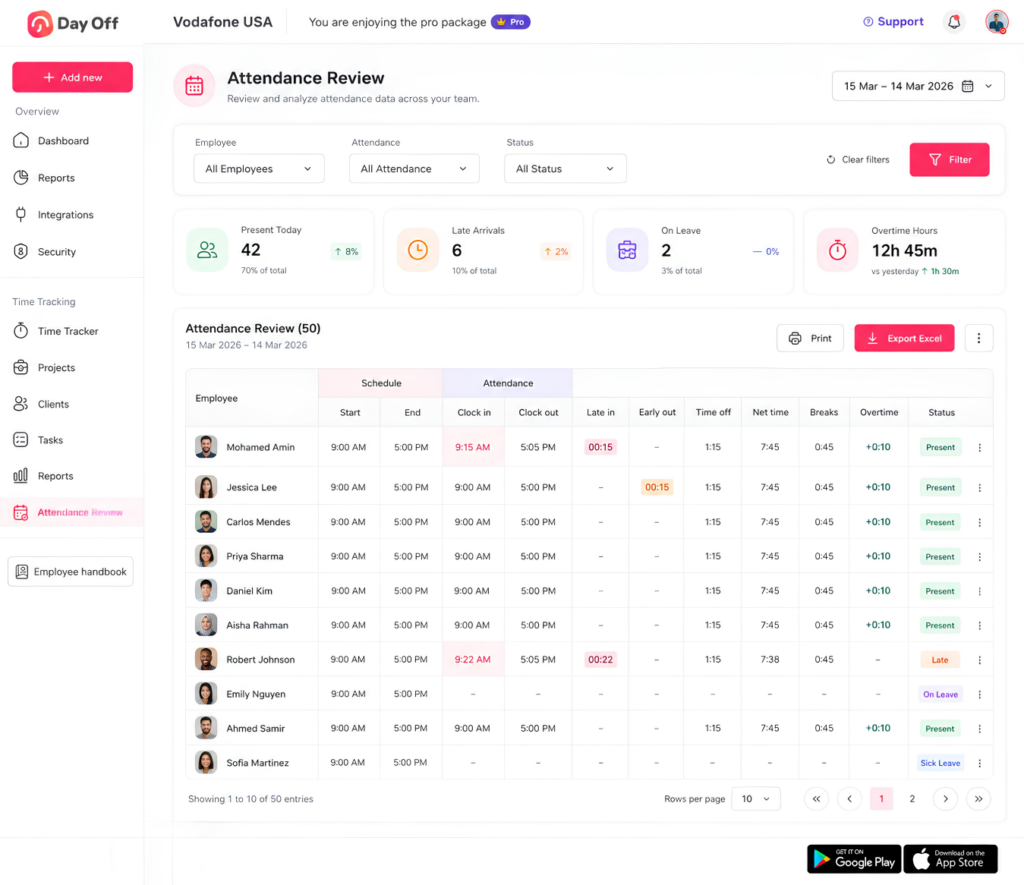
Leave management systems can help prevent these administrative errors by keeping protected or approved leave separate from ordinary attendance violations.
Can Employers Require Employees to Work Before or After Jury Duty?
This is another area where state law may matter.
A company should avoid creating a policy that automatically requires employees to work a full shift before or after a full day in court without reviewing local requirements.
Important considerations include:
- How long the employee spent at court
- Commute time
- Overnight shifts
- Safety sensitive duties
- State specific jury duty protections
- Applicable rest requirements
For example, requiring an employee to work an overnight shift immediately before morning jury service may create both legal and safety concerns.
A reasonable policy should give managers discretion while complying with applicable law.
What If the Employee Is Summoned but Never Selected?
Jury duty leave is not limited to employees who ultimately sit on a jury.
Employees may need time away from work to:
- Report for jury selection
- Wait at the courthouse
- Participate in voir dire
- Remain available under an on call juror system
If the employee was legally required to attend, the absence should generally be handled according to the company’s jury duty policy even if the employee was never selected for a trial.
What If Jury Duty Lasts Several Weeks?
Long jury trials can create genuine operational challenges, particularly for small companies.
However, employers should focus on temporary workforce planning instead of discouraging jury service.
Possible approaches include:
- Redistributing responsibilities
- Temporarily adjusting schedules
- Hiring temporary coverage
- Cross training employees
- Reassigning nonessential duties
- Establishing interim approval responsibilities
The employee should continue updating HR if the court extends the expected service period.
Jury Duty and Remote Employees
Remote employees are still subject to jury service requirements based on the applicable court summons.
An employee cannot generally continue normal remote work while physically attending court.
Employers should treat the absence according to the same jury duty policy used for onsite employees.
However, a remote employee who is released early may sometimes be able to resume work more easily because there is no commute back to a workplace.
The policy should still prioritize applicable law and the employee’s actual court schedule.
Recommended Jury Duty Leave Process for HR
A consistent workflow reduces mistakes.
Step 1: Receive the Employee’s Notification
The employee informs HR or their manager that they received a jury summons.
Record:
- Date notice was received
- Scheduled jury date
- Expected length of service, if known
Step 2: Review Documentation
Request a copy of the summons or other appropriate documentation if permitted.
Confirm which dates the employee is expected to be unavailable.
Step 3: Check Applicable Laws
Determine whether federal, state, or local requirements affect:
- Pay
- Job protection
- PTO use
- Scheduling
- Documentation
Step 4: Record the Leave Correctly
The absence should be classified as jury duty rather than ordinary vacation, sick leave, or an unexcused absence.
Step 5: Arrange Coverage
Managers can prepare for the absence by:
- Reallocating work
- Scheduling another employee
- Changing deadlines
- Identifying backup responsibilities
Step 6: Maintain Communication
For extended jury service, ask the employee to provide reasonable updates when court schedules change.
Step 7: Process Payroll Correctly
Determine whether the employee is:
- Nonexempt or exempt
- Entitled to paid jury leave under company policy
- Covered by a state pay requirement
- Receiving court jury fees
Payroll should avoid improper salary deductions.
Step 8: Confirm Return to Work
When jury service ends, update the employee’s leave record and schedule.
Jury Duty Leave Policy Example
The following is a general example and should be customized to applicable law.
Jury Duty Leave
Employees who receive a summons for jury service should notify their supervisor and Human Resources as soon as reasonably possible after receiving the summons.
Employees may be asked to provide a copy of the jury summons or other reasonable documentation confirming the dates of jury service.
The company will provide employees with time away from work to fulfill jury service obligations in accordance with applicable federal, state, and local law.
Compensation during jury duty leave will be administered according to applicable law and company policy. Where jury duty leave is unpaid, employees may be permitted to use available paid leave where allowed.
Employees should keep their manager informed of significant changes to their jury service schedule and should notify the company when jury service has ended.
Employees who are released from jury duty before the end of the workday should contact their supervisor regarding whether they are expected to return to work, taking into account travel time, the court schedule, applicable law, and other relevant circumstances.
The company will not discharge, threaten, intimidate, retaliate against, or otherwise unlawfully penalize an employee for lawful jury service.
This sample is intended as general guidance and should be reviewed for compliance with the laws that apply to the employer’s workforce.
Common Jury Duty Policy Mistakes
Treating Jury Duty as an Unexcused Absence
Managers should not classify properly reported jury service as ordinary absenteeism.
Doing so can result in inappropriate discipline or attendance penalties.
Assuming Jury Leave Must Always Be Paid
Federal law generally does not require private employers to pay nonexempt employees for time not worked due to jury service, although state law may require payment.
The employer needs to check the applicable jurisdiction.
Assuming Jury Leave Can Always Be Unpaid
The opposite assumption is also risky.
State law, salary-basis rules for exempt employees, contracts, or company policies may require continued pay in certain circumstances.
Making Improper Exempt Salary Deductions
An employer generally cannot deduct an exempt employee’s salary because of jury duty when that employee performs work during the workweek.
Payroll teams should understand this rule before processing jury leave.
Requiring Employees to Avoid Jury Service
Managers should not pressure employees to seek excuses merely because coverage is difficult.
The court determines whether an employee may be excused.
Applying One Policy Across Every State Without Review
Jury duty laws differ by state.
A national employer may need location-specific policies or HR guidance.
Requiring Employees to Use Vacation Automatically
Using vacation time for jury service may be restricted by policy or state law.
Employers should verify the applicable rules before making PTO mandatory.
Jury Duty Leave Policy Checklist
Before publishing a policy, HR should confirm that it answers the following questions:
- Who is eligible for jury duty leave?
- Who must employees notify?
- How quickly should employees report a summons?
- Is documentation required?
- Is jury duty leave paid or unpaid?
- Are rules different for exempt employees?
- Can employees use PTO?
- What happens to jury fees?
- What should employees do if released early?
- How are long trials handled?
- How should managers record the absence?
- What state laws apply?
- Are employees protected against retaliation?
- Who should managers contact when they have questions?
If these points are unclear, employees and supervisors may handle similar situations differently.
How Day Off Can Help Manage Jury Duty Leave
A jury summons may be unpredictable, but the leave itself should still be recorded accurately.
Day Off allows companies to create and manage different leave types so jury duty can be tracked separately from vacation, sick leave, personal leave, or other absences.
HR teams can use Day Off to:
- Create a dedicated jury duty leave type
- Receive employee leave requests
- Maintain employee leave records
- Manage approval workflows
- View employee absences on shared calendars
- Coordinate team coverage
- Track different leave policies
- Review employee leave history
- Manage work schedules
- Keep PTO balances separate from other types of leave
For businesses that also use attendance and time tracking, keeping schedules, approved leave, and attendance records together makes it easier for managers to understand why an employee is unavailable.
For example, a manager reviewing the schedule can identify that an employee is on approved jury duty leave rather than mistakenly marking the employee as absent.
This becomes especially useful for organizations managing several leave types across multiple employees or locations.
Best Practices for Employers
A strong jury duty policy should be legally compliant, but it should also be easy for employees to follow.
Employers should consider these best practices:
- Put the policy in the employee handbook.
- Explain it during onboarding.
- Use a dedicated jury duty leave category.
- Ask employees to notify HR promptly.
- Request only reasonable documentation.
- Train managers on anti retaliation protections.
- Review state laws regularly.
- Coordinate HR and payroll procedures.
- Avoid automatic PTO deductions.
- Check exempt salary rules before reducing pay.
- Keep attendance records accurate.
- Apply the policy consistently.
Most importantly, managers should understand that jury duty is not simply another scheduling inconvenience. Employees are responding to a legal summons and may have limited control over the timing or length of their service.
FAQ
Does an employer have to let an employee attend jury duty?
Employers must comply with applicable jury-service protections. For federal jury service, employers cannot discharge, threaten, intimidate, or coerce permanent employees because of their service or scheduled attendance.
Is jury duty leave required to be paid?
Federal law generally does not require private employers to pay nonexempt employees for jury duty time. Some states impose additional payment requirements, and employer policies may provide paid leave.
How much do federal jurors receive?
Federal jurors generally receive $50 per day, with potential increases for certain extended service periods and reimbursement for qualifying expenses.
Can an employer fire someone for jury duty?
An employer cannot legally fire a permanent employee because of federal jury service. State law may provide additional protections for state court service.
Can an employer ask for proof of jury duty?
Employers can generally request reasonable proof, such as a jury summons or attendance confirmation, subject to applicable law.
Does an employee have to use PTO for jury duty?
Not necessarily. Whether PTO may or must be used depends on the employer’s policy and applicable state or local law.
Can an employer deduct jury duty from an exempt employee’s salary?
Generally, an employer cannot make salary deductions for jury-duty absences when the exempt employee performs work during that workweek. However, the employer may offset certain jury fees.
Can an employer ask the court to excuse an employee?
Federal courts commonly state that excuse requests generally must come from the juror rather than the employer. The court decides whether an excuse or postponement will be granted.
Does an employee need to return to work after jury duty ends early?
That depends on company policy, applicable law, travel time, and the circumstances. A policy should explain what employees should do when released early.
Should jury duty count against an attendance policy?
Protected jury service should not be treated as ordinary unexcused absenteeism or used as a basis for unlawful retaliation.
Conclusion
A clear Jury Duty Leave Policy helps employers meet legal obligations while keeping employee absences organized and predictable. The policy should explain how employees report jury service, what documentation is needed, how pay will be handled, and what happens when the employee returns to work.
Under federal law, employers cannot discharge, intimidate, threaten, or coerce permanent employees because of federal jury service. Federal law generally does not require private employers to pay nonexempt employees for jury duty, but state requirements and exempt salary rules can create additional obligations.
For HR teams, the best approach is to combine a well written policy with accurate leave records, manager training, and regular reviews of state and local requirements. Tools such as Day Off can help employers keep jury duty leave separate from vacation and other absences, coordinate team availability, and maintain a clearer record of employee leave.