







Employees rarely clock in and out at perfectly round times. One employee might start at 8:57 AM, another at 9:03 AM, and another might finish at 5:06 PM.
When employers calculate hundreds or thousands of employee time entries, those small differences can create questions about payroll and working hours. Historically, some employers have handled this by rounding employee time to fixed increments, such as the nearest five minutes, tenth of an hour, or quarter hour.
One of the best-known approaches is commonly called the 7-minute rule.

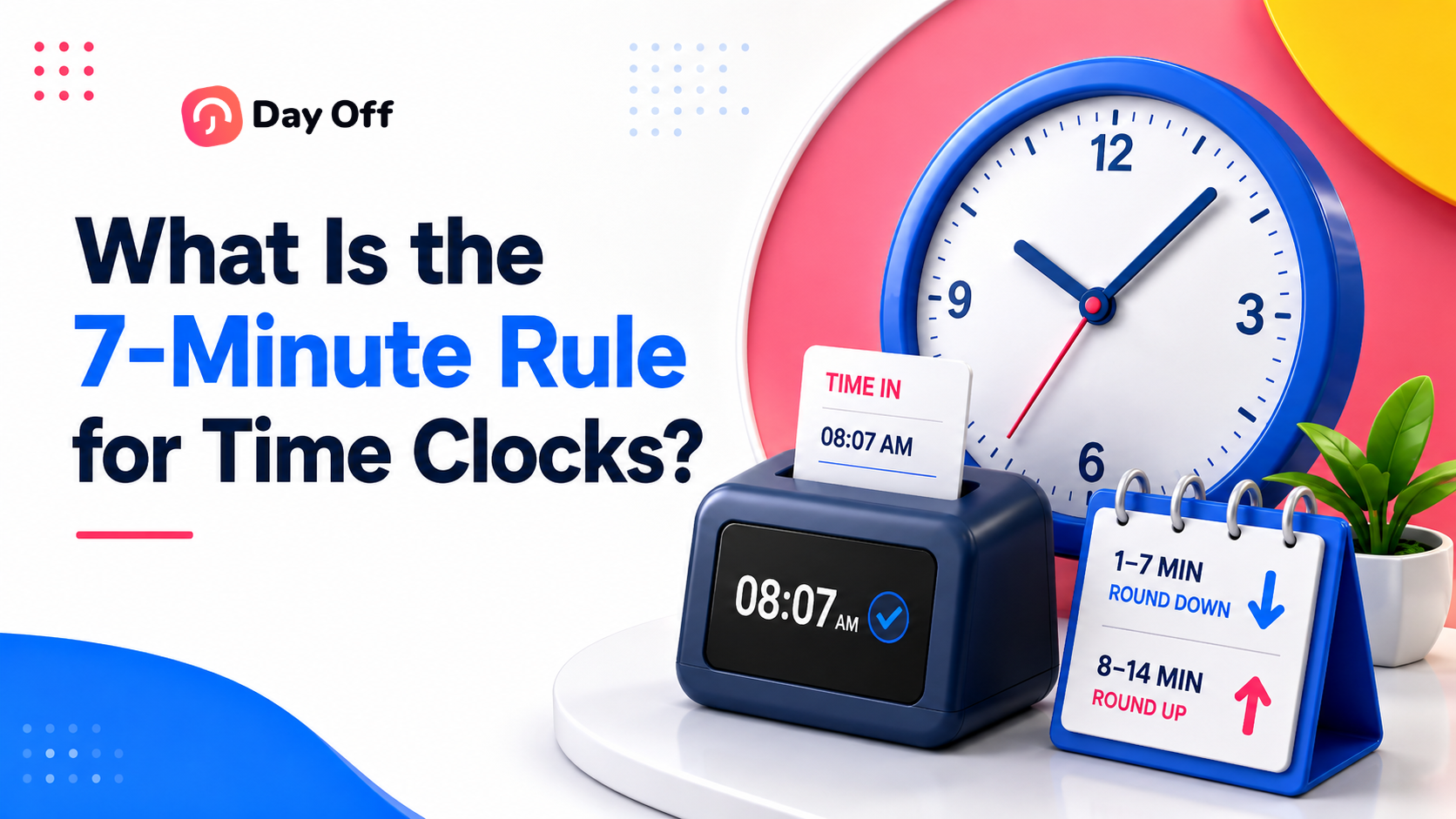
Under the traditional federal quarter-hour rounding approach, a time entry that falls 1 to 7 minutes into a 15-minute interval may be rounded back, while a time entry that falls 8 to 14 minutes into the interval is rounded forward to the next quarter hour. The important condition is that the rounding system must not consistently deprive employees of compensation for time they actually work.
For example:
8:07 AM → 8:00 AM
but:
8:08 AM → 8:15 AM
That is where the phrase “7-minute rule” comes from.
However, this does not mean employers can simply remove the first seven minutes of every employee’s shift. The rule is about neutral time rounding, and federal guidance expects the practice to average out over time so employees are properly compensated for all hours worked.
What Is the 7-Minute Rule?
The 7-minute rule is a common name for a quarter-hour time rounding method used in employee timekeeping.
It divides every hour into four 15-minute periods:
- :00
- :15
- :30
- :45
Within each quarter-hour interval, times are rounded to the nearest quarter hour.
The traditional rule works like this:
| Actual Time | Rounded Time |
|---|---|
| 8:01 AM | 8:00 AM |
| 8:04 AM | 8:00 AM |
| 8:07 AM | 8:00 AM |
| 8:08 AM | 8:15 AM |
| 8:11 AM | 8:15 AM |
| 8:14 AM | 8:15 AM |
| 8:15 AM | 8:15 AM |
The first seven minutes are closer to the previous quarter hour, while minutes eight through fourteen are closer to the next one.
This is why the rule is sometimes also called the 7/8 rule or quarter-hour rounding rule.
The U.S. Department of Labor gives the same federal example: time from one through seven minutes may be rounded down, while time from eight through fourteen minutes must be rounded up to a full quarter hour.
Is the 7-Minute Rule a Federal Law?
Not exactly.
There is no federal statute commonly titled the “7-minute rule.”
Instead, the term describes one application of the federal time-rounding principles found in 29 CFR § 785.48(b) and Department of Labor guidance.
Federal guidance recognizes that some employers have historically recorded employee starting and stopping times to the nearest:
- 5 minutes
- One-tenth of an hour
- Quarter hour
These arrangements can be acceptable when they average out over time so employees are fully compensated for all the time they actually work.
The key requirement is therefore not:
“Employers may remove up to seven minutes.”
It is:
A rounding system must operate neutrally and cannot result, over time, in employees being underpaid for actual working time.
That distinction is extremely important when creating a time clock policy.
How the 7-Minute Rule Works
Consider an employee whose scheduled shift begins at 9:00 AM.
| Actual Clock-In | Rounded Time | Why? |
|---|---|---|
| 9:03 AM | 9:00 AM | Falls within the first 7 minutes |
| 9:09 AM | 9:15 AM | Falls within the next 7-minute range |
Rounding Should Work in Both Directions
Quarter-hour rounding should be applied consistently and neutrally. If time can round backward in one part of the interval, it should also be allowed to round forward when the punch falls on the other side.
For example:
- 9:03 AM → 9:00 AM
- 9:09 AM → 9:15 AM
The system should not be designed so that rounding consistently reduces employees’ recorded working time.
Why Consistency Matters
A rounding policy that repeatedly favors the employer can create wage-and-hour compliance risks. If rounding causes employees to lose compensable working time over time, it may affect minimum wage or overtime calculations.
The key principle is that quarter-hour rounding should operate fairly in both directions, rather than systematically rounding employee time down.
Why Is It Called the 7-Minute Rule?
The rule comes from dividing each 15-minute interval around its midpoint.
Midpoint of 15 minutes: 7 minutes 30 seconds
Because most timekeeping systems round using whole minutes, the midpoint is handled like this:
- 1 to 7 minutes → round back to the previous quarter-hour
- 8 to 14 minutes → round forward to the next quarter-hour
Example: 10:00 to 10:15
| Actual Time | Rounded Time |
|---|---|
| 10:07 | 10:00 |
| 10:08 | 10:15 |
Example: 10:15 to 10:30
| Actual Time | Rounded Time |
|---|---|
| 10:22 | 10:15 |
| 10:23 | 10:30 |
The Rule Applies Throughout the Hour
The 7-minute rule is not limited to the beginning or end of a shift. It applies whenever a time punch falls between two 15-minute increments, using the same rounding pattern throughout the entire hour.
Example: Clocking In With the 7-Minute Rule
Suppose an employee is scheduled to start work at 8:00 AM. Their actual clock-in times over five days are:
| Day | Actual Clock-In | Rounded Time |
|---|---|---|
| Monday | 8:03 AM | 8:00 AM |
| Tuesday | 7:56 AM | 8:00 AM |
| Wednesday | 8:07 AM | 8:00 AM |
| Thursday | 7:53 AM | 8:00 AM |
| Friday | 8:08 AM | 8:15 AM |
Round the Punch, Not the Schedule
The employee’s scheduled start time should not replace the rounding calculation. The rounding rule should be applied to the employee’s actual recorded punch.
The question is not:
“Was the employee close enough to 8:00 AM?”
Instead, ask:
“Which quarter-hour increment does the actual clock-in round to under the employer’s neutral policy?”
Payroll Rounding vs Attendance Rules
Time rounding and attendance policies serve different purposes.
Payroll rounding determines how recorded working time is converted for payroll calculations.
Attendance rules determine whether an employee is considered early, on time, or late based on their scheduled shift.
For example, an employee may clock in at 8:03 AM and have that time rounded to 8:00 AM for payroll, while still being considered 3 minutes late under the company’s attendance policy.
Time Rounding Is Not the Same as a Grace Period
A common mistake is treating the 7-minute rule as permission for employees to arrive up to seven minutes late. It is not necessarily a seven-minute grace period.
For example, suppose an employee is scheduled to start at 9:00 AM but clocks in at 9:06 AM. Under a quarter-hour payroll rounding policy, that punch may be rounded to 9:00 AM for payroll purposes.
However, the employer may still have an attendance policy requiring employees to be ready to work at 9:00 AM. In that case, the employee could still be considered late even though the payroll system rounds the punch back to 9:00 AM.
Payroll Rounding and Attendance Are Different
The two rules serve different purposes:
- Payroll rounding determines how recorded working time is calculated for payroll.
- Attendance rules determine whether an employee followed their scheduled start and end times.
This distinction is important. A rounded payroll time should not automatically determine whether an employee was early, on time, or late.
For this reason, employers should preserve the employee’s actual punch time, even when a separate rounded time is used for payroll calculations.
Can Employers Round Employee Time Under the FLSA?
Federal guidance permits certain rounding arrangements, but only when they are operated appropriately.
The Department of Labor explains that rounding to the nearest five minutes, one-tenth of an hour, or quarter hour can be acceptable provided the arrangement does not, over time, result in employees failing to receive compensation for all of the time they actually worked.
This means employers should look at the effect of the rounding policy over time, not just whether the formula looks neutral on paper.
Suppose a system technically rounds in both directions but workplace practices mean employees consistently arrive early and leave late.
If those extra minutes are repeatedly rounded away while employees are actually performing work, the employer should review whether the policy is producing systematic underpayment.
A mathematically symmetrical rule is not a license to ignore actual compensable work.
Example: Why Employers Cannot Simply Ignore Extra Minutes
The Department of Labor gives a useful example showing the difference between rounding time and ignoring time worked.
Suppose an employee works 12 minutes beyond their scheduled shift each day for five days.
Over the week, those extra minutes add up to:
12 minutes × 5 days = 60 minutes
That equals:
1 additional hour of work
If the employer records time only in complete 15-minute increments and simply ignores those 12-minute periods, the employee would lose an entire hour of compensable working time.
This becomes especially important when the employee has already worked 40 hours in the workweek, because the missing hour could result in unpaid overtime.
The Key Difference
A lawful rounding system applies a consistent method to recorded punches.
It does not allow an employer to disregard actual working time simply because each individual period is shorter than 15 minutes.
The key lesson: Rounding time is not the same as ignoring time worked.
Can Employers Always Round Down the First Seven Minutes?
No. This is one of the most common misunderstandings about the 7-minute rule.
The rule does not mean that employers can automatically treat the first seven minutes of work as unpaid time.
For example, an employer should not apply a policy such as:
“The first seven minutes employees work are unpaid.”
That is not how quarter-hour rounding works.
Rounding Must Work in Both Directions
Under a traditional quarter-hour rounding system:
8:07 → 8:00
while:
8:08 → 8:15
The same neutral method should be applied consistently throughout the workday.
Why This Matters
The Department of Labor warns that a rounding practice may violate federal wage-and-hour requirements if it consistently rounds employee time downward.
Employers should therefore review the overall effect of their rounding policy, not just the formula itself, to make sure employees are not repeatedly losing compensable working time.
The key principle: rounding should be neutral, not consistently favor the employer.
Does Early Clock-In Automatically Count as Work?
Not necessarily.
An employee might arrive early and clock in before the scheduled shift without performing any work.
Federal guidance explains that early or late punching does not automatically become hours worked when the employee performs no work during that time.
For example:
Scheduled start: 9:00 AM
Clock-in: 8:53 AM
Actual work begins: 9:00 AM
If the employee simply waits and performs no work during those seven minutes, the fact that the time clock shows an early punch does not necessarily mean the employee worked seven additional minutes.
But the situation changes if the employee starts working.
Suppose the employee clocks in at 8:53 AM and immediately:
- Opens required systems
- Responds to customers
- Prepares equipment
- Starts required paperwork
- Begins assigned tasks
Those activities may be compensable working time.
The employer should therefore determine when work actually began, rather than relying solely on scheduled time.
What If Employees Work Before or After Their Shift?
Employers should be especially careful when employees regularly work outside their scheduled hours.
Federal working-time principles generally require covered nonexempt employees to be paid for time they are required or permitted to work. The Department of Labor warns that failing to count all hours worked can result in minimum wage or overtime violations.
For example:
Scheduled: 9:00 AM to 5:00 PM
but an employee regularly works:
8:52 AM to 5:09 PM
If that extra time represents actual compensable work, employers should not assume it can simply be removed because the employee’s official schedule is 9:00 to 5:00.
The work schedule tells managers what was expected.
The time record tells managers what actually happened.
That distinction is essential for accurate attendance and payroll records.
7-Minute Rule and Overtime
Time rounding becomes especially important when an employee is close to the 40-hour overtime threshold.
Under the standard federal FLSA rule, covered nonexempt employees generally qualify for overtime after working more than:
40 hours in a workweek
Even a small amount of lost working time can therefore affect overtime pay.
Example
Suppose an employee’s actual recorded time for the week is:
40 hours 50 minutes
If an employer uses one-sided rounding to remove those additional 50 minutes, the employee may lose overtime compensation that should have been included.
The Department of Labor has warned that repeatedly disregarding small amounts of working time can add up and result in unpaid overtime.
What Employers Should Review
Employers should not look only at individual clock-in and clock-out punches. They should also review how rounding affects the employee’s total compensation over time, including:
- Total weekly hours worked
- Overtime hours
- Minimum wage compliance
- Payroll totals
Is the 7-Minute Rule the Same in Every State?
No.
The federal FLSA establishes a national baseline, but employers also need to consider state and local wage-and-hour requirements.
Some jurisdictions may apply stricter standards or interpret time rounding differently.
California is a particularly important example.
In Donohue v. AMN Services, LLC, the California Supreme Court held that employers cannot round meal-period time punches. The court emphasized the precise timing requirements associated with California meal periods and concluded that rounding was inappropriate in that context.
The court also noted that modern electronic systems can record exact punch times, reducing some of the practical reasons employers historically relied on rounding.
That does not mean employers should assume every type of rounding is automatically prohibited everywhere in California or elsewhere. It does mean that businesses should review the laws and current court decisions that apply in each employee’s location before adopting one nationwide rounding rule.
Can Meal Breaks Be Rounded?
Employers need to be particularly careful with meal-period punches.
Federal law and state laws may treat meal periods differently, and certain states have specific requirements about when meal periods must begin and how long they must last.
In California, the state’s Supreme Court specifically held that employers cannot use rounded punches to determine compliance with meal-period requirements.
The case illustrates why a rounded record can sometimes hide what actually happened.
For example:
Actual meal period: 12:04 PM to 12:25 PM
Actual duration:
21 minutes
A system rounding to ten-minute increments could theoretically display:
12:00 PM to 12:30 PM
which looks like a compliant 30-minute meal period even though the employee actually received only 21 minutes.
This is one reason employers should preserve exact break records when applicable law depends on precise timing.

Time Rounding vs Exact Time Tracking
Time rounding developed when recording every employee’s exact minutes could be administratively difficult.
Modern digital time-tracking software has changed that.
A web-based time clock can record:
Clock-in: 8:57 AM
Clock-out: 5:06 PM
without requiring payroll staff to calculate handwritten punch cards manually.
That creates two possible approaches.
Rounding
The company applies a legally compliant rounding policy after capturing punches.
Potential advantages include simpler payroll calculations under certain systems.
Potential disadvantages include additional compliance questions, employee confusion, and the need to confirm that the rounding remains neutral over time.
Exact-Time Tracking
The employer records and calculates time from actual punches.
This gives managers a more detailed record of:
- Exact clock-ins
- Exact clock-outs
- Late arrivals
- Early departures
- Break durations
- Overtime
- Schedule variance
For employers already using modern time-tracking technology, exact records can often simplify attendance review because managers do not need to reconstruct what happened from rounded numbers.
Why Employers Should Preserve Actual Punches
Even when a business uses rounding for a particular payroll process, preserving the employee’s original punch can be useful.
Consider:
Actual clock-in: 8:54 AM
Rounded payroll time: 9:00 AM
If the company saves only 9:00 AM, HR loses information about what actually happened.
Keeping the original punch allows managers to determine:
- Whether the employee actually worked early
- Whether the employee was within the scheduled attendance window
- Whether rounding is operating neutrally
- Whether a payroll dispute needs investigation
- Whether overtime was affected
- Whether the same pattern happens repeatedly
An audit trail is therefore much more useful than simply replacing the actual time with the rounded result.
Time Rounding and Attendance Are Different
Payroll rounding and attendance tracking serve different purposes, so employers should keep them separate.
Example 1: Employee Clocks In Late
Scheduled start: 8:00 AM
Actual clock-in: 8:06 AM
Rounded payroll time: 8:00 AM
Even though the payroll system rounds the punch back to 8:00 AM, the employee actually clocked in at 8:06 AM.
For attendance purposes, that difference may still matter.
Example 2: Employee Clocks In Early
Scheduled start: 8:00 AM
Actual clock-in: 7:54 AM
Rounded payroll time: 8:00 AM
The rounded payroll time does not show whether the employee started working before their scheduled shift. The employer may still need to review the actual punch and determine when work began.
What Should Be Recorded?
A reliable attendance system should keep these as separate records:
- Scheduled time: when the employee was expected to work
- Actual clock time: when the employee actually clocked in or out
- Rounded payroll time: the time used for payroll calculations, if rounding is applied
Keeping all three separate helps managers accurately review lateness, early starts, schedule differences, and payroll calculations without losing the original attendance data.
Time Rounding for Remote Employees
Remote work makes accurate timekeeping just as important as office-based work.
A remote employee may start their workday by opening a company system, answering emails, joining a video call, or beginning a task.
If the employee is required to track working hours, the same timekeeping rules should apply regardless of location.
Employers should establish a clear policy covering:
- When remote employees start the timer
- When they stop the timer
- How breaks are recorded
- How missed punches are corrected
- What happens when work continues after clock-out
- Whether time rounding is used
The fact that an employee works from home does not make actual working time less important.
Should Businesses Still Use the 7-Minute Rule?
There is no single answer for every business. Some employers may continue using a compliant rounding policy, while others may find that exact-time tracking is simpler and more transparent.
Before deciding, employers should consider several factors.
Federal Requirements
The first question is whether the rounding method properly compensates employees over time.
Employers should review whether the policy operates neutrally and whether small rounding differences are accumulating in a way that reduces paid working time.
State and Local Rules
Federal guidance is only part of the picture.
Employers should also check whether the employee’s state or local jurisdiction restricts or prohibits the type of rounding being considered.
Time-Tracking Technology
Modern timekeeping systems can record exact clock-in and clock-out times automatically.
Employers should ask:
Can the system reliably calculate actual worked time without rounding?
If the answer is yes, rounding may no longer provide the same administrative benefit it once did.
Payroll Complexity
Rounding should only be used if it genuinely makes payroll easier.
If the company still needs to review exceptions, original punches, overtime, and attendance separately, rounding may actually add another layer of complexity.
Employee Transparency
Employees should be able to understand how their recorded time becomes paid time.
A clear system reduces confusion and makes it easier to resolve payroll questions or disputes.
Auditability
HR and managers should still be able to access the employee’s original punch times, even if rounded values are used for payroll.
This makes it easier to review attendance, overtime, and whether the rounding policy is working fairly over time.
How Day Off Helps Track Employee Time Accurately
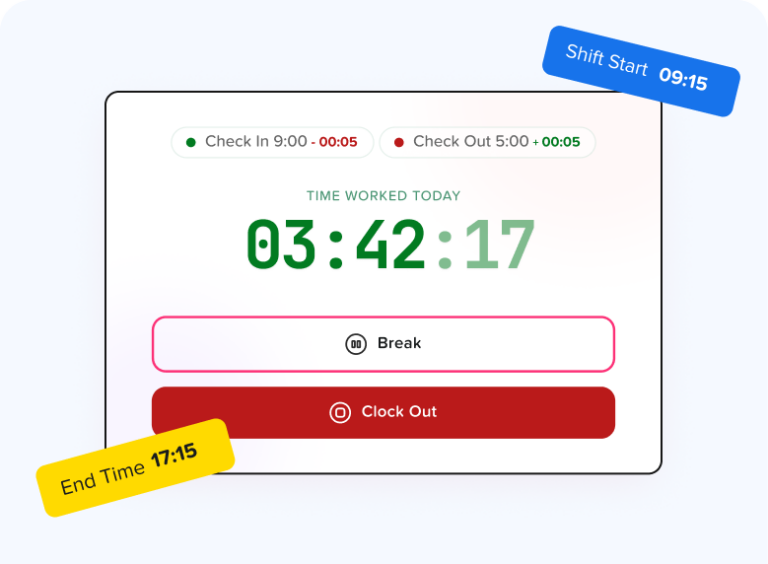
Day Off Time Tracker gives companies a digital way to track actual employee working time alongside work schedules, PTO, attendance, tasks, and projects.
Employees can punch in and punch out, while managers can compare the resulting attendance with the employee’s assigned schedule. Day Off uses work schedules to help calculate worked hours, late time, and overtime.
This provides the exact context managers need before making payroll or attendance decisions.
Track Actual Clock-In and Clock-Out Times
Day Off allows employees to record their start and end times through its Time Tracker.
Instead of relying on handwritten timesheets or reconstructing attendance later, managers have a digital record of when employees punched in and out.
This can be especially useful when a company wants to preserve exact punches rather than automatically reducing every entry to a rounded time.
For example:
Scheduled start: 9:00 AM
Actual clock-in: 8:56 AM
The actual attendance record provides managers with the information needed to understand what happened.
Compare Actual Attendance With the Work Schedule
A clock-in becomes much more useful when it is compared with the employee’s schedule.
Day Off supports work schedules including fixed, flexible, and rotating arrangements. The assigned schedule provides the reference point for understanding attendance.
For example:
Scheduled: 9:00 AM to 5:00 PM
Actual: 9:12 AM to 5:28 PM
Managers can see both the planned schedule and actual attendance rather than having one overwrite the other.
Review Late Time and Overtime
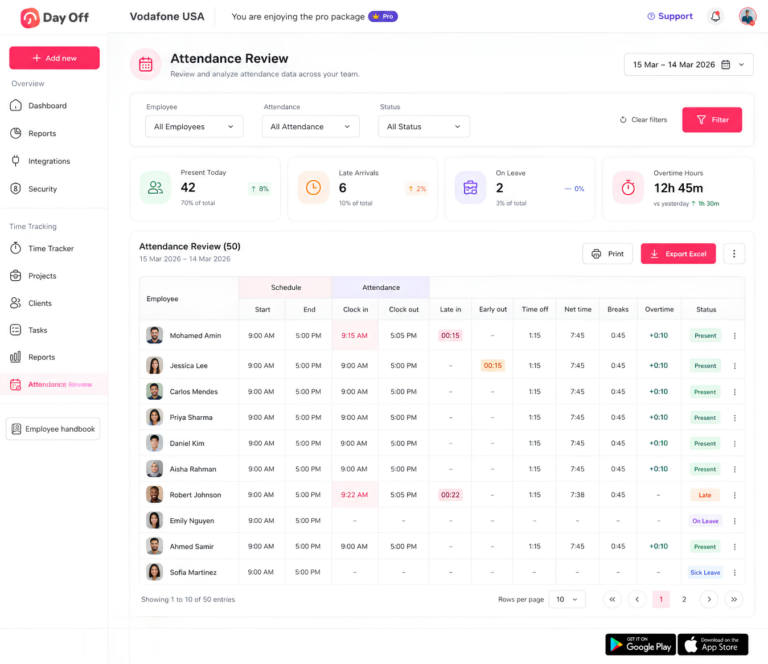
Day Off’s Attendance Review separates the employee’s scheduled times from their actual clock-in and clock-out activity.
Managers can review:
- Schedule start
- Schedule end
- Actual clock-in
- Actual clock-out
- Late time
- Early departure
- Time off
- Net working time
- Breaks
- Overtime
This makes it easier to understand the difference between what the employee was scheduled to work and what actually happened.
That distinction is particularly valuable when companies are reviewing whether a timekeeping practice could hide early starts, late finishes, or other attendance exceptions.
Keep PTO Separate From Worked Time
Day Off also connects employee attendance with PTO and other approved leave.
Attendance Review displays Time off separately from actual worked time, helping managers understand why an employee may have fewer working hours on a particular day.
For example:
Scheduled: 8 hours
Worked: 6 hours
Approved PTO: 2 hours
The two missing hours can be identified as approved leave rather than incorrectly interpreted as a timekeeping problem.
Track Projects and Tasks
Companies that need more than basic attendance can also use Day Off’s task-based Time Tracker.
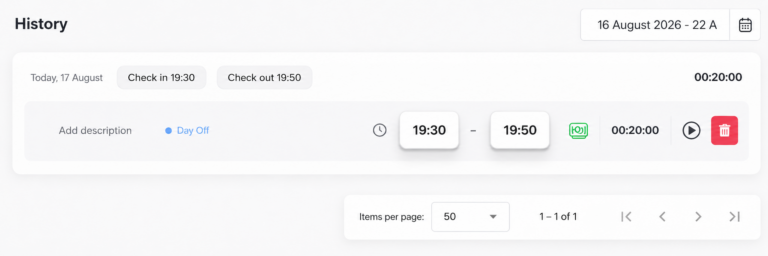
Time sessions can be connected with projects and tasks, and completed sessions are stored with their start time, end time, duration, and other work details. Entries can also be edited when a timer was stopped too early or left running too long.
This provides another layer of time information for teams that need to understand not only when employees worked, but also where those hours went.
Export Attendance for Payroll Review
Day Off allows Time Tracking and Attendance Review information to be exported for internal reporting, recordkeeping, and payroll preparation.
Managers can therefore review attendance exceptions first and then provide cleaner records for payroll rather than relying on a list of unexplained punches.
Best Practices for Time Clock Rounding
Employers considering the 7-minute rule or another time-rounding approach should build the policy around accurate compensation rather than convenience alone.
A good process should:
- Record the employee’s actual punch whenever possible.
- Apply any rounding formula consistently in both directions.
- Never use rounding solely to reduce paid working time.
- Review the results over time for patterns of underpayment.
- Keep attendance rules separate from payroll rounding rules.
- Count compensable work performed before or after scheduled shifts.
- Review state and local rules before applying a company-wide policy.
- Be especially careful with meal-period rounding.
- Explain the rounding method clearly in the timekeeping policy.
- Give employees a simple way to report incorrect time records.
A rounding rule that employees cannot understand or HR cannot audit is likely to create more problems than it solves.
7-Minute Rule Examples at a Glance
Here is a simple quarter-hour rounding reference:
| Actual Punch | Rounded Punch |
|---|---|
| 9:00 | 9:00 |
| 9:01 | 9:00 |
| 9:04 | 9:00 |
| 9:07 | 9:00 |
| 9:08 | 9:15 |
| 9:11 | 9:15 |
| 9:14 | 9:15 |
| 9:15 | 9:15 |
| 9:16 | 9:15 |
| 9:22 | 9:15 |
| 9:23 | 9:30 |
| 9:29 | 9:30 |
| 9:30 | 9:30 |
This is an illustration of traditional nearest-quarter-hour rounding under federal guidance. It does not override state law or determine whether a particular period qualifies as compensable working time.
Frequently Asked Questions About the 7-Minute Rule
What is the 7-minute rule for time clocks?
The 7-minute rule is a common name for quarter-hour time rounding.
Under the traditional federal rounding method, punches that fall 1 to 7 minutes after a quarter hour may be rounded back, while punches that fall 8 to 14 minutes after a quarter hour are rounded forward to the next 15-minute increment.
For example:
8:07 AM → 8:00 AM
8:08 AM → 8:15 AM
The same pattern can apply to clock-out times.
Is the 7-minute rule legal?
The 7-minute rule is not a separate federal law. It is a common way of applying the time-rounding principles recognized under 29 CFR 785.48(b).
Federal guidance allows certain rounding practices when they average out over time and do not result in employees being underpaid for hours actually worked.
State laws may impose stricter requirements, so employers should also review the rules that apply where their employees work.
Can an employer round employee time?
Under federal guidance, employers may use certain time-rounding methods, including rounding to the nearest five minutes, one-tenth of an hour, or quarter hour, provided the practice does not result over time in employees losing compensation for actual working time.
A rounding policy should not consistently work in the employer’s favor.
What is the 15-minute rule for time clocks?
The 15-minute rule generally refers to rounding employee punches to the nearest quarter hour.
Because 15 minutes is divided around the midpoint, the usual pattern is:
1 to 7 minutes → round backward
8 to 14 minutes → round forward
For example:
9:22 AM → 9:15 AM
9:23 AM → 9:30 AM
What happens if I clock in 7 minutes late?
Under a traditional quarter-hour rounding system:
9:07 AM → 9:00 AM
for timekeeping purposes.
However, this does not necessarily mean you are considered on time.
Payroll rounding and attendance rules are separate. An employer may still consider a 9:07 arrival late if your scheduled start time is 9:00 AM.
What happens if I clock in 8 minutes late?
Under quarter-hour rounding:
9:08 AM → 9:15 AM
This is because minute eight falls on the other side of the midpoint between 9:00 and 9:15.
Whether the employee also receives an attendance penalty depends on the employer’s attendance policy.
Can I clock in 7 minutes early?
That depends on your employer’s policy.
Under traditional quarter-hour rounding:
8:53 AM → 9:00 AM
However, an employer can establish rules about how early employees are allowed to clock in or begin working.
Federal guidance also distinguishes between simply punching early and actually performing work. An early clock-in is not automatically compensable working time if no work is performed.
If I clock in early, does my employer have to pay me?
It depends on whether you actually worked.
If you clock in early but simply wait for your shift to begin without performing work, that period is not necessarily considered hours worked.
If you begin performing compensable work, such as opening required systems, serving customers, preparing equipment, or completing assigned tasks, the time may need to be included in your working hours.
Federal guidance states that early or late punching is not hours worked when no work is performed.
Can an employer always round down 7 minutes?
No.
An employer should not interpret the 7-minute rule as permission to automatically remove seven minutes from every employee’s workday.
Federal guidance specifically warns that always rounding downward can violate minimum wage or overtime requirements. The system should operate in both directions and average out over time.
Can an employer round 8 minutes down?
Under the traditional nearest-quarter-hour method, no.
Once a punch reaches eight minutes after the previous quarter hour, it normally rounds forward.
For example:
10:08 AM → 10:15 AM
Rounding 10:08 back to 10:00 while also rounding other punches against employees would not follow the standard quarter-hour method.
Does the 7-minute rule mean employees have a 7-minute grace period?
No.
The 7-minute rule is a time-rounding method, not automatically a workplace grace period.
An employer can still require an employee scheduled at 9:00 AM to be ready to work at 9:00 AM.
Someone arriving at 9:06 AM could still be considered late under the company’s attendance policy, even if a payroll rounding system treats the punch differently.
Does the 7-minute rule apply when clocking out?
Yes, if the employer uses quarter-hour rounding consistently for both starting and stopping times.
For example:
5:07 PM → 5:00 PM
5:08 PM → 5:15 PM
Federal guidance emphasizes that rounding should not consistently reduce employee working time.
What happens if I work 10 minutes after my shift ends?
If those 10 minutes represent actual compensable work, they should not simply be ignored.
The Department of Labor gives an example in which an employee works 12 additional minutes each day for five days. Those minutes total one full hour of additional work, and ignoring them can create an overtime violation.
Small amounts of work can become significant when they occur repeatedly.
Can my employer change my clock-in time to my scheduled start time?
An employer may correct inaccurate records, but simply replacing actual working time with the scheduled time can create problems if the employee actually performed work outside the schedule.
For example:
Scheduled: 9:00 AM
Actual work begins: 8:50 AM
Automatically changing the record to 9:00 AM could remove actual compensable working time.
The schedule shows what was expected. The time record should accurately reflect what actually happened.
Can employers round overtime hours?
A lawful rounding system may affect the total hours used in an overtime calculation, but employers cannot use rounding to systematically remove compensable time.
Federal law generally requires covered nonexempt employees to receive overtime for hours worked over 40 in a workweek. Improper rounding can therefore affect overtime pay when employees are close to or above that threshold.
Does the 7-minute rule apply to lunch breaks?
Employers should be especially careful when rounding meal-period punches.
Federal and state rules may treat meal periods differently, and certain jurisdictions impose stricter requirements.
A rounded meal record can sometimes hide the employee’s actual break duration, so employers should review applicable state and local rules before applying rounding to meal periods.
Is the 7-minute rule the same in every state?
No.
Federal FLSA guidance provides a baseline for time rounding, but states can create stricter wage-and-hour rules.
Employers with employees in multiple states should therefore avoid assuming that one rounding policy will automatically be appropriate everywhere.
Can an employer round only in its own favor?
No.
A policy that repeatedly rounds time in a way that benefits the employer can result in employees losing compensable working time.
The Department of Labor states that rounding is acceptable only when it does not, over time, result in employees failing to receive proper compensation for all the time they actually worked.
Is exact time tracking better than rounding?
For many businesses, modern digital time tracking makes it possible to record exact clock-in and clock-out times without manually calculating punch cards.
Exact records can make it easier to review lateness, overtime, early starts, breaks, and differences between scheduled and actual working hours.
With Day Off, companies can keep employee work schedules, actual clock-in and clock-out records, PTO, breaks, attendance, and overtime information connected in one system, helping managers understand what employees were scheduled to work and what actually happened.
Conclusion
The 7-minute rule for time clocks is a common quarter-hour rounding method, but it should never be used to systematically reduce employees’ recorded working time.
Employers should apply rounding consistently, keep attendance rules separate from payroll calculations, and make sure actual compensable work is properly recorded.
With Day Off, companies can track exact clock-in and clock-out times, compare them with work schedules, and review attendance, breaks, PTO, and overtime in one place for clearer and more accurate time records.