







Whether PTO accrue continues during unpaid leave depends on the employer’s policy, the type of leave involved, how PTO is earned, and the employment laws that apply. In many workplaces, PTO stops accruing when an employee is not in paid status, but that is not a universal rule. Some employers continue accrual during certain protected or approved leaves, while others pause it until the employee returns to active work.

Because PTO affects payroll, leave balances, employee expectations, and compliance, employers should define the rule clearly in their leave policy instead of handling each case differently.
This guide explains when PTO may continue during unpaid leave, when it may stop, how different accrual methods affect the answer, and how employers can create a clear and consistent policy.
What Does PTO Accrual Mean?
PTO accrual is the process employees use to earn paid time off over time.
Instead of receiving all leave at once, employees may build their balance gradually based on:
- Hours worked
- Days worked
- Pay periods
- Weeks
- Months
- Years of service
For example, an employee might earn 4 hours of PTO every two weeks.
Another company might provide 1.5 days of PTO every month.
Some employers also front-load PTO by granting the full annual balance at the beginning of the year or on the employee’s work anniversary.
This distinction matters because an employee who is on unpaid leave may be treated differently depending on whether PTO is earned continuously or granted in advance.
Does PTO Accrue During Unpaid Leave?
Usually, the answer depends on the employer’s written policy.
Many employers base accrual on paid hours or active employment. Under those policies, employees may stop earning PTO during unpaid leave because they are not receiving wages or recording paid hours.
Other employers continue PTO accrual during some types of leave, even when the leave itself is unpaid.
The rule may vary depending on:
- Whether the leave is voluntary or legally protected
- Whether the employee remains in active employment status
- Whether accrual is based on hours worked or calendar time
- Whether company policy treats paid and unpaid leave differently
- State or local law
- Collective bargaining agreements
- Employment contracts
In the United States, federal law does not generally require private employers to provide vacation or PTO in the first place. When PTO is offered, accrual is often governed by employer policy and applicable state law.
For FMLA leave specifically, federal law protects benefits that the employee had already earned before leave began, but it does not generally require the employee to continue accruing additional benefits during unpaid FMLA leave.
PTO Accrual During Unpaid FMLA Leave
The Family and Medical Leave Act provides eligible employees of covered employers with job-protected leave for qualifying reasons.
FMLA leave is generally unpaid, although employees may use paid leave at the same time when permitted or required under the employer’s policy.
An important distinction exists between:
- PTO already earned before FMLA leave
- New PTO that would otherwise accrue during the leave period
Employees do not lose benefits they had already accrued before FMLA leave began. However, federal FMLA rules do not give employees an automatic right to continue earning additional vacation, sick leave, or similar benefits while they are on unpaid FMLA leave.
That means an employer may generally pause PTO accrual during unpaid FMLA leave if its policy treats comparable unpaid leaves the same way.
Consistency is important.
If an employer normally allows employees to continue earning certain benefits during other equivalent forms of unpaid leave, the employer should carefully review whether the same treatment should apply during FMLA leave.
What Happens If FMLA Leave Is Paid?
FMLA leave and paid leave can run at the same time.
For example, an employee may use:
- Vacation
- PTO
- Sick leave
- Other available paid leave
while the absence is also designated as FMLA leave.
The U.S. Department of Labor explains that employers may require employees to use available paid leave during an FMLA absence when the applicable requirements are met.
Whether the employee earns additional PTO during this paid portion still depends on the employer’s accrual policy.
For example, a company could state:
Employees continue accruing PTO while using paid PTO, but accrual pauses once the employee enters unpaid leave status.
Another company might suspend accrual during all leaves longer than a specified period.
Both examples illustrate why the written policy matters.
The PTO Accrual Method Can Change the Answer
| PTO Method | Typical Effect of Unpaid Leave |
|---|---|
| Hours-worked accrual | Accrual usually stops when no qualifying hours are worked |
| Paid-hours accrual | Unpaid hours usually do not generate PTO |
| Biweekly or monthly accrual | Depends on whether active or paid status is required |
| Annual front-loading | Employee may already have received the year’s PTO |
| Anniversary grant | Leave may affect eligibility only if policy says so |
| Unlimited PTO | No traditional accrued balance is created |
PTO Based on Hours Worked
An hours worked system is one of the clearest examples.
Imagine an employee earns:
1 PTO hour for every 30 hours worked.
If that employee takes two unpaid weeks and records no working hours during that period, there are no hours on which to calculate additional PTO.
For example:
| Period | Hours Worked | PTO Accrual Rate | PTO Earned |
|---|---|---|---|
| Week 1 | 40 | 1 hour per 30 hours | 1.33 hours |
| Week 2 | 40 | 1 hour per 30 hours | 1.33 hours |
| Week 3, unpaid leave | 0 | 1 hour per 30 hours | 0 |
| Week 4, unpaid leave | 0 | 1 hour per 30 hours | 0 |
Under this structure, accrual naturally pauses because no qualifying hours were worked.
Employers should still specify which hours count toward accrual.
For example, the policy should answer whether PTO is earned during:
- Regular working hours
- Paid vacation
- Paid sick leave
- Paid holidays
- Overtime
- Unpaid leave
- Parental leave
Leaving those questions unanswered can create inconsistent balance calculations.
PTO Based on Paid Hours
Some companies calculate PTO using paid hours instead of hours physically worked.
Under this model, employees may continue accruing PTO while receiving pay for:
- Vacation
- Sick leave
- Holidays
- Other paid absences
But unpaid leave may generate no accrual because those hours are not paid.
SHRM provides example PTO policies in which accrual is tied to paid hours and does not continue during unpaid leaves of absence.
This can be easier to administer when PTO calculations are connected directly to payroll.
Monthly or Pay Period PTO Accrual
Many employers grant a fixed amount of PTO every pay period or every month.
For example:
120 annual PTO hours ÷ 24 pay periods = 5 PTO hours per pay period
The policy then needs to specify what happens if the employee spends part or all of that pay period on unpaid leave.
Possible approaches include:
- Full accrual if the employee works any part of the period
- Prorated accrual based on eligible hours
- No accrual if the employee is unpaid for the entire period
- No accrual once unpaid leave exceeds a defined threshold
There is no single calculation method that every employer must use.
The important thing is that the chosen method matches the written policy and applicable law.
What Happens With Front Loaded PTO?
Front loaded PTO works differently from earned accrual.
Suppose an employer grants employees 15 days of PTO on January 1.
If an employee takes unpaid leave in April, there may be nothing to “pause” because the employee already received the full annual allocation.
However, the employer’s policy may address situations such as:
- Employees starting midyear
- Extended leaves of absence
- Changes between full-time and part time status
- Termination before the end of the year
- Return from extended leave
Employers must also be careful with any deductions or clawbacks because state wage and vacation laws may restrict what can be taken away after PTO has been granted or earned.
Does PTO Accrue During Unpaid Personal Leave?
For ordinary unpaid personal leave, accrual is usually determined by company policy.
An unpaid personal leave might be granted for:
- Extended travel
- Family responsibilities
- Education
- Personal matters
- Non FMLA medical reasons
- Other approved circumstances
A company might define its rule like this:
“Employees do not accrue PTO during unpaid leaves of absence.”
Another company might allow accrual for the first 30 days and pause it afterward.
What matters operationally is that the employer defines the treatment before employees take leave and applies it consistently.
Does PTO Accrue During Unpaid Parental Leave?
It depends on the source of the parental leave.
Parental leave might be:
- Employer-provided
- Covered by FMLA
- Covered by state family leave laws
- Paid
- Partially paid
- Entirely unpaid
If an employee takes unpaid FMLA leave following the birth, adoption, or placement of a child, federal FMLA law itself does not generally require additional PTO accrual during the unpaid period.
However, state laws or company policies may provide additional rights.
Employers operating across several states should therefore avoid assuming that one national PTO rule automatically works everywhere.
Does PTO Accrue During Unpaid Medical Leave?
Again, the answer depends on the leave program and policy.
Medical leave could fall under:
- FMLA
- State protected leave
- Disability related accommodation
- Workers’ compensation related absence
- Employer provided medical leave
- Personal unpaid leave
The legal protections associated with these absences are not always the same.
Employers should distinguish between:
- Whether the employee is entitled to take the leave.
- Whether employment is protected during the leave.
- Whether benefits must continue.
- Whether new PTO must accrue.
These are separate questions.
An employee may have a legal right to job protected unpaid leave without having a right to earn new vacation hours during that leave.
What About Short Periods of Unpaid Time Off?
A full leave of absence is not the only scenario employers should address.
An employee may take:
- One unpaid day
- Several unpaid hours
- An unpaid week
- Intermittent unpaid leave
If PTO accrues according to hours worked, the calculation may automatically reflect the absence.
For example, suppose an employee earns:
0.05 PTO hours per qualifying work hour
If the employee normally works 80 hours during a two-week pay period but takes 8 unpaid hours:
72 eligible hours × 0.05 = 3.6 PTO hours
Without the unpaid day:
80 eligible hours × 0.05 = 4 PTO hours
That employee would therefore earn 0.4 fewer PTO hours during the pay period.
Do Employees Lose PTO They Already Earned?
Unpaid leave and already-earned PTO should not be confused.
Stopping future accrual does not necessarily mean removing the balance the employee already earned.
For example:
- Employee begins unpaid leave with 54 PTO hours.
- The company’s policy pauses accrual during unpaid leave.
- Employee remains away for six weeks.
- Employee returns with the existing 54-hour balance, assuming no PTO was used and no other lawful policy provision changed it.
For FMLA leave, previously accrued employment benefits are protected and must be available when the employee returns.
Outside FMLA, state law may determine how earned vacation balances must be treated.
State PTO Laws Can Affect the Policy
PTO and vacation laws vary significantly across the United States.
Some states treat earned vacation as a form of earned wages.
Others allow employers more flexibility regarding:
- Accrual
- Carryover
- Expiration
- Payout
- Use it or lose it policies
Employers should therefore avoid relying solely on a generic company wide rule without checking state requirements.
This is particularly important for companies with remote employees in several states.
The employee’s work location can matter even when the company’s headquarters are located somewhere else.
Why Employers Need a Written PTO Accrual Policy
Unclear rules create disputes.
Employees may reasonably ask:
- Will I earn PTO while I’m on leave?
- Does paid leave count toward accrual?
- What happens when my leave becomes unpaid?
- Will my balance stay frozen?
- Does my accrual restart immediately when I return?
- Will an extended leave affect my annual PTO grant?
A written policy should answer these questions before they arise.
What Should the Policy Include?
A strong PTO accrual policy should identify:
The Accrual Rate
For example:
- 4 hours every two weeks
- 1 hour for every 30 hours worked
- 10 hours per month
Eligible Hours
Explain whether accrual includes:
- Regular hours
- Overtime
- PTO hours
- Paid holidays
- Sick leave
- Unpaid leave
Treatment of Leave
Define how accrual works during:
- Paid leave
- Unpaid leave
- FMLA
- Parental leave
- Personal leave
- Workers’ compensation leave
Start and Restart Dates
Explain when accrual pauses and when it resumes.
Maximum Balance
If a PTO cap exists, explain what happens once the employee reaches it.
Carryover Rules
State how unused PTO is handled at the end of a year or policy period.
Differences by Employee Group
Clearly document any legitimate differences between:
- Full time employees
- Part time employees
- Hourly employees
- Salaried employees
- Employees in different locations
Example PTO Accrual During Unpaid Leave
Consider an employee who earns 6 hours of PTO every month.
The employee begins unpaid leave on April 1 and returns on July 1.
If the company’s policy states that PTO does not accrue during complete months of unpaid leave:
| Month | Employment Status | PTO Earned |
|---|---|---|
| March | Active | 6 hours |
| April | Unpaid leave | 0 hours |
| May | Unpaid leave | 0 hours |
| June | Unpaid leave | 0 hours |
| July | Active | 6 hours |
The employee would miss 18 hours of accrual during the three unpaid months.
If the employer instead continued accrual during approved leaves, the employee could receive the normal monthly accrual.
The calculation itself is easy. The key question is which rule the employer has adopted.
When Should PTO Accrual Restart?
The PTO policy should state exactly when accrual resumes.
Common approaches include:
- The employee’s first day back at work
- The beginning of the next pay period
- The next monthly accrual date
- Once the employee returns to paid status
For example, if employees receive PTO on the final day of each month and an employee returns on September 18, the policy should clarify whether the employee receives:
- The full September accrual
- A prorated September accrual
- No September accrual, with accrual restarting in October
Small details like this can create balance disputes if they are not documented.
Can an Employer Change the Accrual Rule?
Employers may sometimes modify their PTO policies prospectively, subject to applicable law, contracts, and notice requirements.
However, changing future accrual rules is different from removing PTO employees have already earned.
Before changing a PTO policy, employers should review:
- State and local law
- Employment agreements
- Collective bargaining agreements
- Existing handbook language
- Required employee notice
- Payroll system configuration
The effective date should also be clearly documented.
How Day Off Helps Manage PTO Accrual
When a business manages many employees, manually adjusting balances for unpaid leave can become difficult.
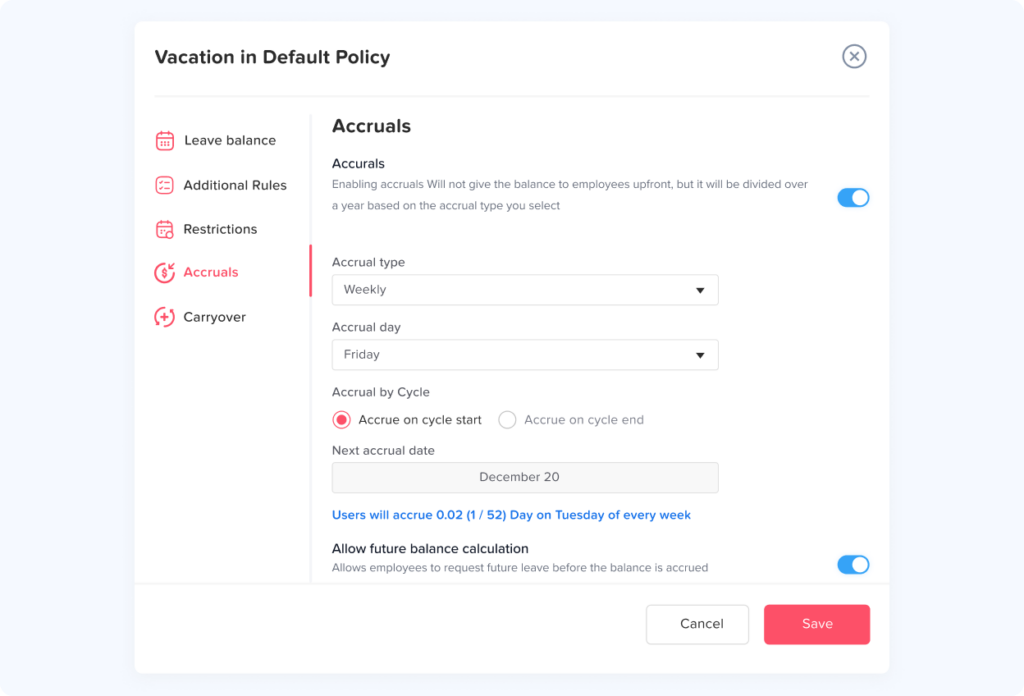
Day Off helps companies manage PTO balances, leave requests, work schedules, and accrual policies in one system.
Depending on the company’s policy configuration, organizations can manage accrual schedules such as:
- Weekly
- Biweekly
- Semimonthly
- Monthly
- Annual
- Hours-worked accruals
Day Off also supports leave policy settings related to carryover, waiting periods, employee schedules, leave balances, and different leave types.
This gives HR teams a clearer view of:
- What employees have earned
- What they have used
- Their remaining balances
- Accrual history
- Upcoming leave
- Policy assignments
Accurate PTO tracking becomes particularly important when employees have different schedules, accrual rates, or leave arrangements.
Best Practices for Managing PTO During Unpaid Leave
Employers can reduce confusion by following a consistent process.
Define the Rule Before Leave Begins
Employees should know whether PTO accrual will stop before their unpaid leave starts.
Separate Paid and Unpaid Periods
An extended absence may begin with paid PTO and later transition to unpaid leave.
Track these periods separately.
Document the Accrual Basis
State whether PTO depends on:
- Hours worked
- Paid hours
- Active service
- Pay periods
- Calendar months
Keep Accrual Records
Maintain records showing how each PTO balance was calculated.
Check Applicable Laws
Do not assume employer policy overrides federal, state, local, contractual, or collective bargaining requirements.
Review the Rule Regularly
As the business expands into new states or countries, existing leave policies may need to be reviewed.
FAQ
Does PTO automatically stop accruing during unpaid leave?
No. There is no universal rule that applies to every employer and every type of leave. Accrual depends on company policy, the accrual method, and applicable law.
Does PTO accrue while an employee is on unpaid FMLA leave?
Federal FMLA law does not generally require employees to earn additional PTO or vacation benefits while taking unpaid FMLA leave. Benefits already earned before the leave are protected.
Can employees use PTO during FMLA leave?
Yes. FMLA leave is generally unpaid, but employees may use paid leave concurrently when allowed by the employer’s policy, and employers may sometimes require that paid leave be substituted.
Does PTO accrue during paid vacation?
It depends on the company’s policy. Some policies count paid vacation hours as eligible accrual hours, while others base accrual only on hours actually worked.
Does PTO accrue during unpaid sick leave?
The answer depends on the sick leave arrangement, company policy, and applicable law. If accrual is based only on paid hours, unpaid sick time may not generate additional PTO.
What happens to an existing PTO balance during unpaid leave?
Usually, pausing accrual affects future PTO earnings rather than PTO that was already earned. Employers should review applicable state laws and protected-leave requirements before changing existing balances.
Can an employer pause PTO accrual for several months?
Potentially, if the policy allows it and applicable law does not require otherwise. Employers should apply the rule consistently and document it clearly.
Does unpaid leave affect front-loaded PTO?
Not necessarily. If the employee already received the full annual balance, there may be no periodic accrual to pause. Other policy rules may still apply.
Does PTO immediately start accruing when an employee returns?
That depends on the policy. Accrual might restart on the return date, next pay period, or next scheduled accrual date.
Should unpaid leave be included in a PTO policy?
Yes. A strong policy should explicitly explain whether unpaid leave earns PTO and how accrual resumes after the employee returns.
Conclusion
In many organizations, PTO stops accruing when an employee enters unpaid status because accrual is tied to hours worked or paid hours. Other employers continue accrual during approved leaves, and specific federal, state, local, contractual, or collective bargaining rules may affect the result.
For unpaid FMLA leave, federal law protects employment benefits that were earned before leave began, but it does not generally require employees to continue earning additional PTO during the unpaid leave period.