







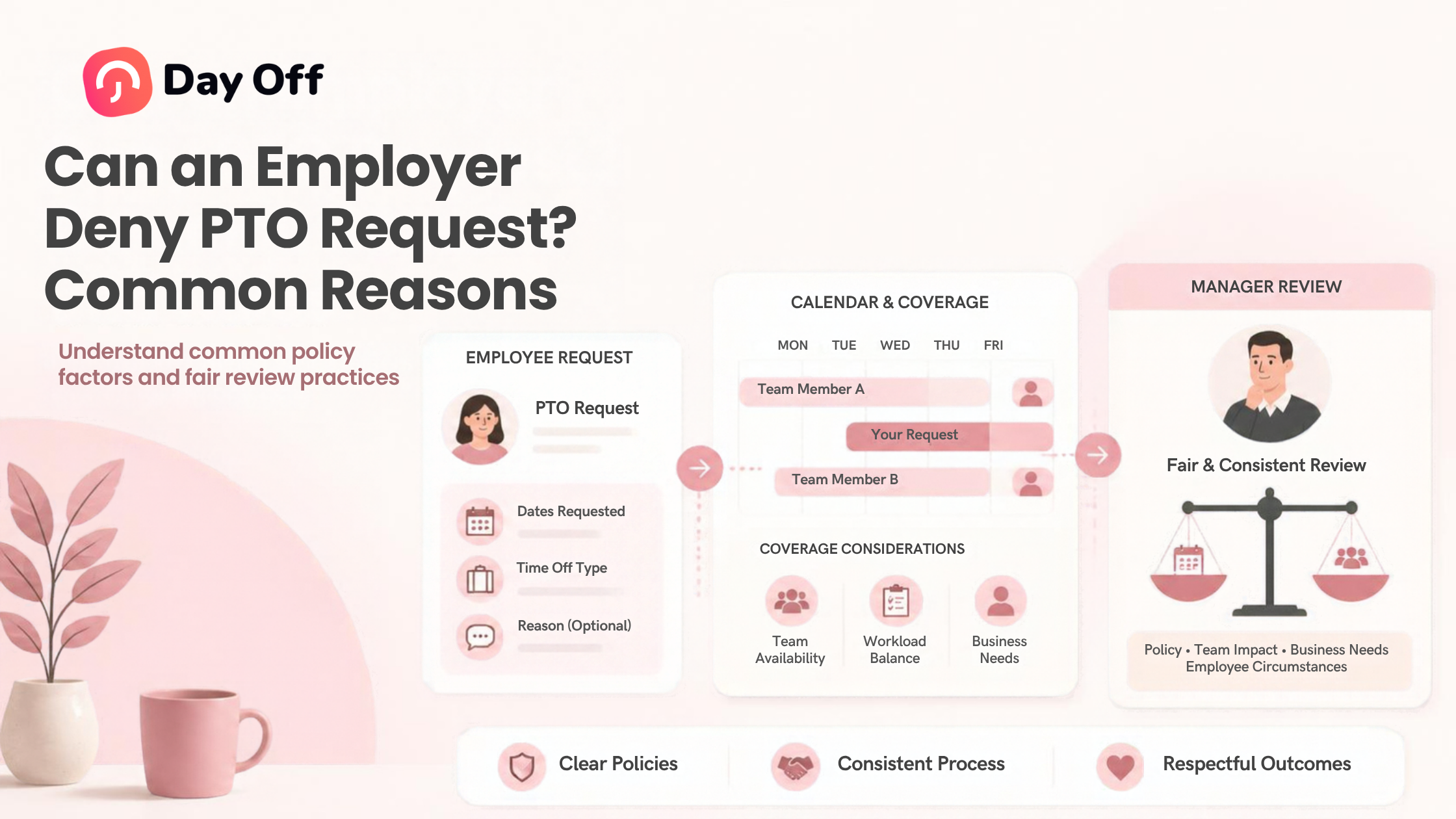
Can an employer Deny PTO Request from an employee who has enough paid time off available? In many cases, yes, but the answer depends on the reason for the leave, the employer’s written PTO policy, applicable state or local law, and whether the absence is protected by another law. In the United States, federal law generally does not require private employers to provide paid vacation time, so ordinary vacation approval is often governed by company policy. However, an employer may have far less discretion when the requested time off qualifies for legally protected family, medical, sick, military, or other protected leave.

This distinction is important for both employers and employees. Having 80 hours of PTO available does not always mean an employee can choose any dates they want, but a manager also should not treat every leave request as an ordinary vacation request.
This guide explains when employers may deny PTO, common reasons for denying a request, situations where additional legal protections may apply, and how businesses can build a fair and consistent PTO approval process.
Can an Employer Deny a PTO Request?
For ordinary vacation or personal PTO, employers often have the ability to approve or deny requested dates based on legitimate business needs and the rules in their PTO policy.
Under the federal Fair Labor Standards Act, employers generally are not required to provide paid vacation, sick leave, holiday pay, or other payment for time not worked. These benefits are normally created through an employment agreement, employer policy, collective bargaining agreement, or applicable state or local law.
That means an employer may be able to deny an ordinary vacation request because:
- Too many employees are already off
- The employee did not provide enough notice
- The dates fall during a company blackout period
- The employee does not have enough PTO available
- The request conflicts with staffing requirements
- The employee has not met a waiting or eligibility period
- Another employee requested the same dates earlier
- The request does not comply with the company’s PTO policy
However, employers should be careful not to assume that every request labeled “PTO” is simply optional vacation time.
An employee may be using PTO during an absence protected under another law. In those cases, different rules can apply.
PTO Availability Does Not Automatically Mean PTO Approval
One of the most common misunderstandings around PTO is the difference between having a PTO balance and having an approved absence.
An employee might have:
PTO balance: 120 hours
But that does not necessarily mean the employee can automatically take three weeks off during the company’s busiest period.
A PTO balance generally tells the employer and employee how much paid leave is available under the company’s plan. The approval process determines whether a particular absence can be scheduled for the dates requested.
For example:
| Situation | PTO Available? | Request Automatically Approved? |
|---|---|---|
| Employee has 40 PTO hours and requests a normal vacation | Yes | Not necessarily |
| Employee requests time during a staffing shortage | Yes | Employer may apply its scheduling policy |
| Employee does not meet the required notice period | Yes | Employer may deny under its policy |
| Leave may qualify for legal protection | Possibly | Separate legal rules may apply |
The employer therefore needs to evaluate both the employee’s available balance and the nature of the request.
Common Reasons an Employer May Deny PTO
Employers should ideally base PTO decisions on clear, documented criteria rather than individual manager preference.
Here are some of the most common reasons a normal vacation request may be denied.
Too Many Employees Have Requested the Same Dates
One of the most common PTO conflicts occurs around:
- Summer holidays
- Thanksgiving
- Christmas
- New Year’s
- School vacation periods
- Long weekends
- Major local events
A department may simply be unable to operate if too many people are absent at once.
For example, imagine a six-person customer support team where four employees request the same Friday off.
Approving all four requests may leave the business unable to maintain basic coverage.
The employer might instead approve requests based on a predetermined method such as:
- First requested, first approved
- Rotating holiday priority
- Seniority, where legally and contractually appropriate
- Minimum staffing requirements
- Manager assessment based on business needs
The important point is consistency.
Employees should know how competing requests will be handled before the conflict occurs.
The Employee Did Not Give Enough Notice
Many PTO policies require employees to request planned leave a certain number of days or weeks in advance.
For example:
- 3 days for one day of PTO
- 2 weeks for several consecutive days
- 30 days for an extended vacation
These rules help managers arrange coverage and adjust schedules.
If the company’s policy requires 14 days’ notice and an employee asks on Wednesday to take the following week off, the employer may be able to deny the request under its normal scheduling rules.
However, notice rules for legally protected leave may be different.
For example, FMLA rules include their own notice requirements for eligible employees. For foreseeable FMLA leave, employees generally should provide 30 days’ advance notice when possible. When 30 days is not practicable, notice should be provided as soon as practicable.
Employers therefore should not automatically apply a standard vacation notice rule to every type of leave.
The Employee Does Not Have Enough PTO
A request may also be denied if the employee wants to take more paid time than is currently available.
For example:
Employee PTO balance: 16 hours
Requested leave: 40 hours
The employer might:
- Deny the request
- Approve only 16 paid hours
- Allow the remaining time as unpaid leave
- Allow a negative PTO balance
- Allow employees to borrow against future PTO
Which option applies depends on the company’s policy and any applicable legal requirements.
A well written PTO policy should explain what happens when employees request more leave than they have accrued.
The Request Falls During a PTO Blackout Period
Some businesses establish blackout dates when discretionary vacation is limited or unavailable.
These may occur during:
- Retail holiday periods
- Annual audits
- Inventory periods
- Product launches
- Seasonal peaks
- Major client deadlines
- Company wide events
For example, a retail business may restrict vacation requests during the final two weeks of December because staffing demand is unusually high.
Blackout periods should be communicated clearly and applied consistently.
They also should not be used as a blanket way to deny legally protected leave.
Minimum Staffing Requirements Would Not Be Met
Managers often need a minimum number of employees working to keep operations running safely and effectively.
Examples include:
- Hospitals
- Restaurants
- Customer service teams
- Retail stores
- Security operations
- Manufacturing facilities
- IT support teams
If approving a PTO request would leave a shift without enough coverage, an employer may decide the requested dates cannot be approved.
This is one reason shared leave calendars can be useful.
Managers can see approved absences before making decisions on new requests instead of discovering scheduling conflicts after several employees have already been approved.
Another Employee Requested the Dates First
A “first come, first served” approach is common in PTO management.
Imagine three employees request the same week:
- Employee A submitted the request in January
- Employee B submitted it in February
- Employee C submitted it in April
If only one employee can reasonably be absent, the company’s policy might give priority to Employee A.
This system can reduce manager subjectivity because the rule is simple and transparent.
However, businesses may choose other systems as long as they are lawful and consistently applied.
The Employee Is Still in a Waiting or Probationary Period
Some employers allow employees to accrue PTO immediately but restrict when the PTO can actually be used.
For example:
Start date: January 1
PTO accrues: Immediately
PTO available for use: After 90 days
An employee requesting vacation in February could therefore have PTO visible in their balance but not yet be eligible to use it.
Employers should make this distinction clear in their PTO policy.
Employees should know:
- When accrual begins
- When PTO becomes usable
- Whether probation affects PTO
- Whether exceptions are available
The Requested Absence Is Too Long
Companies may also establish rules limiting the amount of PTO employees can take continuously without additional approval.
For example:
- Up to 5 consecutive days: manager approval
- 6 to 10 days: department manager approval
- More than 10 days: HR approval
This can be particularly useful for smaller teams where long absences require additional workforce planning.
Employers should be careful, however, when a longer absence may qualify for protected family or medical leave.
When Denying PTO Can Become More Complicated
Not every request for paid time off is merely a request for vacation.
Sometimes an employee may be using PTO while taking leave that is protected under federal, state, or local law.
This is where employers need to distinguish between:
The employee’s right to be absent
and
Whether the absence is paid through PTO.
They are not always the same thing.
PTO and FMLA Leave
The Family and Medical Leave Act provides eligible employees of covered employers with job protected leave for qualifying family and medical reasons.
Eligible employees may generally take up to 12 workweeks of protected leave during a qualifying 12 month period, with up to 26 workweeks available in certain military caregiver situations.
Qualifying reasons can include:
- Birth and bonding with a new child
- Adoption or foster placement
- The employee’s serious health condition
- Caring for a spouse, child, or parent with a serious health condition
- Certain qualifying military exigencies
- Caring for certain covered servicemembers
FMLA itself generally provides unpaid leave.
However, employer-provided paid leave can sometimes run at the same time as FMLA leave. An employee may elect, or an employer may require, accrued vacation, personal leave, or other qualifying paid leave to be substituted for unpaid FMLA leave according to applicable rules.
An employer therefore should not simply deny an absence because the employee calls it a “PTO request” if the underlying reason may qualify for FMLA protection.
The employer may need to evaluate whether FMLA applies.
Employers Cannot Retaliate Against Employees for Protected FMLA Leave
FMLA protections go beyond simply allowing an eligible employee to take qualifying leave.
The U.S. Department of Labor states that employers cannot threaten, punish, discriminate against, suspend, or terminate employees because they requested or used FMLA leave.
This means an employer should avoid treating protected leave as though it were simply an unwanted vacation request.
For example, an employer generally should not:
- Count protected FMLA leave as an attendance violation
- Punish an employee for taking qualifying leave
- Deny a promotion because the employee used FMLA leave
- Require the employee to waive FMLA rights
Employers should train managers to recognize situations that may involve protected leave and refer them to HR rather than making an immediate PTO decision.
PTO and State or Local Leave Laws
Federal law is only one part of the picture.
State and local laws can create additional requirements involving:
- Paid sick leave
- Family leave
- Medical leave
- Pregnancy related leave
- Domestic violence or safe leave
- Jury duty
- Voting leave
- Military leave
- Bereavement leave
- Other protected absences
The rules vary significantly by location.
Even vacation rules can differ.
For example, California treats earned vacation differently from many other jurisdictions. California’s Labor Commissioner states that employers can generally control when vacation may be taken and how much can be taken at one time, but accrued vacation has specific protections under state law.
Employers operating in multiple states should therefore avoid assuming that one PTO rule works everywhere.

Can an Employer Deny PTO After It Has Already Been Approved?
This situation is more complicated than denying an initial request.
Suppose an employee requests a vacation three months in advance.
The manager approves it.
The employee then:
- Books flights
- Reserves accommodation
- Organizes childcare
- Makes other nonrefundable plans
Two weeks before the vacation, the company becomes short-staffed.
Can the employer cancel the approval?
The answer depends heavily on company policy, employment agreements, applicable law, and the circumstances.
In some situations, an employer may have the ability to revoke scheduled vacation because of legitimate business needs. However, doing so can create significant employee relations problems even where it is legally possible.
Employers should therefore treat previously approved PTO differently from a request that has not yet been approved.
Before reversing approval, consider:
- Is the cancellation truly necessary?
- Can another employee provide coverage?
- Can the employee work remotely if appropriate?
- Has the employee already incurred costs?
- Has the company revoked other employees’ PTO consistently?
- Is the leave connected to a protected reason?
Repeatedly canceling approved PTO can quickly undermine employee trust.
Can PTO Be Denied During a Busy Season?
Often, yes, for ordinary vacation requests.
Businesses may need higher staffing levels during periods such as:
- Holiday retail season
- Tax season
- Financial year end
- Summer tourism season
- Product launches
- Annual inventory
- Major project deadlines
Companies can address this with advance planning.
For example:
| PTO Policy Rule | Example |
|---|---|
| Blackout period | No discretionary vacation from Dec. 15-31 |
| Minimum notice | Requests of 3+ days require 30 days’ notice |
| Staffing requirement | At least 70% of the department must remain available |
| Competing requests | First approved request receives priority |
| Extended leave | More than 10 consecutive days requires HR approval |
The exact policy will depend on the business.
The key is to publish the rules before employees make plans rather than inventing them when conflicts arise.
Can PTO Be Denied Because of Poor Performance?
Employers should be cautious about using PTO approval as a performance management tool.
If employees have earned or been granted PTO under company policy, managers should generally avoid making approval decisions arbitrarily.
For example:
“Your performance has been poor, so you aren’t allowed to take vacation.”
This approach can create confusion between disciplinary processes and leave administration.
A better approach is to handle performance through the company’s normal performance management process while applying the same PTO policy consistently.
There may be circumstances where scheduling or policy rules legitimately affect an employee’s request, but the employer should document the actual reason rather than using PTO approval as an informal punishment.
Can PTO Be Denied Because of Attendance Problems?
Again, employers need to distinguish between the employee’s attendance history and the specific leave request.
Suppose an employee frequently arrives late but has 40 hours of vacation available.
If the employee submits a valid vacation request according to policy, automatically denying it because of unrelated attendance problems may create an inconsistent process.
Instead:
- Address attendance problems through the attendance policy
- Review PTO requests under the PTO policy
- Track protected absences separately
- Document approval and denial reasons
Keeping these systems separate creates clearer records and reduces manager subjectivity.
What Should Employers Do Before Denying PTO?
A PTO denial should not be an automatic “no.”
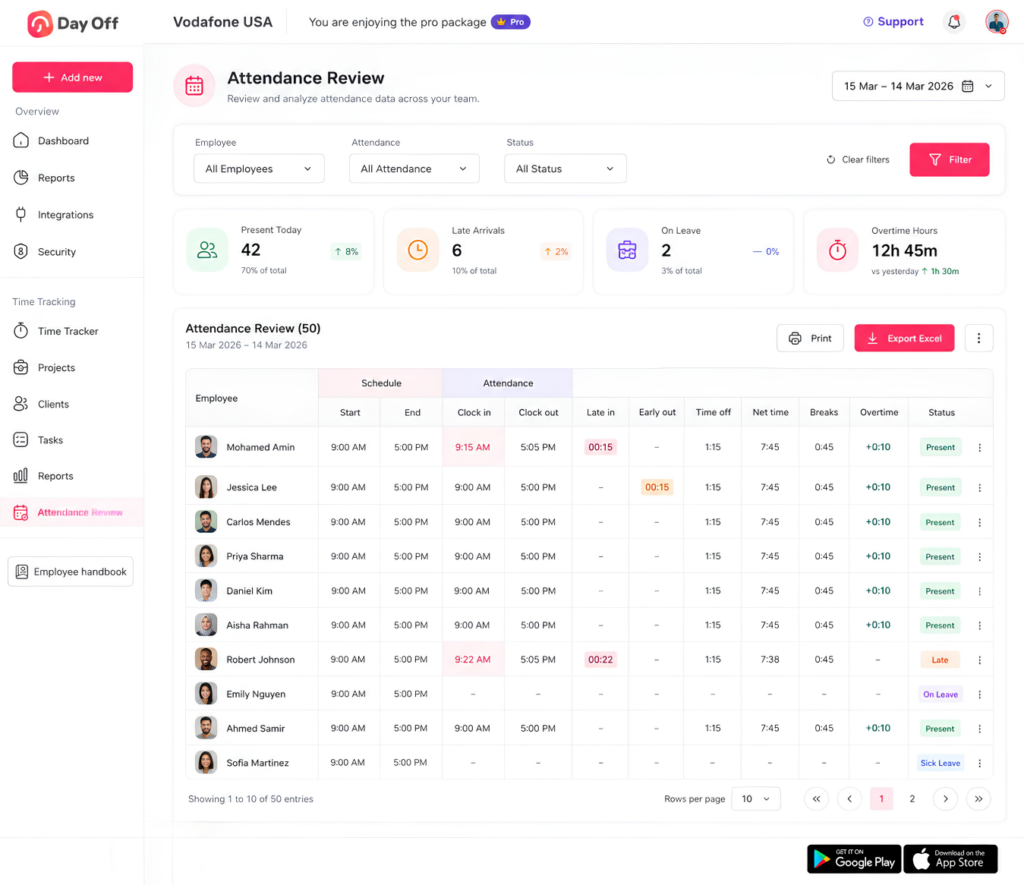
Managers should review several factors first.
Check the Employee’s PTO Balance
Confirm whether the employee actually has enough available leave.
Check the Requested Dates
See whether other employees already have approved absences.
Review Staffing Requirements
Determine whether the department can operate normally during the proposed absence.
Check the PTO Policy
Confirm that the decision is consistent with the company’s written rules.
Determine Whether the Leave May Be Protected
If the employee mentions:
- A serious health condition
- Pregnancy or childbirth
- Caring for a family member
- Military obligations
- Domestic violence
- A disability
- Another potentially protected reason
HR may need to review the request under applicable leave laws.
Check Previous Decisions
Would another employee in the same situation receive the same answer?
Consistency is important.
Offer Alternatives Where Possible
Instead of simply rejecting the request, managers may suggest:
- Different dates
- A shorter absence
- Splitting the leave
- Swapping shifts
- Remote work, where appropriate
- Another team member providing coverage
Not every request can be accommodated, but flexibility often prevents unnecessary conflict.
How to Deny a PTO Request Professionally
When a request needs to be denied, the employee should receive a clear explanation.
A useful response should include:
- Confirmation that the request was reviewed
- The reason it cannot be approved
- Reference to the relevant policy when appropriate
- Possible alternative dates
- Instructions for submitting another request
For example:
“Your request for August 10-14 cannot be approved because two team members already have approved leave during those dates and the department would fall below its minimum staffing requirement. If your dates are flexible, August 17-21 is currently available.”
This is much more helpful than:
“PTO denied.”
The first response explains the decision and gives the employee a path forward.
Why Employers Should Document PTO Denials
A consistent approval history helps HR understand how leave decisions are being made.
Records may include:
- Request date
- Requested leave dates
- Employee PTO balance
- Approver
- Approval or denial
- Reason for denial
- Alternative dates offered
- Final resolution
Documentation can help businesses identify patterns.
For example, HR may discover that one manager rejects 45% of PTO requests while other managers reject only 5%.
That does not automatically mean the manager is doing anything wrong, but it gives HR a reason to investigate whether:
- The department is understaffed
- The manager applies stricter rules
- Employees are requesting leave too late
- Scheduling practices need improvement
Common PTO Approval Mistakes Employers Should Avoid
Having No Written PTO Policy
When employees do not know the rules, every denial can feel arbitrary.
A written policy should explain:
- PTO eligibility
- Accrual
- Request procedures
- Required notice
- Approval rules
- Blackout dates
- Maximum consecutive leave
- Carryover
- Cancellation procedures
Approving Requests Based Only on Manager Preference
Managers should not approve PTO for favored employees while denying similar requests from others without a legitimate reason.
Clear approval criteria reduce inconsistency.
Treating Protected Leave as Normal Vacation
This can create serious compliance problems.
Managers should know when to involve HR.
Ignoring Previously Approved Leave
Employees often spend money after vacation is approved.
Canceling leave casually can damage trust and morale.
Waiting Too Long to Respond
An employee should not have to wait three weeks to find out whether a vacation request was approved.
Companies can establish internal response targets such as:
- Requests reviewed within 2 business days
- Longer absences reviewed within 5 business days
Fast decisions allow employees and managers to plan effectively.
Allowing Too Many Employees Off Before Checking Coverage
Approval systems should show existing absences before managers approve another request.
This reduces the likelihood that managers later need to cancel approved PTO.
First Come, First Served vs Manager Discretion
Companies often struggle with how to handle competing requests.
Two common models are:
First Come, First Served
Advantages:
- Easy to understand
- More objective
- Encourages employees to plan early
Disadvantages:
- Employees who can plan months ahead may always have an advantage
- Emergencies cannot always be predicted
Manager Discretion
Advantages:
- Allows flexibility
- Managers can consider business needs
- Managers can account for unusual circumstances
Disadvantages:
- More subjective
- Can create inconsistency
- Employees may perceive favoritism
Many organizations use a combination.
For example, requests may normally be handled first come, first served, while managers retain discretion for exceptional circumstances.
What Employees Can Do If PTO Is Denied
A denial does not always mean the conversation is over.
Employees can ask:
- Why was the request denied?
- Would different dates work?
- Is another employee already off?
- Can I shorten the leave?
- Can I swap shifts?
- When can I resubmit?
- Does the company have an appeal or HR review process?
If the leave involves a medical, family, disability-related, or other potentially protected reason, the employee may also want to clarify the purpose of the absence so HR can determine whether additional leave protections apply.
How Day Off Helps Manage PTO Requests Fairly
Managing PTO through email, spreadsheets, or chat messages makes it difficult to see who requested leave first, who is already off, how much PTO employees have available, and why previous requests were approved.
Day Off brings PTO requests, balances, policies, approvals, work schedules, and shared calendars into one system.
Employees Can See Their PTO Balance
Employees can check their available leave before submitting a request.
That reduces unnecessary questions to HR and helps employees plan within their available balance.
Managers Can Review Leave Before Approving It
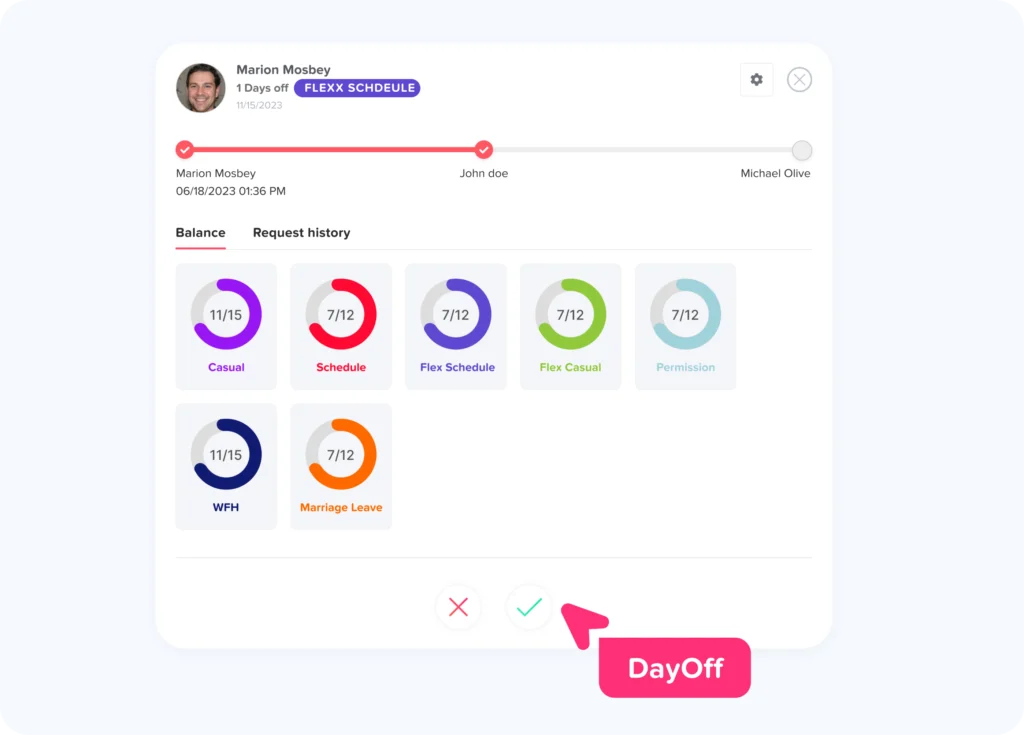
Managers can review:
- Requested dates
- Leave type
- Employee balance
- Other employee absences
- Relevant approval information
This provides more context before making a decision.
Shared Calendar Visibility
A shared team calendar helps managers identify overlapping PTO before approving another request.
For example, if three employees are already scheduled off on July 12, the manager can see the conflict immediately instead of discovering it after approving a fourth request.
Multi Level Approval
Organizations that require additional review can use multi-level approval workflows.
A request might move through:
Employee → Direct Manager → Department Head
This can be useful for long absences or departments with strict staffing requirements.
PTO Policies and Leave Rules
Organizations can configure leave policies based on how their PTO program works, including rules involving:
- Accrual
- Carryover
- Waiting periods
- Request duration
- Advance notice
- Blackout dates
- Employee eligibility
Using consistent system rules helps reduce manual decisions and ensures employees understand the requirements before submitting leave.
FAQ
Can an employer deny vacation even if I have PTO available?
Often, yes. Having an available balance does not necessarily guarantee approval of specific vacation dates. Employers may apply scheduling requirements and other rules in their PTO policy, subject to applicable law.
Can an employer deny all PTO during a busy season?
Employers may restrict ordinary vacation during busy periods, depending on applicable law and policy. However, protected leave cannot necessarily be denied simply because the business is busy.
Can a manager deny PTO without giving a reason?
Company policy may determine whether managers must provide an explanation. From an HR perspective, documenting the reason for a denial is usually better for consistency and transparency.
Can approved PTO be canceled?
Sometimes, depending on company policy, employment agreements, and applicable law. Employers should be cautious about canceling previously approved leave because employees may have already made financial or personal commitments.
Can an employer deny PTO because someone else is already off?
Yes, this can be a legitimate reason for denying ordinary vacation if approving another absence would create a staffing problem.
Can an employer deny PTO because I did not give enough notice?
For ordinary vacation, an employer may be able to enforce reasonable notice requirements contained in its PTO policy. Protected leave may be subject to different notice rules.
Can PTO be denied if I am sick?
That depends on the jurisdiction and circumstances. Paid sick leave laws, FMLA, disability laws, or other protections may apply. Employers should not automatically treat sickness-related leave as an ordinary vacation request.
Can an employer force employees to use PTO during FMLA leave?
Under federal FMLA rules, employers may in certain circumstances require employees to substitute accrued paid leave for unpaid FMLA leave, provided applicable requirements are followed.
Can an employer deny unpaid time off after PTO is exhausted?
Potentially, but additional laws may require leave in certain circumstances. Exhausting PTO does not automatically mean the employee has no right to take additional protected leave.
Should every PTO denial be documented?
It is a strong HR practice. Documentation helps companies apply their policies consistently and understand recurring staffing or scheduling problems.
Conclusion
So, can an employer deny a PTO request? For ordinary vacation or personal time, employers often have discretion to deny specific dates based on staffing, notice requirements, blackout periods, PTO availability, and other legitimate policy rules.
But the reason behind the absence matters.
A request that appears to be ordinary PTO may also involve FMLA, paid sick leave, disability accommodation, military leave, or another legally protected absence. Employers should therefore evaluate the nature of the request before treating it as a normal vacation decision.
The strongest PTO process is not one that approves every request or denies every difficult one. It is one that uses clear policies, objective criteria, consistent decisions, visible schedules, and good documentation.
With Day Off, businesses can centralize PTO balances, requests, approvals, policies, blackout dates, shared calendars, and employee leave history. That gives managers the information they need to make faster, more consistent PTO decisions while giving employees a clearer view of how their time off is managed.