





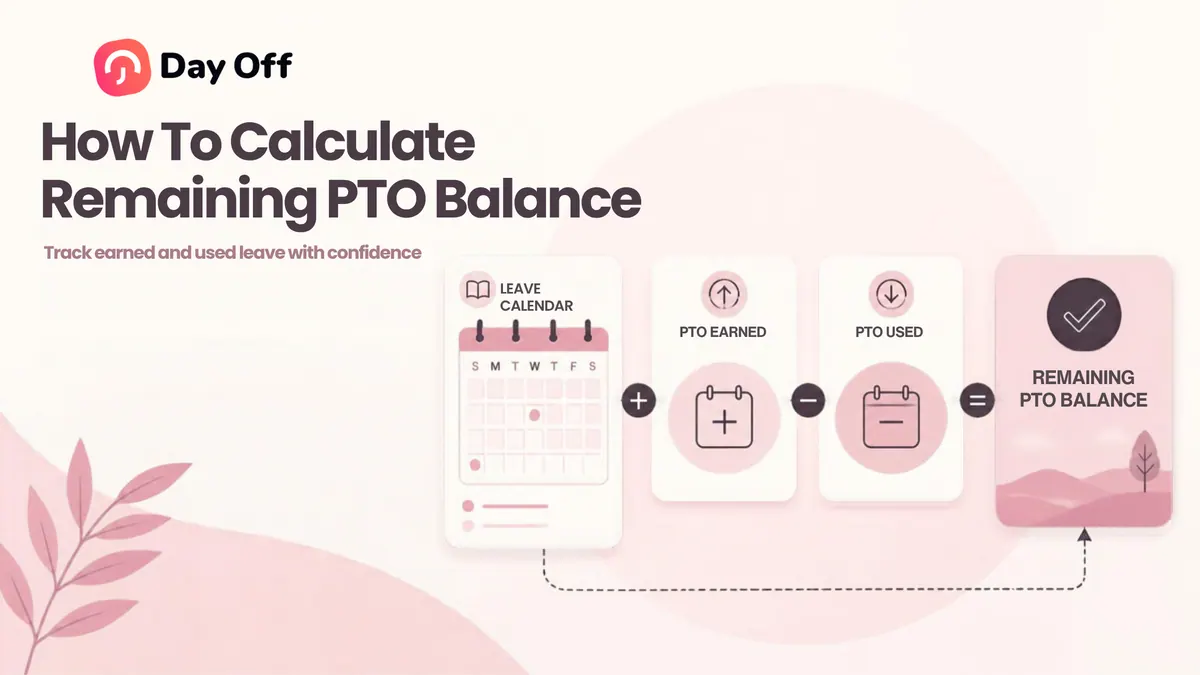
Knowing how much paid time off an employee has left should be simple, but a PTO Balance can become complicated once accruals, used leave, pending requests, carryover, adjustments, and different work schedules are involved. Whether you manage PTO for a small team or hundreds of employees, accurately calculating remaining PTO helps employees plan their time off and gives HR and managers a reliable view of future leave obligations.

At its simplest, remaining PTO is the amount of paid time off an employee has earned or received but has not yet used. The actual calculation, however, depends on how the company’s PTO policy is structured.
This guide explains how to calculate remaining PTO balance, which factors should be included, how different PTO policies affect the calculation, and how employers can maintain accurate PTO records throughout the year.
What Is a PTO Balance?
A PTO balance is the amount of paid time off currently available to an employee.
Depending on the employer’s policy, PTO may include:
Vacation days
Personal days
Sick time
A combined PTO bank
Compensatory time off
Other employer provided paid leave
Some companies keep vacation, sick leave, and personal leave in separate balances. Others combine several types of paid leave into one PTO bank.
For example, if an employee has earned 80 PTO hours and has already used 24 hours, their basic remaining PTO balance would be:
80 earned PTO hours – 24 used PTO hours = 56 remaining PTO hours
However, employers may also need to account for carryover, manual adjustments, approved future leave, negative balances, or PTO that has expired.
Basic Remaining PTO Balance Formula
The most basic formula is:
Remaining PTO Balance = PTO Available – PTO Used
If PTO is accrued gradually, a more complete formula is:
Remaining PTO Balance = Starting Balance + PTO Accrued + Adjustments – PTO Used
When carryover is involved:
Remaining PTO Balance = Carryover + PTO Accrued + PTO Granted + Positive Adjustments – PTO Used – Negative Adjustments – Expired PTO
The exact formula should match the company’s written PTO policy.
Example
Suppose an employee:
Carried over 16 hours from the previous year
Accrued 40 hours so far this year
Received an 8-hour manual adjustment
Used 24 hours
The calculation would be:
16 + 40 + 8 – 24 = 40 hours
The employee’s remaining PTO balance is 40 hours.
What Should Be Included in a PTO Balance Calculation?
A reliable PTO calculation may involve several components.
| PTO Component | Effect on Balance | Example |
|---|---|---|
| Starting balance | Adds available PTO | 40 hours |
| PTO accrual | Adds earned PTO | +4 hours |
| Carryover | Adds eligible unused PTO | +16 hours |
| Manual credit | Adds PTO | +8 hours |
| PTO used | Reduces balance | -8 hours |
| Manual deduction | Reduces balance | -4 hours |
| Expired PTO | Reduces balance | -16 hours |
| Approved future PTO | May reduce available balance, depending on system | -8 hours |
Not every employer uses every component. A front loaded policy, for example, may not require periodic accrual calculations because the annual entitlement is made available at the beginning of the leave year.
How to Calculate Remaining PTO Balance Step by Step
Identify the Employee’s Starting PTO Balance
Start with the amount available at the beginning of the calculation period.
The starting balance may come from:
PTO carried over from the previous year
A front-loaded annual allowance
Previously accrued leave
A balance entered when the employee was added to a new PTO system
For example, an employee may begin the year with 24 hours carried forward from the previous year.
Their starting balance is:
24 hours
If the policy does not allow carryover and PTO starts at zero before new accruals begin, the starting balance may instead be zero.
Calculate PTO Earned During the Period
Next, calculate how much PTO the employee has earned since the start of the period.
How this works depends on the accrual method.
PTO may accrue:
Weekly
Biweekly
Semimonthly
Monthly
Annually
Per hour worked
Based on another schedule established by the employer
For example, suppose an employee earns 120 hours of PTO per year and the employer uses 24 semimonthly accrual periods.
The accrual per period would be:
120 ÷ 24 = 5 PTO hours per pay period
After 10 completed accrual periods:
5 × 10 = 50 PTO hours accrued
If the employee began with zero PTO, they would have earned 50 hours before deductions for any time already taken.
Add Eligible PTO Carryover
Some policies allow employees to bring unused PTO from one leave year into the next.
For example:
Previous unused PTO: 32 hours
Carryover limit: 24 hours
Only 24 hours would move into the new leave year.
If the employee then earns another 40 hours:
24 carried over + 40 accrued = 64 available hours
Employers should distinguish between the employee’s actual unused balance and the amount permitted to carry forward under the applicable policy and law.
Add Any PTO Credits or Adjustments
Manual adjustments sometimes change a PTO balance.
An employer might add PTO because of:
A corrected accrual
A starting balance correction
Compensation for an additional day worked
A special leave award
An administrative correction
Suppose an employee has 48 hours available and HR determines that 8 hours were accidentally omitted.
The corrected balance becomes:
48 + 8 = 56 hours
Any adjustment should have a clear record explaining why it was made.
Subtract PTO Already Used
Next, subtract paid time off that the employee has already taken.
For example:
PTO available: 72 hours
PTO used: 24 hours
72 – 24 = 48 hours remaining
If an employee tracks leave in days rather than hours, the same concept applies:
PTO available: 15 days
PTO used: 6 days
15 – 6 = 9 PTO days remaining
Account for Approved Future PTO
This is where PTO balances can become confusing.
An employee may have approved a future vacation that has not yet occurred.
For example:
Current earned and unused PTO: 48 hours
Approved vacation next month: 16 hours
Two useful figures can exist:
Current balance: 48 hours
Balance available for additional requests: 32 hours
Some PTO systems immediately reserve approved future leave. Others deduct leave only when the leave date arrives.
Whichever method the employer uses, employees should be able to understand whether a displayed balance includes or excludes future approved requests.
Subtract PTO That Has Expired
Some PTO policies include expiration rules.
For example:
Balance before expiration: 64 hours
PTO scheduled to expire: 16 hours
After expiration:
64 – 16 = 48 hours
Employers should verify whether PTO expiration is permitted under applicable state or local law before enforcing forfeiture rules. PTO requirements in the United States can vary significantly by jurisdiction.
At the federal level, the Fair Labor Standards Act does not generally require employers to provide vacation pay or paid time off. Such benefits are generally determined by the employer’s policy, employment agreement, collective bargaining agreement, or applicable state and local law.
PTO Balance Calculation Examples
| Scenario | Calculation | Remaining PTO |
|---|---|---|
| 80 hours granted, 24 used | 80 – 24 | 56 hours |
| 16 carried over, 40 accrued, 24 used | 16 + 40 – 24 | 32 hours |
| 60 accrued, 8 added, 20 used | 60 + 8 – 20 | 48 hours |
| 96 available, 16 used, 8 expired | 96 – 16 – 8 | 72 hours |
| 40 available, 8 used, 16 approved for future leave | 40 – 8 – 16 | 16 hours available after reservations |
The last example depends on whether the employer reserves approved future PTO immediately. A system that waits until the leave occurs may still display a current balance of 32 hours while separately showing 16 hours as scheduled.
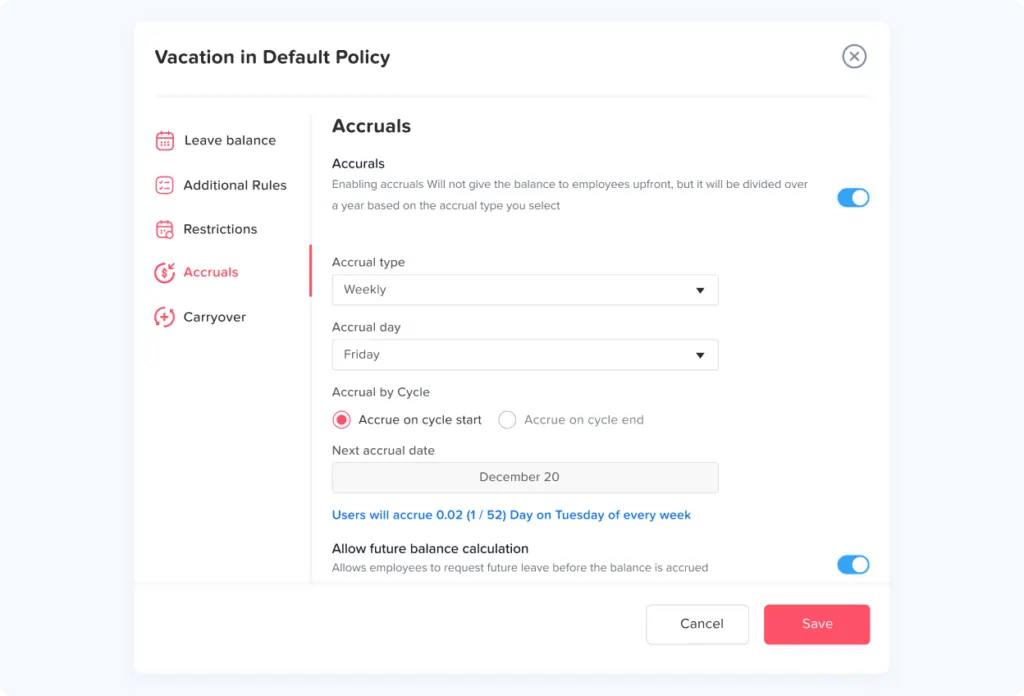
How to Calculate PTO Balance for an Accrual Policy
Under an accrual policy, employees earn PTO gradually rather than receiving their entire annual allowance at once.
Suppose the policy provides:
120 hours per year
24 semimonthly accrual periods
No starting carryover
First calculate PTO earned per accrual period:
120 ÷ 24 = 5 hours per period
After 14 completed accrual periods:
5 × 14 = 70 hours accrued
If the employee has used 24 hours:
70 – 24 = 46 hours
The employee’s remaining PTO balance is 46 hours.
Accrual Formula
A simplified formula is:
Accrued PTO = Accrual Rate × Completed Accrual Periods
Then:
Remaining PTO = Accrued PTO + Starting Balance + Adjustments – PTO Used
This approach is useful for weekly, biweekly, semimonthly, and monthly accrual systems.
How to Calculate PTO Based on Hours Worked
Some employers award PTO according to the number of hours an employee works.
For example, an employee may earn:
0.05 PTO hours for every hour worked
If the employee works 800 eligible hours:
800 × 0.05 = 40 PTO hours earned
If the employee has used 12 PTO hours:
40 – 12 = 28 PTO hours remaining
The employer’s policy should clearly define which hours count toward accrual.
Depending on the policy, the calculation might include or exclude:
Regular working hours
Overtime hours
PTO hours
Holiday hours
Unpaid leave
Other non working time
The accrual rules should be applied consistently.
How to Calculate Remaining PTO From an Annual Allowance
A front-loaded PTO policy gives employees some or all of their PTO entitlement upfront rather than requiring them to earn it throughout the year.
Suppose an employee receives:
20 PTO days at the beginning of the year
During the year, they take:
3 days in March
5 days in July
2 days in September
Total PTO used:
3 + 5 + 2 = 10 days
Remaining PTO:
20 – 10 = 10 days
If the employee also carried over 3 eligible days:
20 + 3 – 10 = 13 days remaining
This method is simpler than periodic accrual, but rules concerning new hires, carryover, expiration, and termination still need to be considered.
How to Calculate Prorated PTO for a New Employee
An employee who joins partway through a leave year may receive a prorated PTO allowance if the company’s policy provides for it.
Suppose:
Full annual allowance: 24 days
Employee is eligible for 6 months of the year
A simple monthly proration would be:
24 × 6 ÷ 12 = 12 days
If the employee has already taken 3 days:
12 – 3 = 9 days remaining
However, employers should follow the actual proration method in their policy. Some companies prorate by month, days of employment, pay periods, or hours worked.
New hires may also be subject to waiting periods before they begin accruing PTO or before earned PTO can be used.
How to Convert PTO Hours Into Days
Many PTO systems store balances in hours even when employees think about leave in days.
To convert PTO hours into days:
PTO Days = PTO Hours ÷ Standard Hours per Workday
For an employee who normally works 8 hours per day:
40 PTO hours ÷ 8 = 5 PTO days
But an 8-hour conversion should not automatically be applied to every employee.
For example, if an employee normally works 10-hour days:
40 ÷ 10 = 4 workdays
This is particularly important for companies with:
Part time employees
4/10 schedules
Flexible schedules
Different daily working hours
Shift based teams
Using an employee’s actual scheduled hours can provide a more meaningful calculation than assuming every workday equals eight hours.
PTO Balance vs. Accrued PTO
These terms are related but not identical.
Accrued PTO is the amount an employee has earned through the company’s accrual system.
PTO balance generally refers to the amount available after accounting for deductions and other balance changes.
For example:
Accrued PTO: 60 hours
PTO used: 16 hours
Manual credit: 4 hours
Remaining balance:
60 – 16 + 4 = 48 hours
The employee has accrued 60 hours but currently has a 48-hour remaining balance.
Current PTO Balance vs. Available PTO Balance
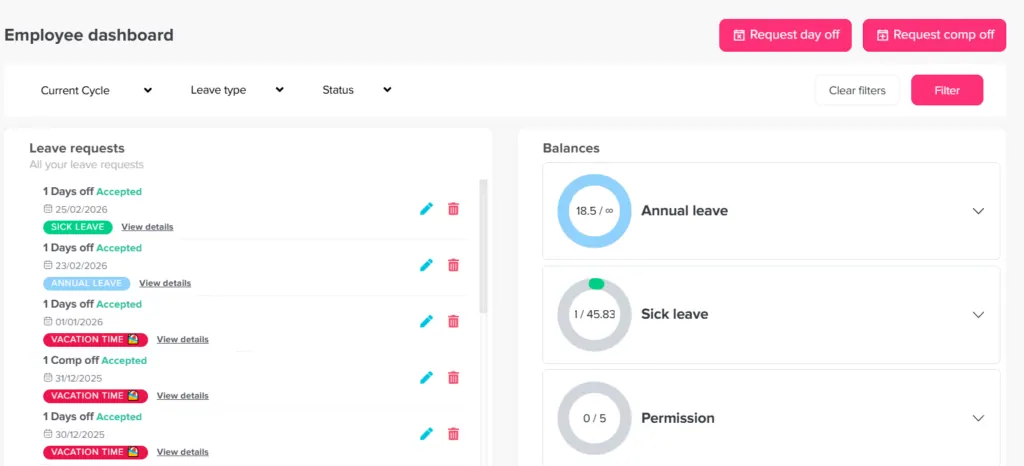
Companies may also distinguish between a current balance and an available balance.
Suppose an employee currently has:
56 unused hours
They also have an approved 24-hour vacation scheduled next month.
The system might display:
Current balance: 56 hours
Scheduled PTO: 24 hours
Available balance after scheduled leave: 32 hours
This distinction can prevent employees from accidentally requesting more PTO than they will have available.
Can a PTO Balance Be Negative?
Yes, if the company’s policy permits employees to use PTO before they have earned enough to cover the request.
For example:
Current PTO balance: 8 hours
PTO taken: 16 hours
8 – 16 = -8 hours
The employee now has a negative balance of 8 hours.
Future accruals may gradually bring the balance back to zero.
For example, if the employee later earns 5 hours:
-8 + 5 = -3 hours
Employers that permit negative PTO should define what happens if an employee leaves the company before earning back the advanced leave. Any deductions from final wages must comply with applicable wage-payment laws and authorization requirements.
Does PTO Continue to Accrue While an Employee Is on PTO?
There is no single answer for every employer.
Whether an employee continues earning PTO while using PTO depends on:
Company policy
Employment contract
Collective bargaining agreement
Applicable state or local law
How the accrual formula defines eligible hours
For example, a company using monthly accrual may continue adding PTO regardless of whether an employee took vacation that month.
A company using an hours worked formula may calculate accrual differently.
Employers should document this rule clearly instead of assuming that all PTO policies treat paid leave the same way.
What Happens to PTO Balance at the End of the Year?
The answer depends on the company’s policy and applicable law.
Common approaches include:
Full Carryover
All eligible unused PTO moves into the next leave year.
Example:
40 unused hours → 40 hours carried forward
Limited Carryover
Only a specified amount moves forward.
Example:
Unused balance: 72 hours
Maximum carryover: 40 hours
New carryover balance:
40 hours
Expiration
Some policies provide that unused PTO expires after a certain date, where legally permitted.
PTO Accrual Cap
Instead of removing PTO at year-end, some companies stop additional accrual once the employee reaches a maximum balance.
For example:
Maximum balance: 160 hours
Current balance: 160 hours
The employee may stop earning additional PTO until the balance falls below the cap, depending on the employer’s policy.
Carryover limits and accrual caps are not the same thing.
A carryover limit controls how much unused PTO can move from one leave year into another.
An accrual cap controls how much PTO an employee can accumulate at one time.
What Happens to Remaining PTO When an Employee Leaves?
This depends heavily on jurisdiction and employer policy.
Federal law generally does not require employers to provide vacation benefits in the first place. The U.S. Department of Labor states that vacation benefits are generally matters of agreement between employers and employees rather than a benefit required by the FLSA.
However, state laws can impose additional requirements, including rules affecting accrued vacation or PTO when employment ends.
Employers therefore should not assume that an unused balance can automatically be forfeited.
Before processing an employee’s final PTO balance, HR should verify:
The employee’s remaining accrued PTO
PTO already used
Approved leave that was canceled or never taken
Applicable company policies
Employment agreements
Collective bargaining agreements, where applicable
State and local wage payment requirements
If unused vacation is paid out, the payment may also have payroll and tax implications. IRS guidance treats vacation allowances as supplemental wages for federal income tax withholding purposes.
How to Calculate a PTO Payout
Where PTO payout is required or provided by company policy, a basic calculation may be:
Unused PTO Hours × Employee’s Applicable Hourly Rate = Gross PTO Payout
For example:
Remaining eligible PTO: 40 hours
Applicable hourly rate: $25
40 × $25 = $1,000
The gross payout would be $1,000 before applicable payroll taxes and deductions.
For salaried employees, the employer needs a consistent method for determining the applicable rate based on its policy and legal requirements.
PTO payout rules should be verified under applicable law before payment is calculated.
How to Audit an Employee’s PTO Balance
If an employee believes their balance is incorrect, avoid simply changing the number.
Instead, reconstruct the balance.
Start with the last confirmed balance and review each transaction chronologically.
Check:
Starting PTO balance
Carryover amount
Every accrual
Approved leave taken
Canceled requests
Manual adjustments
Expired PTO
Compensation or additional credits
Policy changes
Schedule or employment-status changes
A basic audit might look like this:
| Transaction | Change | Running Balance |
|---|---|---|
| Starting carryover | +16 | 16 |
| January accrual | +8 | 24 |
| February accrual | +8 | 32 |
| PTO used | -8 | 24 |
| March accrual | +8 | 32 |
| Correction | +4 | 36 |
The transaction history makes it much easier to identify exactly where an incorrect balance originated.
Why PTO Balance Accuracy Matters
PTO tracking is more than displaying a number next to an employee’s profile.
Accurate balances help employees know:
How much leave they can request
How much PTO they have already used
How much PTO is scheduled
Whether unused leave can carry forward
Whether part of their balance may expire
Accurate balances also help managers understand staffing availability and make more informed approval decisions.
For HR and payroll teams, reliable PTO data can reduce:
Manual corrections
Employee disputes
Incorrect deductions
Incorrect payouts
Year end balance problems
Administrative work
How Often Should PTO Balances Be Updated?
Ideally, a PTO balance should change whenever a balance affecting event occurs.
That might include:
A scheduled accrual
An approved or completed leave request
A canceled request
A carryover event
An expiration event
A manual adjustment
A compensation credit
Employees should not need to wait until the end of a month or pay period to discover that a previously displayed balance was outdated if the organization’s system is capable of reflecting the change earlier.
How to Keep PTO Balances Accurate
A strong PTO process starts with a clearly documented policy.
Define the Accrual Method
Specify exactly how PTO is earned.
For example:
5 hours every semimonthly period
10 hours every month
0.05 hours per eligible hour worked
120 hours granted annually
Define the Leave Year
State whether balances operate on:
Calendar year
Employee anniversary year
Fiscal year
Another defined period
Define Carryover Rules
Employees should know:
Whether PTO carries over
Maximum carryover amount
When carryover occurs
Whether carried PTO expires
Define the Accrual Cap
If balances have a maximum, state what happens when the employee reaches it and when accrual can resume.
Explain Future Leave Reservations
Employees should know whether approved future leave is immediately subtracted from their available balance.
Maintain a Transaction History
Every balance change should be traceable.
A useful PTO history includes:
Date
Transaction type
PTO added or deducted
Resulting balance
Related request
Adjustment reason, when applicable
How Day Off Helps Track PTO Balances
Manually recalculating employee balances whenever someone earns or uses leave becomes increasingly difficult as a team grows.
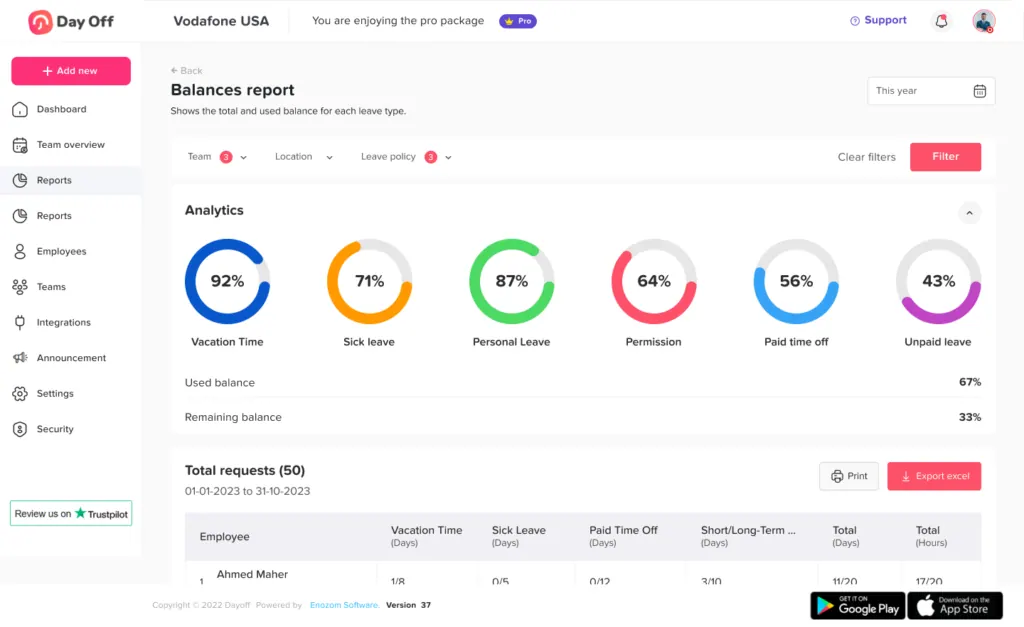
Day Off helps companies manage PTO policies and employee balances in one place.
Organizations can configure leave policies according to how their team earns and uses time off, while employees can see their available balances and submit leave requests without relying on separate spreadsheets or manual calculations.
Depending on the configured policy and plan, Day Off can support PTO management features such as:
PTO balances for employees
Custom leave types
Weekly, biweekly, semimonthly, monthly, annual, and hours worked accruals
Carryover rules
Carryover limits and expiration
Waiting periods
Leave in days or hours
Annual and anniversary based balance rules
Leave approval workflows
Employee leave history
Balance, accrual, usage, and carryover reports
Shared calendars for approved absences
This makes the employee’s PTO balance part of the actual leave-management process rather than a number maintained separately from leave requests and approvals.
For example, when an employee submits PTO through Day Off, managers can review the request alongside the team’s leave schedule, while the organization’s configured leave policy controls how balances are earned and managed.
For HR teams, having leave requests, balances, policies, accruals, and reporting in the same system can reduce the risk of maintaining different versions of an employee’s PTO information.
PTO Balance Calculation Checklist
Before considering a PTO balance final, check the following:
Confirm the employee’s starting balance.
Confirm the correct PTO policy.
Add all eligible accruals.
Add eligible carryover.
Add valid manual credits.
Subtract leave already used.
Check approved future leave.
Remove valid negative adjustments.
Apply expiration rules where permitted.
Check whether an accrual cap has been reached.
Verify the employee’s work schedule.
Check whether employment status changed.
Confirm that canceled requests were restored correctly.
Review applicable state or local requirements.
FAQ
What does remaining PTO balance mean?
Remaining PTO balance is the amount of paid time off an employee still has available after accounting for the PTO they have earned or received and the leave that has already been used, along with applicable carryover, adjustments, and other policy rules.
What is the easiest way to calculate PTO balance?
For a simple policy, use:
PTO Balance = PTO Earned or Granted – PTO Used
For more complex policies, add carryover and positive adjustments, then subtract used PTO, negative adjustments, and any valid expiration.
Should approved future PTO be deducted from the balance?
That depends on how the employer defines its displayed balance. Some systems reserve approved future PTO immediately, while others deduct it when the leave occurs. The most important point is to clearly distinguish current unused PTO from PTO still available for new requests.
Do pending PTO requests reduce PTO balance?
Usually, it is clearer to keep pending requests separate until they are approved. However, companies may display a projected balance showing what would remain if the request is approved.
Can an employee have more PTO than their annual allowance?
Yes. Carryover, manual credits, compensatory time, or other policy provisions can result in a balance higher than the current year’s standard allowance, unless an accrual cap or other limit prevents it.
Can a PTO balance expire?
Potentially, but employers must consider applicable state and local law. Some jurisdictions restrict forfeiture of earned vacation or impose specific rules on how accrued leave is treated.
Is PTO required by federal law?
Generally, no. The FLSA does not require employers to provide paid vacation or paid time off for time not worked. PTO benefits are generally established through employer policies or agreements, although state and local laws may create additional obligations.
Is PTO included in hours worked for overtime?
Paid vacation generally represents pay for time not worked rather than actual hours worked. Under federal FLSA overtime principles, overtime calculations are based on hours worked. Employers should still review applicable laws and specific compensation arrangements.
Why does my PTO balance differ from my available PTO?
Your current balance may include PTO that has already been approved for a future absence. A system may therefore show one figure as the current unused balance and a lower figure as the amount still available for additional requests.
How can employers prevent PTO balance errors?
Use clearly documented policies, consistent accrual formulas, reliable transaction histories, standardized approval processes, and regular balance audits. Automated leave-management software can also reduce manual calculation and data-entry errors.
Conclusion
Calculating a remaining PTO balance starts with a simple idea: determine how much paid leave an employee has received or earned, then subtract what has already been used. In practice, an accurate PTO Balance may also need to account for carryover, periodic accruals, future approved leave, adjustments, expiration rules, accrual caps, and changes to an employee’s schedule or status.
The most reliable approach is to treat every balance change as a transaction that can be traced. Employers should be able to explain where an employee’s starting balance came from, when PTO was earned, what was deducted, and why any adjustment occurred.
Clear PTO policies and accurate records make the process easier for everyone. Employees can plan time off with confidence, managers can approve requests with better information, and HR teams spend less time correcting balances.
For organizations managing multiple employees and leave policies, a PTO management system such as Day Off can automate much of this process by connecting leave balances with accruals, requests, approvals, carryover rules, employee schedules, and reporting in one place.