







Employees do not always need a full day away from work. A doctor’s appointment, school meeting, personal errand, late arrival, or early departure might require only one or two hours. In these situations, allowing PTO to be used in hourly increments can give employees more flexibility while helping employers deduct only the amount of paid time that was actually missed.

But hourly PTO is not as simple as subtracting a few hours from a balance. Employers need to decide what increments employees can use, how partial day absences are calculated, how the policy interacts with work schedules, and whether federal, state, or local leave laws impose additional requirements.
This guide explains how PTO in hourly increments works, common rules employers use, how to calculate partial day PTO, and what businesses should consider when creating an hourly PTO policy.
What Does It Mean to Use PTO in Hourly Increments?
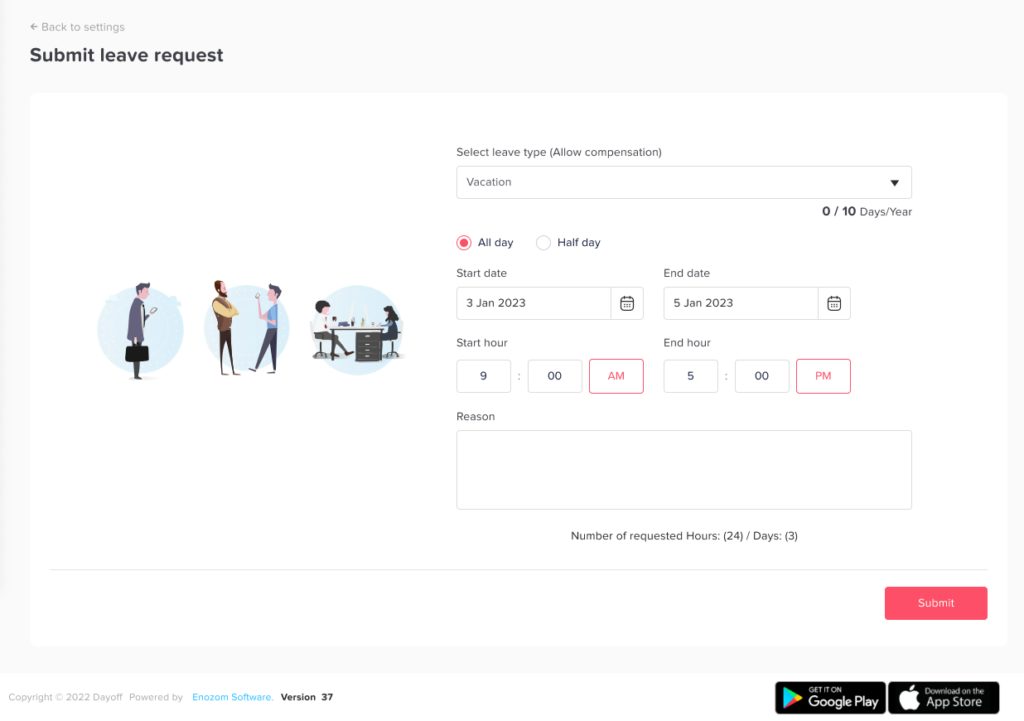
Using PTO in hourly increments means employees can take part of a workday off and deduct only those hours from their available paid time off balance.
For example, suppose an employee normally works from 9:00 AM to 5:00 PM with eight paid working hours.
If the employee has a medical appointment and leaves work two hours early, an hourly PTO policy may allow the employee to use:
2 hours of PTO
instead of requiring the employee to take:
8 hours of PTO
The employee therefore receives pay for the two hours they were absent while preserving the remaining PTO balance for future use.
Depending on the employer’s policy, PTO might be available in:
- 15-minute increments
- 30-minute increments
- 1-hour increments
- 2-hour increments
- Half day increments
- Full day increments
The appropriate increment depends on the employer’s policy, payroll practices, workforce structure, and applicable leave laws.
Can PTO Be Used in Hourly Increments?
Yes. Employers can generally structure a PTO policy so employees may use paid time off by the hour.
At the federal level, there is no general law requiring private employers to provide PTO such as vacation or general purpose paid time off. The U.S. Department of Labor explains that PTO policies are generally established by employers, although state and local laws can create additional requirements, particularly for paid sick leave.
This means an employer may commonly decide whether regular vacation or general PTO can be taken in:
- Full days
- Half days
- One hour increments
- 30 minute increments
- Other defined increments
However, an employer cannot look only at its general PTO policy.
If the same PTO bank is also being used to satisfy a legally required paid sick leave program, or if an absence is protected under a law such as the Family and Medical Leave Act, different rules can apply.
For this reason, the best answer to “Can PTO be used by the hour?” is:
Yes, but the permitted minimum increment should be clearly defined in the employer’s PTO policy and checked against any applicable federal, state, and local leave requirements.
Why Employers Allow Hourly PTO
Hourly PTO is useful because many employee absences do not require an entire workday.
Common examples include:
- Attending a medical appointment
- Going to the dentist
- Picking up a child from school
- Attending a parent teacher meeting
- Arriving late because of a personal commitment
- Leaving early for an appointment
- Handling an urgent personal matter
- Taking several hours away from work for an eligible family need
Requiring a full day of PTO for a two hour absence can unnecessarily reduce the employee’s balance.
Hourly PTO gives employers a more accurate way to connect paid leave with the employee’s actual scheduled absence.
Common PTO Increment Policies
| PTO Increment | Example | Best Suited For |
|---|---|---|
| 15 minutes | Employee misses 45 minutes and uses 0.75 PTO hours | Employers already tracking time in 15-minute units |
| 30 minutes | Employee leaves 1.5 hours early | Businesses wanting detailed tracking without very small units |
| 1 hour | Employee attends a 2-hour appointment | Simple hourly PTO administration |
| 2 hours | Employee needs part of the morning off | Employers wanting fewer small PTO transactions |
| Half day | Employee works morning and takes afternoon off | Businesses with simple fixed schedules |
| Full day | Entire scheduled day is deducted | Policies designed mainly around vacation days |
For many organizations, one hour PTO increments offer a balance between employee flexibility and administrative simplicity.
However, employers should also consider how their payroll and time-tracking systems record employee working time.
How to Calculate PTO in Hourly Increments
The basic calculation is:
Scheduled Hours Missed = PTO Hours Used
Suppose an employee was scheduled to work eight hours but only worked six hours because they left early.
The calculation is:
8 scheduled hours – 6 worked hours = 2 PTO hours
If the absence qualifies under the employer’s PTO policy and the employee requests paid leave for the missing time, two hours are deducted from the employee’s balance.
Example
Employee PTO balance before request:
32 hours
PTO used:
2 hours
Remaining balance:
32 – 2 = 30 hours
The employee now has:
30 hours of PTO remaining
This approach is particularly useful when PTO balances are already maintained in hours rather than days.
Examples of Hourly PTO Calculations
| Situation | Scheduled Hours | Hours Worked | PTO Needed | Remaining PTO From a 40-Hour Balance |
|---|---|---|---|---|
| Leaves 1 hour early | 8 | 7 | 1 | 39 |
| Doctor appointment | 8 | 6 | 2 | 38 |
| Arrives 30 minutes late | 8 | 7.5 | 0.5 | 39.5 |
| Takes afternoon off | 8 | 4 | 4 | 36 |
| Works only 2 hours | 8 | 2 | 6 | 34 |
These examples assume the employer allows PTO to be used in increments small enough to cover the exact absence.
If the employer uses a minimum increment, the calculation may be different.
Example: PTO With a 1-Hour Minimum Increment
Suppose an employer’s PTO policy states:
PTO must be requested in increments of at least one hour.
An employee arrives 30 minutes late.
Because the policy uses one-hour increments, the employee may need to use one hour of PTO if the policy legally permits that treatment.
However, employers need to be particularly careful when the absence qualifies as legally protected paid sick leave or another type of protected leave. State or local laws may regulate the maximum minimum increment an employer can impose.
This distinction is important.
A company may have discretion over ordinary vacation PTO while having less discretion over PTO used to satisfy statutory sick leave requirements.
PTO in Hours vs PTO in Days
PTO can be tracked in either days or hours, but hourly tracking is usually more precise when employees are allowed to take partial days.
Imagine two employees:
Employee A
Works 8 hours per day.
Employee B
Works 10 hours per day.
Both take one scheduled workday off.
If the company simply deducts “one PTO day,” the balance may appear equal even though the employees missed different numbers of scheduled hours.
With hourly PTO:
- Employee A uses 8 hours.
- Employee B uses 10 hours.
This becomes even more important for employees with flexible schedules, rotating shifts, split shifts, or different scheduled hours on different days.
How Hourly PTO Works With Different Work Schedules
Employers should normally base the PTO deduction on the hours the employee was scheduled to work during the absence.
Standard 8-Hour Schedule
Employee schedule:
9:00 AM to 5:00 PM
Employee leaves three hours early.
PTO deduction:
3 hours
10-Hour Shift
Employee schedule:
7:00 AM to 5:00 PM
Employee takes the final four hours off.
PTO deduction:
4 hours
The employer should not automatically assume that “half a day” always means four hours. Half of a 10-hour shift would actually be five scheduled hours.
Variable Schedule
Suppose an employee works:
- Monday: 8 hours
- Tuesday: 6 hours
- Wednesday: 10 hours
- Thursday: 8 hours
- Friday: 4 hours
If the employee takes the final two hours of Wednesday off, the deduction should generally be based on the two scheduled hours missed, not a standard eight-hour day.
Split Shift
Consider an employee scheduled to work:
8:00 AM to 12:00 PM
and
4:00 PM to 8:00 PM
The employee works the morning shift but takes the evening shift off.
The scheduled absence is:
4 hours
The appropriate PTO deduction would therefore normally be:
4 PTO hours
Using the employee’s actual work schedule is much more accurate than applying one fixed number of PTO hours to every partial-day absence.
Can Salaried Employees Use PTO by the Hour?
Yes, salaried employees can generally have hours deducted from a PTO or leave bank for partial-day absences.
However, employers need to distinguish between:
- Deducting time from a PTO balance
- Deducting money from an employee’s salary
Those are not the same thing.
For employees who qualify for an overtime exemption under the Fair Labor Standards Act’s salary basis rules, partial day salary deductions can create compliance problems.
The Department of Labor has explained that an employer can deduct from an exempt employee’s accrued leave bank for a partial day absence without violating the salary basis requirement, provided the employee still receives the required full guaranteed salary.
For example:
An exempt employee earns a fixed weekly salary and leaves three hours early.
The employer may be able to deduct:
3 hours from the employee’s PTO balance
while still paying:
the employee’s full salary
That is very different from reducing the employee’s salary by three hours.
Federal salary basis rules generally restrict deductions from an exempt employee’s actual salary for partial-day absences, subject to specific exceptions.
Employers should therefore make sure payroll and PTO deductions are treated separately.
How Does Hourly PTO Work With FMLA Leave?
The Family and Medical Leave Act has its own rules for intermittent and reduced-schedule leave.
Eligible employees may sometimes take FMLA leave in hours or even smaller units of time.
Under Department of Labor guidance, employers generally must account for FMLA leave using an increment no greater than the smallest increment used for other forms of leave, provided that the increment does not exceed one hour. Only the amount of leave actually taken may generally be counted against the employee’s FMLA entitlement.
For example, suppose an employer tracks:
- Vacation in 1-hour increments
- Sick leave in 30-minute increments
The employer would generally need to account for FMLA leave in increments no larger than 30 minutes because that is the smallest increment used for another form of leave.
This is one reason employers should review PTO increment policies alongside FMLA procedures instead of treating the two systems independently.
State Paid Sick Leave Laws Can Affect PTO Increments
A company’s regular PTO policy may allow one-hour or half-day increments, but state and local paid sick leave laws can establish different requirements.
This becomes especially important when an employer uses a combined PTO bank to meet statutory paid sick leave requirements.
For example:
| Jurisdiction | Example Rule for Paid Sick Leave |
|---|---|
| California | Employers may set a reasonable minimum increment, but it cannot exceed two hours |
| Washington | Paid sick leave generally must be usable in increments consistent with payroll practices and no greater than one hour |
| New York | Employers may establish increments, but the minimum increment cannot exceed four hours |
California’s Labor Commissioner confirms that employees may determine how much paid sick leave they need, although employers may establish a reasonable minimum increment of up to two hours. California also allows qualifying PTO plans to satisfy paid sick leave requirements if those plans meet the applicable statutory standards.
Washington requires covered employers to allow paid sick leave in increments consistent with their normal payroll systems and practices, generally not exceeding one hour. For example, if payroll tracks work in 15-minute increments, paid sick leave generally must also be available in 15-minute increments.
New York permits employers to establish minimum sick-leave increments, but those increments generally cannot exceed four hours. The state also recognizes existing PTO or leave policies that meet or exceed its accrual, carryover, and use requirements.
These are examples rather than a complete list of state and local rules. Employers should check requirements for every jurisdiction in which employees work.
What Happens When PTO and Paid Sick Leave Use the Same Balance?
Some employers maintain separate balances for:
- Vacation leave
- Sick leave
- Personal leave
Others use a single PTO bank for multiple purposes.
A combined system can simplify administration, but employers must be careful when part of that PTO balance is being used to satisfy a legal paid sick leave requirement.
For example, suppose a company says:
All PTO must be taken in four hour increments.
That might be acceptable for ordinary vacation time in some locations.
But if the same PTO policy is intended to satisfy California paid sick leave requirements, the four-hour minimum could conflict with California’s rule limiting a minimum paid sick leave increment to two hours.
Employers should therefore ask:
- Is this PTO purely an employer-provided vacation benefit?
- Does the PTO bank also satisfy a paid sick leave law?
- Does state law specify an increment of use?
- Does local law impose a stricter standard?
- Is the employee taking FMLA protected leave?
- Is the employee exempt or non exempt?
The answer can affect how the absence should be recorded.
Should PTO Be Available in 15-Minute Increments?
It can be.
A 15-minute PTO increment provides highly accurate leave deductions and can work well when a company’s time clock and payroll system already track work in quarter-hour increments.
For example:
Employee leaves at:
4:15 PM
Scheduled end:
5:00 PM
Time missed:
45 minutes
PTO deduction:
0.75 hours
PTO balance before:
20 hours
Remaining balance:
20 – 0.75 = 19.25 hours
The downside is that smaller increments create more individual transactions and can make manual PTO management difficult.
Businesses using spreadsheets may find 15-minute increments harder to maintain accurately across a large workforce.
Should PTO Be Available in 30-Minute Increments?
Thirty-minute increments are another practical option.
For example, an employee who needs to leave 90 minutes early would use:
1.5 PTO hours
An employee leaving two and a half hours early would use:
2.5 PTO hours
This provides more flexibility than half day PTO without creating as many small leave transactions as 15-minute increments.
Is a 1-Hour PTO Increment Easier to Manage?
For many employers, yes.
A one hour minimum can simplify:
- PTO requests
- Manager approvals
- Balance calculations
- Payroll reconciliation
- Attendance records
- Reporting
Employees can still take partial days while HR avoids managing extremely small leave transactions.
Whether a one hour minimum is appropriate depends on the organization’s workforce and applicable leave laws.
What If the Employee Does Not Have Enough PTO?
Suppose an employee needs three hours away from work but has only:
1.5 PTO hours remaining
Possible outcomes depend on company policy and applicable law.
The employer may:
- Apply the remaining 1.5 hours of PTO and treat the remaining time as unpaid
- Allow a negative PTO balance
- Permit the employee to make up the time
- Apply another available leave balance
- Allow the absence to remain unpaid
- Use another legally required leave entitlement where applicable
Employers should define this situation in advance.
Employees should not have to discover the rule only after their balance reaches zero.
Can Employees Combine PTO With Hours Worked on the Same Day?
Yes, if the employer’s policy allows partial-day PTO.
Suppose an employee is scheduled for eight hours.
They work:
5 hours
and use:
3 hours of PTO
Total compensated hours:
8 hours
The PTO does not represent hours actually worked. It represents paid leave.
This distinction matters when determining overtime.
Under federal FLSA rules, overtime for non-exempt employees is generally based on hours actually worked. Paid leave time such as vacation or PTO is generally not treated as hours worked for purposes of federal overtime calculation.
For example:
Hours actually worked:
38
PTO hours:
8
Total compensated hours:
46
Federal overtime hours based solely on this information:
0
The employee received compensation covering 46 hours, but only 38 hours were actually worked.
State law, collective bargaining agreements, or employer policies can sometimes provide more generous treatment, so employers should review the rules that apply to their workforce.
Hourly PTO and Overtime Should Be Tracked Separately
Employers should avoid treating PTO hours as interchangeable with working hours.
Consider:
Monday to Thursday:
9 hours worked each day = 36 hours
Friday:
4 hours worked + 4 hours PTO
Actual hours worked:
40
PTO:
4
Total paid hours:
44
The employee has 44 compensated hours, but only 40 actual working hours.
Accurate time tracking makes this distinction much easier to maintain.
What Should an Hourly PTO Policy Include?
A good PTO policy should clearly explain how partial day leave works.
At minimum, consider defining the following.
Minimum PTO Increment
State whether PTO may be taken in:
- 15-minute increments
- 30-minute increments
- One-hour increments
- Two-hour increments
- Another permitted unit
Eligible PTO Uses
Explain whether hourly PTO can be used for:
- Vacation
- Personal matters
- Medical appointments
- Family needs
- Late arrival
- Early departure
- Other approved reasons
If the policy includes statutory sick leave, make sure the permitted uses satisfy applicable law.
How PTO Is Deducted
Specify whether PTO is based on:
the actual scheduled hours missed
This is particularly important for employees with varying schedules.
Request and Approval Rules
Explain:
- How employees submit a partial-day PTO request
- Whether advance notice is required
- Who approves the request
- How unexpected absences are handled
Insufficient Balance Rules
Explain what happens when an employee does not have enough PTO to cover the requested hours.
Work Schedule Treatment
Define how PTO works for:
- Part-time employees
- Flexible schedules
- Rotating shifts
- Split shifts
- Overnight shifts
- Variable daily hours
Protected Leave
State that statutory leave rights may override or modify normal PTO procedures when required by law.
Why Accurate Work Schedules Matter for Hourly PTO
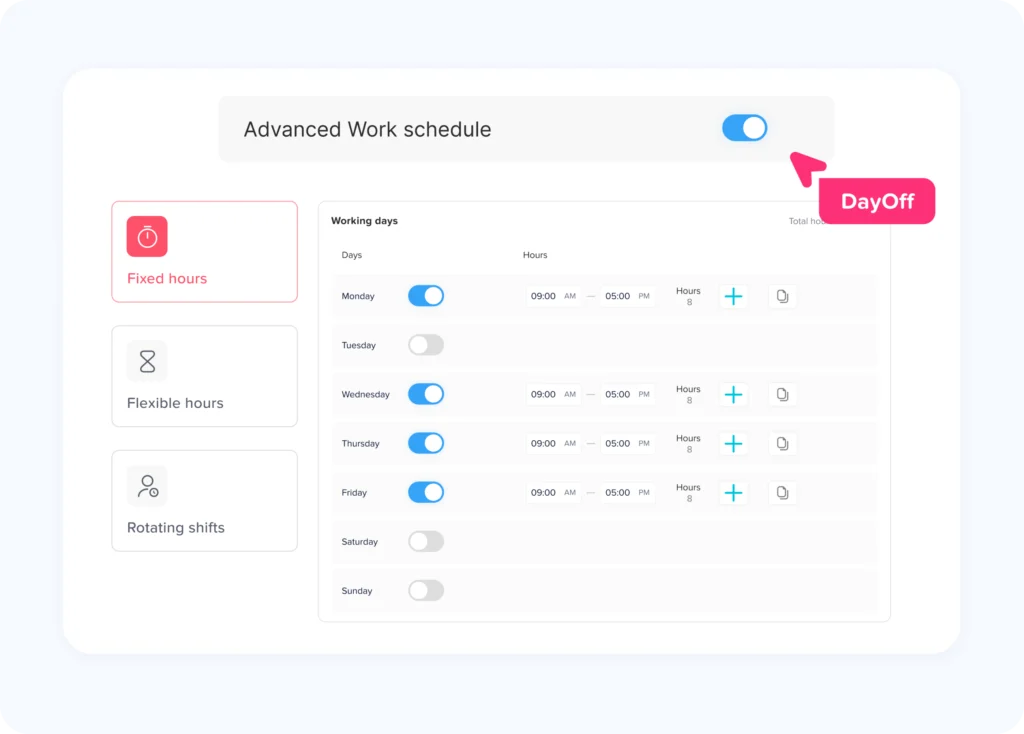
Hourly PTO becomes much more accurate when leave management and employee work schedules are connected.
Suppose one employee works eight hours on Monday but only four hours on Friday.
If the employee requests Friday off, the correct PTO deduction is:
4 hours
not:
8 hours
A system that automatically understands the employee’s scheduled hours can prevent managers from manually calculating each request.
This is especially helpful for:
- Flexible schedules
- Fixed hour schedules
- Rotating shifts
- Split shifts
- Part time employees
- Employees with different hours each day
When PTO balances are maintained in hours, each absence can be matched directly with the employee’s actual scheduled working time.
Using PTO Software for Hourly Leave Tracking
Managing hourly PTO manually can become difficult as the number of employees, schedules, leave types, and requests increases.
A leave management system such as Day Off can help businesses maintain PTO balances in hours, connect leave requests with employee work schedules, and provide managers with a clearer view of time off and employee availability.
Instead of manually calculating:
Previous balance – hours requested = new balance
for every request, a PTO tracking system can keep balances and leave records organized in one place.
This becomes particularly useful when employees have different work schedules or use PTO for only part of the day.
Best Practices for Managing PTO in Hourly Increments
Employers introducing hourly PTO should consider the following practices:
- Define the minimum PTO increment in writing.
- Use the employee’s actual work schedule when calculating partial-day leave.
- Keep PTO balances in hours when employees regularly take partial days.
- Align PTO tracking with payroll and attendance systems.
- Distinguish PTO hours from actual hours worked.
- Review FMLA requirements when protected intermittent leave is involved.
- Check state and local paid sick leave laws.
- Apply increment rules consistently among similarly situated employees.
- Clearly explain how insufficient PTO balances are handled.
- Maintain accurate records of every deduction and balance adjustment.
- Review the policy when employees work across multiple states or jurisdictions.
The goal should be to make partial-day leave both flexible for employees and predictable for managers.
Frequently Asked Questions
Can I use PTO for only one hour?
Yes, if your employer’s PTO policy permits one hour increments. Ordinary PTO rules are often established by the employer, although paid sick leave and protected leave laws may impose additional requirements.
Can an employer require PTO to be taken in full day increments?
An employer may be able to require ordinary vacation PTO to be used in larger increments, depending on applicable law. However, statutory paid sick leave, FMLA leave, or other protected leave may be subject to separate increment rules.
Employers should check state and local law before requiring employees to use a full day for a partial-day absence.
Can PTO be used for a doctor’s appointment?
Usually, if the employer’s PTO policy allows it. A doctor appointment may also qualify for paid sick leave or another protected form of leave depending on the circumstances and applicable law.
For example, an employee who misses two scheduled hours for an appointment may use two PTO hours if the policy permits hourly leave.
Can I take 30 minutes of PTO?
Possibly. If the employer permits PTO in 30-minute or smaller increments, an employee may be able to use 0.5 PTO hours.
Some paid sick leave laws can also influence the minimum increment an employer may require.
Can salaried employees take two hours of PTO?
Yes. An employer may generally deduct two hours from an exempt salaried employee’s accrued PTO bank while continuing to pay the employee’s full guaranteed salary. Employers should be careful not to confuse reducing a leave balance with making an unlawful partial-day salary deduction.
How much PTO should be deducted for a partial day?
A common approach is to deduct the scheduled working hours the employee missed.
For example:
Scheduled shift:
8 hours
Hours worked:
5.5 hours
Scheduled absence:
2.5 hours
PTO deduction:
2.5 hours
This assumes the company’s PTO increment rules allow the exact deduction.
Is PTO considered hours worked for overtime?
Generally, no under the federal FLSA. PTO provides compensation for time away from work, but it generally does not convert those leave hours into hours actually worked for federal overtime purposes.
Employers should still check state laws, contracts, collective bargaining agreements, and company policies that may provide different or more generous rules.
Can an employer round PTO hours?
Employers may establish lawful increment and timekeeping practices, but rounding should be handled consistently and should not conflict with applicable paid leave or wage and hour requirements.
For example, if the organization tracks PTO in 15-minute increments, 45 minutes may be recorded as:
0.75 PTO hours
Employers should avoid informal or inconsistent rounding that results in inaccurate employee balances.
Is hourly PTO better than half day PTO?
Hourly PTO is generally more precise.
If an employee needs only two hours away from work, hourly PTO may deduct two hours rather than forcing the employee to use a four hour half day.
Half-day PTO can be easier to administer manually, but hourly PTO provides employees with greater flexibility and more accurately reflects the time actually missed.
Should PTO balances be tracked in hours or days?
Hours are usually more practical when employees:
- Work different shift lengths
- Have flexible schedules
- Take partial days frequently
- Work rotating shifts
- Work split shifts
- Have leave policies calculated by working hours
Tracking PTO in hours makes it easier to deduct exactly the amount of scheduled working time covered by a leave request.
Conclusion
Yes, PTO can be used in hourly increments, and for many workplaces it provides a more accurate and flexible way to manage partial day absences.
Instead of requiring an employee to use a full vacation day for a short appointment or early departure, employers can deduct the scheduled hours actually missed. Depending on the policy, this may mean allowing PTO in 15-minute, 30-minute, one hour, or other defined increments.
The key is consistency.
Employers should clearly document the minimum PTO increment, base deductions on employee schedules, keep PTO separate from actual hours worked, and ensure that their rules comply with applicable paid sick leave, FMLA, salary basis, and state or local requirements.
As work schedules become more flexible, tracking PTO in hours can also make leave balances more accurate. Connecting work schedules, attendance records, and PTO tracking gives HR teams a clearer picture of when employees are working, when they are away, and exactly how much leave should be deducted.