







Employee attendance affects staffing, customer service, productivity, payroll, team workload, and daily operations. But without clear rules, employees may not know what counts as late, when an absence must be reported, how missed clock-ins should be corrected, or when PTO should be used.
An Employee Attendance Policy Template gives employers a starting point for setting consistent expectations around attendance, punctuality, absences, work schedules, time tracking, and notification procedures.

A strong attendance policy should do more than tell employees to “arrive on time.” It should explain how attendance is measured, how employees report problems, which absences follow separate leave procedures, and how managers should respond consistently.
This guide explains what an employee attendance policy should include, provides a ready-to-customize template, and shows how tools such as Day Off can connect work schedules, PTO, time tracking, and attendance records in one system.
What Is an Employee Attendance Policy?
An employee attendance policy is a written set of rules explaining when employees are expected to work and what happens when they are late, absent, leave early, miss a scheduled shift, or fail to record their working time correctly.
The policy typically covers:
- Work schedules
- Expected start and end times
- Clock-in and clock-out procedures
- Late arrivals
- Early departures
- Absences
- Call-in procedures
- PTO and sick leave
- Missed punches
- No-call, no-show situations
- Attendance records
- Repeated attendance problems
- Protected leave and accommodations
- Manager responsibilities
The goal is not simply to penalize absence.
A good policy creates a shared process for distinguishing between situations such as:
Employee A: Arrives 25 minutes late without notifying anyone.
Employee B: Starts later because of an approved flexible schedule.
Employee C: Is absent because of approved PTO.
Employee D: Misses work for a reason covered by legally protected leave.
Those situations should not automatically be treated the same.
Why Is an Attendance Policy Important?
Without written attendance rules, managers may handle similar situations differently.
One manager might consider an employee late after five minutes.
Another might allow 20 minutes.
One department might require employees to call their manager before a shift.
Another might accept a message several hours later.
Over time, inconsistent practices can create confusion and make attendance management more difficult.
A clear employee attendance policy can help organizations:
- Establish consistent expectations
- Define what counts as lateness or absence
- Tell employees how to report attendance problems
- Improve schedule coverage
- Support accurate payroll records
- Reduce missed time entries
- Create a documented process for repeated attendance issues
- Separate approved leave from unexplained absence
- Give managers consistent procedures to follow
The policy should be understandable enough that employees know what to do before a problem occurs.
What Should an Employee Attendance Policy Include?
The exact policy depends on the organization, but most attendance policies should address the following areas.
Purpose of the Attendance Policy
Start by explaining why reliable attendance matters.
Avoid making the opening sound purely disciplinary.
For example:
Reliable attendance and punctuality help the company maintain appropriate staffing, support customers, distribute workloads fairly, and operate effectively. Employees are expected to follow their assigned work schedules and communicate promptly when they cannot work as scheduled.
This gives employees context before introducing specific rules.
Who the Policy Applies To
Specify the employees covered by the policy.
For example:
- Full-time employees
- Part-time employees
- Hourly employees
- Salaried employees
- Remote employees
- Hybrid employees
- Shift workers
- Temporary employees
Different employee groups may have different schedules or time-recording requirements.
If rules differ significantly, consider adding separate sections rather than trying to apply one identical process to everyone.
Work Schedules
Employees need to know when they are expected to work.
The policy should explain whether the organization uses:
- Fixed schedules
- Flexible hours
- Rotating shifts
- Split shifts
- Variable schedules
- Remote schedules
- Part-time schedules
The assigned work schedule should be the baseline used to determine attendance.
Example
Employee A is scheduled:
9:00 AM to 5:00 PM
Employee B has flexible hours and must complete:
8 hours per workday
A 9:20 AM arrival could represent lateness for Employee A but be completely acceptable for Employee B.
Attendance rules therefore need to reflect the employee’s actual schedule rather than applying one clock time to everyone.
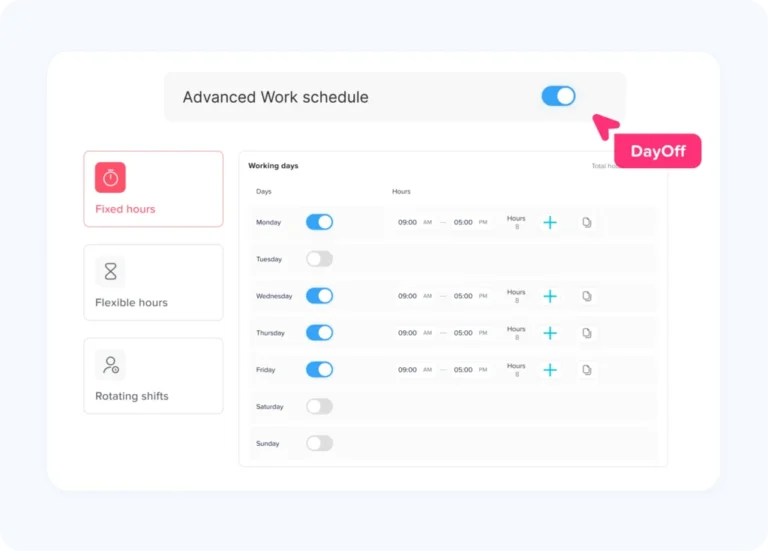
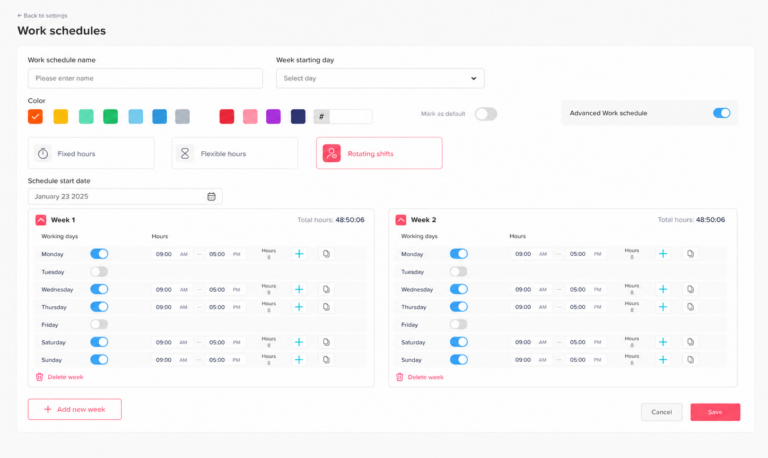
Day Off supports different employee work schedules, including fixed hours, flexible hours, and rotating shifts, allowing scheduled working time to be connected with attendance and leave tracking.
Attendance and Punctuality Expectations
Define what employees are expected to do.
For example:
- Be ready to work at the scheduled start time
- Remain available during required working periods
- Follow assigned break procedures
- Record working time accurately where required
- Notify the appropriate person when unable to work
- Request planned time off through the normal PTO process
- Report unexpected absences promptly
Be careful with vague terms such as: Excessive lateness is prohibited.
Employees still do not know what “excessive” means.
If the organization uses a specific threshold, grace period, attendance point system, or disciplinary process, document it clearly.
What Counts as Late?
A late arrival occurs when an employee begins work after the required start time unless the delay is approved, protected, or otherwise covered by company policy.
For example:
Scheduled start: 8:30 AM
Actual start: 8:47 AM
Potential late time:
17 minutes
However, employers should define whether they use:
- Exact scheduled start
- A grace period
- Flexible arrival windows
- Core working hours
- Shift-specific rules
Do not rely on an unwritten expectation.
Early Departures
Attendance policies should also address employees leaving before their scheduled end time.
For example:
Scheduled end: 5:00 PM
Actual departure: 4:20 PM
Potential early departure:
40 minutes
An early departure may be:
- Approved in advance
- Covered by PTO
- Related to an emergency
- Part of an approved schedule change
- Protected by applicable law
- Unapproved
The attendance record should therefore provide context rather than automatically labeling every early clock-out as misconduct.
How Employees Should Report an Absence
A strong attendance policy should tell employees exactly how to notify the company when they cannot work.
Specify:
- Who should be contacted
- How they should be contacted
- How far in advance notice should be given when possible
- What information employees should provide
- What happens if the employee cannot personally make contact
Example
Employees who are unable to report for a scheduled shift should notify their manager as soon as reasonably possible and, where practicable, before the scheduled start time. Employees should follow the company’s designated absence-reporting procedure rather than relying solely on a message to a coworker.
Avoid requiring employees to disclose unnecessary medical information in routine attendance reporting.
HR should separately manage documentation and medical information where required.
Planned vs Unplanned Absences
It is useful to distinguish between the two.
Planned Absence
Examples include:
- Vacation
- Personal day
- Scheduled appointment
- Planned family leave
- Pre-approved unpaid leave
These should normally follow the company’s PTO or leave request procedure.
Unplanned Absence
Examples may include:
- Sudden illness
- Family emergency
- Transportation emergency
- Unexpected personal situation
The employee may not be able to provide advance notice, but should follow the organization’s call-in procedure where possible.
The distinction helps managers avoid treating an unexpected emergency as if the employee simply ignored the PTO approval process.
PTO and Attendance
PTO and attendance should work together.
If an employee has approved vacation for Wednesday, the absence should not appear in the same way as an unexplained missed shift.
A good attendance process distinguishes between:
Scheduled absence: Approved PTO
Protected absence: Leave covered by applicable law
Unscheduled but reported absence: Employee notified management
Unreported absence: Employee did not follow the attendance procedure
Attendance exception: Late arrival, early departure, or missed time
This is one reason connecting PTO with attendance records can be valuable.
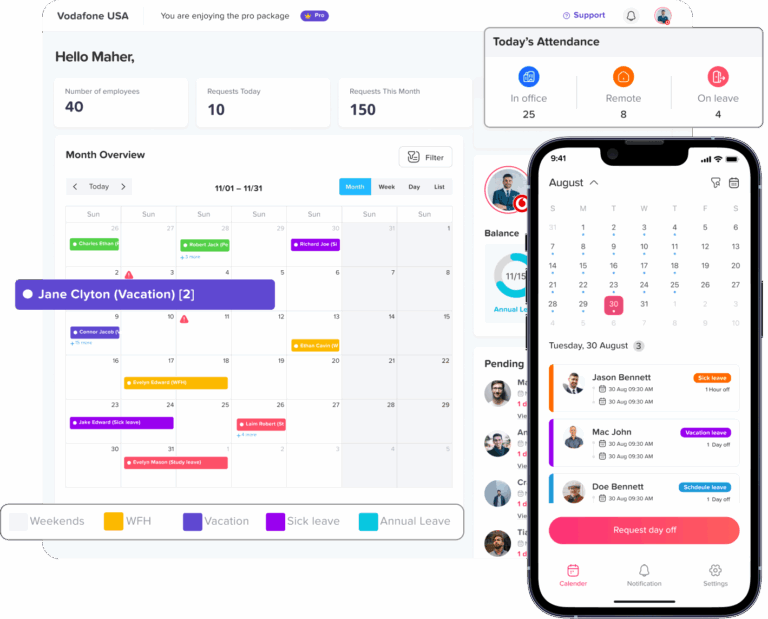
Day Off connects leave requests and absence records with employee attendance. Managers can review approved time off alongside scheduled and actual attendance rather than managing separate leave and time records.
Clock-In and Clock-Out Rules
If employees are required to track their working time, the policy should explain how.
Employees should know:
- When to clock in
- When to clock out
- How breaks are recorded
- Whether they clock out when leaving the workplace
- What to do when working remotely
- What happens if they forget a punch
- Whether time entries can be corrected
- Who reviews corrections
For U.S. employers covered by the Fair Labor Standards Act, the Department of Labor requires certain records for covered nonexempt employees, including hours worked each day and total hours worked each workweek. The DOL does not require one specific timekeeping method, but the records must be complete and accurate.
This makes accurate timekeeping more than an internal attendance preference for many employers.
Employees Should Never Work Off the Clock
If an employee forgets to clock in but actually performs work, the solution should generally be to correct the time record, not erase the work.
Attendance policy and payroll policy should remain separate concepts.
A missed punch may violate company procedure, but actual compensable working time still needs to be recorded accurately where wage-and-hour law requires it.
Missed Clock-Ins and Clock-Outs
Missed punches are common.
Employees forget to start the timer, leave without clocking out, lose access to the system, or make another simple mistake.
Define a correction process.
For example:
- Employee notices the missing punch.
- Employee submits the correct start or end time.
- Manager reviews the correction where required.
- Corrected attendance is retained in the system.
- Repeated missed punches may be addressed separately under the attendance policy.
The important distinction is:
Correct the attendance record first.
Address repeated failure to follow the procedure separately.
This helps preserve accurate working-time records.
Breaks
If the organization records breaks, explain:
- Which breaks employees receive
- Which breaks must be recorded
- Whether employees must clock out
- Expected break duration
- Who approves schedule changes
- What employees should do when interrupted during a break
Break requirements vary by jurisdiction, employee type, and circumstances, so the policy should reflect the applicable rules for each workforce.
Overtime
Attendance policies should explain how overtime interacts with work schedules and timekeeping.
The company might require employees to obtain approval before working overtime.
However, employers should avoid creating the impression that unapproved work automatically disappears from the time record.
For covered nonexempt workers, accurate hours-worked records remain important under the FLSA.
A company can address failure to follow an overtime approval procedure separately from its obligation to maintain accurate working-time records.
No-Call, No-Show
A no-call, no-show generally describes a situation where an employee:
- Does not report for a scheduled shift, and
- Does not follow the required notification procedure.
The policy should define:
- What counts as a no-call, no-show
- Who employees must contact
- What communication methods are acceptable
- What happens after repeated incidents
- How emergencies are handled
Avoid automatically assuming that every failure to contact the company represents job abandonment.
There may be situations where the employee genuinely could not communicate.
Management should review the circumstances and applicable legal requirements before taking significant employment action.
Remote and Hybrid Employee Attendance
Attendance policies should reflect how remote employees actually work.
Physical presence at an office may not be the relevant measure.
A remote attendance policy might focus on:
- Required working hours
- Availability windows
- Core collaboration hours
- Scheduled meetings
- Time tracking
- Required total working hours
- Absence notification
- PTO procedures
For example:
Required hours: 8 hours per day
Core availability: 10:00 AM to 3:00 PM
Start time: Flexible
In this case, attendance should not be measured using a fixed 9:00 AM arrival rule.
A flexible employee’s attendance may be more accurately measured using required hours and availability periods.
Flexible Work Schedule Attendance
Flexible schedules require different attendance rules from fixed shifts.
Instead of asking:
Was the employee at work exactly at 9:00 AM?
the company may need to ask:
- Did the employee complete the required hours?
- Was the employee available during core hours?
- Were scheduled meetings attended?
- Was any missing time explained by PTO?
- Was the employee’s time recorded accurately?
For example:
Required: 8 hours
Worked: 6 hours
Approved hourly PTO: 2 hours
Unaccounted time: 0 hours
Without connecting PTO and attendance, the employee might incorrectly appear two hours short.
Excused vs Unexcused Absences
Some organizations classify absences as excused or unexcused.
If this terminology is used, define it carefully.
Excused Absence
May include an absence that:
- Was approved in advance
- Followed the company’s reporting procedure
- Was covered by an applicable leave policy
- Was otherwise authorized
Unexcused Absence
May include an absence where:
- Required notice was not provided
- Approval was required but not obtained
- The employee did not follow attendance procedures
However, legal protections must still be considered.
Do not classify an absence as unexcused simply because it was inconvenient for the business if applicable law provides protection.
Protected Leave and Attendance Policies
This is one of the most important parts of an attendance policy.
Not every absence should count against an employee.
For qualifying U.S. employers and employees, the Family and Medical Leave Act provides job-protected leave for specified family and medical reasons. The U.S. Department of Labor specifically states that employers cannot assess negative attendance points for FMLA-protected leave or count FMLA leave against employees under a no-fault attendance system.
The Americans with Disabilities Act may also require modifications to an attendance policy as a reasonable accommodation in appropriate circumstances.
The EEOC explains that possible modifications can include:
- Adjusted arrival times
- Adjusted departure times
- Periodic breaks
- Paid leave
- Unpaid leave
- Modified schedules
when required as a reasonable accommodation and when doing so does not create an undue hardship.
Attendance policies should therefore include wording such as:
Absences, lateness, or schedule changes protected by applicable law, approved leave, or reasonable accommodation will be handled according to the applicable policy and legal requirements and may be excluded from ordinary attendance discipline where required.
This prevents the template from implying that every absence automatically receives the same consequence.
Attendance Points Systems
Some employers use attendance points.
For example:
| Attendance Event | Example Points |
|---|---|
| Late arrival | 0.5 |
| Early departure | 0.5 |
| Unscheduled absence | 1 |
| No-call, no-show | 2 |
Points may trigger action at defined thresholds.
For example:
3 points: Coaching
5 points: Written warning
7 points: Final warning
8 points: Further disciplinary review
These numbers are only examples, not recommended universal thresholds.
Employers should create a system that reflects their workforce, local laws, applicable contracts, and operational needs.
Most importantly, protected leave must be handled correctly.
The Department of Labor explicitly prohibits counting FMLA-protected leave as negative attendance points.
Progressive Attendance Management
An alternative to automatic points is progressive attendance management.
For example:
First Pattern
Manager discusses the attendance issue with the employee.
Continued Problem
Written attendance warning.
Repeated Problem
Final warning or attendance improvement plan.
Continued Violation
Additional action according to company policy.
This approach gives managers more room to understand the pattern and circumstances.
Whichever system is used, consistency is important.
Two employees with similar attendance situations should not receive dramatically different treatment without a legitimate reason.
Manager Responsibilities
Lorem ipsum dolor sit amet, consectetur adipiscing elit. Ut elit tellus, luctus nec ullamcorper mattis, pulvinar dapibus leo.
Attendance policies should tell managers what they are expected to do as well.
Managers may be responsible for:
- Maintaining accurate schedules
- Reviewing attendance exceptions
- Responding to employee notifications
- Reviewing time corrections
- Approving PTO promptly
- Escalating potential protected-leave situations to HR
- Applying attendance rules consistently
- Documenting discussions
- Protecting confidential employee information
Managers should not improvise separate attendance rules for their own teams unless company policy allows them to do so.
Employee Responsibilities
Employees should also have clearly defined responsibilities.
These may include:
- Following the assigned schedule
- Recording working time accurately
- Submitting planned PTO through the correct process
- Reporting unexpected absences promptly
- Reporting missed punches
- Reviewing attendance records where required
- Communicating schedule problems
- Providing required documentation through the appropriate HR process
The policy works best when both manager and employee responsibilities are documented.
Employee Attendance Policy Template
The following template can be adapted for an employee handbook or internal attendance policy.
Purpose
[Company Name] relies on regular and reliable employee attendance to maintain appropriate staffing, support customers, distribute workloads effectively, and meet operational requirements.
Employees are expected to follow their assigned work schedules, record working time accurately where required, and communicate promptly when they cannot work as scheduled.
Scope
This policy applies to [all employees / specified employee groups] unless another employment agreement, collective bargaining agreement, local policy, or applicable law establishes different requirements.
Work Schedules
Employees will be assigned a work schedule based on their role, team, location, and operational requirements.
Schedules may include:
- Fixed working days
- Fixed working hours
- Flexible working hours
- Rotating shifts
- Part-time schedules
- Other approved arrangements
Employees are responsible for reviewing and following their assigned schedule.
Attendance and Punctuality
Employees are expected to be ready to work at their scheduled start time and remain available for the required working period unless they have approved leave, an approved schedule modification, or another authorized absence.
Employees should notify their manager promptly when they expect to arrive late, leave early, or miss scheduled work.
Reporting an Absence
Employees who cannot report to work should notify [Manager / HR / Designated Contact] using [approved communication method].
Where possible, notification should occur [X minutes/hours] before the employee’s scheduled start time.
The notification should include:
- That the employee cannot work as scheduled
- Expected duration of the absence, if known
- Any information required under the applicable leave procedure
Employees should not provide unnecessary confidential medical information through ordinary attendance channels.
Planned Time Off
Planned vacation, personal leave, and other foreseeable absences should be submitted through the company’s PTO request process.
Submitting a request does not automatically mean the leave is approved.
Employees should confirm approval before making arrangements that depend on the leave being granted.
Time Tracking
Employees who are required to track working time must accurately record their start time, end time, and other required attendance information.
Employees must not intentionally:
- Record time for another employee
- Ask another employee to record time for them
- Falsify working hours
- Delete or alter time to hide actual work
- Work off the clock where time recording is required
Missed Punches
Employees who forget to clock in or clock out should report the missing record as soon as possible through [correction procedure].
The company will correct verified working-time records where necessary.
Repeated failure to follow the timekeeping procedure may be reviewed separately as an attendance or policy issue.
Late Arrival and Early Departure
An employee may be considered late when they begin work after the required scheduled start time without approval or another applicable exception.
An employee may be considered to have left early when they stop work before the required end time without approval or another applicable exception.
Flexible schedules will be evaluated according to their assigned schedule and required working hours rather than a fixed start time where applicable.
No-Call, No-Show
An employee may be considered a no-call, no-show when the employee does not report for scheduled work and does not follow the required absence-notification procedure.
The company will review the circumstances of each situation before determining the appropriate action.
Repeated incidents may result in further action under company policy, subject to applicable law.
Approved and Protected Absences
Approved PTO, sick leave, protected leave, reasonable accommodations, and other authorized absences will be handled according to the applicable company policy and legal requirements.
Absences protected by applicable law will not be treated as ordinary attendance violations where prohibited.
Attendance Review
The company may review employee attendance based on information including:
- Assigned work schedule
- Clock-in and clock-out records
- Late arrivals
- Early departures
- Approved PTO
- Absences
- Breaks
- Worked hours
- Overtime
- Missed attendance records
Managers should consider the relevant schedule, leave status, and circumstances before determining whether an attendance issue occurred.
Repeated Attendance Problems
Repeated failure to follow attendance expectations may lead to coaching or other action under company policy.
Possible actions may include:
- Informal coaching
- Written warning
- Attendance improvement plan
- Final warning
- Further disciplinary review
The company will apply attendance procedures subject to applicable laws, approved leave, accommodations, employment contracts, and collective bargaining agreements.
Questions and Exceptions
Employees who have questions about attendance, scheduling, PTO, disability accommodation, protected leave, or timekeeping should contact [HR / Manager / Designated Contact].
Employees who believe they may need an adjustment to their schedule or attendance requirements because of a protected reason should contact HR so that the appropriate process can be followed.
Example: How an Attendance Policy Works in Practice
Consider an employee scheduled from:
9:00 AM to 5:00 PM
Scenario 1: Unreported Late Arrival
Clock-in:
9:35 AM
No manager notification or approved reason exists.
The company records:
35 minutes late
The incident is reviewed according to the attendance policy.
Scenario 2: Approved PTO
The employee has approved PTO from:
9:00 AM to 12:00 PM
The employee begins work at:
12:00 PM
This should not automatically appear as three hours of ordinary lateness.
The PTO record explains the schedule difference.
Scenario 3: Flexible Schedule
The employee is required to work eight hours but does not have a fixed 9:00 AM start.
The employee works:
10:00 AM to 6:30 PM, including a 30-minute break.
The employee completes:
8 working hours
A fixed-start lateness rule would not accurately describe this employee’s attendance.
Scenario 4: Missed Clock-In
The employee starts working at 9:00 AM but forgets to clock in until 10:00 AM.
The employee should follow the correction process so the attendance record reflects the actual working time.
The company may separately address repeated missed punches if they continue.
These examples demonstrate why attendance policies should consider schedules, PTO, and actual working time together.
How Day Off Helps Manage Employee Attendance
An attendance policy defines the rules.
An attendance system provides the records managers need to apply those rules consistently.
Day Off combines employee work schedules, PTO, time tracking, attendance review, and absence information in one platform.
Create Employee Work Schedules
Companies can create work schedules that match different working arrangements.
Day Off supports:
- Fixed hours
- Flexible hours
- Rotating shifts
Work schedules provide the expected working pattern against which actual attendance can be reviewed.
This is particularly important because a clock-in time has little meaning without knowing what the employee was expected to work.
For example:
Scheduled start: 8:00 AM
Clock-in: 8:42 AM
Potential late time:
42 minutes
But if the employee has a flexible schedule without an 8:00 AM start requirement, the same clock-in could be completely normal.
Track Clock-In and Clock-Out Activity
Day Off Time Tracker allows employees to record when they begin and finish work.
Companies can use simple punch-in and punch-out tracking for attendance or use task and project time tracking when more detailed working-time information is required.
The resulting records help managers review actual working time instead of relying on paper logs, messages, or memory.
Compare Scheduled and Actual Attendance
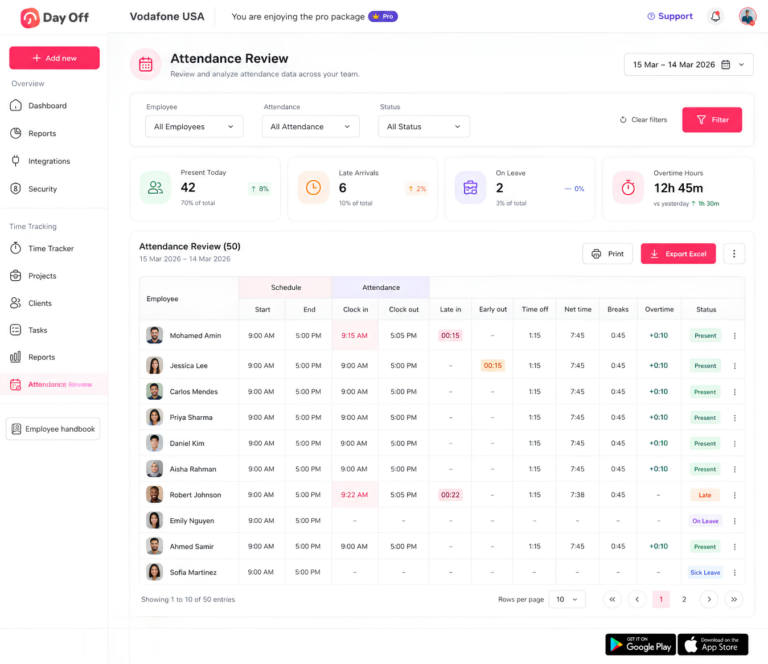
Day Off’s Attendance Review connects expected schedules with actual attendance.
Managers can review:
- Scheduled start
- Scheduled end
- Clock-in
- Clock-out
- Late arrival
- Early departure
- Time off
- Net working time
- Breaks
- Overtime
The system organizes the information by date and allows managers to filter attendance by employee, team, or location.
This makes it easier to identify exceptions without treating every difference between scheduled and actual hours as the same type of problem.
Connect PTO With Attendance
Attendance records become much more useful when they include approved leave.
An employee with no clock-in could be:
- On vacation
- Using sick leave
- On another approved leave type
- Not scheduled to work
- Absent
- Missing a punch
Day Off connects attendance with time-off information so managers can see approved leave alongside attendance records. Attendance Review includes a Time Off field, and administrators can add a day off when a missing attendance record needs to be aligned with leave.
This reduces the risk of interpreting approved time off as an unexplained attendance problem.
Manage PTO Requests and Approvals
Employees can submit time-off requests through Day Off while managers review requests and team availability.
Day Off also supports configurable leave policies, accruals, carryover rules, PTO balances, approval workflows, and leave reporting.
Connecting the leave process to attendance makes it easier to determine whether an employee’s reduced working time has already been approved.
Track Flexible and Rotating Employees More Accurately
Traditional attendance systems often assume everyone works the same Monday-to-Friday schedule.
That can produce misleading attendance data for employees working:
- Flexible hours
- Rotating shifts
- Different team schedules
- Different locations
Day Off uses the employee’s assigned work schedule as the basis for attendance calculations, including late time and overtime where the necessary schedule information exists.
This gives managers a more useful comparison between what the employee was expected to work and what actually happened.
Review Attendance Before Payroll
Attendance Review can also support payroll preparation.
Day Off allows attendance information to be exported, including records such as clock-in, clock-out, late time, overtime, absences, and worked hours.
Before exporting, managers can review exceptions such as:
- Missing clock-outs
- Incorrect schedules
- Unrecorded leave
- Unexpected overtime
- Incomplete attendance
Correcting those problems before payroll helps reduce reliance on manual adjustments later.
How to Introduce a New Attendance Policy to Employees
Writing the policy is only the first step.
Employees also need to understand it.
Explain Why the Policy Exists
Avoid introducing it only as: Employees who violate attendance rules will be disciplined.
Explain the operational purpose.
For example: The attendance policy helps ensure reliable staffing, accurate working-time records, consistent PTO handling, and clear procedures when employees cannot work as scheduled.
Explain What Employees Must Do
Employees should be able to answer:
- When am I expected to work?
- Where do I see my schedule?
- How do I clock in?
- How do I report an absence?
- Where do I request PTO?
- What happens if I am late?
- How do I correct a missed punch?
- Who should I contact with questions?
If employees cannot answer those questions after reading the policy, the policy may still be too vague.
Train Managers First
Managers should understand:
- Attendance definitions
- PTO procedures
- Time corrections
- Schedule rules
- Protected-leave escalation
- Documentation requirements
- How repeated attendance issues are handled
Employees should not receive different answers depending on which manager they ask.
Review the Policy Regularly
Attendance practices change as organizations introduce:
- Remote work
- Flexible schedules
- New time-tracking systems
- Shift changes
- New leave policies
- New locations
- Different legal requirements
Review the policy periodically to make sure it still matches actual workplace practices.
Common Attendance Policy Mistakes
Using the Same Rule for Every Schedule
A fixed 9:00 AM lateness rule does not make sense for an employee with a flexible schedule.
Use the employee’s assigned work pattern.
Treating Approved PTO as an Attendance Violation
Approved leave should be recorded as leave, not ordinary unexplained absence.
Counting Protected Leave as Attendance Points
In the United States, FMLA-protected leave cannot be counted as negative attendance points.
Ignoring Potential Accommodations
The ADA may require modifications to attendance requirements in appropriate cases, such as modified start times or additional leave, unless doing so would create an undue hardship.
Keeping Attendance Rules Too Vague
Terms such as “frequent lateness” and “excessive absence” can create uncertainty unless employees understand how the policy is actually applied.
Failing to Record Actual Working Time
A missed clock-in should not automatically erase time the employee actually worked.
For covered nonexempt employees, accurate hours-worked records are required under the FLSA.
Using Attendance Data Without Context
A six-hour workday could mean:
- Employee left two hours early
- Employee used two hours of PTO
- Employee was scheduled for six hours
- Employee forgot to record two hours
Managers need schedule and leave context before deciding what happened.
Frequently Asked Questions About Employee Attendance Policies
What should be included in an employee attendance policy?
An employee attendance policy should normally explain work schedules, punctuality expectations, absence reporting, PTO procedures, late arrivals, early departures, time tracking, missed punches, no-call no-show situations, attendance documentation, and how repeated attendance problems are handled.
It should also explain that protected leave and legally required accommodations are handled according to applicable law.
How do you write an attendance policy for employees?
Start by defining the employee’s attendance responsibilities and assigned work schedule. Then establish procedures for reporting absences, requesting PTO, recording working time, correcting missed punches, and handling lateness or unapproved absences.
Use clear examples and specific procedures rather than relying only on terms such as “regular attendance” or “excessive lateness.”
What is considered excessive absenteeism?
There is no universal number of absences that automatically qualifies as excessive absenteeism for every employer.
The answer depends on the employer’s attendance policy, employee schedule, type of absence, operational requirements, applicable law, and whether the absence is approved or protected.
A company should avoid applying one numerical threshold without considering legally protected leave and accommodations.
Can an employer give attendance points for calling in sick?
It depends on the applicable policy and the reason for the absence.
Employers using attendance point systems need to distinguish ordinary unscheduled absences from legally protected leave. For example, the U.S. Department of Labor states that FMLA-protected leave cannot be counted as negative attendance points.
State and local paid sick leave laws may create additional requirements.
Can an employee be disciplined for being late?
Employers may generally establish reasonable attendance and punctuality expectations, but disciplinary decisions should follow applicable law and company policy.
Managers should first determine whether the lateness was unapproved or whether it relates to approved leave, a modified schedule, protected leave, or an applicable reasonable accommodation.
What is the difference between an absence and a no-call, no-show?
An absence means an employee did not work scheduled time.
A no-call, no-show typically means the employee both missed scheduled work and failed to follow the employer’s required notification procedure.
An employee who properly calls in sick is therefore absent but may not be a no-call, no-show.
Should remote employees follow an attendance policy?
Yes, but the policy should reflect how remote work is actually scheduled.
Instead of physical office arrival, remote attendance may be based on required working hours, core availability, scheduled meetings, time tracking, work schedules, and absence notification.
How should missed clock-ins be handled?
Employees should have a clear way to report and correct missed punches.
The attendance record should first be corrected to reflect actual working time. Repeated failure to follow the clock-in procedure can then be addressed separately according to the company’s attendance policy.
Final Thoughts
A good Employee Attendance Policy creates clear expectations without treating every absence or schedule difference as the same problem.
The strongest policies connect work schedules, punctuality, absence reporting, PTO, time tracking, missed punches, and protected leave into one consistent process. Employees should understand what is expected of them, while managers should have enough information to distinguish an ordinary attendance issue from approved leave, flexible scheduling, or another legitimate exception.
With Day Off, companies can connect employee work schedules, PTO requests, clock-in and clock-out records, attendance review, overtime, and leave information in one system. This gives HR and managers better context when reviewing attendance while giving employees a clearer way to manage both working time and time away from work.