







Managing paid time off and overtime becomes more complicated when both appear on the same timesheet. To Track PTO correctly during a pay period that also includes overtime, employers need to separate paid leave hours from actual hours worked, apply the correct overtime rules to each workweek, and make sure payroll records clearly show where every paid hour came from.

An employee might take a vacation day on Monday, work longer shifts later in the week, and still receive both PTO pay and overtime pay on the same paycheck. The important question is not simply how many total paid hours appear on the payroll record. What matters is how many hours the employee actually worked and when those hours were worked.
Understanding this distinction helps HR teams and payroll administrators prevent overtime calculation errors, incorrect PTO deductions, and confusing employee records.
What Does It Mean To Track PTO And Overtime Together?
PTO tracking and overtime together means recording two different types of employee time within the same payroll period:
PTO hours represent time the employee was not working but was paid according to the company’s leave policy.
This may include:
- Vacation
- Paid sick leave
- Personal leave
- Floating holidays
- Other paid leave categories
Overtime hours represent actual working time that qualifies for an overtime premium under applicable employment laws or company policies.
For many U.S. nonexempt employees covered by the Fair Labor Standards Act (FLSA), overtime is generally required when an employee works more than 40 hours in a defined workweek. The overtime rate must generally be at least 1.5 times the employee’s regular rate of pay.
The important distinction is:
PTO is paid time. Overtime is based on working time.
These numbers can appear together on a paycheck without necessarily being added together when calculating overtime eligibility.
Does PTO Count Toward Overtime?
Under the federal FLSA, paid vacation, sick leave, holidays, and other periods when an employee does not work generally do not have to be treated as hours worked when determining whether the employee exceeded the overtime threshold.
The U.S. Department of Labor specifically states that paid time off for holidays, vacations, or sickness is not considered hours worked for federal overtime calculations.
For example:
An employee works:
- Monday: 8 hours
- Tuesday: 8 hours
- Wednesday: 8 hours PTO
- Thursday: 8 hours
- Friday: 8 hours
- Saturday: 5 hours
The employee receives pay for:
45 total hours
However, the employee actually worked:
37 hours
The other eight hours were PTO.
Under the federal 40-hour weekly overtime standard, the employee has not worked more than 40 hours, so those five Saturday hours would not automatically become FLSA overtime simply because total paid hours reached 45.
This distinction is one of the most important rules when tracking PTO and overtime.
Paid Hours And Hours Worked Are Not The Same Thing
Payroll systems often display several different totals.
You may see:
- Regular worked hours
- PTO hours
- Sick leave
- Holiday pay
- Overtime hours
- Unpaid leave
- Total paid hours
The total paid hours shown on the paycheck should not automatically be used as the overtime calculation base.
Consider this example.
| Time Category | Hours |
|---|---|
| Regular hours worked | 38 |
| PTO | 8 |
| Overtime hours | 0 |
| Total paid hours | 46 |
| Hours counted toward federal overtime threshold | 38 |
The employee is being paid for 46 hours, but only 38 of those hours represent actual work.
That distinction becomes especially important when employees use PTO and then work additional hours later in the same week.
How To Track PTO And Overtime In The Same Pay Period
A reliable process should separate leave records from attendance records before payroll calculates overtime.
Here is a practical approach.
Step 1: Identify The Employee’s Workweek
Start by defining the employee’s official workweek.
Under the FLSA, a workweek is a fixed period of 168 consecutive hours, or seven consecutive 24-hour periods. It does not necessarily need to run Monday through Sunday.
For example, a company’s workweek could run:
Monday 12:00 AM through Sunday 11:59 PM
or:
Sunday 12:00 AM through Saturday 11:59 PM
The workweek matters because federal overtime is generally calculated by workweek, not by simply adding everything in the payroll period.
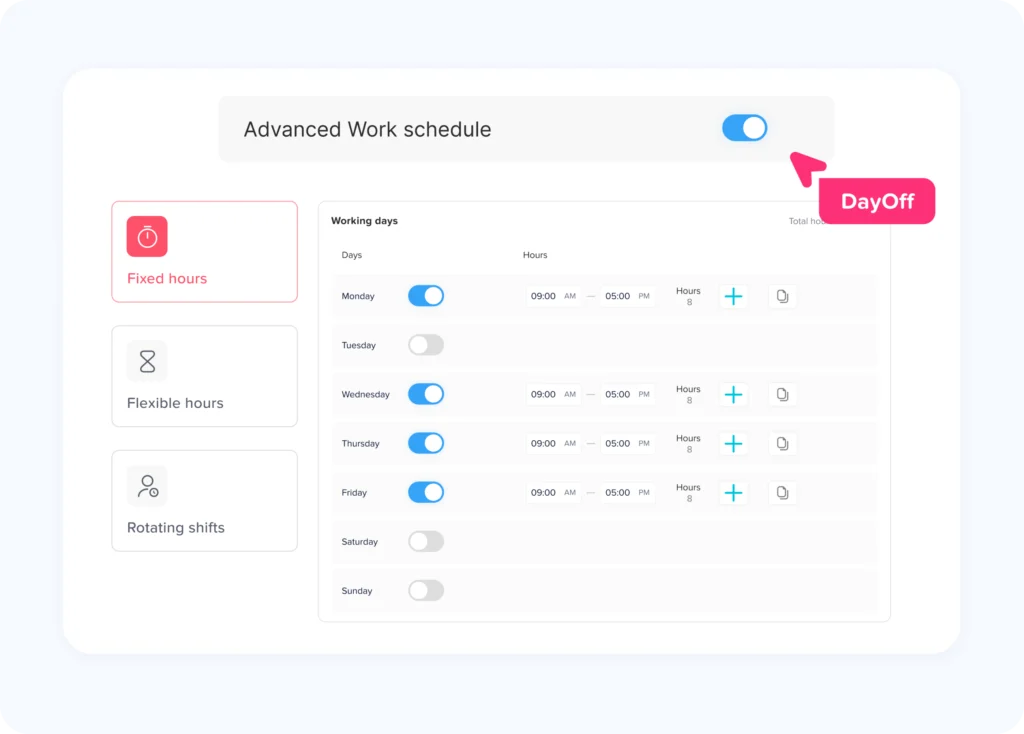
Step 2: Record The Employee’s Scheduled Hours
Next, identify what the employee was expected to work.
Suppose an employee’s normal schedule is:
Monday to Friday
9:00 AM to 5:00 PM
8 paid working hours per day
That creates a standard:
40-hour scheduled workweek
The schedule provides the baseline for comparing:
- Expected working time
- Actual attendance
- Approved PTO
- Late arrivals
- Early departures
- Additional work
- Overtime
However, the schedule alone does not determine overtime. Actual hours worked are what matter for the federal weekly threshold.
Step 3: Record Actual Working Hours Separately
Use clock-in and clock-out records, approved timesheets, or another reliable attendance system to determine how long the employee actually worked.
Do not fill approved PTO into the employee’s actual working-time total.
For example:
Monday: 8 hours worked
Tuesday: 9 hours worked
Wednesday: PTO
Thursday: 10 hours worked
Friday: 9 hours worked
Saturday: 7 hours worked
Actual hours worked:
8 + 9 + 10 + 9 + 7 = 43 hours
PTO:
8 hours
Total paid hours:
51 hours
For federal overtime purposes, the employee has worked 43 hours, so the employee has three hours above the standard 40-hour threshold.
The PTO did not create the overtime. The employee’s 43 actual working hours did.
Step 4: Record PTO As Its Own Time Category
PTO should remain separate from regular working hours.
Instead of recording:
51 hours worked
the record should show:
43 hours worked
8 hours PTO
This provides much more accurate information for payroll and HR.
It also prevents PTO from accidentally increasing the employee’s overtime total.
Step 5: Calculate Overtime From Actual Working Hours
For a basic federal calculation:
Overtime Hours = Actual Hours Worked in the Workweek – 40
If the result is positive, the employee may have overtime hours, assuming the employee is covered and nonexempt and no special rule applies.
Using the earlier example:
43 actual hours – 40 = 3 overtime hours
The employee’s eight hours of PTO remain separate.
Example: PTO And Overtime In The Same Workweek
Consider an employee earning $20 per hour.
Their week looks like this:
| Day | Work Hours | PTO Hours |
|---|---|---|
| Monday | 8 | 0 |
| Tuesday | 10 | 0 |
| Wednesday | 0 | 8 |
| Thursday | 10 | 0 |
| Friday | 9 | 0 |
| Saturday | 6 | 0 |
| Total | 43 | 8 |
The employee has:
- 40 regular worked hours
- 3 overtime hours
- 8 PTO hours
- 51 total paid hours
Using a simple hourly-rate example where the regular rate is $20:
Regular Pay
40 × $20 = $800
PTO Pay
8 × $20 = $160
Overtime Rate
$20 × 1.5 = $30
Overtime Pay
3 × $30 = $90
Total Gross Pay
$800 + $160 + $90 = $1,050
The employee receives pay covering 51 hours, but only three hours are overtime because the overtime calculation is based on actual working time.
For some employees, determining the “regular rate” can be more complicated because certain bonuses, commissions, shift differentials, and other compensation may need to be included. The Department of Labor explains that the regular rate is generally based on eligible compensation divided by hours actually worked.
What If The Employee Uses PTO And Works More Than 40 Hours Anyway?
Taking PTO does not cancel overtime that is otherwise earned from actual working hours.
Suppose an employee takes eight hours of PTO but also works:
42 actual hours
during the same workweek.
The employee would have:
- 40 regular working hours
- 2 overtime hours
- 8 PTO hours
The employee therefore receives compensation covering 50 paid hours, but only the two actual hours worked beyond 40 are overtime under the general federal rule.
Employers should not reduce those two overtime hours because the employee happened to receive PTO during the same week.
What If An Employee Has 40 Total Hours Including PTO?
Now consider the opposite situation.
An employee records:
32 hours worked
8 hours PTO
Total paid time:
40 hours
The employee has no federal overtime because they only worked 32 hours.
The eight PTO hours simply bring the employee’s compensated time to the equivalent of a normal 40-hour week.
What If An Employee Has More Than 40 Paid Hours But Less Than 40 Worked Hours?
This is another common source of payroll confusion.
Suppose the employee has:
39 working hours
8 PTO hours
Total paid:
47 hours
Despite receiving compensation for 47 hours, the employee has only worked 39 hours.
Under the general federal standard, no overtime has been created.
This is why employers should never calculate overtime solely from the “total paid hours” field.
PTO And Overtime In A Biweekly Pay Period
Biweekly payroll can make the calculation look more complicated than it actually is.
A biweekly pay period contains two workweeks, but federal overtime generally must still be calculated separately for each workweek.
The Department of Labor states that employers generally cannot average hours across two or more workweeks for overtime purposes.
Consider this example:
Week One
36 hours worked
8 hours PTO
44 paid hours
Actual working time: 36 hours
Federal overtime: 0 hours
Week Two
44 hours worked
0 PTO
44 paid hours
Actual working time: 44 hours
Federal overtime: 4 hours
Across the full pay period:
- 80 actual hours worked
- 8 PTO hours
- 88 paid hours
- 4 overtime hours
You cannot simply calculate:
80 hours worked across two weeks = no overtime
because the second week independently exceeded 40 hours.
Why You Should Not Average Hours Across A Pay Period
Imagine another employee works:
Week 1: 50 hours
Week 2: 30 hours
The biweekly total equals:
80 hours
It might appear that the employee averaged exactly 40 hours per week.
But under the normal FLSA workweek rule:
Week 1 includes 10 overtime hours.
Week 2 includes 0 overtime hours.
The 30-hour second week does not erase overtime already earned during the 50-hour first week.
This becomes particularly important when PTO is also present because payroll systems may show several categories of compensated time inside the same two-week period.
Should PTO Be Paid At The Overtime Rate?
Normally, PTO itself does not automatically become overtime pay simply because it appears in a week where the employee also earns overtime.
Suppose an employee’s normal rate is $20 per hour and they have:
40 regular work hours
5 overtime hours
8 PTO hours
The PTO would generally be paid according to the employer’s PTO policy rather than automatically at the $30 overtime rate.
The overtime premium applies to qualifying working hours.
The employer should therefore maintain separate records for:
- Regular hours
- Overtime hours
- PTO hours
Does Working On A PTO Day Automatically Create Overtime?
Not necessarily.
Imagine an employee schedules Friday as PTO but is asked to work Friday after all.
If they cancel the PTO and work eight hours, those eight hours should be recorded as actual working time.
Whether they become overtime depends on the employee’s other working hours during the workweek.
For example:
Monday: 8 worked
Tuesday: 8 worked
Wednesday: 8 worked
Thursday: 8 worked
Friday: 8 worked
Total:
40 hours worked
There is no federal overtime simply because Friday was originally intended to be PTO.
However, if the employee works:
Monday through Thursday: 40 hours
Friday: 8 hours
then:
48 hours actually worked
The employee would generally have eight federal overtime hours if covered and nonexempt.
HR should also restore or adjust the PTO balance if the originally approved leave was not actually taken, according to company policy.
Should Employees Be Allowed To Use PTO To Reach 40 Hours?
This is usually a matter of company policy and applicable state or local rules.
For example, an employee might work:
34 hours
and request:
6 hours of PTO
to reach a 40 hour paycheck.
If company policy permits this, payroll could record:
34 working hours
6 PTO hours
40 total paid hours
However, this does not mean the employee worked 40 hours.
For attendance and overtime purposes, keeping the categories separate remains important.
Employers should explain in their PTO policy:
- Whether PTO can supplement a partial workweek
- Whether employees can use PTO after working additional hours
- Whether PTO can be used during partial-day absences
- Whether managers can adjust approved PTO after an employee works
- How PTO interacts with alternative schedules
- How payroll handles PTO and overtime within the same week
Can An Employee Use PTO And Earn Overtime On The Same Day?
It is possible for both PTO and working hours to appear on the same calendar day.
Consider an employee scheduled for eight hours who takes four hours of approved PTO and then works six hours later that day.
Their record might show:
4 hours PTO
6 hours actually worked
The employee receives compensation for 10 hours, but overtime treatment depends on applicable laws and the employee’s total working time.
Under federal law, the four PTO hours do not generally count as actual hours worked toward the weekly 40-hour threshold.
However, employers should check state rules because some jurisdictions impose overtime requirements beyond the federal weekly standard.
State Overtime Rules May Be Different
Employers should not rely only on the federal 40 hour rule.
State laws can impose additional requirements.
California is a well known example.
California generally requires overtime for nonexempt employees for certain hours worked beyond eight hours in a workday, as well as overtime for hours worked beyond 40 in a workweek. Additional rules apply for longer workdays and consecutive days of work.
This means an employee may earn overtime under state law even without exceeding 40 weekly hours.
For example, an employee might work:
Monday: 10 hours
Tuesday: 6 hours
Wednesday: 6 hours
Thursday: 6 hours
Friday: 6 hours
Total:
34 hours
There may be daily overtime implications in California despite the employee remaining under 40 weekly hours.
Employers should therefore configure their time tracking and payroll processes around the laws that apply where each employee works.
Collective bargaining agreements, employment contracts, industry specific rules, and company policies may also provide overtime benefits beyond the federal minimum.
PTO And Overtime For Exempt Employees
The calculations discussed above primarily apply to nonexempt employees who are eligible for overtime.
Employees who meet an applicable FLSA overtime exemption may be treated differently.
For qualifying exempt employees, employers often track PTO balances for absence management even though the employee is not generally paid overtime based on every additional hour worked.
Employers should therefore distinguish between:
PTO tracking, which may apply to both exempt and nonexempt employees.
and
Overtime tracking, which depends on the employee’s classification and applicable law.
Employee classification should never be determined only by whether someone receives a salary. Salary alone does not automatically make an employee exempt from overtime requirements.
Three Different Numbers Payroll Should Track
A good payroll record should make it possible to identify at least these three totals:
Scheduled Hours
How many hours was the employee expected to work?
Actual Hours Worked
How much time did the employee actually spend working?
Paid Leave Hours
How much approved paid time away from work did the employee use?
These numbers answer different questions.
| Metric | What It Tells You | Example |
|---|---|---|
| Scheduled hours | What the employee was expected to work | 40 hours |
| Actual hours | What the employee actually worked | 43 hours |
| PTO hours | Paid time away from work | 8 hours |
| Overtime hours | Qualifying additional working time | 3 hours |
| Total compensated hours | Combined paid work and PTO | 51 hours |
How PTO And Overtime Affect The Employee’s PTO Balance
Overtime should generally not change an employee’s PTO deduction unless the company’s PTO policy specifically connects the two.
Suppose an employee starts with:
80 hours PTO
and uses:
8 hours PTO
while also earning:
4 overtime hours
The new PTO balance would normally be:
80 – 8 = 72 hours
The four overtime hours do not automatically add four hours back into the PTO balance.
Overtime compensation and PTO balances are separate concepts.
Some organizations offer compensatory time or time off in lieu under specific arrangements, but those programs are subject to separate legal and policy considerations and should not simply be treated as ordinary PTO.
Common Mistakes When Tracking PTO And Overtime
Even businesses with formal payroll processes can make mistakes when leave and working hours overlap.
Counting PTO As Hours Worked
One of the most common errors is adding:
38 actual work hours + 8 PTO hours = 46 overtime-eligible hours
Under the general federal rule, this would be incorrect.
The employee worked 38 hours.
Calculating Overtime From The Entire Pay Period
For biweekly payroll, businesses sometimes check whether the employee exceeded 80 hours.
That can miss overtime that occurred during one individual workweek.
Each workweek generally needs to be reviewed separately under the FLSA.
Removing Overtime Because PTO Was Used
Another mistake is assuming an employee cannot receive both PTO and overtime during the same week.
They can.
If the employee actually works enough qualifying hours to earn overtime, receiving PTO for another period does not automatically eliminate that overtime.
Deducting PTO For Time The Employee Actually Worked
Suppose an employee requested eight hours of PTO but later works four hours during that day.
The company should review whether the PTO deduction should be changed to four hours, cancelled, or otherwise adjusted according to its policy.
Without connected PTO and attendance records, the employee could incorrectly lose eight hours of PTO while also recording four hours of work.
Treating All Overtime The Same
Different jurisdictions, industries, collective bargaining agreements, and employment arrangements may apply different rules.
A payroll system should not assume every employee follows exactly the same overtime calculation.
Ignoring Breaks And Missing Time Entries
Overtime calculations depend on accurate working-time records.
Forgotten clock-outs, missing breaks, duplicate time entries, or unapproved manual edits can change the employee’s apparent working time.
Attendance records should therefore be reviewed before payroll is finalized.
A Better Workflow For Tracking PTO And Overtime
An effective process can follow this order:
Before The Workweek
- Assign the employee’s work schedule.
- Confirm applicable PTO rules.
- Confirm overtime eligibility and employee classification.
- Approve leave requests.
During The Workweek
- Record actual clock-in and clock-out times.
- Record breaks when required.
- Record approved PTO separately.
- Flag unexpected absences.
- Capture additional working time.
Before Payroll
- Review the employee’s schedule.
- Compare scheduled hours with actual hours.
- Confirm PTO used.
- Correct missing attendance entries.
- Calculate overtime by workweek.
- Apply the appropriate overtime rate.
- Verify the remaining PTO balance.
- Export or transfer the final records to payroll.
This creates a clear audit trail explaining why the employee received each type of compensation.
Why PTO And Time Tracking Should Be Connected
Managing PTO and employee attendance in separate systems increases the amount of reconciliation HR has to perform.
Imagine an employee did not clock in on Tuesday.
An attendance system alone may only show:
No attendance record
HR then has to determine whether the employee:
- Was on vacation
- Was sick
- Had another approved leave
- Was not scheduled
- Forgot to clock in
- Was absent without approval
When PTO and attendance are connected, approved leave provides immediate context.
The same principle applies during payroll.
Instead of manually comparing a leave spreadsheet with a timesheet, managers can review working hours, leave, schedules, and overtime together.
How Day Off Helps Track PTO And Overtime Together
Day Off brings PTO management and employee time tracking into the same platform.
Companies can manage:
- PTO and leave requests
- Employee leave balances
- Work schedules
- Clock in and clock out records
- Actual working hours
- Late arrivals
- Early departures
- Breaks
- Time off
- Overtime
- Attendance reports
Day Off’s Attendance Review compares employees’ assigned schedules with actual attendance and displays information such as scheduled hours, clock-in and clock-out times, time off, net working hours, breaks, and overtime.
This connection is particularly useful when an employee uses PTO and works additional hours during the same payroll period.
Instead of treating PTO and attendance as unrelated records, HR can see the employee’s working time and approved leave in context.
For payroll preparation, attendance data can also be exported for further review.
A connected system does not replace the need to apply the correct employment laws, but it can make the underlying time records much easier to review.
Best Practices For Tracking PTO And Overtime Accurately
Keep PTO Separate From Actual Work
Never combine PTO and working hours into one generic “hours” field.
Maintain separate categories.
Calculate Overtime By Workweek
Even if employees are paid every two weeks or twice per month, identify overtime within each applicable workweek.
Define A Clear Workweek
Employees and payroll administrators should know exactly when the company’s workweek begins and ends.
Use Actual Attendance Data
Where appropriate, use reliable clock-in and clock-out data instead of estimating working hours from schedules.
Reconcile PTO Against Attendance
If approved PTO overlaps with actual working time, review the record before payroll runs.
Document Your PTO Policy
Employees should know how PTO interacts with:
- Partial workdays
- Overtime
- Holidays
- Shift changes
- Schedule changes
- Working during approved leave
Check State And Local Requirements
Federal law is only the starting point.
Always determine whether state or local regulations impose additional overtime, paid leave, recordkeeping, or wage requirements.
Review Exceptions Before Payroll
Attendance exceptions such as unusually long shifts, missing punches, overlapping PTO, or unusually high overtime should receive additional review.
Frequently Asked Questions
Does PTO count toward 40 hours for overtime?
Under the general federal FLSA rule, paid vacation, sick leave, holidays, and similar paid periods when no work is performed do not have to be counted as hours worked when determining whether an employee exceeded 40 hours in a workweek.
State laws, collective bargaining agreements, contracts, or company policies may provide different or more generous rules.
Can I get overtime if I used PTO during the same week?
Yes. An employee can receive PTO and overtime during the same week.
For example, an employee could use eight hours of PTO and still actually work 45 hours. Under the general federal overtime rule for a covered nonexempt employee, the five working hours beyond 40 may qualify for overtime.
If I work 32 hours and use 8 hours of PTO, is that 40 hours worked?
No.
It may equal 40 paid hours, but it represents:
32 actual working hours
8 PTO hours
The distinction is important for overtime calculations.
If I work 38 hours and take 8 hours of PTO, do I get 6 hours of overtime?
Generally not under the federal FLSA.
You would have 46 paid hours, but only 38 actual working hours.
If I work more than 40 hours after taking PTO, do I still get overtime?
Potentially, yes.
If a covered nonexempt employee actually works more than 40 hours during the workweek, PTO taken during another period generally does not remove overtime otherwise owed.
Can my employer make me use PTO instead of paying overtime?
Employers generally cannot simply replace legally required overtime compensation with ordinary PTO for covered nonexempt employees. Specific rules may differ depending on the employment setting, applicable law, and whether a lawful compensatory-time arrangement applies.
Is overtime calculated weekly or by pay period?
Under the general FLSA standard, overtime is calculated by workweek.
A biweekly payroll period does not allow employers to average two workweeks together to avoid paying overtime.
Does vacation pay increase my overtime rate?
PTO payments for periods when no work is performed can generally be excluded from the FLSA regular-rate calculation. Other compensation, including certain nondiscretionary bonuses or shift differentials, may need to be included.
Can PTO and overtime appear on the same paycheck?
Yes.
A paycheck might contain:
- Regular pay
- PTO pay
- Overtime pay
- Holiday pay
- Other eligible compensation
The important part is calculating each category correctly.
What happens if I work during approved PTO?
The employer should record the hours actually worked and review whether the approved PTO should be reduced, cancelled, or adjusted based on company policy.
Keeping attendance and leave records connected makes these situations easier to identify.
Should PTO be deducted if an employee works overtime later in the week?
Usually, yes, if the employee actually took the approved PTO.
Working additional hours later does not automatically restore PTO that was legitimately used earlier.
However, company policies may establish specific rules about PTO usage, so employers should document the process clearly.
Can PTO cause overtime?
PTO itself generally does not cause federal overtime because it is not treated as working time.
An employee can have a high number of paid hours because PTO and work occur during the same week, but overtime depends primarily on qualifying actual working hours.
Conclusion
Tracking PTO and overtime in the same pay period becomes much easier once businesses stop treating all paid hours as the same type of time.
The key is to maintain separate records for:
Scheduled time
Actual working time
PTO
Overtime
For most covered nonexempt employees under federal law, overtime is based on actual hours worked beyond 40 in a workweek, not simply the number of hours appearing on a paycheck. Paid vacation, sick leave, and similar PTO generally do not count toward that federal threshold.
At the same time, using PTO does not prevent an employee from earning overtime if they actually work enough qualifying hours.
Businesses should calculate overtime by workweek, keep leave and attendance records separate but connected, review state and local requirements, and reconcile unusual time entries before payroll is processed.
Using a connected system such as Day Off can simplify this process by bringing PTO balances, leave requests, employee schedules, clock in and clock out records, attendance, time off, and overtime into one place. That gives HR and payroll teams a clearer picture of both sides of employee time: when employees are away from work and when they are actually working.