


Offering a comprehensive PTO policy is no longer a luxury, it’s a necessity. A PTO policy, or Paid Time Off policy, defines the rules and structure for how employees can take paid leave from work. This includes time off for vacation, personal matters, illness, and increasingly, for mental health and community involvement. A thoughtfully designed PTO policy supports employee well-being, enhances productivity, and reflects the values of a progressive organization.
But with so many variations, what is considered the most common PTO policy in practice? This article explores the major types of PTO policies, with in-depth explanations and a special focus on how employers incorporate “Day Off” provisions to promote healthier work-life balance.
Major Types of PTO Policies
Accrual-Based PTO Policy (The Classic Model)
One of the most traditional and widely implemented PTO policies is the accrual-based model. In this system, employees earn their paid time off gradually, typically based on the number of hours or days they work. For instance, an employee might earn one hour of PTO for every 30 hours worked. Over time, these hours add up and can be used for any qualifying reason—be it vacation, illness, or personal time.
An accrual-based PTO policy promotes a sense of fairness and structure. It aligns the employee’s time off privileges with their level of engagement and commitment to the organization. Companies often adjust the accrual rate based on tenure, offering faster accumulation as an employee’s service years increase. This structure benefits both employees, who appreciate the steady buildup of benefits, and employers, who retain greater oversight and scheduling flexibility.
Lump-Sum or Banked PTO Policy (Annual Allocation)
Another prevalent PTO policy is the lump-sum or “banked” system, where employees are granted a fixed number of PTO days at the beginning of each calendar year or on their work anniversary. For example, a standard policy may allocate 15 or 20 days of PTO upfront for the year.
This kind of PTO policy is favored for its simplicity and predictability. Employees can plan their vacations and other time-off needs more freely without tracking accrual rates each pay period. It also reduces the administrative burden on HR departments, which don’t need to calculate or monitor accrual rates. However, this policy also introduces some risks, such as employees taking large amounts of time off early in the year, potentially disrupting operations if not managed carefully.
Unlimited PTO Policy (Trust-Based Approach)
In more progressive and trust-oriented workplaces, particularly within the tech industry and startups, the unlimited PTO policy has gained popularity. Under this policy, there is no fixed limit to the number of PTO days an employee can take. Instead, employees are encouraged to take time off as needed, as long as they meet their performance goals and project deadlines.
An unlimited PTO policy symbolizes trust and flexibility. It suggests a deep belief in employees’ ability to self-manage and prioritize responsibilities. However, paradoxically, studies have shown that employees under an unlimited PTO policy often take less time off than their peers due to unclear expectations or fear of seeming less committed. Therefore, for this model to succeed, it’s crucial that leadership actively supports and models taking regular time off.
Flexible PTO Policy (The Hybrid Option)
A flexible PTO policy is a hybrid approach that combines the structure of accrual or lump-sum systems with a more open-use philosophy. In this model, employees are given a block of time off, say 20 days per year, and are not required to categorize it as vacation, sick leave, or personal time. They can use their days however they see fit.
This model reflects the evolving nature of work and personal needs. A flexible PTO policy acknowledges that employees may need time off for reasons that don’t fit neatly into a box, whether it’s mental health, family caregiving, or simply needing to recharge. It also fosters a culture of openness and respect, where the focus is on outcomes and well-being rather than rigid protocols.
How Day Off Enhances PTO Policy Management
Implementing an effective PTO policy is crucial for any organization aiming to promote work-life balance and maintain operational efficiency. Day Off provides features that align with these objectives:
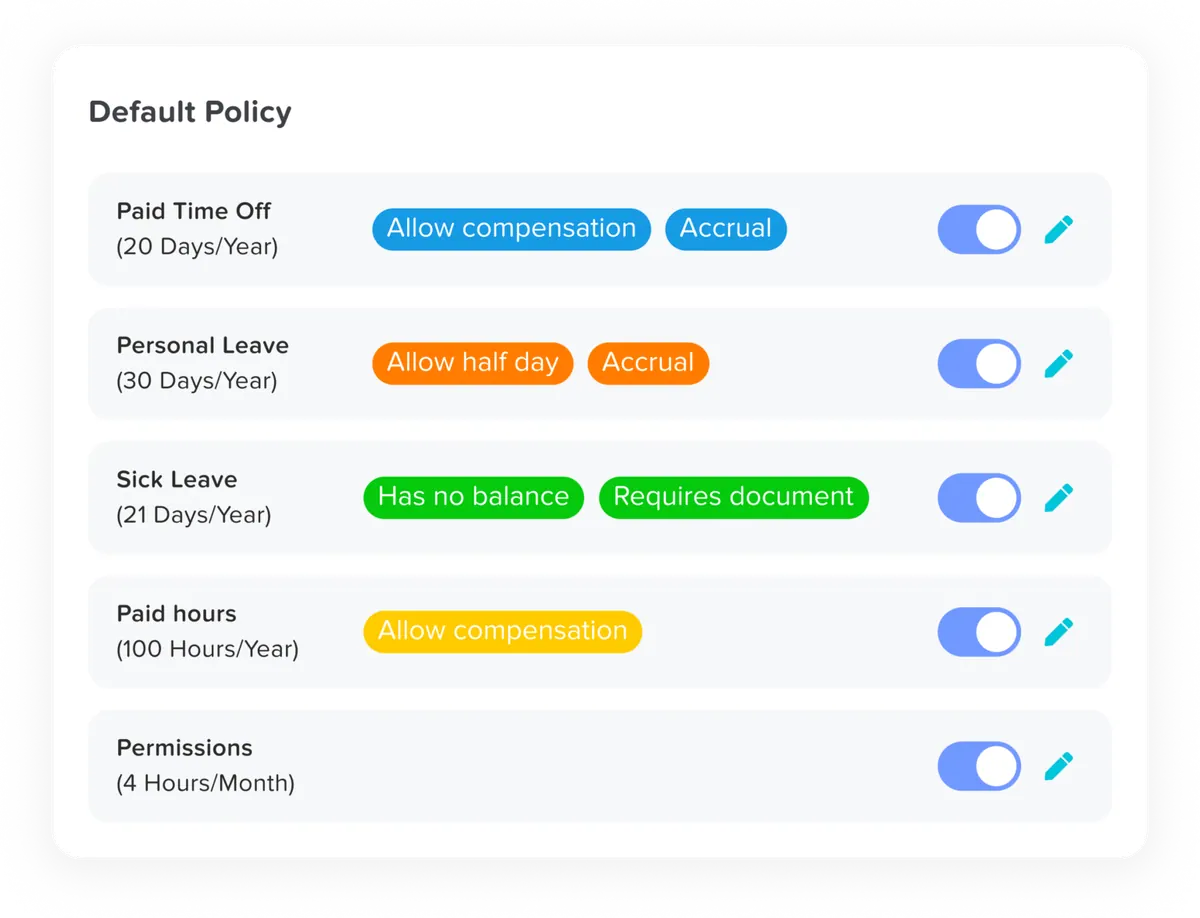
Customizable Leave Policies
Day Off allows organizations to define and manage their PTO policies with precision. Whether it’s setting accrual rates, carryover rules, or specific leave types like sick leave, vacation, or personal days, the platform offers flexibility to tailor policies to organizational needs.
Automated Accrual and Carryover Tracking
The application automates the tracking of leave accruals and carryovers, reducing administrative burdens and minimizing errors. Employees can view their leave balances in real-time, ensuring transparency and aiding in planning their time off effectively.
Integrated Calendar and Notifications
With integrations to platforms like Google Calendar and Outlook, Slack, and Microsoft Teams, Day Off ensures that approved leaves are synchronized with organizational calendars. Additionally, automated notifications keep both employees and managers informed about leave requests, approvals, and upcoming absences.
Mobile Accessibility
Recognizing the need for flexibility, Day Off offers mobile applications, allowing users to manage leave requests, approvals, and view balances on-the-go. This feature is particularly beneficial for remote teams or employees who are frequently on the move.
Common Features Found in PTO Policies
Even though the structure of a PTO policy may differ from one organization to another, there are several common practices found across most industries:
Tenure-Based PTO Growth
One of the most common incentives built into a PTO policy is the tiered accrual based on years of service. For example, employees may start with 10 days of PTO per year, which increases to 15 after three years and 20 after five years. This approach not only rewards loyalty but also strengthens employee retention by making long-term tenure more attractive.
PTO Rollover Rules
Most PTO policies address what happens to unused time at the end of the year. Some allow limited rollover, typically up to 40 hours, into the next year, while others enforce a “use-it-or-lose-it” rule to encourage employees to take time off regularly. The best PTO policies strike a balance between operational needs and employee wellness.
Payouts for Unused PTO
In some organizations and jurisdictions, PTO policies include provisions for cashing out unused time. This typically occurs upon resignation or retirement, and it ensures that employees don’t lose the monetary value of their unused benefit. Not all states require this, so employers must align their PTO policy with local labor laws.
Designing the Right PTO Policy: Considerations for Employers
When building or revising a PTO policy, employers should consider more than just legal compliance. A well-designed PTO policy takes into account:
Company Culture: A creative, flexible workplace may benefit from unlimited PTO, while a structured environment may need accrual-based plans to maintain workflow balance.
Employee Demographics: Understanding your workforce’s age, family needs, and cultural backgrounds can shape a more inclusive PTO policy.
Legal Requirements: Different states and countries have specific rules around PTO accrual, payout, and sick leave. Any PTO policy must comply with these laws.
Transparency and Communication: The best PTO policies are easy to understand and consistently communicated. Clarity builds trust and prevents misunderstandings.
What Employees Want From a PTO Policy
The type of policy matters less to employees than how it works day to day. When teams are asked what they value, the same themes come up.
Freedom in how time is used
People want to take a half day for a school event, a single day after a hard week, or a long block for a trip, without needing to justify which bucket it comes from. Allowing partial days and short-notice personal days goes a long way.
Rules they can understand
Employees should be able to see how much they earn, when it becomes available and how much is left, without working through complicated formulas. Publish the policy where people can find it and answer questions openly.
Choices for unused days
Some people want to save days for a longer break next year, others would rather be paid for time they did not use. Where the law allows it, offering limited rollover, cash-out or buy-back gives people control and avoids a rushed year-end scramble.
The same treatment in every team
If one department gets easy approvals and another faces strict ones, resentment follows quickly. Apply one set of guidelines, record every decision and give managers the same training.
Real permission to rest
A generous policy means little if people feel judged for using it. Some employers set a minimum number of days everyone should take each year, and leaders who take visible time off make it easier for others to do the same.
A policy that keeps up
Ask employees what they want through short surveys or check-ins, and compare your offer with other employers in your industry each year. Low PTO usage is useful feedback in itself, often pointing to heavy workloads or unclear rules.
Rules to Spell Out in Your PTO Policy
Whichever model you choose, these details cause the most questions and disputes when the policy leaves them out.
When PTO starts
Separate two dates: when new hires start earning PTO, and when they can start using it. Some employers accrue from day one but allow requests only after a waiting period.
Days or hours
Hours work better for part-time and variable schedules. Days are simpler for teams on fixed schedules. Pick one and use it everywhere.
How to request and cancel
Say how much notice is needed, who approves, how fast managers should respond, and how employees change or cancel approved leave.
Overlaps and blackout dates
Explain how you decide when too many people ask for the same dates, such as first come first served or rotating priority, and list any busy periods when leave is limited.
Negative balances
State whether employees can borrow PTO before earning it, how far below zero they can go, and who must approve it. Check local wage rules before planning to recover advanced PTO from final pay.
Other types of leave
Explain how PTO interacts with sick leave, parental leave, jury duty and other leave that may be protected by law where you operate.
Making Your PTO Policy Legally Compliant
A policy can look generous and still break the law if it limits protected leave or conflicts with wage rules. These checks help keep it on the right side of local requirements.
Follow the rules where each employee works
Leave law usually depends on the employee's work location, not the company's headquarters. Remote and distributed teams may need a shared framework with local rules layered on top.
Keep protected leave separate
A single PTO bank is simple, but in places where sick leave or parental leave is protected by law, mixing it with vacation can lead to minimums not being met. Many employers track statutory leave separately and keep a flexible PTO balance for everything else.
Check carryover and payout rules before you write them
Some jurisdictions ban use-it-or-lose-it policies, others allow caps but not forfeiture, and some treat accrued PTO as earned wages that must be paid when employment ends. Confirm these points locally before putting them in the policy.
Do not apply vacation approval rules to protected leave
Requiring advance notice for planned vacation is normal. Sick leave, family leave and other protected absences need a different path and should not be refused for staffing reasons.
Give unlimited PTO a floor
Where the law sets a minimum amount of paid leave, an unlimited policy still has to guarantee it. Track how much people actually take and follow up with anyone taking very little.
Apply it consistently and keep records
Informal exceptions and uneven approvals can lead to discrimination or retaliation claims. Document exceptions, train managers and keep leave records for as long as local rules require.
Audit it once or twice a year
Recalculate a sample of balances by hand to confirm the system matches the written policy, check that final payouts for leavers followed the rules, review denied requests for consistency, and confirm the accrued PTO figure with finance, since unused PTO is often carried as a liability.
Common PTO Policy Mistakes
Vague wording
If the policy does not say how much time people get, how to request it and what happens at year end, managers will apply it differently. Write it in plain language with examples.
Tracking balances by hand
Spreadsheets and email threads lead to wrong balances and payroll errors. Keep one record that employees and managers can both see.
Rigid approvals
Turning down reasonable requests without explanation hurts trust. Give a reason and suggest other dates.
Not encouraging people to use PTO
Unused PTO builds up and so does burnout. Remind people with large balances, and have managers take their own time off.
Changing the policy without notice
Tell employees before the policy year starts what is changing, why, who is affected, what happens to existing balances, and who to ask.
Frequently Asked Questions (FAQs) About PTO Policies
What happens if an employee uses more PTO than they have accrued?
In many companies, if an employee takes more PTO than they have earned, it results in a negative balance. This is often treated as an advance on future PTO. However, company policies vary, some may deduct pay for excess time used or require the employee to make up the time. The exact rule should be clearly stated in the PTO policy.
Can employers deny PTO requests?
Yes, employers can deny PTO requests, especially if the timing conflicts with business needs, project deadlines, or other employees’ vacations. Most PTO policies include guidelines on notice periods and blackout dates during which PTO may be limited.
Is PTO considered a legal requirement?
In the U.S., there is no federal law requiring private employers to offer PTO. However, many states have specific requirements for sick leave or other types of paid leave. Companies typically adopt a PTO policy to remain competitive and to comply with state or local mandates.
Can PTO be used during a notice period when resigning?
This depends on the employer’s policy. Some companies allow or even require the use of accrued PTO during the notice period, while others may restrict it to ensure knowledge transfer and proper transition. A clear PTO policy should state whether this is allowed.
Does PTO accrue during unpaid leave or sabbatical?
Usually, PTO does not accrue during unpaid leave, sabbaticals, or extended leaves of absence unless specified otherwise in the PTO policy. Accrual typically occurs only during active employment and paid work hours.
How is PTO calculated for part-time employees?
Part-time employees often accrue PTO on a pro-rated basis, based on the number of hours worked. For example, if a full-time employee earns 1 PTO day per month, a part-time employee working half the hours might earn 0.5 days. The PTO policy should specify how time is calculated for non-full-time staff.
Can PTO be donated to other employees?
Some organizations allow employees to donate their unused PTO to coworkers experiencing personal hardships, such as medical emergencies. This requires a structured donation program and should be detailed in the PTO policy to ensure compliance and fairness.
What happens to unused PTO if an employee is terminated or quits?
This varies by state and company policy. In some states, unused PTO must be paid out upon separation; in others, it’s optional unless the PTO policy explicitly states it will be paid. Employers must ensure their policy complies with local labor laws.
Is PTO taxed when paid out?
Yes, PTO payouts are considered taxable income and are subject to standard income and payroll taxes. When employees receive a PTO payout, it’s typically included in their final paycheck and taxed accordingly.
How does PTO work for holidays that fall during scheduled leave?
If a paid holiday occurs during an employee’s scheduled PTO, many employers do not deduct that day from the employee’s PTO balance. For instance, if someone is on vacation during a national holiday, their PTO count may skip that day. However, practices vary and should be addressed in the PTO policy.
How often should we review our PTO policy?
At least once a year, ideally a few months before the policy year starts so you can explain changes in time. Also review it when you hire in a new state or country or when local leave laws change.
Which extra time-off benefits do some employers add?
Common extras include volunteer days, mental health days, floating holidays that employees choose themselves, paid learning days and shorter Fridays in summer. Add them only if you can track and fund them consistently.
What is a PTO buy-back program?
It lets employees exchange some unused PTO for pay instead of carrying it over or losing it. If you offer one, set clear limits on how many days qualify and when the option is available, and check that it fits local wage rules.
How can a small company compete with larger employers on PTO?
Flexibility often matters as much as the number of days. Half days, flexible start times, personal or mental health days and quick, friendly approvals can make a smaller allowance feel generous.
Are use-it-or-lose-it PTO policies legal?
It depends on where your employees work. Some places prohibit forfeiting accrued PTO, others allow it under conditions such as advance notice or a reasonable cap. Avoid the rule unless you have confirmed it is allowed in every location you cover.
Can employers ask for documentation when employees take leave?
Sometimes, depending on the leave type and local law. Requests for proof are more common for longer absences, but many laws limit when medical or personal documentation can be required, so asking for too much can create legal and privacy problems.
Conclusion
A clear and well-structured PTO policy is more than just an HR requirement; it’s a key part of building a healthy, motivated, and engaged workforce. Whether you use an accrual system, lump-sum allocations, or a flexible approach, the goal is simple: to give employees the time they need to rest and recharge while keeping operations running smoothly.
With tools like Day Off, creating, managing, and communicating PTO policies becomes effortless. It brings transparency, consistency, and fairness to every step, from tracking balances to approving requests.
When employees clearly understand their time-off benefits and can use them with confidence, it leads to happier teams, lower burnout, and a stronger workplace culture where productivity and well-being go hand in hand.