







Vacation Bidding is a structured way for employers to allocate popular vacation dates when more employees want time off than the business can reasonably accommodate. Instead of managers deciding each request individually, employees submit vacation preferences during a defined period, and those requests are awarded according to predetermined rules such as seniority, a lottery, rotating priority, or another PTO priority system.
Vacation bidding is particularly useful in workplaces where staffing levels must remain predictable throughout the year. Airlines, healthcare organizations, manufacturing facilities, transportation companies, call centers, hospitality businesses, public services, and other shift-based operations may need to limit how many employees can be away at the same time.

A good vacation bidding process does more than decide who gets Christmas week or a summer vacation. It creates a repeatable system employees can understand before they submit their requests.
This guide explains how vacation bidding works, the differences between seniority, lottery, rotation, and other priority methods, how bidding rounds and vacation slots work, and what employers should consider when creating a fair vacation selection process.
What Is Vacation Bidding?
Vacation bidding is a process in which employees submit preferences for available vacation periods during a designated bidding window.
The organization determines in advance:
- Which dates are available
- How many employees can be off on each date
- Who is eligible to participate
- How employees rank their preferred dates
- Which priority method determines the winners
- What happens when multiple employees request the same dates
- Whether there will be multiple bidding rounds
- What happens to unsuccessful requests
- How remaining vacation periods are allocated
The word “bid” does not usually mean employees are paying for vacation dates.
Instead, employees are competing for a limited number of available vacation slots according to the employer’s vacation scheduling rules.
Modern workforce systems can formalize this process. For example, Dayforce documents vacation bidding sessions in which employees bid for eligible vacation periods, with organizations able to establish rankings based on factors such as seniority, lottery, or job assignment.
Vacation Bidding vs Regular PTO Requests
Vacation bidding and ordinary PTO requests solve related but different problems.
With a regular PTO request process, an employee typically chooses dates and sends the request to a manager. The manager then approves or rejects it based on company policy, available balance, staffing, and existing absences.
Vacation bidding usually happens before the vacation period and may involve many employees competing for the same limited dates at once.
| Area | Regular PTO Request | Vacation Bidding |
|---|---|---|
| Timing | Employee requests leave when needed | Employees bid during scheduled rounds |
| Competition | Usually handled when conflicts occur | Conflicts are expected and planned for |
| Priority | Manager or policy determines approval | Ranking rules are defined before bidding |
| Availability | Based on existing absences and staffing | Vacation slots may be published in advance |
| Processing | Often individual | Usually processed as a group |
| Best suited for | General workplaces | High-demand or staffing-sensitive environments |
A company may use both.
For example, employees might select their main annual vacation through vacation bidding at the beginning of the year and submit ordinary PTO requests for shorter absences later.
A collective bargaining agreement published through the U.S. Department of Labor provides a real example of this hybrid structure. In that agreement, vacation requests submitted during a defined March bidding period were awarded according to seniority within each department. Requests submitted after the bidding deadline were instead considered on a first-come, first-served basis.
Why Do Companies Use Vacation Bidding?
The biggest reason is limited staffing capacity.
Suppose a customer service team has 20 employees, but at least 16 must normally be available.
That means only four employees can be away at the same time.
If 11 employees want the week between Christmas and New Year’s Day, approving every request is impossible.
Managers now need a rule for determining who receives those four available slots.
Without a published system, decisions may become inconsistent:
- One manager favors the earliest request.
- Another prioritizes senior employees.
- Another considers the reason for the vacation.
- Employees repeatedly ask why a coworker’s request was approved.
- The same employees obtain desirable dates each year.
- Managers make exceptions without documenting why.
Vacation bidding replaces much of this uncertainty with predetermined rules.
How Does Vacation Bidding Work?
The exact process differs between employers, industries, workforce systems, and collective bargaining agreements.
A typical vacation bidding process can be divided into eight stages.
Determine Vacation Availability
Before employees bid, the organization determines how much vacation capacity exists.
For example:
July 1 to July 15: 4 employees may be off per day
July 16 to August 31: 3 employees may be off per day
December 20 to December 31: 2 employees may be off per day
Capacity may depend on:
- Expected workload
- Seasonal demand
- Required staffing ratios
- Minimum skill coverage
- Employee headcount
- Existing leave
- Public holidays
- Scheduled projects
- Expected turnover
- Training requirements
- Shift coverage
Some vacation bidding systems represent this capacity as vacation slots.
Dayforce, for example, defines vacation slots as the number of employees who can take vacation on a particular eligible day and allows organizations to configure different availability for different dates.
Create the Bidding Groups
Not every employee should necessarily compete against every other employee.
An organization may divide employees into vacation bidding groups based on:
- Location
- Department
- Team
- Job
- Shift
- Business unit
- Required skill
- Employee classification
Imagine a hospital with:
- 30 nurses
- 8 physicians
- 10 administrative employees
- 6 laboratory technicians
Allowing all 54 employees to compete in one vacation pool would not accurately protect staffing because losing three laboratory technicians creates a very different coverage problem from losing three administrative employees.
Creating appropriate bidding groups allows vacation availability to reflect actual operational needs.
Publish the Available Vacation Periods
Employees need enough information to make useful choices.
The bidding calendar may show:
- Available dates
- Number of vacation slots
- Restricted dates
- Minimum vacation block length
- Maximum vacation block length
- Employee bidding group
- Submission deadline
- Number of bidding rounds
Organizations may also publish expected peak periods before bidding begins.
Transparency matters because employees can make better choices when they know which dates are highly competitive.
Rank Employees or Establish the Priority Rule
The employer determines how competing bids will be resolved.
Common vacation priority systems include:
- Seniority
- Lottery
- Rotating priority
- First come, first served
- Ranked preference
- Business or job-based priority
- Hybrid systems
The method should be established before employees submit bids.
Changing the rule after seeing who requested which dates can make the process appear arbitrary or unfair.
Seniority-Based Vacation Bidding
Seniority-based vacation bidding gives employees with longer service greater priority when vacation requests conflict.
For example:
- Employee A: 14 years of service
- Employee B: 9 years
- Employee C: 6 years
- Employee D: 3 years
- Employee E: 1 year
If only two vacation slots exist for a particular week and all five employees request it, Employees A and B may receive the available periods because they hold the highest seniority.
Seniority systems are particularly common in some unionized and highly structured work environments.
The U.S. Equal Employment Opportunity Commission describes seniority systems as systems that allocate employment rights or benefits based on length of employment and specifically notes that seniority can affect vacation leave and other employment benefits.
Real-World Seniority Vacation Bidding
Airline vacation scheduling provides a clear real-world example.
The Association of Professional Flight Attendants states that its 2026-2027 vacation bidding process for American Airlines flight attendants included primary and secondary rounds, with vacation awarded according to seniority.
Vacation bidding also appears in postal operations. A National Association of Letter Carriers resource explains that vacation blocks may be selected according to seniority, with local agreements defining the specific procedures and sometimes providing additional rounds for vacation selection.
These examples show why vacation bidding is particularly useful in environments where many employees perform similar or interdependent roles and staffing must remain within defined limits.
Advantages of Seniority-Based Vacation Bidding
Seniority is relatively easy to understand and verify.
Employees know where they stand before the process begins.
It can also:
- Reward long-term service
- Reduce manager discretion
- Create predictable results
- Fit existing collective bargaining rules
- Simplify conflict resolution
Disadvantages of Seniority-Based Vacation Bidding
The biggest issue is that newer employees can repeatedly lose desirable dates.
Imagine ten employees compete for Christmas leave every year.
If the ranking always starts with the most senior employee, the same group may receive the most desirable periods year after year.
A new employee may wait several years before having a realistic opportunity to obtain certain vacation dates.
This is why some workplaces prefer rotation, lottery systems, or hybrid rules.
Lottery-Based Vacation Bidding
A vacation lottery gives eligible employees an equal or randomized chance of receiving high-demand vacation dates.
Instead of using service length, the organization randomly determines:
- Employee priority order
- Winners for specific periods
- The sequence in which employees choose vacation
For example, eight employees request three vacation slots.
A random selection determines:
Winner 1: Employee F
Winner 2: Employee B
Winner 3: Employee H
The other five employees may be placed on a waiting list or asked to submit alternative dates.
Why Use a Vacation Lottery?
Lottery systems can be useful when an employer wants to avoid giving permanent priority to the same employees.
Potential advantages include:
- Equal opportunity among eligible employees
- No permanent advantage based on tenure
- Simple tie-breaking
- Less manager subjectivity
- Useful treatment of highly desirable dates
Modern vacation bidding technology can support lottery-based rankings. Dayforce, for example, lists lottery as one of the metrics organizations can use when configuring bidding order.
Problems With a Pure Lottery
Random does not automatically mean fair in every employee’s eyes.
One employee could lose several years in a row simply by chance.
Long-serving employees may also believe that service should receive some recognition.
A pure lottery can also be inappropriate when an existing seniority system, employment agreement, or collective bargaining agreement establishes another method.
For these reasons, employers sometimes use a lottery only as the final tie-breaker rather than the primary vacation priority system.
For example:
- Apply rotation history.
- Compare seniority.
- If two employees remain tied, use a lottery.
This keeps random selection limited to situations where other objective rules cannot separate employees.
Rotating Vacation Priority
A rotating priority system changes the vacation selection order between bidding cycles.
Instead of one employee always receiving first choice, the order moves over time.
Example
Year 1
- Employee A
- Employee B
- Employee C
- Employee D
Year 2
- Employee B
- Employee C
- Employee D
- Employee A
Year 3
- Employee C
- Employee D
- Employee A
- Employee B
Employee A receives the strongest position in Year 1 but moves to the end of the line in Year 2.
Over several vacation cycles, everyone receives an opportunity to move toward the top.
Why Rotation Can Feel Fairer
Rotation focuses on past access to desirable dates, rather than only length of service.
It can be useful when the same holiday periods create conflicts every year.
Examples include:
- Christmas
- New Year’s
- Thanksgiving
- Summer school holidays
- Spring break
- Long public holiday weekends
- Major local festivals
- Peak travel weeks
Rotation Does Not Need to Apply All Year
A company can use rotation only for specific high-demand periods.
For example:
Christmas: Rotating priority
Summer: Regular PTO approval
Normal working weeks: First come, first served
This keeps the process simple for most of the year while introducing structured priority only where competition is predictable.
The Main Requirement: Good Records
Rotation becomes difficult if HR cannot reliably answer:
- Who received priority last year?
- Which dates were awarded?
- Who declined an award?
- Who was waitlisted?
- Who should move to the front next year?
A rotating system therefore requires consistent historical tracking.
First-Come, First-Served Vacation Priority
Under a first-come, first-served system, vacation priority depends on when the request is received.
Suppose three slots are available:
9:02 AM: Employee A submits
9:04 AM: Employee B submits
9:06 AM: Employee C submits
9:08 AM: Employee D submits
Employees A, B, and C receive the available slots.
Employee D does not.
Why Companies Use It
The main advantage is simplicity.
There is no ranking calculation, service comparison, or previous-year rotation to maintain.
The request timestamp determines priority.
Where It Can Become Unfair
Submission time can reward access rather than actual vacation priority.
Employees may have an advantage if they:
- Work at a computer when requests open
- Start their shift earlier
- Know their plans months in advance
- Have faster access to the leave system
- Receive information about opening dates sooner
- Can submit requests immediately while others are serving customers or performing field work
It can also create a digital race when annual vacation requests open.
For that reason, first come first served often works better for ordinary requests throughout the year than for one highly competitive annual vacation allocation.
A real U.S. collective bargaining agreement illustrates this distinction. It gives seniority priority to requests submitted during the official vacation bidding period but applies first-request priority to later requests.
Ranked Preference Vacation Bidding
Ranked preference bidding lets employees submit several acceptable vacation options instead of competing for only one date.
For example:
Employee A’s preferences
- July 6-10
- July 20-24
- August 3-7
- August 17-21
If the employee cannot receive Choice 1, the bidding process evaluates Choice 2.
If Choice 2 is unavailable, it continues to Choice 3.
Why Ranked Preferences Are Useful
Imagine 20 employees all want the first week of August.
Without alternatives, HR only learns one thing:
20 people want one week.
With ranked preferences, HR may discover:
- 20 employees prefer August 3-7
- 14 would also accept August 10-14
- 9 would accept July 20-24
- 7 would accept August 17-21
This provides far more flexibility.
The organization can distribute employees across several weeks while still giving many people one of their preferred options.
The Main Challenge
Ranked preference systems require more processing.
The employer needs clear rules covering:
- How many preferences employees can submit
- Whether preference order matters before employee rank
- What happens once one preference is awarded
- Whether employees can receive multiple vacation blocks
- Whether unused preferences move into later rounds
These rules should be defined before bidding begins.
Business-Need or Job-Based Vacation Priority
Some employers cannot determine vacation availability using headcount alone.
They need to consider who is absent.
Suppose a maintenance department must have at least:
- Two electrical technicians
- Two mechanical technicians
- One shift supervisor
The company may theoretically allow four employees off.
But allowing both electrical technicians to take vacation simultaneously would leave the shift without the required electrical coverage.
Vacation rules may therefore account for:
- Job classification
- Certification
- Skill
- Shift
- Department
- Role
- Required management coverage
Dayforce documents job assignment as one of the metrics organizations can use when configuring vacation bidding order, demonstrating how operational criteria can be incorporated into a formal bidding system.
Job-Based Priority Should Protect Coverage, Not Judge Personal Reasons
The purpose is not to decide that one employee’s vacation is more important than another’s.
It is to prevent combinations of absences that make operations unsafe or impractical.
That distinction is important.
A good system asks:
“Can these employees be away together while maintaining required coverage?”
It should generally avoid asking:
“Whose personal vacation plans matter more?”
Hybrid PTO Priority Systems
Many organizations do not need to rely on a single vacation priority rule.
A hybrid PTO priority system combines several criteria in a predetermined sequence.
For example:
- Confirm that the employee is eligible.
- Confirm sufficient vacation balance.
- Apply minimum staffing requirements.
- Protect critical job or skill coverage.
- Compare rotating holiday priority.
- Use seniority as a tie-breaker.
- Use a lottery if employees remain tied.
- Place unsuccessful bids on a waiting list.
Another company could use different methods for different types of leave scheduling:
Annual vacation bidding: Seniority
Christmas and New Year’s: Rotation
Ordinary requests: First come, first served
Exact ties: Lottery
Advantages of a Hybrid System
It can balance:
- Operational requirements
- Employee fairness
- Long service
- Historical vacation access
- Simplicity for ordinary requests
Disadvantages
The more rules a company adds, the harder the process becomes to explain.
A technically consistent system can still feel arbitrary if employees cannot understand how their result was calculated.
The solution is not necessarily fewer rules.
The solution is a clearly documented order of priority.
Employees should be able to follow the process from Step 1 to the final tie-breaker.
Concurrent vs Sequential Vacation Bidding
Another major design decision is whether employees submit bids at the same time or according to an assigned order.
Concurrent Vacation Bidding
In concurrent bidding, all eligible employees receive the same general submission period.
For example:
- Bidding opens: March 1
- Bidding closes: March 10
All employees can submit preferences during those ten days.
After the round closes, the system processes the requests according to the predefined vacation priority order.
An important feature of concurrent bidding is that submitting first does not necessarily mean receiving priority.
Dayforce specifically documents this behavior. Employees in concurrent sessions can submit at any point during the round, but bids are ultimately evaluated based on employee rank and available vacation capacity rather than simply the timestamp of the request.
Advantages of Concurrent Bidding
- Employees receive a longer submission window
- Different work schedules do not determine access
- Employees do not need to be available at one exact hour
- Requests can be collected together
- Priority rules remain separate from submission speed
Sequential Vacation Bidding
Sequential bidding gives employees individual bidding windows according to the priority order.
For example:
- Employee A: Monday, 9:00-10:00
- Employee B: Monday, 10:00-11:00
- Employee C: Monday, 11:00-12:00
- Employee A chooses from the full availability.
When Employee B’s turn begins, some dates may already be taken.
Employee C then selects from what remains.
Dayforce supports sequential vacation bidding by assigning bidding windows in priority order, with higher-ranked employees receiving earlier opportunities to submit bids.
Which Method Is Better?
Neither method is universally better.
Concurrent bidding can provide more flexibility because employees have a longer period to submit preferences.
Sequential bidding gives employees clearer visibility into what remains when their turn arrives.
The right choice depends on workforce size, bidding technology, priority rules, and how much time employees need to make vacation decisions.
What Are Vacation Bidding Rounds?
A vacation bidding process does not have to end after one round.
Multiple rounds allow employers to allocate remaining vacation capacity after the highest-priority choices have been processed.
Primary Round
Employees submit their main vacation preferences.
The organization processes requests according to the vacation priority rules and awards available periods.
Secondary Round
After the primary awards are completed, remaining dates are published.
Employees who still:
- Have vacation entitlement to schedule
- Did not receive enough vacation
- Want additional vacation blocks
- Need to select alternative periods
can bid again.
Additional Rounds
Organizations with complex workforces may continue with more rounds until vacation is sufficiently allocated.
The American Airlines flight attendant process provides a real example. APFA states that the 2026-2027 annual vacation process uses a Primary Round and a Secondary Round, with the Secondary Round covering remaining available vacation days after the first awards are processed.
Postal vacation rules can also provide additional rounds for periods outside the primary choice vacation period, depending on local agreements.
Why Multiple Rounds Help
Without additional rounds, employees who lose their preferred dates may have to restart the scheduling process manually.
Multiple rounds create a structured second chance using the capacity that remains.
What Are Vacation Slots?
A vacation slot represents the number of employees who may be away during a particular day or period.
Suppose a department has 25 employees.
Management determines that at least 21 employees normally need to be available.
A simple starting calculation is:
25 total employees – 21 required employees = 4 potential vacation slots
This suggests that up to four employees may be able to take vacation simultaneously.
But employers should not rely only on total headcount.
Vacation capacity can also depend on:
- Employee skills
- Shift assignments
- Management coverage
- Known sick or family leave
- Training
- Public holidays
- Seasonal demand
- Part-time schedules
- Major projects
- Required certifications
Dayforce defines vacation slots as spaces available for vacation on a particular day and can display the number of available slots to employees during a bidding session.
Vacation Capacity Can Change by Period
A company might allow:
Normal weeks: 5 employees away
Summer: 4 employees away
Peak sales season: 2 employees away
Low-demand weeks: 6 employees away
The goal should be to establish realistic availability, not simply minimize vacation.
Setting too few slots may make it difficult for employees to use the leave they have earned.
What Happens When an Employee Loses a Vacation Bid?
An unsuccessful vacation bid does not necessarily mean the employee has lost the opportunity to take leave.
A good bidding policy explains what happens next.
Move to the Next Preference
If employees submitted ranked dates, the system can evaluate the employee’s second or third choice.
Enter the Next Bidding Round
The employee can compete for remaining dates during a secondary round.
Join a Vacation Waitlist
Employees who lose a popular period can be ranked on a waiting list.
If an approved employee cancels, the available vacation slot can move to the next eligible employee.
Dayforce’s vacation bidding process includes waitlist functionality. When higher-ranked bids exceed the available slots, lower-ranked bids can move onto a waitlist, and their position can improve if higher-priority requests are canceled or removed.
Return to the Normal PTO Process
After annual vacation bidding ends, remaining dates may become available through ordinary PTO requests.
This approach allows the formal bidding process to solve predictable annual conflicts without replacing everyday leave management.
Example of a Vacation Bidding Process
Consider a manufacturing department with 40 employees.
Management normally allows up to five employees to be away simultaneously.
For Christmas week, however, vacation capacity is reduced to three because additional supervisors and contractors are already unavailable.
Step 1: Publish Availability
HR announces that three Christmas vacation slots are available.
The rules state that holiday priority rotates each year.
If employees have identical rotation status, company seniority will be used as the tie-breaker.
Step 2: Open Bidding
Employees receive seven days to submit up to five ranked vacation preferences.
Six employees request Christmas week.
Step 3: Review Rotation History
The records show:
- Employee A received Christmas last year.
- Employee B received Christmas two years ago.
- Employees C, D, E, and F have not received Christmas during the previous two cycles.
Employees A and B therefore move below C, D, E, and F under the published rotation rule.
Step 4: Apply the Tie-Breaker
Four employees now have equal rotation priority, but only three slots exist.
The company applies its seniority tie-breaker.
Employees C, D, and E have more service than Employee F.
C, D, and E receive Christmas.
Step 5: Place Employee F on the Waitlist
Employee F becomes first on the Christmas waiting list.
If one of the awarded employees cancels, Employee F receives the newly available slot.
Step 6: Check Alternative Preferences
Employee F’s second-ranked choice is available.
The organization offers that period instead.
This example demonstrates the real purpose of vacation bidding.
The system does not eliminate competition.
It makes the result predictable, traceable, and easier to explain.
Which Vacation Priority System Is Best?
There is no single vacation bidding method that works for every employer.
| System | Main Advantage | Main Limitation | Often Best When |
|---|---|---|---|
| Seniority | Predictable and easy to verify | New employees can repeatedly lose popular dates | Seniority already governs workplace rights |
| Lottery | Gives eligible employees a randomized opportunity | Some employees may lose repeatedly by chance | Participants otherwise have equal priority |
| Rotation | Distributes priority over time | Requires reliable historical records | The same dates are popular every year |
| First come, first served | Very simple to administer | Access and submission speed can create advantages | Requests occur gradually |
| Ranked preference | Gives employees alternative choices | Requires more processing | Many employees compete for limited dates |
| Job-based | Protects essential coverage | More complex to configure | Certain roles cannot be absent together |
| Hybrid | Balances several objectives | Can become difficult to explain | Multiple constraints must be considered |
The right system depends on the organization’s workforce, employment agreements, operational requirements, employee expectations, and history of vacation conflicts.
How to Create a Fair Vacation Bidding Policy
A strong vacation bidding policy should answer the important questions before the first employee submits a bid.
Define Who Participates
Specify whether vacation bidding applies to:
- All employees
- Particular departments
- Specific locations
- Certain shifts
- Job classifications
- Unionized groups
- Employees with minimum service requirements
If employees compete in separate bidding groups, explain how those groups are determined.
Define Which Vacation Periods Are Included
Vacation bidding does not necessarily need to cover the entire year.
An employer could limit formal bidding to:
- Summer
- Christmas
- Thanksgiving
- School holidays
- Peak travel periods
- Other consistently oversubscribed dates
Normal periods can continue through standard PTO requests.
Set the Bidding Timeline
Employees should know:
- When bidding opens
- When bidding closes
- Whether bids can be edited
- When the first round will be processed
- Whether a second round exists
- When results will be published
- When ordinary PTO requests resume
Publish Vacation Capacity
Explain how many employees may be away.
Where practical, show employees the available vacation slots before they submit preferences.
If capacity varies throughout the year, explain those differences.
Define the Priority System Clearly
Avoid vague policy language such as:
Vacation requests will be approved based on business needs.
Employees still do not know what happens when six valid requests compete for three available slots.
A clearer rule might say:
When requests exceed the available vacation slots, priority will first be determined using the annual holiday rotation. Employees with equal rotation priority will then be ranked according to company seniority.
Now employees understand the decision order.
Define Tie-Breakers
Two employees may eventually have exactly the same priority.
Possible tie-breakers include:
- Seniority date
- Hire date
- Previous vacation history
- Random lottery
- Submission timestamp
Choose the tie-breaker before the conflict occurs.
Explain How Ranked Preferences Work
If employees can submit several choices, specify:
- Maximum number of preferences
- Whether preferences must be ranked
- Whether an employee stops being considered after receiving one award
- Whether remaining preferences move into later rounds
Define the Waitlist Process
Explain:
- Whether unsuccessful employees are automatically waitlisted
- How waitlist order is determined
- What happens when a slot opens
- How long an employee has to accept the available date
Define Cancellation Rules
If an employee gives up an awarded vacation period, determine whether the date:
- Goes to the first employee on the waitlist
- Is reopened for bidding
- Becomes available for normal PTO requests
Keep a Clear Audit Trail
Useful records may include:
- Employee preferences
- Submission dates
- Bidding group
- Employee ranking
- Vacation slot availability
- Awarded dates
- Unsuccessful bids
- Waitlist position
- Cancellations
- Changes
- Final approvals
Good records help HR explain decisions and investigate disputes later.
Vacation Bidding and Collective Bargaining Agreements
Vacation bidding is particularly relevant in unionized workplaces because the vacation selection process may already be defined by a collective bargaining agreement.
An agreement may establish rules covering:
- Seniority
- Vacation bidding periods
- Choice or prime vacation periods
- Number of available slots
- Vacation block lengths
- Bid deadlines
- Primary and secondary rounds
- Waiting lists
- Vacation trading
- Late requests
- Tie-breaking rules
Employers should therefore review the applicable agreement before introducing or changing a vacation bidding process.
Real agreements show how detailed these procedures can become.
One collective bargaining agreement published by the U.S. Department of Labor establishes a March 1 to March 15 vacation bidding period, uses seniority within each department to award competing requests, maintains a waiting list for unsuccessful bids, and treats later requests on a first-come, first-served basis.
Another agreement provides a defined request window and requires supervisors to decide competing requests according to classification seniority, while requests made with shorter notice are processed according to request priority.
Postal agreements provide another established example of annual vacation selection using seniority and available vacation slots.
These examples demonstrate that vacation bidding is not simply an HR theory. It is an established workforce scheduling practice used in real employment arrangements.
Vacation Bidding and Employment Law
Vacation scheduling rules should be designed and applied consistently with applicable employment law.
In the United States, the EEOC states that employers may not discriminate when providing employment benefits, including vacation and sick leave, based on protected characteristics.
A seniority system can be a legitimate method of allocating employment rights and benefits. The EEOC defines such systems as those that distribute rights or benefits according to length of employment and specifically identifies vacation leave among the benefits that can be influenced by seniority.
However, having a written priority system does not mean employers can apply it selectively.
If a company says holiday vacation will be awarded according to rotation and then ignores rotation for selected employees without a legitimate reason, the process becomes harder to defend and much harder for employees to trust.
Employers should consider:
- Applicable state and local laws
- Employment contracts
- Collective bargaining agreements
- Protected leave requirements
- Anti-discrimination obligations
- Company policies
Legal requirements vary by location and circumstances, so organizations should obtain appropriate HR or legal guidance when needed.
Vacation Bidding Should Not Replace Protected Leave
Vacation bidding is mainly intended for planned discretionary vacation.
It should not automatically determine access to every form of employee leave.
Depending on the jurisdiction and situation, different requirements may apply to:
- Medical leave
- Family leave
- Pregnancy-related leave
- Disability-related leave or accommodations
- Religious accommodations
- Military leave
- Jury duty
- Other protected absences
An employee who qualifies for protected leave should not simply be rejected because all vacation slots were already awarded during annual bidding.
Should Managers Ask Why Employees Want Vacation?
Vacation bidding can help companies avoid one of the most subjective ways of resolving PTO conflicts: judging whose personal plans are more important.
Imagine three employees request the same week.
- Employee A: Taking a family trip
- Employee B: Celebrating an anniversary
- Employee C: Wants to stay home and rest
Trying to decide which reason is “more deserving” creates a difficult and highly subjective management decision.
Unless a different legal or policy consideration applies, a defined vacation priority system can focus instead on objective factors such as:
- Available slots
- Rotation history
- Seniority
- Job coverage
- Ranked preferences
- Published tie-breakers
The employee does not have to persuade a manager that their vacation is more important than a coworker’s.
The employer simply applies the established scheduling rules.
Common Vacation Bidding Mistakes
Changing the Rules After Bidding Starts
Employees should know the priority method before submitting preferences.
Changing the rules after managers see who requested which dates undermines the purpose of having a structured process.
Making the Policy Too Vague
“Subject to business needs” may be necessary as a general condition, but it does not explain how competing valid requests are ranked.
Define the actual priority order.
Relying Entirely on Manager Discretion
Manager judgment may still be necessary for unusual situations, but a process based entirely on subjective decisions will be difficult to apply consistently.
Ignoring Skill and Job Coverage
Four vacation slots do not necessarily mean any four employees can be away.
Organizations should consider whether specific roles, certifications, or skills must remain available.
Giving the Same Employees Permanent Priority Without Intending To
A seniority system may intentionally prioritize long-serving employees.
But if that is not the organization’s objective, management should examine whether the same people are repeatedly receiving the most popular dates.
Rotation may be a better option in that situation.
Failing to Track Previous Vacation Awards
A rotation system cannot work properly without historical data.
HR needs to know who received priority in previous cycles.
Treating Every Leave Type as a Vacation Bid
Vacation bidding should not automatically control sick leave, emergencies, or legally protected leave.
Creating Too Few Vacation Slots
Operational coverage matters, but organizations also need realistic opportunities for employees to use their vacation.
The U.S. Office of Personnel Management, for example, emphasizes that employees and supervisors share responsibility for planning annual leave throughout the year while supervisors must also consider workload and operational requirements.
Failing to Explain Losing Bids
“Denied” should not be the end of the process.
Employees should know whether they:
- Move to another preference
- Enter a new round
- Join a waiting list
- Submit new dates later
That clarity makes the system easier to use.
How PTO Tracking Supports Vacation Bidding
Vacation bidding answers:
Who has priority for a limited vacation period?
PTO tracking answers a different question:
Does the employee have the available leave to use that period?
Both pieces are necessary.
Before awarding or finalizing vacation, employers may need accurate information about:
- Current PTO balances
- Expected accruals
- Carryover balances
- Expiring leave
- Approved PTO
- Pending requests
- Employee work schedules
- Public holidays
- Team absences
- Leave policy eligibility
Consider an employee who wins a two-week vacation period through seniority bidding.
If HR later discovers that the employee only has enough vacation balance for seven working days, another scheduling problem appears.
The organization therefore needs to connect vacation priority with accurate leave records.
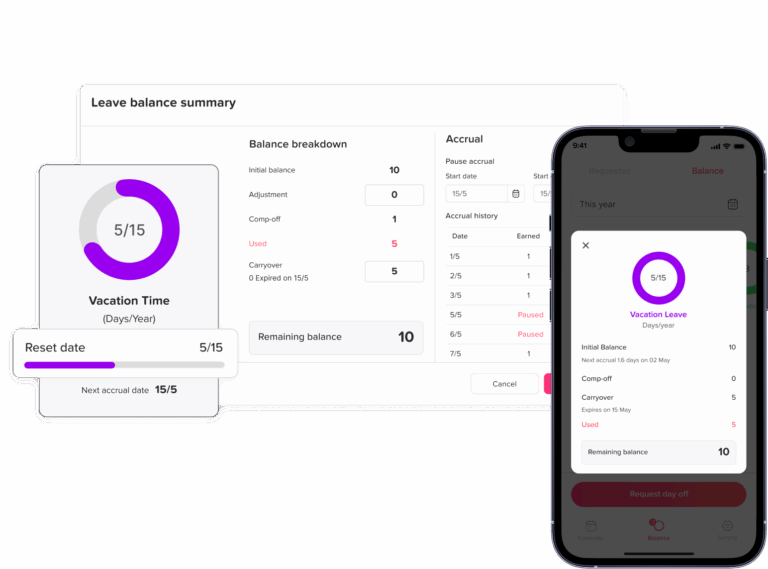
Managing PTO and Team Availability With Day Off
Day Off helps companies manage the leave information surrounding vacation planning in one place.
Employees can submit time-off requests while managers can review:
- Employee PTO balances
- Existing leave requests
- Team availability
- Work schedules
- Company holidays
- Leave policies
- Upcoming absences
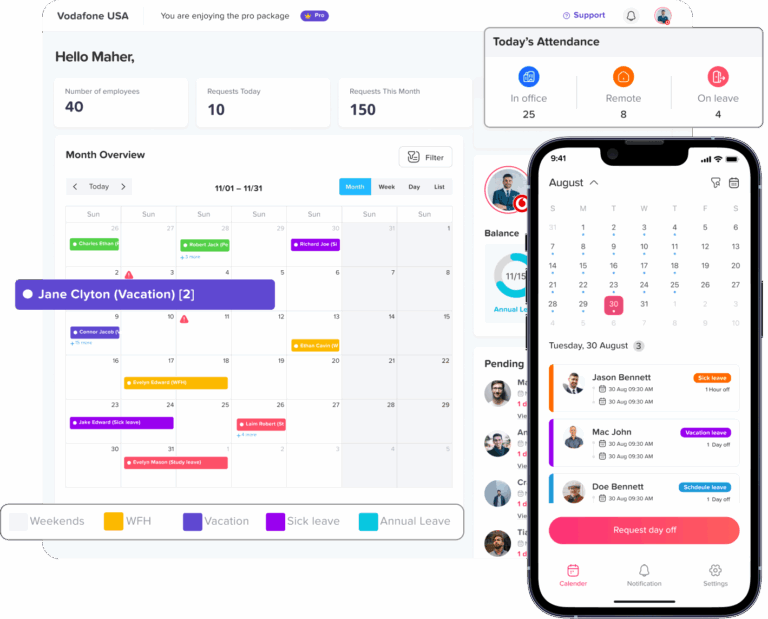
Shared leave calendars can also make overlapping absences easier to identify before managers finalize additional requests.
If an organization uses a formal seniority, lottery, rotating, or contractual vacation bidding process, those priority rules can remain part of the company’s vacation policy while Day Off supports the underlying PTO management process.
This helps replace disconnected spreadsheets, messages, manual balance calculations, and separate absence calendars with a more organized leave management workflow.
Vacation Bidding Policy Example
The following example shows how an employer might document a basic vacation bidding process.
Annual Vacation Selection Policy
Employees may submit annual vacation preferences during the vacation bidding period announced by HR.
Before the bidding period opens, the company will publish available vacation periods, applicable staffing limits, bidding deadlines, and the vacation priority method.
Employees may submit up to five vacation preferences in order of preference.
Where the number of eligible requests does not exceed the available vacation slots, requests may be awarded without further ranking.
Where requests exceed the available vacation capacity, priority will first be determined using the company’s annual vacation rotation. Employees with equal rotation priority will be ranked according to company seniority.
Employees who do not receive their first preference will be considered for the next eligible preference.
Where applicable, unsuccessful requests may be placed on a waiting list or included in a secondary vacation bidding round.
If an awarded vacation period is canceled, the available period will first be offered according to the company’s published waitlist procedure.
Vacation requests submitted after the annual bidding process closes will follow the company’s standard PTO request procedure.
All vacation awards remain subject to applicable law, employment contracts, collective bargaining agreements, staffing requirements, and company leave policies.
Organizations should adapt this example to their own workforce and applicable requirements rather than copying it without review.
Frequently Asked Questions About Vacation Bidding
What is vacation bidding?
Vacation bidding is a structured process in which employees submit their preferred vacation dates during a defined period. If more employees request a period than the available vacation slots allow, the employer uses predetermined rules such as seniority, rotation, lottery, job assignment, or ranked preferences to decide who receives the dates.
Vacation bidding is most common in workplaces where staffing must remain within specific limits and popular vacation periods regularly create competition.
How does vacation bidding work?
Employers typically begin by determining how many employees can be away during each vacation period. Employees then submit one or more preferred dates during a bidding window.
After bidding closes, requests are processed according to the organization’s priority rules. Successful bids are awarded, while unsuccessful employees may receive another preference, enter a second bidding round, or move to a waiting list.
Dayforce, for example, supports vacation bidding groups, submission rounds, employee rankings, and priority metrics including seniority, lottery, and job assignment.
Who gets priority for vacation requests?
There is no universal rule that determines vacation priority for every workplace. Priority may depend on:
- Seniority
- First come, first served
- Previous vacation awards
- Rotating holiday priority
- Lottery
- Job or skill coverage
- Ranked preferences
- Collective bargaining rules
The important point is that the employer should define the method in advance and apply it consistently.
SHRM specifically identifies who gets priority for vacation requests as an issue employers should address in a written vacation policy and discusses seniority as one possible method when several employees request the same period.
Does seniority determine vacation preference?
It can.
Some workplaces give employees with longer service priority when several employees want the same vacation period. Seniority-based vacation selection is particularly common in some unionized, transportation, public-sector, and other structured work environments.
For example, New York State guidance for several bargaining units states that seniority is used to schedule vacations when more employees request a period than can reasonably be allowed off.
However, seniority does not automatically control vacation scheduling in every workplace. The applicable company policy, employment agreement, collective bargaining agreement, and local law should be reviewed.
What is vacation bid seniority?
Vacation bid seniority is the employee ranking used to determine the order in which vacation preferences are awarded.
The ranking may be based on:
- Company hire date
- Departmental seniority
- Job classification seniority
- Bargaining-unit seniority
- Another definition established by company policy or contract
Two employees can therefore have different forms of seniority depending on how the organization’s vacation rules are written.
What happens if two employees request the same vacation days?
If both requests can be accommodated, the employer may approve both.
If staffing limits allow only one employee to be away, the employer should apply its published priority rule.
For example, the process might:
- Check required staffing and job coverage.
- Apply rotating vacation priority.
- Compare seniority if employees remain tied.
- Use a lottery as the final tie-breaker.
Some formal agreements use exactly this type of layered approach. California state vacation bidding rules, for example, can use state service seniority, departmental seniority, and then a lottery to break a remaining tie.
Is vacation bidding first come, first served?
Not necessarily.
In a true vacation bidding system, employees may all submit preferences during the same bidding window. The requests are then processed according to a separate ranking system rather than submission time.
Dayforce’s concurrent vacation bidding process, for example, collects employee bids during an active submission round and processes them after the round according to the session’s configured rules.
However, some employers use first come, first served after the formal annual vacation bidding period has ended. Real collective bargaining agreements and public-sector procedures use this combination.
What is the fairest way to decide vacation priority?
There is no single method that will feel equally fair in every workplace.
Different systems solve different fairness problems:
- Seniority rewards long service.
- Lottery gives eligible employees a randomized opportunity.
- Rotation spreads priority across different years.
- First come, first served rewards early planning.
- Ranked preferences increase the chance of receiving an acceptable alternative.
- Hybrid systems combine several rules.
For holidays that create the same conflicts every year, rotation may distribute opportunities more evenly. Where seniority is already central to workplace rights, seniority-based bidding may be easier to understand and administer.
The best system is usually one employees can understand before they submit their requests.
Can an employer deny vacation because of staffing?
A vacation request may be denied when approving it would create insufficient staffing, subject to applicable company policy, contracts, and law.
This is one of the main reasons vacation slots exist. Instead of waiting until too many requests have been approved, the employer determines in advance how many employees can reasonably be away during a particular period.
SHRM recommends addressing vacation scheduling and priority rules clearly in the employer’s written policy, especially when several employees request overlapping time off.
What happens if I don’t get my vacation bid?
The answer depends on the employer’s bidding rules.
An unsuccessful employee may:
- Move to the next ranked vacation preference
- Enter a secondary bidding round
- Select from remaining vacation dates
- Join a waiting list
- Submit an ordinary PTO request later
Some formal vacation systems also assign remaining vacation automatically when an employee cannot obtain any of the dates they requested. APFA’s airline vacation bidding guidance, for example, explains how remaining vacation can be assigned after primary and secondary bidding when an employee cannot hold a submitted vacation bid.
What happens if an employee does not submit a vacation bid?
This depends entirely on the vacation bidding policy.
Possible outcomes include:
- The employee participates in a later round.
- Remaining dates are assigned automatically.
- The employee chooses only from periods left after other bids are processed.
- Vacation remains available through the normal PTO request process.
Some airline vacation systems automatically assign vacation to employees who fail to submit sufficient bids.
Employers should state this consequence clearly before bidding opens so employees understand what happens if they miss the deadline.
Why do companies use vacation bidding instead of normal PTO requests?
Vacation bidding is most useful when demand for particular dates is predictable and limited staffing makes it impossible to approve everyone.
Instead of waiting until conflicting requests arrive, employers can establish:
- How many vacation slots exist
- Who is eligible
- How employees submit preferences
- Which priority rule applies
- How ties are resolved
- What happens to unsuccessful requests
The result is a more structured approach to high-demand vacation scheduling while ordinary PTO requests can continue throughout the rest of the year.
Final Thoughts on Vacation Bidding
Vacation bidding gives employers a structured way to manage competing vacation requests while protecting staffing needs.
Whether the system uses seniority, lottery, rotation, ranked preferences, or a hybrid approach, the key is to keep the rules clear and consistent. Employees should understand how priority is determined and what happens if their preferred dates are unavailable.
With accurate PTO balances, work schedules, and team availability, companies can make vacation planning more transparent, fair, and easier to manage.