





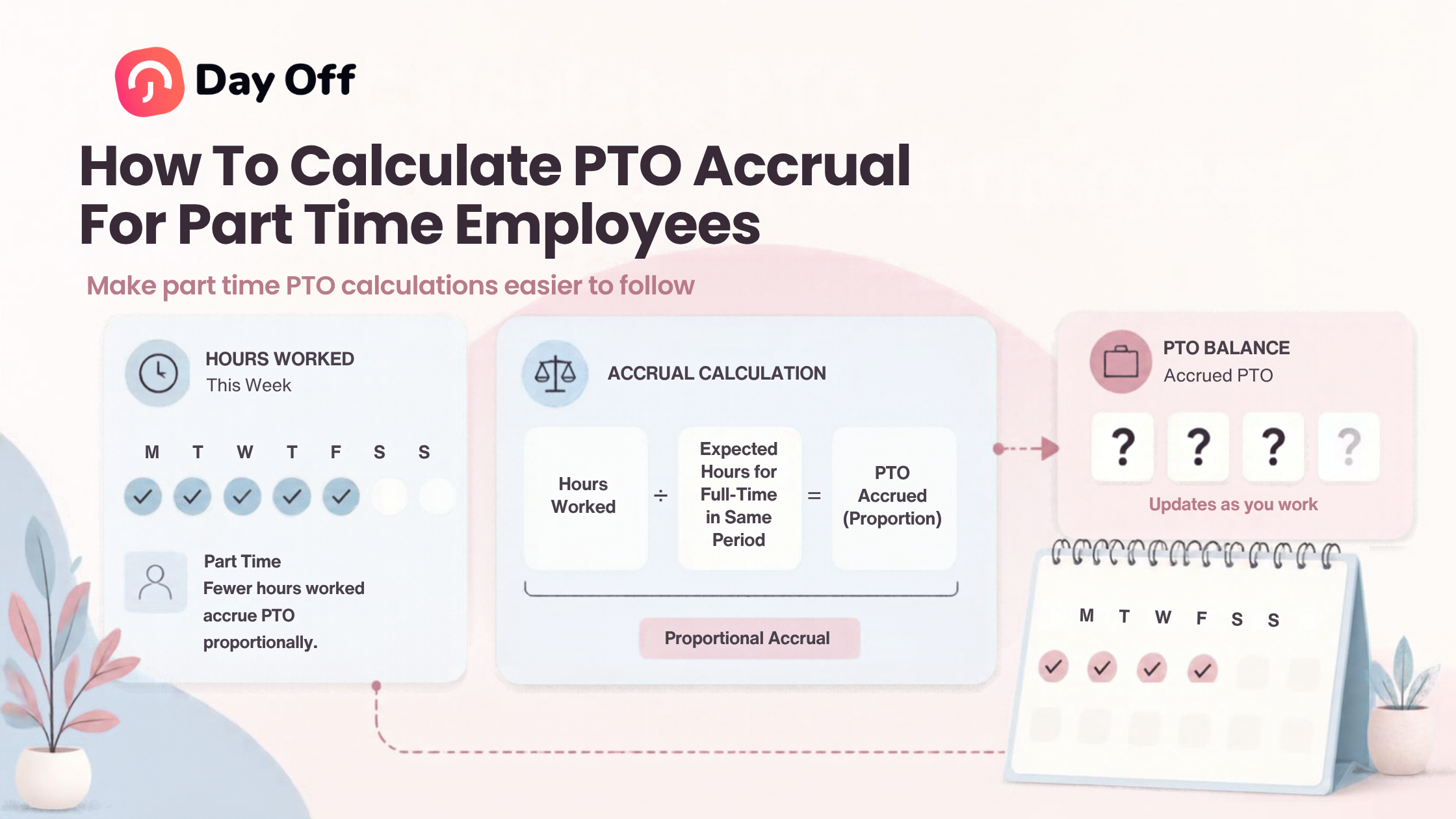
Paid time off can be straightforward when every employee works the same schedule. It becomes more complicated when employees work 20, 24, 30, or a different number of hours each week. To Calculate PTO Accrual correctly for part time employees, employers need to decide how PTO is earned, identify which hours count toward accrual, and apply the same policy consistently.
Related reading: PTO Accrual Calculator by Pay Period: Calculate PTO Earned Each Paycheck

There is no single PTO accrual formula that every employer must use. A company may accrue PTO according to hours worked, weekly schedules, pay periods, months, or another defined system. The best method depends on the organization’s PTO policy, workforce structure, payroll schedule, and applicable state or local laws.
This guide explains how PTO accrual works for part time employees, the most common calculation methods, practical examples, and ways employers can make the process easier to manage.
What Is PTO Accrual?
PTO accrual is the process through which an employee gradually earns paid time off.
Instead of receiving an entire year’s PTO allowance at once, an employee may earn a portion of their leave throughout the year.
For example, an employee might:
Earn PTO for every hour worked.
Receive a set number of PTO hours every two weeks.
Accrue PTO monthly.
Earn a prorated portion of the allowance available to full time employees.
The accumulated balance can generally be used for vacation or other qualifying absences according to the employer’s leave policy.
Accrual is different from a front loaded PTO system. With front loading, the employer provides a predetermined amount of PTO at the beginning of the year or another defined period rather than requiring employees to earn it gradually.
Do Part Time Employees Have to Receive PTO?
At the federal level in the United States, the Fair Labor Standards Act does not generally require employers to provide paid vacation, personal leave, sick leave, or holiday leave. These benefits are usually established through an agreement or policy between the employer and employee.
The FLSA also does not define whether an employee is full-time or part-time. Employers generally establish those classifications themselves, subject to other applicable laws and benefit requirements.
However, employers should not assume that this means there are no legal requirements affecting paid leave.
State and local laws may impose requirements involving:
Paid sick leave
Paid leave accrual
Carryover
Accrual caps
PTO payout
Use it or lose it policies
Employee eligibility
Required notices and recordkeeping
Employers should therefore review the laws that apply to each employee’s work location before creating or changing a PTO policy.
There may also be special rules for certain employees or government contracts. For example, the U.S. Department of Labor explains that under the Service Contract Act, qualifying part time employees may be entitled to proportionate vacation and holiday benefits.
Why PTO Accrual for Part Time Employees Needs a Clear Formula
A part time employee does not necessarily work exactly half of a full-time schedule.
One person may work 15 hours each week, another 25, and another may work varying hours depending on staffing needs.
Providing every part time employee with the same PTO allowance can therefore produce inconsistent results.
A structured accrual formula can help organizations:
Treat employees consistently.
Connect PTO entitlement to working time.
Avoid manual calculation errors.
Forecast future PTO balances.
Keep payroll and leave records aligned.
Make the PTO policy easier for employees to understand.
Manage employees whose weekly hours change.
There are several ways to calculate PTO accrual. The employer should select the method that matches the wording of its PTO policy.
Method 1: Calculate PTO Based on Hours Worked
For part-time employees with changing schedules, calculating PTO according to hours worked is often one of the most precise methods.
The basic formula is:
PTO earned = Eligible hours worked × PTO accrual rate
The most important part is determining the accrual rate.
How to Calculate the PTO Accrual Rate
Suppose an employer wants an employee working a standard full-time schedule of 40 hours per week to earn 80 hours of PTO annually.
A full time schedule of 40 hours for 52 weeks equals:
40 × 52 = 2,080 hours
The accrual rate would therefore be:
80 PTO hours ÷ 2,080 work hours = 0.03846 PTO hours per hour worked
This means an eligible employee earns approximately:
0.03846 hours of PTO for every eligible hour worked.
Example: Employee Working 20 Hours Per Week
If a part-time employee works:
20 hours × 52 weeks = 1,040 hours per year
Their PTO would be:
1,040 × 0.03846 = approximately 40 hours
So the employee would earn approximately 40 hours of PTO per year if they maintained that schedule.
Example: Employee Working 30 Hours Per Week
Annual working hours:
30 × 52 = 1,560 hours
PTO:
1,560 × 0.03846 = approximately 60 hours
The employee would accrue approximately 60 PTO hours per year.
This approach effectively prorates PTO according to working time.
| Weekly Schedule | Approx. Annual Hours | Annual PTO at 0.03846/hour |
|---|---|---|
| 10 hours | 520 | 20 hours |
| 20 hours | 1,040 | 40 hours |
| 25 hours | 1,300 | 50 hours |
| 30 hours | 1,560 | 60 hours |
| 35 hours | 1,820 | 70 hours |
| 40 hours | 2,080 | 80 hours |
These figures assume all listed hours are eligible for PTO accrual and the employee works the schedule for the full 52 weeks.
When an Hours Worked Accrual Method Makes Sense
This method can work particularly well for:
Hourly employees
Employees with variable schedules
Retail teams
Restaurants
Seasonal staffing
Shift-based businesses
Employees whose weekly hours frequently change
Because PTO follows actual eligible hours, employers do not have to continually recalculate an employee’s annual allowance when their schedule fluctuates.
Method 2: Prorate PTO Based on a Part Time Schedule
Another common approach is to determine what percentage of a full-time schedule the employee works and give them the same percentage of a full-time PTO allowance.
The formula is:
Part time PTO = Full time PTO allowance × (Part-time weekly hours ÷ Full-time weekly hours)
Suppose full time employees work 40 hours per week and receive 120 PTO hours annually.
A part-time employee works 24 hours per week.
First, calculate the employee’s full time equivalent:
24 ÷ 40 = 0.60
The employee works 60% of the standard full-time schedule.
Then calculate PTO:
120 × 0.60 = 72 hours
The employee receives 72 PTO hours per year.
Another Example
Full time allowance: 160 hours
Full time schedule: 40 hours per week
Part time schedule: 30 hours per week
30 ÷ 40 = 0.75
Then:
160 × 0.75 = 120 hours
The part-time employee would receive 120 hours of PTO annually.
When Prorating PTO Works Best
Schedule-based proration is usually easier when employees have predictable schedules.
For example:
Employee A always works 20 hours per week.
Employee B always works 24 hours.
Employee C always works 32 hours.
If weekly schedules regularly change, an hours worked accrual system can provide more accurate results.
Method 3: Calculate PTO Per Pay Period
Employers can also distribute an employee’s annual PTO entitlement across payroll periods.
The formula is:
PTO per pay period = Annual PTO entitlement ÷ Number of pay periods
Suppose a part time employee is entitled to 60 PTO hours annually.
If employees are paid biweekly, there are typically 26 pay periods:
60 ÷ 26 = 2.3077 hours
The employee would accrue approximately 2.31 PTO hours each pay period.
If the organization uses semimonthly payroll with 24 pay periods:
60 ÷ 24 = 2.5 hours
The employee would accrue 2.5 hours per pay period.
| Pay Frequency | Typical Pay Periods Per Year | PTO Per Period for 60 Annual Hours |
|---|---|---|
| Weekly | 52 | 1.15 hours |
| Biweekly | 26 | 2.31 hours |
| Semimonthly | 24 | 2.50 hours |
| Monthly | 12 | 5.00 hours |
The actual number of payroll periods should always be confirmed for the specific year and payroll schedule.
A Common Mistake With Pay Period Accrual
Employers should first calculate the employee’s correct annual entitlement.
For example, if full-time employees receive 120 hours and a part time employee qualifies for only 60 hours, divide 60, not 120, across the payroll periods.
Otherwise, the part time employee would accrue the full time allowance.
Method 4: Calculate PTO Using a Weekly Accrual
Some employers prefer to add PTO balances weekly.
The formula is:
Annual PTO entitlement ÷ 52 = Weekly PTO accrual
If a part-time employee receives 52 hours annually:
52 ÷ 52 = 1 hour per week
If they receive 78 hours:
78 ÷ 52 = 1.5 hours per week
A weekly method is simple when an employee’s annual allowance has already been determined.
However, employers should define what happens if the employee:
Starts in the middle of a week.
Takes unpaid leave.
Has no eligible hours during a week.
Changes from full time to part-time.
Changes from part time to full time.
Method 5: Calculate PTO Using Monthly Accrual
A monthly system divides the annual allowance into 12 accrual periods.
The formula is:
Annual PTO entitlement ÷ 12 = Monthly PTO accrual
For example, an employee entitled to 72 hours annually would earn:
72 ÷ 12 = 6 hours per month
An employee entitled to 48 hours would earn:
48 ÷ 12 = 4 hours per month
Monthly accrual is easy to administer, although it may be less precise for highly variable hourly schedules unless the annual allowance is regularly adjusted.
Full Example: Calculating PTO for a Part Time Employee
Consider the following policy:
Full time schedule: 40 hours per week
Fulltime PTO allowance: 15 days per year
Standard workday: 8 hours
Part time employee schedule: 25 hours per week
First, convert full time PTO days into hours:
15 × 8 = 120 PTO hours
Next, calculate the employee’s schedule ratio:
25 ÷ 40 = 0.625
The employee works 62.5% of the full time schedule.
Now calculate annual PTO:
120 × 0.625 = 75 hours
The employee’s annual PTO entitlement would be 75 hours.
If PTO accrues biweekly:
75 ÷ 26 = approximately 2.88 hours per pay period
If PTO accrues monthly:
75 ÷ 12 = 6.25 hours per month
This demonstrates why defining both the annual entitlement and accrual frequency matters.
Should Part Time PTO Be Calculated in Hours or Days?
For part time employees, calculating PTO in hours is often clearer than using days.
Consider two employees:
Employee A works eight hour shifts.
Employee B works four hour shifts.
Giving both employees “10 days” of PTO can be misleading because one employee’s day represents twice as many working hours.
Tracking PTO in hours allows leave deductions to reflect the employee’s actual schedule more precisely.
For example, if an employee normally works five hours on Thursday and takes Thursday off, deducting five PTO hours is clearer than deducting one generic PTO day.
This becomes even more important when employees:
Work different hours on different days.
Take partial day leave.
Work flexible schedules.
Change their regular hours.
Have nontraditional weekly schedules.
How Do You Calculate PTO for Employees With Variable Hours?
Variable hour employees require more careful handling because their weekly schedule may not provide a reliable basis for annual proration.
For these employees, an hours worked accrual formula can be easier to maintain.
For example:
Accrual rate: 0.04 PTO hours per eligible hour worked
If an employee works 67 eligible hours during a pay period:
67 × 0.04 = 2.68 PTO hours
If they work only 42 hours during the next period:
42 × 0.04 = 1.68 PTO hours
Their accrual automatically adjusts with their eligible working time.
This eliminates the need to estimate an average weekly schedule.
Which Hours Count Toward PTO Accrual?
Employers must clearly define what counts as an accrual eligible hour.
Depending on company policy and applicable law, employers may treat the following differently:
Regular working hours
Overtime hours
PTO hours
Paid sick leave
Paid holidays
Unpaid leave
Parental leave
Jury duty
Bereavement leave
Other paid absences
For example, an employer might allow PTO to accrue while an employee uses paid vacation but pause accrual during unpaid leave.
Another company may base accrual only on actual hours worked.
Neither approach should be assumed automatically. The organization’s written policy and applicable laws should determine how these situations are treated.
The U.S. Department of Labor also notes that paid vacation, sick time, and holidays are generally not treated as hours worked for FLSA overtime calculations simply because the employee receives pay for those hours.
How Does Overtime Affect PTO Accrual?
This depends on the policy.
Suppose an employee earns:
0.04 PTO hours per eligible hour
They work 45 hours in one week.
If PTO accrues on all hours worked:
45 × 0.04 = 1.8 hours
If the policy caps accrual-eligible hours at 40:
40 × 0.04 = 1.6 hours
The calculation is different even though the employee worked the same schedule.
The PTO policy should therefore answer whether:
All worked hours count.
Only regular hours count.
Overtime hours count at the normal accrual rate.
Eligible hours are subject to a weekly or annual maximum.
How to Handle PTO When a Part Time Employee Changes Hours
Part time employees sometimes increase or decrease their regular schedules.
For example, an employee may move from:
20 hours per week to 30 hours per week
If PTO is based on hours actually worked, the accrual calculation can adjust automatically.
If PTO is based on a fixed annual entitlement, the employer may need to recalculate the employee’s future accrual.
Suppose:
Full time employees receive 120 PTO hours.
Full time schedule is 40 hours.
Employee initially works 20 hours.
Original annual entitlement:
20 ÷ 40 × 120 = 60 hours
The employee later moves to 30 hours per week.
New annualized entitlement:
30 ÷ 40 × 120 = 90 hours
The organization then needs rules specifying how the change affects the remainder of the year.
Possible approaches include:
Changing the accrual rate beginning on the effective date of the schedule change.
Prorating each portion of the year separately.
Updating the entitlement at the start of the next accrual period.
The policy should explain which method applies.
Example of Prorating PTO After a Midyear Schedule Change
Assume:
Full time annual PTO: 120 hours
Full time schedule: 40 hours
Employee works 20 hours per week for six months.
Employee then works 30 hours per week for six months.
At 20 hours:
20 ÷ 40 × 120 = 60 annualized hours
For half the year:
60 × 0.5 = 30 hours
At 30 hours:
30 ÷ 40 × 120 = 90 annualized hours
For the second half:
90 × 0.5 = 45 hours
Total calculated entitlement for that year:
30 + 45 = 75 hours
This is an illustrative calculation. Employers should follow their written policy and applicable laws when handling changes in status.
What Is a PTO Accrual Cap?
A PTO accrual cap establishes the maximum balance an employee may accumulate.
For example:
Employee accrues up to 80 hours annually.
Maximum stored balance is 120 hours.
Employee currently has 120 hours.
If the company’s policy stops additional accrual at the cap, the employee would not earn more PTO until their balance falls below that threshold.
Once the employee uses some PTO, accrual may resume according to the policy.
Employers should distinguish between:
Annual accrual limit: How much PTO can be earned during a defined year.
Balance cap: The maximum unused PTO an employee can hold at one time.
These are not necessarily the same number.
Employers should also confirm whether state or local laws affect the use of accrual caps or forfeiture rules.
What About PTO Carryover?
Carryover determines whether unused PTO remains available after the end of an accrual year.
An employer might allow employees to:
Carry over all unused PTO.
Carry over only a limited amount.
Carry over PTO but require it to be used by a certain date.
Apply another method permitted under applicable law.
PTO rules can vary significantly by jurisdiction, particularly when vacation is treated as earned compensation. Employers should verify the rules that apply where employees work rather than applying a single assumption nationwide.
PTO Accrual vs. PTO Front Loading
Employers do not always need to use an accrual model.
Two common systems are:
| Accrual Method | Front-Loaded Method |
|---|---|
| PTO is earned gradually | PTO is provided upfront |
| Balance grows over time | Full allowance may be immediately available |
| Can reflect hours actually worked | Usually based on predetermined entitlement |
| Useful for variable schedules | Often simpler administratively |
| Requires regular accrual calculations | Requires rules for new hires and midyear changes |
Neither method is automatically better.
The right approach depends on the organization’s policy, workforce, administrative needs, and applicable paid leave rules.
How to Build a Clear Part Time PTO Policy
A strong policy should answer more than simply how many PTO hours employees receive.
Employers should define:
Eligibility
Explain which employees qualify.
For example:
All employees
Employees working at least a certain schedule
Employees after a waiting period
Specific employment classifications
Make sure eligibility rules comply with applicable laws.
Accrual Method
State whether PTO is earned:
Per hour worked
Weekly
Biweekly
Semimonthly
Monthly
Annually
Accrual Rate
Employees should be able to understand how the balance is calculated.
For example:
Eligible employees accrue 0.04 hours of PTO for each eligible hour worked.
Eligible Hours
Define whether PTO accrues on:
Regular hours
Overtime
Paid leave
Holidays
Other absences
Maximum Balance
Explain whether an accrual cap exists.
Carryover
Explain how unused PTO is handled when one leave year ends and another begins.
Schedule Changes
Describe what happens if employees move between full-time and part-time schedules or change their regular weekly hours.
Leaving the Company
Explain what happens to unused PTO when employment ends, subject to applicable state and local laws.
How to Calculate PTO Accrual for New Part Time Employees
Employees who begin partway through a leave year may require additional proration.
For example:
Annual part-time PTO entitlement: 72 hours
Employee starts exactly halfway through the leave year.
A simple prorated calculation could be:
72 × 0.5 = 36 hours
If the organization uses monthly accrual instead:
72 ÷ 12 = 6 hours per month
If six months remain:
6 × 6 = 36 hours
An hours-worked model can be even simpler because the employee starts earning PTO based on eligible hours after their accrual start date.
Employers should also clearly define whether a waiting period applies before PTO begins accruing or merely before employees can use the PTO they have earned.
Those are two different policy rules.
Accrued PTO vs. Available PTO
Another distinction employers should make is between accrued and available PTO.
Suppose an employee has earned 20 hours but has already scheduled 8 hours for an upcoming vacation.
Their system might display:
Accrued balance: 20 hours
Scheduled PTO: 8 hours
Remaining available balance: 12 hours
Separating these values can help managers avoid approving more leave than the employee actually has available.
Why Manual PTO Accrual Gets Difficult as a Team Grows
A spreadsheet can calculate a simple PTO formula.
Managing the complete process is more challenging.
HR may need to track:
Different accrual rates
Different employee schedules
Part time versus full time status
Tenure based increases
Carryover
Expiration
Accrual caps
Approved future leave
Manual balance adjustments
Work anniversaries
Public holidays
Changes in working schedules
Leave measured in hours instead of days
One spreadsheet formula may be correct while another employee’s balance is outdated because their schedule changed three months earlier.
This is where automated leave management becomes especially useful.
How Day Off Helps Manage PTO Accrual for Part Time Employees
Day Off is a leave management and PTO tracking platform designed to help companies manage employee balances, leave policies, requests, approvals, and calendars without relying on manual spreadsheets.
Companies with full time and part time employees can configure leave policies to match how their organization manages PTO.
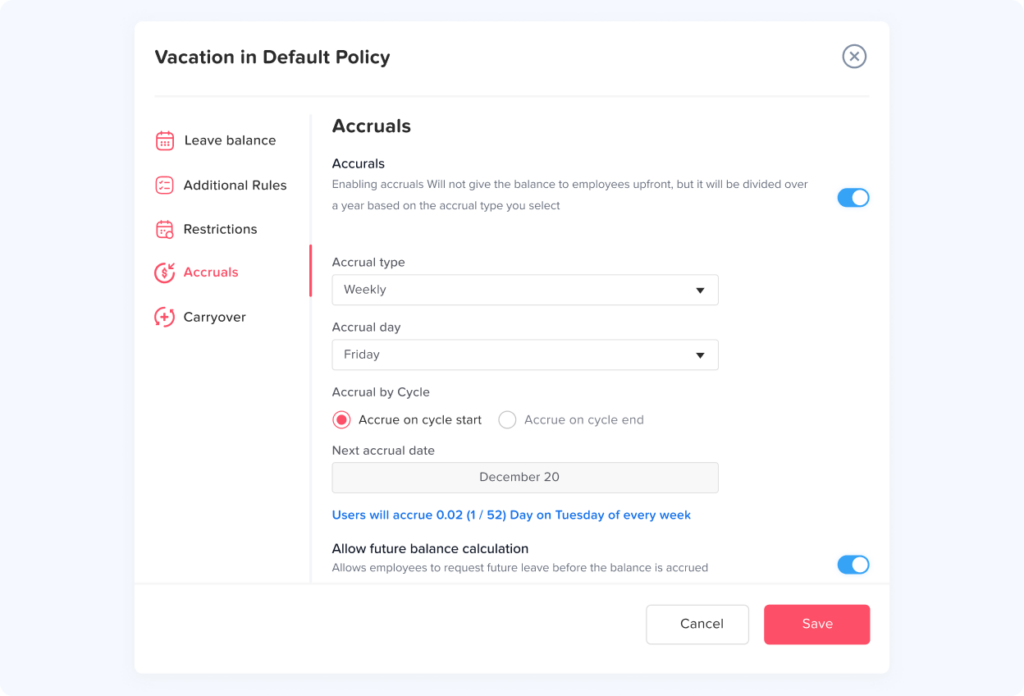
Depending on the selected plan and policy configuration, Day Off can support accrual schedules including:
Weekly
Biweekly
Semimonthly
Monthly
Annual accrual
Accrual based on hours worked
This is especially useful when PTO needs to build gradually rather than being manually added to an employee’s balance.
Organizations can also manage rules such as:
Carryover
Carryover limits
Carryover expiration
Waiting periods
Accrual limits
Leave balances
Time off in hours
Different work schedules
Public holiday calendars
Different leave types
Approval workflows
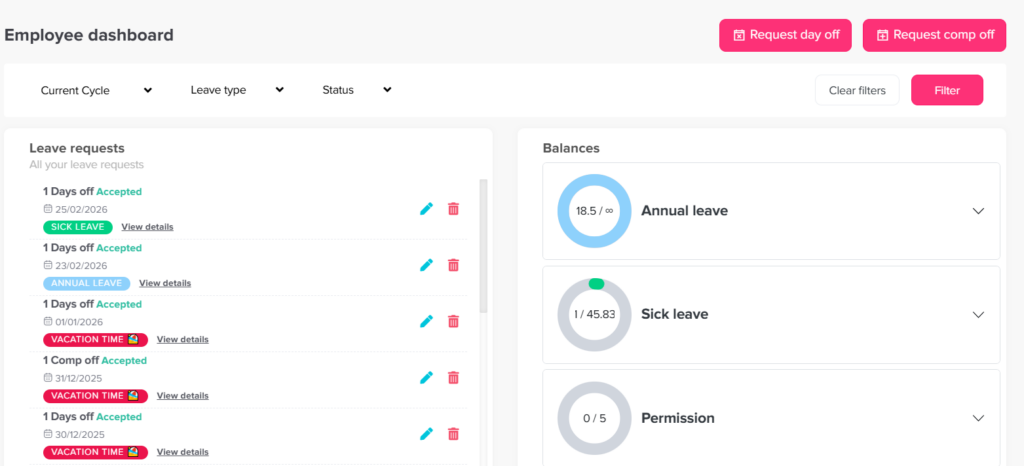
Employees can see their available leave balance and submit time-off requests, while managers can review requests and planned absences through a shared calendar.
For part time teams, maintaining work schedules and PTO policies in the same system can also make it easier to understand how employee leave relates to their actual working pattern.
Day Off is available through the web, iOS, and Android, allowing employees and managers to manage leave without relying on spreadsheets or back and forth balance requests.
Final Thoughts
Learning how to Calculate PTO Accrual for part time employees starts with one basic principle: the calculation must match the organization’s written leave policy.
For employees with consistent schedules, prorating a full time annual PTO allowance can provide a simple solution. For employees whose working hours change from week to week, calculating PTO based on actual eligible hours worked can provide greater precision. Employers may then apply the resulting entitlement weekly, monthly, or according to each payroll period.
The formula itself is only one part of effective PTO management. Employers also need clear rules for eligibility, eligible hours, overtime, schedule changes, carryover, accrual caps, waiting periods, and unused balances.
Federal law generally does not require employers to provide vacation or other PTO benefits, but state and local laws may establish additional requirements. Employers should review the laws applicable to each employee’s work location before finalizing their policy.
For growing teams, automating these calculations can reduce repetitive administrative work and make balances easier for employees and managers to understand. A leave management platform such as Day Off can bring PTO accruals, balances, policies, requests, approvals, calendars, and employee schedules together in one place.