







A Negative PTO Balance occurs when an employee has used more paid time off than they have earned or accrued. This commonly happens when an employer allows employees to borrow against future PTO so they can take vacation, personal time, or other paid leave before enough time has accumulated. The arrangement may work smoothly while the employee remains employed because future accruals gradually bring the balance back toward zero. The situation becomes more complicated when the employee quits before earning back the advanced time.

For HR teams and employers, the immediate question is usually straightforward: Can the company recover the value of the negative PTO from the employee’s final paycheck?
The answer is not always straightforward.
Federal law does not generally require employers to provide vacation pay, but once an employer chooses to offer PTO, the employer’s written policy and applicable state wage laws can affect what happens when employment ends. Final pay deductions are particularly important because a deduction that is permissible in one state may be restricted or prohibited in another.
This guide explains what a negative PTO balance means at termination, how employers should calculate it, whether it can be deducted from final pay, what happens when deductions are prohibited, and how HR teams can design PTO policies that reduce disputes when employees leave.
Legal note: This article provides general U.S. HR information, not legal advice. Wage deduction, vacation payout, sick leave, and final pay laws vary by state and locality. Employers should review the rules that apply where the employee works before making a deduction.
What Is a Negative PTO Balance?
A negative PTO balance means an employee has used more PTO than they currently have available.
Suppose an employee earns 10 hours of PTO each month.
At the beginning of June, the employee has:
- 8 hours of available PTO
- A request for 24 hours of vacation
- Employer permission to borrow future PTO
After the 24-hour request is approved, the employee’s balance becomes:
8 available hours – 24 hours used = -16 hours
The employee now has a negative balance of 16 hours.
If the employee continues working, future accruals can normally reduce that deficit. If another 10 hours accrue in July, for example, the balance would move from -16 hours to -6 hours.
The problem arises if the employee resigns while the balance is still negative.
Why Do Employers Allow negative PTO balance?
Negative PTO is essentially a way to give employees access to paid time before they have accumulated enough leave.
Employers may permit it when:
- A newly hired employee has a vacation planned before enough PTO will accrue.
- An employee faces an unexpected personal situation.
- PTO accrues slowly throughout the year.
- The company wants to give employees greater flexibility.
- An employee needs several consecutive days off but is only slightly short of the required balance.
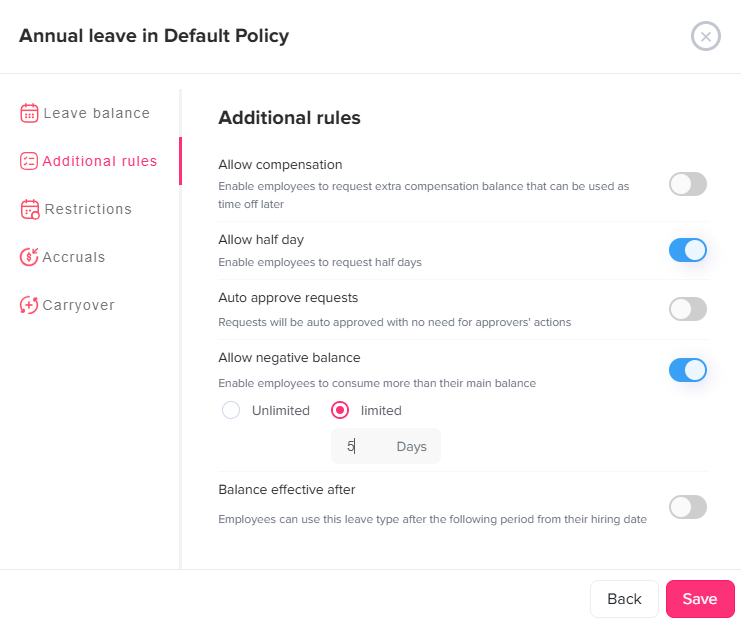
Day Off, for example, allows companies to configure negative leave balances and choose either a limited negative amount or an unlimited negative balance for a particular leave type.
Allowing employees to borrow PTO can be useful, but it creates a financial risk for the employer: the employee might leave before earning the borrowed time back.
What Happens to Negative PTO When an Employee Quits?
A negative PTO balance does not automatically disappear when an employee resigns, but it also does not automatically give the employer the right to deduct money from the employee’s final paycheck.
HR should first determine:
- How much PTO was actually earned.
- How much PTO was used.
- Whether the negative amount represents advanced vacation, another PTO category, or legally protected sick leave.
- What the company’s written policy says.
- Whether the employee signed a valid agreement concerning advanced PTO.
- Which state and local wage laws apply.
- Whether those laws permit recovery through payroll deduction.
Only after those questions are answered should payroll determine how the final paycheck should be handled.
Example of an Employee Leaving With negative PTO balance
Assume an employee earns 120 hours of PTO annually through monthly accruals.
The employee receives:
10 hours per month
By June 30, the employee has earned:
6 months × 10 hours = 60 hours
During those six months, however, the employee used 72 hours.
The employee therefore leaves with:
60 hours earned – 72 hours used = -12 hours
If the employee earns $25 per hour, the value of the advanced time is:
12 × $25 = $300
The employer may view the $300 as an outstanding PTO advance.
That does not necessarily mean payroll should deduct $300 from the employee’s final check. The company must first determine whether the deduction is permitted under applicable law.
Can an Employer Deduct Negative PTO From the Final Paycheck?
Sometimes, but not always.
At the federal level, paid vacation is generally not required by the Fair Labor Standards Act. The U.S. Department of Labor has also addressed situations involving advanced vacation and indicated that recovery of advanced vacation through a final-pay deduction can be permissible under the FLSA under the circumstances discussed in its guidance.
However, employers cannot stop at federal law.
State wage laws may impose significantly stricter rules on deductions from final wages.
That means an employer should never create a nationwide rule that says:
“Any negative PTO balance will automatically be deducted from your final paycheck.”
Such a rule may be lawful in one jurisdiction and unlawful in another.
California Shows Why State Law Matters
California provides a particularly clear example.
California treats earned vacation as wages. The California Division of Labor Standards Enforcement states that when an employer allows an employee to use vacation before earning it, that advanced vacation effectively represents an advance on wages.
If the employee leaves before earning the advanced vacation back, California recognizes that the resulting overpayment may constitute a debt owed to the employer.
But there is an important distinction:
The employer cannot simply deduct that debt from the employee’s final wages.
California’s Labor Commissioner specifically states that an employer may not use final wages as a form of self help to recover advanced vacation.
This is why HR teams need to separate two questions:
Does the employee owe money?
and
Can the employer collect that money by deducting it from final wages?
Those are not always the same legal question.
State Rules Can Produce Very Different Results
PTO payout and wage deduction rules vary considerably throughout the United States. The following examples illustrate why employers should evaluate the employee’s work location before processing final payroll.
| State | Important Consideration at Separation |
|---|---|
| California | Earned vacation is treated as wages. Advanced vacation that has not been earned back may create a debt, but the employer cannot simply deduct the advanced vacation from the employee’s final wages. |
| Illinois | Earned vacation generally must be included in final compensation when required by the employment agreement or policy, and Illinois restricts deductions from wages or final compensation without proper consent. |
| Massachusetts | Earned vacation is treated as wages and must generally be paid when employment ends. |
| New York | Whether unused vacation must be paid can depend on the employer’s written vacation or resignation policy. Wage deductions are limited by state law. |
| Oregon | Employers must follow their established vacation-pay policy or agreement, while wage deductions are separately regulated. |
| Washington | Vacation benefits generally depend on employer policy or agreement. Final pay must generally be provided no later than the next regularly scheduled payday, and final-pay deductions are subject to specific restrictions. |
These examples are not a complete 50 state analysis. California’s Labor Commissioner expressly requires payment of earned unused vacation and prohibits deduction of advanced vacation from final wages. Illinois requires employers to pay earned vacation in accordance with the applicable employment contract or policy and regulates deductions from final compensation. Massachusetts treats earned vacation as wages. New York allows written vacation policies to determine certain forfeiture conditions while restricting permissible wage deductions. Oregon requires employers to honor established vacation-payment policies. Washington generally treats vacation as an employer-provided benefit governed by policy or agreement.
Negative PTO Is Not the Same as Unused Positive PTO
It is important to distinguish between a negative PTO balance and unused accrued PTO.
Consider two employees leaving the same company.
Employee A: Positive PTO Balance
Employee A has:
- 40 hours earned
- 24 hours used
- 16 hours remaining
The employee has a positive 16-hour PTO balance.
Whether those 16 hours must be paid at separation depends on the type of leave, applicable state law, and the employer’s policy. Some states, including California, require earned and unused vacation to be paid at separation.
Employee B: Negative PTO Balance
Employee B has:
- 40 hours earned
- 56 hours used
- -16 hours remaining
The employee has taken 16 hours before earning them.
The question is no longer whether the company owes PTO to the employee. It is whether the employer can recover the value of the 16 advanced hours, and if so, through what method.
The two situations should not be processed the same way.
Accrued PTO and Frontloaded PTO Are Also Different
One of the biggest mistakes employers make is assuming that every balance provided at the beginning of the year represents future, unearned PTO.
That is not necessarily true.
Accrued PTO
Under an accrual system, employees earn PTO gradually.
For example:
- January: 10 hours earned
- February: another 10 hours
- March: another 10 hours
After three months, the employee has earned 30 hours.
If the employer allows the employee to use 50 hours, 20 hours may represent an advance against future accruals.
Frontloaded PTO
Under a frontloaded plan, an employer might make an entire annual bank available at the beginning of the benefit year.
For example:
January 1 balance: 120 hours
Whether those 120 hours are considered fully granted, earned gradually behind the scenes, subject to proration, or recoverable when employment ends depends on the policy and applicable law.
Employers should therefore avoid assuming that an employee who used most of a frontloaded bank early in the year automatically owes the company money.
The policy must distinguish clearly between:
- Earned PTO
- Available PTO
- Advanced PTO
- Frontloaded PTO
- Accrued PTO
How Should HR Calculate a Negative PTO Balance at Termination?
The safest approach is to calculate the employee’s actual balance as of the termination date rather than simply relying on the balance that appeared at the beginning of the pay period.
Step 1: Determine PTO Earned Through the Last Day
Include all PTO the employee was entitled to accrue through the separation date according to the company’s policy.
For example:
- Starting balance: 0
- PTO earned through final date: 54 hours
- PTO used: 68 hours
The balance is:
54 – 68 = -14 hours
Step 2: Check for Carryover
The employee may have carried unused PTO from the previous year.
Example:
- Carryover: 8 hours
- Current-year accrual: 54 hours
- Total earned/available under the policy: 62 hours
- PTO used: 68 hours
Final balance:
62 – 68 = -6 hours
Ignoring carryover would incorrectly double the employee’s apparent PTO debt.
Step 3: Review Manual Adjustments
Check for:
- PTO added manually by an administrator
- Previously corrected balances
- Compensatory time
- Adjustments after payroll corrections
- Canceled PTO requests
- Requests that were approved but never taken
An inaccurate balance can quickly create an inaccurate final-pay deduction.
Step 4: Confirm the Employee’s Work Schedule
PTO should normally reflect the working time the employee actually missed under the company’s policy.
An employee working four 10-hour shifts may use 10 PTO hours for one full scheduled day, while another employee working eight-hour shifts would use eight.
HR should therefore verify the employee’s schedule before converting leave days into monetary amounts.
Step 5: Determine the Applicable Pay Rate
If recovery is legally permitted, employers must determine what rate their policy and applicable law use to value the advanced leave.
For example:
Negative balance: 12 hours
Applicable hourly rate: $30
Potential value:
12 × $30 = $360
That calculation determines the value of the balance. It does not by itself establish a legal right to deduct $360 from final wages.
Examples of Negative PTO When Employment Ends
| Scenario | Balance at Departure | HR Issue |
|---|---|---|
| Employee borrowed 8 vacation hours and resigns before the next accrual | −8 hours | Determine whether recovery is permitted and whether final-pay deduction is lawful |
| Employee has 40 hours of frontloaded PTO available and uses 32 before resigning | Depends on policy | Determine whether the frontloaded balance was earned, granted, or advanced |
| Employee leaves with −16 hours caused by an HR balance error | −16 hours shown | Correct the records before considering recovery |
| Employee has −12 vacation hours but +8 compensatory hours | Separate balances | Review whether the policy permits offsetting different leave categories |
| Employee resigns while an approved future PTO request remains in the system | Current balance may be misleading | Cancel future leave before calculating the termination balance |
| Employee owes 20 advanced PTO hours but state law restricts final wage deductions | −20 hours | Final wages may need to be paid without the deduction; review other lawful recovery options |
What If the negative PTO balance Is Caused by a Payroll or HR Error?
Employers should never assume that a negative PTO balance represents employee borrowing.
The balance could be wrong because:
- An accrual did not run.
- The employee was assigned to the wrong PTO policy.
- A canceled request was not restored.
- Carryover was calculated incorrectly.
- A schedule change caused too many hours to be deducted.
- The employee’s service anniversary was entered incorrectly.
- PTO was deducted for a non-working day.
- A manual adjustment was entered incorrectly.
Before recovering anything, HR should reconcile the leave record.
A good termination review should compare:
Opening balance + earned PTO + valid adjustments – PTO actually used = final PTO balance
If the system and manual calculation do not match, resolve the discrepancy before processing final pay.
What If the Employee Quits During the PTO Accrual Period?
Suppose employees receive 8 hours of PTO on the last day of every month.
An employee resigns on June 18.
Should the employee receive the full June accrual?
That depends on the PTO policy and applicable state law.
Some policies award the accrual only after employees complete a defined period. Others prorate PTO through the separation date. In states that treat vacation as earned wages, employers must be especially careful that their accrual rules do not improperly eliminate vacation already earned through work performed.
California, for example, treats vacation as earned as labor is performed and requires unused earned vacation to be paid at separation.
The termination calculation therefore needs to use the policy’s actual earning method rather than simply looking at the employee’s most recent posted balance.
What If the Employee Is Fired Instead of Quitting?
Employers should not assume that negative PTO can be handled differently simply because the company terminated the employee.
Some state rules apply whenever the employment relationship ends.
California, for example, requires payment of earned and unused vacation when employment ends regardless of whether the employee quits or is discharged, and its restriction on self-help recovery of advanced vacation applies when the employee leaves before earning it back.
Other states can have different final-pay deadlines depending on whether an employee resigns or is discharged. Oregon, for example, has different timing requirements depending on the circumstances of separation and the notice provided by a resigning employee.
HR should therefore review both:
- What money is owed, and
- When that money must be paid
These are separate compliance questions.
Can the Employer Withhold the Entire Final Paycheck?
Employers should not withhold an entire final paycheck merely because there is a dispute over PTO.
The U.S. Department of Labor notes that federal law does not require former employees to receive final pay immediately, but states may impose their own final-pay deadlines.
States may also restrict an employer’s ability to hold final wages because of outstanding property, debts, or other disputes.
Washington, for example, states that an employer cannot withhold a final paycheck merely because an employee has not returned items such as keys, uniforms, tools, or equipment, and final wages generally must be paid by the next regularly scheduled payday.
The same principle makes it risky to hold an entire final paycheck while HR tries to resolve a disputed negative PTO balance.
Can an Employer Ask the Employee to Repay Negative PTO Separately?
Potentially.
The key issue is that the ability to pursue repayment and the ability to deduct repayment directly from wages may be different legal questions.
California illustrates this particularly well. The state describes advanced vacation that has not been earned back as a debt owed to the employer, while still prohibiting the employer from using the employee’s final wages to recover that debt through self help.
Depending on the jurisdiction, policy, signed agreement, amount involved, and circumstances, an employer may consider other lawful recovery methods.
Before sending an invoice, requesting repayment, using collections, or taking legal action, however, the employer should review applicable law and any employment agreement. For small balances, the administrative and employee-relations costs of collection may also outweigh the amount involved.
Should Employers Require Employees to Sign a PTO Advance Agreement?
A written acknowledgement can help establish clear expectations, but it does not automatically override state wage laws.
An advance policy might explain:
- How much PTO employees may borrow
- Which leave types allow negative balances
- The maximum negative balance
- How future accruals reduce the balance
- Whether borrowing is discretionary
- What happens when employment ends
- Whether repayment may be requested
- How repayment will be handled where legally permitted
However, employers should avoid language stating that payroll will automatically deduct any debt from final wages “regardless of applicable law.”
A better policy should make recovery expressly subject to federal, state, and local wage-payment requirements.
A Better negative PTO balance Policy Structure
A well designed policy should address the problem before an employee ever enters a negative balance.
Set a Maximum negative PTO balance
Instead of unlimited borrowing, consider a limit such as:
- 8 hours
- 16 hours
- 24 hours
- One scheduled workweek
The appropriate amount will depend on the workforce and accrual structure.
For a company with 10-hour shifts, for example, a 16-hour limit behaves differently from a two-day limit.
Define Which PTO Can Go Negative
Employers may choose to allow negative balances for vacation but not for every leave category.
Do not assume statutory paid sick leave can be managed in exactly the same way as employer-provided vacation. State and local sick-leave laws can impose separate accrual, usage, reinstatement, payout, and recordkeeping requirements. Washington, for example, states that unused statutory paid sick leave generally does not have to be cashed out at separation, although exceptions exist.
Explain How Future Accruals Repay the Balance
For example:
Employee balance: -12 hours
Next accrual: +5 hours
New balance: -7 hours
Next accrual: +5 hours
New balance: -2 hours
Future accruals continue restoring the account until the balance reaches zero.
Explain What Happens at Termination
The policy should tell employees that an outstanding negative PTO balance will be reviewed when employment ends and that the company may seek repayment or make a lawful deduction where permitted.
Avoid Promising an Illegal Deduction
Include language such as:
Any recovery of advanced PTO will be handled in accordance with applicable federal, state, and local wage-payment and deduction laws.
This gives the employer room to comply with different state requirements.
Keep Accurate PTO Records
HR should be able to see:
- PTO earned
- PTO taken
- Current balance
- Negative PTO approved
- Manual adjustments
- Accrual history
- Carryover
- Request history
- Approval history
Good records become particularly important when an employee disputes the balance after receiving final pay.
What Should HR Do When an Employee With negative PTO balance Gives Notice?
Once HR receives a resignation, several steps can reduce payroll errors.
Review the Current Leave Balance
Confirm the employee’s balance immediately.
Review Upcoming PTO Requests
Check whether the employee has future approved leave during the notice period.
If a future request should no longer be taken or will occur after the termination date, make sure it is removed from the final balance calculation.
Stop Inappropriate Future Accruals
Do not accidentally credit PTO scheduled to accrue after the employee’s last day.
At the same time, do not remove PTO the employee is legally or contractually entitled to earn through the final date.
Review the Policy
Confirm whether the employee was actually allowed to borrow PTO and whether the policy addresses termination.
Identify the Employee’s Jurisdiction
Do not process a deduction based solely on the company’s headquarters.
Employment rules generally need to be reviewed based on the jurisdiction governing the employee’s work.
Coordinate HR and Payroll
Payroll should not discover the negative balance for the first time while processing the final check.
HR should provide payroll with a verified balance and instructions that have already been reviewed for compliance.
Should Employers Allow New negative PTO balance During a Notice Period?
Employers may decide not to allow employees to increase an existing PTO deficit after resignation notice has been given, provided the rule is consistent with applicable law and the company’s policies.
For example:
- Employee current balance: 3 hours
- Employee gives two weeks’ notice
- Employee requests 16 hours of vacation
- Request would create a -13-hour balance
A company could establish a policy that PTO advances are unavailable once an employee has given or received notice of separation.
This reduces the risk that an employee will deliberately or unintentionally leave with a larger PTO debt.
The rule should be clearly documented and applied consistently.
What About an Employee Who Leaves Without Notice?
Leaving without two weeks’ notice does not automatically give the employer the right to withhold earned wages or vacation.
For example, Illinois states that employers cannot withhold earned vacation, wages, or other final compensation simply because an employee failed to provide notice of termination.
Employers should therefore avoid policies such as:
“Employees who quit without notice lose their final paycheck or all accrued vacation.”
Whether unused vacation can be forfeited varies by jurisdiction, but earned wages remain subject to wage-payment laws.
How PTO Type Changes the Analysis
Not every type of paid leave should automatically be treated as ordinary vacation.
An employer may track:
- Vacation
- General PTO
- Paid sick leave
- Personal leave
- Floating holidays
- Compensatory time
- Statutory leave
- Company provided wellness days
Different legal requirements can apply to different categories.
California, for example, states that a combined general purpose PTO plan that replaces vacation and sick leave is generally treated under the state’s vacation-pay principles, including the requirement to pay earned and unused PTO at separation.
Employers should therefore determine exactly which balance is negative before deciding how to handle it.
How PTO Tracking Software Helps Prevent Negative Balance Problems
Negative PTO becomes much harder to manage when balances are tracked in spreadsheets or manually updated after leave requests.
A PTO tracking system can help employers maintain a clear record of:
- Current PTO balances
- Accrual history
- Carryover
- Leave requests
- Approval dates
- Negative balance limits
- Employee work schedules
- Manual adjustments
- PTO reports
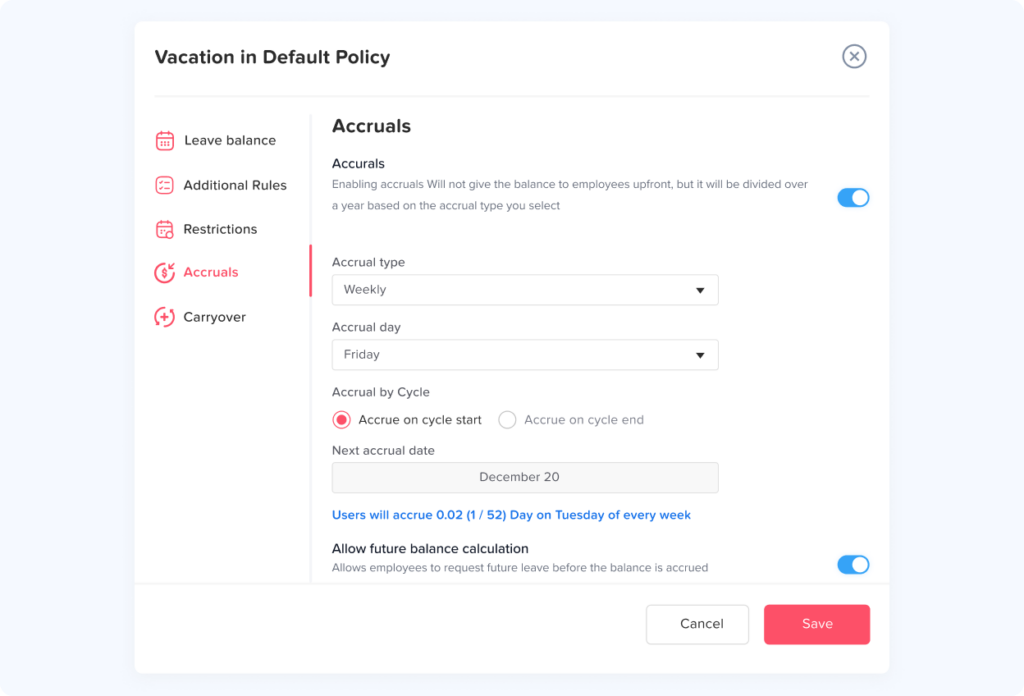
Day Off allows companies to enable negative balances for individual leave types and define a limit for how far below zero an employee may go. This can help organizations prevent employees from accidentally borrowing more leave than the company’s policy allows.
Software does not determine whether a payroll deduction is legally permissible, but accurate leave records make it much easier for HR and payroll to determine what actually happened before employment ended.
Negative PTO Termination Checklist for HR
Before processing an employee with a negative PTO balance, HR should verify:
- The employee’s last working date
- PTO earned through that date
- Carryover from previous periods
- PTO actually used
- Canceled or future leave requests
- Manual balance adjustments
- The employee’s work schedule
- The specific leave category involved
- Whether PTO was accrued, frontloaded, or advanced
- The negative balance policy
- Any signed PTO advance agreement
- State and local wage deduction requirements
- PTO payout requirements
- Final pay deadlines
- Whether the proposed deduction is legally permitted
- Whether another recovery method is required
This review is far safer than simply multiplying the negative hours by the employee’s hourly rate and reducing the final check.
Frequently Asked Questions
What happens if you quit with a negative PTO balance?
If you quit with a negative PTO balance, your employer will typically determine how much PTO you actually earned and how much was used before your last day. The employer may have a policy requiring repayment of advanced PTO, but whether the amount can be deducted directly from final wages depends on applicable state and federal law.
Can an employer take negative PTO out of a final paycheck?
In some circumstances and jurisdictions, a deduction may be permitted, but employers should not assume it is always legal. Federal guidance has recognized certain deductions involving advanced vacation, while states can impose stricter wage-deduction rules. California, for example, does not allow an employer to deduct advanced vacation from final wages.
Do you have to pay back PTO if you quit?
Possibly. If the employer clearly advanced PTO that had not yet been earned, the employer may have a claim for repayment depending on the policy, agreement, and applicable law. However, owing an amount and allowing that amount to be deducted directly from a final paycheck are separate issues.
Is negative PTO considered a debt?
It can be in some circumstances. California, for example, describes advanced vacation that remains unearned when employment ends as an overpayment of wages and a debt owed to the employer. However, California does not allow the employer to recover that debt by simply taking it from final wages.
Can an employer make employees repay vacation they used before earning it?
An employer may establish an advance PTO policy, but the method used to recover an outstanding advance must comply with applicable wage and deduction laws. Employers should review state rules before requesting or collecting repayment.
What happens to future PTO accruals when a balance is negative?
While the employee remains employed, future accruals can generally be applied to the negative balance according to the company’s PTO policy. For example, if the employee has -10 hours and earns 6 new hours, the balance becomes -4 hours.
Can an employee have negative PTO during their two weeks’ notice?
That depends on the employer’s policy. Employers may choose to stop approving new PTO advances after notice of resignation has been given, provided the policy complies with applicable law and is applied consistently.
Does unused PTO have to be paid when an employee quits?
There is no single nationwide rule requiring every private employer to pay every form of unused PTO. State law and the employer’s policy matter. California generally requires earned unused vacation to be paid at separation, Illinois requires payment of earned vacation according to the employment contract or policy, and New York’s treatment can depend on the employer’s written vacation or resignation policy.
Can an employer withhold a final paycheck because PTO is negative?
Employers should not simply withhold the entire final paycheck because of an outstanding PTO balance. Final pay deadlines and permissible deductions are regulated by state and federal wage laws, and state rules may prohibit or restrict the proposed deduction.
Conclusion
A negative PTO balance becomes more complicated the moment employment ends. While an employee may have used paid leave before earning it, employers should not assume the value can automatically be taken from the final paycheck.
The proper process is to calculate the employee’s true earned balance, identify whether the time was accrued, frontloaded, or advanced, review the written PTO policy, determine which leave category is involved, and then check the wage payment rules that apply in the employee’s jurisdiction.
Clear policies can prevent much of the confusion. Employers that allow PTO advances should define negative balance limits, explain how future accruals repay the balance, document what happens when employment ends, and make any recovery subject to applicable law.
Accurate leave tracking is equally important. With Day Off, HR teams can track negative PTO balance, accruals, leave requests, approvals, and negative balance limits in one place, helping them identify outstanding balances before payroll reaches the final check stage.
The goal is not simply to recover negative PTO. It is to make sure the employee’s final balance is accurate, the PTO policy is applied consistently, and final wages are processed correctly.