








Whether employees accrue PTO while using PTO depends mainly on how the employer’s PTO policy calculates accrual.
Some employees continue earning PTO while they are on paid time off because their company grants leave by pay period, month, or year. Others stop accruing during PTO because their employer calculates leave only from hours actually worked.
At the federal level, the Fair Labor Standards Act does not require employers to provide paid vacation, sick leave, or PTO. These benefits are generally determined by the employer’s policy or agreement with employees, although state and local laws may impose additional requirements.

The short answer is:
Employees may accrue PTO while using PTO, but they do not automatically have a federal right to do so. The answer depends on the company’s accrual method, written PTO policy, and applicable state or local law.
Understanding the difference is important because even a small change in what counts toward accrual can affect employee balances throughout the year.
How PTO Accrual Works
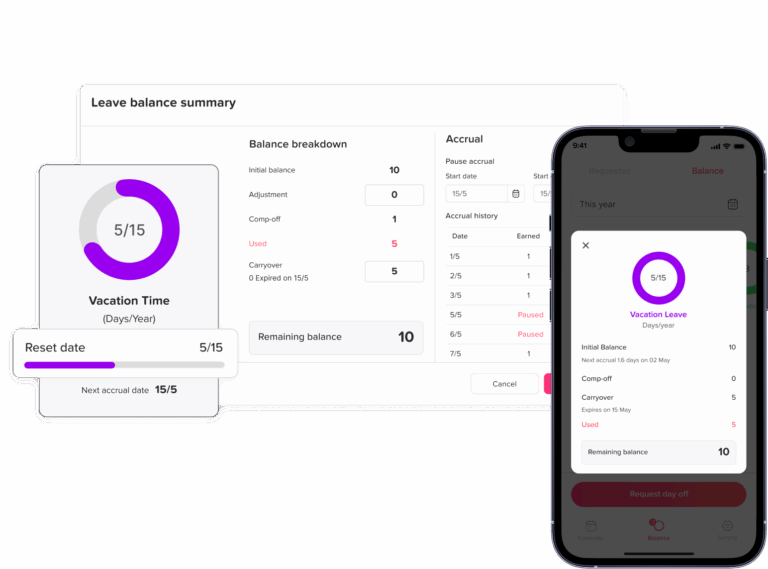
PTO accrual is the process by which employees gradually earn paid time off.
Instead of receiving an entire annual allowance at once, an employer might allow employees to earn PTO throughout the year based on:
- Hours worked
- Paid hours
- Each week
- Each pay period
- Monthly accrual
- Employee anniversary dates
- Length of service
For example, an employee entitled to 120 hours of PTO per year might earn 10 hours every month.
If the employee takes one week of vacation in June, whether they still receive their normal June accrual depends on the rules established in the company’s PTO policy.
The Most Important Question: What Counts Toward Accrual?
The key is not simply whether an employee was paid.
Employers need to determine what type of time their accrual formula counts.
There are three common approaches.
| Accrual Method | Does PTO Usually Continue While Taking PTO? | Why? |
|---|---|---|
| Hours actually worked | Usually no | PTO hours are not actual working hours |
| Paid hours | Often yes | PTO can count as compensated hours under the policy |
| Fixed accrual per pay period/month | Usually yes | Accrual is not directly tied to individual hours worked |
The company’s written policy should clearly identify which approach applies.
PTO Accrual Based on Hours Actually Worked
Some employers calculate PTO based only on the employee’s actual working hours.
For example, a policy might provide:
1 hour of PTO for every 40 hours worked.
If an employee works:
- 32 hours
- Uses 8 hours of PTO
- Receives pay for 40 hours
the accrual calculation may still use only the 32 hours actually worked.
The 8 PTO hours would not count toward earning additional PTO.
Example
Suppose an employee earns:
1 PTO hour for every 40 hours worked
During one week:
- Hours worked: 32
- PTO used: 8
- Total paid hours: 40
If the policy counts only hours worked, the employee has accumulated only 32 hours toward the next PTO hour.
They have not yet earned another full PTO hour.
This is not just a theoretical calculation. Illinois provides a clear example under its Paid Leave for All Workers Act. The Illinois Department of Labor states that employees do not accrue statutory paid leave while using PTO or unpaid leave because only hours actually worked count toward the accrual requirement.
Employers still need to check the specific law applying to their location because statutory paid leave requirements vary between states.
PTO Accrual Based on Paid Hours
Other employers calculate accrual using paid hours rather than only hours worked.
Under this type of policy, qualifying paid time might include:
- Regular working hours
- PTO
- Vacation
- Paid sick leave
- Paid holidays
- Other paid absences
If PTO itself counts as a paid hour for accrual purposes, an employee may continue earning PTO while taking PTO.
Example
Assume the employee earns:
1 hour of PTO for every 40 paid hours
During the week, the employee has:
- 24 hours worked
- 16 hours PTO
- 40 total paid hours
If the policy considers PTO to be an eligible paid hour, the employee could still earn 1 hour of additional PTO.
This is why employers should avoid writing policies that simply say employees “accrue PTO based on hours.”
The policy should specify whether that means:
hours worked or eligible paid hours.
That small distinction can produce very different balances over a year.
PTO Accrual Per Pay Period
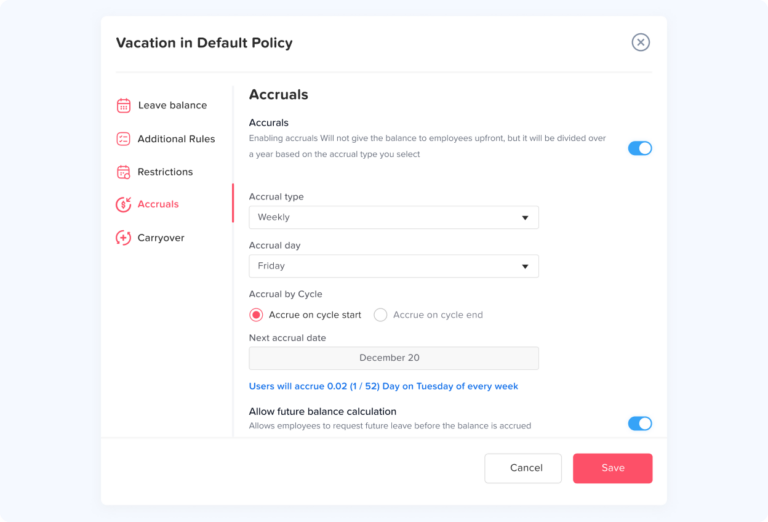
Many employers avoid hour-by-hour calculations entirely.
Instead, employees earn a fixed amount of PTO each pay period.
For example:
An employee receives 120 PTO hours annually and is paid twice per month.
The calculation would be:
120 ÷ 24 pay periods = 5 PTO hours per pay period
The employee would normally earn 5 hours each pay period as long as they remain eligible under the company’s policy.
Taking three days of PTO during that pay period would not necessarily reduce the accrual because the calculation is not based directly on the number of hours worked.
Employers should still specify situations where accrual may stop, such as extended unpaid leave or another inactive employment status.
Monthly PTO Accrual
Monthly accrual works similarly.
Suppose an employee receives:
120 PTO hours per year
The monthly accrual would be:
120 ÷ 12 = 10 hours per month
If the employee takes five days of vacation during August but remains actively employed and eligible for PTO, the policy might still credit 10 hours at the end of August.
In this case, employees effectively continue accruing PTO while using PTO.
Again, this is a policy decision unless a law covering the employee establishes specific requirements.
What If PTO Is Front-Loaded?
Some employers do not use accrual at all.
Instead, they front-load an employee’s PTO balance.
For example, an employee could receive:
120 PTO hours on January 1
Because the full allowance is already available, the employee does not earn additional PTO each week or month.
If the employee takes 40 hours of vacation in March:
Starting balance: 120 hours
PTO used: 40 hours
Remaining balance: 80 hours
There is no separate question about whether PTO continues to accrue during the vacation because the annual allowance was already granted.
This distinction is important when comparing front-loaded PTO policies with traditional accrual policies.
PTO Accrual While on Vacation
A common employee question is:
“Do I still earn vacation time while I am on vacation?”
The answer follows the same principle.
If vacation accrual is based on:
- Fixed pay periods
- Monthly credits
- Eligible paid hours
the employee may continue earning vacation while away.
If accrual is based strictly on:
- Actual hours worked
vacation hours may not generate additional vacation.
There is no general federal law requiring private employers to provide vacation benefits in the first place. The U.S. Department of Labor states that vacation benefits are generally matters of agreement between employers and employees.
Does PTO Accrue During Sick Leave?
This also depends on the policy and applicable sick leave laws.
Suppose an employer offers:
- Vacation leave
- Separate sick leave
The vacation policy could specify that vacation accrues only based on hours actually worked.
If an employee takes 16 hours of paid sick leave, those hours might not count toward vacation accrual.
Another employer could define eligible paid hours to include sick leave, meaning accrual would continue.
Statutory sick leave is different because some states establish their own accrual formulas.
For example, California generally requires employees using an accrual method for statutory paid sick leave to earn at least one hour of paid sick leave for every 30 hours worked, although employers can use qualifying alternative accrual methods or provide the required leave through other permitted approaches.
Employers should therefore distinguish between:
Company PTO rules and legally required paid leave rules.
They are not always the same.
Does PTO Accrue During Unpaid Leave?
Often, no, particularly when PTO accrual depends on hours worked or paid hours.
Consider an employee who normally works 40 hours per week but takes an entire week of unpaid personal leave.
If the PTO policy states:
Employees earn 1 PTO hour for every 40 hours worked
the employee earns no PTO for that week because they worked zero hours.
However, a company using fixed monthly accrual might have a different policy.
For example, it might state that employees continue accruing during short unpaid absences but stop accruing after a certain period of unpaid leave.
This should be defined before the situation occurs.
What Happens During FMLA Leave?
The Family and Medical Leave Act can provide eligible employees with job-protected unpaid leave for qualifying family and medical reasons, but FMLA itself does not create a general requirement for employers to continue PTO accrual during unpaid FMLA leave.
The U.S. Department of Labor explains that PTO and similar leave benefits are generally determined by employer policies, while FMLA provides specific job-protected leave rights.
Employers should review both their FMLA procedures and their normal benefits policies when determining whether PTO continues to accrue.
The key is consistent treatment.
If employees normally stop accruing PTO during comparable unpaid leave, the same rules may be relevant during unpaid FMLA leave, subject to FMLA requirements and applicable law.
Can Employees Earn PTO From PTO?
It can sound strange:
Use PTO and simultaneously earn more PTO.
But it is entirely possible under certain accrual systems.
Consider an employee who receives:
6 hours PTO every biweekly pay period.
The employee takes the entire second week of the pay period as vacation.
Their balance might work like this:
Beginning balance: 80 hours
PTO taken: -40 hours
Biweekly accrual: +6 hours
New balance: 46 hours
The employee used PTO and earned additional PTO during the same pay period.
That does not mean the 40 vacation hours directly generated the 6 new hours. Instead, the employee remained eligible for the normal pay-period accrual.
This distinction helps prevent confusion when employees review their balances.
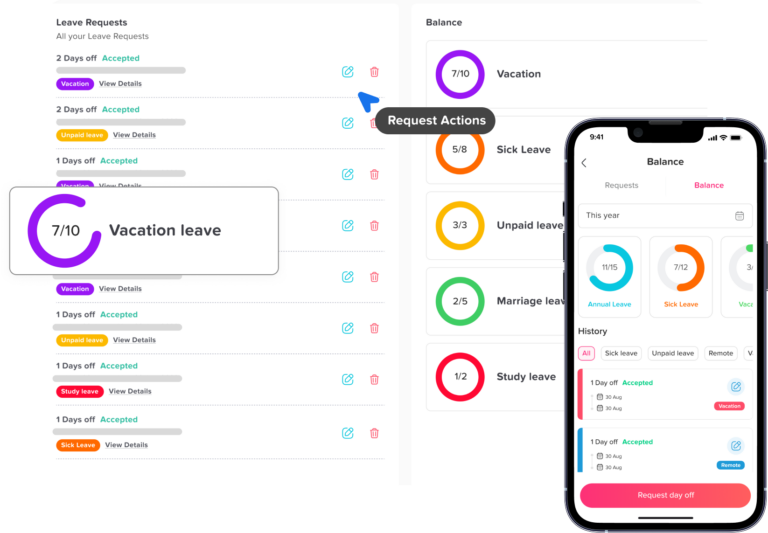
What About PTO Accrual Caps?
An accrual cap is the maximum amount of PTO an employee can accumulate.
For example:
PTO balance: 158 hours
Accrual cap: 160 hours
Next scheduled accrual: 8 hours
The employee cannot necessarily receive the full 8 hours.
Depending on the policy, only 2 hours may accrue before the employee reaches the 160-hour cap.
The remaining 6 hours may not accrue.
If the employee later uses 24 hours of PTO:
New balance: 136 hours
Accrual may resume because the employee is once again below the cap.
California is one example of a state where employers may establish reasonable caps on vacation accrual, even though earned vacation generally cannot be forfeited under California law.
Employers should distinguish an accrual cap from a carryover limit, since they serve different purposes.
PTO Accrual Cap vs Carryover Limit
These terms are often confused.
PTO Accrual Cap
An accrual cap determines how much PTO an employee can hold before they temporarily stop earning more.
Example:
Maximum balance: 200 hours
Once the employee reaches 200 hours, additional accrual stops until the balance drops below the cap.
Carryover Limit
A carryover limit determines how much unused PTO moves from one leave year into the next.
For example:
Balance on December 31: 90 hours
Maximum carryover: 40 hours
What happens to the remaining 50 hours depends on applicable law and the employer’s policy.
Some jurisdictions restrict or prohibit forfeiture of earned vacation, so employers should review state requirements before implementing use-it-or-lose-it rules.
PTO Accrual Examples
Here are several examples showing how different policies can produce different results.
| Situation | Policy | Result |
|---|---|---|
| Employee works 32 hours and uses 8 PTO hours | Accrual based only on hours worked | 32 hours count toward accrual |
| Employee works 32 hours and uses 8 PTO hours | Accrual based on paid hours | All 40 eligible hours may count |
| Employee takes one week of PTO | Fixed monthly accrual | Normal monthly accrual may continue |
| Employee receives annual PTO on January 1 | Front-loaded policy | No ongoing accrual calculation |
| Employee reaches maximum PTO balance | Accrual cap | New accrual may pause |
| Employee takes unpaid leave | Hours-worked accrual | Usually no accrual for those hours |
These examples demonstrate why there is no universal answer to whether PTO accrues while an employee is using PTO.
The accrual formula matters.
How Employers Should Write a Clear PTO Accrual Policy
A good PTO policy should remove ambiguity before employees start checking their balances.
Employers should define the following.
Accrual Rate
State exactly how much PTO employees earn.
For example:
Employees accrue 5 hours of PTO every two-week pay period.
Or:
Employees accrue 1 PTO hour for every 30 hours worked.
What Counts Toward Accrual
Specify whether the calculation includes:
- Regular working hours
- Overtime hours
- PTO
- Vacation
- Sick leave
- Paid holidays
- Unpaid leave
Simply writing “hours” can create unnecessary disputes.
When Accrual Is Added
Explain whether PTO is credited:
- Weekly
- Biweekly
- Semimonthly
- Monthly
- Quarterly
- Annually
Employees should be able to predict when their balance will change.
Accrual Caps
If employees stop earning PTO after reaching a certain balance, state the maximum clearly.
Also explain when accrual resumes.
Waiting Periods
New employees may not immediately begin earning or using PTO.
If a waiting period applies, specify:
- When accrual begins
- When PTO becomes available
- Whether accrued time is visible before it can be used
Treatment During Leave
The policy should specifically address whether PTO continues accumulating during:
- Paid vacation
- Paid sick leave
- Unpaid leave
- FMLA leave
- Other extended absences
This is one of the easiest ways to prevent disagreements over PTO balances.
Why Accurate PTO Accrual Tracking Matters
A difference of one or two hours may seem minor, but accrual errors can accumulate quickly.
If 100 employees each receive an incorrect two-hour PTO credit every month, the company could create:
2 × 12 × 100 = 2,400 incorrect PTO hours per year.
Incorrect balances can lead to:
- Employee disputes
- Incorrect leave approvals
- Payroll issues
- Unexpected PTO liabilities
- Incorrect termination payouts
- HR administration problems
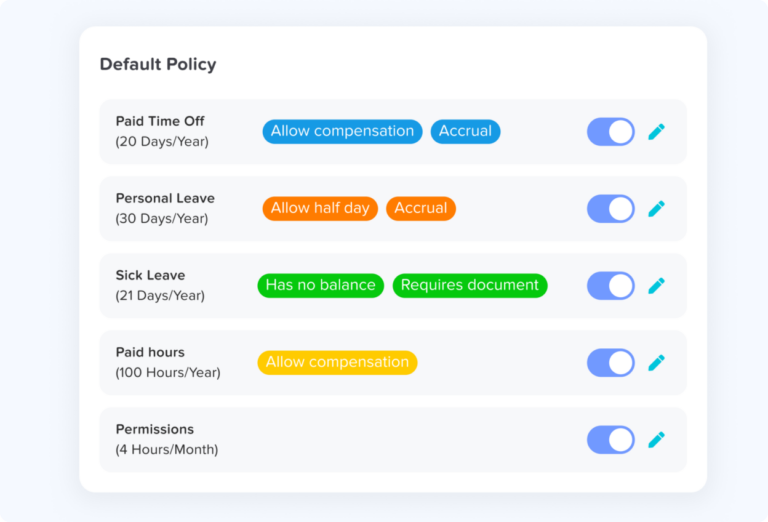
Automated leave management software can help companies apply the same accrual rules consistently rather than relying on manual spreadsheets.
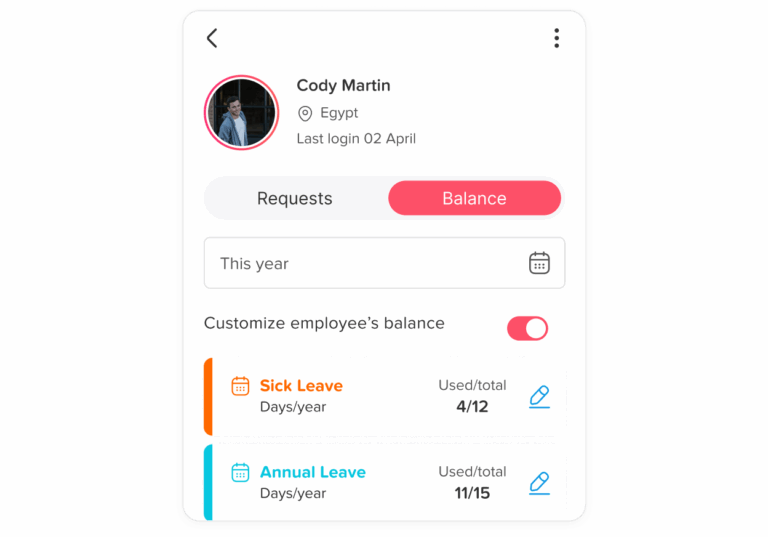
With Day Off, companies can manage PTO policies, track employee balances, and automate leave calculations so employees and managers can see updated time-off information from one system.
Should PTO Accrue While Employees Are Taking PTO?
There is no single policy that works for every company.
However, employers should prioritize three things:
Consistency, clarity, and compliance.
A pay-period or monthly accrual system is often easier for employees to understand because taking an ordinary vacation does not unexpectedly change the amount they earn.
An hours-worked system can be useful for employers with employees whose schedules vary substantially, but the policy must clearly state which hours count.
Whatever method is selected, HR should make sure:
- The written policy matches the actual calculation.
- Payroll and HR systems use the same rules.
- Employees can understand how their balances are calculated.
- State and local laws are reviewed before changing accrual rules.
Frequently Asked Questions About PTO Accrual
Do you accrue PTO while on PTO?
It depends on your employer’s PTO policy. If PTO accrues based on pay periods, months, or eligible paid hours, you may continue earning PTO while using it. If the policy calculates accrual only from hours actually worked, PTO hours may not count toward additional accrual.
Does PTO accrue while on vacation?
Sometimes. Employees who receive a fixed amount of PTO each pay period or month will often continue accruing while on vacation. Employees whose accrual is based strictly on hours worked may not earn additional PTO during those vacation hours.
Do you earn PTO while using PTO?
You can, depending on the accrual method. For example, an employee who receives 5 hours of PTO every pay period may still receive that accrual even if they used PTO during the same period. Under an hours-worked policy, the result may be different.
Does PTO count as hours worked for PTO accrual?
Not automatically. PTO is paid time away from work, but whether it counts toward your PTO accrual calculation depends on how your employer defines eligible hours. Some policies count paid hours, while others count only hours actually worked.
Does PTO accrue during sick leave?
It depends on the policy. If PTO accrual is based on paid hours, paid sick leave may count toward accrual. If the policy uses actual hours worked, sick leave may not count. Statutory sick leave laws may also have separate accrual requirements.
Do you accrue PTO while on unpaid leave?
Usually not when PTO is based on hours worked or paid hours because the employee is not working or receiving paid hours during the absence. A fixed monthly or pay-period policy may handle unpaid leave differently.
Do you accrue PTO while on FMLA?
Not necessarily. Federal FMLA rules do not generally require employees to continue earning additional PTO during unpaid FMLA leave. Employers should follow their normal benefit policies for comparable forms of leave.
Does PTO accrue during paid FMLA leave?
It may. If an employee uses paid PTO or another form of paid leave at the same time as FMLA and the employer normally allows PTO to accrue during paid leave, accrual may continue. The exact treatment depends on the employer’s policy.
Does PTO accrue during maternity leave?
It depends on the type of maternity leave and the employer’s policy. PTO may continue during paid portions of leave but stop during unpaid periods. FMLA, state paid family leave programs, and employer-provided parental leave can each have different rules.
Does PTO accrue while on short-term disability?
Not automatically. Short-term disability benefits replace some income but do not necessarily mean the employee is considered to be actively working or earning PTO. Employers should clearly state whether PTO accrual continues during disability leave.
Do salaried employees accrue PTO while on vacation?
Often, yes, particularly when salaried employees receive PTO according to a fixed monthly or pay-period schedule. However, the employer’s written PTO policy ultimately determines how the accrual works.
Do hourly employees accrue PTO while using PTO?
It depends on the accrual formula. If an hourly employee earns PTO based only on hours actually worked, PTO hours may not generate additional leave. If eligible paid hours are used instead, PTO may continue to accrue.
Can my employer stop me from accruing PTO?
An employer may be able to pause accrual when an employee reaches a PTO cap or under circumstances defined in the company’s policy, subject to applicable state and local laws. For example, California permits reasonable vacation accrual caps, although earned vacation generally cannot be forfeited.
What happens when you reach your PTO accrual limit?
Once an employee reaches an accrual cap, additional PTO normally stops accumulating until the employee uses enough leave to bring the balance below the limit. Accrual can then resume according to the company’s policy.
How much PTO do you accrue per pay period?
Divide the annual PTO allowance by the number of pay periods in the year.
For example, an employee receiving 120 hours of PTO with 24 pay periods would accrue:
120 ÷ 24 = 5 hours of PTO per pay period
The calculation may differ if the company bases PTO on hours worked instead.
Does PTO accrue on holidays?
It depends on whether paid holidays count as eligible hours under the employer’s PTO policy. A policy based on paid hours may include holidays, while one based only on actual working hours may exclude them.
Does PTO accrue when you are not working?
Sometimes. Employees can still earn PTO while away from work if their company uses a fixed pay-period or monthly accrual system. Employees under an hours-worked system generally need qualifying working hours before additional PTO is earned.
Is an employer required to let PTO accrue while you are on PTO?
There is no general federal law requiring private employers to provide vacation or PTO benefits, so federal law does not establish a universal rule requiring PTO to accrue while it is being used. Employer policy and applicable state or local laws determine the answer. Some state laws impose specific accrual rules. For example, Illinois states that under its Paid Leave for All Workers Act, only hours actually worked count toward statutory paid leave accrual.
How can I tell if I accrue PTO while taking time off?
Whether employees accrue PTO while using PTO depends on how the employer’s accrual policy is structured. Employees may continue earning PTO when accrual is based on pay periods, months, or eligible paid hours, while policies based strictly on hours worked may pause accrual during time off.
For employers, the most important step is to clearly define what counts toward PTO accrual and apply the same rules consistently. A transparent PTO policy helps employees understand their balances, reduces disputes, and makes leave planning easier for both HR and employees.
Using an automated PTO tracking system can also help ensure accruals, leave usage, caps, and balances are calculated accurately, giving everyone a clear view of available time off.