








Employees do not always need to take an entire workday off. They may arrive late because of a medical appointment, leave a few hours early for a personal commitment, work only the morning, or step away during the day and return later.
These situations create an important question for HR and managers: how much PTO should actually be deducted from the employee’s balance?
The most accurate approach is to compare the employee’s scheduled working hours with their actual clock-in and clock-out times, then identify the scheduled work time covered by the approved PTO request.

A simple formula is:
Partial-Day PTO = Scheduled Working Time Missed During the Approved Absence
However, the calculation can become more complicated when employees have unpaid lunches, flexible hours, rotating shifts, split shifts, or several clock-in and clock-out sessions during the same day.
That is why employers should look at the complete workday rather than simply subtracting one clock time from another.
What Is Partial-Day PTO?
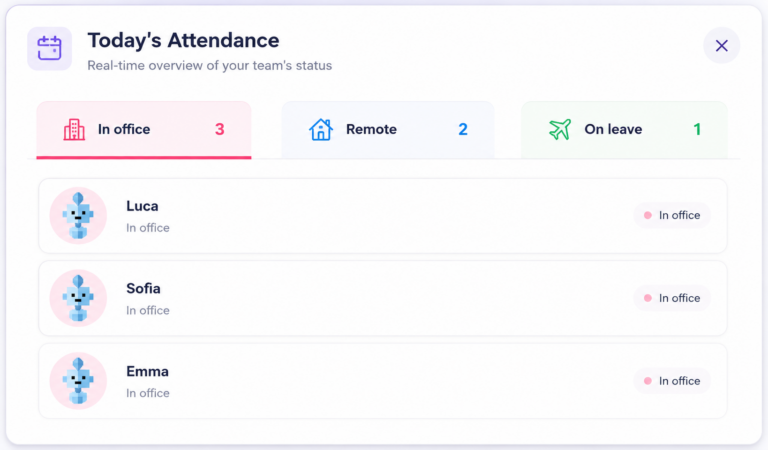
Partial-day PTO is paid time off used for only part of an employee’s scheduled workday rather than the entire shift.
For example, an employee scheduled to work eight hours may complete six hours of work and use two hours of PTO to cover the remaining scheduled time.
The final record would look like:
6 hours worked + 2 hours PTO = 8 scheduled hours
Partial-day PTO is commonly used when employees need time away for:
- Doctor or dentist appointments
- Family responsibilities
- School appointments
- Personal errands
- Late arrivals
- Early departures
- Short medical treatments
- Other planned personal commitments
Whether employees can use PTO in hourly or partial-day increments depends on the employer’s policy and any applicable state or local requirements.
A clear policy should explain the smallest amount of PTO employees can request, such as 30 minutes, one hour, or another defined increment.
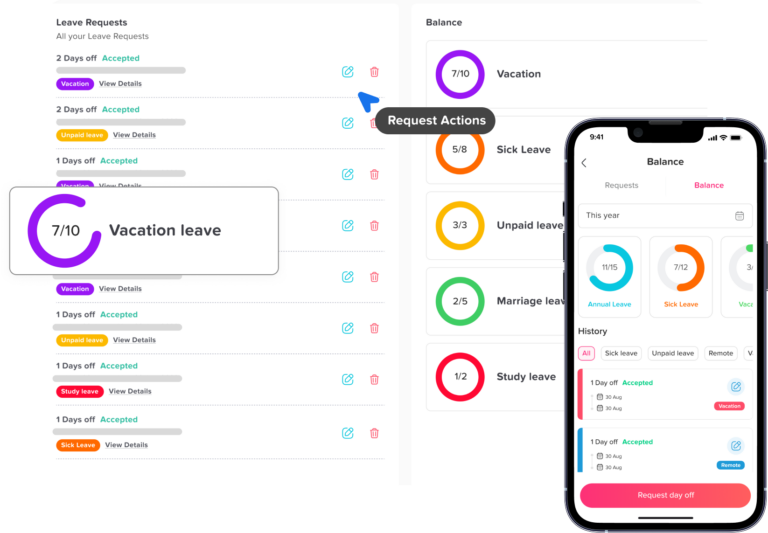
The Basic Partial-Day PTO Calculation
The starting point is to compare the employee’s scheduled working hours with the hours they actually worked.
A basic calculation may look like:
Scheduled Hours – Actual Worked Hours = Missing Scheduled Hours
However, employers should not automatically convert every missing hour into PTO.
Missing time could represent an unpaid break, unpaid leave, an unapproved late arrival, a schedule adjustment, sick leave, or another type of absence.
For this reason, a more accurate calculation is:
Partial-Day PTO = Approved PTO Time That Overlaps Scheduled Working Hours
The purpose is to deduct PTO only for the hours the employee was actually expected to work but was approved to miss.
Simple Example
An employee is scheduled:
9:00 AM to 5:00 PM
with an unpaid lunch from:
12:00 PM to 1:00 PM
The employee works normally until 2:00 PM and then leaves for an approved appointment.
Actual work completed:
- 9:00 AM to 12:00 PM = 3 hours
- 1:00 PM to 2:00 PM = 1 hour
Total worked = 4 hours
The employee was still scheduled to work:
2:00 PM to 5:00 PM = 3 hours
Therefore:
Partial-day PTO = 3 hours
The lunch period does not need to be included because the employee was already scheduled to be off duty during that hour.
How to Calculate Partial-Day PTO Step by Step
Using the same calculation process for every employee helps HR maintain consistent PTO balances and reduces the chance of over-deducting or under-deducting leave.
Step 1: Check the Employee’s Scheduled Hours
Always begin with the employee’s assigned work schedule for that specific date.
Do not automatically assume that every employee works a standard eight-hour day. Depending on the workplace, employees may have seven-hour schedules, ten-hour shifts, twelve-hour shifts, flexible schedules, rotating shifts, split shifts, or part-time working patterns.
For example:
Scheduled shift: 8:00 AM to 4:30 PM
Unpaid lunch: 12:00 PM to 12:30 PM
Although 8.5 hours pass between the employee’s scheduled start and end times, the employee is actually scheduled to complete:
8 working hours
That eight-hour requirement should be used when calculating how much PTO is needed.
Starting with the correct schedule is particularly important for companies where employees have different working hours on different days.
Step 2: Review the Actual Clock-In Time
Next, check when the employee actually started working.
If the employee arrived later than their scheduled start time, calculate the difference between the scheduled start and actual clock-in.
For example:
Scheduled start: 9:00 AM
Actual clock-in: 10:30 AM
Scheduled working time missed:
1 hour 30 minutes
If the absence was approved as PTO:
Partial-day PTO = 1.5 hours
However, the clock record alone does not determine whether PTO should be deducted.
If the employee simply arrived late without an approved leave request, the missing time may need to be handled through the company’s attendance or unpaid-time policy instead.
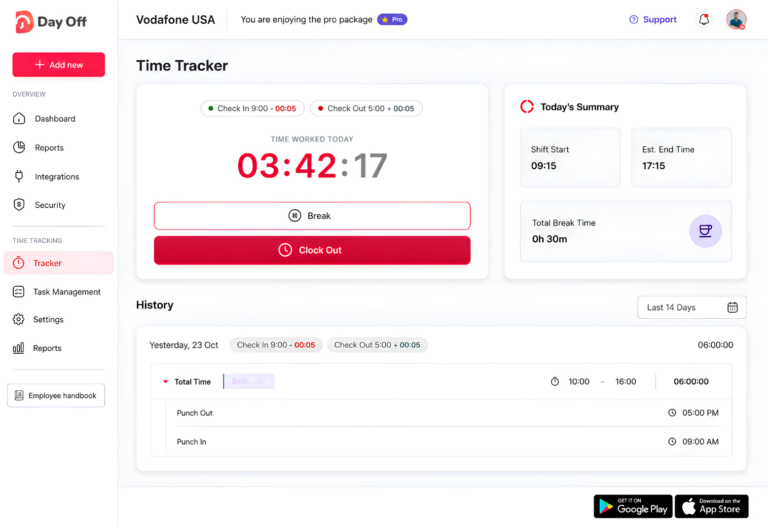
The time tracker shows when the employee actually started working, while the leave record explains why the scheduled time was missed.
Step 3: Review the Actual Clock-Out Time
The same process applies when an employee leaves before the scheduled end of their workday.
Suppose the employee is scheduled until:
5:00 PM
but clocks out at:
3:30 PM
The remaining scheduled working time is:
3:30 PM to 5:00 PM = 1 hour 30 minutes
If the employee has approved PTO covering that period:
Partial-day PTO = 1.5 hours
Using the exact scheduled time missed is generally more accurate than automatically classifying the absence as a half day and deducting four hours.
This becomes especially important when employees have shorter or longer shifts than the traditional eight-hour workday.
Step 4: Exclude Unpaid Meal Periods
Unpaid meal periods are one of the most common sources of incorrect partial-day PTO calculations.
If an employee was already scheduled to be off duty during lunch, that period should generally not be deducted from the employee’s PTO balance.
For example:
Schedule: 9:00 AM to 5:00 PM
Unpaid lunch: 12:00 PM to 1:00 PM
Employee leaves: 11:00 AM
At first glance, it appears that the employee is away for six hours:
11:00 AM to 5:00 PM = 6 hours
However, one hour of that period is already an unpaid lunch.
The employee actually misses scheduled work during:
11:00 AM to 12:00 PM = 1 hour
and:
1:00 PM to 5:00 PM = 4 hours
Therefore:
Partial-day PTO = 5 hours
This is why employers should calculate PTO against scheduled working periods rather than simply measuring the total elapsed time between leaving and the end of the day.
Partial-Day PTO Calculation Examples
Looking at practical examples makes it easier to understand how scheduled time, actual attendance, and approved leave should work together.
Example 1: Employee Arrives Late
An employee is scheduled to work:
8:00 AM to 4:00 PM
but arrives and clocks in at:
10:00 AM
The employee already has approved PTO covering the morning absence.
Scheduled time missed:
8:00 AM to 10:00 AM = 2 hours
Therefore:
Partial-day PTO = 2 hours
If the employee then completes the remaining six scheduled hours, the day can be recorded as:
6 hours worked + 2 hours PTO = 8 scheduled hours
This gives HR a complete record of the day and clearly distinguishes approved leave from unexplained lateness.
Example 2: Employee Leaves Work Early
An employee is scheduled:
9:00 AM to 5:00 PM
and needs to leave work at:
2:30 PM
Assume the employee has already completed their scheduled lunch period before leaving.
The employee misses:
2:30 PM to 5:00 PM = 2 hours 30 minutes
Therefore:
Partial-day PTO = 2.5 hours
Deducting the exact 2.5 hours provides a more accurate PTO balance than automatically deducting four hours because the employee informally described the absence as a half day.
Example 3: Employee Leaves and Returns Later
Partial-day PTO becomes slightly more complicated when an employee leaves during the day and later returns to work.
Consider this schedule:
9:00 AM to 5:00 PM
with an unpaid lunch:
12:00 PM to 1:00 PM
The employee:
- Clocks in at 9:00 AM
- Leaves at 10:30 AM
- Returns at 1:30 PM
- Clocks out at 5:00 PM
The employee was physically away for:
10:30 AM to 1:30 PM = 3 hours
However, the employee was already scheduled to be off duty between 12:00 PM and 1:00 PM.
The actual scheduled work missed was:
10:30 AM to 12:00 PM = 1.5 hours
plus:
1:00 PM to 1:30 PM = 0.5 hour
Therefore:
Partial-day PTO = 2 hours
The employee should not automatically lose three hours of PTO simply because they were away from the workplace for three clock hours.
Example 4: Employee Works the Morning and Takes the Afternoon Off
Suppose an employee is scheduled:
8:00 AM to 5:00 PM
with an unpaid lunch:
12:00 PM to 1:00 PM
The employee works from 8:00 AM until noon and then takes approved PTO for the remainder of the working day.
Actual working time:
8:00 AM to 12:00 PM = 4 hours
The employee is already scheduled to be off between noon and 1:00 PM.
The remaining scheduled work is:
1:00 PM to 5:00 PM = 4 hours
Therefore:
4 hours worked + 4 hours PTO = 8 scheduled hours
The correct PTO deduction is four hours, not five, because the unpaid lunch period does not need to be covered by PTO.
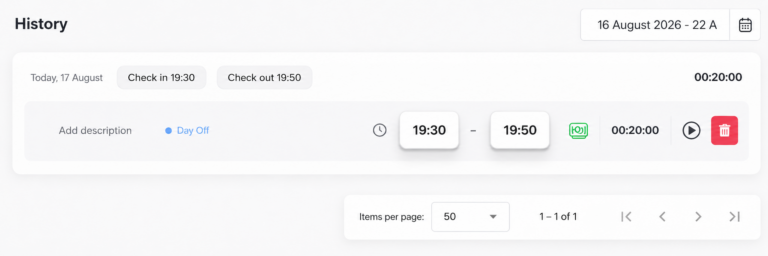
Example 5: Employee Has Multiple Clock-In and Clock-Out Sessions
Some employees may clock in and out several times during the same day, particularly when they have appointments or flexible working arrangements.
For example:
Clock in: 8:00 AM
Clock out: 11:00 AM
Clock in: 1:00 PM
Clock out: 5:00 PM
The employee’s normal schedule is:
8:00 AM to 5:00 PM
with lunch:
12:00 PM to 1:00 PM
The employee was absent between 11:00 AM and 1:00 PM, but only one hour of that period was scheduled working time.
The missing scheduled period is:
11:00 AM to 12:00 PM = 1 hour
The following hour was already the employee’s lunch break.
Therefore:
Partial-day PTO = 1 hour
Looking at each clock session individually helps prevent HR from deducting leave for periods when the employee was never expected to work.
How Partial-Day PTO Works With Different Work Schedules
Partial-day PTO calculations become even more important when employees do not follow a standard Monday-to-Friday, eight-hour schedule.
The employee’s assigned schedule should always determine how many PTO hours are needed.
Partial-Day PTO for Split Shifts
A split shift divides the employee’s workday into two or more separate working periods with an unpaid gap between them.
For example:
Morning shift: 8:00 AM to 12:00 PM
Evening shift: 4:00 PM to 8:00 PM
Total scheduled working time:
8 hours
Suppose the employee requests approved leave from:
10:00 AM to 5:00 PM
Although the entire absence lasts seven clock hours, the employee is not scheduled to work for all seven hours.
The leave overlaps scheduled work during:
10:00 AM to 12:00 PM = 2 hours
and:
4:00 PM to 5:00 PM = 1 hour
Therefore:
Partial-day PTO = 3 hours
The four-hour gap between the morning and evening shifts should not reduce the employee’s leave balance because it was already non-working time.
Partial-Day PTO for Flexible Schedules
Flexible work schedules require employers to look at the employee’s required working hours rather than automatically focusing on a specific start time.
For example, an employee may be required to complete:
8 hours of work per day
but may be allowed to choose when those hours begin and end within an approved working window.
If the employee completes:
6 hours of work
and uses approved PTO for the remaining requirement:
Partial-day PTO = 2 hours
In this situation, arriving later than another employee does not automatically mean the employee is late.
The employer should first review the flexible schedule rules and determine whether the employee actually failed to complete scheduled working time.
Partial-Day PTO for Rotating Shifts
Rotating shifts can change from one day or week to another, which makes schedule-aware PTO tracking especially important.
For example:
Monday: 8 hours
Tuesday: 10 hours
Wednesday: Off
Thursday: 12 hours
Friday: 8 hours
Suppose the employee works seven hours of Thursday’s 12-hour shift and has approved PTO for the remaining scheduled time.
Calculation:
12 scheduled hours – 7 worked hours = 5 hours
Therefore:
Partial-day PTO = 5 hours
Automatically deducting four hours because the employee requested “half a day” would not accurately represent the employee’s actual Thursday schedule.
Should Short Breaks Affect Partial-Day PTO?
Short rest breaks and unpaid meal periods should not automatically be treated in the same way.
A short paid break is normally part of the employee’s working time, while a qualifying unpaid meal period generally represents time when the employee is not required to work.
For example, an employee works:
9:00 AM to 1:00 PM
and takes a normal paid 15-minute break during that period.
The employee has still completed the scheduled four-hour working period. The 15-minute break should not automatically be removed from worked time and replaced with PTO.
An unpaid lunch is different because the employee was already expected to be off duty.
Distinguishing between these types of breaks helps employers calculate both actual working hours and PTO more accurately.
Can PTO and Worked Hours Overlap?
The same period should generally not appear as both actual working time and PTO.
Consider this example:
Approved PTO begins: 2:00 PM
Employee actually continues working until: 2:45 PM
If the system records the employee as working until 2:45 PM while also recording PTO beginning at 2:00 PM, then 45 minutes are being counted twice.
The record should be reviewed so that it reflects what actually happened.
Depending on the circumstances and company policy, the corrected record might show:
Worked until: 2:45 PM
PTO begins: 2:45 PM
This creates a clearer separation between time the employee actually worked and time that was covered by paid leave.
Why Clock-In and Clock-Out Records Matter for PTO
A PTO request explains why an employee was approved to be away from work, while clock-in and clock-out records show when the employee actually worked.
Both pieces of information are needed for an accurate partial-day PTO calculation.
For example, an employee may request PTO beginning at 3:00 PM but actually remain at work until 3:30 PM. Another employee may have PTO approved until 10:00 AM but clock in early at 9:45 AM.
Without comparing attendance records with leave requests, HR may deduct more PTO than the employee actually used.
Accurate time records also help managers distinguish between:
- Approved partial-day PTO
- Late arrivals
- Early departures
- Missing punches
- Schedule changes
- Unpaid absences
- Actual overtime
Bringing these records together gives employers a much clearer picture of what happened during the employee’s workday.
Does Partial-Day PTO Count Toward Overtime?
Worked hours and PTO hours should be treated separately when reviewing overtime.
For federal overtime purposes in the United States, overtime for covered nonexempt employees is generally based on hours actually worked, rather than the total number of compensated hours.
For example:
| Time Type | Hours |
|---|---|
| Actual hours worked | 38 |
| PTO | 4 |
| Total compensated hours | 42 |
Although the employee receives compensation covering 42 hours, the employee has generally worked only:
38 hours
for federal overtime purposes.
An employer may choose to maintain a more generous overtime policy, and other rules may apply depending on location or an employment agreement, but PTO should not automatically be treated as actual working time.
Partial-Day PTO for Salaried Employees
Employers should also distinguish between deducting PTO from an employee’s leave balance and reducing the salary of an exempt employee.
For example, a salaried exempt employee may leave three hours early for an approved personal appointment.
The employer’s policy may allow:
3 hours to be deducted from the employee’s PTO balance
while the employee still receives the full salary required under the applicable salary-basis rules.
This means:
PTO deduction and salary deduction are not necessarily the same thing.
Employers should review employee classification and applicable wage rules before making actual partial-day deductions from an exempt employee’s salary.
Common Partial-Day PTO Calculation Mistakes
Even simple partial-day requests can create incorrect balances when schedules and attendance records are not reviewed together.
Common mistakes include:
- Deducting PTO for an unpaid lunch period that was already non-working time
- Automatically treating every partial-day absence as four hours
- Assuming every employee works an eight-hour schedule
- Ignoring flexible, rotating, or split-shift schedules
- Deducting PTO for gaps between split shifts
- Recording the same period as both worked time and PTO
- Using scheduled times without checking actual clock-in and clock-out records
- Treating all missing time as PTO without confirming that leave was approved
- Ignoring multiple clock sessions during the same day
- Calculating partial-day leave manually without checking the employee’s assigned schedule
The safest approach is to review the work schedule, attendance record, and PTO request together before finalizing the deduction.

How Day Off Makes Partial-Day PTO Easier to Track
When PTO and time tracking are managed separately, HR may need to compare a leave spreadsheet, employee schedule, and time clock before understanding one partial absence.
Day Off brings PTO, work schedules, attendance, and time tracking into the same system, making it easier for managers to understand why scheduled and actual working hours are different.
Use the Employee’s Actual Work Schedule
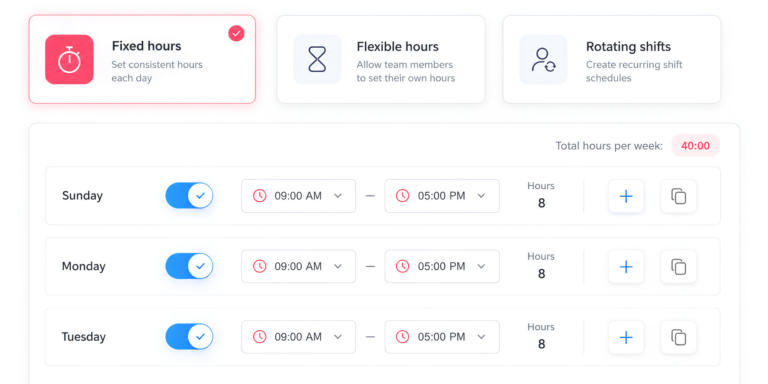
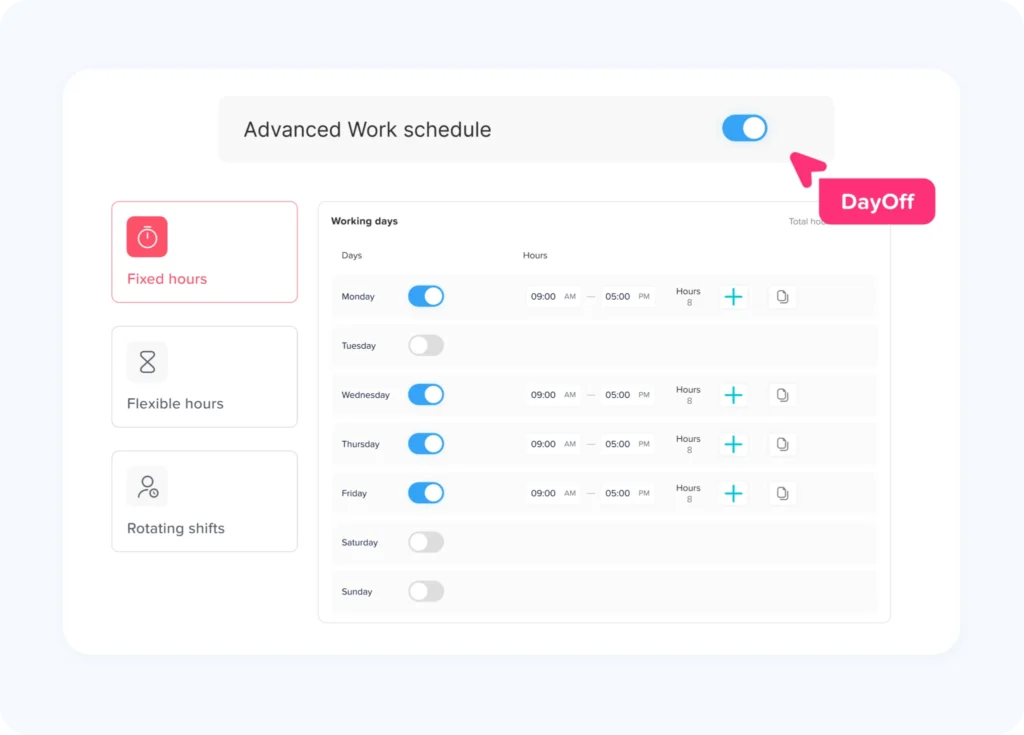
Day Off supports different types of work schedules, including:
- Fixed Days
- Fixed Hours
- Flexible Hours
- Rotating Shifts
Fixed Hours and Rotating Shifts can also include split shifts, which makes it possible to represent working days that do not follow one continuous block of time.
For hour-based leave policies, using the employee’s actual work schedule helps the system identify the correct number of scheduled hours associated with each day.
This is especially useful when employees work ten-hour shifts, rotating schedules, or different hours throughout the week.
Compare Scheduled Hours With Actual Attendance
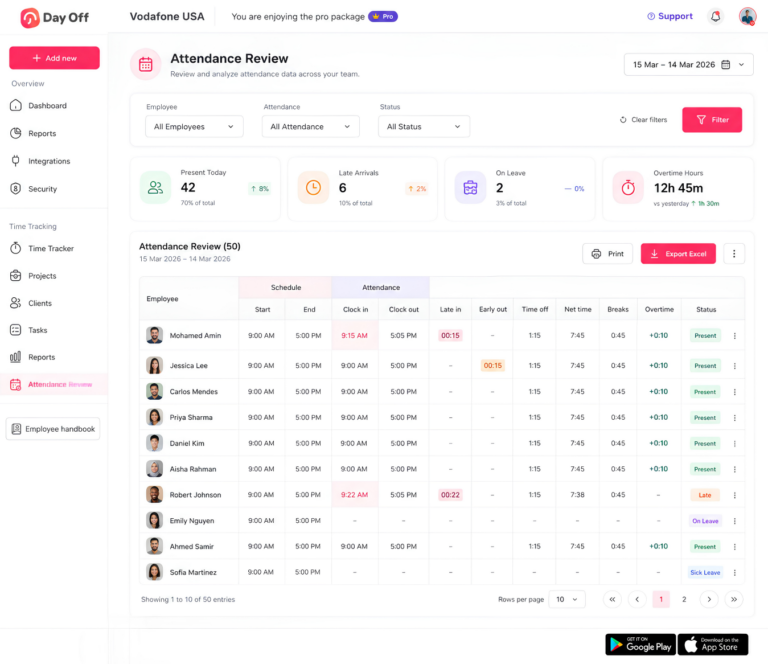
Day Off’s Attendance Review helps managers compare the hours an employee was expected to work with the hours they actually recorded.
Managers can review information such as:
- Scheduled hours
- Clock-in time
- Clock-out time
- Late arrival
- Early departure
- Breaks
- Time off
- Net working hours
- Overtime
- Attendance status
This makes it easier to understand whether a difference between scheduled and actual hours is caused by approved PTO or an attendance issue.
For example:
Scheduled hours: 8
Actual work: 6
Approved PTO: 2
Instead of simply seeing a two-hour shortage, the manager can see that the missing scheduled time is covered by approved leave.
Keep PTO and Time Tracking Connected
Day Off’s Time Tracker records employee clock-in and clock-out activity while PTO and leave are managed within the same company account.
This gives managers additional context when reviewing an employee’s day.
For example, an employee may:
Clock in at 9:00 AM → Work until 2:00 PM → Use approved PTO until 5:00 PM
Seeing both the attendance record and approved leave makes it easier to distinguish legitimate partial-day PTO from unexplained missing working time.
Frequently Asked Questions
Can I use PTO for part of a day?
Yes, if your employer allows PTO to be taken in hourly or partial-day increments. Instead of taking an entire day off, you may be able to use PTO only for the scheduled hours you miss.
For example, if you are scheduled for eight hours, work six hours, and have approved leave for the final two hours, your day could be recorded as:
6 hours worked + 2 hours PTO = 8 scheduled hours
The exact minimum amount of PTO you can use depends on your employer’s policy and any applicable state or local requirements.
Can I use PTO to leave work early?
Often, yes. If your employer permits partial-day PTO and approves the request, PTO can be used to cover the remaining scheduled hours after you leave.
For example:
Scheduled end: 5:00 PM
Clock-out: 3:00 PM
Approved PTO: 3:00 PM to 5:00 PM
The employee would generally use:
2 hours of PTO
The PTO covers the scheduled working time that was missed rather than automatically deducting a half or full day.
Can I use PTO if I come in late?
Potentially, yes. If the late arrival is approved under your employer’s PTO policy, you may be able to use PTO to cover the scheduled working time before you clock in.
For example:
Scheduled start: 8:00 AM
Actual clock-in: 9:30 AM
If the entire absence is approved:
Partial-day PTO = 1.5 hours
However, simply having enough PTO does not necessarily mean an unapproved late arrival is automatically excused. The employer’s attendance and leave policies may still apply.
Can I use PTO for only one or two hours?
Yes, if your employer allows PTO to be taken in small increments. Some workplaces allow PTO to be requested by the hour or even in smaller increments, while others establish a larger minimum request.
For example, an employee who needs to leave two hours early for an appointment may be able to request exactly:
2 hours of PTO
rather than using four hours or an entire day.
Employers should clearly state the minimum PTO increment in their leave policy so employees know how short absences will be handled.
If I work half a day, how many hours of PTO should I use?
The amount should usually be based on the scheduled working hours you actually miss, not automatically on a standard four-hour “half day.”
For an employee scheduled to work eight hours:
4 hours worked + 4 hours PTO = 8 scheduled hours
But if the employee is scheduled for a 10-hour shift and works five hours, the remaining scheduled time may require:
5 hours of PTO
This is why using actual scheduled hours is more accurate than applying the same half-day deduction to every employee.
Does lunch count when calculating partial-day PTO?
Usually, an unpaid lunch should not be included in the PTO deduction because the employee was already scheduled to be off duty during that period.
For example:
Employee leaves: 11:00 AM
Unpaid lunch: 12:00 PM to 1:00 PM
Scheduled end: 5:00 PM
The employee is away for six clock hours, but only five of those hours are scheduled working time.
Therefore:
Partial-day PTO = 5 hours
rather than six.
Can I work 6 hours and use 2 hours of PTO?
Yes, if you are scheduled for eight working hours and the remaining two hours are approved as PTO.
The day could be recorded as:
6 hours worked + 2 hours PTO = 8 scheduled hours
However, the worked hours and PTO hours should remain separate in the employee’s records. This is particularly important because PTO is not necessarily treated the same as hours actually worked for overtime and other wage calculations.
Can I clock out early and use PTO for the rest of my shift?
If your employer approves the absence and permits partial-day PTO, the remaining scheduled portion of the shift may be covered by PTO.
For example:
Scheduled: 9:00 AM to 5:00 PM
Clock-out: 2:30 PM
Remaining scheduled work: 2.5 hours
The employee could potentially use:
2.5 hours of PTO
assuming there are no unpaid breaks during that remaining period.
What happens if I work during approved PTO?
The attendance and PTO records should be reviewed so the same period is not counted as both work and leave.
Suppose PTO was approved beginning at:
2:00 PM
but the employee actually continued working until:
2:45 PM
The employer may need to adjust the PTO record so the employee receives credit for the 45 minutes actually worked and PTO begins only after the employee stops working.
Accurate time records are important because employers generally need to account for time employees are actually permitted to work.
Can you work and use PTO on the same day?
Yes. Employees commonly work part of a day and use PTO for another part of the same day.
For example:
9:00 AM to 1:00 PM: Worked
1:00 PM to 2:00 PM: Unpaid lunch
2:00 PM to 5:00 PM: PTO
The employee would have:
4 hours worked + 3 hours PTO = 7 scheduled working hours
The important point is that the same specific hours should not be recorded as both PTO and working time.
How do you calculate PTO if an employee clocks in and out multiple times?
Review each working period separately and compare the gaps with the employee’s schedule.
For example:
Clock in: 8:00 AM
Clock out: 11:00 AM
Clock in: 1:00 PM
Clock out: 5:00 PM
If the employee’s normal unpaid lunch is:
12:00 PM to 1:00 PM
then only:
11:00 AM to 12:00 PM
represents missed scheduled work.
Therefore:
Partial-day PTO = 1 hour
This is more accurate than treating the entire two-hour gap as PTO.
Does PTO count as hours worked for overtime?
Generally, not for federal FLSA overtime calculations. The FMLA guidance also distinguishes hours actually worked from paid leave, noting that vacation, sick leave, PTO, and other leave are not included when calculating the FMLA’s 1,250 hours-of-service requirement.
For example:
Actual hours worked: 38
PTO: 4 hours
Total paid time: 42 hours
The employee generally has 38 actual hours worked for federal overtime purposes, even though they are compensated for 42 hours. Employers may have more generous policies, and state rules or collective agreements can affect the result.
Can salaried employees use partial-day PTO?
Yes. An employer may generally reduce an exempt salaried employee’s accrued PTO or leave balance for a partial-day absence without affecting the salary basis requirement, as long as the employee still receives the required predetermined salary.
For example, an exempt employee who leaves three hours early might have:
3 hours deducted from their PTO balance
while still receiving their required salary.
Employers should distinguish between reducing a leave balance and reducing an exempt employee’s actual salary, because the rules are different.
What happens if I forget to clock out before taking PTO?
The time record should normally be corrected before the PTO deduction is finalized.
For example, if an employee was approved for PTO beginning at 3:00 PM but forgot to clock out, HR may not be able to determine whether the employee actually stopped working at 3:00 PM, 3:15 PM, or another time.
Correcting the attendance record first helps prevent the same period from being counted incorrectly as both working time and PTO.
How do you calculate partial-day PTO for a 10-hour or 12-hour shift?
Use the employee’s actual scheduled hours for that specific day rather than assuming an eight-hour shift.
For example, an employee scheduled for:
12 hours
who works:
7 hours
and has approved PTO for the remaining scheduled time would generally need:
12 – 7 = 5 hours of PTO
This approach is especially important for employees working rotating shifts, compressed schedules, healthcare schedules, and other nonstandard working patterns.
Can an employer require me to use PTO for a partial-day absence?
Possibly. Employers can establish policies governing when available PTO must or may be used, subject to applicable federal, state, and local laws.
The answer can also depend on why the employee is absent. Protected sick leave, FMLA, disability accommodations, and other legally protected absences may have additional requirements that employers need to consider before applying a general PTO rule.
Conclusion
Partial-day PTO is most accurate when employers calculate leave based on the employee’s actual scheduled working time rather than automatically treating every short absence as a half or full day.
By comparing work schedules with clock-in and clock-out records, managers can determine exactly how many working hours were missed, exclude unpaid breaks, and avoid overlapping PTO with time the employee actually worked. This is especially important for employees with flexible schedules, rotating shifts, split shifts, or nonstandard working hours.
Using Day Off helps bring PTO, work schedules, attendance, and time tracking together in one place. Managers can review scheduled hours against actual attendance and clearly understand whether missing time is covered by approved leave, making partial-day PTO easier to calculate and employee balances more accurate.