







An attendance point system matters because employee attendance affects scheduling, customer service, workload distribution, payroll preparation, and overall team performance. When employees arrive late, leave early, miss scheduled shifts, or fail to report an absence, managers need a fair and consistent way to document what happened.
An attendance point system is one method employers use to manage these situations. Under this approach, employees receive points for specific attendance violations. When the employee reaches certain point levels, the company may provide coaching, issue a warning, begin a performance improvement process, or take another action defined in its attendance policy.

Although the concept appears simple, an attendance point system can create serious problems when the company designs it poorly. Managers may treat protected leave as an ordinary absence, they may apply rules differently, and employees may not understand how their attendance record was calculated.
This guide explains how an attendance point system works, provides practical examples, identifies common problems, and shows how employers can create a fairer attendance management process.
What Is an Attendance Point System?
An attendance point system is a workplace policy that assigns numerical points to attendance-related events such as:
- Arriving late
- Leaving work early
- Missing a scheduled shift
- Failing to notify a manager about an absence
- Taking an extended break
- Missing part of a shift
- Repeatedly failing to follow the company’s call-in procedure
Each type of attendance event may have a different point value. For example, arriving 10 minutes late may result in half a point, while missing an entire shift without notice may result in two or more points.
The company adds the points to the employee’s attendance record. When the total reaches a defined threshold, the employer follows the next step in its attendance policy.
An attendance point system is sometimes called:
- An occurrence-based attendance policy
- A no-fault attendance policy
- An attendance occurrence system
- An absence point system
- An employee attendance points policy
The terms are often used interchangeably, although some policies count attendance incidents as “occurrences” instead of assigning different numerical values.
How Does an Attendance Point System Work?
Most attendance point systems follow five basic stages.
The Company Defines Attendance Events
The policy identifies which events may result in points.
Examples include:
- Late arrival
- Early departure
- Unplanned absence
- No-call, no-show
- Missed clock-in or clock-out
- Failure to follow the absence notification process
- Returning late from a scheduled break
The policy should clearly explain how it defines each event. For example, it should state whether an employee is considered late after one minute, five minutes, or a defined grace period.
Each Event Receives a Point Value
The company assigns a point value based on the seriousness of the event.
A short delay may receive fewer points than a full absence. A no-call, no-show may receive more points because the employer was not given time to arrange coverage.
Attendance Events Are Recorded
Managers or HR document each attendance event in the employee’s record.
A complete attendance record should normally include:
- Employee name
- Scheduled shift
- Actual arrival and departure times
- Date of the event
- Type of attendance issue
- Number of points assigned
- Reason provided by the employee
- Supporting notes or documents
- Manager responsible for reviewing the event
- Whether the event was later excused or corrected
Point Thresholds Trigger Actions
The policy establishes what happens when an employee reaches different point totals.
Lower levels may result in a conversation or reminder. Higher levels may lead to written warnings or additional review.
Points Expire or Are Removed
Many attendance systems allow points to expire after a specific period, such as six or twelve months.
Other systems remove points when employees complete a defined period without another attendance incident.
The expiration process should be automatic, transparent, and clearly described in the policy.
Attendance Point System Example
There is no universal point structure that every employer must use. The right approach depends on the company’s industry, scheduling needs, workforce, local laws, and internal policies.
The following table is an illustrative example only.
Attendance Point System Example
Example point values for common employee attendance events.
| Attendance Event | Example Point Value |
|---|---|
| Arriving up to 15 minutes late | 0.25 point |
| Arriving 16 to 30 minutes late | 0.5 point |
| Arriving more than 30 minutes late | 1 point |
| Leaving early without approval | 0.5 point |
| Missing part of a scheduled shift | 1 point |
| Unplanned absence with proper notice | 1 point |
| Failing to follow the call-in procedure | 1.5 points |
| Missing a full shift without notice | 2 points |
| No-call, no-show on consecutive shifts | 2 points per shift |
| Approved PTO or protected leave | 0 points |
A company should not copy this example without reviewing whether it is appropriate for its workplace. The point values must be clear, reasonable, and consistent with applicable employment and leave requirements.
Example Attendance Point Thresholds
Employers may connect point totals to a progressive attendance review process.
Attendance Point Thresholds
Example actions that may be taken when an employee reaches different active point levels.
| Total Active Points | Example Response |
|---|---|
| 2 points | Informal attendance reminder |
| 3 points | Manager coaching conversation |
| 5 points | Written attendance warning |
| 7 points | Final written warning |
| 8 points | Formal employment review |
| More than 8 | Further action based on company policy |
These thresholds are examples, not legal requirements.
Employers should avoid making major employment decisions automatically based only on a number. HR should review the underlying events, supporting documentation, applicable protections, prior corrections, and consistency before taking action.
Example of How Attendance Points Accumulate
Consider an employee named Jordan who works Monday through Friday.
During a four-month period, the following events occur:
- Jordan arrives 20 minutes late and receives 0.5 point.
- Jordan leaves work early without approval and receives 0.5 point.
- Jordan misses a shift due to an unplanned personal matter but follows the call-in procedure and receives 1 point.
- Jordan fails to report for a later shift and does not contact the manager, resulting in 2 points.
Jordan’s total would be: 0.5 + 0.5 + 1 + 2 = 4 attendance points
Under the example threshold table, four points might lead to a manager conversation but not yet a written warning.
However, the employer should still review each event before confirming the total. For example:
- Was the schedule correct?
- Was an approved shift change missing from the system?
- Was the early departure approved verbally?
- Did the absence qualify for protected leave?
- Was there a system failure that prevented Jordan from notifying the manager?
- Was the employee’s clock-in time recorded incorrectly?
A point should only remain on the employee’s record after these questions have been addressed.
Attendance Points vs. Attendance Occurrences
Although these terms are related, they are not always identical.
Attendance Points
A point system assigns different numerical values based on the type or seriousness of the event.
For example:
- Minor lateness: 0.5 point
- Full absence: 1 point
- No-call, no-show: 2 points
Attendance Occurrences
An occurrence system counts each event as one attendance incident.
For example, a late arrival and a full absence might each count as one occurrence, even though they have different operational effects.
Some companies also treat several consecutive absence days caused by the same illness as one occurrence. Others count every missed day separately.
Whichever method is used, the policy should explain:
- What creates an occurrence
- Whether consecutive days are combined
- How partial-day absences are handled
- When an occurrence begins and ends
- When the event expires
- Which absences are excluded
What Should Not Automatically Receive Attendance Points?
Not every absence, late arrival, or schedule change should result in points.
Employers should create a review process for situations such as:
- Approved vacation or PTO
- Approved sick leave
- Approved unpaid leave
- Company holidays
- Approved shift swaps
- Manager-approved schedule changes
- Jury duty
- Bereavement leave
- Military leave
- Family or medical leave
- Disability-related accommodations
- Pregnancy-related accommodations
- Workplace injury reporting
- Emergency office closures
- System or time clock failures
- Other absences protected by applicable law
The exact protections depend on the employee’s location, the employer’s size, and the circumstances of the absence.
Family and Medical Leave
For covered employers and eligible employees in the United States, qualifying leave under the Family and Medical Leave Act is job-protected. The U.S. Department of Labor specifically identifies assessing negative attendance points for FMLA leave as an example of conduct that can violate an employee’s FMLA rights.
Employees do not always need to use the term “FMLA” when notifying an employer. They must provide enough information for the employer to recognize that the absence may qualify, which is why managers should escalate potentially protected absences to HR instead of immediately assigning points.
Disability-Related Absences
The Americans with Disabilities Act may require an employer to modify an attendance policy as a reasonable accommodation, unless doing so would create an undue hardship.
Possible accommodations may include modified arrival or departure times, periodic breaks, unpaid leave, or changes to existing leave rules. A strict no-fault attendance policy does not remove the employer’s responsibility to consider a reasonable accommodation when required.
Pregnancy-Related Limitations
The Pregnant Workers Fairness Act requires covered employers to consider reasonable accommodations for known limitations related to pregnancy, childbirth, or related medical conditions, unless the accommodation would create an undue hardship.
Depending on the circumstances, an accommodation may involve leave, additional breaks, temporary schedule changes, or another workplace adjustment.
Workplace Injuries and Illnesses
Attendance rules should not discourage employees from reporting work-related injuries or illnesses.
OSHA requires employers to maintain a reasonable reporting procedure that does not deter or discourage employees from accurately reporting a workplace injury or illness. Employers should therefore review attendance actions connected to workplace incidents carefully and avoid automatic penalties merely because an employee reported an injury.
Paid Sick Leave and Local Requirements
There is no general federal requirement in the United States for private employers to provide paid sick leave, although the FMLA may provide qualifying employees with unpaid, job-protected leave. Many states and local jurisdictions have additional sick leave, family leave, or attendance protections.
Employers should review the laws that apply in every location where they have employees before assigning points for sick leave or other absences.
Advantages of an Attendance Point System
When it is designed carefully, an attendance point system can provide several operational benefits.
Creates a Consistent Framework
Managers have a defined process instead of making a different decision every time an attendance problem occurs.
Makes Expectations Clear
Employees can see which events may affect their attendance record and what happens at each threshold.
Identifies Repeated Patterns
A centralized attendance record can show whether an employee has repeated lateness, frequent short absences, or recurring missed shifts.
Supports Earlier Conversations
Managers do not need to wait until attendance becomes a major problem. Lower point levels can trigger an early conversation about schedules, transportation, health concerns, childcare, or other barriers.
Improves Documentation
A structured system can help managers record:
- What occurred
- When it occurred
- How the employee explained it
- Whether the event was excused
- What action was taken
- When points should expire
Helps With Workforce Planning
Attendance trends can reveal difficult shifts, understaffed departments, transportation challenges, scheduling conflicts, or periods with unusually high absence rates.
Common Problems With Attendance Point Systems
An attendance point system can create unfair outcomes when the number becomes more important than the reason behind the event.
Protected Leave Receives Points
One of the most serious problems occurs when managers automatically assign points before determining whether an absence is protected.
A manager may see only an unplanned absence, while HR may later discover that the employee provided information suggesting a qualifying medical condition, disability accommodation, pregnancy-related limitation, or other protected reason.
The attendance process should include a clear review step before points are finalized.
Managers Apply the Policy Differently
One manager may excuse an employee who arrives 10 minutes late, while another assigns points immediately.
Inconsistent application creates confusion and can make employees believe the system is unfair.
Companies should provide managers with:
- Written definitions
- Consistent approval rules
- Escalation procedures
- Training on protected leave
- Examples of common scenarios
- Access to the same attendance records
The Policy Does Not Consider Context
A purely automatic system may fail to recognize circumstances such as:
- A schedule was changed without proper notice
- A manager approved the absence but forgot to record it
- The time clock was unavailable
- The employee was sent home early
- A shift swap was approved outside the system
- Severe weather affected an entire location
- The employee was following emergency procedures
Attendance points should support decision-making, not replace it.
Employees Cannot See Their Records
Employees may not know they have accumulated points until they receive a warning.
A transparent system should allow employees to review:
- Active attendance points
- Event dates
- Reasons for the points
- Expiration dates
- Relevant manager notes
- How to report an error
- How to provide missing information
Employees should also be told whenever a new point is added.
Points Never Expire
A policy can become unnecessarily punitive when old attendance incidents remain active forever.
Organizations should define a reasonable review or expiration period. Common approaches include:
- Points expire after a fixed number of months
- Points expire after a period of good attendance
- Older points remain in history but no longer count toward active thresholds
- Points are reviewed at scheduled intervals
Historical information may remain available for recordkeeping, while the active total reflects the policy’s defined period.
Minor and Serious Events Are Treated the Same
Arriving five minutes late should not necessarily have the same effect as missing an entire shift without notice.
A weighted point system can create more proportional outcomes, although too many point categories can make the policy difficult to understand.
The system should be detailed enough to distinguish meaningful differences without becoming unnecessarily complicated.
No-Call, No-Show Rules Are Unclear
Policies often use the phrase “no-call, no-show” without defining it.
The policy should explain:
- Who the employee must contact
- Which communication methods are accepted
- How long before the shift notice should be given
- What happens if the direct manager is unavailable
- How emergencies are handled
- Whether a message through a coworker is accepted
- Whether each consecutive missed shift receives separate points
Approved PTO and Attendance Records Are Not Connected
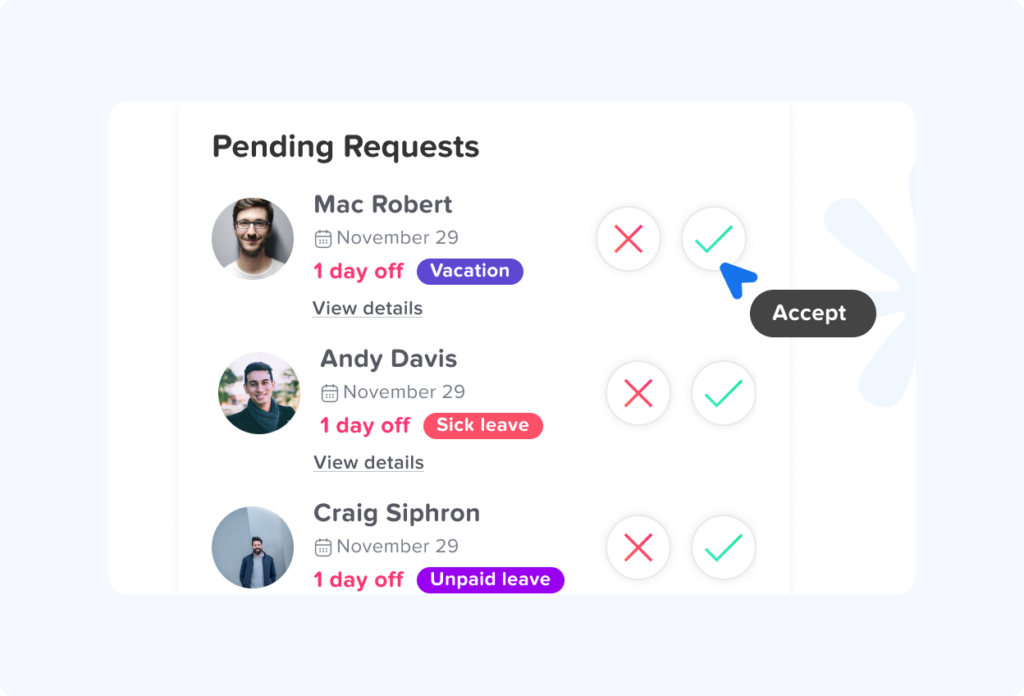
An employee may receive a point because an approved vacation, sick day, or partial-day request was not reflected in the attendance system.
Integrating PTO records with schedules and attendance data can reduce these errors.
Points Are Used as the Only Attendance Metric
An employee’s total points do not provide the complete picture.
HR should also review:
- Absence frequency
- Total absent hours
- Schedule adherence
- Repeated lateness
- Early departures
- Missed punches
- Approved versus unapproved absences
- Attendance patterns by shift
- Attendance patterns by department
- Manager correction rates
The Policy Encourages Employees to Work While Sick
Employees may come to work while ill because they fear receiving points.
This can create health, safety, productivity, and morale concerns. A well-designed system should distinguish between attendance misconduct and legitimate leave needs.
How to Create a Fair Attendance Point Policy
A fair policy requires more than choosing point values.
Define Every Attendance Event
Avoid vague phrases such as “excessive lateness.”
Instead, define:
- What counts as late
- Whether a grace period applies
- What counts as leaving early
- How partial shifts are handled
- What creates an absence occurrence
- How no-call, no-show events are recorded
List All Excluded Absences
The policy should explain that certain events may be excluded from points after review, including approved PTO and legally protected leave.
Avoid trying to list every possible legal protection in a short policy. Include a broader statement directing employees to HR when they believe an absence may qualify for protection or accommodation.
Create a Review Process
Before assigning points, the manager or HR should confirm:
- The employee was scheduled to work.
- The schedule was accurate.
- No approved leave or shift change existed.
- The employee’s actual attendance data was correct.
- The employee had an opportunity to explain.
- The event did not require further leave or accommodation review.
- The point value matched the written policy.
Give Employees an Appeal or Correction Method
Employees should be able to report:
- Incorrect clock records
- Missing approvals
- Schedule errors
- Duplicate points
- Incorrect point values
- Protected leave concerns
- Points that should have expired
The policy should identify how corrections are submitted and who reviews them.
Use Progressive Responses
Not every threshold needs to result in formal discipline.
Earlier steps may include:
- A policy reminder
- A schedule discussion
- Attendance coaching
- Review of transportation or shift availability
- Explanation of leave options
- Referral to HR
- A written attendance improvement plan
Audit the System Regularly
HR should periodically review whether:
- Managers apply points consistently
- Protected leave is excluded
- Expired points are removed
- Specific groups receive unusually high point totals
- Certain shifts experience repeated problems
- Corrections are handled promptly
- Employees receive timely notifications
- Attendance actions match the written policy
Attendance Point System Policy Example
The following is a simplified example and should be adapted to the organization’s requirements and applicable laws.
Employees are expected to report to work according to their assigned schedules and notify their manager as soon as possible when they cannot attend a scheduled shift.
Attendance events such as unapproved lateness, early departure, absence, or failure to follow the notification procedure may result in attendance points.
Points will not be finalized until the event has been reviewed. Approved leave, approved schedule changes, and absences protected by applicable law or an approved accommodation will not receive attendance points.
Employees will be notified when points are added to their attendance record and may request a correction if they believe the information is inaccurate.
Active points will expire according to the company’s attendance policy. Reaching a point threshold will result in a review of the employee’s attendance history and the circumstances of the recorded events.
Before publishing or implementing an attendance policy, employers should have it reviewed for the jurisdictions where their employees work.
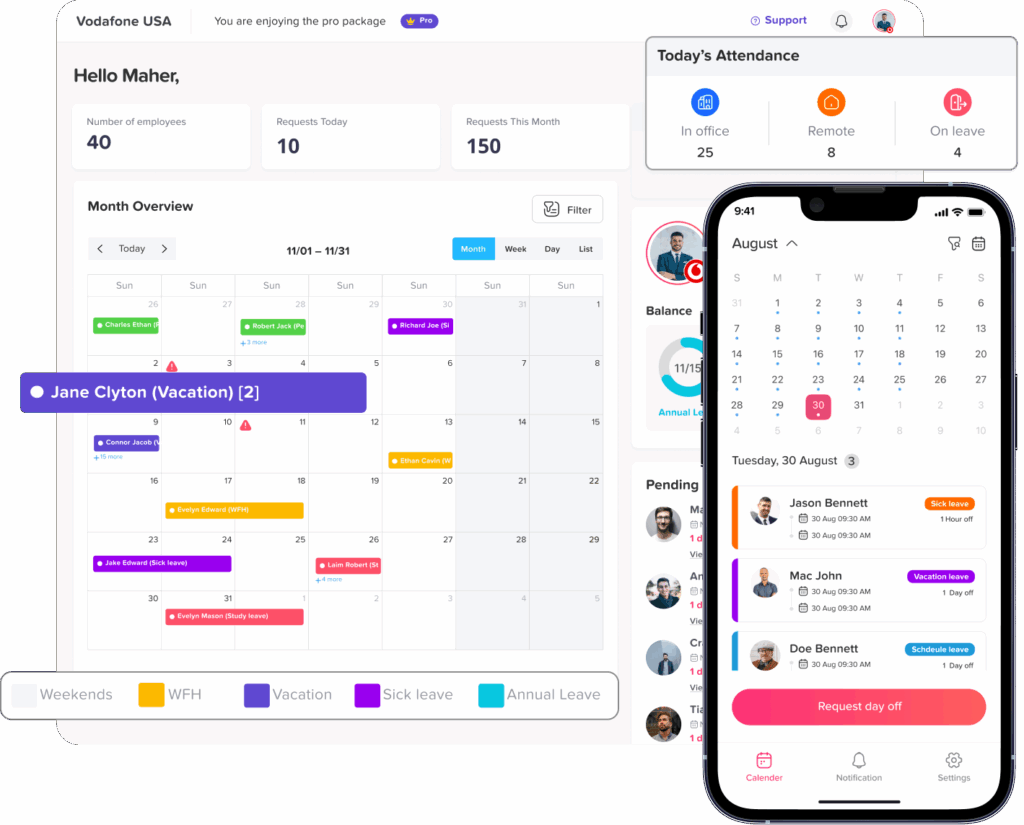
How Day Off Helps Manage Attendance and Leave
Attendance point systems become difficult to manage when schedules, leave requests, approvals, attendance records, and employee balances are stored in separate spreadsheets or messages.
Day Off helps organizations centralize important workforce information in one system.
HR teams and managers can use Day Off to:
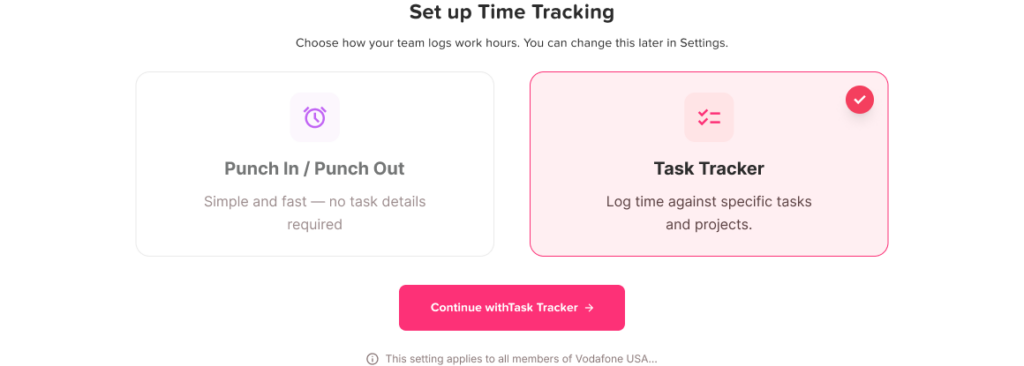
- Manage PTO and leave requests
- Create custom leave types
- Route requests through approval workflows
- Track employee leave balances
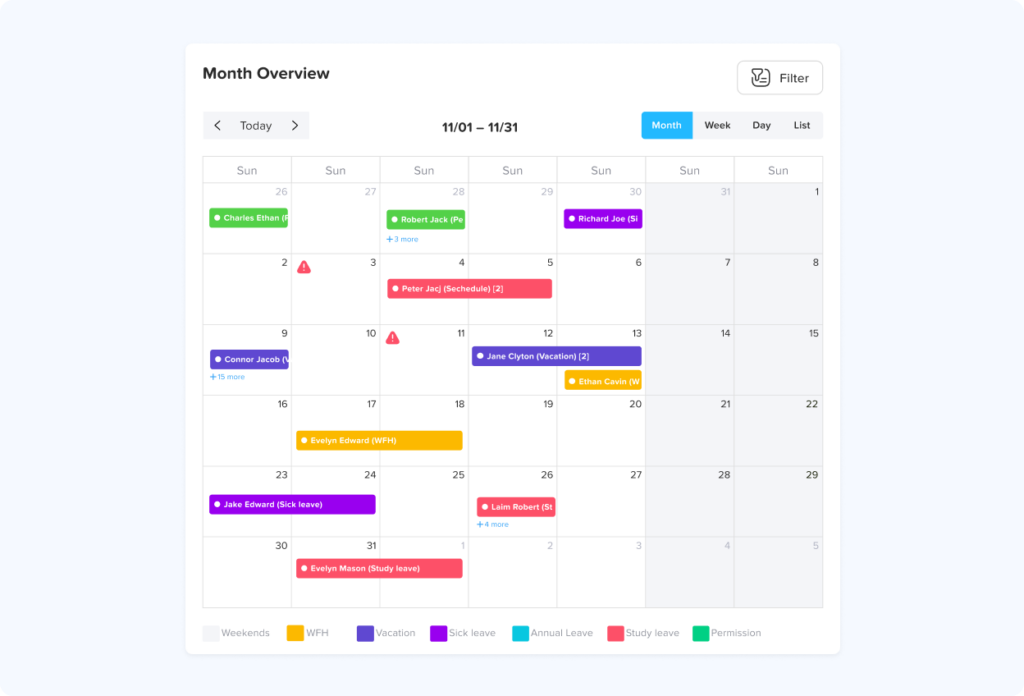
- View employee availability on a shared calendar
- Manage work schedules
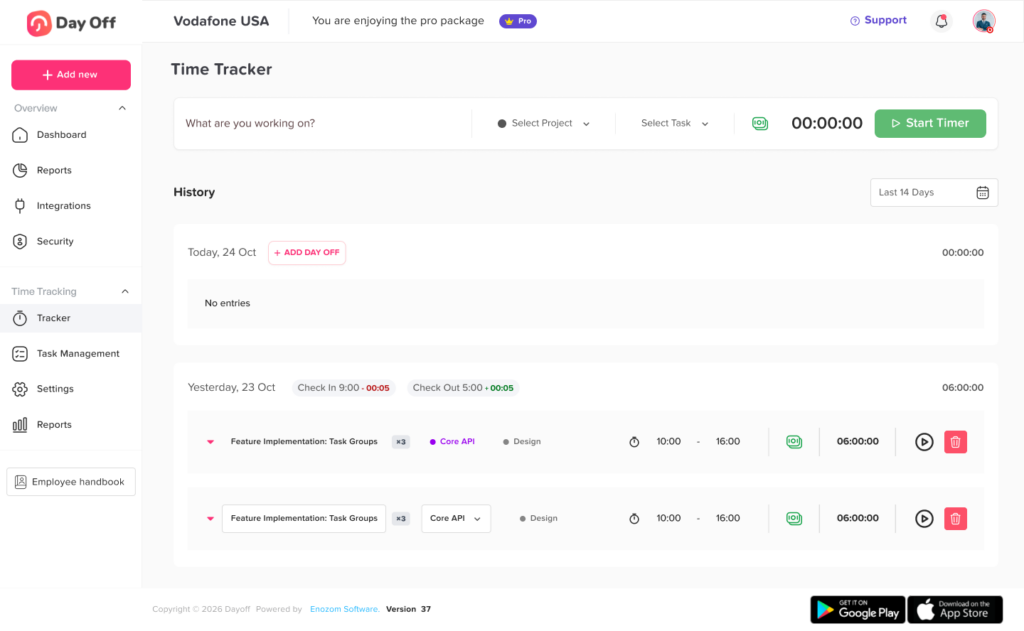
- Record attendance and working time
- Review late arrivals and absences
- Connect approved leave with attendance records
- Organize employees by team, department, location, or policy
- Create reports for HR and workforce planning
Connecting approved leave with schedules and attendance records helps managers avoid assigning attendance points for absences that were already approved.
It also gives HR a clearer record when reviewing patterns, corrections, and attendance decisions.
Attendance Point System Best Practices
For a more accurate and employee-friendly process:
- Publish the policy and make it easy to access.
- Train managers before allowing them to assign points.
- Review protected leave before finalizing an event.
- Connect attendance records with approved PTO.
- Notify employees whenever their point total changes.
- Allow employees to request corrections.
- Use the same definitions across departments.
- Review context instead of relying only on automation.
- Apply point expiration rules consistently.
- Audit point records before formal employment action.
- Review state and local requirements for every employee location.
- Update the policy when scheduling or leave practices change.
Frequently Asked Questions About Attendance Point Systems
What is an attendance point system?
An attendance point system is a workplace policy that assigns points to events such as lateness, early departures, unplanned absences, and missed shifts. Point totals may trigger coaching, warnings, or another review process.
How many attendance points can an employee receive?
There is no universal number. Each employer defines its own point values and thresholds based on its operations, policies, applicable laws, and workforce needs.
How many points does an absence usually receive?
Some employers assign one point for an unplanned absence, but the number varies. A no-call, no-show may receive more points than an absence reported through the proper procedure.
Is an attendance point system legal?
Attendance point systems can be used, but employers must ensure that they do not penalize protected leave, disability-related accommodations, pregnancy-related accommodations, workplace injury reporting, or other legally protected activity.
Because requirements differ by jurisdiction and situation, employers should obtain qualified legal advice before implementing or changing a policy.
Can an employer give attendance points for FMLA leave?
Qualifying FMLA leave should not be counted negatively under an attendance point system. The U.S. Department of Labor identifies assessing negative attendance points for FMLA leave as a potential violation of employee protections.
Can an employer give points for calling in sick?
It depends on the circumstances and applicable law. An ordinary unprotected absence may fall under the company’s policy, but paid sick leave laws, FMLA protections, disability accommodation requirements, pregnancy protections, or other rules may apply.
The absence should be reviewed before points are assigned.
Can an employee receive points for being late because of a disability?
An employer may need to consider a modified schedule or attendance rule as a reasonable accommodation under the ADA, unless the accommodation would create an undue hardship. The employer should engage in the appropriate accommodation process instead of automatically assigning points.
Do attendance points expire?
Many employers allow points to expire after a defined period, such as six or twelve months. Others remove points after a period without new attendance incidents.
The expiration rule should be written clearly and applied consistently.
Can attendance points be removed?
Points may be removed when:
- The attendance record was incorrect
- The schedule was wrong
- Approved leave was not recorded
- A manager had approved the event
- The point was duplicated
- The event qualified for protection
- The point reached its expiration date
Employees should have a clear way to request a review.
Is a no-call, no-show worse than an ordinary absence?
Many employers assign more points to a no-call, no-show because the lack of notice makes it harder to arrange coverage.
However, emergency situations should still be reviewed before the event is finalized.
Should consecutive sick days count as one occurrence?
Some policies treat consecutive days caused by the same illness as one occurrence. Other policies count each missed shift separately.
The company should define its approach clearly while ensuring that protected or approved leave is excluded.
What happens when an employee reaches the maximum attendance points?
The employer should conduct a complete review before taking action. The review should confirm the accuracy of the events, remove expired or protected absences, examine supporting information, and check whether the policy has been applied consistently.
How can employers track attendance points accurately?
Employers can use attendance and leave management software to connect employee schedules, clock records, approved PTO, absences, manager notes, and attendance reports.
A centralized system reduces dependence on spreadsheets and makes it easier to identify incorrect or duplicate records.
Final Thoughts
An attendance point system can help employers create clearer attendance expectations, document repeated issues, and respond more consistently. However, the system must be designed carefully.
Points should never be assigned without reviewing the underlying reason for an absence. Approved PTO, protected leave, workplace accommodations, schedule errors, and emergency circumstances must be handled correctly.
The most effective attendance policies combine clear rules with human review. They give managers a consistent process while allowing HR to consider context, correct errors, and protect employees’ rights.
By connecting leave requests, schedules, attendance records, approvals, and reporting, Day Off helps organizations maintain more accurate attendance information and make better workforce decisions.