







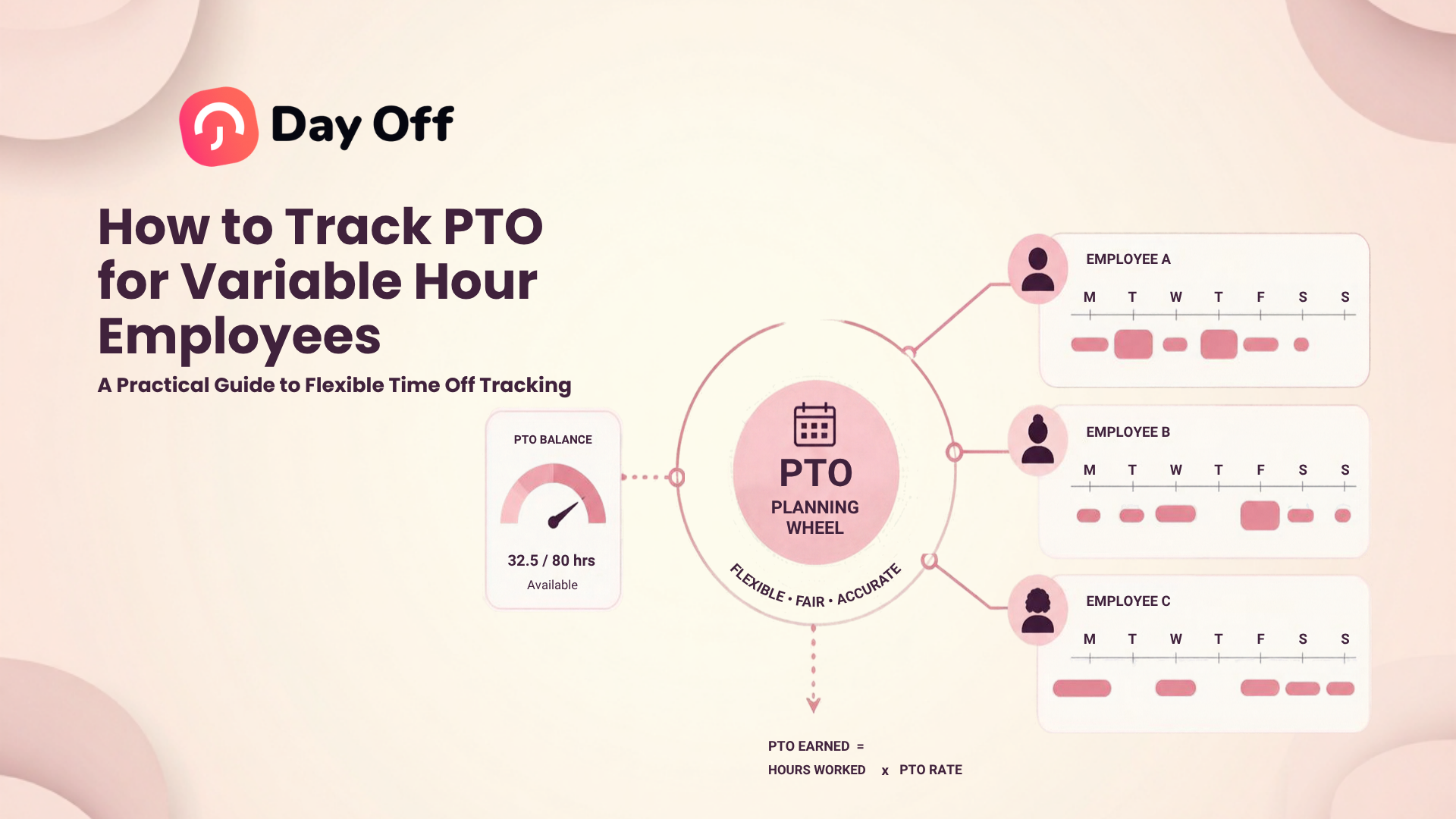
Learning how to Track PTO for variable hour employees is more complicated than managing leave for employees who work the same number of hours every week. When an employee works 18 hours one week, 32 hours the next, and 25 hours after that, a fixed PTO calculation can quickly become inaccurate. Employers need a system that accounts for actual hours worked, changing schedules, partial days, accrual rules, and the number of working hours an employee is actually expected to miss.

Variable hour employees are common in restaurants, retail, healthcare, hospitality, customer support, seasonal businesses, field services, and other industries where staffing changes according to demand. Their schedules may vary significantly from week to week, which means a traditional policy such as “15 PTO days per year” may be difficult to administer fairly unless the employer also defines what one PTO day means.
A better approach is to create clear rules for two separate questions: How does the employee earn PTO, and how much PTO is deducted when the employee takes time off? Once those two rules are defined, variable-hour PTO becomes much easier to calculate, explain, and audit.
What Is a Variable Hour Employee?
For the purpose of PTO management, a variable hour employee is generally an employee whose working hours are not the same every week or every workday.
For example, an employee might work:
Monday: 5 hours
Tuesday: 8 hours
Wednesday: Off
Thursday: 4 hours
Friday: 7 hours
The following week, that same employee could work completely different days and hours.
Variable schedules may occur because employees work rotating shifts, respond to changing customer demand, choose shifts based on availability, work seasonal schedules, or hold part time positions without guaranteed weekly hours.
It is important to distinguish this practical HR use of the term from its specific use under the Affordable Care Act. For certain ACA employer shared responsibility rules, the IRS uses a specific definition of a variable hour employee in connection with the look back measurement method. That definition relates to determining full-time status for health coverage purposes and should not automatically be treated as the definition used in a company’s PTO policy.
Why PTO Tracking Is More Difficult With Variable Hours
The main challenge is that there may be no standard workday.
Suppose an employer gives every employee 10 PTO days.
For an employee who always works eight hours per day, the meaning is straightforward:
10 days × 8 hours = 80 PTO hours
For a variable-hour employee, one working day might be four hours, another might be six hours, and another might be ten hours.
Deducting one full “day” from the employee’s balance every time they are absent could therefore produce inconsistent results. An employee could lose the same amount of PTO for missing a four-hour shift as another employee loses for missing a ten-hour shift.
Tracking PTO in hours instead of days usually provides more precision when schedules vary.
PTO Accrual and PTO Deduction Are Two Different Calculations
One of the most important concepts in variable-hour PTO management is separating earning leave from using leave.
Accrual determines how much PTO enters the employee’s balance.
Deduction determines how much is removed when the employee takes leave.
For example, a company could have a policy where an employee earns:
1 PTO hour for every 30 eligible hours worked
An employee who works 90 hours would earn:
90 ÷ 30 = 3 PTO hours
However, if that employee later requests Tuesday off and was scheduled to work six hours on Tuesday, the balance would normally be reduced by six PTO hours.
The accrual formula and deduction formula therefore solve two completely different problems.
Common Ways to Track PTO for Variable Hour Employees
Employers can structure PTO in several ways. The most appropriate approach depends on the company’s policy, workforce, payroll system, and applicable state or local laws.
| PTO Method | How It Works | Best Suited For | Main Consideration |
|---|---|---|---|
| Hours-worked accrual | PTO is earned according to actual eligible hours worked | Highly variable schedules, hourly staff, part-time teams | Requires accurate time records |
| Fixed pay-period accrual | A set amount of PTO is added every pay period | Employees whose employment classification is stable | May not reflect major differences in hours worked |
| Prorated annual allowance | Annual PTO is adjusted according to expected working hours | Predictable part-time schedules | Harder when weekly hours change significantly |
| Front-loaded PTO | A fixed PTO balance is provided at the start of a year or policy period | Companies wanting simpler administration | Must account for applicable accrual, carryover, and sick-leave rules |
| Average-hours method | Entitlement or deductions use an average over a defined period | Schedules that cannot be known far in advance | Policy must clearly define the averaging period |
Method 1: Accrue PTO Based on Hours Worked
Under an hours worked accrual model, employees earn a specific amount of PTO for every eligible hour they work.
The formula is:
PTO Accrued = Eligible Hours Worked × PTO Accrual Rate
There are two common ways to establish the rate.
Example: One PTO Hour for Every 30 Hours Worked
If company policy provides one PTO hour for every 30 hours worked:
Accrual rate = 1 ÷ 30 = 0.03333 PTO hours per hour worked
If the employee works 72 hours during a pay period:
72 × 0.03333 = approximately 2.4 PTO hours
If the employee works 96 hours during the next period:
96 × 0.03333 = approximately 3.2 PTO hours
Their PTO adjusts automatically according to the amount they actually work.
Example: Converting an Annual PTO Allowance Into an Hourly Accrual Rate
Suppose the company’s reference full-time policy provides 80 PTO hours for 2,080 working hours per year.
The accrual rate would be:
80 ÷ 2,080 = 0.03846 PTO hours per eligible hour
If a variable employee works 64 hours during a period:
64 × 0.03846 = 2.46 PTO hours
If they work only 38 hours during another period:
38 × 0.03846 = 1.46 PTO hours
This approach automatically scales PTO accrual as working time changes.
What Hours Should Count Toward PTO Accrual?
Employers should define exactly what qualifies as an “eligible hour” before calculating PTO.
The policy should address whether PTO accrues based only on hours physically worked or on a broader definition of paid hours.
For example, a policy may need to specify treatment of:
- Regular working hours
- Overtime hours
- PTO hours
- Paid sick leave
- Paid holidays
- Unpaid leave
- Training time
- Jury duty
- Other paid absences
There is no universal rule saying that every employer must use the same definition for voluntary vacation PTO. The U.S. Department of Labor states that the Fair Labor Standards Act generally does not require employers to provide vacation, holiday, or sick pay. These benefits are generally determined by employer policy, agreements, and applicable state or local laws.
Employers should therefore document the rule clearly and then apply it consistently.
Do Overtime Hours Earn Additional PTO?
This depends on the policy.
Suppose an employee works:
Regular hours: 40
Overtime hours: 6
Total hours worked: 46
With an accrual rate of 0.04 PTO hours per eligible working hour, a policy that counts all hours actually worked would produce:
46 × 0.04 = 1.84 PTO hours
If the policy limits accrual to the first 40 hours per week, the calculation would instead be:
40 × 0.04 = 1.6 PTO hours
Whichever rule the company chooses should be written clearly into its PTO policy and checked against applicable state and local requirements.
Employers should also avoid confusing PTO accrual with overtime calculations. Under the FLSA, paid vacation and sick time generally are not considered hours actually worked when determining federal overtime obligations.
How to Deduct PTO When Employee Schedules Vary
Accruing PTO correctly is only half of the process.
Employers also need a consistent method for reducing the balance when leave is taken.
For variable hour employees, one practical method is to deduct the scheduled working hours covered by the approved absence.
Suppose an employee’s published schedule is:
| Day | Scheduled Hours | PTO Requested | Suggested PTO Deduction |
|---|---|---|---|
| Monday | 5 hours | Full scheduled shift | 5 hours |
| Tuesday | 8 hours | Full scheduled shift | 8 hours |
| Wednesday | 0 hours | Full day | 0 hours |
| Thursday | 6 hours | 3 hours | 3 hours |
| Friday | 9 hours | Full scheduled shift | 9 hours |
The employee is using PTO to replace scheduled working time, not simply to cover calendar dates.
If the employee requests Wednesday off but was already scheduled not to work, there is normally no scheduled working time to replace.
Why Hour Based PTO Works Better for Variable Schedules
Consider two employees.
Employee A works a four hour shift on Friday.
Employee B works a ten hour shift on Friday.
Both request Friday off.
If the company deducts “one PTO day” from each employee, both balances decrease equally even though Employee B misses six more working hours.
If PTO is tracked in hours:
Employee A uses 4 PTO hours.
Employee B uses 10 PTO hours.
The leave balance now reflects the amount of scheduled work each employee actually missed.
This is particularly useful for part time employees, rotating shifts, compressed schedules, split shifts, and employees whose daily hours frequently change.
What If the Schedule Has Not Been Published Yet?
This is one of the most important situations to define in a variable hour PTO policy.
An employee may request vacation three months in advance, while their work schedule is created only two weeks in advance.
The employer therefore does not yet know exactly how many hours the employee would have worked.
A policy could use a predefined method such as average daily hours over a specified look back period, contracted weekly hours, expected schedule hours, or another documented calculation. Once the schedule becomes available, the company may also define whether the original deduction remains final or is adjusted.
The important issue is consistency.
A manager should not estimate five hours for one employee and eight hours for another without a policy explaining the difference.
Using Average Working Hours
A rolling average can be useful when variable schedules are extremely unpredictable.
Suppose an employee worked the following hours during the previous eight weeks:
24, 28, 31, 20, 26, 30, 22, and 27 hours.
Total:
208 hours
Average weekly hours:
208 ÷ 8 = 26 hours per week
If the employee normally works four days per week, an employer using an average-day policy might calculate:
26 ÷ 4 = 6.5 hours per average workday
The company could therefore use 6.5 hours as the leave value when a future shift has not yet been scheduled.
This method should not be introduced informally. The policy should define the measurement period, when averages are recalculated, how incomplete weeks are handled, and what happens when the actual schedule later differs from the estimate.
How to Handle Partial Day PTO
Variable hour employees may need only part of a shift off.
Suppose an employee is scheduled from 9:00 a.m. to 5:00 p.m., with seven scheduled working hours after excluding an unpaid meal break.
The employee works until 1:00 p.m. and takes the remainder of the scheduled working time as approved PTO.
If three working hours remain, the leave deduction would be:
3 PTO hours
This is another reason hourly PTO tracking is often more precise than half day rules.
A generic “half day” may represent four hours in one situation, three hours in another, and five hours for an employee working a ten-hour shift.
Variable Hour PTO Calculation Examples
The following examples show how an accrual policy of 1 PTO hour per 30 eligible hours worked changes according to the employee’s schedule.
| Employee | Eligible Hours Worked | Calculation | PTO Earned |
|---|---|---|---|
| Employee A | 45 | 45 ÷ 30 | 1.50 hours |
| Employee B | 67.5 | 67.5 ÷ 30 | 2.25 hours |
| Employee C | 96 | 96 ÷ 30 | 3.20 hours |
| Employee D | 118.5 | 118.5 ÷ 30 | 3.95 hours |
| Employee E | 150 | 150 ÷ 30 | 5.00 hours |
The example demonstrates why hours-worked accrual adapts well to changing schedules. Employees who work more eligible hours during a period earn more PTO automatically, while employees who work fewer hours accrue proportionally less.
Decide How PTO Rounding Works
Variable hour calculations frequently create decimals.
For example:
77 hours ÷ 30 = 2.5667 PTO hours
The employer needs a consistent rounding policy.
The system might retain four decimal places internally and display two decimals to employees. Another policy might round only after the full pay period calculation is complete.
Frequent rounding after every shift can gradually create larger differences over time, so calculating from the full eligible hour total before rounding is generally easier to audit.
Whatever method is used, HR, payroll, and the PTO tracking system should follow the same rule.
Carryover and PTO Caps
Variable-hour employees may also accumulate balances at different speeds.
A policy should therefore make a distinction between:
Accrual rate: How quickly PTO is earned.
Accrual cap: The maximum amount an employee can hold.
Annual usage limit: The amount an employee may use during a defined period, where legally permitted.
Carryover: How much unused leave moves into the next policy year.
These concepts should not be treated as interchangeable.
For example, an employee may be allowed to carry unused hours into the following year but stop accruing temporarily after reaching the company’s maximum balance.
Applicable state and local laws must be checked before setting these rules, particularly when a PTO bank is also being used to satisfy legally required paid sick leave.
PTO and State Paid Sick Leave Laws
One of the most important compliance issues is the difference between voluntary vacation PTO and legally required sick leave.
Federal law generally does not require private employers to provide paid vacation or general PTO. However, states and local jurisdictions may impose paid sick leave or other paid leave requirements. The U.S. Department of Labor specifically notes that although there is no general federal law guaranteeing paid sick leave, numerous state and local laws establish their own requirements.
This matters because an employer may use a combined PTO bank to satisfy a paid sick leave requirement. If it does, the PTO plan may need to comply with rules covering accrual, permissible uses, carryover, notice, documentation, or other requirements.
For example, California generally provides for paid sick leave accrual of at least one hour for every 30 hours worked under its standard accrual method, while also permitting certain alternative methods and front-loading arrangements that meet statutory requirements.
New York also provides a one hour per 30 hours worked accrual framework for covered employees, with the required amount of leave depending on employer size and other factors. New York guidance specifically addresses front-loading leave for part-time employees whose anticipated hours may differ from the hours ultimately worked.
These examples should not be treated as a complete list of U.S. leave requirements. Employers with employees in multiple states or cities should review the rules applicable to each employee’s work location.
What Happens When an Employee’s Hours Change Mid Year?
Variable hour employees may move between very different workloads during the year.
For example:
January to March: approximately 15 hours per week
April to June: approximately 28 hours per week
July to September: approximately 36 hours per week
An hours worked accrual system naturally responds to these changes because the employee earns PTO based on the hours actually worked.
A fixed annual or prorated entitlement requires more policy decisions.
If an employee increases from 20 hours per week to 35 hours per week, the employer must determine whether future PTO entitlement increases immediately, at the beginning of the next policy period, or according to another defined rule.
Existing earned PTO should also be kept separate from future accrual calculations. Changing an employee’s schedule does not automatically mean their previously earned leave should be recalculated.
Avoid Recalculating Earned PTO Every Time the Schedule Changes
Consider an employee who has already accumulated 32 PTO hours.
Their weekly schedule then changes from approximately 32 hours to approximately 20 hours.
It would be confusing to reduce their existing 32-hour balance simply because their future schedule is shorter.
Instead, policies can separate:
Existing balance: PTO already earned under the previous conditions.
Future accrual: PTO earned after the schedule or employment status changes.
This creates a cleaner audit trail and makes it easier for employees to understand their balances.
Applicable state law should still be reviewed because some jurisdictions treat accrued vacation as earned compensation and regulate forfeiture or payout.
Keep PTO Records Connected to Work Schedules
The more variable an employee’s schedule becomes, the more important accurate scheduling data becomes.
A PTO record should ideally show the employee’s schedule that applied to the absence, the PTO requested, the amount deducted, the approval status, the balance before the request, and the balance afterward.
This helps HR answer questions later.
For example, imagine an employee disputes a six hour PTO deduction several months after taking leave. If HR can see that the employee was scheduled for six working hours on that date, the calculation can be verified quickly.
If schedules and PTO are stored in separate spreadsheets, reconstructing that history can be much harder.
Do Not Change Historical Schedules Without Considering Approved PTO
Schedule edits are another potential source of PTO errors.
Suppose an employee was originally scheduled for eight hours on June 10 and an approved PTO request deducted eight hours.
Later, a manager edits the schedule template and changes Tuesdays to six hours.
The PTO system should not blindly change historical leave from eight hours to six simply because the employee’s current schedule is different.
PTO calculations should reflect the schedule that applied at the appropriate effective date.
This is particularly important when employees frequently change departments, shift patterns, locations, or weekly working hours.
Use Effective Dates for Schedule Changes
Instead of overwriting an employee’s work schedule, record when the new schedule becomes effective.
For example:
Old schedule: January 1 through August 31
New schedule: Effective September 1
Leave taken in July should still use the July schedule.
Leave taken in October should use the October schedule.
This creates a clear history and prevents current work arrangements from unintentionally changing previous PTO calculations.
How to Build a Clear Variable Hour PTO Policy
A well-designed policy should answer the questions employees are most likely to ask.
It should explain how PTO is earned, which hours count toward accrual, whether overtime counts, when accrual begins, how decimals are rounded, whether there is an accrual cap, how unused PTO carries over, and what happens when an employee changes schedules.
The policy should also define how leave is deducted. Employees should know whether the deduction uses scheduled hours, average hours, contracted hours, or another method when a future schedule has not yet been published.
Clear rules reduce the number of situations where managers need to make individual judgment calls.
Why Automated PTO Tracking Helps Variable-Hour Teams
Manual calculations become increasingly difficult as the workforce grows.
Imagine 80 employees who all work different schedules. During every pay period, HR may need to collect working hours, calculate individual accruals, apply caps, process leave requests, calculate hourly deductions, update balances, account for carryover, and investigate schedule changes.
Automation reduces the number of calculations that need to be handled manually.
A leave management platform can connect leave balances, employee schedules, accrual policies, requests, and reporting in one system.
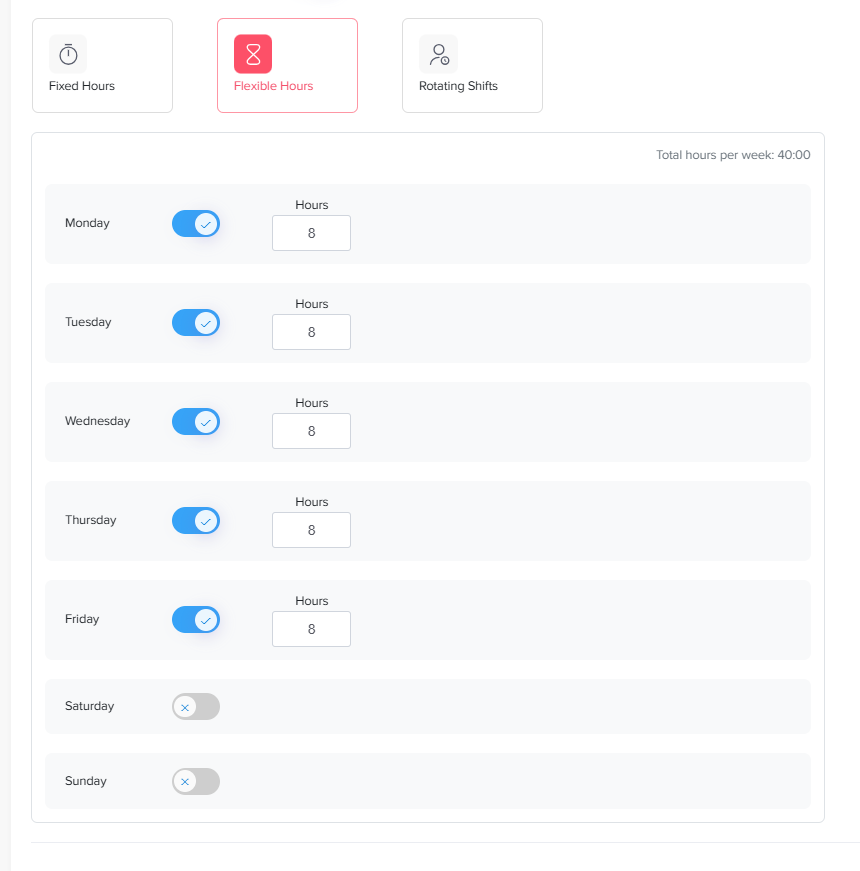
For example, Day Off supports work schedules including fixed days, fixed hours, flexible hours, and rotating shifts. Work schedules can be used to determine the working days and hours associated with employee leave requests.
Day Off also supports hourly leave tracking, which can be useful for variable hour employees, part time employees, flexible schedules, and partial day absences where tracking an entire “day” would not accurately represent the employee’s missed working time.
A Practical PTO Tracking Workflow
For a variable-hour workforce, a reliable process can be summarized as follows:
First, define the PTO policy and determine whether employees earn leave based on hours worked, pay periods, an annual allowance, or another method.
Next, establish what counts as an eligible hour for accrual.
Then, store PTO in hours when employee workdays vary significantly.
Connect the employee’s work schedule with the leave request so the system can identify how much scheduled working time the absence covers.
Apply the same accrual, rounding, carryover, and deduction rules consistently.
Finally, retain historical schedule and balance records so HR can explain how any PTO figure was calculated.
This workflow creates a clear chain from hours worked → PTO earned → leave requested → scheduled hours missed → PTO deducted → remaining balance.
FAQ
How should you track PTO for employees with variable hours?
One practical approach is to track PTO in hours and calculate accrual according to eligible hours worked. When employees take leave, deduct the working hours they were scheduled to miss rather than automatically deducting a fixed eight-hour day.
Can variable hour employees receive PTO?
Yes. Employers may provide PTO to employees with variable schedules according to their policies and applicable laws. State and local paid leave requirements may also cover certain part-time or variable-hour workers.
How do you calculate PTO based on hours worked?
Multiply eligible hours worked by the PTO accrual rate.
For example, if the accrual rate is 0.04 PTO hours per hour worked and the employee works 75 eligible hours:
75 × 0.04 = 3 PTO hours
Should PTO be tracked in hours or days for variable-hour employees?
Hours are often more precise because variable-hour employees may work different shift lengths. Tracking in hours allows the PTO deduction to correspond to the employee’s actual scheduled working time.
Should PTO be deducted on an employee’s scheduled day off?
Normally, if an employee was not expected to work that day, there is no scheduled working time for PTO to replace. However, employers should follow their written policy and applicable leave laws.
What if an employee requests PTO before their schedule is created?
The PTO policy should establish a calculation method in advance. This might use average working hours over a defined period, contracted hours, expected hours, or another consistent method. The policy should also state whether the amount will be adjusted after the actual schedule is published.
Do employees earn PTO while taking PTO?
It depends on how the employer defines eligible accrual hours. A policy based strictly on hours actually worked may treat PTO differently from a policy based on total paid hours. Applicable laws may impose additional requirements.
Does PTO count as hours worked for overtime?
Generally, paid vacation and sick leave are not treated as hours actually worked for federal FLSA overtime calculations. For example, an employee who works 36 hours and uses eight PTO hours has 44 paid hours but generally only 36 hours actually worked for federal overtime purposes.
Conclusion
Tracking PTO for variable-hour employees does not need to rely on estimates or manual adjustments. The key is to separate the process into clear rules for earning PTO and using PTO.
For many variable hour teams, tracking balances in hours and basing accrual on eligible working hours provides a practical way to account for schedules that change from week to week. When an employee takes leave, the PTO deduction can then reflect the scheduled working time actually covered by the absence.
The strongest policies also define how overtime, partial days, future unscheduled leave, schedule changes, rounding, carryover, and accrual caps are handled. Employers should review applicable state and local requirements, especially when a general PTO bank is also intended to satisfy mandatory paid sick leave requirements.
As variable schedules become more complex, connecting employee work schedules directly with PTO balances and leave requests can significantly reduce manual calculations. A leave management system such as Day Off can help businesses manage PTO policies, employee schedules, hourly leave, requests, balances, and absence records in one place, making PTO tracking clearer for both employees and managers.