







Employees do not always have enough paid time off available when they need to miss work. A new employee may have planned travel before joining the company, while another employee may face an illness or family emergency shortly before the next PTO accrual.
A PTO advance policy allows an eligible employee to use paid time off before earning it. Instead of moving directly to unpaid leave, the employee borrows from future accruals and temporarily enters a negative PTO balance.
For example, an employee with four available hours who receives approval for a 12-hour absence would have a balance of negative eight hours. Future accruals would normally be applied to that negative balance until it returns to zero.

PTO advances can give employees useful flexibility, but they also create financial, payroll and compliance risks. The employer must decide how much time employees may borrow, who qualifies, how repayment works and what happens if an employee leaves before earning back the advanced hours.
Federal law does not generally require private employers to provide paid vacation or general PTO. These benefits are normally created by an employer policy, employment agreement or collective bargaining agreement. State laws may regulate earned vacation, wage deductions and final pay, making location-specific review essential before an employer attempts to recover an outstanding negative balance.
This guide explains how to create a clear PTO advance policy, calculate borrowed leave, manage negative balances and avoid common payroll mistakes.
What Is a PTO Advance Policy?
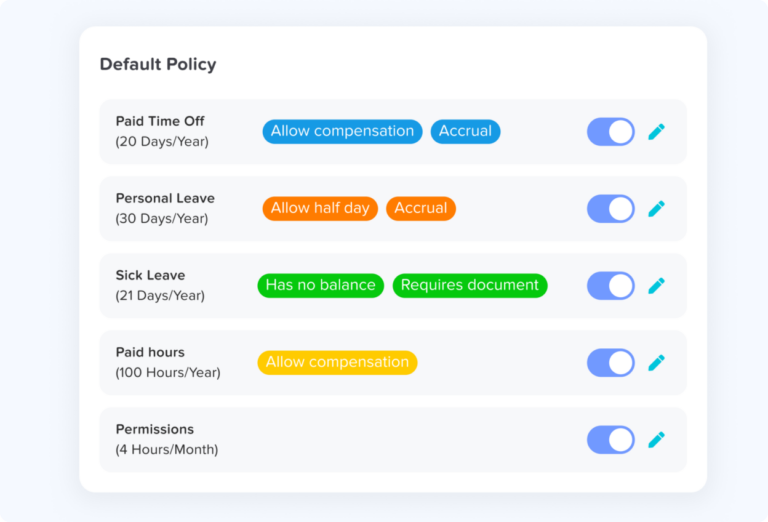
A PTO advance policy is a written workplace rule that allows employees to use paid leave they have not yet accrued.
The employer effectively makes future PTO available early. The employee receives pay for the approved absence, but their leave balance becomes negative until later accruals repay the advance.
A PTO advance may also be described as:
- Borrowing future PTO
- Advanced vacation
- Advanced paid leave
- A negative PTO balance
- A negative leave allowance
- Using unearned PTO
Although the wording varies, the central idea is the same: the employee receives paid leave before completing the work or service that would ordinarily generate the balance.
Simple PTO advance example
Assume an employee has:
- Four available PTO hours
- A request for 16 hours
- Approval to borrow up to 24 hours
The calculation is:
4 available hours − 16 requested hours = −12 hours
The employee receives 16 paid hours off and ends the request with a negative 12-hour balance.
If the employee later accrues four hours per pay period, the balance would change as follows:
| Pay Period | Accrual Posted | Balance After Accrual |
|---|---|---|
| After the request | None | −12 hours |
| First pay period | 4 hours | −8 hours |
| Second pay period | 4 hours | −4 hours |
| Third pay period | 4 hours | 0 hours |
| Fourth pay period | 4 hours | 4 available hours |
The employee does not receive new usable PTO until the borrowed amount has been earned back, unless the policy permits additional borrowing.
Is a PTO Advance the Same as Front-Loaded PTO?
No. Both methods give employees access to paid leave before the end of the year, but they operate differently.
PTO advance
An employee uses more PTO than is currently available and enters a negative balance. Future accruals repay the amount used.
Front-loaded PTO
The employer grants the employee an annual or periodic allowance in advance, such as 120 hours on January 1. The employee may use the available grant without creating a negative balance.
| Policy Feature | PTO Advance | Front-Loaded PTO |
|---|---|---|
| Employee balance | Can become negative | Begins with a positive grant |
| Future accruals | Repay borrowed time | May not accrue during the grant period |
| Approval | Usually required for each advance | Normal request approval applies |
| Main risk | Employee leaves before repayment | Employee uses the full grant and leaves early |
| Availability | Often used as an exception | Usually applies to an entire employee group |
| Policy purpose | Short-term flexibility | Standard method of providing annual PTO |
A company may use an accrual policy while allowing limited advances in exceptional circumstances. Another company may front-load the annual benefit and prohibit negative balances entirely.
Is It Legal to Let Employees Borrow Future PTO?
Federal law does not prohibit employers from voluntarily offering advanced vacation or PTO. Because the Fair Labor Standards Act generally does not require paid vacation, the employer’s written policy usually determines whether employees may borrow future leave, subject to state and local requirements.
The more difficult legal question is not whether the employer may grant advanced PTO. It is whether the employer can recover the value of that PTO from wages when the employee leaves with a negative balance.
A U.S. Department of Labor opinion letter concluded that, under the specific facts described, an employer could deduct the value of advanced vacation from an employee’s final paycheck without violating the FLSA. The opinion treated the advanced vacation payment as a bona fide advance rather than an ordinary deduction for the employer’s benefit. However, the letter addressed federal law and does not override stricter state wage-payment rules.
State laws may prohibit or restrict recovery
California provides an important example. The California Division of Labor Standards Enforcement states that an employer cannot deduct advanced vacation from an employee’s final paycheck. California treats the employer’s decision to allow vacation before it is earned as an advance that cannot later be deducted from final wages.
New York also restricts wage deductions. Its Department of Labor states that deductions for pay advances or overpayments are lawful only when they comply with the state’s wage-deduction rules.
Therefore, a signed PTO advance agreement does not automatically make every final-pay deduction lawful. Before adopting a recovery clause, employers should review:
- State wage-deduction laws
- Final-pay rules
- Vacation vesting requirements
- Minimum wage protections
- Written authorization requirements
- Collective bargaining agreements
- The employee’s work location
Why Would an Employer Allow PTO Advances?
A carefully controlled PTO borrowing policy can help employees manage absences without immediately losing income.
Supporting new employees
A recently hired employee may have a preplanned vacation, wedding, family event or medical appointment before accumulating enough PTO.
Allowing a limited advance can make the transition into a new job easier without requiring the company to change the accrual rules for every employee.
Providing emergency flexibility
An employee may need time off for an urgent personal or family situation shortly before the next accrual.
A PTO advance can prevent a small balance shortage from turning the entire absence into unpaid leave.
Improving employee experience
Employees may view a controlled borrowing option as evidence that the employer understands unexpected life events.
The benefit can be particularly useful in workplaces where employees accrue PTO gradually and have limited balances during their first months of employment.
Reducing unplanned unpaid leave
When employees have no paid balance, they may still need to be absent. Allowing a reasonable advance can simplify payroll and reduce the financial strain associated with unpaid time.
Supporting consistent exceptions
Without a written policy, managers may make informal exceptions for selected employees. A formal PTO advance policy establishes the same eligibility, limits and approval process across teams.
What Are the Risks of Advanced PTO?
PTO borrowing should not be treated as an unlimited benefit. It creates responsibilities for HR, payroll, managers and employees.
The employee may leave before repayment
The most obvious risk is that the employee resigns or is terminated while the balance remains negative.
Depending on applicable law, the employer may be unable to recover the amount from final wages. The remaining balance may become a business cost.
Employees may repeatedly remain negative
An employee who receives a new advance before repaying the first one may remain in a continuous negative balance.
This can make the employee dependent on future PTO and leave no available balance for later emergencies.
Managers may apply the policy inconsistently
One manager may approve borrowing for vacations, while another approves it only for emergencies.
Undefined discretion can lead to confusion, favoritism concerns and unequal employee treatment.
Payroll records may become difficult to reconcile
A negative balance must match:
- The approved request
- The attendance record
- The payroll payment
- The accrual schedule
- Any manual adjustments
- The final balance
If one system prevents negative balances while another processes the paid absence, HR may end up with conflicting records.
The advance may be confused with protected leave
Advanced PTO provides pay. It does not independently provide job protection.
An absence may also qualify for FMLA, disability accommodation leave, state family leave, paid sick leave or another protected program. HR should review those rights separately.
Who Should Be Eligible to Borrow Future PTO?
The policy should define eligibility before employees submit requests.
Possible requirements include:
- Active employment status
- Completion of a probation or waiting period
- Enrollment in an eligible PTO policy
- Satisfactory attendance
- No pending separation date
- No existing negative balance
- A minimum period of service
- Manager and HR approval
Employers should avoid eligibility rules that unintentionally conflict with legally protected leave or accommodation obligations.
For example, an employee who does not qualify for an optional PTO advance may still be entitled to unpaid leave as a reasonable accommodation under the Americans with Disabilities Act when the accommodation would not create an undue hardship. The EEOC advises employers to explain ordinary leave eligibility while recognizing that additional leave may be required for medical or religious reasons.
Should PTO Advances Be Limited to Emergencies?
Employers can choose whether advances are available for any approved PTO request or only for limited situations.
Broad advance policy
Employees may borrow future time for vacation, personal matters, illness or another reason normally covered by PTO.
This is flexible but creates more frequent negative balances.
Emergency-only policy
Advances are limited to circumstances such as:
- The employee’s illness
- A family emergency
- Bereavement
- Urgent caregiving
- A natural disaster
- An unexpected personal crisis
This limits financial exposure but requires HR to define what qualifies as an emergency.
New-hire exception
The policy may allow borrowing only when a new employee disclosed a preplanned absence during recruitment or onboarding.
Case-by-case exception
HR may approve advances only in unusual circumstances.
If using this model, the policy should still identify who approves the request, which factors are considered and how decisions are documented.
How Much PTO Should Employees Be Allowed to Borrow?
A PTO advance policy should include a maximum negative balance.
Common limits may be expressed as:
- Eight hours
- 16 hours
- 24 hours
- 40 hours
- One scheduled workweek
- One future accrual period
- A percentage of the employee’s annual entitlement
The appropriate limit depends on the employee’s accrual rate, average shift length, expected turnover and the employer’s ability to absorb an unrecoverable balance.
Example based on one future accrual
An employee accrues five PTO hours per month.
The company allows employees to borrow no more than the amount expected during the next two months:
5 hours × 2 months = 10-hour maximum advance
This keeps the expected repayment period relatively short.
Example based on annual entitlement
An employee receives 120 hours per year.
The company permits borrowing up to 20% of the annual entitlement:
120 hours × 20% = 24-hour maximum advance
Example based on work schedule
The company permits employees to borrow one normal workweek.
| Employee Schedule | Maximum Advance |
|---|---|
| Five 8-hour days | 40 hours |
| Four 10-hour days | 40 hours |
| Three 12-hour shifts | 36 hours |
| Part-time, 24 hours weekly | 24 hours |
Using scheduled hours can create a more equitable limit for employees with different work patterns.
How Should Employees Repay Advanced PTO?
The most common method is automatic repayment through future accruals.
Every new accrual reduces the negative balance before the employee receives additional available time.
Full accrual repayment
Assume an employee has a balance of negative 16 hours and accrues eight hours each month.
| Month | Accrual | Ending Balance |
|---|---|---|
| Starting balance | — | −16 hours |
| Month 1 | 8 hours | −8 hours |
| Month 2 | 8 hours | 0 hours |
| Month 3 | 8 hours | 8 hours |
The employee begins accumulating usable leave again in the third month.
Partial repayment
An employer may apply only part of each accrual to the debt.
For example, an employee accrues eight hours monthly, and the policy applies four hours to the negative balance while making four hours available for new requests.
This method gives the employee continued access to some leave, but it extends the repayment period and increases the employer’s financial risk.
Payroll repayment
Some employers may consider requiring cash repayment or a wage deduction. This method creates greater compliance risk and should not be implemented without confirming that it is permitted under the laws governing the employee’s work location.
Can Employees Borrow More PTO While Already Negative?
The policy should answer this directly.
Possible approaches include:
No additional borrowing
Employees cannot submit another request that would increase the negative balance.
This is the easiest rule to administer.
Borrowing up to the overall cap
An employee with a negative eight-hour balance may borrow eight additional hours when the maximum is negative 16 hours.
Emergency exception
Additional borrowing requires approval from HR or a senior manager and is limited to urgent circumstances.
Protected-leave review
A request that cannot be covered by the available PTO advance may still require analysis under FMLA, the ADA or another leave law.
The system should not automatically reject the entire absence simply because the employee has reached the borrowing limit.
How Does Advanced PTO Work With FMLA?
A PTO advance and FMLA serve different purposes.
- Advanced PTO provides compensation under an employer policy.
- FMLA provides eligible employees with job-protected leave for qualifying reasons.
Under the FMLA, an employee may choose, or an employer may require, the use of accrued paid leave during otherwise unpaid FMLA leave when the employee meets the conditions of the employer’s paid-leave policy. The paid leave and FMLA leave then run concurrently.
Federal guidance refers to accrued paid leave. An employer’s own PTO advance policy determines whether unearned future PTO can also be made available during an FMLA absence.
For example:
- An employee has eight accrued PTO hours.
- The employee needs 40 hours of FMLA leave.
- The employer allows a maximum PTO advance of 16 hours.
The employee might receive:
- Eight hours from the accrued balance
- 16 hours from the PTO advance
- 16 hours of unpaid FMLA leave
All 40 hours may count against the employee’s FMLA entitlement, but only 24 hours are paid.
Receiving advanced PTO does not extend the employee’s total FMLA entitlement.
Does Advanced PTO Count Toward Overtime?
Under federal law, PTO generally represents paid time not worked. It ordinarily does not count as hours worked when calculating whether a nonexempt employee exceeded 40 hours in a workweek.
For example:
| Time Category | Hours |
|---|---|
| Hours actually worked | 36 |
| Advanced PTO used | 8 |
| Total paid hours | 44 |
| Federal overtime hours | 0 |
A state law, employment agreement, collective bargaining agreement or more generous company policy may use a different calculation.
The policy should explain whether advanced PTO is treated differently from earned PTO for payroll purposes. In most cases, both are paid leave rather than hours actually worked.
What Happens if the Employee Leaves With a Negative PTO Balance?
This is the most important part of a PTO advance policy.
The handbook should explain what the company intends to do, but the actual recovery method must comply with applicable law.
Possible treatments include:
Deduction from final wages where lawful
The employer deducts the value of the unearned leave from the employee’s final paycheck, but only when permitted by federal, state and local law and supported by any required authorization.
Repayment agreement
The employee agrees to repay the amount separately after separation.
The employer should determine whether such an agreement is enforceable and whether pursuing a small balance is practical.
Offset against earned PTO
If the employee has another payable leave balance, the employer may consider whether the balances can lawfully be offset.
This should not be assumed. Different leave types may receive different treatment under state law.
Waiver of the negative balance
The company treats the outstanding advance as a business expense and does not attempt recovery.
This may be the safest or most practical approach in locations where deductions are restricted.
Case-by-case legal review
HR sends every negative balance at separation to payroll or legal review before making any deduction.
This can be useful for multi-state employers because the lawful result may differ according to the employee’s location.
Why a Signed Authorization May Not Be Enough
Employers sometimes assume that a signed form permits a deduction from final pay.
That is not always correct.
Some jurisdictions limit the types of deductions employees may authorize. Others require specific timing, notices, repayment schedules or opportunities to challenge the amount. Some prohibit certain final-pay deductions even when the employee previously agreed to them.
California’s official vacation guidance expressly states that advanced vacation cannot be deducted from an employee’s final paycheck. New York permits deductions related to pay advances only when the employer follows the state’s detailed wage-deduction requirements.
A PTO advance form should therefore explain the policy and acknowledge the negative balance, but employers should not promise an automatic deduction unless that recovery method has been reviewed for the relevant location.
What Happens When the Employee’s PTO Policy Changes?
An employee may still have a negative balance when moving to another policy because of:
- A promotion
- A transfer
- A change from full-time to part-time
- A location change
- A switch from accrued to front-loaded PTO
- A change in annual entitlement
- A company merger or restructuring
The policy should define how the outstanding balance is handled.
Possible methods include:
Keep the balance unchanged
A negative 12-hour balance remains negative 12 hours under the new policy.
Recalculate according to the new schedule
The balance is preserved, but the repayment period changes because the employee now accrues at a different rate.
Convert hours based on scheduled work
A day-based balance may need to be converted into hours before the transfer.
Freeze additional borrowing
The employee keeps the existing balance but may not receive another advance until the balance reaches zero.
The employer should not silently delete the negative balance or create a duplicate debt when moving the employee between policies.
What Happens at the PTO Reset Date?
A reset date does not automatically erase a negative balance.
The policy should specify whether the balance:
- Carries into the new leave year
- Is repaid from a new annual grant
- Is deducted from the first accruals of the new year
- Is forgiven
- Is reviewed manually
Example with a front-loaded new-year grant
An employee ends the year with negative 16 hours. The employee receives 120 front-loaded hours on January 1.
The new balance becomes:
120-hour grant − 16-hour advance = 104 available hours
Example with continuing accruals
An employee ends the year at negative 16 hours and continues accruing eight hours monthly.
The balance remains negative 16 hours until the January accrual changes it to negative eight hours.
Automatically resetting the employee to zero would effectively forgive the advance. That may be the employer’s intended policy, but it should not happen accidentally.
Should PTO Continue Accruing During the Advanced Leave?
The answer depends on the employer’s accrual rules.
Common approaches include:
- PTO continues accruing during paid leave.
- PTO accrues only on hours actually worked.
- PTO accrues during paid leave but not unpaid leave.
- Accrual stops during an extended leave of absence.
- Accrual follows the same rules regardless of whether the balance is positive or negative.
The PTO advance policy should not create a separate accrual rule unless that difference is intentional.
For example, if regular PTO hours normally count toward service-based accrual, advanced PTO should generally receive the same treatment unless the policy states otherwise.
How to Create a PTO Advance Approval Process
A structured approval process can reduce inconsistent decisions.
Step 1: Employee submits a normal PTO request
The request should show:
- Requested dates
- Requested hours
- Current balance
- Amount that would be advanced
- Reason, when required
- Expected return date
Step 2: Manager reviews operational coverage
The manager confirms whether the absence can be supported based on staffing, scheduling and business requirements.
Step 3: HR reviews policy eligibility
HR checks:
- Employee status
- Service requirement
- Current balance
- Existing advances
- Maximum negative balance
- Applicable location rules
- Possible protected-leave issues
Step 4: Employee receives the policy terms
The employee should receive a written explanation showing:
- Hours being advanced
- Resulting negative balance
- Accrual rate
- Estimated repayment period
- Rules for future requests
- Separation treatment
- Contact for questions
Step 5: The request is approved and recorded
The leave-management system should preserve the approved request and negative balance.
Step 6: HR monitors repayment
Future accruals should reduce the balance automatically or through a documented adjustment.
Step 7: Payroll and HR reconcile the record
The paid absence, accrual history and leave balance should agree.
PTO Advance Policy Examples
Example 1: New employee with a planned vacation
An employee starts work on June 1 and accrues eight PTO hours per month. The employee disclosed a three-day trip planned for July during recruitment.
By the trip date, the employee has accrued eight hours but needs 24 hours.
The employer approves a 16-hour advance:
8 available hours − 24 requested hours = −16 hours
The employee returns to zero after two monthly accruals.
Example 2: Part-time employee
A part-time employee works 24 hours per week and has six PTO hours available. The employee requests one 8-hour day.
The resulting balance is:
6 available hours − 8 requested hours = −2 hours
The policy should clarify whether the deduction follows the scheduled shift length rather than treating every day as eight hours.
Example 3: Employee reaches the negative cap
An employee has a balance of negative 12 hours. The policy permits a maximum balance of negative 16 hours.
The employee requests eight additional hours.
Only four hours can be paid through the PTO advance unless HR approves an exception:
−12 existing balance − 4 additional hours = −16-hour limit
The remaining four hours may be unpaid or covered by another applicable leave benefit.
Example 4: Employee resigns before repayment
An employee leaves with a balance of negative 20 hours and an hourly rate of $25.
The estimated value is:
20 hours × $25 = $500
The employer should not automatically deduct $500 from the final paycheck. HR must first determine whether the deduction is lawful in the employee’s location and whether required authorizations and procedures were completed.
Sample PTO Advance Policy
The company may permit eligible employees to use a limited amount of paid time off before it is earned. Approval is discretionary and depends on employee eligibility, available staffing, the reason for the request and the limits established in this policy.
To qualify, an employee must be actively employed, have completed [waiting period] and be covered by an eligible PTO policy. Employees with a pending separation date or an existing negative balance may be ineligible for an additional advance.
Employees may borrow up to [number] hours, but the PTO balance may not fall below [negative balance limit]. The approved advance will appear as a negative PTO balance.
Future PTO accruals will be applied automatically to the negative balance until it returns to zero. Employees may not use newly accrued PTO while a negative balance remains unless the company approves an exception.
Requests must be submitted through the company’s approved leave-management system. A request is not approved until the employee receives written confirmation.
Approval of advanced PTO does not provide additional job-protected leave. Absences that may qualify under FMLA, disability accommodation requirements, state leave laws or another protected program will be reviewed separately.
If employment ends before the negative balance is repaid, the company will handle the outstanding amount according to applicable law. The company will not make a deduction from final wages unless the deduction is legally permitted and all required procedures have been completed.
The company may deny an advance, limit the number of advances or suspend the program based on operational needs, employee eligibility or legal requirements. Decisions will be made consistently and without unlawful discrimination or retaliation.
This sample should be reviewed and customized before implementation.
PTO Advance Policy Checklist
| Policy Area | What to Define |
|---|---|
| Eligible employees | Status, classification, service, and waiting-period requirements |
| Eligible leave types | Vacation, general PTO, or another approved balance |
| Eligible reasons | Any PTO reason, emergencies, new-hire plans, or specific events |
| Maximum advance | Hours, days, percentage, or expected future accrual |
| Negative balance limit | Lowest balance the employee may reach |
| Approval authority | Manager, HR, payroll, or multiple approvers |
| Existing negative balance | Whether another advance is permitted |
| Repayment method | Full future accrual, partial accrual, or another method |
| Repayment period | Expected or maximum time to return to zero |
| Additional requests | Whether new PTO is restricted while the balance is negative |
| Accrual during leave | Whether PTO continues to accrue |
| Policy transfer | Treatment after schedule, status, or location changes |
| Reset date | Whether the negative balance carries into the new cycle |
| Protected leave | FMLA, disability, pregnancy, and state-leave review |
| Separation | Lawful recovery, repayment agreement, or waiver |
| Final-pay deductions | Location-specific legal review and authorization |
| Payroll records | Pay period, hours, rates, and adjustments |
| Audit trail | Request, approval, original balance, and repayment history |
Common PTO Advance Policy Mistakes
Allowing unlimited negative balances
Without a cap, an employee can accumulate a large amount of unearned leave that may never be repaid.
Approving advances verbally
A conversation between an employee and manager may not reach HR or payroll. Every advance should be documented in the approved system.
Using one national final-pay rule
State wage-deduction requirements differ. A recovery method that may be permissible under federal law may be prohibited under state law.
Treating the balance as a payroll loan without review
Advanced PTO may resemble a wage advance, but the legal treatment depends on the policy and jurisdiction.
Forgetting part-time and variable schedules
A “five-day advance” can have very different values for employees working eight-hour, ten-hour or twelve-hour shifts.
Resetting negative balances accidentally
A yearly system reset may erase the amount when the policy intended future accruals to repay it.
Ignoring protected-leave rights
Reaching the PTO advance limit does not automatically mean the employee’s absence can be denied.
Deducting final wages automatically
Even a signed authorization may not satisfy state rules. Every deduction should be reviewed before payroll is finalized.
Failing to stop repeated borrowing
Employees who continually borrow future time may never build a usable balance. The policy should limit additional advances or require full repayment first.
How to Audit Negative PTO Balances
HR should review advanced PTO regularly rather than waiting until an employee separates.
The audit should include:
- Employee name
- Work location
- Leave policy
- Accrual rate
- Current negative balance
- Date of the advance
- Reason category
- Approver
- Future accrual dates
- Estimated repayment date
- Additional pending requests
- Employment-status changes
- Payroll value
- Separation risk
- Manual adjustments
Warning signs
Investigate when:
- The employee exceeds the policy limit.
- The balance remains negative longer than expected.
- Accruals are not reducing the balance.
- The employee received another advance without approval.
- A manager approves significantly more advances than others.
- Negative balances disappear during resets or policy changes.
- Payroll shows paid leave that does not appear in the leave system.
- The employee has a pending termination or resignation date.
- The system applies the wrong accrual rate.
How Day Off Helps Manage PTO Advances
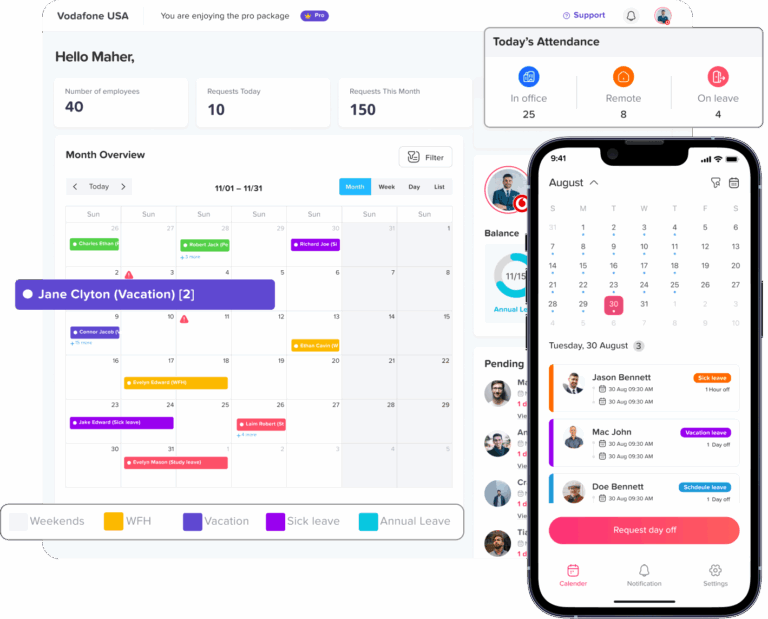
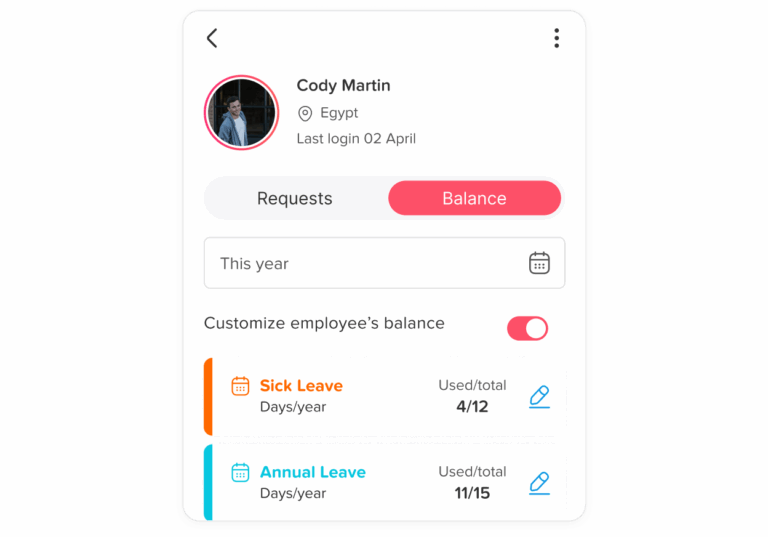
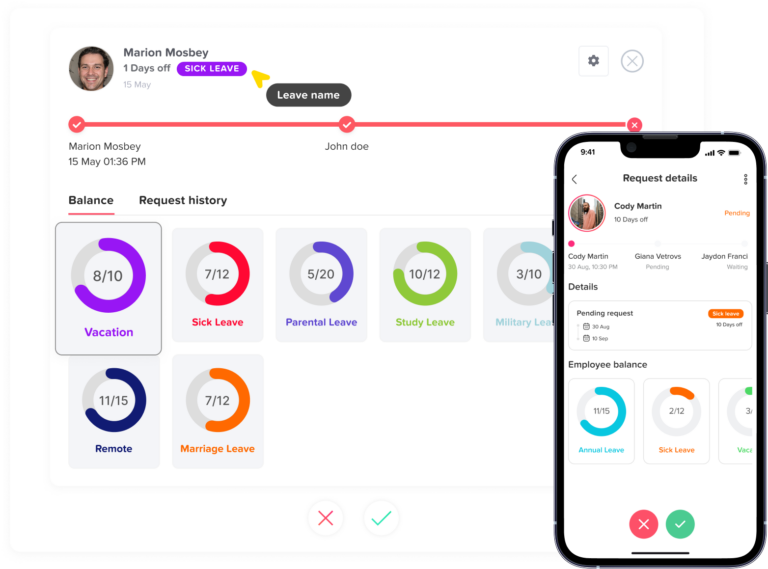
Day Off allows organizations to enable negative balances for selected leave types. This gives employees the ability to submit requests even when their available balance is not sufficient, while the company keeps the normal balance and approval workflow in one system.
Employers can apply the option only to the leave types and policies where borrowing is permitted. This is useful when one employee group may borrow general PTO while statutory sick leave or another restricted balance must remain separate.
Day Off also allows administrators to configure accruals, carryover, half-day requests, approval rules and other leave settings. Employees can review their current balances, while HR can use reports to monitor quotas, used leave and upcoming accruals.
The software configuration should follow the employer’s written policy. Day Off can record and manage a negative balance, but each employer remains responsible for establishing lawful recovery, final-pay and protected-leave procedures.
Frequently Asked Questions About PTO Advances
Can employees borrow future PTO?
Employees may borrow future PTO when the employer’s written policy permits negative balances or advanced leave. Federal law does not generally require employers to offer this option.
What is a negative PTO balance?
A negative PTO balance means the employee has used more paid leave than they have earned or received. Future accruals normally reduce the negative amount until the balance reaches zero.
Is advanced PTO the same as unlimited PTO?
No. Advanced PTO creates a measurable negative balance that must usually be repaid through future accruals. Unlimited PTO does not provide employees with a fixed accrued balance.
Is advanced PTO the same as front-loaded PTO?
No. Front-loaded PTO gives employees a positive allowance at the beginning of a period. Advanced PTO permits employees to use more than their current available balance.
Can an employer deny a PTO advance request?
Yes. PTO advances are generally optional benefits. An employer may deny a request based on eligibility, the advance limit, staffing needs or consistently applied policy rules.
A separate review may still be necessary when the absence could qualify for protected leave.
How much future PTO can an employee borrow?
The employer establishes the limit. It may be based on a fixed number of hours, one scheduled workweek, a percentage of annual PTO or the amount expected to accrue during a defined period.
How is borrowed PTO repaid?
Future accruals are usually applied automatically to the negative balance. The employee begins receiving available PTO again after the balance returns to zero.
Can an employee take more PTO while their balance is negative?
The policy determines whether additional borrowing is allowed. Employers may prohibit it, allow borrowing up to an overall cap or require special approval.
Can employees borrow PTO during probation?
Only when the employer’s policy permits it. Some employers require employees to complete probation before using or advancing PTO, while others make exceptions for preplanned leave.
Can advanced PTO be used during FMLA leave?
An employer may choose to make advanced PTO available during an FMLA absence if the reason qualifies under the company’s PTO policy. The paid time may run concurrently with FMLA, but it does not extend the employee’s FMLA entitlement.
Does borrowed PTO count toward overtime?
Under federal law, paid leave generally does not count as hours actually worked when determining overtime. State law or a more generous policy may provide a different result.
Can an employer deduct negative PTO from a final paycheck?
The answer depends on applicable law. Federal guidance has permitted a deduction under specific circumstances, but some states restrict or prohibit the practice. California, for example, states that advanced vacation cannot be deducted from an employee’s final paycheck.
Does a signed agreement always allow a final-pay deduction?
No. State law may prohibit a deduction or impose requirements that cannot be waived through a general authorization.
What happens if the employee is terminated before repaying PTO?
The employer may recover the amount where lawful, seek repayment separately or waive the balance. The policy should not promise an automatic deduction in every location.
Can a negative PTO balance carry into the next year?
Yes, when the policy states that advances remain outstanding across reset dates. The balance may be repaid from the next annual grant or future accruals.
Should negative PTO be forgiven at year-end?
Only when that is the employer’s intended rule. Automatic forgiveness increases the value of the benefit and may create inconsistent results between employees who borrowed PTO and those who did not.
Can part-time employees borrow PTO?
Yes, if they are eligible under the policy. The borrowing limit should account for the employee’s scheduled hours and accrual rate.
Can an employer cancel the PTO advance program?
An employer may generally change a discretionary program prospectively, subject to applicable law and existing agreements. Employees should receive written notice explaining how existing negative balances will be handled.
Conclusion
A PTO advance policy can help employees handle planned absences and unexpected emergencies before they have accumulated enough paid leave. It can be particularly useful for new employees, workers with gradual accruals and employees who are only a few hours short of covering an important absence.
However, allowing employees to borrow future PTO creates more than a negative number in a leave system.
Employers need clear rules for eligibility, borrowing limits, approval, repayment, additional requests, policy changes, reset dates and separation. The policy must also recognize that state wage laws may restrict recovery from an employee’s final paycheck.
The safest approach is to keep advances limited, document every approval, apply future accruals consistently and review negative balances regularly. HR should also separate PTO availability from protected-leave eligibility so an exhausted or negative balance does not lead to an unlawful denial.
Day Off helps organizations configure negative balances, accruals, leave policies and approval workflows in one system. When the software settings match a carefully reviewed PTO advance policy, employees receive more flexibility while HR maintains clear and auditable leave records.