







Paid time off may look like one company benefit, but it can interact differently with payroll depending on whether an employee is exempt or nonexempt.
An exempt employee may receive a fixed salary that generally cannot be reduced because the employee worked fewer hours in a particular week. A nonexempt employee, meanwhile, must be paid for every compensable hour worked and may qualify for overtime when work hours exceed the applicable limit.

These differences affect how employers should record:
- Partial-day absences
- Full-day absences
- PTO hours
- Unpaid time off
- Overtime
- Work performed during leave
- Salary and wage deductions
- Attendance and payroll records
Employers that treat exempt and nonexempt PTO exactly the same may create inaccurate balances, unpaid overtime, improper salary deductions, or confusing payroll records.
This guide explains how PTO for exempt vs. nonexempt employees works under United States federal wage-and-hour rules and what employers should track differently.
Important: This article provides general information for U.S. employers and is not legal advice. State and local laws, employment agreements, union agreements, and company policies may provide additional requirements or greater employee protections.
What Is the Difference Between Exempt and Nonexempt Employees?
The terms exempt and nonexempt generally describe whether an employee is covered by the Fair Labor Standards Act’s minimum-wage and overtime protections.
Most covered nonexempt employees must receive at least the applicable minimum wage for all hours worked and overtime pay for hours worked over 40 in a workweek. Certain executive, administrative, professional, computer, and outside-sales employees may qualify for an exemption when the applicable requirements are satisfied.
The classification cannot be determined from a job title alone. Calling someone a manager, administrator, professional, or salaried employee does not automatically make that person exempt. The employee’s actual responsibilities, compensation method, salary level, and the specific exemption being used must satisfy the applicable tests.
As of July 2026, most employees classified under the federal executive, administrative, or professional exemptions must receive at least $684 per week on a salary basis, in addition to satisfying the appropriate duties test. The U.S. Department of Labor restored this threshold in a technical amendment published in May 2026 after the 2024 rule was judicially vacated. Some exemptions and occupations have different compensation rules, and state law may impose a higher threshold.
Exempt does not always mean salaried
Many exempt employees are salaried, but these terms are not interchangeable.
An employee may be:
- Salaried and exempt
- Salaried and nonexempt
- Hourly and nonexempt
- Hourly and exempt under a limited exemption, such as certain qualifying computer employees
A salaried nonexempt employee still needs accurate work-hour records and must receive any overtime pay that is due. Paying a fixed salary does not remove the employer’s obligation to determine how many hours a nonexempt employee worked.
Quick Comparison: Exempt vs. Nonexempt PTO Tracking
| Area | Exempt Employee | Nonexempt Employee |
|---|---|---|
| Regular compensation | Usually receives a predetermined salary. | May be paid hourly or on another basis. |
| Detailed work-hour tracking | May be tracked for attendance, projects, leave, workload, or company policy. | Accurate daily and weekly work hours are essential. |
| Overtime | Generally not eligible under the exemption being used. | Usually eligible after more than 40 work hours in a workweek under federal law. |
| Partial-day PTO | PTO balance may generally be reduced if the full salary is still paid. | PTO may be recorded according to the number of scheduled hours missed. |
| Partial-day pay deduction | Generally not allowed, except in limited circumstances. | Employee generally must be paid for hours worked; unworked hours may be unpaid unless covered by PTO or another rule. |
| Full-day absence | Salary deductions may be permitted in certain situations. | Pay is generally based on hours worked plus any paid leave used. |
| Employer closure | Full salary is generally required if the employee performs any work in that week. | The FLSA generally does not require pay for unworked closure hours. |
| PTO and overtime | PTO balance matters, but ordinary PTO hours do not change the fixed weekly salary. | PTO hours generally do not count as hours worked for federal overtime. |
| Working during PTO | Track the activity and protect the salary basis. | Record and pay all compensable work time. |
Does Federal Law Require Employers to Provide PTO?
The Fair Labor Standards Act does not generally require employers to provide paid vacation, paid sick leave, holiday pay, or other payment for time that an employee does not work. These benefits are usually created by company policy, an employment agreement, a collective bargaining agreement, or another applicable law.
However, the absence of a general federal PTO requirement does not mean employers can manage leave without restrictions.
State or local laws may:
- Require paid sick leave
- Regulate how vacation is earned
- Restrict forfeiture of accrued vacation
- Require unused vacation to be paid at separation
- Require specific information on wage statements
- Protect certain medical, family, civic, or military absences
Employers should apply the rules that cover the employee’s actual work location, especially when managing remote or multi-state teams.
What Employers Should Track for Exempt Employees
PTO tracking for exempt employees is not primarily about calculating an hourly wage. It is about maintaining accurate leave balances, applying the policy consistently, documenting full- and partial-day absences, and protecting the employee’s salary-basis status.
The employee’s correct classification
Before applying special salary-basis rules, employers should verify that the employee actually qualifies as exempt.
The record should identify:
- The exemption being used
- The employee’s actual primary duties
- The employee’s salary or other qualifying compensation
- The applicable federal and state salary thresholds
- The date of the most recent classification review
- Any substantial changes to the employee’s responsibilities
Classification should be reviewed when an employee is promoted, moved into another department, assigned primarily nonexempt work, transferred to another state, or given a significantly different level of authority.
A salary alone is not enough to establish exempt status.
Full-day and partial-day absences separately
Employers should distinguish between a full-day absence and a partial-day absence because the salary-basis rules treat them differently.
An exempt employee generally must receive the full predetermined salary for any week in which the employee performs work, regardless of the number of days or hours worked. Salary deductions for partial-day personal absences are generally not permitted, except in limited situations such as qualifying unpaid Family and Medical Leave Act leave or the employee’s first or final week of employment.
The PTO system should therefore record:
- Whether the absence covered a full or partial day
- The number of PTO hours or days charged
- The reason category allowed by the policy
- Whether the absence was paid or unpaid
- Whether a salary deduction was processed
- The legal or policy basis for any salary deduction
This distinction is especially important when employees take two hours for an appointment, leave early, arrive late, or use a half day of PTO.
PTO-bank deductions and salary deductions as separate transactions
Reducing an exempt employee’s PTO balance is not necessarily the same as reducing the employee’s salary.
Under federal guidance, an employer may generally reduce an exempt employee’s accrued leave balance for a full-day or partial-day absence without violating the salary-basis rule, as long as the employee still receives the full predetermined salary required for that week.
For example, an exempt employee earning a fixed weekly salary leaves four hours early for a personal appointment.
The employer may be able to:
- Deduct four hours from the employee’s PTO bank
- Continue paying the employee’s full weekly salary
The employer generally should not:
- Deduct four hours of salary simply because the employee worked part of the day
Keeping the leave transaction separate from the payroll transaction helps prevent an automatic PTO rule from creating an improper salary deduction.
Full-day personal absences
Federal salary-basis rules permit deductions from an exempt employee’s salary when the employee is absent for one or more full days for personal reasons other than sickness or disability.
Consider an exempt employee who takes a full personal day after using all available PTO.
Depending on the company policy and applicable law, the employer may be able to treat the full day as unpaid without losing the exemption. However, the deduction should correspond to a full-day absence rather than a partial day.
Employers should document:
- That the employee was absent for the full workday
- That the absence was for a personal reason
- Whether PTO was available
- Whether the employee requested unpaid leave
- How payroll calculated the deduction
- Whether state law or company policy provided a different result
Full-day sickness or disability absences
Salary deductions may also be allowed for full-day absences caused by sickness or disability when the deduction is made under a bona fide plan, policy, or practice that provides compensation for salary lost because of illness or disability.
This can apply when an employee has exhausted the leave available under a qualifying sick-leave or disability plan, subject to the policy and applicable law.
The employer should preserve records showing:
- The applicable sick-leave or disability plan
- The employee’s eligibility
- The balance available before the absence
- The full dates of absence
- Any wage-replacement payment
- Any salary deduction
- The reason the deduction was permitted
Medical details should be restricted to employees who need that information. A general PTO or attendance calendar should not unnecessarily disclose an employee’s diagnosis or confidential medical information.
Employer closures and lack of work
An employer generally cannot reduce an exempt employee’s predetermined salary because the business closed for part of a week or did not have enough work available, provided the employee was ready, willing, and able to work and performed some work during that workweek.
The employer may be able to reduce the employee’s available PTO balance during the closure, but the employee must still receive the required salary for the week when the salary-basis rule applies. Federal guidance also states that an employer may reduce an exempt employee’s leave balance even when the absence is directed because of a lack of work, provided the guaranteed salary is paid.
For closure days, track:
- Whether the workplace was open or closed
- Whether work was available
- Whether the employee performed any work during the week
- Whether PTO was required
- Whether the employee had sufficient PTO
- Whether the full salary was paid
Do not configure payroll to automatically dock exempt employees by the hour whenever the office closes early.
Entire workweeks with no work performed
An exempt employee generally does not need to receive the salary for an entire workweek in which the employee performs no work.
This rule should be applied carefully. Answering emails, joining a meeting, completing an assignment, or performing another work duty may mean the employee worked during the week.
Employers should confirm:
- The exact dates of the absence
- Whether the employee performed any work
- Whether systems or communication records show activity
- Whether PTO covers the entire period
- Whether another protected-leave rule applies
Managers should avoid contacting employees for work during a week that payroll intends to treat as fully unpaid.
Improper-deduction complaints and corrections
An actual practice of making improper salary deductions can jeopardize the exempt status of affected employees. Federal guidance considers factors such as the number and timing of deductions, the employees affected, the managers responsible, and whether the employer has a clearly communicated policy against improper deductions.
Employers should maintain:
- A written salary-deduction policy
- A complaint process
- Payroll correction records
- Reimbursement records
- Manager training records
- Documentation of corrective action
Isolated or inadvertent improper deductions may not destroy the exemption when the employer reimburses the employee and complies with the applicable safe-harbor requirements.
What Employers Should Track for Nonexempt Employees
For nonexempt employees, PTO management must remain closely connected to timekeeping and payroll.
The central question is not only how much leave the employee used. Employers must also know exactly how many hours the employee worked.
Actual hours worked each day and workweek
Covered employers must maintain accurate records of the hours worked each day and the total hours worked during each workweek for nonexempt employees. Required records also include the employee’s regular pay rate, straight-time earnings, overtime earnings, wage deductions, total wages, and the pay period covered.
The employer should track:
- Clock-in time
- Clock-out time
- Compensable breaks
- Meal periods
- Work performed before or after a shift
- Remote work
- Training and meetings
- Work-related calls and messages
- Total daily hours
- Total weekly hours
The scheduled shift is not always the same as the hours worked. Work that an employer allows or permits an employee to perform is generally compensable, even when it was not requested in advance.
PTO hours separately from work hours
PTO hours should be recorded separately from actual work hours.
Suppose a nonexempt employee has the following week:
| Day | Hours Worked | PTO Hours |
|---|---|---|
| Monday | 8 | 0 |
| Tuesday | 8 | 0 |
| Wednesday | 8 | 0 |
| Thursday | 8 | 0 |
| Friday | 0 | 8 |
| Total | 32 | 8 |
The employee may receive pay for 40 total hours, but only 32 hours were actually worked.
Under federal rules, paid vacation, holiday, and sick time generally are not treated as hours worked for calculating FLSA overtime.
A company policy, union agreement, or state rule may be more generous, but the payroll system should not automatically treat every paid hour as an hour worked.
Overtime based on work hours
Unless an exemption applies, covered nonexempt employees must generally receive overtime pay at not less than one and one-half times their regular rate for hours worked over 40 in a workweek.
Consider this example:
| Category | Hours |
|---|---|
| Monday through Thursday work | 40 |
| Friday work | 6 |
| PTO used earlier in the week | 8 |
| Actual hours worked | 46 |
| Federal overtime hours | 6 |
The employee recorded 54 paid hours when PTO and work are combined, but federal overtime is based on the 46 hours actually worked.
Now consider a different week:
| Category | Hours |
|---|---|
| Actual hours worked | 38 |
| PTO hours | 8 |
| Total paid hours | 46 |
| Federal overtime hours | 0 |
Although the employee received payment for 46 hours, the employee worked only 38.
The system should clearly separate:
- Regular work hours
- Overtime work hours
- Vacation hours
- Sick-leave hours
- Holiday hours
- Other paid absences
- Unpaid absences
Partial-day absences according to scheduled hours
A nonexempt employee who misses part of a scheduled shift can generally use PTO for the scheduled hours not worked, subject to the company policy and applicable law.
For example, an employee scheduled from 9:00 a.m. to 5:00 p.m. leaves at 1:00 p.m.
The employer might record:
- Four work hours
- Four PTO hours
If the employee does not have PTO available, the four unworked hours may be unpaid unless another law, agreement, or policy requires payment.
The PTO record should reflect the employee’s assigned schedule. Otherwise, a system might deduct eight hours from someone who was scheduled for six or deduct four hours when the employee was scheduled for ten.
Work performed while the employee is on PTO
A nonexempt employee may check email, answer a customer call, complete a report, or respond to a manager while officially marked as being on PTO.
That activity may be compensable work. The FLSA requires payment for work the employer suffers or permits, including work that was not requested but was allowed to occur.
When work occurs during PTO, employers should:
- Record the actual work time.
- Pay the employee for that time.
- Include the time in the workweek’s overtime calculation.
- Decide whether the corresponding PTO should be restored or reduced.
- Review why the employee was contacted during approved leave.
- Prevent repeated off-the-clock work.
A policy stating that unauthorized work will not be paid does not remove the obligation to pay for compensable work. The employer may address the policy violation separately, but the time record and wages must still be corrected.
Salaried nonexempt employee hours
A salaried nonexempt employee may receive a fixed salary, but the employer must still track the employee’s hours and pay overtime correctly.
The employee’s PTO record should not replace the timesheet.
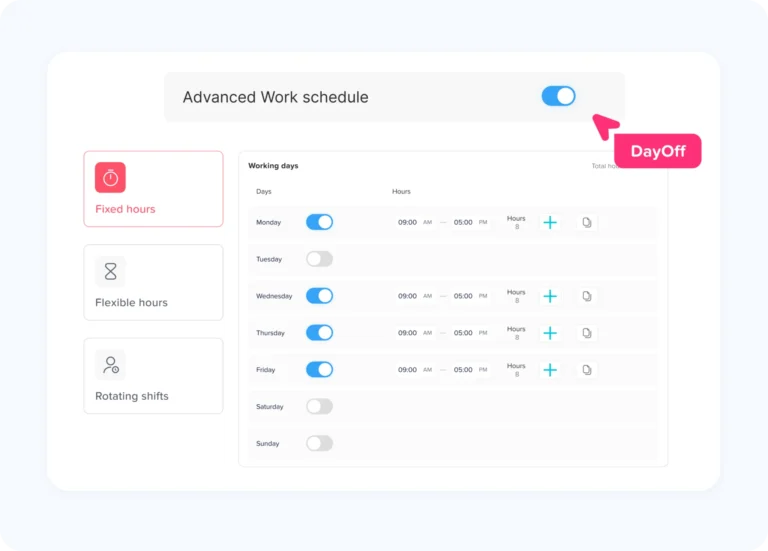
For each workweek, the employer still needs to identify:
- Actual hours worked
- The salary or straight-time compensation
- The employee’s regular rate under the applicable pay method
- Overtime hours
- Overtime compensation
- PTO hours
- Unpaid hours
Employers should not assume that a salaried employee can work additional hours without overtime merely because the employee receives the same base pay each period.
Common PTO Scenarios
Scenario 1: An exempt employee takes two hours off
An exempt employee leaves two hours early for a personal appointment.
The employer may generally deduct two hours from the employee’s PTO balance while continuing to pay the full salary. A two-hour salary deduction would generally be improper unless a specific exception applies.
Scenario 2: A nonexempt employee takes two hours off
A nonexempt employee leaves two hours early.
The employer records the hours actually worked and may apply two PTO hours to the missed portion of the scheduled shift. If no PTO or other paid leave applies, the unworked hours may be unpaid under federal law.
Scenario 3: An exempt employee works during a planned vacation week
An exempt employee plans to take an entire week off but joins a work meeting on Wednesday.
Because the employee performed work during the week, the employer should carefully review the salary-basis requirement before treating the week as fully unpaid. Exempt employees generally must receive their full salary for a week in which they perform any work, subject to limited exceptions.
Scenario 4: A nonexempt employee works during PTO
A nonexempt employee answers customer messages for 45 minutes during a vacation day.
The 45 minutes should be recorded and paid as work time and included in the overtime calculation. The employer should then correct the PTO record according to its policy.
Scenario 5: The company closes for one day
The company closes on Friday because of a systems problem.
A nonexempt employee generally does not have to be paid under the FLSA for hours not worked, although PTO, state law, a contract, or company policy may provide payment.
An exempt employee who worked earlier in the week generally must still receive the full salary. The employer may be able to charge the closure day to the employee’s leave bank without reducing the required salary.
Scenario 6: PTO pushes a nonexempt employee above 40 paid hours
A nonexempt employee works 36 hours and uses eight PTO hours.
The employee receives 44 paid hours but has only 36 hours worked for the federal overtime calculation. The eight PTO hours generally do not create federal overtime.
Should Exempt Employees Track Their Time?
Exempt employees do not usually need the same wage-calculation time records as nonexempt employees, but that does not mean employers should avoid tracking all exempt employee time.
Time records may still support:
- PTO deductions
- Attendance
- Project costing
- Client billing
- Workload analysis
- Staffing decisions
- FMLA administration
- Required internal controls
- Grant or government-contract reporting
- Security and access records
The safest approach is to explain why the information is being collected.
For example, a company can state that exempt employees record time off and project activity for planning and reporting, while their salary is not ordinarily reduced according to the number of hours worked.
Managers should also be trained not to use an exempt employee’s timesheet as an automatic salary-docking tool.
How to Build a PTO Policy for Both Classifications
A clear policy should explain where the rules are the same and where they differ.
Apply consistent eligibility rules where appropriate
Employers may decide that exempt and nonexempt employees receive the same annual PTO allowance. They may also use different policies based on legitimate factors such as:
- Full-time or part-time status
- Length of service
- Work location
- Union coverage
- Job category
- Scheduled weekly hours
The policy should define eligibility clearly and apply it consistently.
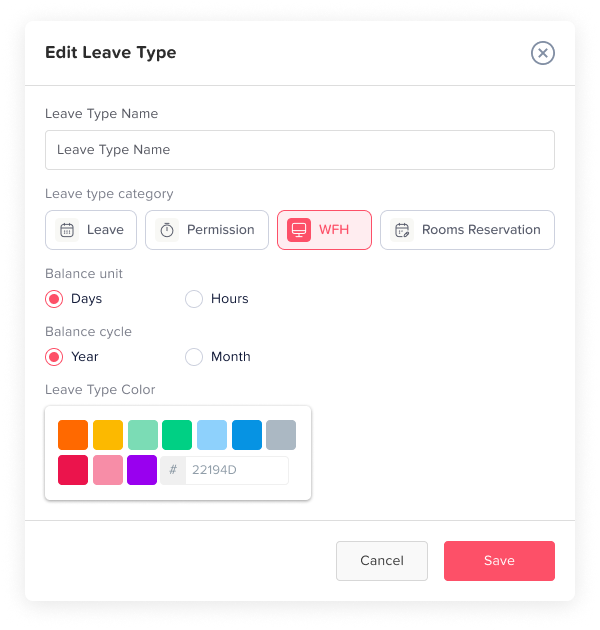
Define the unit used for PTO
State whether leave is tracked in:
- Days
- Half days
- Hours
- Portions of an hour
Hourly tracking is often more accurate for employees with different schedules. It can also help employers process partial-day leave consistently.
For exempt employees, the policy should distinguish a deduction from the PTO bank from a deduction from salary.
Explain partial-day leave
The policy should address:
- The minimum PTO increment
- Whether employees must use PTO for short absences
- How exempt employee salary will be protected
- How nonexempt missed hours are recorded
- What happens when no PTO remains
- How FMLA or other protected leave is handled
Explain overtime treatment
For nonexempt employees, state whether PTO hours count toward overtime under the company’s policy.
Federal law generally does not require vacation, holiday, or sick-leave hours to be counted as hours worked for overtime.
A policy may be more generous, but payroll must apply the chosen rule consistently.
Address work during PTO
The policy should instruct employees not to perform work during approved leave unless specifically authorized.
It should also explain that nonexempt employees must report all work time, even when the work was brief, remote, or not approved in advance.
Include a salary-deduction complaint procedure
Exempt employees should have a clear process for reporting a suspected improper deduction. The policy should identify:
- Who receives the complaint
- How payroll reviews it
- When reimbursement is provided
- How the employer prevents recurrence
A clearly communicated policy and complaint mechanism are important parts of the federal safe-harbor framework for improper deductions.
PTO Tracking Checklist for Employers
For exempt employees
Track:
- Exemption category
- Salary basis and salary level
- Primary duties
- Full-day versus partial-day absence
- PTO-bank deduction
- Salary deduction, if any
- Reason for the deduction
- FMLA status where applicable
- Entire weeks with no work
- Work performed during leave
- Payroll corrections
- Improper-deduction complaints
For nonexempt employees
Track:
- Scheduled hours
- Actual daily work hours
- Total weekly work hours
- PTO hours
- Sick-leave hours
- Holiday hours
- Unpaid absence hours
- Work performed during leave
- Regular rate
- Overtime hours
- Overtime pay
- Timesheet corrections
- Manager approvals
For all employees
Track:
- Leave type
- Request date
- Leave dates
- Approval status
- Approver
- Available balance
- Amount used
- Accruals
- Carryover
- Cancellations
- Balance adjustments
- Policy version
- Work location
- Supporting documentation where necessary
How PTO Software Helps Employers Keep the Records Separate
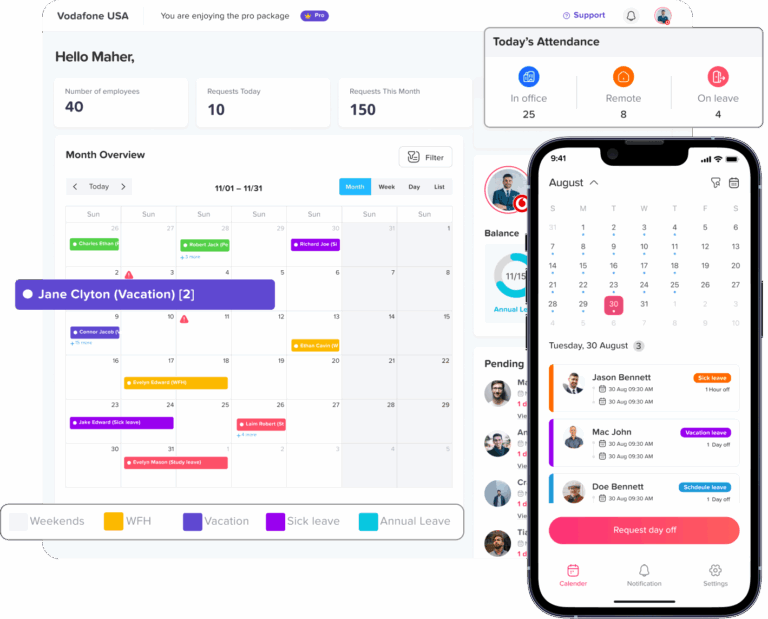
Using one spreadsheet column for “paid hours” can hide the difference between hours worked, PTO hours, holidays, sick leave, and overtime.
A PTO and attendance system should keep these records connected but distinct.
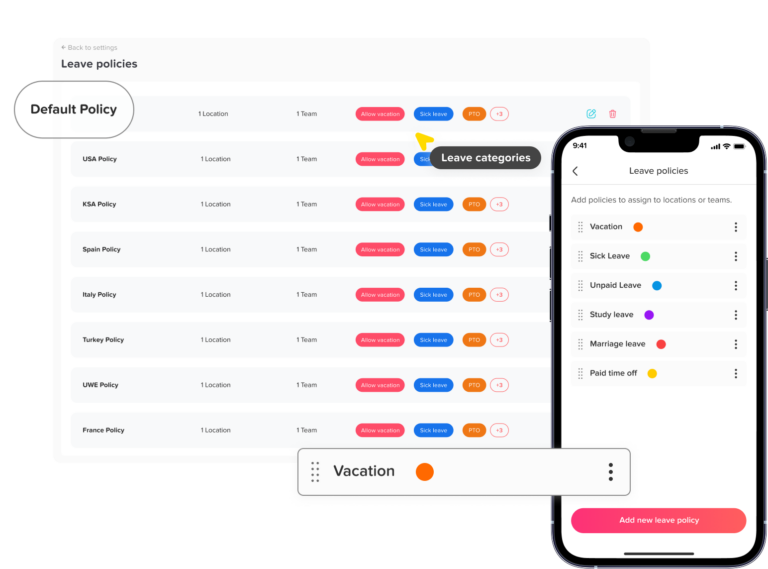
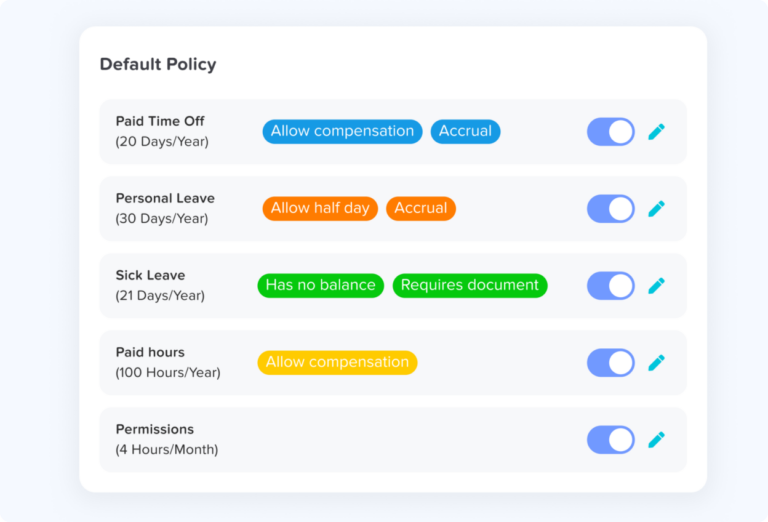
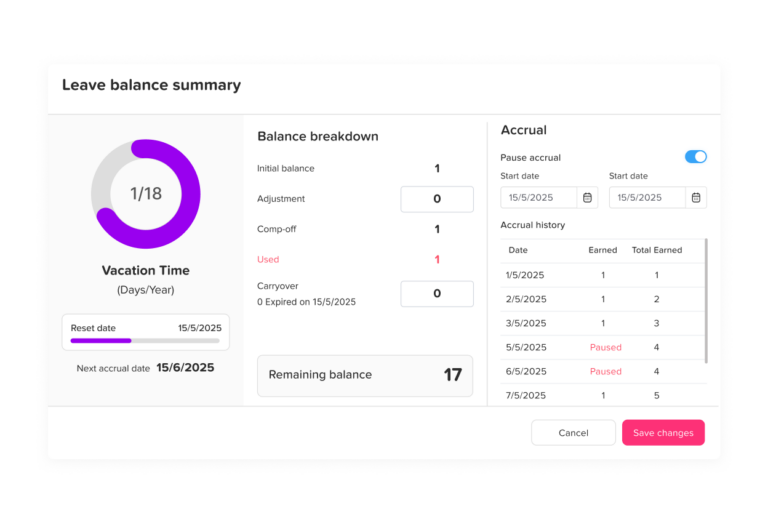
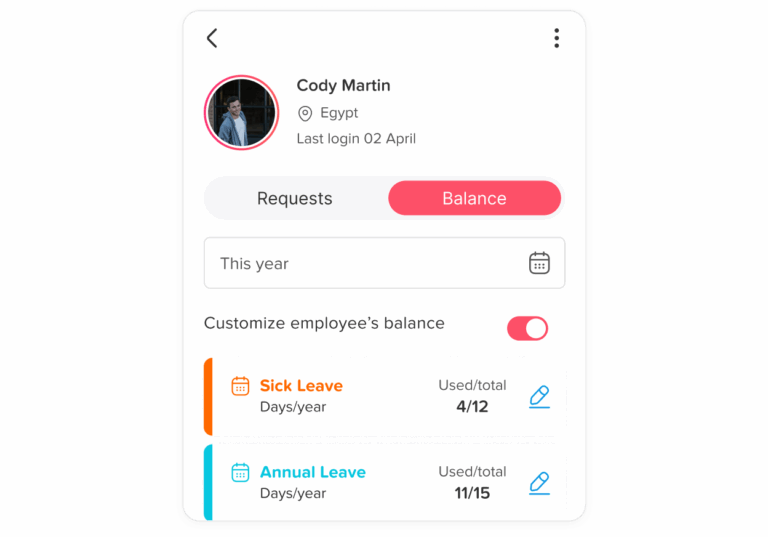
Day Off helps employers manage leave requests, available balances, approval workflows, work schedules, attendance, overtime, and employee reports in one place. Its reports can show allocated, used, and remaining leave and can break usage down into days and hours.
Employers can use separate policies for different employee groups while maintaining a consistent request process.
For example:
- Exempt employees can submit partial-day PTO without triggering an automatic salary deduction.
- Nonexempt employees can connect PTO to their scheduled hours.
- Managers can compare approved leave with attendance records.
- Payroll can distinguish work hours from paid absence hours.
- HR can export leave records for reconciliation and review.
The goal is not simply to count days off. It is to create a reliable record of why an employee was away, how the absence affected the leave balance, whether work was performed, and how the employee should be paid.
Frequently Asked Questions
Do exempt employees get PTO?
Federal law does not generally require employers to provide PTO to exempt or nonexempt employees. An employer may offer PTO through its policy, while state or local law may require certain forms of paid leave.
Can an employer deduct PTO from an exempt employee?
Under federal salary-basis guidance, an employer may generally reduce an exempt employee’s accrued PTO balance for a full-day or partial-day absence as long as the employee still receives the required predetermined salary for a week in which work is performed.
Can an employer deduct pay for a partial-day absence?
A partial-day salary deduction from an exempt employee is generally not permitted, except in limited circumstances such as qualifying unpaid FMLA leave or the initial or final week of employment. A nonexempt employee generally must be paid for hours worked but does not have to be paid under the FLSA for unworked hours unless paid leave or another requirement applies.
Can an exempt employee take unpaid time off?
Yes, but employers must apply the salary-basis rules carefully. Full-day salary deductions may be permitted for certain personal absences or qualifying sickness or disability absences. Partial-day unpaid deductions are generally restricted unless a recognized exception applies.
Does PTO count toward overtime?
Paid vacation, holiday, and sick-leave hours generally do not count as hours worked when calculating federal FLSA overtime. A company policy, employment agreement, or other applicable rule may provide a more generous calculation.
Can a salaried employee be nonexempt?
Yes. Receiving a salary does not automatically make an employee exempt. A salaried nonexempt employee must still have work hours tracked and receive overtime compensation when required.
Do exempt employees have to complete timesheets?
Employers may require exempt employees to complete timesheets for attendance, PTO, project tracking, client billing, staffing, or other business purposes. However, employers should not automatically reduce an exempt employee’s salary based on small variations in hours worked.
What happens when an employee works during PTO?
For a nonexempt employee, the work time should be recorded, paid, and included in the overtime calculation. For an exempt employee, performing work during a week may affect whether the employer can treat the entire week as unpaid.
Can employers require exempt employees to use PTO during a closure?
Under federal salary-basis guidance, an employer may generally reduce an exempt employee’s leave balance during a partial-week closure while continuing to pay the full required salary. State law, employment agreements, and company policies should also be reviewed.
Should exempt and nonexempt employees have separate PTO policies?
They do not always need completely separate policies. However, the policy should clearly explain differences involving partial-day absences, salary deductions, hourly records, overtime, unpaid time, and work performed during leave.
Final Thoughts
Exempt and nonexempt employees may receive the same number of PTO days, but employers should not process every absence in the same way.
For exempt employees, the main concerns are preserving the salary basis, separating PTO-bank reductions from salary deductions, distinguishing full-day and partial-day absences, and documenting the reason for any unpaid time.
For nonexempt employees, employers must accurately track every hour worked, keep PTO separate from work time, calculate overtime from compensable hours, and record any work performed during approved leave.
A reliable process should answer four questions for every absence:
- Was the employee scheduled to work?
- How much time did the employee actually work?
- Which leave balance should be used?
- How should payroll treat the absence?
When PTO, schedules, attendance, and payroll records are connected, employers can apply their policies more consistently, reduce manual errors, and maintain a clearer record for both employees and managers.