








Employee clock-in and clock-out records do not always transfer directly to payroll. Some employers use a time clock rounding policy to convert actual punch times into standard five-minute, six-minute, or fifteen-minute increments.
For example, an employee who clocks in at 7:57 a.m. may be recorded as starting at 8:00 a.m. Another employee who clocks in at 8:03 a.m. may also be credited with an 8:00 a.m. start.
Time rounding may make payroll calculations easier, but it can also create wage and hour risks. A rounding system that repeatedly removes employee work time, treats early and late punches differently, or rounds only in the employer’s favor can result in inaccurate regular wages and overtime.

Federal regulations recognize certain neutral time-rounding practices, but the method must not systematically undercompensate employees over time. State and local laws may impose stricter requirements, particularly for meal periods or where an employer’s system already records time precisely.
This guide explains how time clock rounding works, how the 7-minute rule is calculated, which practices create payroll risks, and what HR teams should review during a timekeeping audit.
What Is a Time Clock Rounding Policy?
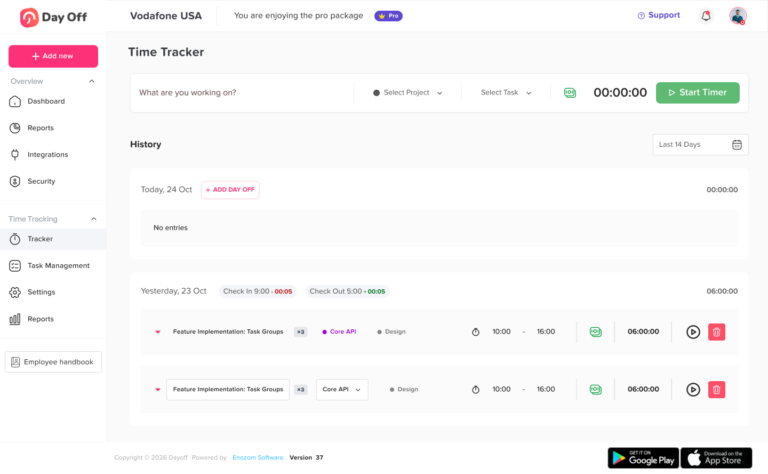
A time clock rounding policy is a workplace rule that converts an employee’s actual starting and stopping times into predetermined increments for payroll calculation.
Instead of paying employees according to every recorded minute, an employer may round a punch to the nearest:
- Five minutes
- Six minutes, which equals one-tenth of an hour
- Fifteen minutes, which equals one-quarter of an hour
For example, under a quarter-hour policy, a 7:56 a.m. clock-in may become 8:00 a.m., while an 8:08 a.m. clock-in may become 8:15 a.m.
The purpose of employee time rounding has traditionally been to simplify time calculations. This was especially useful when employers relied on mechanical time clocks, paper timecards, and manual payroll calculations.
Modern time-tracking systems can record exact punches automatically. However, some businesses still use rounding because of existing payroll practices, industry procedures, collective bargaining agreements, or established workplace policies.
Federal regulations do not require employers to use time clocks or rounding. When rounding is used, it must not prevent employees from receiving proper compensation for all time actually worked.
Time Clock Rounding Is Not the Same as Scheduling
A work schedule shows when an employee is expected to work. A time record should show when compensable work actually occurred.
For example, an employee may be scheduled to begin at 8:00 a.m. but start performing required tasks at 7:54 a.m. The employer cannot automatically disregard those six minutes simply because the scheduled shift begins later.
Similarly, an employee scheduled to finish at 5:00 p.m. may remain until 5:08 p.m. to close a register, complete a customer transaction, prepare a handoff, or finish a required report.
A scheduling policy may tell employees not to work before or after their assigned hours. The employer may address violations through attendance management, coaching, or discipline. However, a scheduling rule does not erase compensable work that the employer required, allowed, or had reason to know was being performed.
A reliable timekeeping process should therefore separate three records:
| Record | What It Represents |
|---|---|
| Work schedule | When the employee was expected to work |
| Actual punch record | When the employee clocked in and out |
| Payable work time | The compensable time included in payroll |
Comparing these records helps HR identify late arrivals, unauthorized overtime, missed punches, incorrect rounding, and off-the-clock work.
Are Employers Required to Round Employee Time?
No. Federal law does not require an employer to use a time clock or to round employee punches.
Employers may use:
- Electronic time clocks
- Mobile punch-in applications
- Browser-based attendance systems
- Paper timesheets
- Manual time records
- A designated timekeeper
- Another reliable recordkeeping method
The method must provide accurate information about the employee’s daily and weekly hours. Employers covered by the Fair Labor Standards Act generally need records showing the hours worked each day and the total hours worked during each workweek.
An employer can choose to pay according to exact punch times instead of rounding. Because modern software can calculate minutes automatically, exact-time payroll may reduce disputes about whether a rounding policy is operating neutrally.
What Are the Federal Time Clock Rounding Rules?
The primary federal regulation addressing employee time rounding is 29 C.F.R. § 785.48.
The regulation recognizes that employers have historically rounded employee starting and stopping times to the nearest five minutes, one-tenth of an hour, or one-quarter of an hour.
However, the practice is accepted only when it does not result, over time, in employees being improperly compensated for the hours they actually worked.
A time clock rounding policy should satisfy two important conditions.
The policy must be neutral as written
The written rule should be capable of benefiting either the employee or the employer.
For example, a policy should not say:
- Early clock-ins are always moved forward to the scheduled start.
- Late clock-outs are always moved backward to the scheduled end.
- Late arrivals are recorded at their exact time.
- Early departures are recorded at their exact time.
That arrangement would remove time when the change benefits the employer while preserving time when the employee loses pay.
A facially neutral policy applies the same mathematical rule regardless of which party benefits from the result.
The policy must operate neutrally in practice
A policy may look neutral on paper but still create systematic underpayment.
Suppose a company rounds to the nearest quarter hour. Employees regularly begin setup work five minutes before their shifts, so those minutes are removed. At the end of the day, employees clock out exactly at their scheduled time and never receive an equivalent rounding benefit.
The mathematical rule may appear neutral, but the actual pattern consistently reduces paid time.
In a May 28, 2026 opinion letter, the U.S. Department of Labor examined a hospital practice that rounded early clock-ins forward to the scheduled shift start. The department explained that the critical question is whether the policy is neutral on its face and in operation. When employees performed compensable work during the removed time and the practice only benefited the employer, the described practice was inconsistent with the federal rounding regulation.
Employers should therefore review real payroll data instead of assuming that a mathematically balanced rule automatically produces neutral results.
How Does the 7-Minute Rounding Rule Work?
The 7-minute rounding rule is the common name for rounding time to the nearest quarter hour.
A quarter hour contains 15 minutes. Because the midpoint falls between seven and eight minutes, the usual calculation works as follows:
- One through seven minutes are rounded to the earlier quarter hour.
- Eight through fourteen minutes are rounded to the next quarter hour.
The U.S. Department of Labor uses this method as an example of quarter-hour rounding. It also warns that always rounding down can violate minimum wage and overtime requirements.
Quarter-hour rounding chart
| Actual Punch Time | Rounded Time | Difference |
|---|---|---|
| 7:52 a.m. | 7:45 a.m. | 7 minutes earlier |
| 7:55 a.m. | 8:00 a.m. | 5 minutes later |
| 8:00 a.m. | 8:00 a.m. | No difference |
| 8:07 a.m. | 8:00 a.m. | 7 minutes earlier |
| 8:08 a.m. | 8:15 a.m. | 7 minutes later |
| 8:09 a.m. | 8:15 a.m. | 6 minutes later |
| 8:22 a.m. | 8:15 a.m. | 7 minutes earlier |
| 8:23 a.m. | 8:30 a.m. | 7 minutes later |
The same rule should apply to both clock-ins and clock-outs.
This table explains the mathematical method only. It does not establish that quarter-hour rounding is appropriate for every business or legal jurisdiction.
Five-Minute Rounding Example
When time is rounded to the nearest five minutes, the midpoint is two and a half minutes.
A system may therefore calculate punches approximately as follows:
| Actual Punch | Rounded Punch |
|---|---|
| 7:58 a.m. | 8:00 a.m. |
| 8:02 a.m. | 8:00 a.m. |
| 8:03 a.m. | 8:05 a.m. |
| 8:07 a.m. | 8:05 a.m. |
| 8:08 a.m. | 8:10 a.m. |
Five-minute rounding creates smaller differences than quarter-hour rounding, but the employer must still examine whether the results systematically remove employee work time.
Using a smaller increment does not make an otherwise employer-favoring policy neutral.
Six-Minute Rounding Example
Some payroll systems calculate time in tenths of an hour. Because one-tenth of 60 minutes is six minutes, punches are rounded to six-minute increments.
Examples include:
| Actual Time | Payroll Time |
|---|---|
| 8 hours and 3 minutes | 8.1 hours |
| 8 hours and 9 minutes | 8.2 hours |
| 8 hours and 15 minutes | 8.3 hours |
| 8 hours and 27 minutes | 8.5 hours |
Employers should confirm how their payroll software converts minutes into decimal hours. A decimal such as 8.30 does not mean eight hours and thirty minutes. It represents eight hours plus three-tenths of an hour, which equals eight hours and eighteen minutes.
Confusing decimal hours with clock minutes can create payroll errors even when the punch-rounding rule itself is applied correctly.
Example of Neutral Employee Time Rounding
Assume a company rounds employee start and end times to the nearest quarter hour.
| Day | Actual Start | Rounded Start | Actual End | Rounded End | Net Result |
|---|---|---|---|---|---|
| Monday | 7:56 a.m. | 8:00 a.m. | 5:06 p.m. | 5:00 p.m. | Employee loses 10 minutes |
| Tuesday | 8:04 a.m. | 8:00 a.m. | 4:54 p.m. | 5:00 p.m. | Employee gains 10 minutes |
| Wednesday | 7:58 a.m. | 8:00 a.m. | 5:04 p.m. | 5:00 p.m. | Employee loses 6 minutes |
| Thursday | 8:03 a.m. | 8:00 a.m. | 4:57 p.m. | 5:00 p.m. | Employee gains 6 minutes |
| Friday | 8:00 a.m. | 8:00 a.m. | 5:00 p.m. | 5:00 p.m. | No difference |
In this simplified example, the gains and losses balance across the week.
However, one balanced employee record does not prove that the company’s entire rounding practice is neutral. HR should examine a meaningful period across different:
- Employees
- Shifts
- Managers
- Departments
- Locations
- Pay periods
- Job duties
- Clock-in and clock-out patterns
A company-wide total can also hide a problem. One department may consistently gain minutes while employees working an opening or closing shift consistently lose them.
Example of an Employer-Favoring Rounding Policy
Consider a company with the following practice:
- Employees may clock in up to seven minutes early.
- Every early clock-in is moved forward to the scheduled start.
- Employees may not clock out before the scheduled end.
- Clock-outs after the scheduled end are moved backward.
- Late arrivals are recorded at their actual time.
- Early departures are recorded at their actual time.
This is not a genuinely neutral system.
Employees lose time when they arrive early or remain late, but they do not receive an equivalent benefit when they arrive after the scheduled start or leave before the scheduled end.
The risk becomes greater when employees perform actual duties during the removed periods. Examples may include accepting shift handoffs, preparing equipment, opening systems, serving customers, or completing closing procedures.
The Department of Labor’s 2026 opinion letter emphasized that rounding early clock-ins may be inconsistent with federal rules when employees perform compensable work and the practice only benefits the employer.
Rounding Cannot Remove Compensable Work
A payroll setting does not determine whether an activity is work.
Under federal hours-worked principles, covered nonexempt employees generally must be paid for work that an employer requires, allows, or has reason to know is being performed. That can include work completed outside scheduled hours or without advance permission.
Potentially compensable pre-shift activities may include:
- Preparing tools or equipment
- Opening required computer systems
- Reviewing work assignments
- Reading required messages
- Receiving a shift handoff
- Completing safety procedures
- Setting up a register or workstation
Potentially compensable post-shift activities may include:
- Closing a cash register
- Completing a customer transaction
- Cleaning required equipment
- Writing a shift report
- Securing the workplace
- Responding to a manager
- Completing a required handoff
A company may prohibit employees from working outside scheduled hours without approval. It can manage the policy violation separately. However, when compensable work occurred, the time generally still needs to be recorded and paid.
What About Early Clock-Ins When No Work Is Performed?
An early punch does not always prove that the employee started working immediately.
An employee might arrive before the shift and spend the time:
- Buying coffee
- Putting away personal belongings
- Talking with colleagues
- Waiting in a break area
- Handling personal messages
- Preparing for personal convenience rather than performing required duties
Federal regulations recognize that clock records and actual work time may differ when an employee voluntarily arrives early or stays late without performing work.
The employer should not simply assume that every early punch is work or that none of it is work. Managers should understand the employee’s actual activities and the operational expectations placed on the employee.
A strong procedure should clearly explain:
- How early employees may clock in.
- When they are permitted to begin work.
- Which preparation activities are compensable.
- How employees should report work performed outside scheduled hours.
- What managers must do when they observe early or late work.
Can Employers Round Meal Breaks?
Employers should treat meal-period rounding separately from general shift rounding.
Under federal law, short rest periods of 20 minutes or less are generally treated as compensable work time. A bona fide meal period may be unpaid when the employee is completely relieved from duty for the purpose of eating a regular meal.
A rounding rule can hide important meal-period problems. For example, an employee may clock out for lunch at 12:04 p.m. and return at 12:30 p.m. If the system changes the punches to 12:00 p.m. and 12:30 p.m., the payroll record appears to show a complete 30-minute meal even though the employee received only 26 minutes.
California meal-period rounding
In Donohue v. AMN Services, LLC, the California Supreme Court held that employers may not round meal-period punches. The court emphasized the importance of precise meal-period records because rounding can conceal short, late, or missed meals.
Washington meal and rest periods
Washington’s administrative guidance states that employers cannot round, deduct, or average time from required meal or rest periods. If an employee works four minutes into an unpaid meal, the meal period begins when the employee actually stops working.
Because break laws vary significantly, employers should not automatically apply a general time clock rounding policy to meal and rest records.
State Time Clock Rounding Laws May Be Stricter
Federal acceptance of a neutral rounding method does not mean that the same method is permitted in every state.
Employers must consider:
- State wage laws
- Local ordinances
- Meal and rest requirements
- Daily overtime rules
- Industry wage orders
- Predictive scheduling requirements
- Collective bargaining agreements
- Court decisions interpreting state law
California remains particularly important for businesses using exact electronic timekeeping systems.
In Camp v. Home Depot U.S.A., Inc., a California Court of Appeal questioned the use of quarter-hour rounding where the employer could record exact time and the employee claimed a net loss of 470 minutes over approximately four and a half years.
As of July 10, 2026, the California Supreme Court continued to list the broader legality of neutral time rounding under California law as a pending issue.
Multi-state employers should therefore avoid applying one national time rounding configuration without reviewing the requirements that apply in each location.
Common Time Clock Rounding Policy Mistakes
Always rounding to the scheduled shift
Replacing actual punches with scheduled times may remove real work performed before or after the shift.
Schedules should help identify exceptions. They should not automatically replace actual attendance records.
Rounding only when it reduces payroll
A manager should not choose whether to round based on which result is less expensive.
The same documented mathematical rule should apply consistently.
Treating unauthorized work as unpaid
An employee may violate a rule by working early, late, or overtime without approval. That issue can be handled through management procedures, but the employer should not automatically remove time that was actually worked.
Applying rounding to meal periods
General shift rounding may not be permitted for meal or rest periods, especially in states with strict break-recording requirements.
Automatically deducting meal time
An automatic 30-minute deduction may be inaccurate when an employee works through lunch, starts the meal late, returns early, or is interrupted.
Employers using automatic deductions need an accessible process for reporting missed or interrupted meals.
Deleting the original punch
When a system stores only the rounded value, HR cannot compare actual time with paid time.
Both values should be retained:
- Original employee punch
- Rounded payroll value
Replacing a missing punch with the schedule
The scheduled shift may be useful evidence, but it does not always show when the employee actually began or ended work.
A correction should be based on available evidence, such as the employee’s statement, manager confirmation, access logs, work activity, customer records, or system usage.
Ignoring small repeated differences
A few minutes may look insignificant on one shift. Repeated across many employees and pay periods, those minutes can create substantial regular and overtime wage differences.
Auditing only company-wide totals
A company-wide average can appear neutral while a specific department, shift, manager, or employee group regularly loses time.
Audit results should be divided into meaningful groups.
How Small Rounding Differences Affect Payroll
Assume a company has:
- 20 employees
- Five uncompensated minutes per shift
- Five shifts per week
- 50 working weeks
- An average hourly rate of $20
The yearly difference is:
20 employees × 5 minutes × 5 shifts × 50 weeks = 25,000 minutes
That equals approximately 416.67 hours.
At $20 per hour, the straight-time wage difference would be approximately $8,333.40.
The total exposure may be higher if some of the removed time should have been paid at an overtime rate or if applicable law provides penalties, interest, liquidated damages, attorney fees, or waiting-time penalties.
This is why HR should evaluate the combined payroll impact rather than reviewing each difference in isolation.
How to Write a Time Clock Rounding Policy
A good policy should explain the entire time-recording process, not only the mathematical increment.
Identify the employees covered
Clarify whether the policy applies to:
- Hourly nonexempt employees
- Salaried nonexempt employees
- Temporary employees
- Remote employees
- Selected departments
- Specific locations
- Unionized employees
Different employee groups may be subject to different requirements.
State the exact rounding increment
Specify whether punches are rounded to the nearest:
- Five minutes
- Six minutes
- Fifteen minutes
Avoid vague wording such as “employee time may be adjusted for payroll.”
Explain the mathematical rule
Employees should be able to understand how an actual punch becomes a payroll time.
Include examples showing punches that round both forward and backward.
Apply the rule consistently
The policy should confirm that the same rule applies regardless of whether the result favors the employee or the employer.
Managers should not manually select the result they prefer.
Separate scheduled time from worked time
Explain that scheduled hours do not replace actual compensable hours.
Employees must record work performed before or after the scheduled shift.
Prohibit off-the-clock work
State that employees should not:
- Begin work before clocking in
- Continue working after clocking out
- Work during an unpaid meal
- Perform remote tasks without recording the time
- Ask another employee to record time for them
Managers should also be prohibited from requesting or allowing off-the-clock work.
Provide a correction process
Employees should know how to report:
- Missed clock-ins
- Missing clock-outs
- Incorrect punches
- Interrupted meals
- System failures
- Unrecorded early or late work
- Incorrect manager edits
The process should be easy to access and should not discourage employees from reporting errors.
Preserve the audit trail
A correction record should show:
- Original value
- Updated value
- Date of the correction
- User who made the correction
- Reason for the change
- Approval status
- Payroll impact
Explain overtime treatment
Rounding should not be used to remove overtime.
The policy should explain how extra work is reported, reviewed, and paid, even when the employee did not obtain advance permission.
Commit to regular audits
Assign responsibility for checking whether the system operates neutrally.
The policy should identify who reviews the data and how frequently the review occurs.

Sample Time Clock Rounding Policy
The company records employees’ actual clock-in and clock-out times through its approved timekeeping system. Where legally permitted, starting and ending times may be rounded to the nearest [five minutes, six minutes, or quarter hour] for payroll calculation.
The rounding method will be applied consistently in both directions. It will not be used to systematically reduce employee work time or compensation.
Employees must record all time worked. Employees may not perform work before clocking in, after clocking out, or during an unpaid meal period. Scheduled start and end times do not replace actual compensable work time.
Employees who perform work outside their scheduled hours must report the time, even when the work was not approved in advance. Failure to obtain advance approval may be addressed separately, but employees should never omit work from their time record.
Employees must review their time records and report missing or inaccurate entries promptly. Managers may correct a record only after confirming the appropriate time and documenting the reason for the change.
The company will preserve original punch records and periodically compare actual punches with rounded and paid time. Confirmed payroll errors will be reviewed and corrected according to applicable requirements.
This sample should be reviewed and adapted for the company’s locations, workforce, payroll process, and legal requirements.
Time Clock Rounding Audit Checklist
| Audit Item | What to Verify | Recommended Action |
|---|---|---|
| Written policy | The increment and calculation method are clearly explained | Update vague or outdated wording |
| Legal review | Federal, state, local, industry, and union rules were considered | Complete a location-specific review |
| Original punches | Exact clock-in and clock-out times are retained | Preserve the original record |
| Rounded values | The payroll value can be compared with the exact punch | Export both values |
| Rule direction | The method rounds both forward and backward | Remove employer-only treatment |
| Actual work | Rounded-away minutes did not contain compensable work | Review employee duties and workflows |
| Net employee result | Employees sometimes gain and sometimes lose time | Investigate consistent losses |
| Company-wide result | Paid time is not systematically lower than worked time | Calculate corrections where needed |
| Department results | Individual teams and locations are reviewed separately | Investigate concentrated patterns |
| Pre-shift activity | Employees are not completing unpaid setup work | Change workflows or pay the time |
| Post-shift activity | Required closing tasks are included | Add missing time |
| Meal periods | Breaks are recorded according to applicable law | Remove prohibited meal rounding |
| Automatic deductions | Employees can report missed or interrupted meals | Add an exception process |
| Overtime | Rounding does not remove overtime minutes | Recalculate affected workweeks |
| Manager edits | Changes retain the original value and reason | Require an audit trail |
| Missing punches | Corrections reflect verified time rather than only the schedule | Confirm the actual start or end |
| Payroll export | Approved time records match payroll totals | Reconcile before payroll closes |
| Employee complaints | Reported concerns are documented and investigated | Correct confirmed errors promptly |
| Record retention | Records meet federal and applicable state requirements | Update the retention procedure |
| Future reviews | The audit is repeated regularly | Schedule quarterly or semiannual testing |
How to Audit a Time Clock Rounding Policy
Export the necessary data
The audit should include:
- Employee name or identifier
- Work date
- Department
- Location
- Manager
- Scheduled start and end
- Actual clock-in and clock-out
- Rounded clock-in and clock-out
- Actual worked minutes
- Paid minutes
- Regular hours
- Overtime hours
- Meal punches
- Manual corrections
- Correction reasons
- Payroll rate
Without both actual and rounded values, the employer cannot determine the effect of the policy.
Calculate the difference for each shift
Use this basic calculation:
Paid minutes minus actual compensable minutes equals the rounding difference.
A positive number means the employee received additional paid time.
A negative number means the employee lost paid time.
The calculation should focus on compensable work, not simply the difference between the earliest and latest punches. The employer may need to investigate what the employee was doing during disputed periods.
Review the results over a meaningful period
A single day or week may not show whether the policy averages out.
Review multiple pay periods and include different operating conditions, such as:
- Busy and quiet weeks
- Opening and closing shifts
- Weekday and weekend shifts
- Different managers
- Different locations
- Seasonal periods
- Overtime weeks
Separate the results into groups
Analyze the data by:
- Employee
- Department
- Location
- Supervisor
- Shift
- Job
- Pay period
- Clock-in difference
- Clock-out difference
- Regular time
- Overtime time
This can reveal a pattern hidden by the overall company total.
Investigate warning signs
Potential warning signs include:
- Early punches almost always round forward.
- Late punches rarely round backward in the employee’s favor.
- Clock-outs are frequently moved to the scheduled end.
- One manager makes an unusually high number of edits.
- Opening-shift employees consistently lose time.
- Closing-shift employees perform unpaid tasks.
- Rounding frequently eliminates overtime.
- Meal records repeatedly show exactly 30 minutes.
- Employees report that they must prepare equipment before clocking in.
Correct past errors separately
Changing the policy for future pay periods does not automatically resolve previous underpayments.
When an audit identifies an error, HR and payroll should document:
- Employees affected
- Dates affected
- Regular minutes owed
- Overtime minutes owed
- Applicable pay rates
- Payroll correction
- Approval
- Employee communication
- Reason for the adjustment
Time Clock Record Retention
Federal recordkeeping rules generally require employers to preserve payroll records for at least three years.
Records used to calculate wages, including timecards, work schedules, and records of wage additions or deductions, generally should be retained for at least two years. State laws may require longer retention periods.
Employers should retain enough information to reconstruct the calculation. Saving only the final paid total may not explain:
- The employee’s original punch
- How rounding changed the punch
- Whether a manager edited the entry
- Whether overtime was affected
- Why payroll issued a correction
Is Exact-Time Tracking Better Than Rounding?
Paying employees according to exact recorded minutes may be a simpler approach for many businesses.
Modern timekeeping software can calculate work hours automatically without requiring payroll teams to convert every punch manually. Exact-time tracking also eliminates the need to prove that a rounding rule averaged out neutrally.
However, exact punches do not solve every attendance problem.
Employers still need procedures for:
- Missing punches
- Off-the-clock work
- Early work
- Late work
- Interrupted meals
- Automatic break deductions
- Unauthorized overtime
- Manager edits
- Remote work
- System failures
The best approach is one that accurately records compensable work, complies with applicable laws, and gives employees a clear way to report mistakes.
How Day Off Supports Accurate Time and Attendance Records
Day Off Time Tracker connects employee work hours with schedules, attendance, leave requests, absences, late time, and overtime.
Employees can punch in and punch out through one system. Managers can review who is working, who is absent, who missed a punch, and how the employee’s recorded time compares with the assigned schedule.
Day Off can calculate total worked hours, late time, and overtime based on fixed, flexible, or rotating schedules. Managers can also export attendance sheets containing punch-in time, punch-out time, absences, overtime, late time, and total worked hours for payroll preparation.
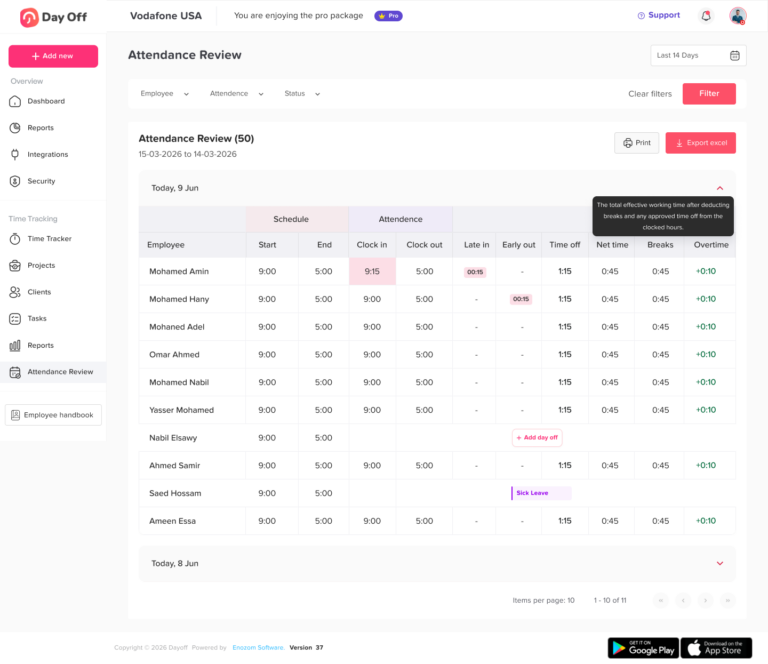
Connecting time tracking with leave management also helps explain attendance exceptions. When an employee does not punch in, managers can check whether the employee has approved vacation, sick leave, unpaid leave, or another recorded absence instead of treating every missing punch as unexplained attendance.
When a company uses employee time rounding, it should preserve exact punches and apply the reviewed payroll calculation separately. Keeping both records provides a clearer audit trail and makes it easier to detect patterns of underpayment.
Frequently Asked Questions About Time Clock Rounding
What is a time clock rounding policy?
A time clock rounding policy converts actual employee punch times into standard payroll increments, such as five, six, or fifteen minutes. Where legally permitted, the rule must operate neutrally and should not systematically reduce employee compensation.
Is the 7-minute time clock rule legal?
Federal guidance recognizes quarter-hour rounding in which one through seven minutes round to the previous quarter hour and eight through fourteen minutes round to the next quarter hour.
The practice must work in both directions and must not consistently underpay employees. State and local rules may be more restrictive.
Can an employer always round an early clock-in to the scheduled start?
Not safely when the employee is performing compensable work during the removed period.
The Department of Labor explained in 2026 that rounding early clock-ins to the scheduled shift may be inconsistent with federal rules when the practice only benefits the employer and employees perform work during that time.
Can an employer round clock-in time but not clock-out time?
Using different rules for the beginning and end of a shift may create a non-neutral result.
Employers should evaluate the entire policy and actual payroll data to determine whether employees receive proper compensation over time.
Can employers round to the nearest 15 minutes?
Federal regulations recognize neutral quarter-hour rounding, but the method cannot result in systematic underpayment. Employers must also consider stricter state or local requirements.
Can an employer round an employee’s lunch break?
Employers should be cautious. California prohibits rounding meal-period punches, and Washington guidance states that required meal and rest periods cannot be rounded, deducted, or averaged.
Does unauthorized overtime still need to be paid?
Covered nonexempt employees generally must be paid for compensable work the employer required, allowed, or had reason to know was performed.
The employer may address the failure to obtain approval separately, but it should not remove work from the employee’s time record.
How often should a rounding policy be audited?
Federal law does not prescribe one universal audit schedule.
A practical approach is to review the policy quarterly or semiannually and after:
- A payroll-system change
- A timekeeping-policy change
- The opening of a new location
- A change in work schedules
- Employee complaints
- Repeated time corrections
- A change in applicable law
Should a company pay employees by the exact minute?
Employers are not required under federal law to use rounding. Paying according to exact compensable time may reduce rounding-related risk, especially where the system already records precise employee punches.
The employer must still identify missing time, off-the-clock work, meal-period issues, and inaccurate edits.
Conclusion
A time clock rounding policy should not be treated as a simple payroll shortcut.
The policy must be clearly written, mathematically neutral, applied consistently, and tested against actual employee records. A rule that appears fair may still create underpayment when employees routinely begin preparation before a shift, complete closing tasks afterward, work through meals, or lose overtime because of rounding.
Employers should preserve original punches, separate scheduled hours from actual work, provide an accessible correction process, and audit results across employees, locations, managers, and shifts.
Where modern attendance software already records exact minutes, paying according to exact compensable time may be easier to explain and audit.
Day Off helps companies connect punch-in and punch-out records with schedules, attendance, overtime, late time, PTO, and payroll-ready reports. By keeping time worked and time off in one system, HR and payroll teams can identify exceptions earlier and maintain more complete employee records.