








When an employee moves from full-time to part-time, their PTO and working hours are not the only things that may need to change. HR must also decide how the new schedule affects the employee’s paid time off, future accrual rate, existing balance, approved leave, public holidays, and payroll records.
The transition can become confusing when the company’s PTO policy only explains how full-time and part-time employees earn leave separately but does not explain what happens when someone moves from one category to the other.
Should the employee keep all the PTO they earned as a full-time employee? Should their balance be reduced to match their new schedule? When should the part-time accrual rate begin? What happens to vacation that was approved before the schedule changed?
Related reading: If you’re building out a broader time-off policy, see our guide to the Free PTO Tracker App For Managing Employee Time Off.

There is no single answer that applies to every employer. In the United States, federal law generally does not require private employers to provide vacation or ordinary paid sick leave. PTO benefits are usually governed by company policy, employment agreements, collective bargaining agreements, and state or local laws.
A clear policy should protect leave that has already been earned, define how future PTO will accrue, and ensure that leave deductions match the employee’s new working schedule.
This guide explains what happens to PTO when an employee changes from full-time to part-time, with formulas, examples, common mistakes, and practical steps for HR teams.
What Changes in PTO When an Employee Moves From Full-Time to Part-Time?
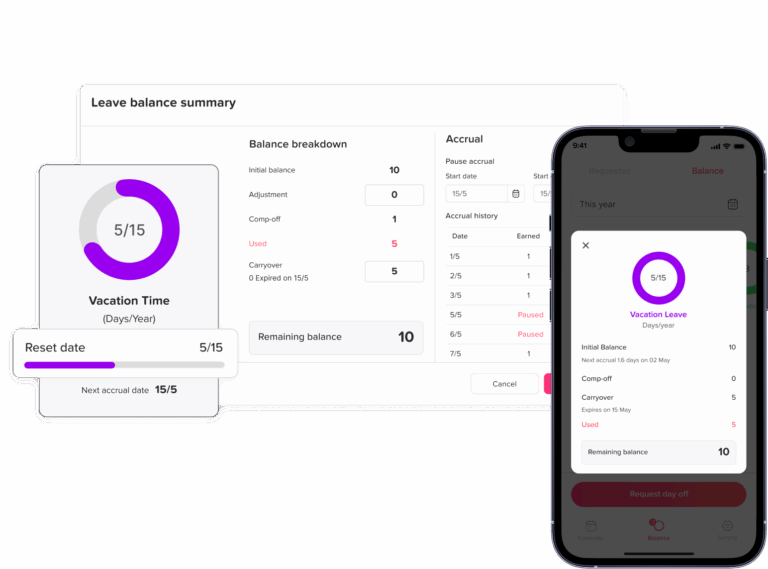
A move from full-time to part-time may affect several connected records:
- Weekly working hours
- Scheduled working days
- Daily shift length
- PTO eligibility
- Annual PTO entitlement
- Accrual rate
- Public holiday treatment
- Benefits eligibility
- Payroll classification
- Overtime calculations
- Approved future leave
- FMLA eligibility and leave calculations
- Attendance expectations
The company should treat the change as a formal employment-status update rather than simply editing the employee’s weekly schedule.
HR should identify an exact effective date and determine which rules apply before and after that date.
For example:
The employee works full-time through August 31 and begins a part-time schedule on September 1.
The full-time PTO rules would normally apply through August 31. The new part-time accrual rate and work schedule would begin on September 1.
Do Part-Time Employees Receive PTO?
Federal law does not generally require private employers to offer vacation PTO to either full-time or part-time employees. The Fair Labor Standards Act also does not define whether a worker must be classified as full-time or part-time. These classifications and voluntary vacation benefits are generally determined by the employer’s policy, subject to other applicable laws and agreements.
An employer may provide part-time employees with:
- The same PTO as full-time employees
- A prorated annual entitlement
- PTO based on hours worked
- A smaller fixed annual grant
- Sick leave only
- Unpaid time off
- No voluntary vacation benefit, when legally permitted
However, state and local sick leave laws may cover part-time employees even when the company’s voluntary vacation plan does not. California, for example, generally requires qualifying full-time, part-time, and temporary employees to receive paid sick leave.
Employers must also administer benefits without unlawful discrimination. Federal equal employment opportunity laws prohibit discrimination in compensation and employee benefits based on protected characteristics.
What Happens to PTO Already Earned Before the Change?
The safest general approach is to separate PTO already earned from PTO that will be earned in the future.
Previously Earned PTO
PTO earned while the employee was full-time should normally remain in the employee’s balance unless a lawful policy clearly provides another treatment.
Reducing future hours does not mean the employee did not earn the previous balance.
For example:
- Full-time schedule before the change: 40 hours per week
- Existing PTO balance: 48 hours
- New part-time schedule: 24 hours per week
The employee would generally keep the 48-hour balance. Future accruals could then be calculated using the part-time rate.
This is especially important in jurisdictions where accrued vacation is treated as earned wages. California, for example, treats earned vacation as vested wages and does not permit an employer to take away accrued vacation through a forfeiture policy.
Rules differ by jurisdiction, so employers should review local requirements before reducing, converting, or removing an existing balance.
Future PTO Accrual
PTO earned after the status-change date may follow the part-time policy.
For example:
- Full-time accrual through August 31: 10 hours per month
- Part-time accrual beginning September 1: 6 hours per month
The employee keeps the balance earned before September 1 but begins earning new PTO at the lower rate after the effective date.
Should HR Reduce the Existing PTO Balance?
Automatically reducing an existing balance is risky and may be unlawful in some locations.
Suppose an employee has five full-time PTO days. Under their old schedule, each day represented eight working hours:
5 days × 8 hours = 40 PTO hours
The employee then moves to a schedule of four hours per day.
If HR simply keeps the balance as “five days,” the employee would receive only:
5 days × 4 hours = 20 PTO hours
The employee would lose half the value of the leave previously earned.
A more accurate approach is to preserve the balance in hours:
Existing balance: 40 hours
Under the new four-hour schedule, those 40 hours could cover ten scheduled part-time days.
This may look like the employee gained extra days, but the employee did not gain additional paid hours. The balance still represents the same 40 hours earned before the schedule changed.
For this reason, hours are often a clearer unit than days when employees have different or changing schedules.
Why PTO Should Be Tracked in Hours
Tracking PTO only in days can cause errors when employees work:
- Shorter part-time days
- Different hours on different days
- Split shifts
- Rotating schedules
- Four-day workweeks
- Variable weekly schedules
Consider an employee who works:
- Monday: 8 hours
- Tuesday: 6 hours
- Wednesday: 4 hours
A one-day absence should not always deduct the same amount. Monday leave should deduct eight hours, while Wednesday leave should deduct four.
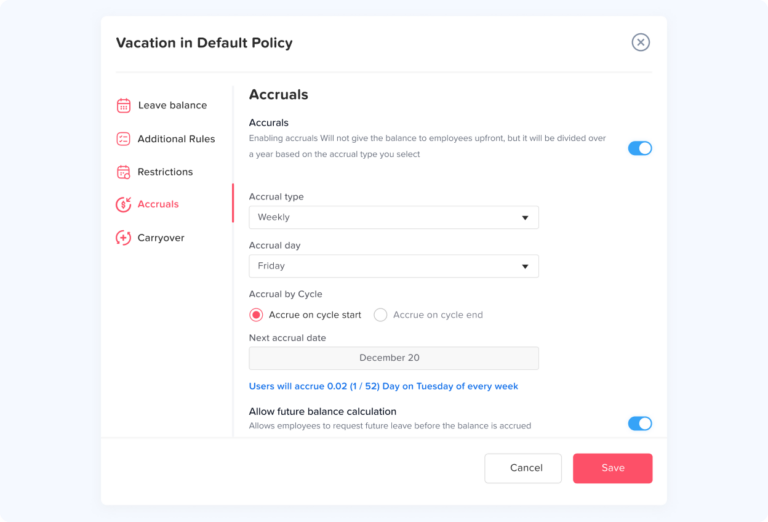
Day Off uses each employee’s assigned work schedule to determine working days and calculate the correct leave deduction when a request is submitted. It supports fixed-day, fixed-hour, flexible-hour, and shift-based schedules.
How to Calculate the New Part-Time PTO Entitlement
Employers use several common methods to calculate part-time PTO.
Method 1: Prorate PTO Based on Weekly Hours
This method compares the employee’s new weekly hours with the company’s standard full-time hours.
Formula
Part-time annual PTO = Full-time annual PTO × Part-time weekly hours ÷ Full-time weekly hours
Example
Assume:
- Full-time annual PTO: 120 hours
- Full-time schedule: 40 hours per week
- New part-time schedule: 24 hours per week
Calculation:
120 × 24 ÷ 40 = 72 PTO hours per year
The employee’s new annual entitlement is 72 hours.
The employee is working 60% of the full-time schedule and therefore receives 60% of the full-time annual PTO allowance.
Another Example
Assume:
- Full-time entitlement: 20 eight-hour days
- Full-time annual hours: 160 PTO hours
- Part-time schedule: 30 hours per week
- Full-time schedule: 40 hours per week
Calculation:
160 × 30 ÷ 40 = 120 PTO hours
If the part-time employee works six-hour days, those 120 hours equal 20 scheduled six-hour days.
The employee receives the same number of working weeks off proportionally, even though the daily hours are different.
Method 2: Accrue PTO for Each Hour Worked
Under an hours-worked method, employees earn PTO according to the number of eligible hours they actually work.
Formula
PTO accrual rate = Full-time annual PTO ÷ Full-time annual working hours
Assume:
- Annual full-time PTO: 120 hours
- Annual full-time working hours: 2,080
Calculation:
120 ÷ 2,080 = 0.0577 PTO hours per eligible hour worked
This is approximately one PTO hour for every 17.33 eligible working hours.
If the employee works 24 hours per week for 52 weeks:
24 × 52 = 1,248 working hours
1,248 × 0.0577 = approximately 72 PTO hours
This produces the same annual result as the prorated weekly-hours method when the schedule remains consistent.
An hours-worked method can be useful for employees whose schedules change from week to week because the balance responds to actual eligible hours rather than relying on a fixed annual estimate.
Method 3: Provide a Fixed Part-Time Entitlement
Some employers create separate fixed PTO policies.
For example:
| Employment Category | Weekly Hours | Annual PTO |
|---|---|---|
| Full-time | 40 hours | 120 hours |
| Part-time tier 1 | 30–39 hours | 90 hours |
| Part-time tier 2 | 20–29 hours | 60 hours |
| Part-time tier 3 | Fewer than 20 hours | 40 hours |
This method is easy to explain but can create sharp differences.
An employee working 30 hours could receive 90 hours, while someone working 29 hours receives only 60. Employers should decide whether these eligibility thresholds are appropriate and apply them consistently.
Method 4: Prorate PTO Based on Working Days
This method may work when employees have fixed, equal-length working days.
Formula
Part-time leave days = Full-time leave days × Part-time working days ÷ Full-time working days
Assume:
- Full-time entitlement: 20 days
- Full-time schedule: 5 days per week
- Part-time schedule: 3 days per week
Calculation:
20 × 3 ÷ 5 = 12 leave days
This gives both employees four working weeks of annual leave:
- Full-time employee: 20 days ÷ 5 days per week = 4 weeks
- Part-time employee: 12 days ÷ 3 days per week = 4 weeks
This method becomes less reliable when daily shift lengths vary. In those cases, tracking leave in hours is usually clearer.
How to Recalculate PTO During the Year
When an employee changes status in the middle of the PTO year, HR should divide the year into two periods:
- The full-time period
- The part-time period
The employee earns the appropriate portion under each policy.
Example: Accrued PTO Policy
Assume:
- PTO year: January 1 to December 31
- Full-time entitlement: 120 hours per year
- Full-time accrual: 10 hours per month
- New part-time entitlement: 72 hours per year
- Part-time accrual: 6 hours per month
- Status change effective: July 1
The employee earns:
January through June: 6 × 10 = 60 hours
July through December: 6 × 6 = 36 hours
Total annual accrual:
60 + 36 = 96 PTO hours
The employee does not receive the full 120-hour full-time entitlement or only the 72-hour part-time entitlement. They receive a combined amount reflecting the time spent in each status.
Mid-Month Status Change Example
Suppose the change becomes effective on September 16 instead of September 1.
HR must define how partial months are handled.
Possible methods include:
- Prorate the month by calendar days
- Prorate by scheduled working days
- Prorate by eligible hours worked
- Apply the old rate through the end of the month
- Apply the new rate from the beginning of the next pay period
- Apply the new rate from the next complete month
Calendar-Day Proration Example
Assume September has 30 days:
- Full-time monthly accrual: 10 hours
- Part-time monthly accrual: 6 hours
- Full-time status: September 1–15
- Part-time status: September 16–30
Calculation:
10 × 15 ÷ 30 = 5 full-time accrual hours
6 × 15 ÷ 30 = 3 part-time accrual hours
Total September accrual:
5 + 3 = 8 PTO hours
The employer should use the same proration method for employees in comparable situations.
What Happens Under a Frontloaded PTO Policy?
A frontloaded policy gives employees their leave entitlement at the beginning of the year or benefit period rather than adding it gradually.
A midyear change from full-time to part-time creates a difficult question:
Should the company reduce the unused portion of the original grant?
Possible approaches include:
Preserve the Full Frontloaded Balance
The employee keeps the full amount granted at the beginning of the year.
This is simple and avoids taking away leave that the employee may have understood to be available.
Prorate Only Future Grants
The employee keeps the current year’s balance, but the next annual grant is based on the part-time schedule.
For many employers, this is the cleanest approach.
Recalculate the Current-Year Entitlement
The employer calculates a blended entitlement based on the full-time and part-time periods.
This should only be done when the written policy and applicable law permit the adjustment. The employer must also determine whether the frontloaded amount was earned immediately or advanced subject to future service.
Example of a Blended Frontloaded Entitlement
Assume:
- Full-time annual entitlement: 120 hours
- Part-time annual entitlement: 72 hours
- Full-time for six months
- Part-time for six months
Calculation:
120 × 6 ÷ 12 = 60 hours
72 × 6 ÷ 12 = 36 hours
Blended entitlement:
60 + 36 = 96 hours
If the employee was originally granted 120 hours, the system shows a 24-hour difference.
Before removing that difference, the employer should review:
- The written policy
- Whether the grant was described as earned or advanced
- State law
- PTO already used
- Existing approved leave
- Employee communications
- Any contract or collective bargaining terms
A retroactive reduction should not be made casually.
What If the Employee Has Already Used More Than the New Entitlement?
Suppose the blended annual entitlement after recalculation is 96 hours, but the employee has already used 105 hours.
The employer may consider:
- Allowing the employee to keep the nine-hour difference
- Creating a nine-hour negative balance
- Treating the difference as an advance
- Stopping future accrual until the balance returns to zero
- Recording the excess as an employer-approved exception
- Making no current adjustment and applying the new rate prospectively
The correct treatment depends on company policy and applicable wage-deduction laws.
The employer should avoid deducting money from future wages or final pay without confirming that the deduction is lawful and properly authorized.
When Should the New PTO Rate Begin?
The policy should identify the effective date clearly.
Common options include:
- The exact date the employee becomes part-time
- The beginning of the next pay period
- The first day of the following month
- The beginning of the next PTO year
Exact Status-Change Date
This is the most precise method but may require a split-period calculation.
Next Pay Period
This aligns the new accrual rate with payroll and may simplify administration.
First Day of the Following Month
This avoids partial-month calculations but may temporarily provide too much or too little leave.
Next PTO Year
This is simple but may allow a part-time employee to continue earning at the full-time rate for several months.
Whatever method is selected, it should be documented before or when the schedule changes.
What Happens to Approved Future PTO?
Approved leave should be reviewed when the employee’s schedule changes.
The most important question is:
What schedule will apply on the actual leave date?
Example 1: Shorter Daily Hours
An employee requested and received approval for Monday through Friday while working eight-hour days.
Before the vacation, the employee moves to a part-time schedule of five four-hour days.
The absence now covers:
5 days × 4 hours = 20 PTO hours
The original request may have been entered as 40 hours, so HR should update it to avoid deducting too much.
Example 2: Fewer Working Days
An employee originally worked Monday through Friday and received approval for a full week.
The employee now works Monday, Wednesday, and Friday.
Only scheduled working days should normally reduce the PTO balance:
- Monday: deduct leave
- Tuesday: no deduction
- Wednesday: deduct leave
- Thursday: no deduction
- Friday: deduct leave
Day Off’s work schedule rules use the employee’s assigned working days and hours to calculate deductions, helping avoid charging leave for non-working days.
Example 3: Approved Day Becomes a Non-Working Day
An employee had approved PTO for Friday. After moving part-time, Friday is no longer a scheduled workday.
The request should normally be cancelled or changed because the employee no longer needs PTO to be absent on that date.
Should HR Cancel Existing Approved PTO?
A schedule change should not automatically cancel approved vacation.
Instead, HR should review:
- Whether the leave dates are still needed
- The employee’s new scheduled hours
- Whether the employee still has enough PTO
- Whether the request should be converted from days to hours
- Whether any requested dates are now non-working days
- Whether minimum staffing has changed
- Whether travel or personal commitments were made based on the approval
If the employee accepted the part-time arrangement after the leave was approved, HR should discuss any necessary adjustment openly rather than making a silent change.
What Happens to PTO Carryover?
Existing carryover should be handled separately from future accrual.
For example, an employee may have:
- 30 hours carried over from the previous year
- 20 hours earned during the current year
- A new part-time accrual rate beginning next month
The employee’s balance would remain 50 hours unless the policy and applicable law permit another treatment.
The employer should then determine whether the part-time policy has a different:
- Carryover limit
- Expiration rule
- Accrual cap
- Maximum usable balance
Applying a lower part-time cap immediately could cause an employee to lose earned leave. A transition rule may be needed, such as:
Employees whose existing balance exceeds the new part-time cap may retain the balance but will not earn additional PTO until the balance falls below the cap.
This approach preserves existing hours while applying the new cap prospectively.
What Happens to a Negative PTO Balance?
An employee may already have a negative PTO balance when moving to part-time.
For example:
- Current balance: –16 hours
- Full-time accrual: 10 hours per month
- New part-time accrual: 6 hours per month
At the old rate, the employee would recover the deficit in approximately two months. At the new rate, it will take almost three months.
The company should decide whether:
- The negative balance remains unchanged
- Future part-time accruals repay the balance
- A repayment schedule is needed
- The deficit is forgiven
- New PTO requests are restricted until the balance returns to zero
The employee should receive written notice because the status change affects how quickly new PTO becomes available.
How Should Public Holidays Be Handled?
A part-time employee’s holiday treatment depends on the company’s policy, work schedule, and applicable law.
Possible approaches include:
- Paid only when the holiday falls on a scheduled workday
- A prorated annual holiday allowance
- Floating holiday hours
- Public holidays included in a combined PTO bank
- No separate holiday pay where legally permitted
A common fairness problem occurs when a part-time employee works Tuesday through Thursday while most public holidays fall on Monday.
If holiday pay is provided only when the holiday falls on a scheduled day, that employee may receive significantly less paid holiday time than another part-time employee working Mondays.
Employers may address this by offering a proportional holiday allowance instead of relying only on the calendar.
Federal law does not generally require private employers to provide paid holidays, but state law, contracts, or company policy may create additional obligations.
How Does the Change Affect Sick Leave?
Vacation PTO and statutory sick leave should not automatically be treated the same.
When a company uses a combined PTO bank to satisfy paid sick leave requirements, HR must ensure that the revised part-time policy still meets the legal minimum in every applicable location.
Some sick leave laws use hours-worked accrual, which naturally adjusts when an employee works fewer hours. For example, California permits an accrual approach that provides at least one hour of paid sick leave for every 30 hours worked, although other compliant methods are also available.
Before changing the employee’s sick leave balance or accrual method, HR should review:
- Required accrual rate
- Annual usage minimum
- Carryover rules
- Balance caps
- Reinstatement requirements
- Employee notice requirements
- Local ordinances that provide greater benefits
Does Moving Part-Time Affect FMLA Eligibility?
It can.
To qualify for federal FMLA leave, an employee generally must have worked at least 1,250 hours during the 12 months before the leave begins, in addition to meeting the law’s other eligibility requirements. An employee who moves to a reduced schedule may eventually have fewer hours in the 12-month lookback period.
For eligible employees, FMLA leave is based on the employee’s actual workweek. When a part-time employee takes intermittent or reduced-schedule FMLA leave, only the proportion of the normal workweek actually missed is counted.
For example:
- Normal part-time schedule: 30 hours per week
- FMLA absence: 10 hours
The employee uses one-third of an FMLA workweek:
10 ÷ 30 = one-third
PTO balances and FMLA entitlement are different records. Paid PTO may run at the same time as FMLA leave in some circumstances, but the employer should not treat the employee’s PTO balance as the measure of their FMLA entitlement.
What If the Part-Time Change Is a Medical Accommodation?
Sometimes an employee moves from full-time to part-time because of:
- A disability
- Pregnancy-related limitations
- Recovery from an illness or surgery
- An intermittent or reduced-schedule FMLA need
In these situations, HR should not treat the change only as an ordinary voluntary reduction in hours.
A reduced work schedule may be a form of FMLA leave under qualifying circumstances. The FMLA regulations define a reduced leave schedule as a temporary reduction in the employee’s usual hours, often from full-time to part-time.
Disability and pregnancy accommodation requirements may also apply. Employers should coordinate the schedule, PTO, unpaid leave, benefits, and attendance records through the appropriate HR process rather than simply assigning the employee to a standard part-time policy.
Full-Time to Part-Time PTO Examples
| Situation | Recommended Review | Possible Treatment |
|---|---|---|
| Employee has 40 earned PTO hours | Determine whether the leave is vested or otherwise protected | Preserve the 40-hour balance |
| Employee’s annual entitlement falls from 120 to 72 hours | Identify the effective date of the new entitlement | Apply the new accrual rate prospectively |
| Employee changes status halfway through the year | Divide the year into full-time and part-time employment periods | Calculate a blended annual entitlement |
| Employee has approved future leave | Review the employee’s schedule on the approved leave dates | Recalculate the deduction using the new scheduled hours |
| Approved PTO falls on a new non-working day | Confirm whether the employee will miss any scheduled working time | Cancel or adjust that portion of the request |
| Employee has a negative PTO balance | Review repayment, deduction, and future accrual rules | Recover the balance through future accruals or apply the written policy |
| Existing balance exceeds the new part-time cap | Avoid immediately removing previously earned PTO | Freeze new accruals until the balance falls below the cap |
| Part-time schedule has variable hours | Determine whether a fixed monthly accrual would remain accurate | Consider calculating PTO according to eligible hours worked |
| Combined PTO bank covers sick leave | Review applicable state and local paid sick leave requirements | Ensure the revised policy continues to meet all applicable requirements |
| Reduced schedule is medically necessary | Review possible FMLA, disability accommodation, or other leave obligations | Coordinate the change through HR before modifying leave treatment |
Common Mistakes When an Employee Becomes Part-Time
Deleting Part of the Existing Balance
Reducing a balance simply because the employee now works fewer hours can remove leave earned under the previous schedule.
Keeping PTO in Days Without Converting the Value
Five eight-hour days should not silently become five four-hour days. Convert the balance to hours before the schedule change.
Applying the New Rate Retroactively
The part-time rate should not normally replace accruals properly earned while the employee was full-time.
Forgetting to Update Approved Requests
Future requests may continue deducting full-time hours even after the schedule changes.
Charging PTO on Non-Working Days
A part-time employee should not normally lose PTO for a date they were not scheduled to work.
Changing the Work Schedule but Not the Leave Policy
The employee may continue earning at the full-time rate because the HR system still assigns the old policy.
Changing the Policy but Not the Schedule
The employee may earn a part-time balance but continue having eight hours deducted for a day that now contains only four scheduled hours.
Ignoring Sick Leave Requirements
A voluntary vacation policy may be flexible, but a state or local sick leave law may impose specific minimums.
Failing to Define the Effective Date
Payroll, HR, managers, and the employee may use different dates, producing inconsistent accruals and deductions.
Making an Undocumented Manual Adjustment
Every balance change should show what changed, who approved it, why it was necessary, and how the employee was notified.
Step-by-Step Process for HR
Step 1: Confirm the New Work Arrangement
Record:
- New weekly hours
- New working days
- Daily shift lengths
- Effective date
- Whether the change is permanent or temporary
- Whether the change is voluntary or accommodation-related
- Expected duration, when temporary
Step 2: Review Applicable Policies and Laws
Check:
- Full-time PTO policy
- Part-time PTO policy
- Paid sick leave requirements
- Accrued vacation protections
- Employment agreement
- Collective bargaining agreement
- Benefits plan documents
- Accommodation or protected-leave requirements
Step 3: Calculate the Balance Before the Change
Create a balance record as of the final full-time date:
Opening balance + accruals + carryover + adjustments − approved leave used = ending full-time balance
This creates a clear cutoff point.
Step 4: Preserve or Lawfully Convert Existing Leave
Convert leave from days to hours when necessary and confirm that previously earned value is not improperly reduced.
Step 5: Calculate the New Accrual Rate
Use the method specified by the part-time policy:
- Weekly-hours proration
- Hours-worked accrual
- Fixed part-time tier
- Working-days proration
Step 6: Review Future Requests
Update requests based on the schedule that will apply on each leave date.
Step 7: Review Caps and Carryover
Determine whether the new policy has different limits and whether a transition rule is required.
Step 8: Update Payroll and HR Systems
Update:
- Employment status
- Work schedule
- Standard weekly hours
- Leave policy
- Accrual rate
- Benefits eligibility
- Manager or team assignment, if relevant
- Attendance expectations
Step 9: Give the Employee a Written Summary
The employee should receive:
- Effective date
- Existing PTO balance
- New annual entitlement
- New accrual rate
- Accrual frequency
- New schedule
- Treatment of approved leave
- Carryover and cap rules
- Sick leave treatment
- Contact for reporting an error
Step 10: Audit the First Accrual and Deduction
Check the employee’s first PTO accrual and first leave request after the change to confirm the system is applying the new rules correctly.
Sample Full-Time to Part-Time PTO Policy
Employees who move from full-time to part-time status will retain PTO properly earned before the effective date of the status change, subject to applicable law and the terms of the company’s leave policy.
Existing PTO will be maintained in hours to preserve the employee’s recorded balance when daily or weekly working hours change.
Beginning on the effective date of part-time status, future PTO will accrue according to the part-time leave policy and the employee’s assigned work schedule.
When the status change occurs during an accrual period, the company will prorate the period using the method described in the leave policy.
Approved future leave will be reviewed and adjusted to match the working hours scheduled on the leave dates. Days on which the employee is not scheduled to work will not normally be deducted from the PTO balance.
Any changes to carryover limits, accrual caps, eligibility, or public holiday treatment will be communicated to the employee in writing.
Statutory sick leave, protected leave, accommodation-related schedules, and other legally required benefits will be administered according to applicable law.
This is a general example and should be reviewed before use.
How Day Off Helps Manage Full-Time to Part-Time PTO Changes
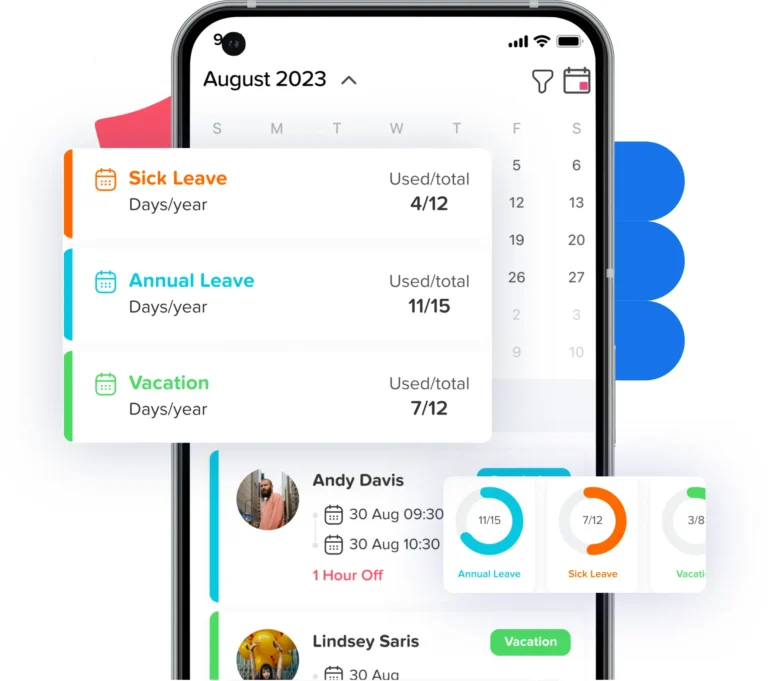
Changing an employee’s status can create errors when work schedules, leave policies, balances, and approved requests are stored in separate spreadsheets.
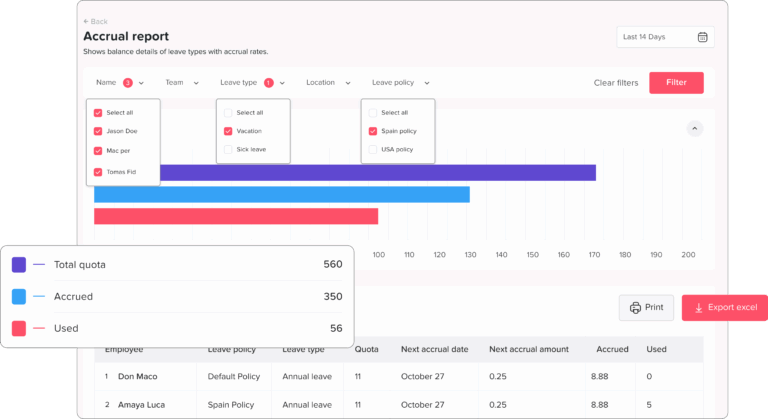
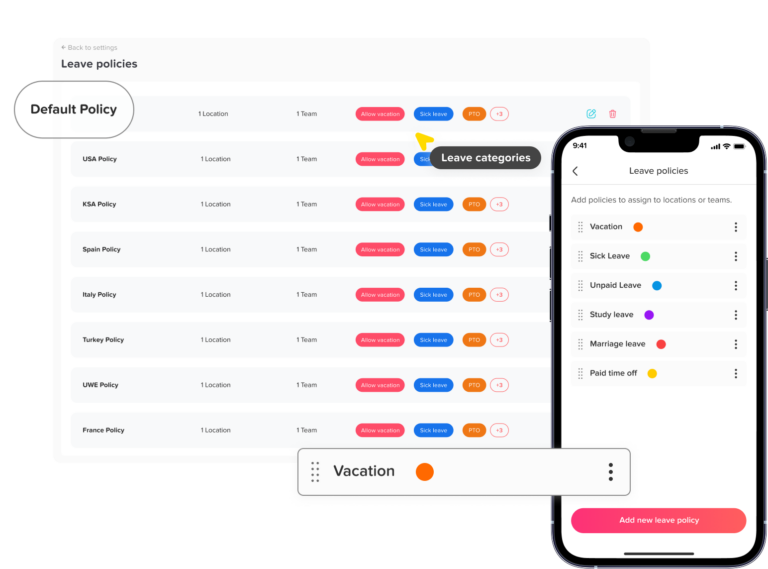
Day Off allows organizations to create different leave policies for teams, employee groups, departments, or locations. Administrators can manage entitlements, accrual rules, carryover limits, blackout periods, notice requirements, and other policy settings.
When an employee moves to part-time, HR can:
- Assign the employee to the appropriate part-time leave policy
- Update their working days and hours
- Preserve and review the existing balance
- Configure weekly, biweekly, semimonthly, monthly, or annual accruals
- Track balance adjustments
- Review approved and pending requests
- Use hours for accurate partial-day deductions
- View the employee’s future availability
- Apply different holiday calendars by location
- Maintain a transaction and approval history
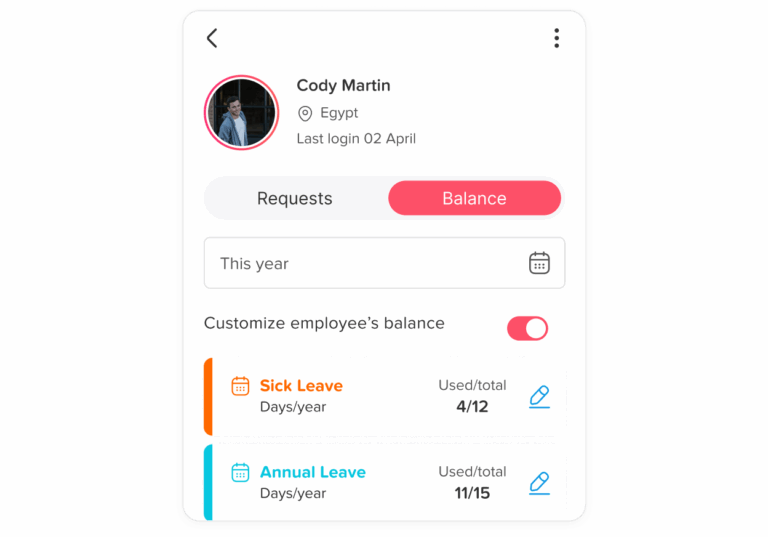
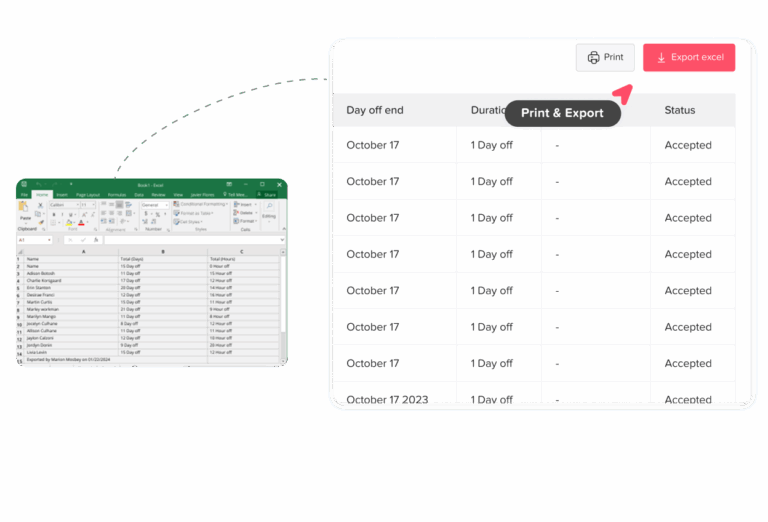
- Generate leave balance and accrual reports
Day Off’s work schedules help determine whether a requested date is a scheduled workday and how much leave should be deducted. Its accrual tools can also update future balances according to the employee’s new policy without relying on repeated spreadsheet calculations.
Frequently Asked Questions About PTO When Moving From Full-Time to Part-Time
What happens to my PTO if I go from full-time to part-time?
Your employer may change how much PTO you earn in the future, but PTO already earned should be reviewed separately. In many policies, the existing balance remains available while future accruals change to the part-time rate.
The exact treatment depends on company policy and applicable state or local law.
Do I lose my accrued PTO if I become part-time?
You should not assume that changing to part-time automatically removes accrued PTO.
Some jurisdictions treat earned vacation as vested wages. California, for example, does not permit forfeiture of earned vacation. Other jurisdictions may follow different rules.
Ask HR for a written statement showing your balance before the change and how it will be treated afterward.
Can my employer reduce my PTO when I become part-time?
An employer may generally reduce future PTO accruals under a lawful, properly communicated policy. Reducing leave that was already earned is a separate issue and may be restricted by state law or contract.
The employer should distinguish between:
- Existing accrued balance
- Future annual entitlement
- Future accrual rate
- PTO that was frontloaded but not yet earned, if the policy treats it as an advance
How is PTO calculated when changing from full-time to part-time?
A common calculation is:
Full-time annual PTO × Part-time weekly hours ÷ Full-time weekly hours
For example:
120 hours × 24 ÷ 40 = 72 annual PTO hours
The employer may instead use an hours-worked accrual or a fixed part-time benefit tier.
Should my current PTO balance be prorated when I go part-time?
Future entitlement may be prorated, but an existing earned balance should not automatically be reduced.
For example, a 40-hour balance should generally remain 40 hours even when the employee moves from eight-hour to four-hour days. The balance may cover more scheduled days, but it still provides the same number of paid hours.
If I have five PTO days and become part-time, how many days do I have?
First convert the days to hours using the schedule under which they were earned.
If five PTO days were earned while working eight-hour days:
5 × 8 = 40 PTO hours
If the new part-time day is four hours, those 40 hours can cover ten scheduled four-hour days.
Your employer’s policy and local law determine the final treatment.
Does PTO accrue differently for part-time employees?
It often does. Part-time PTO may be calculated using:
- A prorated annual allowance
- An accrual for every hour worked
- A fixed part-time allowance
- A percentage of full-time entitlement
- Scheduled working days
The policy should identify which method applies.
How much PTO should a part-time employee receive?
There is no single federal PTO amount for private-sector part-time employees. Vacation benefits are generally established by the employer, although state and local sick leave rules may require paid leave for part-time employees.
A common employer approach is to provide PTO proportionally based on weekly hours.
Do part-time employees accrue PTO based on hours worked?
Many employers use this approach, especially for variable schedules.
For example, if the policy provides one PTO hour for every 20 eligible hours worked, an employee who works 60 hours during a pay period earns three PTO hours.
When should the part-time PTO rate begin?
The new rate may begin:
- On the exact status-change date
- At the beginning of the next pay period
- On the first day of the following month
- At the next PTO year
The employer should specify the effective date in writing.
What happens if I become part-time in the middle of the year?
The employer may calculate a blended annual entitlement.
For example, if you are full-time for six months and part-time for six months, you may earn half of the full-time annual amount plus half of the part-time annual amount.
Does part-time PTO count toward overtime?
Under the federal FLSA, paid vacation, sick leave, and other time when no work is performed generally do not need to be counted as hours worked when calculating overtime. A company policy, state law, or agreement may provide a more generous rule.
What happens if I have a negative PTO balance when I go part-time?
The negative balance may remain and be recovered through future part-time accruals.
Because the new accrual rate may be lower, it may take longer for the balance to return to zero. The employer should explain whether new requests will be restricted during this period.
What if my existing PTO exceeds the part-time balance cap?
A fair transition rule may allow you to keep the balance but stop earning additional PTO until it falls below the new cap.
Removing the excess immediately may violate applicable law when the leave was already earned.
Can part-time employees receive the same PTO as full-time employees?
Yes. An employer may choose to offer the same PTO benefit to both groups.
The policy may also provide a proportional entitlement, provided that it complies with applicable laws and is administered consistently.
Should PTO be based on days or hours for part-time employees?
Hours are often more accurate, particularly when daily schedules vary.
Tracking PTO in hours prevents a four-hour absence and an eight-hour absence from being deducted as if they were equal.
What should HR give an employee who changes to part-time?
HR should provide a written summary showing:
- Status-change date
- New work schedule
- Existing PTO balance
- New annual entitlement
- New accrual rate
- Accrual frequency
- Treatment of approved requests
- Carryover and cap rules
- Sick leave treatment
- How to report an incorrect balance
Final Thoughts
When an employee changes from full-time to part-time, PTO should not be reduced through a quick percentage calculation without reviewing what the employee has already earned.
The clearest approach is to preserve the existing balance in hours and apply the new part-time accrual rate prospectively from a documented effective date. When the change occurs in the middle of a month or PTO year, HR can calculate separate full-time and part-time portions to create a fair blended entitlement.
Approved future leave should also be reviewed against the employee’s new schedule. If a requested date is no longer a working day, no PTO may be needed. If the employee now works shorter days, the deduction should normally reflect the shorter scheduled hours.
Employers must also review sick leave laws, FMLA rules, accommodation requirements, carryover limits, and local restrictions before changing balances or eligibility. A voluntary vacation policy may allow flexibility, but statutory leave and earned-wage protections may create additional obligations.
With Day Off, HR teams can assign the right work schedule and leave policy, automate future accruals, preserve balance records, and calculate requests according to the employee’s actual working days and hours. Keeping the schedule, policy, balance, and approval history connected helps companies manage employment-status changes fairly and avoid preventable PTO disputes.