








An employee is scheduled to start at 9:00 a.m. They arrive at the building on time, but the elevator is slow, there is a queue at the time clock, or their computer takes longer than expected to load. By the time they clock in, it is 9:03.
Should those three minutes count as a late arrival?
That is exactly the problem a clock in grace period is designed to solve.
A clock-in grace period gives employees a small amount of flexibility around their scheduled start time without automatically treating every minor delay as an attendance violation. It can make attendance policies feel more reasonable while reducing unnecessary disputes between employees, managers, HR, and payroll.

However, grace periods need to be designed carefully.
A grace period should determine whether an employee is considered late, not automatically change how much time an hourly employee is paid for. Confusing attendance rules with payroll rules can create wage-and-hour compliance problems.
This guide explains how clock-in grace periods work, how they differ from time rounding, how many minutes employers commonly allow, what happens when employees exceed the grace period, and how to build a clear policy that managers can enforce consistently.
What Is a Clock-In Grace Period?
A clock-in grace period is a short period after an employee’s scheduled start time during which the employee can clock in without being marked late for attendance purposes.
For example, imagine an employee is scheduled to begin work at 9:00 a.m. and the company has a five-minute grace period.
| Clock-in time | Attendance result |
|---|---|
| 8:58 a.m. | On time |
| 9:00 a.m. | On time |
| 9:03 a.m. | On time under the grace policy |
| 9:05 a.m. | On time under the grace policy |
| 9:06 a.m. | Late |
The important distinction is that the grace period is an attendance rule.
It does not automatically mean an hourly employee should be paid as though they started at 9:00.
If the employee begins compensable work at 8:58, that work time generally needs to be recorded appropriately. Similarly, if the employee begins working at 9:03, the employer should not automatically pretend they began working at 9:00 simply because the attendance policy allows a five-minute grace period.
The attendance record and the payroll record can therefore show slightly different things.
An employee might be considered “on time” for attendance purposes while still being paid according to their actual recorded work time.
Why Do Employers Use Clock-In Grace Periods?
Without a grace period, even very small delays can create attendance incidents.
That sounds straightforward, but in practice it may produce unnecessary administrative work.
A one-minute late punch could require a manager to review the employee’s record. HR might then need to determine whether the delay should count toward an attendance point system. Employees may dispute the record, especially when the delay was caused by a crowded entrance, slow equipment, parking congestion, or another small operational issue.
A well-designed grace period gives employers a way to distinguish between minor timing variations and meaningful lateness.
For employees, it creates predictability. They know exactly when a late arrival becomes an attendance issue.
For managers, it reduces subjective decisions.
For HR, it makes attendance data easier to interpret.
And for payroll teams, it helps separate attendance enforcement from calculations of actual hours worked.
The goal is not to tell employees that start times do not matter. The goal is to avoid treating every tiny deviation as though it were a serious attendance problem.
Clock-In Grace Period vs. Time Rounding
Grace periods and time rounding are often discussed together because both involve minutes around a scheduled start or end time.
They are not the same thing.
| Aspect | Clock-in grace period | Time rounding |
|---|---|---|
| Main purpose | Determines whether an employee is considered late | Adjusts recorded time for payroll calculations |
| Changes attendance status? | Yes | Not necessarily |
| Changes paid hours? | It should not by itself | Yes |
| Usually defined by | Company attendance policy | Wage-and-hour rules and company payroll policy |
| Example | Employee clocks in at 9:04 and is not marked late | 9:04 punch is rounded according to the employer’s rounding method |
| Primary risk | Inconsistent enforcement | Systematic underpayment |
Under federal guidance, certain neutral rounding methods may be permissible when they average out over time and do not result in employees being underpaid for the time they actually work. The U.S. Department of Labor gives quarter-hour rounding as an example and explains that a system cannot simply round against employees every time.
A grace period has a different purpose.
Imagine this situation:
- Scheduled start: 9:00 a.m.
- Grace period: 5 minutes
- Actual clock-in: 9:04 a.m.
The attendance system may consider that employee on time.
That does not mean the payroll system must automatically pretend the punch occurred at 9:00.
This distinction is one of the most important concepts to explain in a written late clock-in policy.
For more information about payroll rounding, see our guides to the 7-minute rule and creating a time clock rounding policy.
Is a Clock-In Grace Period Required by Law?
There is no general federal rule requiring employers to give every employee a certain number of grace minutes before they are considered late.
That means employers generally establish their own attendance expectations, subject to applicable federal, state, local, contractual, and other legal requirements.
The more important legal question is what happens to compensable working time.
What the FLSA Says About Working Time
The Fair Labor Standards Act requires covered non-exempt employees to be paid for compensable working time.
The U.S. Department of Labor explains that work an employer “suffers or permits” an employee to perform is work time, even if the work was not specifically requested.
This becomes important when employees clock in early or continue working after their scheduled shifts.
Suppose an employee’s shift begins at 9:00 a.m.
They clock in at 8:56 and immediately begin answering customer messages.
An attendance policy may still say their scheduled start is 9:00, but the employer should not simply ignore those minutes because they happened before the scheduled shift.
The Department of Labor also states that employees who voluntarily arrive early or remain after their shift without performing work do not necessarily have to be paid simply because they are on the premises.
The critical question is therefore not only when did the employee punch in?
It is also when did compensable work begin?
The Payroll Trap Employers Should Avoid
A poorly configured grace period can accidentally become an unpaid-work rule.
Consider these examples:
The safest way to think about the issue is simple:
Attendance policies determine whether someone is late. Payroll rules determine what working time must be paid.
Do not make one system silently replace the other.
What About Very Small Amounts of Work?
Federal law recognizes a limited concept commonly referred to as the de minimis doctrine for certain insignificant amounts of time that cannot practically be recorded.
However, employers should be careful about relying on it.
The Department of Labor explains that the rule applies to uncertain and insignificant periods that cannot practically be recorded and should not be used to arbitrarily ignore identifiable working time. Regular working time that can practically be measured should be counted.
Modern timekeeping systems can often record work to the minute or even more precisely, which can make arguments about unrecordable time less relevant in many workplaces.
California Employers Need Extra Caution
Employers with workers in California should pay particular attention to exact timekeeping.
In Troester v. Starbucks Corp., the California Supreme Court held that California wage law had not adopted the federal de minimis doctrine for the regularly recurring off-the-clock work at issue in that case. The court concluded that employers could not routinely require employees to work minutes off the clock without compensation.
California has also taken a strict approach to meal-period timekeeping.
In Donohue v. AMN Services, LLC, the California Supreme Court held that employers may not use rounding practices to determine whether employees received compliant meal periods.
That does not mean every attendance grace period is automatically prohibited in California. It means employers should avoid using a grace-period policy as a reason to erase or ignore compensable working time.
California employers should review their timekeeping and attendance policies with qualified employment counsel.
What About Salaried Exempt Employees?
Clock-in grace periods are usually most relevant to non-exempt employees whose attendance and working time are recorded precisely.
Exempt salaried employees are different.
Federal salary-basis rules generally require qualifying exempt employees to receive their predetermined salary regardless of variations in the number of hours or days worked, subject to specific exceptions.
For example, federal regulations generally permit salary deductions for certain full-day absences but do not provide the same broad ability to deduct pay because an exempt employee arrived several minutes late.
Employers may still enforce attendance expectations for exempt employees.
Repeated lateness can be addressed through performance management, attendance conversations, scheduling expectations, or other appropriate policies.
The key difference is that attendance enforcement should not automatically become an improper salary deduction.
How Many Minutes Late Is Considered Late?
There is no universal answer.
The right grace period depends on the type of work, how important exact shift coverage is, and how much flexibility the employer wants to provide.
A five-minute grace period is often easy for employees and managers to understand, but that does not make five minutes a legal standard or the correct choice for every workplace.
The policy should match the job.
A hospital shift handover may require much tighter attendance than an employee performing independent administrative work with flexible hours.
How to Choose the Right Grace Period for Your Team
Instead of choosing a number because another company uses it, consider how attendance actually affects your operation.
Look at the Consequences of a Late Arrival
Ask what happens if someone arrives five minutes late.
Does another employee have to stay beyond their scheduled shift?
Does a production line wait?
Does a store open late?
Does a customer-facing desk remain unattended?
Or does the employee simply begin individual work a few minutes later without affecting anyone else?
The operational impact should influence how strict your policy needs to be.
Review Current Attendance Data
Before changing the policy, examine existing clock-in records.
If dozens of employees clock in one or two minutes after their scheduled start because there is only one time clock, the issue might not be employee punctuality.
It could be a process problem.
Changing the time clock location, allowing web clock-ins, staggering schedules, or improving the clock-in process may solve the real issue.
Consider Work Schedules
A single company does not necessarily need the same attendance rule for every job.
Employees may work:
| Schedule | Grace-period consideration |
|---|---|
| Fixed office hours | A small grace period may work well |
| Retail shifts | Opening and coverage requirements matter |
| Rotating shifts | Handover timing may make punctuality more important |
| Flexible hours | A traditional grace period may be unnecessary |
| Split shifts | Each scheduled work period may need separate rules |
| Remote work | Login and actual work activity may matter more than physical arrival |
If employees already have flexible start times, adding a traditional grace period can create unnecessary complexity.
In that case, defining core hours or a permitted start-time range may work better.
See our guide to tracking attendance without fixed start times for another approach.
A Grace Period Should Not Become the Real Start Time
One of the most common problems with grace periods is behavioral rather than legal.
Imagine that a company schedules everyone at 9:00 a.m. but allows a five-minute grace period.
After several months, employees may begin thinking:
“My shift really starts at 9:05.”
That is not what the policy is supposed to mean.
The scheduled start should remain 9:00.
The grace period simply tells employees that an occasional 9:01 or 9:03 arrival will not automatically create an attendance violation.
Managers should communicate this distinction clearly.
Otherwise, organizations may slowly create an unofficial start time that is different from the schedule employees actually see.
Should the Grace Period Apply to Breaks?
It can, but employers should define this separately.
Do not assume that a five-minute grace period at the start of a shift automatically applies to every break, meal period, and clock-out.
For example, an organization might allow five minutes at the beginning of a shift but only two minutes when employees return from a short rest break.
Meal periods require even more caution because specific state laws may regulate their timing and duration.
A written policy should state exactly where the grace period applies.
What About Early Clock-Ins?
Early clock-ins deserve just as much attention as late clock-ins.
Some employers establish a rule such as:
“Employees should not clock in more than five minutes before their scheduled shift unless a manager has approved the early start.”
That can help prevent employees from starting work unnecessarily early.
However, a rule against unauthorized overtime does not automatically allow the employer to refuse payment for work that was actually performed.
If an employee begins compensable work and the employer knows or has reason to know about it, the time may still need to be paid even if the employee violated a scheduling rule. The employer can address the policy violation separately.
That distinction protects both sides.
The payroll record remains accurate, while the attendance or scheduling rule can still be enforced.
What Happens When an Employee Exceeds the Grace Period?
This is where many policies become unclear.
Imagine the company has a five-minute grace period and an employee clocks in at 9:07.
Is the employee two minutes late because they exceeded the grace period by two minutes?
Or seven minutes late because their scheduled shift began at 9:00?
For attendance reporting, the clearer approach is usually to treat the scheduled start as the reference point.
The five-minute grace period determines whether the lateness triggers an attendance event. It does not necessarily move the scheduled start time to 9:05.
For example:
| Scheduled start | Grace period | Clock-in | Attendance result |
|---|---|---|---|
| 9:00 | 5 min | 9:03 | On time |
| 9:00 | 5 min | 9:05 | On time |
| 9:00 | 5 min | 9:06 | Late |
| 9:00 | 5 min | 9:15 | Late |
The employer’s policy should then explain how repeated late arrivals are handled.
Some organizations start with a manager conversation. Others use written warnings or an attendance point system.
Whatever approach you choose, employees should know the rule before it is enforced.
Occasional Lateness vs. a Pattern of Lateness
A grace period works best when it protects employees from occasional minor delays without hiding recurring attendance problems.
An employee who clocks in at 9:03 once during the month is very different from an employee who clocks in at 9:04 almost every day.
Both arrivals may technically fall within a five-minute grace period.
However, repeated use of the grace window may show that the employee is treating it as the expected start time.
Employers can address this by clearly stating that the grace period is intended for occasional minor delays and does not change an employee’s scheduled start time.
Managers should look at patterns, not isolated minutes.
That is another reason attendance reporting matters. A manager who only sees whether an employee was officially marked “late” may miss a recurring pattern of near-late arrivals.
How Should Exceptions Be Handled?
Real workplaces need exceptions.
Severe weather, transportation shutdowns, building access problems, emergency situations, system outages, and other events can affect attendance.
The policy should explain who has authority to excuse a late arrival and how the exception is documented.
Without documentation, two managers may treat identical situations completely differently.
One may excuse a ten-minute delay while another gives an attendance point for six minutes.
Consistent documentation gives HR a record of why an exception was approved and helps managers apply the same standard across the organization.
Common Clock-In Grace Period Mistakes
The most effective policies avoid a few recurring problems:
- Using the grace period to erase worked time. Attendance and payroll should remain separate.
- Treating the grace period as the actual start time. A 9:00 schedule should still mean 9:00.
- Applying the rule differently between managers or departments. Similar situations should be handled consistently.
- Creating a policy verbally instead of writing it down. Employees need a clear reference.
- Automatically applying the same grace period to shifts, breaks, meals, and early departures. Each situation should be addressed separately.
- Ignoring repeated near-late arrivals. An employee who consistently arrives at the edge of the grace period may need a conversation even if the system does not flag each punch.
- Changing punches without an audit trail. Managers should be able to explain why a time entry was edited.
- Using the same policy for jobs with completely different operational requirements. Attendance rules should reflect how the work is actually performed.
For more help reviewing time records, see our timesheet audit checklist.
How to Implement a Clock-In Grace Period
A good policy is not only about choosing a number of minutes.
Employers should also decide how the policy will work operationally.
Before launching or updating the policy, confirm the scheduled start time employees are expected to follow, the length of the grace window, which employee groups are covered, whether the rule applies to breaks, whether early clock-ins are restricted, how late arrivals are recorded, what happens after repeated lateness, who can approve exceptions, how managers document exceptions, how payroll handles actual working time, and how employees will be informed about the policy.
The more of these questions you answer before implementation, the fewer disputes managers will need to resolve later.
Sample Clock-In Grace Period Policy Template
The following template can be adjusted to fit your company.
Clock-In Grace Period Policy
Purpose
This policy is designed to allow employees reasonable flexibility for minor, unavoidable delays while maintaining clear and consistent attendance expectations.
Scope
This policy applies to non-exempt employees who are required to record their working time using the company’s time tracking system.
Scheduled start time
Employees are expected to be ready to begin work at their scheduled start time.
Grace period
Employees may clock in up to five minutes after their scheduled start time without automatically being recorded as late for attendance purposes.
The grace period does not change the employee’s scheduled start time. An employee scheduled for 9:00 a.m. is still expected to begin work at 9:00 a.m.
Pay and working time
Employees will be paid for all compensable time worked according to applicable wage-and-hour requirements. The attendance grace period does not authorize the company to remove or disregard compensable working time.
Late arrivals
A clock-in after the grace period may be recorded as a late arrival. When a late arrival occurs, attendance will be measured against the employee’s scheduled start time.
Repeated lateness
Three late arrivals within a rolling 30-day period may result in a conversation with the employee’s manager. Continued attendance problems may be addressed under the company’s Attendance Policy.
Rest breaks
Employees returning from an authorized rest break may receive a two-minute grace period, where permitted by law and company policy.
Meal periods
Meal-period punches must be recorded accurately and are not adjusted by this attendance grace period.
Early clock-ins
Employees should not clock in more than five minutes before their scheduled shift without manager approval. Employees must report all compensable time actually worked.
Extended lateness
Arrivals more than two hours after the scheduled start time may be reviewed as a partial-day absence under the company’s leave policy.
Exceptions
Managers may approve exceptions for emergencies, major transportation disruptions, system outages, or other documented circumstances. Approved exceptions should be recorded in the attendance system.
Consistency
Managers are expected to apply this policy consistently across employees performing comparable work.
Review
HR will review the policy periodically and may update it when operational or legal requirements change.
You can combine this template with a broader time clock policy template or employee attendance policy template.
Grace Periods and Partial-Day PTO
Not every late arrival should become a PTO request.
If an employee is six minutes late, treating the missing time as vacation leave may create more administration than the situation deserves.
But an employee who arrives several hours late creates a different problem.
For example, an employee scheduled for 8:00 a.m. may not arrive until 11:30 a.m.
At that point, the organization may want to record the missing hours as partial-day PTO, unpaid leave, or another approved absence type depending on the company’s policies.
Your attendance policy should define when ordinary lateness becomes a partial-day absence.
That prevents managers from making different decisions for similar situations.
See our guide to calculating partial-day PTO using clock-in and clock-out times.
Grace Periods and Missed Punches Are Different
A missing clock-in is not the same as a late clock-in.
If an employee begins working at 9:00 but forgets to clock in until 9:25, the time system may make them appear 25 minutes late even though they were working.
That should normally be handled through a missed punch policy.
Managers should determine when the employee actually began working, correct the record according to company procedures, and preserve an audit trail explaining the edit.
Combining missed punches with lateness can make attendance reports unreliable.
How to Make the Policy Fair Across Different Employees
Consistency does not always mean that every employee must have the exact same schedule.
It means employees in comparable situations should be treated according to the same written rules.
For example, a warehouse shift beginning at 6:00 a.m. may have a different attendance requirement from a remote software team using flexible hours.
That can be reasonable when the operational requirements are different.
Problems arise when two employees doing the same work under the same policy receive different treatment for similar attendance incidents.
Managers therefore need clear rules about when lateness can be excused, when exceptions need documentation, and when HR should review a situation.
Track the Pattern, Not Just the Individual Punch
Attendance management becomes more useful when employers look beyond individual incidents.
Instead of asking only, “Was this employee late today?” HR can examine broader patterns.
Useful questions include whether late arrivals are concentrated on a particular shift, whether one location has significantly more late punches than another, whether employees consistently arrive close to the end of the grace period, whether transportation or parking issues affect a particular start time, and whether managers are applying attendance rules consistently.
This can reveal operational problems that individual warnings will not solve.
For example, if 40 employees are scheduled for 8:00 and there is only one clock-in station, the company may create its own punctuality problem.
Attendance data should help employers improve the system, not simply penalize employees.
How Day Off Helps With Attendance and Late Arrivals
A grace-period policy becomes much easier to manage when employee schedules, clock-ins, leave, and attendance records are connected.
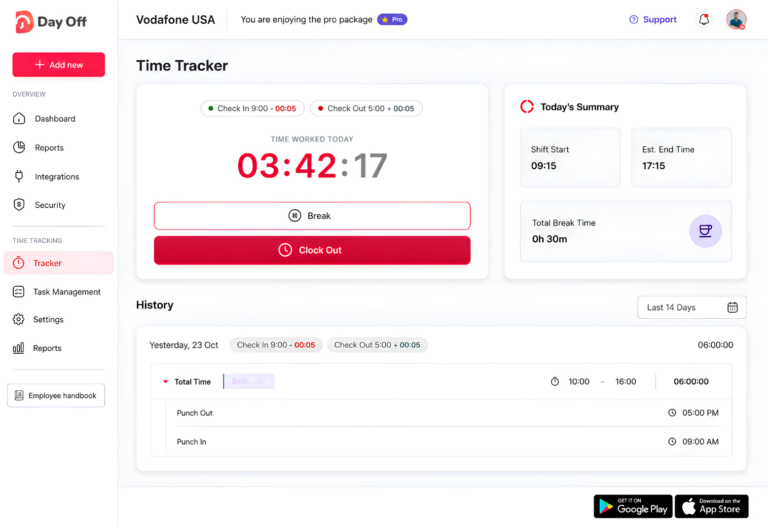
Day Off’s Time Tracker helps teams compare scheduled working time with actual attendance while keeping PTO and absence information in the same platform.
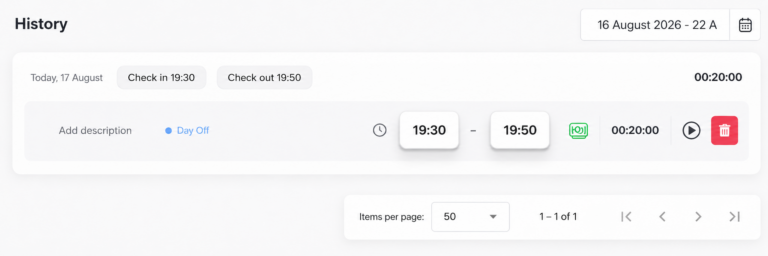
Employees can record their working time through the web-based Time Tracker, while managers can review attendance against the work schedule assigned to each employee.
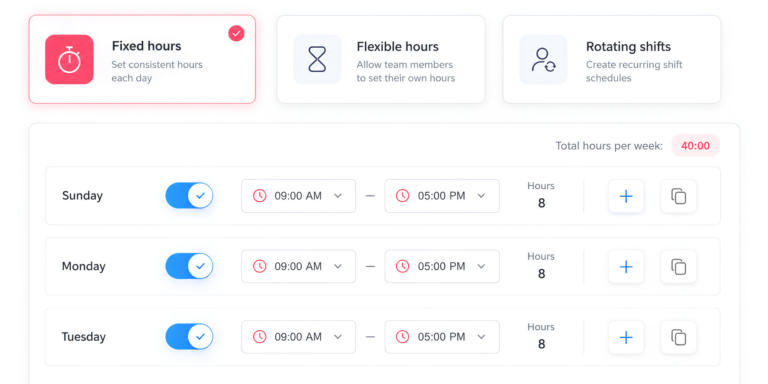
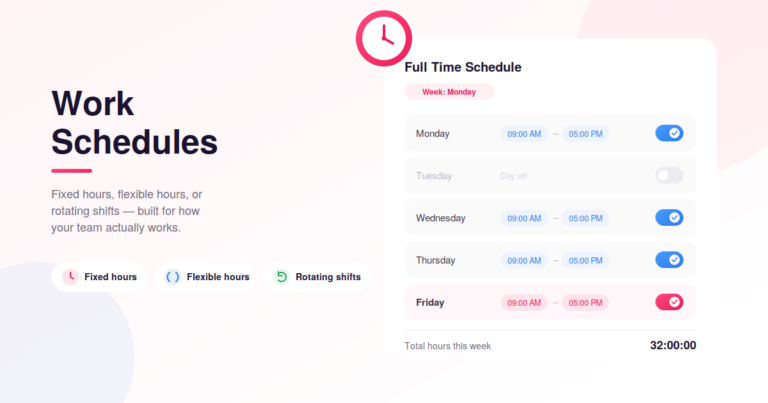
Day Off supports different work schedule structures, including fixed hours, flexible hours, and rotating shifts. This matters because an employee should be compared with their own scheduled working time rather than a company-wide assumption about when everyone starts.
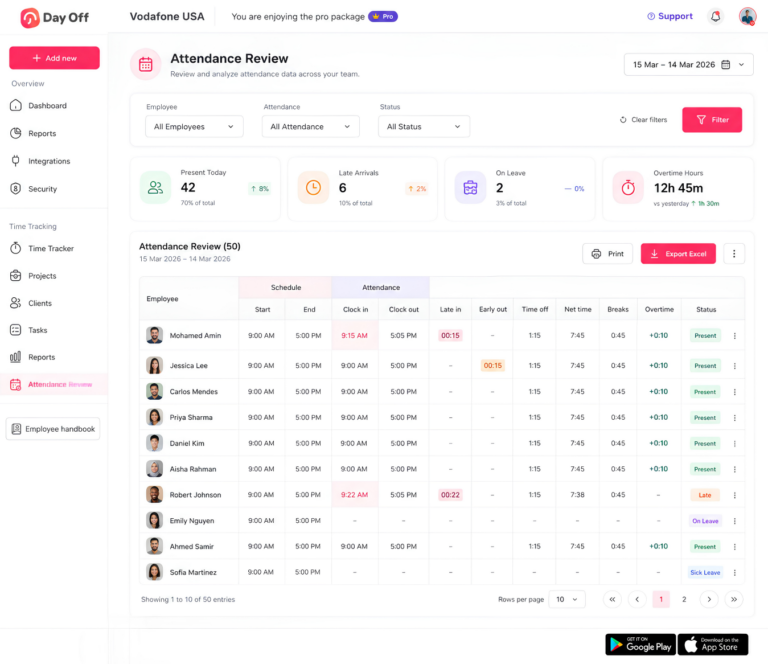
The system can also calculate information such as late time, overtime, and total working hours based on scheduled and actual attendance.
With Attendance Review, managers can compare what an employee was scheduled to work with what actually happened. That makes it easier to identify repeated late arrivals, early departures, missed working time, breaks, overtime, and approved leave.
See our guide to scheduled hours vs. actual hours for more information.
Because attendance and leave are connected, a longer late arrival can also be handled alongside PTO and other absence records instead of being tracked in a completely separate spreadsheet.
Attendance sheets can then support payroll review by showing actual clock-in and clock-out times together with late time, overtime, and total hours.
The result is a clearer record for employees, managers, HR, and payroll.
Frequently Asked Questions About Clock-In Grace Periods
What is a grace period for clocking in?
A grace period for clocking in is a short window after an employee’s scheduled start time during which they can clock in without automatically being classified as late under the company’s attendance policy.
It should generally affect attendance status rather than erase or add working time for payroll purposes.
Is a five-minute grace period standard?
Five minutes is a common and easy-to-understand policy choice, but there is no universal legal rule saying employers must provide a five-minute grace period.
The right amount depends on the workplace, job responsibilities, scheduling requirements, and applicable law.
Do employers have to give employees a grace period?
Federal law does not generally require employers to provide a specific attendance grace period.
Employers can establish their own attendance expectations, provided their policies comply with applicable wage, discrimination, leave, disability, contractual, and other employment requirements.
Can an employee be disciplined for being one minute late?
An employer may establish a strict attendance policy, subject to applicable law and other requirements.
However, organizations should consider whether treating every one-minute deviation as a formal attendance incident is operationally useful.
A small grace period often helps separate minor timing variations from meaningful attendance problems.
Does a grace period mean the employee gets paid for the grace minutes?
Not automatically.
A grace period determines whether the employee is considered late.
Pay for non-exempt employees depends on compensable working time and applicable wage-and-hour requirements.
What is the difference between a grace period and the 7-minute rule?
The 7-minute rule is associated with quarter-hour time rounding.
Under federal rounding principles, a punch one to seven minutes from a quarter-hour may be rounded one way while eight to fourteen minutes may be rounded the other way, provided the overall rounding practice complies with applicable requirements.
A grace period is different. It determines whether an employee’s arrival creates an attendance violation.
Can employees clock in early during the grace period?
Employers can establish rules limiting early clock-ins, such as requiring approval to clock in more than five minutes before a scheduled shift.
However, employers should distinguish unauthorized early work from unpaid work. If compensable work actually occurs, wage-and-hour requirements may still apply.
Should the grace period apply after lunch?
Not automatically.
Employers should specify whether the attendance grace period applies to shift starts, rest breaks, meal periods, or other situations.
Meal-period rules can be particularly strict in some states, so employers should review applicable requirements carefully.
What happens if an employee is always within the grace period?
An employee who consistently clocks in near the end of the grace window may technically avoid late marks while still demonstrating an attendance pattern.
Employers can clarify that the grace period is intended for occasional minor delays and does not change the employee’s scheduled starting time.
Managers can then address repeated patterns through normal performance or attendance discussions.
How can employers track grace periods without spreadsheets?
Use a time and attendance system that compares actual clock-in times with each employee’s assigned work schedule.
A platform such as Day Off can help managers review scheduled versus actual attendance, late time, overtime, leave, and employee work schedules in one place.
Final Thoughts
A clock in grace period can make an attendance policy more practical without weakening expectations around punctuality.
The most important part is not whether the grace period is three minutes, five minutes, or another amount.
It is making sure everyone understands what the policy actually does.
The scheduled start time should remain clear. Attendance rules should be applied consistently. Payroll should continue to reflect compensable working time. Exceptions should be documented. Managers should understand the difference between an occasional delay and a recurring attendance problem.
When those pieces are in place, a grace period can reduce unnecessary disputes while giving HR better attendance data and employees clearer expectations.
And when schedules, clock-ins, late time, attendance, and PTO are managed together, it becomes much easier to apply those rules consistently across the organization.